Time-domain framework for the Teukolsky equation with a particle source using comoving hyperboloidal coordinates
Pith reviewed 2026-06-26 01:13 UTC · model grok-4.3
The pith
Comoving hyperboloidal coordinates enable stable time-domain solutions of the Teukolsky equation with particle sources.
A machine-rendered reading of the paper's core claim, the machinery that carries it, and where it could break.
Core claim
The scheme based on comoving, spatially compactified hyperboloidal coordinates for the 1+1 dimensional Teukolsky equation with a point-particle source evades nonphysical growing modes and simplifies jump conditions on the particle worldline, as shown in scalar field tests for circular and scattering geodesics and in a stable implementation for the s = -2 case.
What carries the argument
Comoving hyperboloidal coordinates that are spatially compactified, which compactify the spatial domain and align with the particle motion to simplify jumps and ensure stability.
If this is right
- The method allows long-term stable evolutions without growing modes for the gravitational Teukolsky equation.
- Jump conditions at the particle location are simplified by the comoving frame.
- It provides a path to calculating the full gravitational self-force in extreme-mass-ratio scattering.
- Performance is demonstrated for both circular and scattering geodesic sources in the scalar case.
Where Pith is reading between the lines
- This approach may generalize to other perturbation equations in black hole spacetimes.
- It could facilitate waveform modeling for extreme mass ratio events in gravitational wave astronomy.
- Comparisons with noncompactified methods highlight the role of compactification in stability.
Load-bearing premise
The assumption that comoving hyperboloidal coordinates can be implemented to both simplify jump conditions and maintain long-term stability for the s = -2 Teukolsky equation without introducing other numerical artifacts.
What would settle it
A long-term numerical evolution of the s = -2 Teukolsky equation with a scattering particle source that develops growing nonphysical modes would falsify the stability claim.
Figures
read the original abstract
We present a scheme and implementation code for time-domain integration of the Teukolsky equation in 1+1 dimensions with a point-particle source, based on comoving, spatially compactified hyperboloidal coordinates. We demonstrate that the scheme evades the problem of nonphysical growing modes that plague some numerical evolution schemes without compactification. Our use of comoving coordinates greatly simplifies the application of jump conditions on the particle's worldline. We develop our method and test its performance for a scalar field on a Schwarzschild background, first for a circular geodesic orbit source and then for a scattering geodesic orbit. We then present a test implementation of the method for the $s = -2$ Teukolsky equation, illustrating its long-term stability and absence of growing-mode behavior through comparison with similar results using noncompactified characteristic coordinates. Our method paves the way to calculations of the full gravitational self-force in extreme-mass-ratio scattering.
Editorial analysis
A structured set of objections, weighed in public.
Referee Report
Summary. The manuscript presents a time-domain numerical scheme for integrating the Teukolsky equation sourced by a point particle in 1+1 dimensions, using comoving spatially compactified hyperboloidal coordinates. The method is developed and tested first for a scalar field on Schwarzschild with circular and scattering geodesic sources, then extended to the s = -2 gravitational case. It claims to evade nonphysical growing modes that affect some non-compactified schemes, to simplify jump conditions at the particle worldline via the comoving choice, and to demonstrate long-term stability through explicit comparisons, thereby enabling future gravitational self-force calculations for extreme-mass-ratio scattering.
Significance. If the reported stability and absence of growing modes hold under the presented tests, the work provides a concrete, implementable framework that addresses a known obstacle in time-domain self-force computations for scattering trajectories. The explicit numerical demonstrations for both scalar and s = -2 cases, together with the code implementation, constitute a practical contribution that could be directly extended to full gravitational self-force calculations.
minor comments (2)
- [Section describing jump conditions] The manuscript states that the comoving coordinates 'greatly simplify' the jump conditions, but does not quantify the reduction in complexity (e.g., number of non-zero jump terms before and after the coordinate choice) in the relevant section describing the source implementation.
- [Figures showing time-domain evolution] Figure captions for the stability comparisons should explicitly state the evolution duration in units of M and the grid resolution used, to allow direct assessment of the 'long-term' claim.
Simulated Author's Rebuttal
We thank the referee for their positive summary, significance assessment, and recommendation of minor revision. No specific major comments were provided in the report, so we have no individual points requiring point-by-point response or manuscript changes at this stage. We remain available for any additional clarifications or minor edits the editor may request.
Circularity Check
No significant circularity in numerical method development
full rationale
The paper presents a numerical time-domain integration scheme for the Teukolsky equation using comoving hyperboloidal coordinates, with direct tests for scalar (circular/scattering geodesics) and s=-2 cases demonstrating stability and absence of growing modes via comparison to non-compactified methods. No load-bearing derivation steps reduce by construction to fitted parameters, self-definitions, or self-citation chains; claims rest on explicit implementation and numerical verification rather than tautological reductions.
Axiom & Free-Parameter Ledger
axioms (1)
- domain assumption Hyperboloidal coordinates allow spatial compactification at future null infinity without introducing instabilities for wave equations on black hole backgrounds.
Reference graph
Works this paper leans on
-
[1]
height” and “shift
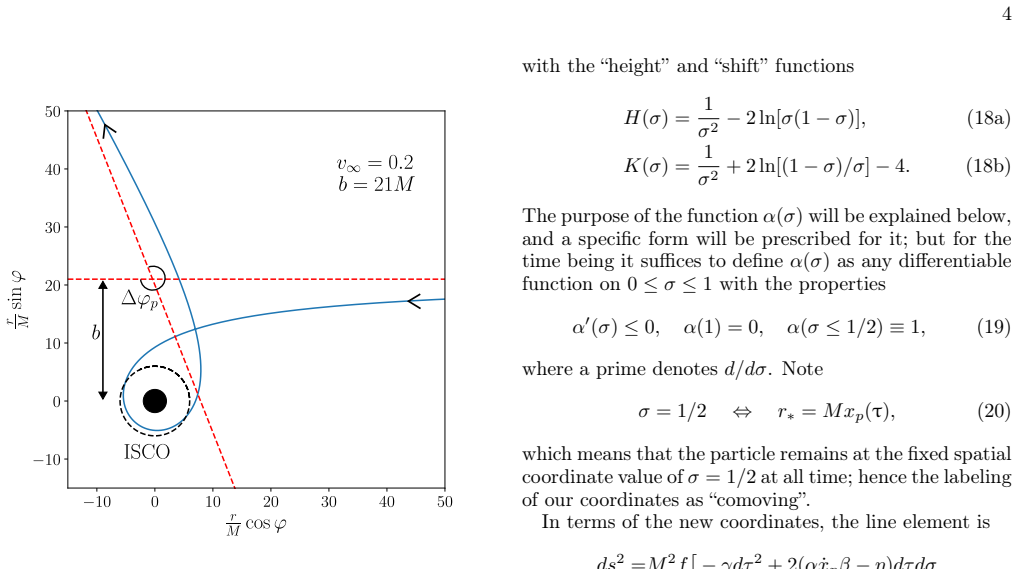
The total scattering angle is given by ∆φp =φ p(χ∞)−φ p(−χ∞)−π.(14) A section of a sample scattering orbit with(v∞, b) = (0.2,21M)is depicted in Figure 1. This will be our reference scattering geodesic for various numerical tests in this work. 4 FIG. 1. A sample scattering orbit with(v∞, b) = (0.2,21M). The black disc represents the central Schwarzschild ...
1944
-
[2]
has been a roadblock in the program to calculate the gravitational self-force in extreme-mass-ratio scattering. In this work we have confirmed the expectation, expressed in Ref. [19], that the problem can be effectively mitigated through the use of spatially compactified hyperboloidal coordinates. This we have illustrated here with an explicit numerical i...
-
[3]
Damour, Phys
T. Damour, Phys. Rev. D97, 044038 (2018)
2018
-
[4]
Damour, Phys
T. Damour, Phys. Rev. D102, 024060 (2020)
2020
-
[5]
Damour, Phys
T. Damour, Phys. Rev. D94, 104015 (2016)
2016
-
[6]
G. Kälin and R. Porto, J. High Energ. Phys. (2020), https://doi.org/10.1007/JHEP01(2020)072
-
[7]
G.KälinandR.A.Porto,JournalofHighEnergyPhysics 2020, 120 (2020), arXiv:1911.09130 [hep-th]
arXiv 2020
-
[8]
D. A. Kosower, B. Maybee, and D. O’Connell, Journal of High Energy Physics2019, 137 (2019)
2019
-
[9]
Z. Bern, A. Luna, R. Roiban, C.-H. Shen, and M. Zeng, Phys. Rev. D104, 065014 (2021)
2021
-
[10]
Cheung, I
C. Cheung, I. Z. Rothstein, and M. P. Solon, Phys. Rev. Lett.121, 251101 (2018)
2018
-
[11]
L. Barack and A. Pound, Rep. Prog. Phys (2019), 10.1088/1361-6633/aae552
-
[12]
Black hole perturbation theory and gravitational self-force,
A. Pound and B. Wardell, “Black hole perturbation theory and gravitational self-force,” inHandbook of Gravitational Wave Astronomy, edited by C. Bambi, S. Katsanevas, and K. D. Kokkotas (Springer Singapore, Singapore, 2020) pp. 1–119
2020
-
[13]
Warburton, (2025), arXiv:2512.02274 [gr-qc]
N. Warburton, (2025), arXiv:2512.02274 [gr-qc]
Pith/arXiv arXiv 2025
-
[14]
Hopper, Phys
S. Hopper, Phys. Rev. D97, 064007 (2018)
2018
-
[15]
Hopper and V
S. Hopper and V. Cardoso, Phys. Rev. D97, 044031 (2018)
2018
-
[16]
L. Barack and O. Long, Physical Review D106, 104031 (2022), arXiv:2209.03740 [astro-ph, physics:gr-qc]
arXiv 2022
- [17]
-
[18]
C. Whittall and L. Barack, Phys. Rev. D108, 064017 (2023), arXiv:2305.09724 [gr-qc]
arXiv 2023
-
[19]
C. Whittall, L. Barack, and O. Long, Phys. Rev. D112, 124045 (2025), arXiv:2509.19439 [gr-qc]
arXiv 2025
-
[20]
O. Long, C. Whittall, and L. Barack, Phys. Rev. D110, 044039 (2024), arXiv:2406.08363 [gr-qc]
arXiv 2024
-
[21]
O.LongandL.Barack,Phys.Rev.D104,024014(2021), arXiv:2105.05630 [gr-qc]. 18
arXiv 2021
-
[22]
L. Barack and N. Sago, Phys. Rev. D75, 064021 (2007), arXiv:gr-qc/0701069
Pith/arXiv arXiv 2007
-
[23]
L. Barack and N. Sago, Phys. Rev. D81, 084021 (2010), arXiv:1002.2386 [gr-qc]
Pith/arXiv arXiv 2010
-
[24]
O’Toole, A
C. O’Toole, A. Ottewill, and B. Wardell, Phys. Rev. D 103, 124022 (2021)
2021
-
[25]
O’Toole,Green Function Methods in Black Hole Spacetimes, Ph.D
C. O’Toole,Green Function Methods in Black Hole Spacetimes, Ph.D. thesis, University College Dublin, School of Mathematical Sciences (2022)
2022
-
[26]
Vishal, Private communication
M. Vishal, Private communication
-
[27]
S. D. Bishoyi, S. E. Field, and S. R. Lau, (2026), arXiv:2604.22734 [gr-qc]
Pith/arXiv arXiv 2026
-
[28]
A. Zenginoglu, D. Nunez, and S. Husa, Class. Quant. Grav.26, 035009 (2009), arXiv:0810.1929 [gr-qc]
Pith/arXiv arXiv 2009
-
[29]
E. Harms, S. Bernuzzi, and B. Brügmann, Class. Quant. Grav.30, 115013 (2013), arXiv:1301.1591 [gr-qc]
Pith/arXiv arXiv 2013
-
[30]
R. Panosso Macedo and M. Ansorg, J. Comput. Phys. 276, 357 (2014), arXiv:1402.7343 [physics.comp-ph]
Pith/arXiv arXiv 2014
- [31]
-
[32]
K. Csukás and I. Rácz, Phys. Rev. D103, 084035 (2021), arXiv:2101.05530 [gr-qc]
arXiv 2021
-
[33]
E. Harms, S. Bernuzzi, A. Nagar, and A. Zenginoglu, Class. Quant. Grav.31, 245004 (2014), arXiv:1406.5983 [gr-qc]
Pith/arXiv arXiv 2014
-
[34]
M. F. O’Boyle and C. Markakis, (2023), arXiv:2308.02385 [math.NA]
arXiv 2023
-
[35]
L. J. G. Da Silva, R. Panosso Macedo, J. E. Thompson, J. A. V. Kroon, L. Durkan, and O. Long, (2023), arXiv:2306.13153 [gr-qc]
arXiv 2023
- [36]
-
[37]
L. J. G. Da Silva, (2024), arXiv:2401.08758 [gr-qc]
arXiv 2024
- [38]
-
[39]
A. Roy, L. Küchler, A. Pound, and R. Panosso Macedo, (2025), arXiv:2510.11793 [gr-qc]
Pith/arXiv arXiv 2025
-
[40]
R. Panosso Macedo, B. Leather, N. Warburton, B. Wardell, and A. Zenginoğlu, Phys. Rev. D105, 104033 (2022), arXiv:2202.01794 [gr-qc]
arXiv 2022
- [41]
- [42]
-
[43]
A. Pound, C. Merlin, and L. Barack, Phys. Rev. D89, 024009 (2014), arXiv:1310.1513 [gr-qc]
Pith/arXiv arXiv 2014
-
[44]
A. Zenginoglu, Class. Quant. Grav.25, 145002 (2008), arXiv:0712.4333 [gr-qc]
Pith/arXiv arXiv 2008
-
[45]
R. Panosso Macedo, Phil. Trans. Roy. Soc. Lond. A382, 20230046 (2024), arXiv:2307.15735 [gr-qc]
arXiv 2024
-
[46]
M. Ansorg and R. Panosso Macedo, Phys. Rev. D93, 124016 (2016), arXiv:1604.02261 [gr-qc]
Pith/arXiv arXiv 2016
-
[47]
R. Panosso Macedo, J. L. Jaramillo, and M. Ansorg, Phys. Rev. D98, 124005 (2018), arXiv:1809.02837 [gr- qc]
Pith/arXiv arXiv 2018
-
[48]
R. Panosso Macedo, Class. Quant. Grav.37, 065019 (2020), arXiv:1910.13452 [gr-qc]
arXiv 2020
-
[49]
W. H. Press, S. A. Teukolsky, W. T. Vetterling, and B. P. Flannery,Numerical recipes 3rd edition(Cambridge University Press, 2007)
2007
-
[50]
R. H. Price, Phys. Rev. D5, 2419 (1972)
1972
-
[51]
R. H. Price, Phys. Rev. D5, 2439 (1972)
1972
-
[52]
J. Thornburg, B. Wardell, and M. van de Meent, Phys. Rev. Res.2, 013365 (2020), arXiv:1906.06791 [gr-qc]
arXiv 2020
-
[53]
Z. Nasipak, T. Osburn, and C. R. Evans, Phys. Rev. D 100, 064008 (2019), arXiv:1905.13237 [gr-qc]
arXiv 2019
-
[54]
C. Merlin, A. Ori, L. Barack, A. Pound, and M. van de Meent, Phys. Rev. D94, 104066 (2016), arXiv:1609.01227 [gr-qc]
Pith/arXiv arXiv 2016
-
[55]
L. Barack and P. Giudice, Phys. Rev. D95, 104033 (2017), arXiv:1702.04204 [gr-qc]
Pith/arXiv arXiv 2017
-
[56]
Kelly, A
C. Kelly, A. Vaswani, L. Barack, and A. Pound, In progress
-
[57]
Black Hole Perturbation Toolkit,
“Black Hole Perturbation Toolkit,” (bhptoolkit.org)
discussion (0)
Sign in with ORCID, Apple, or X to comment. Anyone can read and Pith papers without signing in.