A new formulation of metriplectic dynamics with an application to quasigeostrophic ocean modeling with advected quantities
Pith reviewed 2026-06-26 00:44 UTC · model grok-4.3
The pith
Multiplying two skew-symmetric brackets creates a metriplectic four-bracket that conserves internal energy and generates entropy in quasigeostrophic ocean models.
A machine-rendered reading of the paper's core claim, the machinery that carries it, and where it could break.
Core claim
By constructing the metriplectic four-bracket as the product of two skew-symmetric brackets, the dynamics of the generalized quasigeostrophic model with advected quantities ensure conservation of internal energy and generation of entropy in accordance with the first and second laws of thermodynamics, while allowing flexible specification of irreversibility.
What carries the argument
The metriplectic four-bracket defined as the product of two skew-symmetric brackets, which carries the dissipative dynamics while preserving the required algebraic structure for thermodynamic consistency.
Load-bearing premise
The product of two skew-symmetric brackets yields a four-bracket with the algebraic properties needed for metriplectic dynamics and the correct dissipative behavior in the generalized QG model.
What would settle it
A direct calculation or numerical test showing that the constructed four-bracket produces negative entropy generation or fails to conserve internal energy in the generalized quasigeostrophic model would falsify the central claim.
Figures
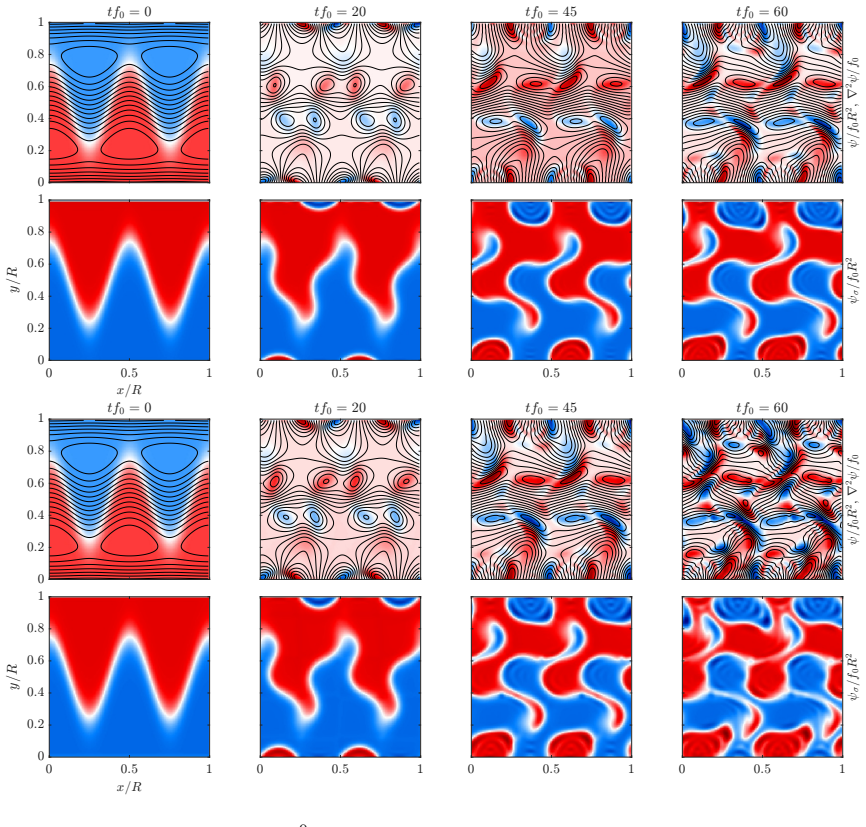
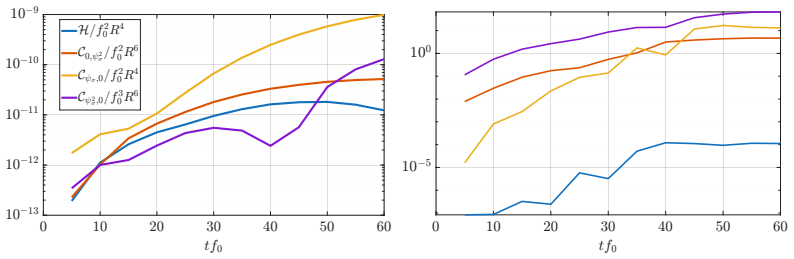
read the original abstract
A general formulation of metriplectic dynamics is presented, where the metriplectic four-bracket is constructed by multiplying two skew-symmetric brackets. The new formulation is then used to introduce irreversibility in a generalized two-dimensional (2D) quasigeostrophic (QG) upper-ocean model involving advected quantities, with the thermal QG model as a special case. By construction, the resulting dynamics ensure the conservation of internal energy and the generation of entropy, in accordance with the first and second laws of thermodynamics. Our metriplectic dynamics formulation allows for a flexible specification of irreversibility, ranging from a type that results in nearly material conservation of potential vorticity to the representation of realistic forcing and dissipation in 2D QG ocean modeling with advected quantities.
Editorial analysis
A structured set of objections, weighed in public.
Referee Report
Summary. The manuscript proposes a new formulation of metriplectic dynamics in which the four-bracket is constructed as the product of two skew-symmetric brackets. This construction is applied to introduce irreversibility into a generalized two-dimensional quasigeostrophic upper-ocean model that includes advected quantities (with the thermal QG model as a special case), with the claim that thermodynamic consistency—conservation of internal energy and non-negative entropy production—follows automatically from the algebraic properties of the product bracket.
Significance. If the transfer of degeneracy and positivity properties holds, the approach supplies a systematic and flexible route to thermodynamically consistent dissipation in QG-type models, ranging from nearly material conservation of potential vorticity to more realistic forcing. This could be useful for ocean modeling applications where both conservation laws and entropy production must be respected.
major comments (1)
- [general formulation and QG application sections] The central claim rests on the assertion that the product of two skew-symmetric brackets automatically inherits the degeneracy condition with the Hamiltonian (so the dissipative term vanishes on energy) and the symmetry/positive-semidefiniteness needed for non-negative entropy production. This transfer must be shown explicitly for the general four-bracket construction and then verified when the construction is specialized to the generalized QG model with advected quantities; without that verification the thermodynamic consistency is not established.
Simulated Author's Rebuttal
We thank the referee for the careful reading and constructive comment. We address the major comment below.
read point-by-point responses
-
Referee: [general formulation and QG application sections] The central claim rests on the assertion that the product of two skew-symmetric brackets automatically inherits the degeneracy condition with the Hamiltonian (so the dissipative term vanishes on energy) and the symmetry/positive-semidefiniteness needed for non-negative entropy production. This transfer must be shown explicitly for the general four-bracket construction and then verified when the construction is specialized to the generalized QG model with advected quantities; without that verification the thermodynamic consistency is not established.
Authors: We agree that the manuscript asserts thermodynamic consistency 'by construction' without providing the explicit algebraic verification of how the product bracket inherits degeneracy with the Hamiltonian and the required symmetry/positive-semidefiniteness. In the revised manuscript we will add a new subsection to the general formulation section that proves these inheritance properties for the product of two skew-symmetric brackets. We will then specialize the same algebraic arguments to the generalized 2D QG model (including the thermal QG case) to confirm that energy is conserved and entropy production is non-negative for the chosen dissipation operators. revision: yes
Circularity Check
No circularity; thermodynamic properties follow from explicit algebraic construction
full rationale
The paper defines a metriplectic four-bracket explicitly as the product of two skew-symmetric brackets and states that the resulting dynamics conserve internal energy and generate entropy 'by construction.' This is a definitional feature of the new formulation rather than a prediction or result derived from independent inputs that later reduces back to those inputs. No self-citations, fitted parameters renamed as predictions, or uniqueness theorems imported from prior author work are invoked in the abstract or described claims. The derivation chain is therefore self-contained: the algebraic construction is chosen precisely to enforce the desired degeneracy and positivity properties, with no evidence of the target result being smuggled in via redefinition or external self-reference.
Axiom & Free-Parameter Ledger
axioms (1)
- domain assumption The product of two skew-symmetric brackets defines a valid metriplectic four-bracket satisfying the algebraic properties needed for energy conservation and entropy production.
Reference graph
Works this paper leans on
-
[1]
Equations of atmospheric motion in non-Eulerian vertical coordinates: Vector-invariant form and quasi-Hamiltonian formulation
Thomas Dubos and Marine Tort. Equations of atmospheric motion in non-Eulerian vertical coordinates: Vector-invariant form and quasi-Hamiltonian formulation. Monthly Weather Review. 2014
2014
-
[2]
Majda and Esteban Tabak
Peter Constantin and Andrew J. Majda and Esteban Tabak. Formation of strong fronts in the 2-D quasigeostrophic thermal active scalar. Nonlinearity. 1995
1995
-
[3]
Constantin and M
P. Constantin and M. Ignatova. Estimates near the boundary for critical SQG. Ann. PDE. 2020
2020
-
[4]
Strong ill-posedness for SQG in critical Sobolev apces
In-Jee Jeong and Junha Kim. Strong ill-posedness for SQG in critical Sobolev apces. Ann. PDE. 2024
2024
-
[5]
New Numerical Results for the Surface Quasi-Geostrophic Equation
In-Jee Jeong and Junha Kim. New Numerical Results for the Surface Quasi-Geostrophic Equation. J. Sci. Comput. 2012
2012
-
[6]
F. J. Beron-Vera and Erwin Luesink , journal =. 2025 , pages =
2025
-
[7]
J. Atmos. Sci. , year =
-
[8]
Polar night vortex breakdown and large-scale stirring in the southern stratosphere , journal =. 2009 , volume =. doi:10.1007/s00382-009-0632-6 , owner =
-
[9]
2010 , volume =
Non-diffusive, non-local transport in fluids and plasmas , journal =. 2010 , volume =
2010
-
[10]
2000 , volume =
Self-consistent chaotic transport in fluids and plasmas , journal =. 2000 , volume =
2000
-
[11]
2000 , volume =
Chaotic transport in zonal flows in analogous fluid and plasma systems , journal =. 2000 , volume =
2000
-
[12]
1998 , volume =
Asymmetric Transport and Non-Gaussian Statistics of Passive Scalars in Vortices in Shear , journal =. 1998 , volume =
1998
-
[13]
1997 , volume =
Renormalization and Transition to Chaos in Area Preserving Nontwist Maps , journal =. 1997 , volume =
1997
-
[14]
Physica D , year =
Area Preserving Nontwist Maps:. Physica D , year =
-
[15]
1996 , number =
Renormalization and Transition to Chaos in Area Preserving Nontwist Maps , institution =. 1996 , number =
1996
-
[16]
Chaotic Transport by. Phys. Fluids A , year =
-
[17]
J. Phys. Oceanogr. , year =
-
[18]
J. Geophys. Res. , year =. doi:10.1029/2009JC005585 , owner =
-
[19]
, year =
J.Phys.Oceanogr. , year =
-
[20]
Geophys. Res. Lett. , year =
-
[21]
Environ. Res. Lett. , title =. 2012 , pages =
2012
-
[22]
Geophys. Res. Lett. , year =. doi:10.1029/2010GL046267. , owner =
-
[23]
2010 , volume =
Fluid dynamical niches of phytoplankton types , journal =. 2010 , volume =
2010
-
[24]
J. Phys. A: Math. Theor. , year =
-
[25]
Mixing structures in the. Geophys. Res. Let. , year =. doi:10.1029/2004GL020328 , owner =
-
[26]
Deep Sea Res. I , year =. doi:10.1016/j.dsr.2008.07.014 , howpublished =
-
[27]
Detection of. Anais. 2007 , pages =
2007
-
[28]
1989 , volume =
Dipole formation and collisions in a stratified fluid , journal =. 1989 , volume =
1989
-
[29]
Topography-induced modulation of a tripolar vortex in a rotating fluid , year =
-
[30]
1989 , volume =
Tripolar vortices in a rotating fluid , journal =. 1989 , volume =
1989
-
[31]
Laboratory experiments on the tripolar vortex in a rotating fluid , journal =
-
[32]
II , year =
Dee-Sea Res. II , year =
-
[33]
Eddy Formation in 2. J. Phys. Oceanogr. , year =
-
[34]
J. Geophys. Res. , year =
-
[35]
I , year =
Deep-Sea Res. I , year =
-
[36]
2007 , volume =
Influence of initial conditions on decaying two-dimensional turbulence , journal =. 2007 , volume =
2007
-
[37]
Deep-Sea Res
Zooplankton and Micronekton Biomass Off Somalia and in the Southern Red Sea During the. Deep-Sea Res. Part II , year =
-
[38]
2019 , volume =
Role of Indian Ocean Dynamics on Accumulation of Buoyant Debris , journal =. 2019 , volume =
2019
-
[39]
Maria Teresa M. Verification of Sargassum natans (Linnaeus) Gaillon (Heterokontophyta: Phaeophyceae) from the Sargasso Sea off the coast of Brazil, western Atlantic Ocean , journal =. 2012 , volume =. doi:10.15560/8.4.638 , publisher =
-
[40]
J. Phys. Oceanogr. , year =. doi:10.1175/1520-0485(1997)027<2288:TVOTLS>2.0.CO;2 , owner =
-
[41]
Proceedings of Symposia in Pure Mathematics 69 , year =
A Tutorial on. Proceedings of Symposia in Pure Mathematics 69 , year =
-
[42]
Geopphys
J. Geopphys. Res. , year =
-
[43]
J. Geophys. Res. , year =. doi:10.1029/94JC00383 , owner =
-
[44]
and C.G.H
\"Ostlund, H.G. and C.G.H. Rooth , title =. Journal of Geophysical Research , year =
-
[45]
Estuaries and Enclosed Seas , year =
Gulf of. Estuaries and Enclosed Seas , year =
-
[46]
2002 , volume =
Dynamics of Two-Dimensional Turbulent Bottom Gravity Currents , journal =. 2002 , volume =
2002
-
[47]
1998 , volume =
The Emergence of Inertial Gyres in a Two-Layer Quasigeostrophic Model , journal =. 1998 , volume =
1998
-
[48]
1997 , volume =
Impact of Wind Forcing, Bottom Topography and Inertia on Midlatitude Jet Separation in a Quasigeostrophic Model , journal =. 1997 , volume =
1997
-
[49]
On the Connection Between the. J. Phys. Oceanogr. , year =
-
[50]
2001 , volume =
On the Dynamics of Plumes , journal =. 2001 , volume =
2001
-
[51]
1998 , volume =
Asymmetric Salt Fingers Induced by a Nonlinear Equation of State , journal =. 1998 , volume =
1998
-
[52]
1998 , volume =
A Numerical Study of Layer Formation Due to Fingers in Double-Diffusive Convection in a Vertically-Bounded Domain , journal =. 1998 , volume =
1998
-
[53]
Turbulent Mixing in the. J. Phys. Oceanogr. , year =
-
[54]
Abarbanel, H.D.I. and D.D. Holm and J.E. Marsden and T. Ratiu , title =. Philos. Trans. R. Soc. London, A , year =
-
[55]
Abarbanel, H.D.I. and D.D. Holm and J.E. Marsden and T. Ratiu , title =. Phys. Rev. Lett. , year =
-
[56]
Abarbanel, H. D. I. and R. Brown and J. J. Sidorowich and L. Analysis of Observed Chaotic Data in Physical Systems , journal =. 1993 , volume =
1993
-
[57]
Abdullaev, S. S. , volume =. Chaos and the Dynamics of Rays in Waveguide Media , publisher =. 1993 , editor =
1993
-
[58]
Abdullaev, S. S. , title =. Chaos , year =
-
[59]
Abdullaev, S. S. and G. M. Zaslavsky , title =. Usp. Phys. Nauk , year =
-
[60]
Abernathey, R. and G. Haller , title =. J. Phys. Oceanogr. , year =
-
[61]
Ablowitz, M.J. and R. Haberman , title =. J. Math. Phys. , year =
-
[62]
Abraham, E. R. , title =. Nature , year =
-
[63]
Abraham, E. R. and M. M. Bowen , title =. Chaos , year =. doi:0.1063/1.1481615 , owner =
-
[64]
Abraham, E. R. and C. S. Lae and P. W. Boyd and S J. Lavender and M. T. Maldonado and A. R. Bowie , title =. Nature , year =
-
[65]
1988 , author =
Manifolds, Tensor Analysis and Applications , publisher =. 1988 , author =
1988
-
[66]
, title =
Abramopoulos, F. , title =. Monthly Weather Rev. , year =
-
[67]
Abramov, R. V. and A. J. Majda , title =. Proc. Natl. Acad. Sci. U.S.A. , year =
-
[68]
Abtew, W. and R. S. Huebner , title =. 2005 , number =
2005
-
[69]
Acha, E. M. and H. W. Mianzan and R. A. Guerrero and M. Favero and J. Bava , title =. J. Mar. Syst. , year =
-
[70]
Achterberg, R. A. and A. P. Ingersoll , title =. J. Atmos. Sci. , year =
-
[71]
Adamec, D. and R.L. Elsberry and R.W. Garwood and R.L. Haney , title =. Dyn. Atmos. Oceans , year =
-
[72]
G. N. D. Addico and K. A. A. deGraft-Johnson , journal =. 2016 , pages =. doi:10.5897/AJB2015.15177 , owner =
-
[73]
Adduce, C. and C. Cenedese , title =. J. Mar. Res. , year =
-
[74]
Aguirre-Hernandez, E. and G. Gaxiola-Castro and S. Najera-Martinez and T. Baumgartner and M. Kahru and B. G. Mitchell , title =. Deep-Sea Res. II , year =
-
[75]
Ahrenholz, Dean W. and Morris, James A. , title =. Environmental Biology of Fishes , year =. doi:10.1007/s10641-010-9647-4 , issn =
-
[76]
Aiki, H. and T. Yamagata , title =. Geophys. Astrophys. Fluid Dyn. , year =
-
[77]
Aksamit, N. and T. Sapsis and G. Haller , title =. J. Phys. Oceanogr. , year =
-
[78]
1989 , volume =
A stochastic simulation model of oil spill fate and transport , journal =. 1989 , volume =
1989
-
[79]
, title =
Albert, H.F. , title =. Z. Angew. Math. Mech. , year =
-
[80]
Albert, H. F. , title =. Beitr. Phys. Atmosph. , year =
discussion (0)
Sign in with ORCID, Apple, or X to comment. Anyone can read and Pith papers without signing in.