Quantum Hall effect in three-dimensional lattice induced by Wannier-Stark-Landau localization
Pith reviewed 2026-06-26 00:29 UTC · model grok-4.3
The pith
Parallel electric and magnetic fields on a cubic lattice produce quantized Hall conductance perpendicular to the fields when the Fermi energy lies in spectral gaps.
A machine-rendered reading of the paper's core claim, the machinery that carries it, and where it could break.
Core claim
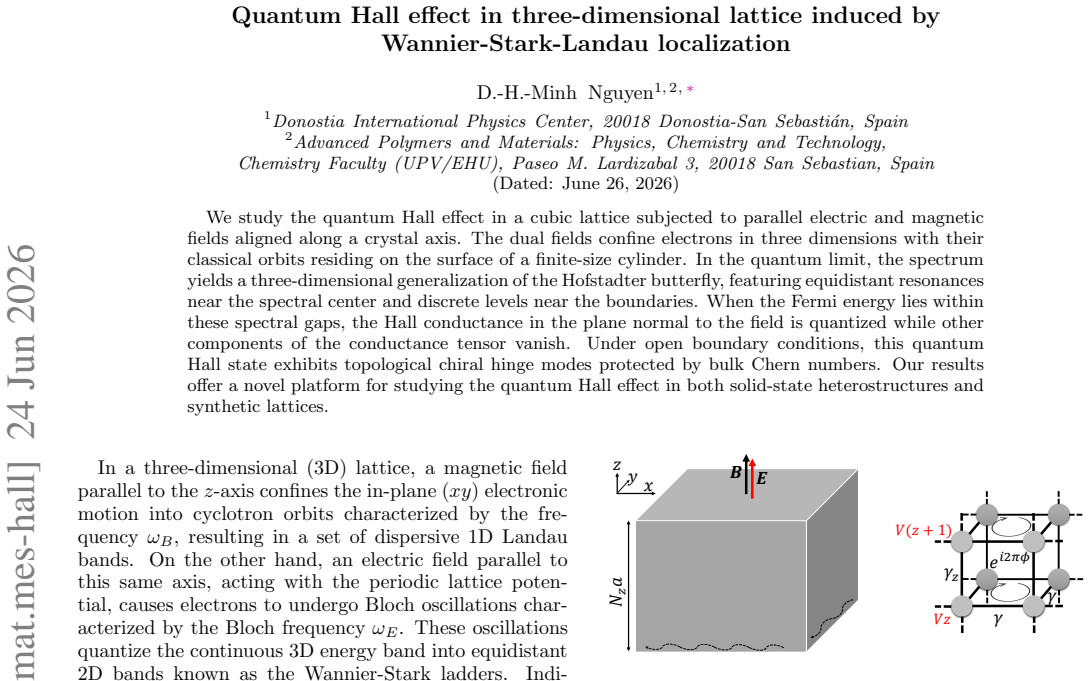
Subjecting a cubic lattice to parallel electric and magnetic fields aligned along a crystal axis confines electrons three-dimensionally so that their classical orbits lie on the surface of a finite-size cylinder. In the quantum limit this produces a three-dimensional generalization of the Hofstadter butterfly containing equidistant resonances near the band center and discrete levels near the edges. Fermi energies inside the resulting gaps yield a quantized Hall conductance in the plane normal to the fields while the remaining components of the conductance tensor vanish. With open boundaries the same state supports topological chiral hinge modes that are protected by the bulk Chern numbers.
What carries the argument
Wannier-Stark-Landau localization that restricts classical orbits to cylindrical surfaces and opens gaps in the three-dimensional spectrum.
If this is right
- Hall conductance in the plane normal to the fields is quantized.
- Other components of the conductance tensor vanish.
- Topological chiral hinge modes appear under open boundary conditions.
- These modes are protected by bulk Chern numbers.
- The setup supplies a platform for quantum Hall studies in solid-state heterostructures and synthetic lattices.
Where Pith is reading between the lines
- The same cylindrical confinement may produce analogous gaps and quantized transport in non-cubic three-dimensional lattices.
- The equidistant resonances near the spectral center could serve as a clear experimental signature for detecting the effect.
- Varying the relative strengths of the two fields might allow tuning between different quantized values or different topological sectors.
Load-bearing premise
That the parallel electric and magnetic fields create a confining potential whose classical orbits sit on finite-size cylinders and thereby open gaps in the quantum spectrum.
What would settle it
Numerical diagonalization or transport measurement showing unquantized Hall conductance for Fermi energies inside the predicted gaps would disprove the claim.
Figures
read the original abstract
We study the quantum Hall effect in a cubic lattice subjected to parallel electric and magnetic fields aligned along a crystal axis. The dual fields confine electrons in three dimensions with their classical orbits residing on the surface of a finite-size cylinder. In the quantum limit, the spectrum yields a three-dimensional generalization of the Hofstadter butterfly, featuring equidistant resonances near the spectral center and discrete levels near the boundaries. When the Fermi energy lies within these spectral gaps, the Hall conductance in the plane normal to the fields is quantized while other components of the conductance tensor vanish. Under open boundary conditions, this quantum Hall state exhibits topological chiral hinge modes protected by bulk Chern numbers. Our results offer a novel platform for studying the quantum Hall effect in both solid-state heterostructures and synthetic lattices.
Editorial analysis
A structured set of objections, weighed in public.
Referee Report
Summary. The manuscript studies the quantum Hall effect in a 3D cubic lattice under parallel electric and magnetic fields aligned along a crystal axis. The dual fields are argued to confine electrons such that classical orbits lie on a finite-size cylinder surface, producing a 3D generalization of the Hofstadter butterfly with equidistant resonances near the spectral center and discrete levels near the boundaries. When the Fermi energy lies in the resulting gaps, the Hall conductance normal to the fields is quantized while other tensor components vanish; under open boundaries the state hosts topological chiral hinge modes protected by bulk Chern numbers.
Significance. If the central claims hold, the work would provide a concrete lattice realization of 3D quantum Hall physics induced by Wannier-Stark-Landau localization, offering a platform for both solid-state heterostructures and synthetic lattices. The explicit construction of a gapped spectrum and the prediction of hinge modes would constitute a falsifiable extension of 2D Hofstadter physics to three dimensions.
major comments (1)
- [Abstract and §3] Abstract and §3 (spectrum and topology): the central claim that the gapped states are protected by bulk Chern numbers and host topological chiral hinge modes rests on the existence of well-defined 3D bulk invariants. However, the Hamiltonian contains the term eEz (Wannier-Stark localization), which explicitly breaks translational invariance along z. Standard bulk Chern numbers are obtained by integrating Berry curvature over a closed 3D Brillouin zone that requires periodicity in all three directions; no such zone exists here. The manuscript must specify the precise effective construction (e.g., projected Landau levels, finite-cylinder slicing, or an auxiliary periodicity restoration) used to define the Chern numbers and demonstrate that this construction remains valid in the quantum limit.
minor comments (1)
- [Abstract] The abstract refers to 'equidistant resonances' and 'discrete levels' without indicating the precise energy scale or the magnetic-field strength at which the quantum limit is reached; a brief statement of the parameter regime would improve clarity.
Simulated Author's Rebuttal
We thank the referee for their careful reading of the manuscript and for highlighting the subtlety in defining bulk invariants under broken translational symmetry. We address the major comment below and will revise the manuscript accordingly.
read point-by-point responses
-
Referee: [Abstract and §3] Abstract and §3 (spectrum and topology): the central claim that the gapped states are protected by bulk Chern numbers and host topological chiral hinge modes rests on the existence of well-defined 3D bulk invariants. However, the Hamiltonian contains the term eEz (Wannier-Stark localization), which explicitly breaks translational invariance along z. Standard bulk Chern numbers are obtained by integrating Berry curvature over a closed 3D Brillouin zone that requires periodicity in all three directions; no such zone exists here. The manuscript must specify the precise effective construction (e.g., projected Landau levels, finite-cylinder slicing, or an auxiliary periodicity restoration) used to define the Chern numbers and demonstrate that this construction remains valid in the quantum limit.
Authors: We agree that the eEz term breaks continuous translational invariance along z and that a naive 3D Brillouin zone does not exist. In the manuscript the Chern numbers are obtained by an effective construction that exploits the Wannier-Stark-Landau localization: the strong electric field quantizes the z-motion into discrete, exponentially localized states whose centers are separated by the Stark ladder spacing. For each such localized z-slice the problem reduces to a 2D Hofstadter Hamiltonian in the x-y plane (with magnetic flux through the plaquettes), whose Berry curvature is integrated over the magnetic Brillouin zone of the x-y torus. The resulting 2D Chern number is assigned to that slice; the 3D state is topologically nontrivial when a gap separates slices with different Chern numbers. This construction is equivalent to a finite-cylinder slicing in the presence of the linear potential and reduces exactly to the standard 2D Hofstadter Chern number when the electric field is taken to zero while keeping the magnetic field fixed. We will add an explicit subsection in §3 that (i) derives the effective 2D Hamiltonian for each Stark level, (ii) shows the Berry-curvature integral over the 2D zone, and (iii) verifies that the same integers protect the hinge modes under open boundaries. The revision will also include a short numerical check confirming that the invariants remain quantized in the quantum-limit regime where the localization length is smaller than the lattice constant. revision: yes
Circularity Check
No significant circularity detected
full rationale
The abstract and available description present a physical model with dual fields, spectral gaps, quantized conductance, and topological modes protected by bulk Chern numbers. No equations, self-citations, fitted parameters, or ansatzes are quoted that reduce any claimed prediction or result to an input by construction. The derivation chain is not shown to be self-definitional or tautological; the central claims rest on the stated Hamiltonian and boundary conditions without evident reduction to prior fitted quantities or author-specific uniqueness theorems. This is the expected non-finding for a paper whose provided text contains no load-bearing circular steps.
Axiom & Free-Parameter Ledger
axioms (1)
- domain assumption Standard assumptions of tight-binding model in lattice with magnetic and electric fields.
Reference graph
Works this paper leans on
-
[1]
(Right column) The trajec- tories of the wave packet’s CoM in real space
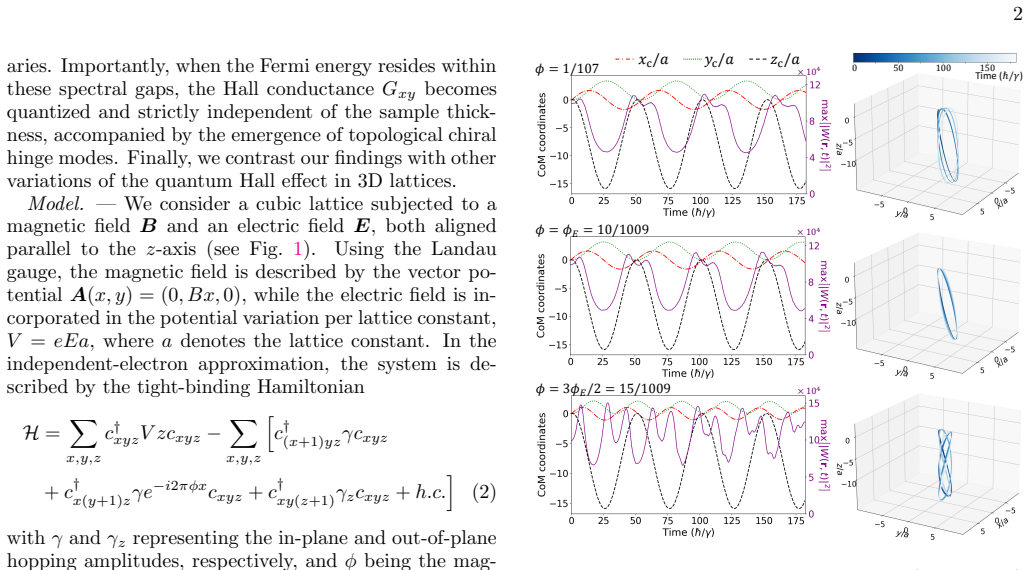
The three rows correspond to three values of the magnetic flux. (Right column) The trajec- tories of the wave packet’s CoM in real space. The color denotes time and the line thickness indicates the height of |W(r, t)| 2. The initial wave packet is defined byr 0 = (0,0,0), σ= 4a, andq= (0.1,0,0.1)/a. The lattice dimensions are Nx =N y =N z = 101. The time ...
-
[2]
In 3 (a) 𝐸/𝛾 (c) 𝐺𝑥𝑦 𝑒2/ℎ 𝐸F/𝛾 𝐸/𝛾 𝑘𝑦𝑎 (d) (e) 𝑥/𝑎 𝐸/𝛾 (b) 𝜙 Figure 3.Three-dimensional Hofstadter-Stark spectrum and the chiral hinge mode
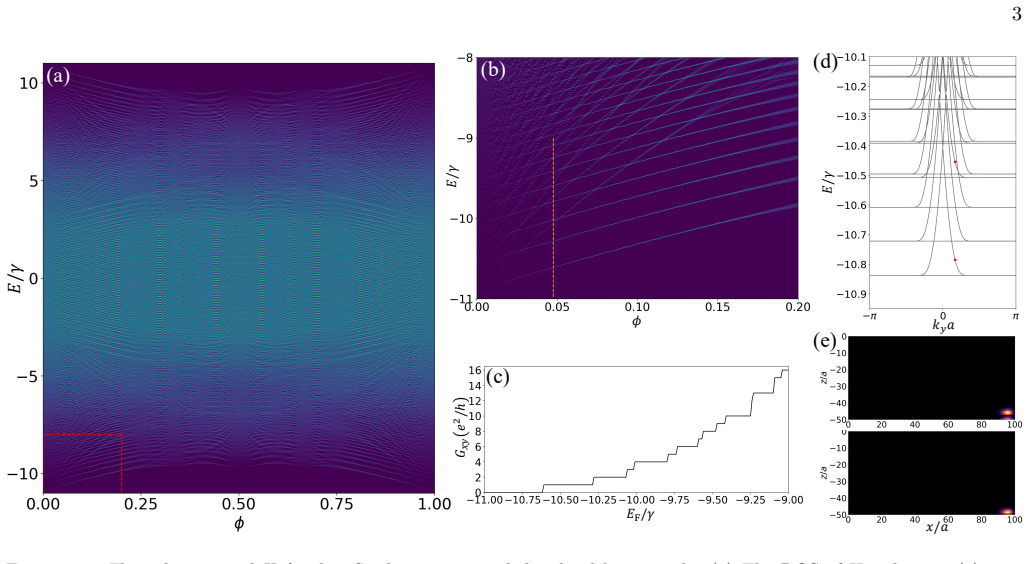
To analyze the dynamics of the wave packet, it is convenient to define the resonant fluxϕ E, at which (ϕ=ϕ E) the cyclotron frequency matches the Bloch frequency, i.e.,ωB =ω E. In 3 (a) 𝐸/𝛾 (c) 𝐺𝑥𝑦 𝑒2/ℎ 𝐸F/𝛾 𝐸/𝛾 𝑘𝑦𝑎 (d) (e) 𝑥/𝑎 𝐸/𝛾 (b) 𝜙 Figure 3.Three-dimensional Hofstadter-Stark spectrum and the chiral hinge mode. (a) The DOS of Hamiltonian (5) as a fun...
-
[3]
(c) The transverse conductance along the orange line of panel (b) forϕ= 5
(b) The magnified spectrum indicated by the red dashed box in (a). (c) The transverse conductance along the orange line of panel (b) forϕ= 5
-
[4]
(e) The modulus squared of two edge states’ eigenmodes atk ya= π 6 , depicted by the red dots in (d)
(d) The dispersion of the lowest bands when the periodic boundary condition is broken along thexdirection withN x = 201. (e) The modulus squared of two edge states’ eigenmodes atk ya= π 6 , depicted by the red dots in (d). all three cases, the CoM of the wave packet circulates in thexy-plane and oscillates periodically along thez-axis. Meanwhile, the peak...
-
[5]
Meanwhile, near the spectral boundaries, distinct gaps open between discrete energy levels, indicating the formation of flat bands within the 3D lattice
Near the spectral center, E= 0, the spectrum is gapless and features equidistant resonances that manifest as discrete sharp peaks in the DOS at specific values ofϕ. Meanwhile, near the spectral boundaries, distinct gaps open between discrete energy levels, indicating the formation of flat bands within the 3D lattice. Hereafter, we focus on the 3D flat ban...
-
[6]
For simplicity, we focus on the resonant regimeϕ=ϕ E, where the condition for Stark- cyclotron resonances is met
carry the same Chern numberC nν = 1, the Hall con- ductivity atE F = 0 is therefore equal to the total num- ber of occupied bands. For simplicity, we focus on the resonant regimeϕ=ϕ E, where the condition for Stark- cyclotron resonances is met. For the Landau indexn= 0, there areNlevels belowE F = 0. Similarly, for an index n >0, the number of WSL states ...
-
[7]
Ferreira, Resonances in the hopping probability be- tween flexible quantum dots: The case of superlattices under parallel electric and magnetic fields, Phys
R. Ferreira, Resonances in the hopping probability be- tween flexible quantum dots: The case of superlattices under parallel electric and magnetic fields, Phys. Rev. B 43, 9336(R) (1991)
1991
-
[8]
Pacheco, Z
M. Pacheco, Z. Barticevic, and F. Claro, Optical response of a superlattice in parallel magnetic and electric fields, Phys. Rev. B46, 15200 (1992)
1992
-
[9]
Wacker, Vertical transport and domain formation in multiple quantum wells, inTheory of transport proper- ties of semiconductor nanostructures(Springer, 1998) pp
A. Wacker, Vertical transport and domain formation in multiple quantum wells, inTheory of transport proper- ties of semiconductor nanostructures(Springer, 1998) pp. 321–355
1998
-
[10]
Gl¨ uck, A
M. Gl¨ uck, A. R. Kolovsky, and H. J. Korsch, Wan- nier–stark resonances in optical and semiconductor su- perlattices, Physics Reports366, 103 (2002)
2002
-
[11]
V. A. Margulis, S. Makarov, T. Piterimova, and E. Gaiduk, Collective electronic excitations in a semicon- ductor superlattice in the landau and wannier-stark lad- der regime, The European Physical Journal B-Condensed Matter and Complex Systems33, 153 (2003)
2003
-
[12]
F. G. Bass, V. V. Zorchenko, and V. I. Shashora, Stark- cyclotron resonance in semiconductors with a superlat- tice, Soviet Journal of Experimental and Theoretical Physics Letters31, 314 (1980)
1980
-
[13]
Claro, M
F. Claro, M. Pacheco, and Z. Barticevic, Novel electro- optical properties of a semiconductor superlattice under a magnetic field, Phys. Rev. Lett.64, 3058 (1990)
1990
-
[14]
Lyanda-Geller and J.-P
Y. Lyanda-Geller and J.-P. Leburton, Antiresonant hop- ping conductance and negative magnetoresistance in quantum-box superlattices, Phys. Rev. B52, 2779 (1995)
1995
-
[15]
Canali, M
L. Canali, M. Lazzarino, L. Sorba, and F. Beltram, Stark-cyclotron resonance in a semiconductor superlat- tice, Phys. Rev. Lett.76, 3618 (1996)
1996
-
[16]
N. H. Shon and H. N. Nazareno, Hopping conduction in semiconductor superlattices in a quantized magnetic field, Phys. Rev. B53, 7937 (1996)
1996
-
[17]
J. Liu, E. Gornik, S. Xu, and H. Zheng, Sequential reso- nant tunnelling through landau levels in gaas/alas super- lattices, Semiconductor science and technology12, 1422 (1997)
1997
-
[18]
M. Helm, W. Hilber, G. Strasser, R. De Meester, F. M. Peeters, and A. Wacker, Continuum wannier-stark lad- ders strongly coupled by zener resonances in semicon- ductor superlattices, Phys. Rev. Lett.82, 3120 (1999)
1999
-
[19]
Blaser, M
S. Blaser, M. Rochat, M. Beck, J. Faist, and U. Oesterle, Far-infrared emission and stark-cyclotron resonances in a quantum-cascade structure based on photon-assisted tunneling transition, Phys. Rev. B61, 8369 (2000)
2000
-
[20]
T. M. Fromhold, A. A. Krokhin, C. R. Tench, S. Bu- jkiewicz, P. B. Wilkinson, F. W. Sheard, and L. Eaves, Effects of stochastic webs on chaotic electron transport in semiconductor superlattices, Phys. Rev. Lett.87, 046803 (2001)
2001
-
[21]
B. I. Halperin, Possible states for a three-dimensional electron gas in a strong magnetic field, Japanese Journal of Applied Physics26, 1913 (1987)
1913
-
[22]
Gooth, S
J. Gooth, S. Galeski, and T. Meng, Quantum-hall physics and three dimensions, Reports on Progress in Physics86, 044501 (2023)
2023
-
[23]
C. M. Wang, H.-P. Sun, H.-Z. Lu, and X. C. Xie, 3d quantum hall effect of fermi arcs in topological semimet- als, Phys. Rev. Lett.119, 136806 (2017)
2017
-
[24]
B. A. Bernevig, T. L. Hughes, S. Raghu, and D. P. Arovas, Theory of the three-dimensional quantum hall effect in graphite, Phys. Rev. Lett.99, 146804 (2007)
2007
-
[25]
Szumniak, D
P. Szumniak, D. Loss, and J. Klinovaja, Hinge modes and surface states in second-order topological three- dimensional quantum hall systems induced by charge density modulation, Phys. Rev. B102, 125126 (2020)
2020
-
[26]
Nguyen, K
D.-H.-M. Nguyen, K. Kobayashi, J.-E. R. Wichmann, and K. Nomura, Quantum hall effect induced by chiral landau levels in topological semimetal films, Phys. Rev. 6 B104, 045302 (2021)
2021
-
[27]
H. Li, H. Liu, H. Jiang, and X. C. Xie, 3d quantum hall effect and a global picture of edge states in weyl semimet- als, Phys. Rev. Lett.125, 036602 (2020)
2020
discussion (0)
Sign in with ORCID, Apple, or X to comment. Anyone can read and Pith papers without signing in.