Photo-thermal origin of pulse laser induced orientation of crystallographic c axis in Tellurium thin films
Pith reviewed 2026-06-26 04:25 UTC · model grok-4.3
The pith
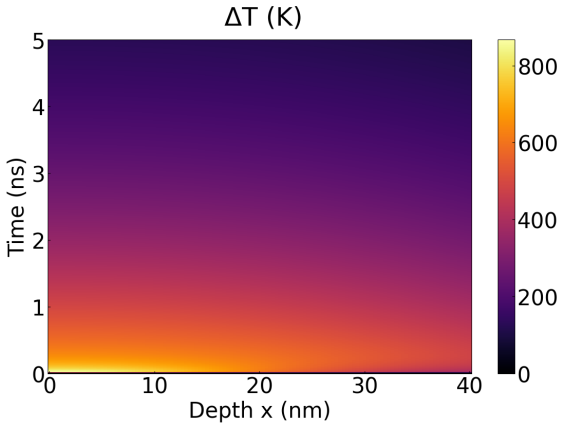
The reorientation of Tellurium's crystal c-axis by laser pulses follows a cumulative thermal activation process described by the Arrhenius law.
A machine-rendered reading of the paper's core claim, the machinery that carries it, and where it could break.
Core claim
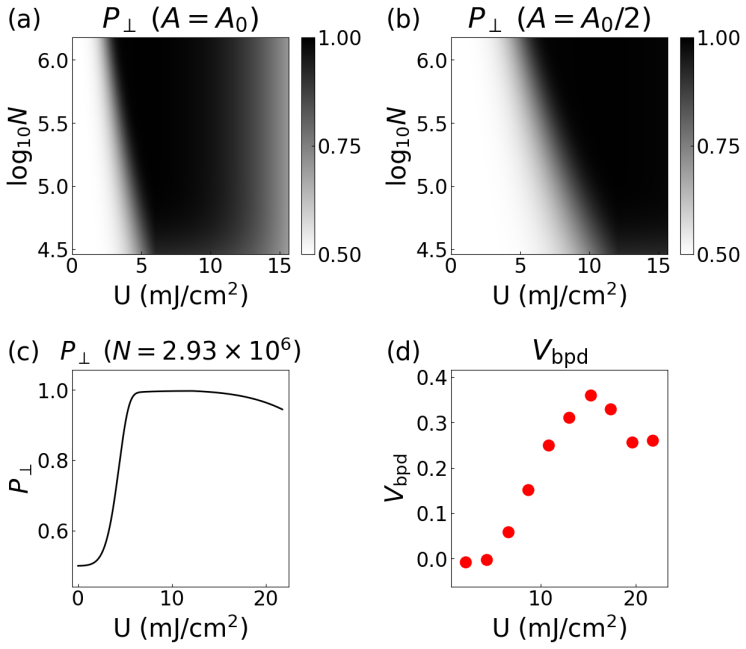
The threshold fluence for laser-induced reorientation of the c-axis in Te thin films decreases with increasing number of pulses, consistent with cumulative thermal activation obeying the Arrhenius rate law rather than a single-pulse melting process.
What carries the argument
A minimal kinetic model based on the Arrhenius law that calculates cumulative thermal activation over multiple laser pulses to determine the reorientation threshold.
If this is right
- The mechanism allows spatial programming of crystal orientation in Te films for optical and electronic devices.
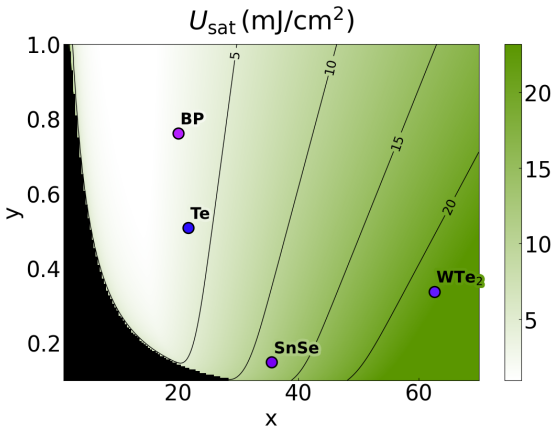
- Similar photo-thermal control should be possible in other anisotropic 2D materials such as black phosphorus, WTe2, and SnSe.
- The number of pulses can be used to tune the fluence threshold for reorientation.
- The process is dominated by thermal effects rather than non-thermal electronic excitations or melting.
Where Pith is reading between the lines
- Testing the model on other materials could reveal if the same Arrhenius dependence holds across different crystal structures.
- If the assumption of pure thermal activation is correct, lowering the pulse repetition rate might reduce the cumulative effect and raise the threshold fluence.
- Extending the model to account for heat diffusion between pulses could refine predictions for thicker films or different substrates.
Load-bearing premise
The fluence dependence arises only from cumulative thermal activation following the Arrhenius law, without non-thermal electronic effects or melting dominating.
What would settle it
Measuring the reorientation threshold at a much lower repetition rate where heat from one pulse dissipates before the next, expecting the threshold to become independent of pulse number if the model is wrong.
Figures
read the original abstract
Recent studies have shown that the orientation of crystallographic c axis of Tellurium thin films can be controlled using picosecond long laser pulses. This method provides spatially programmable control of the crystal orientation and is therefore highly attractive for practical applications in functional optical and electronic devices. Previously, it was suggested that laser-induced selective melting and recrystallization can cause the laser-induced reorientation. However, this interpretation remains inconclusive due to limited data. To clarify the mechanism, here we systematically study Te samples under different irradiation conditions. We find that the threshold fluence for inducing optical reorientation depends on the number of laser pulses. The results agrees well with a minimal kinetic model based on the Arrhenius law. Using the model developed, we investigate the condition required to control the optic axis in other two-dimensional materials, such as black phosphorus, WTe2, and SnSe. These findings provide a guide for developing functional electro-optical devices based on anisotropic materials.
Editorial analysis
A structured set of objections, weighed in public.
Referee Report
Summary. The manuscript claims that the orientation of the crystallographic c-axis in Tellurium thin films can be controlled by picosecond laser pulses through a photo-thermal mechanism. This is evidenced by the dependence of the reorientation threshold fluence on the number of pulses, which is reported to agree with a minimal kinetic model based on the Arrhenius law. The model is then used to identify conditions for analogous control in black phosphorus, WTe2, and SnSe, distinguishing the mechanism from prior suggestions of selective melting and recrystallization.
Significance. If the fluence-number scaling data and model agreement are robustly demonstrated with appropriate controls, the work would clarify the mechanism of laser-induced reorientation in Te films and supply a practical, predictive framework for extending the technique to other anisotropic 2D materials for electro-optical devices. The minimal Arrhenius-based approach would be a strength if activation parameters are independently justified rather than fitted to the same data.
major comments (2)
- [Abstract] Abstract: the claim that the results agree well with the minimal kinetic model is presented without data tables, error bars, fitting details, or exclusion criteria, so the central claim rests on unshown experimental results and an unspecified model.
- [Kinetic model] Kinetic model section: the assertion that the threshold fluence dependence on pulse count arises exclusively from cumulative thermal activation obeying the Arrhenius rate law is load-bearing for the photo-thermal conclusion, yet the manuscript does not report direct temperature measurements, repetition-rate variation to alter inter-pulse cooling, or comparison against non-laser heating at equivalent peak temperatures; without these, non-thermal electronic contributions during the picosecond pulse cannot be excluded.
minor comments (1)
- All experimental figures should include error bars, and the methods should specify how activation parameters were obtained and whether they were fitted to the fluence data.
Simulated Author's Rebuttal
We thank the referee for the constructive comments, which have helped us clarify the presentation of our results and the justification for the kinetic model. We address each major comment below and indicate the corresponding revisions to the manuscript.
read point-by-point responses
-
Referee: [Abstract] Abstract: the claim that the results agree well with the minimal kinetic model is presented without data tables, error bars, fitting details, or exclusion criteria, so the central claim rests on unshown experimental results and an unspecified model.
Authors: We agree that the abstract should reference the supporting data more explicitly. In the revised manuscript we have updated the abstract to cite the relevant main-text figure and supplementary section containing the fluence-versus-pulse-number data, error bars, tabulated values, and the explicit form of the minimal Arrhenius model. A short description of the fitting procedure (including how activation energy and prefactor were constrained by literature values versus the present data) and the data-exclusion criteria have been added to the Methods section. revision: yes
-
Referee: [Kinetic model] Kinetic model section: the assertion that the threshold fluence dependence on pulse count arises exclusively from cumulative thermal activation obeying the Arrhenius rate law is load-bearing for the photo-thermal conclusion, yet the manuscript does not report direct temperature measurements, repetition-rate variation to alter inter-pulse cooling, or comparison against non-laser heating at equivalent peak temperatures; without these, non-thermal electronic contributions during the picosecond pulse cannot be excluded.
Authors: We acknowledge that direct in-situ temperature measurements, repetition-rate variation, and equivalent non-laser heating experiments would strengthen the exclusion of non-thermal channels. These controls were not performed because ultrafast local thermometry on sub-micron Te films is technically demanding and lies outside the scope of the present study. We have revised the kinetic-model section to state that the observed scaling is quantitatively consistent with cumulative thermal activation rather than claiming it arises exclusively from this mechanism. A new paragraph discusses why non-thermal electronic processes are unlikely to produce the observed multi-pulse fluence dependence, referencing known non-thermal thresholds in related materials, while noting the absence of the suggested controls as a limitation. revision: partial
Circularity Check
No circularity; model agreement presented as independent validation
full rationale
The provided abstract and context describe experimental observation of fluence threshold depending on pulse number, followed by statement that results agree with a minimal Arrhenius-based kinetic model. No equations, parameter-fitting details, or self-citations are quoted that would reduce the claimed agreement to a tautology by construction. The model is used for extrapolation to other materials, but this is an application rather than a load-bearing step that collapses into the input data. Per rules, absence of quotable reduction means score 0; the derivation chain is treated as self-contained against external benchmarks.
Axiom & Free-Parameter Ledger
free parameters (1)
- activation energy or prefactor in Arrhenius model
axioms (1)
- domain assumption Reorientation rate follows Arrhenius temperature dependence
Reference graph
Works this paper leans on
-
[1]
3(a) and 3(b), respectively, for the Te film, sapphire substrate and air withα= 0 ◦ and 90 ◦
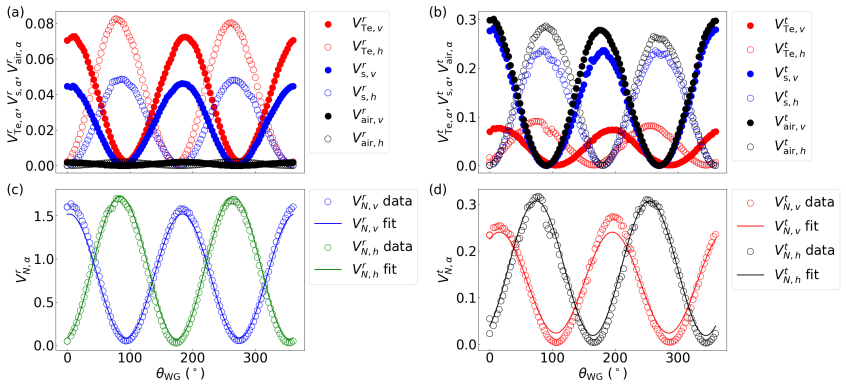
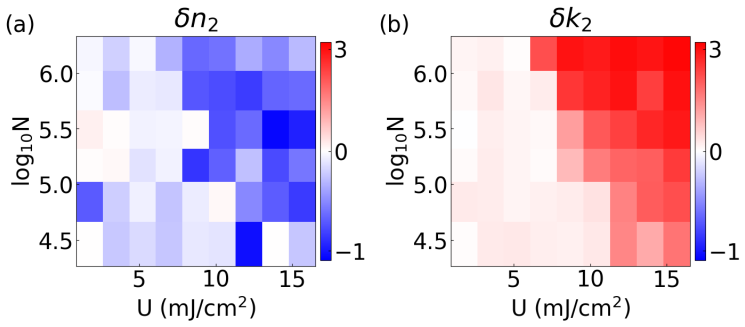
Reflectance and transmittance data Exemplary data obtained using the reflection and transmission geometries are shown in Figs. 3(a) and 3(b), respectively, for the Te film, sapphire substrate and air withα= 0 ◦ and 90 ◦. All data show a sinusoidal dependence onθ WG. To extract parameters from the data, we process the data as follows. For reflection geomet...
-
[2]
Let us assume that the index i(i= 1,2,3) indicates air, Te film, and substrate, respectively
Refractive index of as deposited Te film From the complex transmission and reflection coefficients, we compute the refractive indices of the Te thin film irradiated with the pulse laser. Let us assume that the index i(i= 1,2,3) indicates air, Te film, and substrate, respectively. First, we calculate the refractive index of Te films that have not been irra...
-
[3]
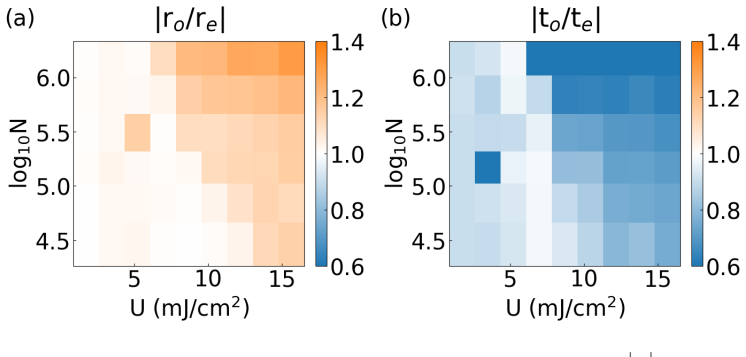
Refractive index of Te film irradiated with laser pulses Next, we calculate the refractive index of the Te films irradiated with pulse laser. The refractive index of the Te film is now set toη 2,o =n o +ik o (η2,e =n e +ik e) when the incident light polarization is parallel (orthogonal) to the pulse laser polarization, i.e. or- thogonal (parallel) to the ...
1950
-
[4]
Adenis, V
C. Adenis, V. Langer, and O. Lindqvist, Reinvestigation of the structure of tellurium, Acta Crystallographica, Section C: Crystal Structure Communications45, 941 (1989)
1989
-
[5]
Rikken and N
G. Rikken and N. Avarvari, Strong electrical magnetochiral anisotropy in tellurium, Phys. Rev. B99, 245153 (2019)
2019
-
[6]
Q. H. Zhang, H. G. Gu, Z. F. Guo, K. Ding, and S. Y. Liu, Quantitatively exploring giant optical anisotropy of quasi-one-dimensional Ta 2NiS5, Nanomaterials13, 3098 (2023)
2023
-
[7]
L. Tong, X. Y. Huang, P. Wang, L. Ye, M. Peng, L. C. An, Q. D. Sun, Y. Zhang, G. M. Yang, Z. Li, F. Zhong, F. Wang, Y. X. Wang, M. Motlag, W. Z. Wu, G. J. Cheng, and W. D. Hu, Stable mid-infrared polarization imaging based on quasi-2d tellurium at room temperature, Nat. Commun.11, 2308 (2020)
2020
-
[8]
J. Yu, H. Mu, P. Wang, H. Li, Z. Yang, J. Ren, Y. Li, L. Mei, J. Zhang, W. Yu,et al., Anisotropic van der waals tellurene-based multifunctional, polarization-sensitive, in-line opti- cal device, ACS nano18, 19099 (2024)
2024
-
[9]
Y. Tang, Y. Song, L. Zeng, Y.-h. Lo, and K. Nomura, Wafer-scale high mobility 2d tellurium thin-film transistor for heterogeneous integrated 3d-CFET logic circuits, Small21, 2504908 (2025)
2025
-
[10]
Zhang, F
J. Zhang, F. Xuan, J. Song, J. Xu, D. Wang, Q. Zhang, Q. Han, K. Cheng, Y. Liang, X. Hou, et al., Dynamically tunable polarized mid-infrared light-emitting diodes from polarization singularities in a band-edge weyl node, Nat. Commun. (2025)
2025
-
[11]
Kobayashi, A
Y. Kobayashi, A. Mitsuzuka, H. Kondo, M. Shoshin, J. Uzuhashi, T. Ohkubo, M. Hayashi, and M. Kawaguchi, Light-programmable reorientation of the crystallographic c axis of tellurium thin films, Nano Lett.26, 104 (2026)
2026
-
[12]
R. C. Jones, A new calculus for the treatment of optical systems i. description and discussion of the calculus, J. Opt. Soc. Am.31, 488 (1941)
1941
-
[13]
R. M. Azzam, N. M. Bashara, and S. S. Ballard, Ellipsometry and polarized light (1978)
1978
-
[14]
C. C. Katsidis and D. I. Siapkas, General transfer-matrix method for optical multilayer systems with coherent, partially coherent, and incoherent interference, Appl. Opt.41, 3978 (2002)
2002
-
[15]
Z. F. Guo, H. G. Gu, M. S. Fang, L. Ye, and S. Y. Liu, Giant in-plane optical and electronic anisotropy of tellurene: a quantitative exploration, Nanoscale14, 12238 (2022). 28
2022
-
[16]
Lin, W.-L
C.-C. Lin, W.-L. Liu, and C.-Y. Hsieh, Scalar scattering model of highly textured transparent conducting oxide, J. Appl. Phys.109(2011)
2011
-
[17]
J. Sipe, J. F. Young, J. Preston, and H. Van Driel, Laser-induced periodic surface structure. i. theory, Phys. Rev. B27, 1141 (1983)
1983
-
[18]
Bonse, S
J. Bonse, S. V. Kirner, and J. Kr¨ uger, Laser-induced periodic surface structures (LIPSS), Handbook of laser micro-and nano-engineering , 1 (2020)
2020
-
[19]
T. H. Fung, T. Veeken, D. Payne, B. Veettil, A. Polman, and M. Abbott, Application and validity of the effective medium approximation to the optical properties of nano-textured silicon coated with a dielectric layer, Opt. Exp.27, 38645 (2019)
2019
-
[20]
C. D. Stanciu, F. Hansteen, A. V. Kimel, A. Kirilyuk, A. Tsukamoto, A. Itoh, and T. Rasing, All-optical magnetic recording with circularly polarized light, Phys. Rev. Lett.99, 047601 (2007)
2007
-
[21]
C. H. Lambert, S. Mangin, B. Varaprasad, Y. K. Takahashi, M. Hehn, M. Cinchetti, G. Ma- linowski, K. Hono, Y. Fainman, M. Aeschlimann, and E. E. Fullerton, All-optical control of ferromagnetic thin films and nanostructures, Science345, 1337 (2014)
2014
-
[22]
A. R. Khorsand, M. Savoini, A. Kirilyuk, A. V. Kimel, A. Tsukamoto, A. Itoh, and T. Rasing, Role of magnetic circular dichroism in all-optical magnetic recording, Phys. Rev. Lett.108, 127205 (2012)
2012
-
[23]
Gorchon, Y
J. Gorchon, Y. Yang, and J. Bokor, Model for multishot all-thermal all-optical switching in ferromagnets, Phys. Rev. B94, 020409 (2016)
2016
-
[24]
M. O. Ellis, E. E. Fullerton, and R. W. Chantrell, All-optical switching in granular ferromag- nets caused by magnetic circular dichroism, Sci. Rep.6, 30522 (2016)
2016
-
[25]
M. S. E. Hadri, P. Pirro, C. H. Lambert, S. Petit-Watelot, Y. Quessab, M. Hehn, F. Montaigne, G. Malinowski, and S. Mangin, Two types of all-optical magnetization switching mechanisms using femtosecond laser pulses, Phys. Rev. B94, 064412 (2016)
2016
-
[26]
Yoshikawa, K
N. Yoshikawa, K. Ogawa, Y. Hirai, K. Fujiwara, J. Ikeda, A. Tsukazaki, and R. Shimano, Non-volatile chirality switching by all-optical magnetization reversal in ferromagnetic weyl semimetal co3sn2s2, Communications Physics5, 328 (2022)
2022
-
[27]
P. J. W. Debye,Polar molecules(Dover publications, 1929)
1929
-
[28]
A. C. Thompson and D. Vaughan,X-Ray Data Booklet: Table 5-2, Properties of the elements, 2nd ed. (Lawrence Berkeley National Laboratory, Berkeley, California, 2001). 29
2001
-
[29]
D. S. Smith, F. Puech, B. Nait-Ali, A. Alzina, and S. Honda, Grain boundary thermal resis- tance and finite grain size effects for heat conduction through porous polycrystalline alumina, International J. Heat and Mass Transfer121, 1273 (2018)
2018
-
[30]
Veprek, F.-A
S. Veprek, F.-A. Sarott, and Z. Iqbal, Effect of grain boundaries on the raman spectra, optical absorption, and elastic light scattering in nanometer-sized crystalline silicon, Phys. Rev. B 36, 3344 (1987)
1987
-
[31]
Sun and S
J. Sun and S. Simon, The melting behavior of aluminum nanoparticles, Thermochimica Acta 463, 32 (2007)
2007
-
[32]
Tsuzuki, M
T. Tsuzuki, M. Yao, and H. Endo, Static and dynamic structures of liquid tellurium, J. Phys. Soc. Jpn.64, 485 (1995)
1995
-
[33]
Akola and R
J. Akola and R. O. Jones, Structure and dynamics in amorphous tellurium and te n clusters: A density functional study, Phys. Rev. B85, 134103 (2012)
2012
-
[34]
Ciesielski, L
A. Ciesielski, L. Skowronski, W. Pacuski, and T. Szoplik, Permittivity of ge, te and se thin films in the 200-1500 nm spectral range. predicting the segregation effects in silver, Materials Science in Semiconductor Processing81, 64 (2018)
2018
-
[35]
Sraitrova, J
K. Sraitrova, J. Cizek, V. Holy, T. Plechacek, L. Benes, M. Jarosova, V. Kucek, and C. Drasar, Vacancies in snse single crystals in a near-equilibrium state, Phys. Rev. B99, 035306 (2019)
2019
-
[36]
Song and J.-T
H.-Y. Song and J.-T. L¨ u, Single-site point defects in semimetal WTe 2: A density functional theory study, AIP Adv.8(2018)
2018
-
[37]
S. Kang, D. Won, H. Yang, C.-H. Lin, C.-S. Ku, C.-Y. Chiang, S. Kim, and S. Cho, Phase- controllable laser thinning in mote2, Appl. Surf. Sci.563, 150282 (2021)
2021
-
[38]
Appalakondaiah, G
S. Appalakondaiah, G. Vaitheeswaran, S. Lebegue, N. E. Christensen, and A. Svane, Effect of van der waals interactions on the structural and elastic properties of black phosphorus, Phys. Rev. B86, 035105 (2012)
2012
-
[39]
C. C. Stephenson, R. L. Potter, T. G. Maple, and J. C. Morrow, The thermodynamic prop- erties of elementary phosphorus. the heat capacities of two crystalline modifications of red phosphorus, ofαandβwhite phosphorus, and of black phosphorus from 15 to 300 k, J. Chem. Thermodyn,1, 59 (1969)
1969
-
[40]
J. E. Callanan, G. A. Hope, R. D. Weir, and E. F. J. Westrum, Thermodynamic proper- ties of tungsten ditelluride (WTe 2) I. the preparation and low-temperature heat capacity at temperatures from 6 k to 326 k, J. Chem. Thermodyn.24, 627 (1992). 30
1992
-
[41]
Wiedemeier, G
H. Wiedemeier, G. Pultz, U. Gaur, and B. Wunderlich, Heat capacity measurements of SnSe and SnSe2, Thermochimica Acta43, 297 (1981)
1981
-
[42]
Lee and K.-J
S.-Y. Lee and K.-J. Yee, Black phosphorus phase retarder based on anisotropic refractive index dispersion, 2D Mater.9, 015020 (2022)
2022
-
[43]
Munkhbat, P
B. Munkhbat, P. Wr´ obel, T. J. Antosiewicz, and T. O. Shegai, Optical constants of several multilayer transition metal dichalcogenides measured by spectroscopic ellipsometry in the 300–1700 nm range: High index, anisotropy, and hyperbolicity, ACS Photon.9, 2398 (2022)
2022
-
[44]
Z. Guo, H. Gu, Y. Yu, Z. Wei, and S. Liu, Broadband and incident-angle-modulation near- infrared polarizers based on optically anisotropic snse, Nanomaterials13, 134 (2023)
2023
-
[45]
Brown and S
A. Brown and S. Rundqvist, Refinement of the crystal structure of black phosphorus, Acta Crystallographica19, 684 (1965)
1965
-
[46]
B. E. Brown, The crystal structures of WTe 2 and high-temperature MoTe 2, Acta Crystallo- graphica20, 268 (1966)
1966
-
[47]
Chattopadhyay, J
T. Chattopadhyay, J. Pannetier, and H. G. von Schnering, Neutron diffraction study of the structural phase transition in SnS and SnSe, J. Phys.Chem.Sol.47, 879 (1986)
1986
-
[48]
Muhammad, M
H. Muhammad, M. Mezouar, G. Garbarino, L. Henry, T. Poreba, M. Gerin, M. Ceppatelli, M. Serrano-Ruiz, M. Peruzzini, and F. Datchi, Melting curve of black phosphorus: Evidence for a solid–liquid–liquid triple point, J. Phys. Chem. Lett.15, 8402 (2024)
2024
-
[49]
Hansen, M
F. Hansen, M. Wels, S. Froeschke, A. Popov, D. Wolf, B. B¨ uchner, P. Schmidt, and S. Hampel, Thermodynamic evaluation and chemical vapor transport of few-layer WTe2, Crystal Growth & Design20, 7341 (2020), primary source for peritectic melting behavior of WTe 2 (reported at 1020 ◦C)
2020
-
[50]
Feutelais, M
Y. Feutelais, M. Majid, B. Legendre, and S. Frics, Phase diagram investigation and proposition of a thermodynamic evaluation of the tin-selenium system, J. Phase Equil.17, 40 (1996)
1996
-
[51]
Chartier,Introduction to Optics(Springer, 2005)
G. Chartier,Introduction to Optics(Springer, 2005)
2005
-
[52]
Y.-M. Sheu, M. Trigo, Y. Chien, C. Uher, D. Arms, E. Peterson, D. Walko, E. Landahl, J. Chen, S. Ghimire,et al., Kapitza conductance of bi/sapphire interface studied by depth- and time-resolved x-ray diffraction, Sol. State Commun.151, 826 (2011)
2011
-
[53]
S. Y. Huang, M. Segovia, X. L. Yang, Y. R. Koh, Y. X. Wang, P. D. Ye, W. Z. Wu, A. Shakouri, X. L. Ruan, and X. F. Xu, Anisotropic thermal conductivity in 2d tellurium, 2d Materials7, 015008 (2020). 31
2020
-
[54]
Li, C.-H
C. Li, C.-H. Su, S. Lehoczky, R. Scripa, B. Lin, and H. Ban, Thermophysical properties of liquid te: Density, electrical conductivity, and viscosity, J. Appl. Phys.97(2005)
2005
-
[55]
Commission on Isotopic Abundances and Atomic Weights (CIAAW), Tellurium: Standard atomic weight (2024). 32
2024
discussion (0)
Sign in with ORCID, Apple, or X to comment. Anyone can read and Pith papers without signing in.