Ductility Design Rules for Tungsten based Refractory High Entropy Alloys from Sparse Experimental Datasets
Pith reviewed 2026-06-26 04:39 UTC · model grok-4.3
The pith
Machine learning on sparse data predicts moderate Ti, Ni, and Co additions improve room-temperature ductility in tungsten refractory high-entropy alloys while high Cr promotes brittleness.
A machine-rendered reading of the paper's core claim, the machinery that carries it, and where it could break.
Core claim
A support vector classifier trained on physics-informed descriptors from a sparse experimental dataset of tungsten-based refractory high-entropy alloys predicts that moderate additions of Ti, Ni, and Co increase the likelihood of room-temperature ductility whereas high Cr contents promote brittle behavior, with the predictions aligning with published experiments and with DFT-derived elastic descriptors.
What carries the argument
Support vector classifier with Shapley additive explanations applied to composition-based physics-informed descriptors such as valence electron concentration and electronegativity mismatch.
If this is right
- Moderate Ti additions are expected to improve ductility via solid-solution and electronic effects.
- High Cr contents should be minimized to reduce the risk of room-temperature brittleness.
- The model supplies an interpretable screening step that narrows the space of compositions for subsequent DFT calculations and targeted experiments.
- Agreement between the classifier margins and independent DFT elastic descriptors reinforces the physical grounding of the learned boundary.
Where Pith is reading between the lines
- Compositions containing balanced moderate levels of Ti, Ni, and Co with low Cr could be prioritized for experimental synthesis and mechanical testing.
- The same descriptor-plus-classifier workflow could be reused on other refractory alloy families once comparable sparse datasets are assembled.
- Collecting additional uniform mechanical-property measurements on borderline compositions would directly test and potentially tighten the current decision boundary.
Load-bearing premise
The sparse and heterogeneous experimental mechanical-property dataset is representative enough for the trained classifier to produce generalizable predictions for new compositions.
What would settle it
Synthesize and mechanically test at room temperature a new tungsten-based composition inside the convex hull of the training data that the model classifies as ductile, such as one with moderate Ti and low Cr, and check whether it exhibits the predicted ductility.
Figures
read the original abstract
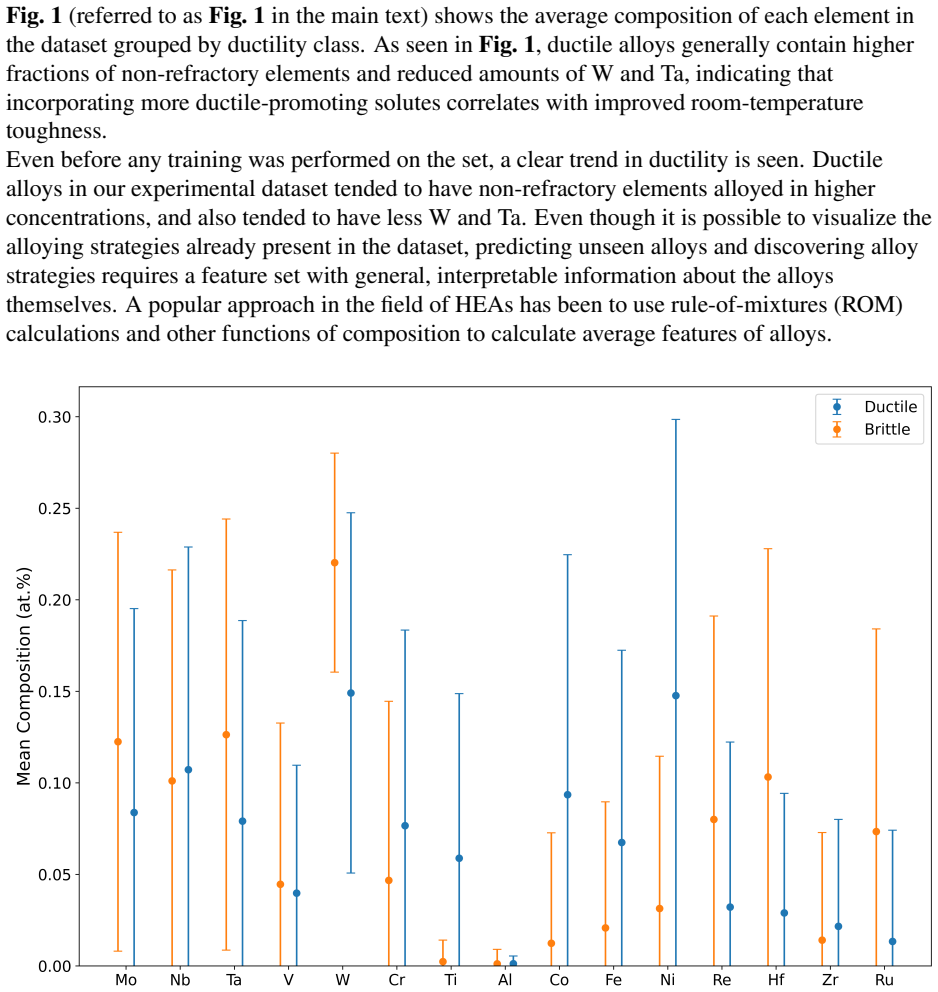
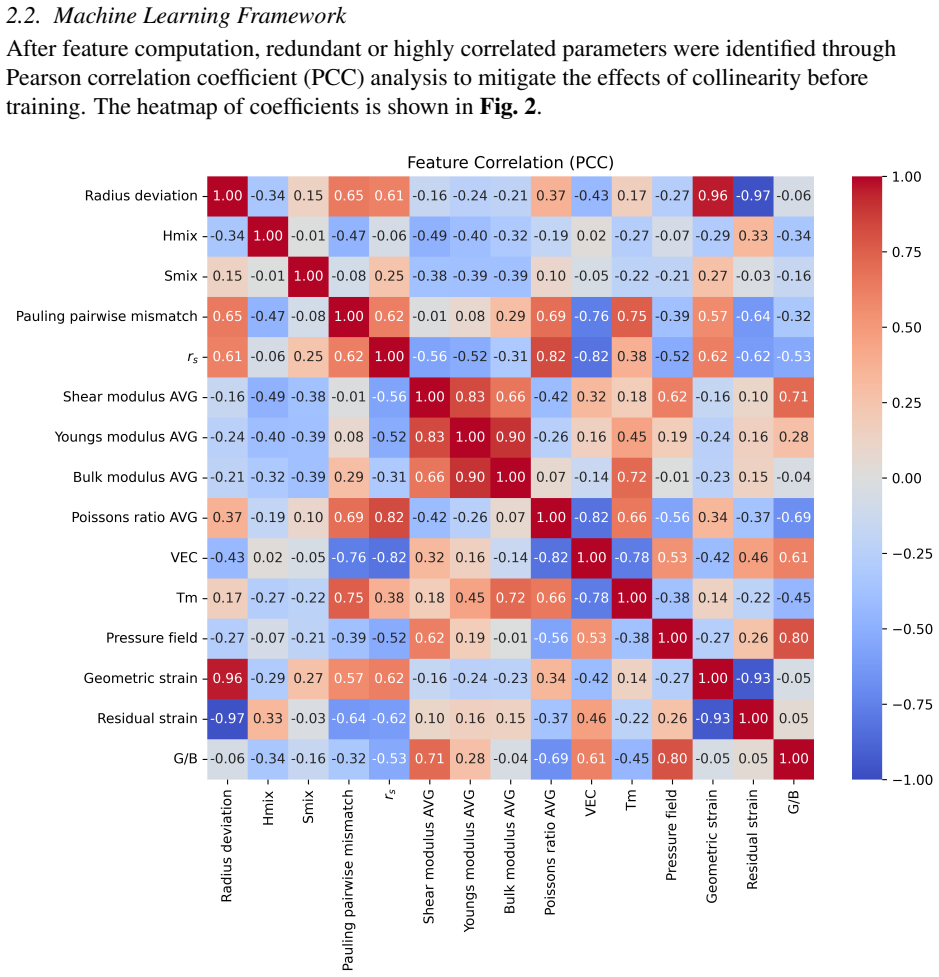
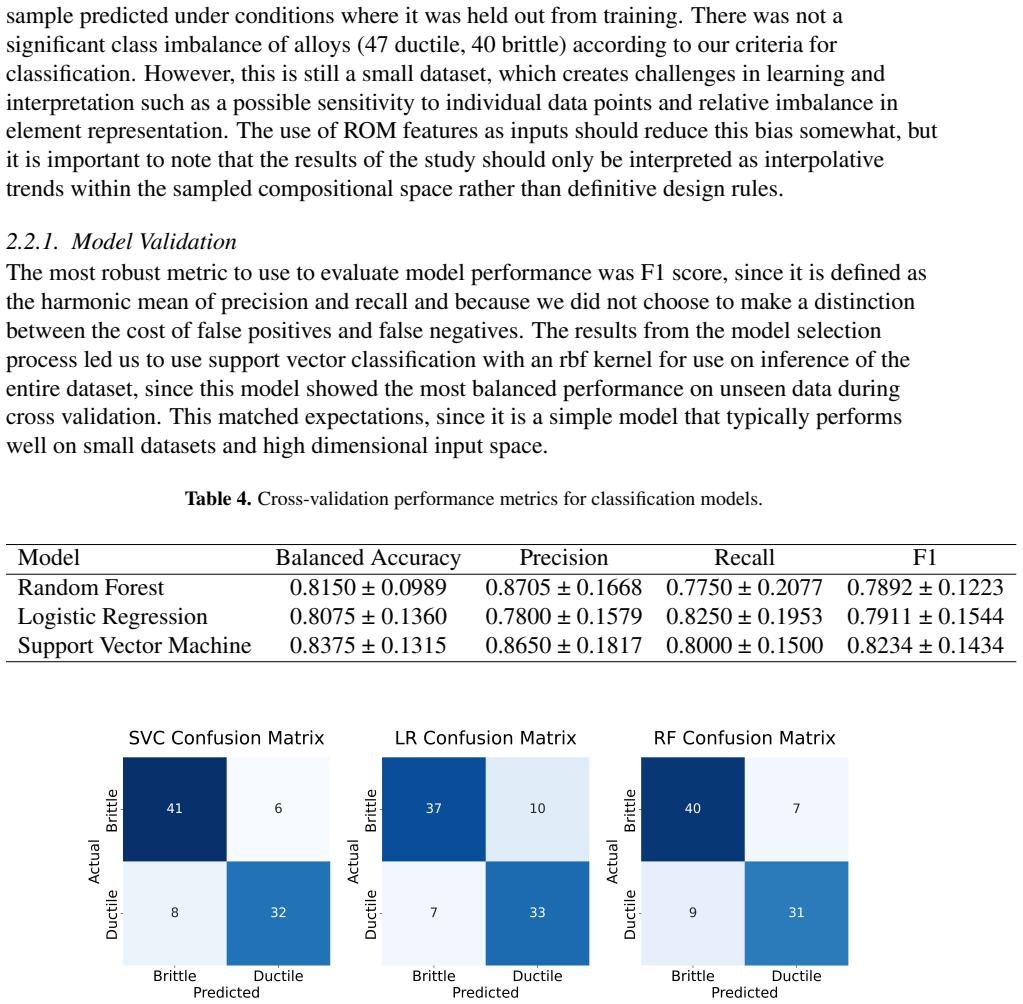
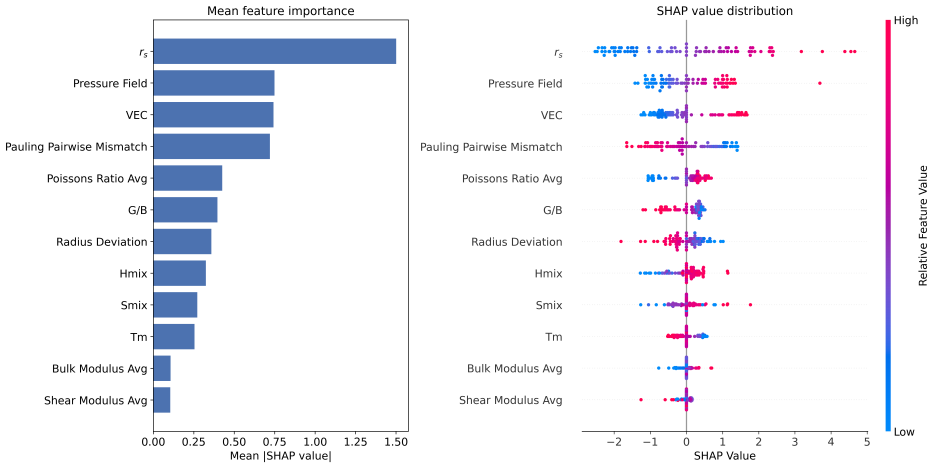
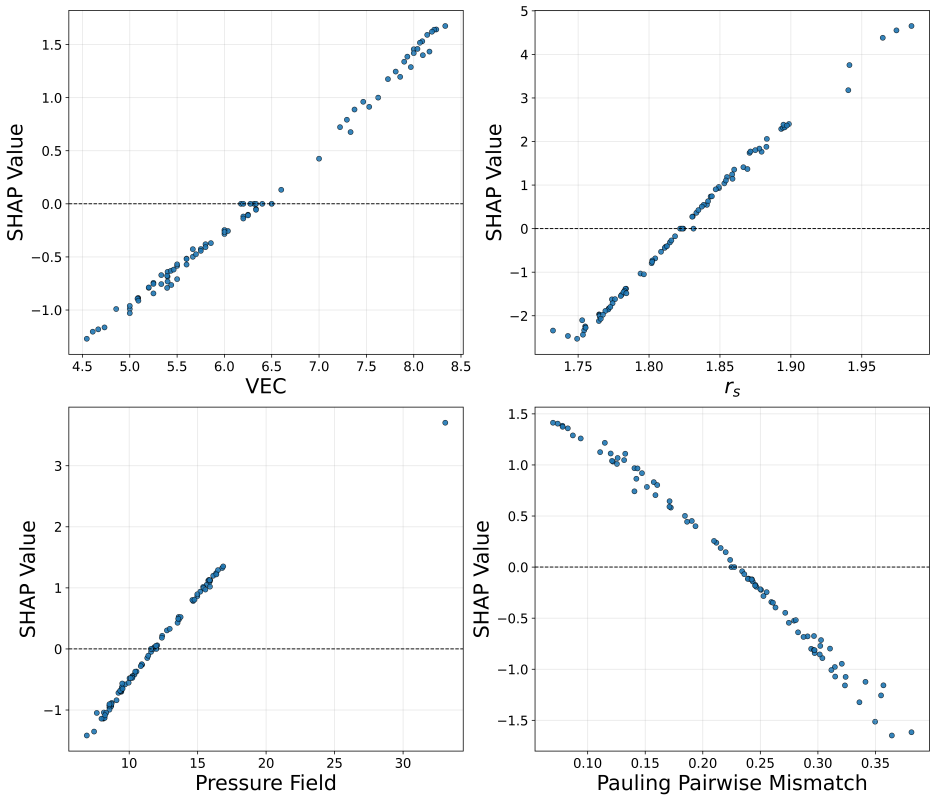
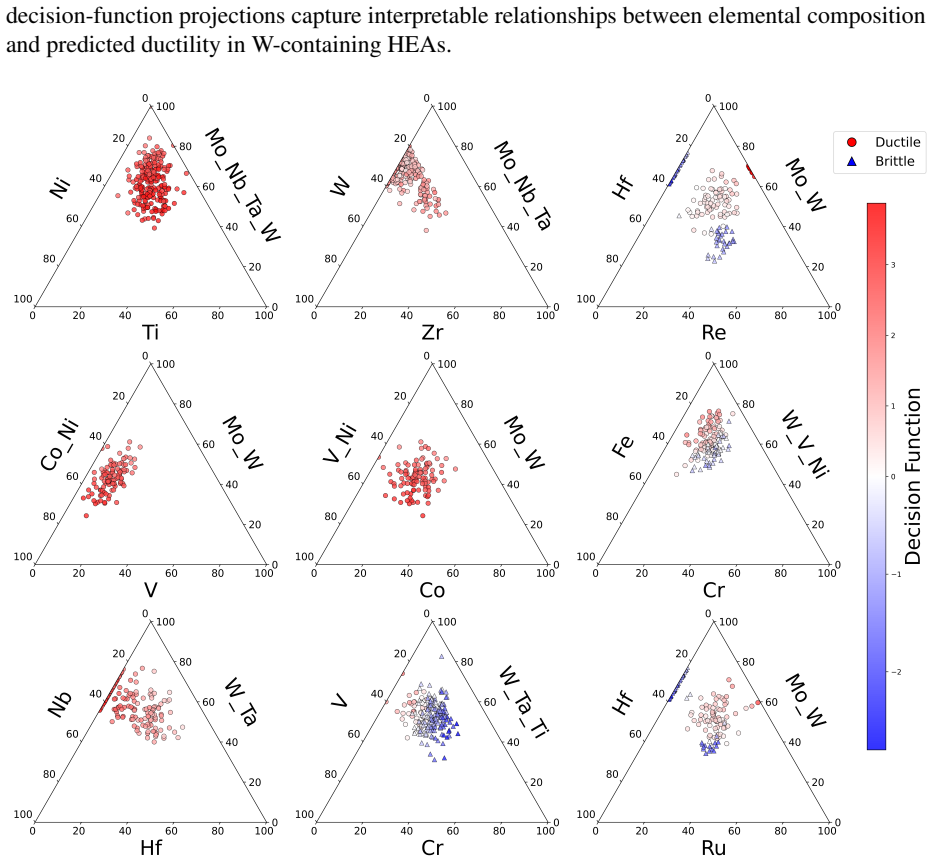
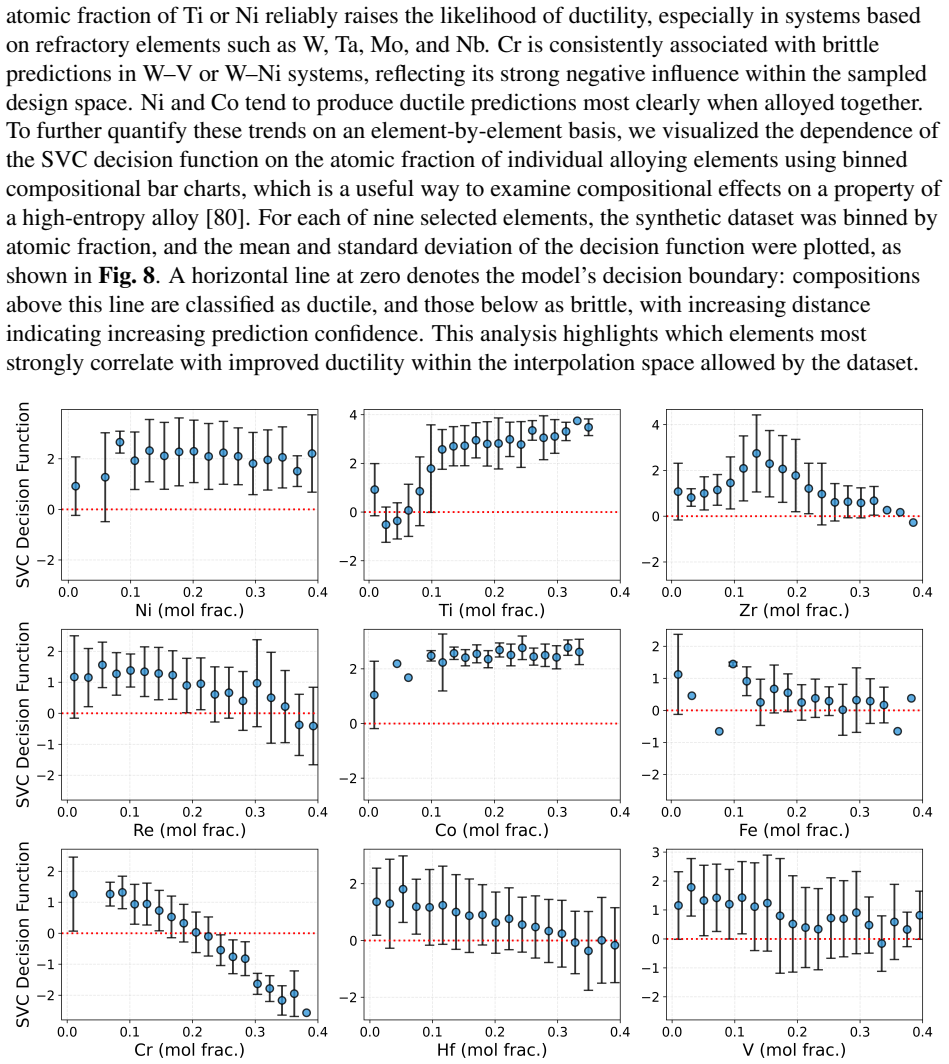
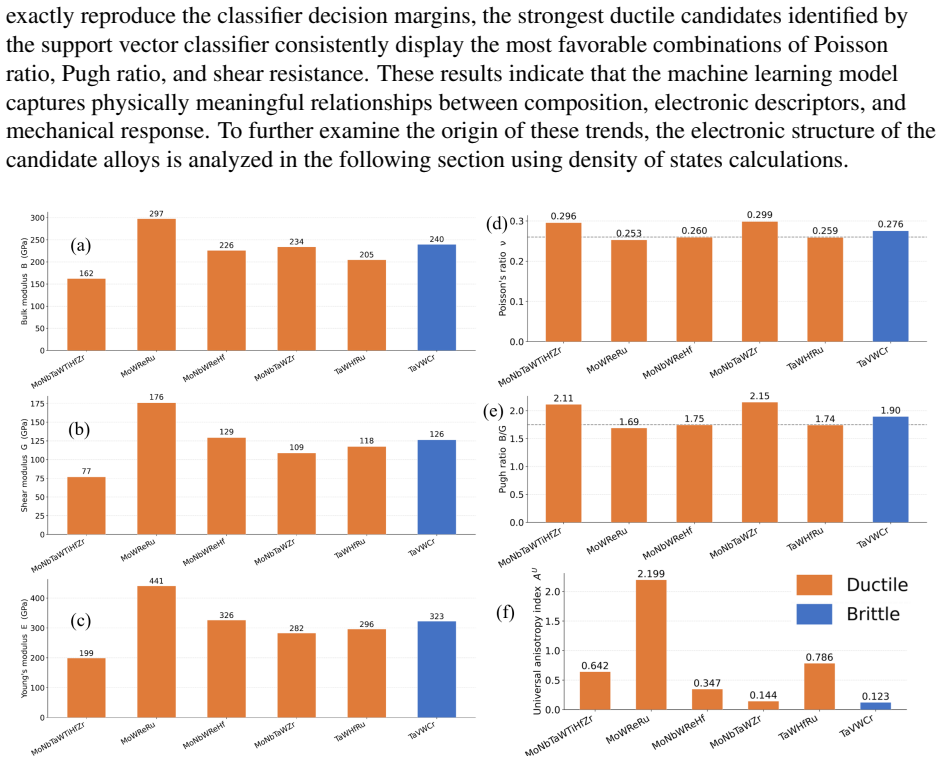
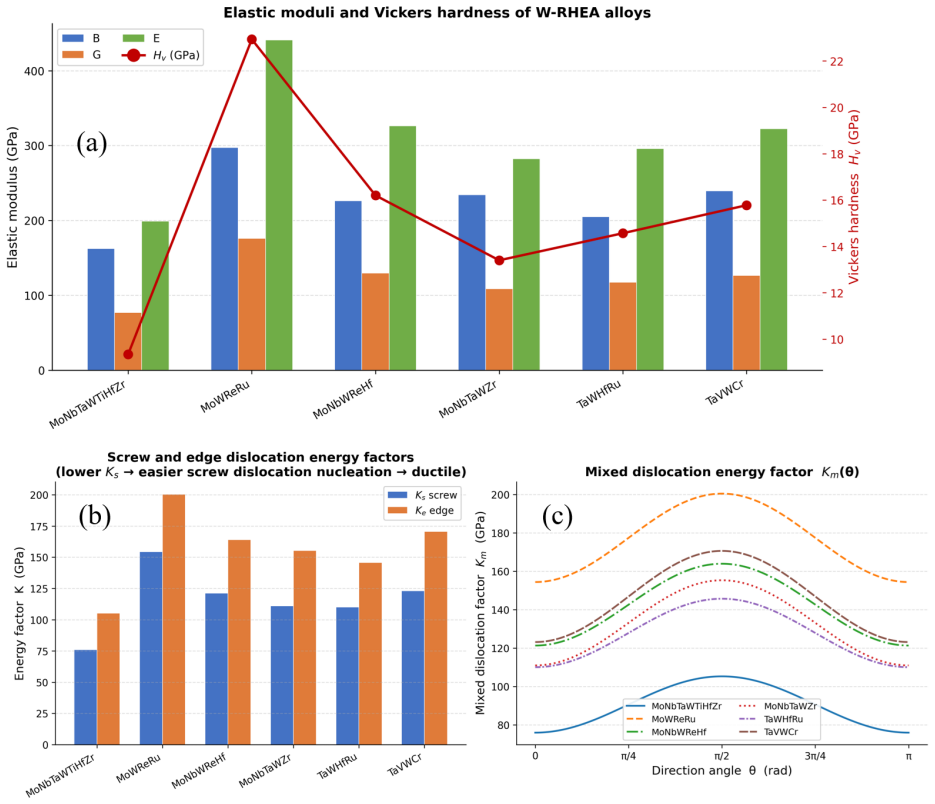
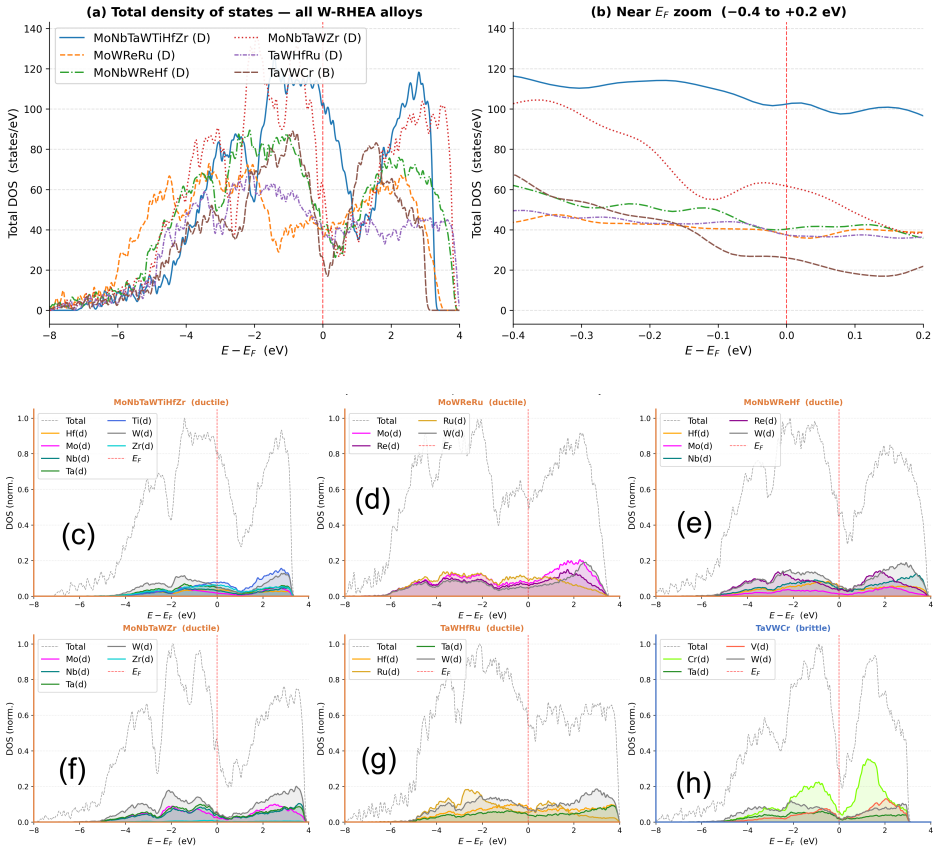
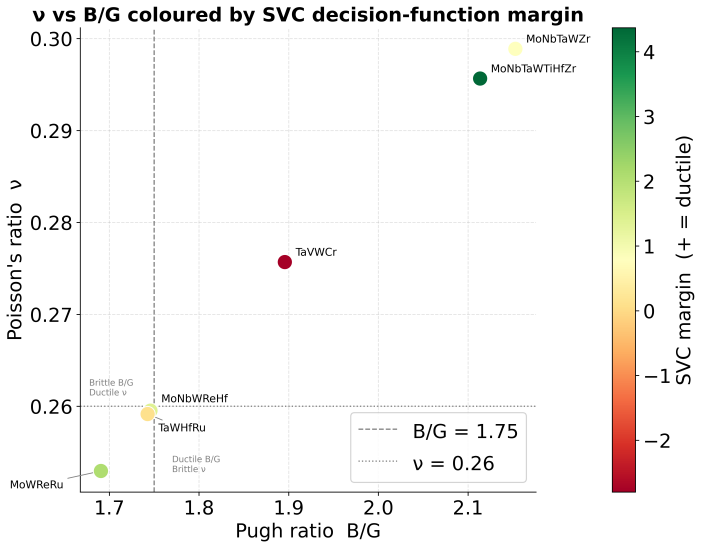
Tungsten-based refractory high-entropy alloys (RHEAs) are promising materials for fusion applications but often remain brittle at room temperature because of tungsten's high ductile-to-brittle transition temperature (DBTT). To identify alloying strategies that improve ductility, we compiled a curated dataset of experimentally reported tungsten-containing alloys and developed composition-based, physics-informed descriptors for machine learning. Three classifiers were evaluated using nested cross-validation, and a support vector classifier (SVC) showed the best generalization for this sparse dataset. Shapley additive explanations identified the exchange-correlation parameter, valence electron concentration, pressure field, and electronegativity mismatch as the most influential features governing ductile-brittle behavior. Synthetic compositions generated within the convex interpolation domain of the training data were evaluated and visualized on pseudo-ternary diagrams to map predicted ductility trends. The model predicts that moderate additions of Ti, Ni, and Co increase the likelihood of room-temperature ductility, whereas high Cr contents promote brittle behavior. These predictions agree with published experimental observations, including Ti-assisted ductility through solid-solution and electronic effects and embrittlement in Cr-rich refractory alloys. Agreement between DFT-derived elastic descriptors and SVC decision-function margins further supports the physical relevance of the learned classification boundary. Although the available mechanical dataset remains limited and heterogeneous, the model captures experimentally consistent trends and provides an interpretable, physics-informed framework for screening tungsten-based RHEAs for targeted simulation and experimental validation in fusion environments.
Editorial analysis
A structured set of objections, weighed in public.
Referee Report
Summary. The paper compiles a curated but sparse and heterogeneous experimental dataset of tungsten-containing alloys, develops physics-informed composition-based descriptors, evaluates three classifiers via nested cross-validation (selecting SVC as best), applies SHAP to rank features (exchange-correlation parameter, valence electron concentration, pressure field, electronegativity mismatch), generates synthetic compositions inside the training convex hull, and maps predicted ductility on pseudo-ternary diagrams. It claims the model identifies trends (moderate Ti/Ni/Co additions favor room-temperature ductility; high Cr favors brittleness) that agree with selected experimental literature and that DFT elastic descriptors are consistent with the SVC decision boundary, thereby offering an interpretable screening framework for fusion-relevant RHEAs despite acknowledged data limitations.
Significance. If the identified trends prove robust and generalizable beyond the training distribution, the work would supply a practical, physics-informed tool for prioritizing alloy compositions in refractory high-entropy alloy design, potentially reducing the experimental search space for ductile tungsten-based materials. Positive elements include the explicit use of nested CV to mitigate overfitting on small data, SHAP-based interpretability, restriction of synthetic points to the convex hull, and cross-check against DFT-derived quantities. These choices strengthen the claim that the learned boundary reflects physical mechanisms rather than pure statistical artifact.
major comments (2)
- [Abstract and model evaluation section] Abstract and § on model evaluation: the central claim that the SVC 'captures experimentally consistent trends' and 'agrees with published experimental observations' is load-bearing for the paper's utility as a screening tool, yet no quantitative metrics (confusion matrix, precision-recall, or per-composition match rate from nested CV) or explicit list of compared literature compositions are supplied; without these, the strength of the agreement cannot be assessed against label noise arising from heterogeneous DBTT definitions and test conditions.
- [Dataset curation and synthetic compositions section] § on dataset and synthetic compositions: the premise that the curated experimental labels are representative enough for extrapolatable predictions rests on an unquantified curation process (no reported exclusion criteria, final sample size after filtering, or sensitivity to label flips); because all synthetic points lie inside the convex hull, any apparent agreement with external experiments may reflect interpolation of existing patterns rather than discovery of transferable rules, directly affecting the generalizability asserted in the final paragraph.
minor comments (1)
- [Methods] The description of SVC hyperparameter optimization would benefit from an explicit table listing the final kernel, C, and gamma values together with their effect on the ranked SHAP features.
Simulated Author's Rebuttal
We thank the referee for the constructive and detailed review. We address each major comment below and indicate where revisions will be made to improve clarity and transparency.
read point-by-point responses
-
Referee: [Abstract and model evaluation section] Abstract and § on model evaluation: the central claim that the SVC 'captures experimentally consistent trends' and 'agrees with published experimental observations' is load-bearing for the paper's utility as a screening tool, yet no quantitative metrics (confusion matrix, precision-recall, or per-composition match rate from nested CV) or explicit list of compared literature compositions are supplied; without these, the strength of the agreement cannot be assessed against label noise arising from heterogeneous DBTT definitions and test conditions.
Authors: We agree that explicit quantitative metrics would allow readers to better evaluate the claimed agreement. In the revised manuscript we will add a table summarizing nested CV performance (accuracy, precision, recall, F1, and averaged confusion matrix from the outer loop). We will also include a supplementary table listing the specific literature compositions used for qualitative comparison, together with the reported DBTT conditions and measurement methods. These additions will make the strength of the experimental agreement assessable while acknowledging the label heterogeneity already noted in the text. revision: yes
-
Referee: [Dataset curation and synthetic compositions section] § on dataset and synthetic compositions: the premise that the curated experimental labels are representative enough for extrapolatable predictions rests on an unquantified curation process (no reported exclusion criteria, final sample size after filtering, or sensitivity to label flips); because all synthetic points lie inside the convex hull, any apparent agreement with external experiments may reflect interpolation of existing patterns rather than discovery of transferable rules, directly affecting the generalizability asserted in the final paragraph.
Authors: We will revise the dataset section to state the exclusion criteria (peer-reviewed sources with reported room-temperature ductility or DBTT, removal of duplicates and incomplete entries) and the final curated sample size. A supplementary robustness check under small random label flips will also be added. On the synthetic points, we accept that generation is restricted to the convex hull and therefore constitutes interpolation; the revised text will explicitly frame the pseudo-ternary maps as a tool for exploring trends inside the spanned composition space rather than claiming broad extrapolation. This clarification aligns with the paper’s existing statement on data limitations and does not alter the utility for guiding experiments within or near the training domain. revision: partial
Circularity Check
No circularity; standard supervised ML on external experimental labels with physics features
full rationale
The derivation proceeds by curating an external experimental dataset of tungsten alloys, computing standard physics-informed descriptors (exchange-correlation, valence electron concentration, etc.), training an SVC via nested cross-validation, applying SHAP, and generating predictions on synthetic compositions inside the training convex hull. These predictions are then compared to independent published experiments. No step reduces by construction to its inputs: the target labels are external, features are not defined from ductility, and no self-citation chain or ansatz smuggling is present. The noted limitation (sparse heterogeneous data) is a generalizability issue, not circularity.
Axiom & Free-Parameter Ledger
free parameters (1)
- SVC hyperparameters and kernel choice
axioms (2)
- domain assumption The selected composition-based descriptors (exchange-correlation parameter, valence electron concentration, pressure field, electronegativity mismatch) capture the dominant physical drivers of ductile-brittle behavior
- domain assumption Nested cross-validation on a small heterogeneous data set yields reliable estimates of generalization performance
Reference graph
Works this paper leans on
-
[1]
Lassner, W.-D
E. Lassner, W.-D. Schubert, Tungsten: Properties, Chemistry, Technology of the Element, Alloys, and Chemical Compounds, Springer US, 1999
1999
-
[2]
M. Rieth, S. L. Dudarev, S. M. de Vicente, J. Aktaa, T. Ahlgren, S. Antusch, D. E. J. Armstrong, R. Ahlstrand, M. Balden, G. Pintsuk, P. Grigorev, S. Kurinskiy, Recent progress in research on tungsten materials for nuclear fusion applications in europe, Journal of Nuclear Materials 432 (1-3) (2013) 482–500.doi:10.1016/j.jnucmat.2012.08.018
-
[3]
J. Webb, S. Gollapudi, I. Charit, An overview of creep in tungsten and its alloys, International Journal of Refractory Metals and Hard Materials 82 (2019) 69–80
2019
-
[4]
J. Das, G. A. Rao, S. Pabi, M. Sankaranarayana, T. Nandy, Thermo-mechanical processing, microstructure and tensile properties of a tungsten heavy alloy, Materials Science and Engineering: A 613 (2014) 48–59
2014
-
[5]
S. H. Lee, S. Y . Kwon, H. J. Ham, Thermal conductivity of tungsten–copper composites, Thermochimica acta 542 (2012) 2–5
2012
-
[6]
Eckstein, J
W. Eckstein, J. Laszlo, Sputtering of tungsten and molybdenum, Journal of nuclear materials 183 (1-2) (1991) 19–24
1991
-
[7]
Venhaus, R
T. Venhaus, R. Causey, R. Doerner, T. Abeln, Behavior of tungsten exposed to high fluences of low energy hydrogen isotopes, Journal of Nuclear Materials 290 (2001) 505–508
2001
-
[8]
Haasz, J
A. Haasz, J. Davis, Deuterium retention in beryllium, molybdenum and tungsten at high fluences, Journal of Nuclear Materials 241 (1997) 1076–1081
1997
-
[9]
V . Philipps, Tungsten as material for plasma-facing components in fusion devices, Journal of Nuclear Materials 415 (1) (2011) S2–S9.doi:10.1016/j.jnucmat.2011.01.110
-
[10]
G. Federici, C. H. Skinner, J. N. Brooks, J. P. Coad, C. Grisolia, A. A. Haasz, A. Hassanein, V . Philipps, C. S. Pitcher, J. Roth, W. R. Wampler, D. Whyte, Plasma–wall interactions in iter, Journal of Nuclear Materials 313–316 (2003) 11–22. doi:10.1016/S0022-3115(02)01365-3
-
[11]
Wronski, A
A. Wronski, A. Foukdeux, The ductile-brittle transition in polycrystalline tungsten, Journal of the Less Common Metals 8 (3) (1965) 149–158
1965
-
[12]
C. S. Täzl, J. Reiser, H. Greuner, et al., Ductile-to-brittle transition temperature of advanced tungsten alloys, Journal of Nuclear Materials 509 (2018) 506–515
2018
-
[13]
D. H. Lassila, F. Magness, D. Freeman, Ductile-brittle transition temperature testing of tungsten using the three-point bend test, Tech. rep., Lawrence Livermore National Lab.(LLNL), Livermore, CA (United States) (1991)
1991
-
[14]
S. J. Zinkle, A. Möslang, Materials for fusion energy systems, MRS Bulletin 37 (2012) 349–357. 36
2012
-
[15]
S. Nogami, S. Watanabe, J. Reiser, M. Rieth, S. Sickinger, A. Hasegawa, A review of impact properties of tungsten materials, Fusion Engineering and Design 135 (2018) 196–203.doi:10.1016/j.fusengdes.2018.08.001
-
[16]
Y . Liu, Q. Wang, J. Xu, J. Zhang, Q. Fang, P. Song, Microstructural evolution and mechanical properties of tungsten alloys reinforced by ceramic particle dispersions, International Journal of Refractory Metals and Hard Materials 78 (2019) 1–9. doi:10.1016/j.ijrmhm.2018.09.010
-
[17]
X. Hu, T. Koyanagi, L. L. Snead, Y . Katoh, Irradiation hardening of pure tungsten exposed to neutron irradiation, Journal of Nuclear Materials 480 (2016) 235–243. doi:10.1016/j.jnucmat.2016.08.024
-
[18]
R. G. Abernethy, ..., Irradiation-induced ductile-to-brittle transition shifts in tungsten, Journal of Nuclear Materials 527 (2019) 151799. doi:10.1016/j.jnucmat.2019.151799
-
[19]
D. Terentyev, ..., Mechanical performance of irradiated tungsten under fusion conditions, Tungsten 3 (2021) 415–432.doi:10.1007/s42864-021-000XX-X
-
[21]
M. Lang, ..., Transmutation effects on electrical resistivity in neutron-irradiated tungsten, Acta Materialia 255 (2023) 119048.doi:10.1016/j.actamat.2023.119048
-
[22]
Y . Shi, Z. Jiang, W. Zhang, T. Xia, X. Ren, M. Wang, L. Liang, K. Zhu, Thermal conductivity and deuterium/helium plasma irradiation effect of wtacrvti high entropy alloy, Journal of Nuclear Materials 594 (2024) 154991. doi:10.1016/j.jnucmat.2024.154991
-
[23]
S. Cui, R. P. Doerner, M. J. Simmonds, C. Xu, Y . Wang, E. Dechaumphai, E. Fu, G. R. Tynan, R. Chen, Thermal conductivity degradation and recovery in ion beam damaged tungsten at different temperature, Journal of Nuclear Materials 511 (2018) 141–147. doi:10.1016/j.jnucmat.2018.09.002
-
[24]
H. Sina, Y . Dai, Y . Lee, M. Wohlmuther, Thermal diffusivity of tungsten irradiated by protons in spallation environment up to 26.5 dpa, Journal of Nuclear Materials 601 (2024) 155324.doi:10.1016/j.jnucmat.2024.155324
-
[25]
J. R. Stephens, The ’rhenium effect’ in BCC alloys, Metallurgical Transactions A 11 (1980) 1297–1307
1980
-
[26]
Romaner, C
L. Romaner, C. Ambrosch-Draxl, R. Pippan, Effect of rhenium on the dislocation core structure in tungsten, Physical review letters 104 (19) (2010) 195503. 37
2010
-
[27]
Y . N. Gornostyrev, M. Katsnelson, G. Peschanskikh, A. Trefilov, On the nature of the rhenium effect. peculiarities of the band structure and elastic moduli of w-and mo-based alloys, physica status solidi (b) 164 (1) (1991) 185–193
1991
-
[28]
Riesch, Y
J. Riesch, Y . Han, J. Almanstötter, J. Coenen, T. Höschen, B. Jasper, P. Zhao, C. Linsmeier, R. Neu, Development of tungsten fibre-reinforced tungsten composites towards their use in demo—potassium doped tungsten wire, Physica Scripta 2016 (T167) (2016) 014006
2016
-
[29]
Nogami, S
S. Nogami, S. Watanabe, J. Reiser, M. Rieth, S. Sickinger, A. Hasegawa, Improvement of impact properties of tungsten by potassium doping, Fusion Engineering and Design 140 (2019) 48–61
2019
-
[30]
Sheng, I
H. Sheng, I. Uytdenhouwen, G. Van Oost, J. Vleugels, Mechanical properties and microstructural characterizations of potassium doped tungsten, Nuclear engineering and design 246 (2012) 198–202
2012
-
[31]
T. P. R. de Kloe, J. van der Vlist, H. Schut, et al., The role of potassium in K-doped tungsten wire, Acta Materialia 56 (16) (2008) 4417–4424
2008
-
[32]
Tandoc, Y .-J
C. Tandoc, Y .-J. Hu, L. Qi, P. K. Liaw, Mining of lattice distortion, strength, and intrinsic ductility of refractory high entropy alloys, npj Computational Materials 9 (1) (2023) 53
2023
-
[33]
Woodcox, A
M. Woodcox, A. Mahata, Enhancing ductility in tungsten-based refractory high-entropy alloys through al and cu alloying: A first-principles study, Next Research (2025) 100743
2025
-
[34]
W. Chen, X. Li, Structure and mechanical properties of novel lightweight refractory high entropy alloys nbmotizr-(al/v): A combined first principles and experimental study, Journal of Alloys and Compounds 973 (2024) 172855
2024
-
[35]
J. Qi, X. Fan, D. I. Hoyos, M. Widom, P. K. Liaw, J. Poon, Integrated design of aluminum-enriched high-entropy refractory b2 alloys with synergy of high strength and ductility, Science Advances 10 (49) (2024) eadq0083
2024
-
[36]
Vitek, Core structure of dislocations in BCC metals, Philosophical Magazine 18 (154) (1968) 773–786
V . Vitek, Core structure of dislocations in BCC metals, Philosophical Magazine 18 (154) (1968) 773–786
1968
-
[37]
R. M. Cannon, R. O. Ritchie, Grain boundary embrittlement in tungsten, Acta Materialia 53 (17) (2005) 4529–4537
2005
-
[38]
D. E. J. Armstrong, A. J. Wilkinson, S. G. Roberts, MD simulation of fracture at a tungsten grain boundary, Journal of Physics: Condensed Matter 26 (37) (2014) 375702
2014
-
[39]
C. L. M. Petersson, A. Fredriksson, S. Melin, A. Ahadi, P. Hansson, A molecular dynamics study on the influence of vacancies and interstitial helium on mechanical properties of tungsten, Journal of Nuclear Materials 580 (2023) 154378
2023
-
[40]
Alivaliollahi, G
A. Alivaliollahi, G. Alahyarizadeh, A. Minuchehr, Effect of temperature, pressure, crystal defect types, and densities on the mechanical behavior of tungsten under tensile deformation: A molecular dynamics simulation study, Nuclear Materials and Energy 37 (2023) 101555. 38
2023
-
[41]
Cereceda, M
D. Cereceda, M. Diehl, F. Roters, P. Shanthraj, D. Raabe, J. M. Perlado, J. Marian, Linking atomistic, kinetic monte carlo and crystal plasticity simulations of single-crystal tungsten strength, GAMM-Mitteilungen 38 (2) (2015) 213–227
2015
-
[42]
Jumper, R
J. Jumper, R. Evans, A. Pritzel, et al., Highly accurate protein structure prediction with AlphaFold, Nature 596 (2021) 583–589
2021
-
[43]
A. Jain, S. P. Ong, G. Hautier, et al., Commentary: The Materials Project: A materials genome approach to accelerating materials innovation, APL Materials 1 (1) (2013) 011002
2013
-
[44]
Z. Li, Z. Zeng, R. Tan, M. Taheri, N. Birbilis, A database of mechanical properties for multi principal element alloys, Chemical Data Collections 47 (2023) 101068
2023
-
[45]
C. Borg, C. Frey, J. Moh, T. Pollock, S. Gorsse, D. Miracle, O. Senkov, B. Meredig, J. Saal, Expanded dataset of mechanical properties and observed phases of multi-principal element alloys, sci data. 7 (2020) 430
2020
-
[46]
Detor, S
A. Detor, S. Oppenheimer, R. Casey, C. Crawford, Refractory high entropy alloy dataset with room temperature ductility screening, Data in Brief 45 (2022) 108582
2022
-
[47]
Reiser, M
J. Reiser, M. Rieth, B. Dafferner, et al., On the challenge of tungsten’s brittleness: An overview of the situation and a perspective on solutions, Nuclear Fusion 57 (9) (2017) 092007
2017
-
[48]
B. G. Butler, J. D. Paramore, J. P. Ligda, C. Ren, Z. Z. Fang, S. C. Middlemas, K. J. Hemker, Mechanisms of deformation and ductility in tungsten–a review, International Journal of Refractory Metals and Hard Materials 75 (2018) 248–261
2018
-
[49]
Lu, Y .-H
Y . Lu, Y .-H. Zhang, E. Ma, W.-Z. Han, Relative mobility of screw versus edge dislocations controls the ductile-to-brittle transition in metals, Proceedings of the National Academy of Sciences 118 (37) (2021) e2110596118
2021
-
[50]
Gumbsch, J
P. Gumbsch, J. Riedle, A. Hartmaier, H. F. Fischmeister, Controlling factors for the brittle-to-ductile transition in tungsten single crystals, Science 282 (5392) (1998) 1293–1295
1998
-
[51]
C. Ren, Z. Z. Fang, M. Koopman, B. Butler, J. Paramore, S. Middlemas, Methods for improving ductility of tungsten-a review, International Journal of Refractory Metals and Hard Materials 75 (2018) 170–183
2018
-
[52]
Z. Xie, R. Liu, S. Miao, X. Yang, T. Zhang, X. Wang, Q. Fang, C. Liu, G. Luo, Y . Lian, et al., Extraordinary high ductility/strength of the interface designed bulk w-zrc alloy plate at relatively low temperature, Scientific reports 5 (1) (2015) 16014
2015
-
[53]
H. Li, S. Wurster, C. Motz, L. Romaner, C. Ambrosch-Draxl, R. Pippan, Dislocation-core symmetry and slip planes in tungsten alloys: Ab initio calculations and microcantilever bending experiments, Acta materialia 60 (2) (2012) 748–758. 39
2012
-
[54]
Tsuru, S
T. Tsuru, S. Han, S. Matsuura, Z. Chen, K. Kishida, I. Iobzenko, S. I. Rao, C. Woodward, E. P. George, H. Inui, Intrinsic factors responsible for brittle versus ductile nature of refractory high-entropy alloys, Nature Communications 15 (1) (2024) 1706
2024
-
[55]
Hatler, I
C. Hatler, I. Robin, H. Kim, N. Curtis, B. Sun, E. Aydogan, S. Fensin, A. Couet, E. Martinez, D. J. Thoma, et al., The path towards plasma facing components: A review of state-of-the-art in w-based refractory high-entropy alloys, Current Opinion in Solid State and Materials Science 34 (2025) 101201
2025
-
[56]
P. L. Raffo, Yielding and fracture in tungsten and tungsten-rhenium alloys, Journal of the Less Common Metals 17 (2) (1969) 133–149
1969
-
[57]
G. Ouyang, P. Singh, R. Su, D. D. Johnson, M. J. Kramer, J. H. Perepezko, O. N. Senkov, D. Miracle, J. Cui, Design of refractory multi-principal-element alloys for high-temperature applications, npj Computational Materials 9 (2023) 141. doi:10.1038/s41524-023-01095-4
-
[58]
O. N. Senkov, D. B. Miracle, Generalization of intrinsic ductile-to-brittle criteria by pugh and pettifor for materials with a cubic crystal structure, Scientific Reports 11 (2021) 4531. doi:10.1038/s41598-021-83953-z
-
[59]
Zhang, C
Y . Zhang, C. Ling, A strategy to apply machine learning to small datasets in materials science, Npj Computational Materials 4 (1) (2018) 25
2018
-
[60]
Martin, C
P. Martin, C. E. Madrid-Cortes, C. Cáceres, N. Araya, C. Aguilar, J. M. Cabrera, Heaps: A user-friendly tool for the design and exploration of high-entropy alloys based on semi-empirical parameters, Computer Physics Communications 278 (2022) 108398
2022
-
[61]
D. D. Johnson, P. Singh, A. Smirnov, N. Argibay, Universal maximum strength of solid metals and alloys, Physical Review Letters 130 (16) (2023) 166101
2023
-
[62]
Pugh, Xcii
S. Pugh, Xcii. relations between the elastic moduli and the plastic properties of polycrystalline pure metals, The London, Edinburgh, and Dublin Philosophical Magazine and Journal of Science 45 (367) (1954) 823–843
1954
-
[63]
G. C. Cawley, N. L. Talbot, On over-fitting in model selection and subsequent selection bias in performance evaluation, The Journal of Machine Learning Research 11 (2010) 2079–2107
2010
-
[64]
Talignani, R
A. Talignani, R. Seede, A. Whitt, S. Zheng, J. Ye, I. Karaman, M. M. Kirka, Y . Katoh, Y . M. Wang, A review on additive manufacturing of refractory tungsten and tungsten alloys, Additive Manufacturing 58 (2022) 103009
2022
-
[65]
M. D. Ernst, Permutation methods: a basis for exact inference, Statistical Science (2004) 676–685
2004
-
[66]
Benjamini, Y
Y . Benjamini, Y . Hochberg, Controlling the false discovery rate: a practical and powerful approach to multiple testing, Journal of the Royal statistical society: series B (Methodological) 57 (1) (1995) 289–300. 40
1995
-
[67]
D. G. Altman, J. M. Bland, Statistics notes: Absence of evidence is not evidence of absence, Bmj 311 (7003) (1995) 485
1995
-
[68]
Kresse, J
G. Kresse, J. Hafner, Ab initio molecular dynamics for liquid metals, Physical Review B 47 (1993) 558–561
1993
-
[69]
Kresse, J
G. Kresse, J. Furthmüller, Efficient iterative schemes for ab initio total-energy calculations using a plane-wave basis set, Physical Review B 54 (1996) 11169–11186
1996
-
[70]
P. E. Blöchl, Projector augmented-wave method, Physical Review B 50 (1994) 17953–17979
1994
-
[71]
Kresse, D
G. Kresse, D. Joubert, From ultrasoft pseudopotentials to the projector augmented-wave method, Physical Review B 59 (1999) 1758–1775
1999
-
[72]
J. P. Perdew, K. Burke, M. Ernzerhof, Generalized gradient approximation made simple, Physical Review Letters 77 (1996) 3865–3868
1996
-
[73]
S. M. Lundberg, S.-I. Lee, A unified approach to interpreting model predictions, Advances in neural information processing systems 30 (2017)
2017
-
[74]
L. S. Shapley, et al., A value for n-person games (1953)
1953
-
[75]
Varvenne, A
C. Varvenne, A. Luque, W. A. Curtin, Theory of strengthening in fcc high entropy alloys, Acta Materialia 118 (2016) 164–176
2016
-
[76]
L. Qi, D. Chrzan, Tuning ideal tensile strengths and intrinsic ductility of bcc refractory alloys, Physical review letters 112 (11) (2014) 115503
2014
-
[77]
M. Yang, L. Shao, J.-M. Duan, X.-T. Chen, B.-Y . Tang, Correlation between mechanical properties and valence electron concentration for nbtizrm (m= hf, ta, w) refractory high entropy alloys: an ab initio study, Applied Physics A 127 (5) (2021) 341
2021
-
[78]
S. M. Shaikh, B. Murty, S. K. Yadav, Designing a thermodynamically stable and intrinsically ductile refractory alloy, Journal of Alloys and Compounds 939 (2023) 168597
2023
-
[79]
D. G. Sangiovanni, K. Kaufmann, K. Vecchio, Valence electron concentration as key parameter to control the fracture resistance of refractory high-entropy carbides, Science Advances 9 (37) (2023) eadi2960.doi:10.1126/sciadv.adi2960
-
[80]
B. Vela, T. Hastings, M. Allen, R. Arróyave, Visualizing high entropy alloy spaces: methods and best practices, Digital Discovery 4 (1) (2025) 181–194
2025
-
[81]
Z. Han, N. Chen, S. Zhao, L. Fan, G. Yang, Y . Shao, K. Yao, Effect of ti additions on mechanical properties of nbmotaw and vnbmotaw refractory high entropy alloys, Intermetallics 84 (2017) 153–157
2017
discussion (0)
Sign in with ORCID, Apple, or X to comment. Anyone can read and Pith papers without signing in.