Budget-Aware Keyboardless Interaction
Pith reviewed 2026-06-26 04:11 UTC · model grok-4.3
The pith
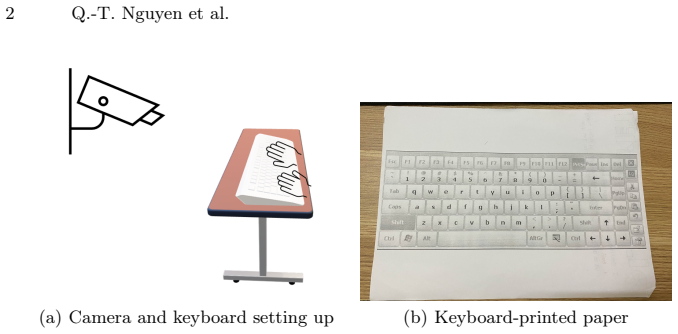
A printed paper keyboard and ordinary webcam enable touch typing by analyzing fingernail color.
A machine-rendered reading of the paper's core claim, the machinery that carries it, and where it could break.
Core claim
The authors claim that keyboard region identification plus fingernail-color touch detection together allow practical virtual-keyboard interaction on a printed paper layout using only an everyday camera in standard environments.
What carries the argument
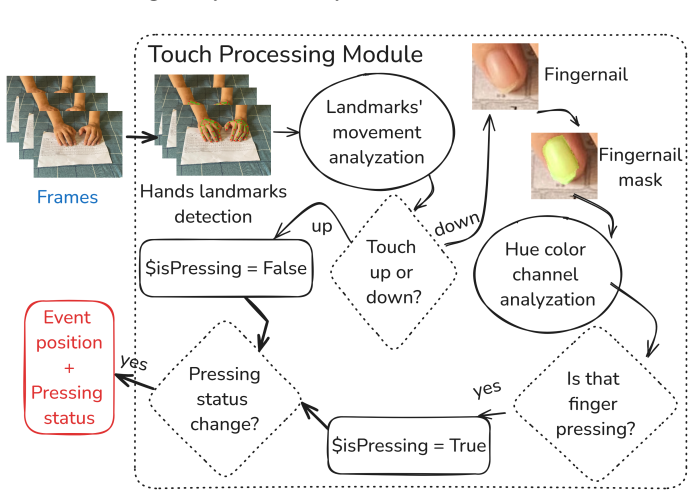
Touch detection algorithm that registers keystrokes by analyzing the color of the user's fingernail.
If this is right
- Keyboard and keystroke detection become feasible for practical applications without complex setups.
- The approach works in ordinary environments using only modern computer vision on a standard camera.
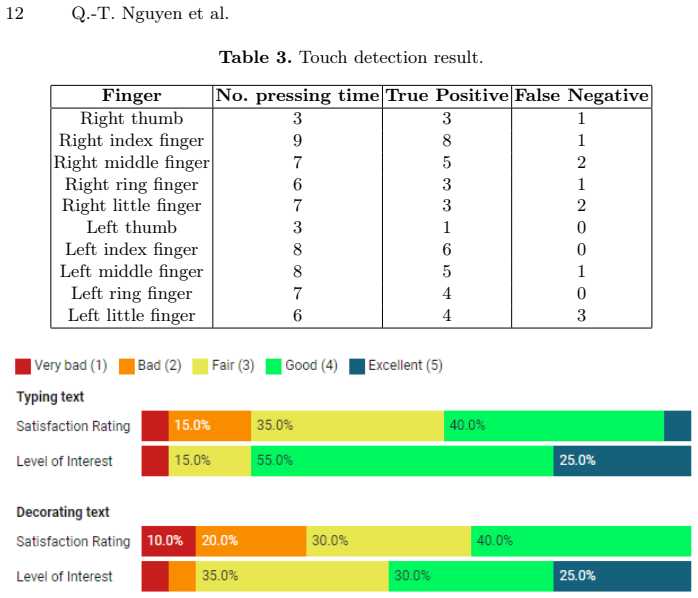
- Users in a study found the printed-paper system interesting.
- No special lighting or calibration steps are required for the described pipeline.
Where Pith is reading between the lines
- The same fingernail-color cue could be tested on other flat printed controls such as number pads or menus.
- Accuracy may drop when nail polish, gloves, or very dark skin tones alter the color signal the algorithm expects.
- Running the pipeline on a smartphone camera would test whether the method supports fully mobile, equipment-free typing.
- Adding a second cue such as fingertip shadow or motion could be compared against color-only detection to measure robustness gains.
Load-bearing premise
Fingernail color analysis alone can reliably detect touches across different users, skin tones, lighting conditions, and nail appearances without extra calibration or sensors.
What would settle it
A controlled test in which participants with varied skin tones type on the system under changing room lights and the detection error rate is measured without any per-user adjustment.
Figures
read the original abstract
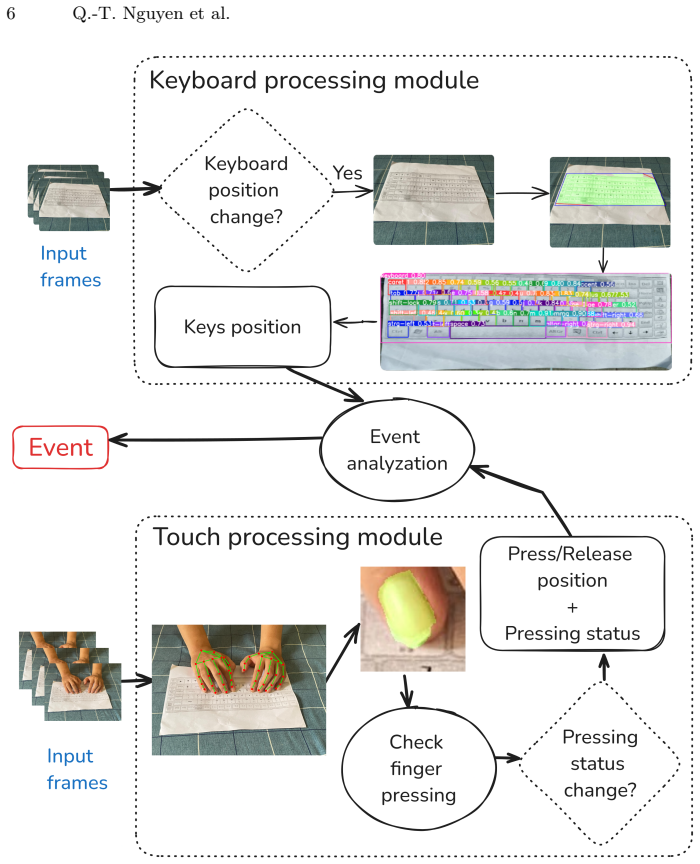
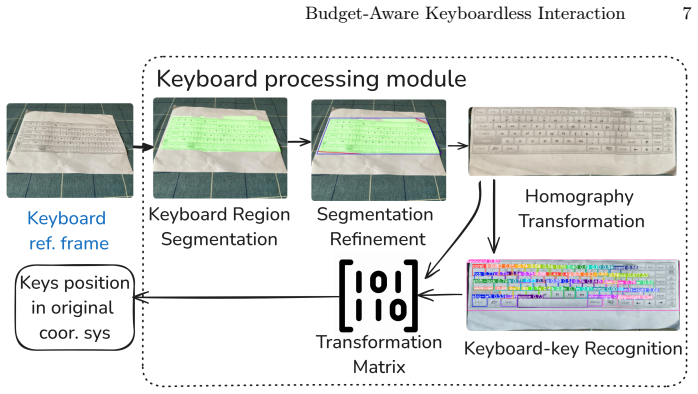
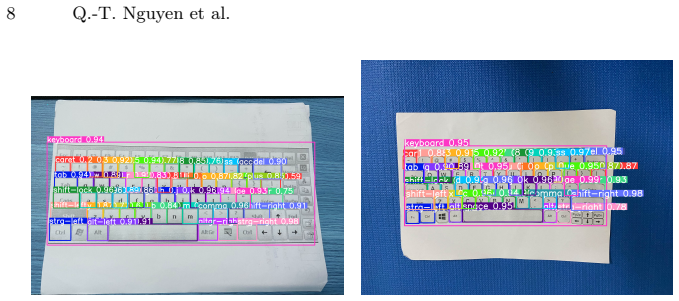
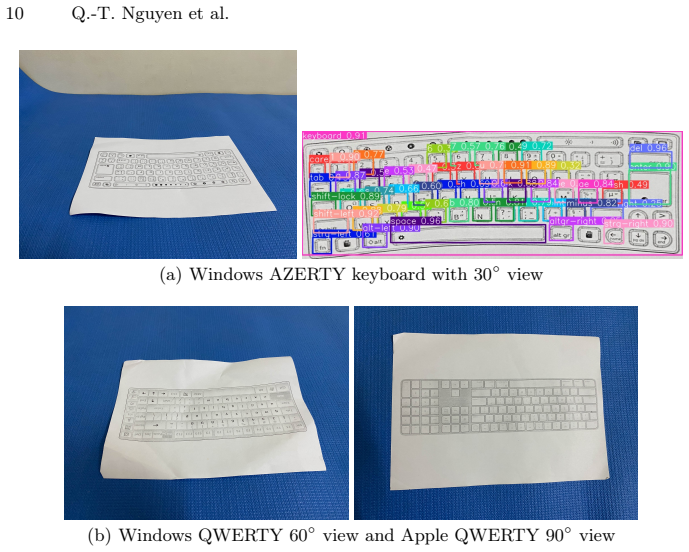
Interacting with computers typically relies on traditional input devices such as keyboards, mice, and monitors, which can be cumbersome for users seeking greater mobility. Virtual keyboards have been explored to address these limitations, but they often involve complex setups or expensive equipment. This paper proposes a novel virtual keyboard system that leverages only a standard camera and a paper with a printed keyboard layout. Unlike previous methods requiring complex calibration or special lighting conditions, our approach can work on standard environment using modern computer vision technologies. Combining modern segmentation and detection models with traditional image processing algorithms, we efficiently identify the keyboard region. Touch detection is performed using an algorithm analyzing the color of the user's fingernail. Experiments demonstrated a promising results our proposed solution of keyboard and keystroke detection for practical applications. Participants attended our user study also found the proposed system interesting.
Editorial analysis
A structured set of objections, weighed in public.
Referee Report
Summary. The manuscript proposes a virtual keyboard system using only a standard camera and a printed paper keyboard layout. Keyboard region identification combines modern segmentation/detection models with traditional image processing algorithms. Touch detection is performed via an algorithm that analyzes the color of the user's fingernail. The authors claim the approach works in standard environments without complex calibration or special lighting, report 'promising results' from experiments, and note positive feedback from a user study.
Significance. If the central claims hold with supporting evidence, the work could contribute to low-cost, mobile HCI by enabling keyboard input with minimal hardware. The integration of modern CV techniques with simple image processing is a potential strength for practical deployment. However, the current lack of any quantitative evaluation, baselines, or robustness testing substantially limits assessment of its significance relative to existing virtual keyboard methods.
major comments (3)
- [Abstract] Abstract: The claim that 'Experiments demonstrated a promising results our proposed solution of keyboard and keystroke detection for practical applications' supplies no quantitative metrics (accuracy, error rates, latency), baselines, or method details. This directly undermines evaluation of the central claim that the system is practically applicable.
- [Method (touch detection)] Touch detection description: The method relies on 'an algorithm analyzing the color of the user's fingernail' with no details on color space, thresholds, handling of skin tone variation, lighting, nail polish, or viewing angle. This assumption is load-bearing for the 'standard environment' and 'no calibration' claims but receives no supporting evidence or testing.
- [User study / Experiments] User study: The statement that 'Participants attended our user study also found the proposed system interesting' provides no participant count, task details, quantitative measures, or comparison data, leaving the usability claim unsupported.
minor comments (2)
- [Abstract] Grammatical issues: 'a promising results' should be 'promising results'; the phrase 'our proposed solution of keyboard and keystroke detection' is unclear and should be rephrased for precision.
- [Introduction / Related Work] The manuscript would benefit from explicit comparison to prior virtual keyboard work (e.g., camera-based or projection methods) and a clearer statement of contributions.
Simulated Author's Rebuttal
We thank the referee for the constructive feedback, which identifies key areas where additional detail and evidence are needed to support the manuscript's claims. We address each major comment below.
read point-by-point responses
-
Referee: [Abstract] Abstract: The claim that 'Experiments demonstrated a promising results our proposed solution of keyboard and keystroke detection for practical applications' supplies no quantitative metrics (accuracy, error rates, latency), baselines, or method details. This directly undermines evaluation of the central claim that the system is practically applicable.
Authors: We agree that the abstract lacks quantitative metrics and supporting details, which weakens the central claim. In the revised manuscript, we will update the abstract to report specific experimental outcomes (e.g., detection accuracy, error rates, and latency where measured) and briefly note method elements or baselines if used. If certain metrics were not collected, we will qualify or remove the unsubstantiated phrasing. revision: yes
-
Referee: [Method (touch detection)] Touch detection description: The method relies on 'an algorithm analyzing the color of the user's fingernail' with no details on color space, thresholds, handling of skin tone variation, lighting, nail polish, or viewing angle. This assumption is load-bearing for the 'standard environment' and 'no calibration' claims but receives no supporting evidence or testing.
Authors: We agree that the touch detection section requires substantially more detail to substantiate the no-calibration and standard-environment claims. The revised manuscript will expand this description to specify the color space, exact thresholds or decision rules, and any approaches taken (or not taken) for skin tone variation, lighting changes, nail polish, and viewing angle. We will also report any robustness testing performed or explicitly note limitations. revision: yes
-
Referee: [User study / Experiments] User study: The statement that 'Participants attended our user study also found the proposed system interesting' provides no participant count, task details, quantitative measures, or comparison data, leaving the usability claim unsupported.
Authors: We agree that the user study reporting is insufficient to support the usability claim. In the revision, we will add the number of participants, detailed task descriptions, any quantitative measures collected (e.g., task times or error rates), and clarify whether comparisons were performed. If the study was informal or qualitative only, we will adjust the claims to match the available evidence. revision: yes
Circularity Check
No circularity: purely applicative system description with no derivations or self-citations
full rationale
The paper contains no equations, parameters, derivations, or predictions. It describes an application that combines existing segmentation/detection models with image processing and a fingernail-color algorithm for touch detection. No load-bearing step reduces to its own inputs by construction, no fitted inputs are relabeled as predictions, and no self-citations are invoked to justify uniqueness or ansatzes. The central claims rest on the described combination of standard CV techniques rather than any internal tautology. This is the expected non-finding for an implementation-focused paper without mathematical structure.
Axiom & Free-Parameter Ledger
Reference graph
Works this paper leans on
-
[1]
In: 2010 3rd International Conference on Emerging Trends in Engineering and Technology
Adajania, Y., Gosalia, J., Kanade, A., Mehta, H., Shekokar, N.: Virtual key- board using shadow analysis. In: 2010 3rd International Conference on Emerging Trends in Engineering and Technology. pp. 163–165 (2010). https://doi.org/10. 1109/ICETET.2010.115
2010
-
[2]
Agarwal, A., Izadi, S., Chandraker, M., Blake, A.: High precision multi-touch sens- ing on surfaces using overhead cameras. In: Second Annual IEEE International Workshop on Horizontal Interactive Human-Computer Systems (TABLETOP’07). pp. 197–200 (2007). https://doi.org/10.1109/TABLETOP.2007.29
-
[3]
The Visual Com- puter1, 112–117 (August 1985)
Aggarwal, A., Yap, C.: Minimum area circumscribing polygons. The Visual Com- puter1, 112–117 (August 1985). https://doi.org/10.1007/BF01898354
-
[4]
Babbar, G., Bajaj, R.: Homography theories used for image mapping: A review. In: 2022 10th International Conference on Reliability, Infocom Technologies and Optimization (Trends and Future Directions) (ICRITO). pp. 1–5 (2022). https: //doi.org/10.1109/ICRITO56286.2022.9964762
-
[5]
In: Proceedings of the British Machine Vision Con- ference
Du, H., Oggier, T., Lustenberger, F., Charbon, E.: A virtual keyboard based on true-3d optical ranging. In: Proceedings of the British Machine Vision Con- ference. pp. 27.1–27.10. BMVA Press (2005), https://bmva-archive.org.uk/bmvc/ 2005/papers/paper-151.html
2005
-
[6]
Fu, X., Xi, M.: Typing on any surface: Real-time keystroke detection in augmented reality. In: 2024 IEEE International Conference on Artificial Intelligence and eX- tended and Virtual Reality (AIxVR). pp. 350–354 (2024). https://doi.org/10.1109/ AIxVR59861.2024.00060
arXiv 2024
-
[7]
Gu, Y., Yu, C., Li, Z., Li, Z., Wei, X., Shi, Y.: Qwertyring: Text entry on physical surfaces using a ring. Proc. ACM Interact. Mob. Wearable Ubiquitous Technol. 4(4) (dec 2020). https://doi.org/10.1145/3432204
-
[8]
Jocher, G., Chaurasia, A., Qiu, J.: Ultralytics yolov8 (2023), https://github.com/ ultralytics/ultralytics
2023
-
[9]
In: Blanc-Talon, J., Philips, W., Popescu, D., Scheunders, P
Katz, I., Gabayan, K., Aghajan, H.: A multi-touch surface using multiple cam- eras. In: Blanc-Talon, J., Philips, W., Popescu, D., Scheunders, P. (eds.) Advanced Concepts for Intelligent Vision Systems. pp. 97–108. Springer Berlin Heidelberg, Berlin, Heidelberg (2007). https://doi.org/10.1007/978-3-540-74607-2_9
-
[10]
In: Fleet, D., Pajdla, T., Schiele, B., Tuytelaars, T
Lin, T.Y., Maire, M., Belongie, S., Hays, J., Perona, P., Ramanan, D., Dollár, P., Zitnick, C.L.: Microsoft coco: Common objects in context. In: Fleet, D., Pajdla, T., Schiele, B., Tuytelaars, T. (eds.) Computer Vision – ECCV 2014. pp. 740–755. Springer International Publishing, Cham (2014) 14 Q.-T. Nguyen et al
2014
-
[11]
CoRR abs/1906.08172(2019), http://arxiv.org/abs/1906.08172
Lugaresi, C., Tang, J., Nash, H., McClanahan, C., Uboweja, E., Hays, M., Zhang, F., Chang, C., Yong, M.G., Lee, J., Chang, W., Hua, W., Georg, M., Grund- mann, M.: Mediapipe: A framework for building perception pipelines. CoRR abs/1906.08172(2019), http://arxiv.org/abs/1906.08172
Pith/arXiv arXiv 1906
-
[12]
In: Indulska, J., Patterson, D.J., Rodden, T., Ott, M
Marshall, J., Pridmore, T., Pound, M., Benford, S., Koleva, B.: Pressing the flesh: Sensing multiple touch and finger pressure on arbitrary surfaces. In: Indulska, J., Patterson, D.J., Rodden, T., Ott, M. (eds.) Pervasive Computing. pp. 38–55. Springer Berlin Heidelberg, Berlin, Heidelberg (2008). https://doi.org/10.1007/ 978-3-540-79576-6_3
2008
-
[13]
com/mie-university/keyboard-v2itg, visited on 2024-06-14
Mie-University: Keyboard dataset (February 2023), https://universe.roboflow. com/mie-university/keyboard-v2itg, visited on 2024-06-14
2023
-
[14]
In: 2012 IEEE 27th Convention of Electrical and Electronics Engineers in Israel
Posner, E., Starzicki, N., Katz, E.: A single camera based floating virtual key- board with improved touch detection. In: 2012 IEEE 27th Convention of Electrical and Electronics Engineers in Israel. pp. 1–5 (2012). https://doi.org/10.1109/EEEI. 2012.6377072
-
[15]
Projects,P.:nailssegmentationdataset(apr2024),https://universe.roboflow.com/ personal-projects-jfbag/nails_segmentation, visited on 2024-08-06
2024
-
[16]
IEEE Transactions on Mobile Computing22(8), 4807–4821 (2023)
Shatilov, K.A., Kwon, Y.D., Lee, L.H., Chatzopoulos, D., Hui, P.: Myokey: Inertial motion sensing and gesture-based qwerty keyboard for extended realities. IEEE Transactions on Mobile Computing22(8), 4807–4821 (2023). https://doi.org/10. 1109/TMC.2022.3156939
arXiv 2023
-
[17]
In: Lew, M., Sebe, N., Huang, T.S., Bakker, E.M
Song, P., Winkler, S., Gilani, S.O., Zhou, Z.: Vision-based projected tabletop inter- face for finger interactions. In: Lew, M., Sebe, N., Huang, T.S., Bakker, E.M. (eds.) Human–Computer Interaction. pp. 49–58. Springer Berlin Heidelberg, Berlin, Hei- delberg (2007). https://doi.org/10.1007/978-3-540-75773-3_6
-
[18]
In: Proceedings of the 2022 CHI Conference on Human Factors in Computing Systems
Streli, P., Jiang, J., Fender, A.R., Meier, M., Romat, H., Holz, C.: Taptype: Ten- finger text entry on everyday surfaces via bayesian inference. In: Proceedings of the 2022 CHI Conference on Human Factors in Computing Systems. CHI ’22, Association for Computing Machinery, New York, NY, USA (2022). https://doi. org/10.1145/3491102.3501878
-
[19]
roboflow.com/trcproject/e-waste-detection-model, visited on 2024-06-14
TRCProject: E-waste detection model dataset (September 2023), https://universe. roboflow.com/trcproject/e-waste-detection-model, visited on 2024-06-14
2023
-
[20]
In: 2006 IEEE International Conference on Sys- tems, Man and Cybernetics
Yamamoto, K., Ikeda, S., Tsuji, T., Ishii, I.: A real-time finger-tapping interface using high-speed vision system. In: 2006 IEEE International Conference on Sys- tems, Man and Cybernetics. vol. 1, pp. 296–303 (2006). https://doi.org/10.1109/ ICSMC.2006.384398
arXiv 2006
-
[21]
Pixel Processor Arrays For Low Latency Gaze Estimation
Yıldıran, N.F., Meteriz-Yildiran, Ü., Mohaisen, D.: Airtype: An air-tapping key- board for augmented reality environments. In: 2022 IEEE Conference on Virtual Reality and 3D User Interfaces Abstracts and Workshops (VRW). pp. 676–677 (2022). https://doi.org/10.1109/VRW55335.2022.00189
discussion (0)
Sign in with ORCID, Apple, or X to comment. Anyone can read and Pith papers without signing in.