The ²²⁹Th Isomer: Nuclear Structure, Clocks, and Tests of Fundamental Physics
Pith reviewed 2026-06-26 02:14 UTC · model grok-4.3
The pith
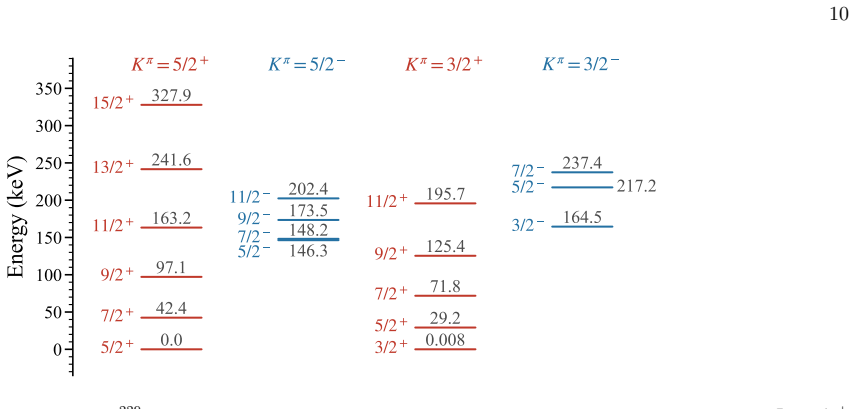
The 8 eV isomer in 229Th arises from near-degenerate 5/2+[633] and 3/2+[631] neutron Nilsson states mixed by Coriolis and octupole effects.
A machine-rendered reading of the paper's core claim, the machinery that carries it, and where it could break.
Core claim
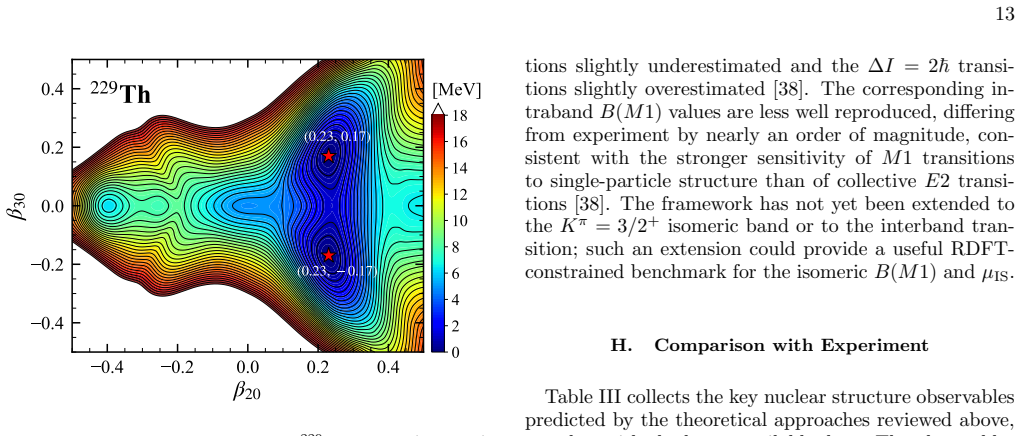
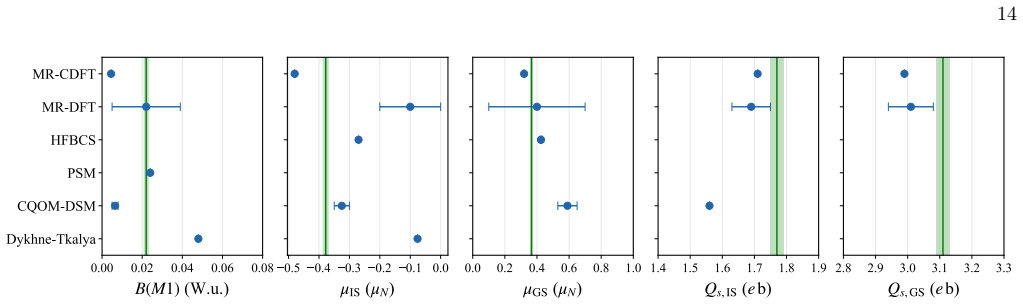
The central claim is that the near-degeneracy of the 5/2+[633] and 3/2+[631] neutron Nilsson configurations, together with Coriolis mixing and octupole correlations, underlies the anomalously low transition energy and its electromagnetic properties. Comparisons among phenomenological and microscopic models identify octupole correlations as the common structural ingredient, while magnetic moments and transition strengths remain sensitive tests of the calculated wave functions.
What carries the argument
The near-degeneracy of the 5/2+[633] and 3/2+[631] neutron Nilsson configurations together with Coriolis mixing and octupole correlations.
If this is right
- The transition frequency lies in the vacuum-ultraviolet and is directly accessible to laser spectroscopy.
- Trapped-ion, highly charged ion, and solid-state platforms can support feedback-loop nuclear-clock operation with nuclear-state manipulation and readout.
- The MeV-scale nuclear contributions that nearly cancel to yield an eV-scale gap increase sensitivity to variations of fundamental constants.
- Signatures of ultralight dark matter, CP-violating interactions, and Lorentz-invariance violation become detectable through the same cancellation.
- Nuclear quantum technologies become feasible through the identified mechanisms for state control.
Where Pith is reading between the lines
- If the Nilsson-orbital picture holds, other nuclei exhibiting similar near-degeneracies could host comparably low-energy isomers worth targeted searches.
- The cancellation mechanism might allow the isomer to register effects from new physics at energy scales inaccessible to ordinary atomic clocks.
- A working solid-state nuclear clock could provide a compact, portable reference independent of electronic transitions.
- Refined calculations of the same configurations could predict measurable properties in neighboring isotopes for immediate experimental checks.
Load-bearing premise
That comparisons among phenomenological and microscopic models can reliably single out octupole correlations as the decisive ingredient even though magnetic moments and transition strengths stay sensitive to wave-function details.
What would settle it
A measured magnetic moment or transition strength that lies outside the range of all models that include octupole correlations would falsify the proposed structural origin of the low energy.
Figures
read the original abstract
The $^{229}$Th nucleus possesses an isomeric state at an excitation energy of $\sim 8$ eV, the lowest known nuclear transition energy, placing its frequency in the vacuum-ultraviolet range and making it directly accessible to laser spectroscopy. In this review, we discuss the $^{229}$Th isomer from three connected perspectives: experimental spectroscopy and clock development, nuclear structure theory, and applications to precision tests of fundamental physics. We first trace the experimental progress from indirect $\gamma$-ray energy inference to resonant laser excitation, absolute frequency comparison with an atomic clock, and feedback-loop operation of a solid-state nuclear clock, and discuss trapped-ion, highly charged ion, and solid-state platforms together with mechanisms for nuclear-state manipulation and readout. We then review, from the nuclear-structure perspective, how the near-degeneracy of the $5/2^+[633]$ and $3/2^+[631]$ neutron Nilsson configurations, together with Coriolis mixing and octupole correlations, underlies the anomalously low transition energy and its electromagnetic properties. Comparisons among different phenomenological and microscopic models show that octupole correlations are a common structural ingredient, while magnetic moments and transition strengths remain sensitive tests of the calculated wave functions. Finally, we discuss how the near-cancellation of MeV-scale nuclear contributions into an eV-scale transition can enhance sensitivity to variations of fundamental constants, signatures of ultralight dark matter, CP-violating interactions, Lorentz-invariance violation, and possible nuclear quantum technologies.
Editorial analysis
A structured set of objections, weighed in public.
Referee Report
Summary. This review article on the 229Th isomer summarizes experimental progress from indirect gamma-ray measurements to resonant laser excitation, absolute frequency metrology, and solid-state nuclear clock operation across trapped-ion, highly charged ion, and solid-state platforms. It presents the nuclear-structure consensus that the ~8 eV transition arises from the near-degeneracy of the 5/2+[633] and 3/2+[631] Nilsson neutron orbitals together with Coriolis mixing and octupole correlations, noting that model comparisons identify octupole effects as common while magnetic moments and transition strengths remain sensitive to wave-function details. The review closes with applications to tests of fundamental-constant variations, ultralight dark matter, CP violation, Lorentz invariance, and nuclear quantum technologies.
Significance. As a synthesis of existing literature rather than a source of new derivations or data, the manuscript provides a coherent, balanced overview of an active interdisciplinary field. The explicit acknowledgment in the abstract that observables beyond the transition energy remain model-sensitive strengthens its utility as a reference. No new parameter-free predictions or machine-checked results are introduced, but the review correctly frames the structural picture as the current consensus while highlighting open experimental and theoretical challenges.
minor comments (2)
- [Abstract] Abstract: the statement that 'comparisons among different phenomenological and microscopic models show that octupole correlations are a common structural ingredient' would benefit from a parenthetical list of the specific models referenced (e.g., in the nuclear-structure section) to allow readers to trace the claim without consulting the full reference list.
- [nuclear structure section] The review correctly notes remaining sensitivity of magnetic moments and transition strengths, but a short table or bullet list in the nuclear-structure section comparing predicted versus measured values across the cited models would improve clarity for non-specialist readers.
Simulated Author's Rebuttal
We thank the referee for their positive assessment of the manuscript, accurate summary of its scope, and recommendation to accept. The review is intended as a synthesis of the field rather than a source of new data or derivations, and we are pleased that this framing is recognized.
Circularity Check
No significant circularity: review article summarizing external literature
full rationale
This is a review paper that traces experimental progress and summarizes nuclear-structure results from the existing literature without performing or presenting any new primary calculations, fits, or derivations. The central claim about near-degeneracy of Nilsson orbitals plus Coriolis mixing and octupole correlations is explicitly presented as the consensus picture drawn from multiple phenomenological and microscopic models in prior work. No equations, parameters, or predictions are introduced that reduce by construction to the paper's own inputs, and no self-citation chain is used to justify a uniqueness theorem or ansatz. The manuscript is therefore self-contained against external benchmarks and receives the default non-circularity finding.
Axiom & Free-Parameter Ledger
Reference graph
Works this paper leans on
-
[1]
G. D. Dracoulis, P. M. Walker, and F. G. Kondev, Rep. Prog. Phys.79, 076301 (2016)
2016
-
[2]
Walker and Z
P. Walker and Z. Podoly´ ak, Phys. Scr.95, 044004 (2020)
2020
-
[3]
G. W. Misch, T. M. Sprouse, M. R. Mumpower, A. J. Couture, C. L. Fryer, B. S. Meyer, and Y. Sun, Symme- try13, 1831 (2021)
2021
-
[4]
F. G. Kondev, M. Wang, W. J. Huang, S. Naimi, and G. Audi, Chin. Phys. C45, 030001 (2021)
2021
-
[5]
S. Garg, B. Maheshwari, B. Singh, Y. Sun, A. Goel, and A. K. Jain, At. Data Nucl. Data Tables150, 101546 (2023)
2023
-
[6]
Aprahamian and Y
A. Aprahamian and Y. Sun, Nature Phys.1, 81 (2005)
2005
-
[7]
Seiferle, L
B. Seiferle, L. von der Wense, P. V. Bilous, I. Amers- dorffer, C. Lemell, F. Libisch, S. Stellmer, T. Schumm, C. E. D¨ ullmann, A. P´ alffy, and P. G. Thirolf, Nature 573, 243 (2019)
2019
-
[8]
U. C. Perera, H. W. T. Morgan, E. R. Hudson, and A. Derevianko, Phys. Rev. Lett.135, 123001 (2025)
2025
-
[9]
E. V. Tkalya, JETP Lett.55, 211 (1992)
1992
-
[10]
Peik and C
E. Peik and C. Tamm, Europhys. Lett.61, 181 (2003)
2003
-
[11]
Sikorsky, J
T. Sikorsky, J. Geist, D. Hengstler, S. Kempf, L. Gastaldo, C. Enss, C. Mokry, J. Runke, C. E. D¨ ullmann, P. Wobrauschek, K. Beeks, V. Rosecker, J. H. Sterba, G. Kazakov, T. Schumm, and A. Fleis- chmann, Phys. Rev. Lett.125, 142503 (2020)
2020
-
[12]
C. J. Campbell, A. G. Radnaev, A. Kuzmich, V. A. Dzuba, V. V. Flambaum, and A. Derevianko, Phys. Rev. Lett.108, 120802 (2012)
2012
-
[13]
E. Peik, T. Schumm, M. S. Safronova, A. P´ alffy, J. Weit- enberg, and P. G. Thirolf, Quantum Sci. Technol.6, 034002 (2021)
2021
-
[14]
L. A. Kroger and C. W. Reich, Nucl. Phys. A259, 29 (1976)
1976
-
[15]
B. R. Beck, J. A. Becker, P. Beiersdorfer, G. V. Brown, K. J. Moody, J. B. Wilhelmy, F. S. Porter, C. A. Kil- bourne, and R. L. Kelley, Phys. Rev. Lett.98, 142501 (2007)
2007
-
[16]
Tiedau, M
J. Tiedau, M. V. Okhapkin, K. Zhang, J. Thielk- ing, G. Zitzer, E. Peik, F. Schaden, T. Pronebner, I. Morawetz, L. T. De Col, F. Schneider, A. Leitner, M. Pressler, G. A. Kazakov, K. Beeks, T. Sikorsky, and T. Schumm, Phys. Rev. Lett.132, 182501 (2024)
2024
-
[17]
Elwell, C
R. Elwell, C. Schneider, J. Jeet, J. E. S. Terhune, H. W. T. Morgan, A. N. Alexandrova, H. B. Tran Tan, A. Derevianko, and E. R. Hudson, Phys. Rev. Lett.133, 013201 (2024)
2024
-
[18]
Zhang, L
C. Zhang, L. von der Wense, J. F. Doyle, J. S. Higgins, T. Ooi, H. U. Friebel, J. Ye, R. Elwell, J. E. S. Ter- hune, H. W. T. Morgan, A. N. Alexandrova, H. B. Tran Tan, A. Derevianko, and E. R. Hudson, Nature636, 603 (2024)
2024
-
[19]
Zhang, T
C. Zhang, T. Ooi, J. S. Higgins, J. F. Doyle, L. von der Wense, K. Beeks, A. Leitner, G. A. Kazakov, P. Li, P. G. Thirolf, T. Schumm, and J. Ye, Nature633, 63 (2024)
2024
-
[20]
W. G. Rellergert, D. DeMille, R. R. Greco, M. P. Hehlen, J. R. Torgerson, and E. R. Hudson, Phys. Rev. Lett.104, 200802 (2010)
2010
-
[21]
von der Wense, B
L. von der Wense, B. Seiferle, S. Stellmer, J. Weiten- berg, G. Kazakov, A. P´ alffy, and P. G. Thirolf, Phys. Rev. Lett.119, 132503 (2017)
2017
-
[22]
G. A. Kazakov, A. N. Litvinov, V. I. Romanenko, L. P. Yatsenko, A. V. Romanenko, M. Schreitl, G. Winkler, and T. Schumm, New J. Phys.14, 083019 (2012)
2012
-
[23]
W. Wang, F. Zou, S. Fritzsche, and Y. Li, Phys. Rev. Lett.133, 223001 (2024)
2024
-
[24]
Hiraki, K
T. Hiraki, K. Okai, M. Bartokos, K. Beeks, H. Fuji- moto, Y. Fukunaga, H. Haba, Y. Kasamatsu, S. Ki- tao, A. Leitner, T. Masuda, M. Guan, N. Nagasawa, R. Ogake, M. Pimon, M. Pressler, N. Sasao, F. Schaden, T. Schumm, M. Seto, Y. Shigekawa, K. Shimizu, T. Sikorsky, K. Tamasaku, S. Takatori, T. Watanabe, A. Yamaguchi, Y. Yoda, A. Yoshimi, and K. Yoshimura, ...
2024
-
[25]
Schaden, T
F. Schaden, T. Riebner, I. Morawetz, L. T. De Col, G. A. Kazakov, K. Beeks, T. Sikorsky, T. Schumm, K. Zhang, V. Lal, G. Zitzer, J. Tiedau, M. V. Okhapkin, and E. Peik, Phys. Rev. Res.7, L022036 (2025)
2025
-
[26]
L. T. De Col, T. Riebner, I. Morawetz, F. Schnei- der, N. Sempelmann, J. Schlachet-L´ epinay, F. Schaden, M. Bartokos, G. A. Kazakov, K. Beeks, B. Gerstenecker, M. Pimon, S. Lahs, A. Hellerschmied, T. Lercher, J. Premper, A. Niessner, M. Matus, H. Denker, 20 M. Cizek, O. Cip, V. Lal, G. Zitzer, V. Petrov, J. Tiedau, M. V. Okhapkin, E. Peik, and T. Schumm,...
Pith/arXiv arXiv 2026
-
[27]
B. Huang, G. Yan, Q. Xiao, W. Bu, Z. Zhang, C. Zhao, C. Yan, Z.-A. Chen, P. Zhang, G. Penyazkov, Z. Zhan, L. Yan, Y. Wang, L. Li, S. Li, X. Qian, X. Liu, Q. He, T. Sun, H. Tian, B. Lu, N. Ma, J. Li, Y. Wu, Q. Gong, Y. Li, H. Shi, X. Li, L. Ma, S. Zhu, Y. Mo, J. Lin, L. You, Y. Lin, X. Zhang, Y. Hang, L. Su, and S. Ding, A nuclear clock based on 229th (202...
Pith/arXiv arXiv 2026
-
[28]
B. R. Mottelson and S. G. Nilsson, Phys. Rev.99, 1615 (1955)
1955
-
[29]
Barci, G
V. Barci, G. Ardisson, G. Barci-Funel, B. Weiss, O. El Samad, and R. K. Sheline, Phys. Rev. C68, 034329 (2003)
2003
-
[30]
A. M. Dykhne and E. V. Tkalya, J. Exp. Theor. Phys. Lett.67, 251 (1998)
1998
-
[31]
P. A. Butler and W. Nazarewicz, Rev. Mod. Phys.68, 349 (1996)
1996
-
[32]
Minkov and A
N. Minkov and A. P´ alffy, Phys. Rev. Lett.118, 212501 (2017)
2017
-
[33]
Minkov and A
N. Minkov and A. P´ alffy, Phys. Rev. Lett.122, 162502 (2019)
2019
-
[34]
Chen, L.-J
Z.-R. Chen, L.-J. Wang, and Y. Wu, Phys. Lett. B869, 139858 (2025)
2025
-
[35]
Minkov, A
N. Minkov, A. P´ alffy, P. Quentin, and L. Bonneau, Phys. Rev. C110, 034327 (2024)
2024
-
[36]
A. Restrepo-Giraldo, J. Dobaczewski, J. Bonnard, and X. Sun, Radiative decay and electromagnetic mo- ments in 229th determined within nuclear DFT (2026), arXiv:2602.02429 [nucl-th]
Pith/arXiv arXiv 2026
-
[37]
E. F. Zhou and J. M. Yao, Microscopic study of low- lying states in odd-mass nuclei for atomic electric dipole moment searches (2025), arXiv:2511.05984 [nucl-th]
arXiv 2025
-
[38]
Wang and P.-W
Y.-Y. Wang and P.-W. Zhao, Chin. Phys. B35, 020603 (2026)
2026
-
[39]
V. V. Flambaum, Phys. Rev. Lett.97, 092502 (2006)
2006
-
[40]
Fuchs, F
E. Fuchs, F. Kirk, E. Madge, C. Paranjape, E. Peik, G. Perez, W. Ratzinger, and J. Tiedau, Phys. Rev. X 15, 021055 (2025)
2025
-
[41]
Caputo, D
A. Caputo, D. Gazit, H. W. Hammer, J. Kopp, G. Paz, G. Perez, and K. Springmann, Phys. Rev. C112, L031302 (2025)
2025
-
[42]
V. V. Flambaum, Phys. Rev. C99, 035501 (2019)
2019
-
[43]
V. V. Flambaum, Phys. Rev. Lett.117, 072501 (2016)
2016
-
[44]
V. A. Dzuba and V. V. Flambaum, Phys. Rev. A111, 053109 (2025)
2025
-
[45]
W. Wang, K. Zhang, K.-M. Xu, and S.-G. Zhou, Hyperfine-resolved laser excitation and detection of nuclear isomer in trapped 229th3+ ions (2026), arXiv:2604.27614 [physics.atom-ph]
Pith/arXiv arXiv 2026
-
[46]
S.-C. Yu, X. Hua, X. Tong, C.-B. Li, and L. She, Chin. Phys. Lett.42, 120302 (2025)
2025
-
[47]
J. Wang, H. Miao, S. Ding, and D. E. Liu, Direct nuclear-level qubits using trapped th-229 ions: A plat- form for entanglement and universal quantum informa- tion processing (2025), arXiv:2508.10626 [quant-ph]
arXiv 2025
-
[48]
W.-T. Gan, Z. Li, C. Wang, X. Hua, and X. Tong, Chin. Phys. B35, 023703 (2026)
2026
-
[49]
C.-C. Zhao, L. Li, S.-M. Li, Q.-R. Gong, P.-X. Zhang, Y. Hang, L.-S. Ma, and S.-N. Zhu, Chin. Phys. B35, 020602 (2026)
2026
-
[50]
Yu, C.-B
S.-C. Yu, C.-B. Li, and L. She, Chin. Phys. B35, 023701 (2026)
2026
-
[51]
D. G. Burke, P. E. Garrett, T. Qu, and R. A. Naumann, Phys. Rev. C42, R499 (1990)
1990
-
[52]
Von Der Wense, B
L. Von Der Wense, B. Seiferle, M. Laatiaoui, J. B. Neu- mayr, H.-J. Maier, H.-F. Wirth, C. Mokry, J. Runke, K. Eberhardt, C. E. D¨ ullmann, N. G. Trautmann, and P. G. Thirolf, Nature533, 47 (2016)
2016
-
[53]
Yamaguchi, Y
A. Yamaguchi, Y. Shigekawa, H. Haba, H. Kikunaga, K. Shirasaki, M. Wada, and H. Katori, Nature629, 62 (2024)
2024
-
[54]
Ruchowska, W
E. Ruchowska, W. A. P l´ ociennik, J. ˙Zylicz, H. Mach, J. Kvasil, A. Algora, N. Amzal, T. B¨ ack, M. J. G. Borge, R. Boutami, P. A. Butler, J. Cederk¨ all, B. Cederwall, B. Fogelberg, L. M. Fraile, H. O. U. Fynbo, E. Hagebø, P. Hoff, H. Gausemel, A. Jungclaus, R. Kaczarowski, A. Kerek, W. Kurcewicz, K. Lagergren, E. Nacher, B. Rubio, A. Syntfeld, O. Teng...
2006
-
[55]
Kraemer, J
S. Kraemer, J. Moens, M. Athanasakis-Kaklamanakis, S. Bara, K. Beeks, P. Chhetri, K. Chrysalidis, A. Claessens, T. E. Cocolios, J. G. M. Correia, H. Witte, R. Ferrer, S. Geldhof, R. Heinke, N. Hosseini, M. Huyse, U. Koster, Y. Kudryavtsev, M. Laatiaoui, R. Lica, G. Magchiels, V. Manea, C. Merckling, L. M. C. Pereira, S. Raeder, T. Schumm, S. Sels, P. G. T...
2023
-
[56]
Masuda, A
T. Masuda, A. Yoshimi, A. Fujieda, H. Fujimoto, H. Haba, H. Hara, T. Hiraki, H. Kaino, Y. Kasamatsu, S. Kitao, K. Konashi, Y. Miyamoto, K. Okai, S. Okubo, N. Sasao, M. Seto, T. Schumm, Y. Shigekawa, K. Suzuki, S. Stellmer, K. Tamasaku, S. Uetake, M. Watanabe, T. Watanabe, Y. Yasuda, A. Yam- aguchi, Y. Yoda, T. Yokokita, M. Yoshimura, and K. Yoshimura, Nat...
2019
-
[57]
Wang, Z.-R
Y. Wang, Z.-R. Xiao, H.-Z. Zhang, L.-Q. Hua, and X.-J. Liu, Chin. Phys. B35, 020601 (2026)
2026
-
[58]
H.-Y. Lan, D. Wu, M.-Z. Wang, Z.-Y. Chen, J.-F. Lv, Y.-H. Xia, Z.-N. Wang, W. Luo, X.-L. Xu, and X.-Q. Yan, Adv. Sci.13, e23384 (2026)
2026
-
[59]
Ahmad, J
I. Ahmad, J. E. Gindler, R. R. Betts, R. R. Chasman, and A. M. Friedman, Phys. Rev. Lett.49, 1758 (1982)
1982
-
[60]
R. G. Helmer and C. W. Reich, Phys. Rev. C49, 1845 (1994)
1994
-
[61]
G. M. Irwin and K. H. Kim, Phys. Rev. Lett.79, 990 (1997)
1997
-
[62]
R. W. Shaw, J. P. Young, S. P. Cooper, and O. F. Webb, Phys. Rev. Lett.82, 1109 (1999)
1999
-
[63]
X. Zhao, Y. N. Martinez de Escobar, R. Rundberg, E. M. Bond, A. Moody, and D. J. Vieira, Phys. Rev. Lett.109, 160801 (2012)
2012
-
[64]
Peik and K
E. Peik and K. Zimmermann, Phys. Rev. Lett.111, 018901 (2013)
2013
-
[65]
Thielking, M
J. Thielking, M. V. Okhapkin, P. G lowacki, D. M. Meier, L. Von Der Wense, B. Seiferle, C. E. D¨ ullmann, P. G. Thirolf, and E. Peik, Nature556, 321 (2018)
2018
-
[66]
Yamaguchi, H
A. Yamaguchi, H. Muramatsu, T. Hayashi, N. Yuasa, K. Nakamura, M. Takimoto, H. Haba, K. Konashi, M. Watanabe, H. Kikunaga, K. Maehata, N. Y. Ya- masaki, and K. Mitsuda, Phys. Rev. Lett.123, 222501 21 (2019)
2019
-
[67]
Y. Shigekawa, A. Yamaguchi, K. Tokoi, N. Sato, H. Kikunaga, K. Shirasaki, Y. Kasamatsu, M. Wada, and H. Haba, Nat. Phys. 10.1038/s41567-026-03251-1 (2026)
-
[68]
C. W. Reich and R. G. Helmer, Phys. Rev. Lett.64, 271 (1990)
1990
-
[69]
H. Ton, S. Roodbergen, J. Brasz, and J. Blok, Nucl. Phys. A155, 245 (1970)
1970
-
[70]
Gerstenkorn, P
S. Gerstenkorn, P. Luc, J. Verges, D. W. Englekemeir, J. E. Gindler, and F. S. Tomkins, J. Phys. France35, 483 (1974)
1974
-
[71]
C. E. Bemis, F. K. McGowan, J. Ford, J. L. C., W. T. Milner, R. L. Robinson, P. H. Stelson, G. A. Leander, and C. W. Reich, Phys. Scr.38, 657 (1988)
1988
-
[72]
C. J. Campbell, A. G. Radnaev, and A. Kuzmich, Phys. Rev. Lett.106, 223001 (2011)
2011
-
[73]
Seiferle, L
B. Seiferle, L. Von Der Wense, and P. G. Thirolf, Phys. Rev. Lett.118, 042501 (2017)
2017
-
[74]
Shigekawa, A
Y. Shigekawa, A. Yamaguchi, K. Suzuki, H. Haba, T. Hiraki, H. Kikunaga, T. Masuda, S. Nishimura, N. Sasao, A. Yoshimi, and K. Yoshimura, Phys. Rev. C104, 024306 (2021)
2021
-
[75]
J. C. Berengut, V. A. Dzuba, V. V. Flambaum, and S. G. Porsev, Phys. Rev. Lett.102, 210801 (2009)
2009
-
[76]
von der Wense and B
L. von der Wense and B. Seiferle, Eur. Phys. J. A56, 277 (2020)
2020
-
[77]
P. V. Bilous, H. Bekker, J. C. Berengut, B. Seiferle, L. von der Wense, P. G. Thirolf, T. Pfeifer, J. R. C. L´ opez-Urrutia, and A. P´ alffy, Phys. Rev. Lett.124, 192502 (2020)
2020
-
[78]
Zitzer, J
G. Zitzer, J. Tiedau, C. E. D¨ ullmann, M. V. Okhapkin, and E. Peik, Phys. Rev. A111, L050802 (2025)
2025
-
[79]
V. F. Strizhov and E. V. Tkalya, Sov. Phys. JETP72, 387 (1991)
1991
-
[80]
X. Ma, W. Q. Wen, Z. K. Huang, H. B. Wang, Y. J. Yuan, M. Wang, Z. Y. Sun, L. J. Mao, J. C. Yang, H. S. Xu, G. Q. Xiao, and W. L. Zhan, Phys. Scr.T166, 014012 (2015)
2015
discussion (0)
Sign in with ORCID, Apple, or X to comment. Anyone can read and Pith papers without signing in.