Floquet-Engineered Chern Insulator in two-dimensional d_(x²-y²)-Wave Altermagnets
Pith reviewed 2026-06-26 03:38 UTC · model grok-4.3
The pith
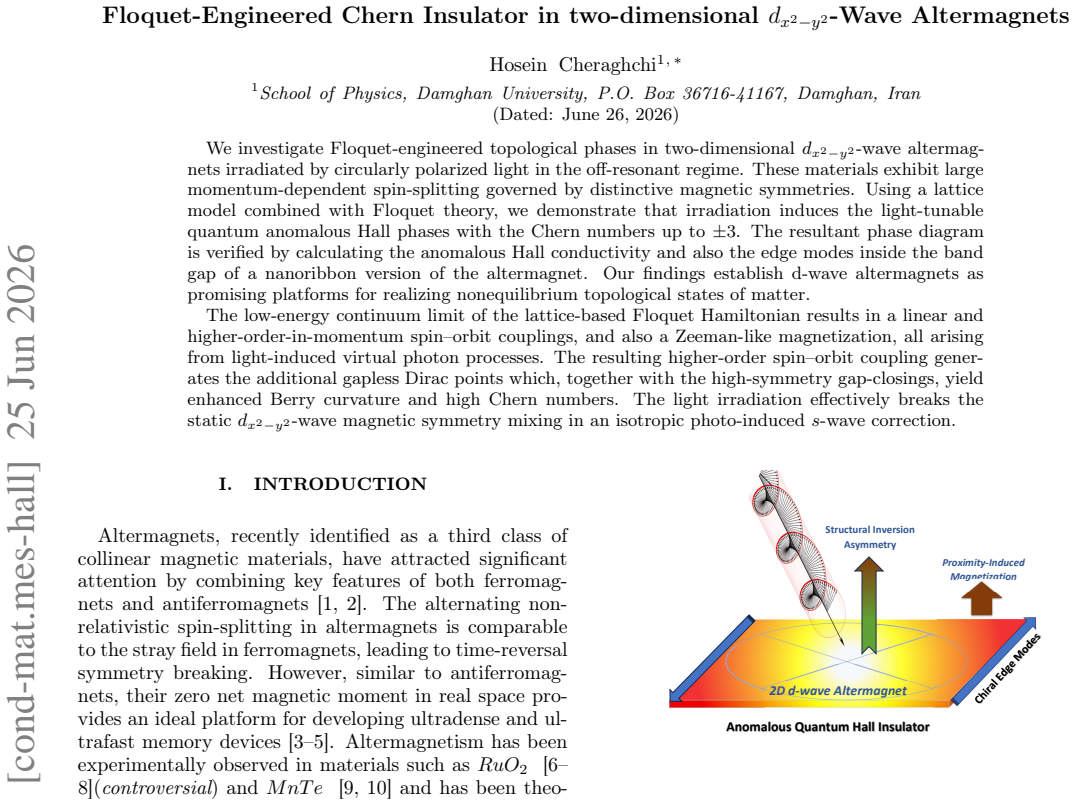
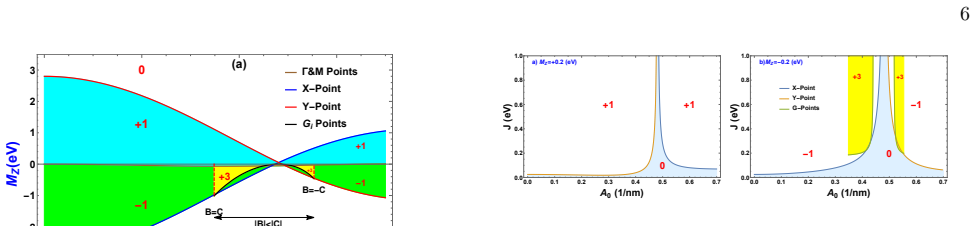
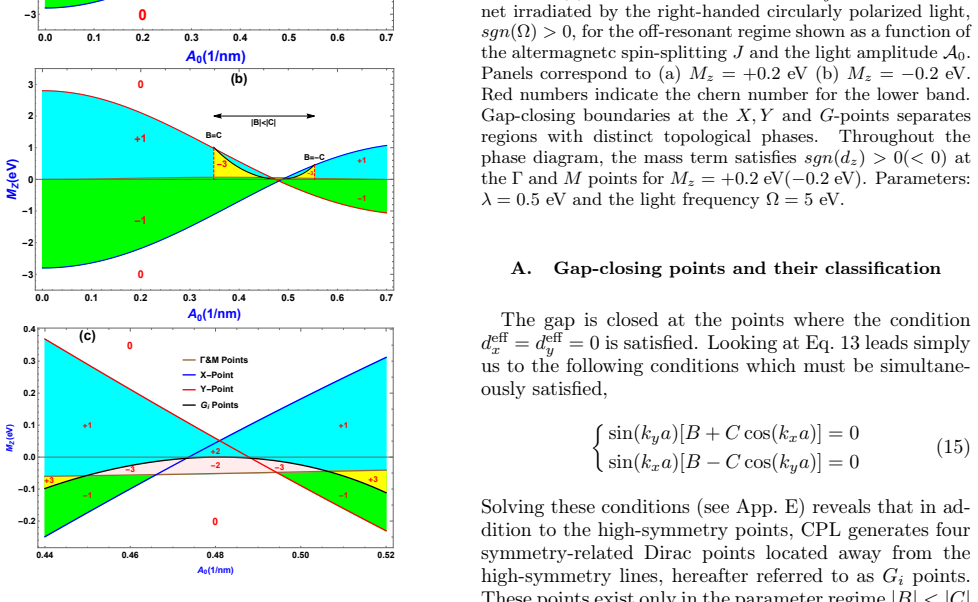
Irradiation with circularly polarized light induces quantum anomalous Hall phases with Chern numbers up to ±3 in two-dimensional d-wave altermagnets.
A machine-rendered reading of the paper's core claim, the machinery that carries it, and where it could break.
Core claim
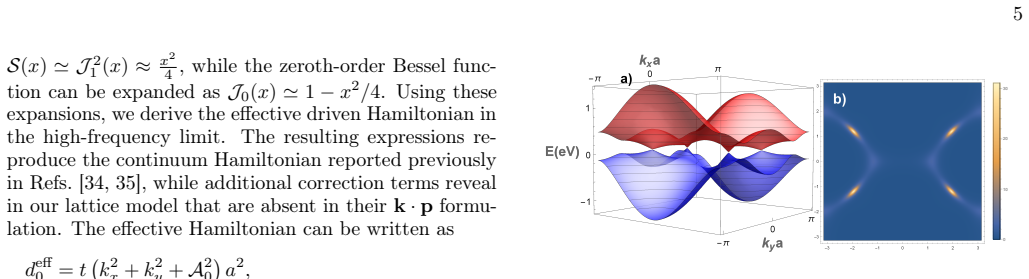
Irradiation induces light-tunable quantum anomalous Hall phases with Chern numbers up to ±3. The low-energy limit produces linear and higher-order-in-momentum spin-orbit couplings and a Zeeman-like magnetization from light-induced virtual photon processes. The higher-order spin-orbit coupling creates additional gapless Dirac points which, together with high-symmetry gap-closings, yield enhanced Berry curvature and high Chern numbers. Light breaks the static d-wave magnetic symmetry by mixing in an isotropic photo-induced s-wave correction.
What carries the argument
Floquet theory applied to the lattice model of the d_{x^2-y^2}-wave altermagnet, where circular light generates effective spin-orbit and magnetization terms via virtual photons.
If this is right
- The phase diagram features multiple topological phases with Chern numbers tunable by light intensity and frequency.
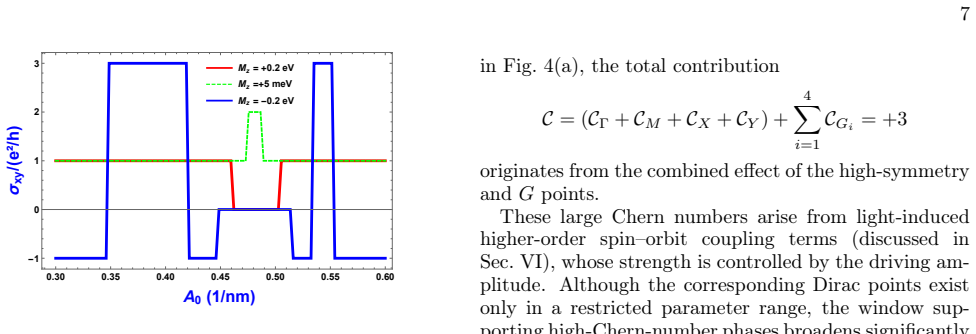
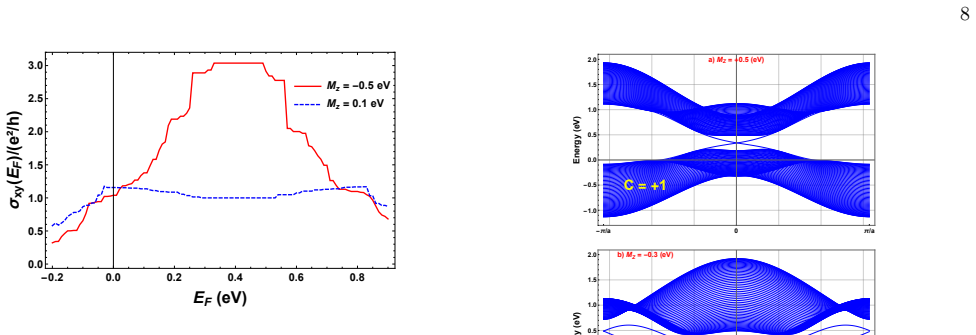
- Anomalous Hall conductivity is quantized to values matching the Chern numbers.
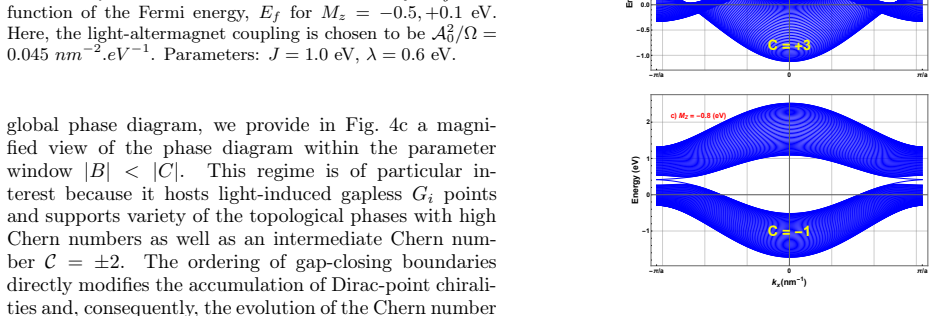
- Chiral edge modes exist within the bulk band gap of nanoribbon geometries.
- The effective low-energy Hamiltonian includes higher-order terms that enhance the topological response.
Where Pith is reading between the lines
- Similar light-induced symmetry breaking could be explored in other altermagnet classes to achieve different Chern numbers.
- The mechanism of generating higher-order spin-orbit coupling from light might generalize to other driven magnetic systems.
- Experimental tests in candidate altermagnetic materials could confirm the light-tunability of the Hall response.
Load-bearing premise
The lattice model accurately captures the d_{x^2-y^2}-wave altermagnet symmetries and the off-resonant regime of the Floquet drive holds without higher-order corrections or heating effects.
What would settle it
Measuring a quantized anomalous Hall conductivity of 3e^2/h (or -3e^2/h) in a fabricated 2D d-wave altermagnet sample exposed to circularly polarized light at appropriate frequency and intensity.
Figures
read the original abstract
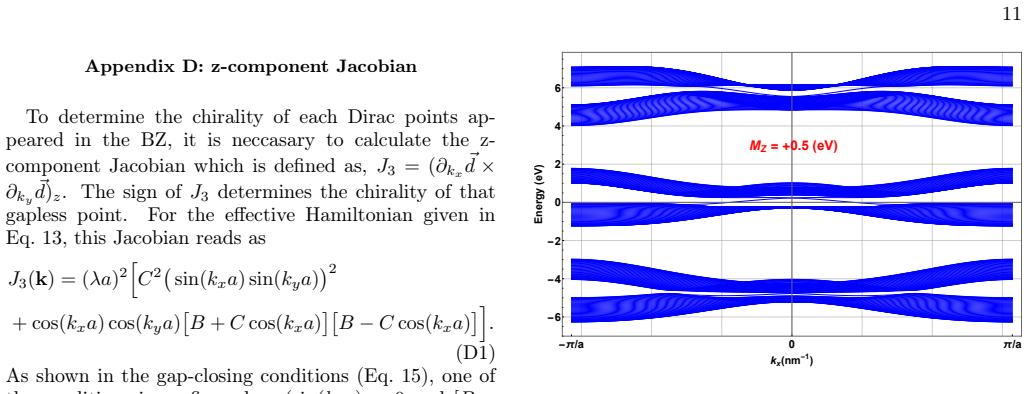
We investigate Floquet-engineered topological phases in two-dimensional $d_{x^2-y^2}$-wave altermagnets irradiated by circularly polarized light in the off-resonant regime. These materials exhibit large momentum-dependent spin-splitting governed by distinctive magnetic symmetries. Using a lattice model combined with Floquet theory, we demonstrate that irradiation induces the light-tunable quantum anomalous Hall phases with the Chern numbers up to $\pm 3$. The resultant phase diagram is verified by calculating the anomalous Hall conductivity and also the edge modes inside the band gap of a nanoribbon version of the altermagnet. Our findings establish d-wave altermagnets as promising platforms for realizing nonequilibrium topological states of matter. The low-energy continuum limit of the lattice-based Floquet Hamiltonian results in a linear and higher-order-in-momentum spin-orbit couplings, and also a Zeeman-like magnetization, all arising from light-induced virtual photon processes. The resulting higher-order spin-orbit coupling generates the additional gapless Dirac points which, together with the high-symmetry gap-closings, yield enhanced Berry curvature and high Chern numbers. The light irradiation effectively breaks the static $d_{x^2-y^2}$-wave magnetic symmetry mixing in an isotropic photo-induced $s$-wave correction.
Editorial analysis
A structured set of objections, weighed in public.
Referee Report
Summary. The manuscript claims that circularly polarized light in the off-resonant regime can be used to engineer quantum anomalous Hall phases with Chern numbers reaching up to ±3 in two-dimensional d_{x^2-y^2}-wave altermagnets. This is achieved by combining a lattice model with Floquet theory to derive an effective Hamiltonian featuring light-induced spin-orbit couplings and Zeeman terms, which lead to additional Dirac points and enhanced Berry curvature. The phase diagram is verified through calculations of the anomalous Hall conductivity and the presence of edge modes in a nanoribbon geometry.
Significance. If the central claims hold, the work is significant in establishing d-wave altermagnets as a platform for realizing tunable nonequilibrium topological phases with high Chern numbers. The approach leverages conventional Floquet perturbation theory in the off-resonant limit and provides cross-verification with multiple observables, which is a strength. This could open avenues for light-controlled topological matter in materials with altermagnetic symmetries.
minor comments (2)
- The statement that the light irradiation 'effectively breaks the static d_{x^2-y^2}-wave magnetic symmetry mixing in an isotropic photo-induced s-wave correction' would benefit from a brief explicit statement of how the symmetry-breaking term is constructed in the effective model.
- The low-energy continuum limit is mentioned in the abstract but the corresponding derivation steps and resulting effective Hamiltonian (including the higher-order SOC term) should be cross-referenced to a specific section or equation for clarity.
Simulated Author's Rebuttal
We thank the referee for the positive assessment of our work and the recommendation for minor revision. No specific major comments were provided in the report.
Circularity Check
No significant circularity in derivation chain
full rationale
The manuscript applies a conventional lattice model for d_{x^2-y^2}-wave altermagnets, performs a high-frequency Floquet expansion in the off-resonant limit to obtain an effective Hamiltonian with light-induced SOC and Zeeman terms, and computes Chern numbers from the resulting band structure. These numbers are cross-validated by anomalous Hall conductivity and nanoribbon edge states. No quoted step reduces by construction to a fitted parameter, self-defined quantity, or load-bearing self-citation chain; the derivation remains independent of its own outputs and follows standard Floquet perturbation theory without circular reductions.
Axiom & Free-Parameter Ledger
free parameters (2)
- light amplitude and frequency
- model hopping and exchange parameters
axioms (2)
- domain assumption Floquet-Magnus expansion is valid in the off-resonant regime
- standard math Chern number computed from Berry curvature of the effective bands correctly classifies the topological phase
Reference graph
Works this paper leans on
-
[1]
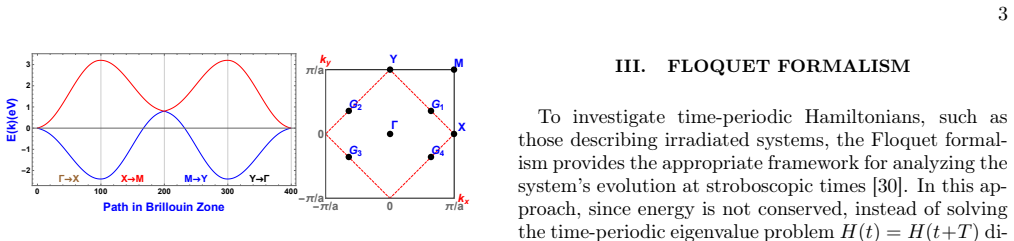
The resulting low-energy Hamiltonian for the dx2−y2- wave symmetry takes the form lim k→0 Hstatic(k) = ta2[k2 x + k2 y]σ0 + J a2[k2 x − k2 y]σz + λa[kxσy − kyσx] + Mzσz (6) III
by settingsin(kia) ≈ kia and cos(kia) ≈ 1 − (kia)2/2. The resulting low-energy Hamiltonian for the dx2−y2- wave symmetry takes the form lim k→0 Hstatic(k) = ta2[k2 x + k2 y]σ0 + J a2[k2 x − k2 y]σz + λa[kxσy − kyσx] + Mzσz (6) III. FLOQUET FORMALISM To investigate time-periodic Hamiltonians, such as those describing irradiated systems, the Floquet formal-...
-
[2]
Under Θ, momentum and spin transform ask → − k and σ → −σ
Static Hamiltonian For spin-1/2 electrons, the time-reversal operator is Θ = iσyK, withK denoting complex conjugation. Under Θ, momentum and spin transform ask → − k and σ → −σ. Acting on the static Hamiltonian, the altermagnetic 10 exchange term transforms as Θ ∆ALT(k)σz Θ−1 = −∆ALT(−k)σz ̸= ∆ALT(k)σz, (A1) demonstrating explicit breaking of time-reversa...
-
[3]
The ef- fective mass terms proportional to J and J ′ in deff z (k) multiply σz and are even functions of momentum
Effective Floquet Hamiltonian We now turn to the effective Floquet Hamiltonian gen- erated by off-resonant circularly polarized light. The ef- fective mass terms proportional to J and J ′ in deff z (k) multiply σz and are even functions of momentum. Con- sequently, time-reversal symmetry remains broken, Θ deff z (k)σz Θ−1 = −deff z (−k)σz. (A5) In contras...
-
[4]
By looking at the Jacobian formula, Eq
giving rise to|B| = ±|C|. By looking at the Jacobian formula, Eq. D1, it is simply seen thatJ3 is zero for these gap-closing conditions. Appendix E: Gap-Closing Conditions In this appendix, we present the detailed gap-closing conditions employed in constructing the phase diagrams discussed in Sec. VII. Depending on the location of the band-touching points...
-
[5]
Smejkal, J
L. Smejkal, J. Sinova, and T. Jungwirth, Beyond Con- ventional Ferromagnetism and Antiferromagnetism: A Phase with Nonrelativistic Spin and Crystal Rotation Symmetry, Phys. Rev. X12, 031042 (2022)
2022
-
[6]
Smejkal, J
L. Smejkal, J. Sinova, and T. Jungwirth, Emerging Re- search Landscape of Altermagnetism, Phys. Rev. X12, 040501 (2022)
2022
-
[7]
C. Song, H. Bai, Z. Zhou, L. Han, H. Reichlova, J. Hugo Dil, J. Liu, X. Chen, and F. Pan, Altermagnets as a New Class of Functional Materials, Nat. Rev. Mater.10, 473 (2025)
2025
-
[8]
H. Bai, W. Feng, S. Liu, L. Smejkal, Y. Mokrousov, and Y. Yao, Altermagnetism: Exploring New Frontiers in Magnetism and Spintronics, Adv. Funct. Mater.34, 2409327 (2024)
2024
-
[9]
Baltz, A
V. Baltz, A. Manchon, M. Tsoi, T. Moriyama, T. Ono, and Y. Tserkovnyak, Antiferromagnetic Spintronics, Rev. Mod. Phys.90, 015005 (2018)
2018
-
[10]
Z. Feng, X. Zhou, L. Šmejkal, L. Wu, Z. Zhu, H. Guo, R. González-Hernández, X. Wang, H. Yan, P. Qin, X. Zhang, H. Zhou, X. Chen, H. Yang, and Y. Yao, An Anomalous Hall Effect in Altermagnetic Ruthenium Dioxide, Nat. Electron.5, 735 (2022)
2022
-
[11]
Šmejkal, R
L. Šmejkal, R. González-Hernández, T. Jungwirth, and J. Sinova, Crystal Time-Reversal Symmetry Breaking and Spontaneous Hall Effect in Collinear Antiferromag- nets, Sci. Adv.6, eaaz8809 (2020)
2020
-
[12]
H. Bai, Y. Chen, Z. Zhou, Y. Li, J. Liu, L. Wang, S. Zhang, C. Cai, J. Zhou, H. Miao, C. Liu, W. Wang, Y. Wang, K. Wang, W. Zhao, G. Wang, Y. Liu, K. T. Law, L. Han, C. Song, and F. Pan, Giant and Anisotropic Magneto-Transport in Altermagnetic RuO2, Phys. Rev. Lett.130, 216701 (2023)
2023
-
[13]
S. Lee, Y. Choi, J. Park, S. Kim, S. Park, K. Kim, J. Lee, B. G. Park, and J. H. Lee, Broken Kramers Degeneracy in Altermagnetic MnTe, Phys. Rev. Lett.132, 036702 (2024)
2024
-
[14]
I. I. Mazin, Altermagnetism in MnTe: Origin, Predicted Manifestations, and Routes to Detwinning, Phys. Rev. B 107, L100418 (2023)
2023
-
[15]
F. D. M. Haldane, Model for a Quantum Hall Effect with- out Landau Levels: Condensed-Matter Realization of the ’Parity Anomaly’, Phys. Rev. Lett.61, 2015 (1988)
2015
-
[16]
Chang, C.-X
C.-Z. Chang, C.-X. Liu, and A. H. MacDon- ald, Colloquium: Quantum Anomalous Hall Effect, Rev. Mod. Phys.95, 011002 (2023)
2023
-
[17]
Chang, J
C.-Z. Chang, J. Zhang, X. Feng, J. Shen, Z. Zhang, M. Guo, K. Li, Y. Ou, P. Wei, L.-L. Wang, Z.-Q. Ji, Y. Feng, S. Ji, X. Chen, J. Jia, X. Dai, Z. Fang, S.- C. Zhang, K. He, Y. Wang, L. Lu, X.-C. Ma, and Q.-K. Xue, Experimental Observation of the Quantum Anomalous Hall Effect in a Magnetic Topological Insula- tor, Science340, 167 (2013)
2013
-
[18]
S. S. Dabiri, H. Cheraghchi, and A. Sadeghi, Light- Induced Topological Phases in Thin Films of Magneti- cally Doped Topological Insulators, Phys. Rev. B103, 205130 (2021)
2021
-
[19]
S. S. Dabiri and H. Cheraghchi, Engineering of topologi- cal phases in driven thin topological insulator: Structure inversion asymmetry effect, Phys. Rev. B104, 245121 (2021)
2021
-
[20]
W. Zhu, H. Bai, L. Han, F. Pan, and C. Song, Tun- able Quantum Anomalous Hall Effect via Crystal Order in Spin-Splitting Antiferromagnets, Nano Lett.25, 5672 (2025)
2025
-
[21]
Reichlova, L
H. Reichlova, L. Smejkal, R. Gonzalez-Hernandez, T. Janda, Z. Soban, T. Ritzmann, P. Krizek, K. Vyborny, J. Zelezny, J. Sinova, and T. Jungwirth, Altermagnetic Lifting of Kramers Spin Degeneracy, Nat. Commun.15, 4961 (2024)
2024
-
[22]
A. K. Nayak, J. E. Fischer, Y. Sun, T. Borzenets, C. Felser, and S. S. P. Parkin, Large Anomalous Hall Effect Driven by a Nonvanishing Berry Curvature in the Noncollinear Antiferromagnet Mn3Ge, Sci. Adv. 2, e1501870 (2016)
2016
-
[23]
Nakatsuji, N
S. Nakatsuji, N. Kiyohara, and T. Higo, Large Anoma- lous Hall Effect in a Non-Collinear Antiferromagnet at Room Temperature, Nature527, 212 (2015)
2015
-
[24]
H. Chen, Q. Niu, and A. H. MacDonald, Anomalous Hall Effect Arising from Noncollinear Antiferromagnetism, Phys. Rev. Lett.112, 017205 (2014)
2014
-
[25]
Guo, Z.-X
P.-J. Guo, Z.-X. Liu, and Z.-Y. Lu, Quantum Anomalous Hall Effect in Collinear Antiferromagnetism, npj Com- put. Mater.9, 70 (2023)
2023
-
[26]
B. Wu, J. Liu, Y. Li, Z. Wang, C. Liu, and S. Zhang, Quantum Anomalous Hall Effect in an Antiferromagnetic Monolayer of MoO, Phys. Rev. B107, 214419 (2023)
2023
-
[27]
Y. Liu, J. Li, and Q. Liu, Chern-Insulator Phase in An- tiferromagnets, Nano Lett.23, 8650 (2023)
2023
-
[28]
Oka and H
T. Oka and H. Aoki, Photovoltaic Hall Effect in Graphene, Phys. Rev. B79, 081406 (2009)
2009
-
[29]
M. S. Rudner, N. H. Lindner, E. Berg, and M. Levin, Anomalous Edge States and the Bulk-Edge Correspon- dence for Periodically Driven Two-Dimensional Systems, Phys. Rev. X3, 031005 (2013)
2013
-
[30]
Y. H. Wang, H. Steinberg, P. Jarillo-Herrero, and N. Gedik, Observation of Floquet-Bloch States on the Surface of a Topological Insulator, Science 342, 453 (2013)
2013
-
[31]
Kitagawa, T
T. Kitagawa, T. Oka, A. Brataas, L. Fu, and E. Dem- ler, Transport Properties of Nonequilibrium Systems un- der the Application of Light: Photoinduced Quantum Hall Insulators without Landau Levels, Phys. Rev. B84, 235108 (2011)
2011
-
[32]
M. S. Rudner and N. H. Lindner, Band Structure Engi- neeringandNon-EquilibriumDynamicsinFloquetTopo- logical Insulators, Nat. Rev. Phys.2, 229 (2020)
2020
-
[33]
Sticlet, F
D. Sticlet, F. Piéchon, J. N. Fuchs, P. Kalugin, and P. Simon, Geometrical Engineering of Complex Phases in Graphene, Phys. Rev. B85, 165456 (2012). 13
2012
-
[34]
J. H. Shirley, Solution of the Schrödinger Equation with a Hamiltonian Periodic in Time, Phys. Rev.138, B979 (1965)
1965
-
[35]
Bukov, L
M. Bukov, L. D’Alessio, and A. Polkovnikov, Universal High-FrequencyBehaviorofPeriodicallyDrivenSystems: From Dynamical Stabilization to Floquet Engineering, Adv. Phys.64, 139 (2015)
2015
-
[36]
Eckardt and E
A. Eckardt and E. Anisimovas, High-Frequency Approx- imation for Periodically Driven Quantum Systems from a Floquet-Space Perspective, New J. Phys.17, 093039 (2015)
2015
-
[37]
Mikami, S
T. Mikami, S. Kitamura, K. Yasuda, N. Tsuji, T. Oka, and H. Aoki, Brillouin-Wigner Theory for High-Frequency Expansion in Periodically Driven Sys- tems: Application to Floquet Topological Insulators, Phys. Rev. B93, 144307 (2016)
2016
-
[38]
Yarmohammadi, U
M. Yarmohammadi, U. Zülicke, J. Berakdar, J. Linder, and J. K. Freericks, Floquet Engineering of Altermag- netic Systems, Phys. Rev. B111, 224412 (2025)
2025
-
[39]
S. A. A. Ghorashi and Q. Li, Dynamical Generation of Higher-Order Spin-Orbit Couplings, Topology and Per- sistent Spin Texture in Light-Irradiated Altermagnets, arXiv:2504.00122 (2025)
arXiv 2025
-
[40]
Tanaka and M
M. Tanaka and M. Sato, Floquet Engineering of Alter- magnetic Systems with Light, Phys. Rev. B110, 045204 (2024)
2024
-
[41]
Fukui, Y
T. Fukui, Y. Hatsugai, and H. Suzuki, Chern Numbers in Discretized Brillouin Zone: Efficient Method of Com- puting (Spin) Hall Conductances, J. Phys. Soc. Jpn.74, 1674 (2005)
2005
discussion (0)
Sign in with ORCID, Apple, or X to comment. Anyone can read and Pith papers without signing in.