Lattice Reconstruction and Orbital Hybridization Suppress Magnetism in TaCo₂Te₂
Pith reviewed 2026-06-26 04:25 UTC · model grok-4.3
The pith
Lattice reconstruction in TaCo2Te2 suppresses magnetism by enhancing orbital hybridization.
A machine-rendered reading of the paper's core claim, the machinery that carries it, and where it could break.
Core claim
In TaCo2Te2 the experimentally observed lattice reconstruction suppresses the magnetic instability present in the undistorted structure and stabilizes a nonmagnetic ground state through enhanced orbital hybridization, with the bias-dependent STM contrast arising from energy-integrated local density of states that exhibit opposite spatial character at different energies.
What carries the argument
Lattice reconstruction that enhances orbital hybridization between atoms to eliminate magnetic instability.
If this is right
- The ground state of TaCo2Te2 is nonmagnetic rather than magnetically ordered.
- STM contrast reflects energy-integrated LDOS with opposite spatial patterns at selected energies rather than simple occupied-unoccupied reversal.
- The Fermi surface is strongly anisotropic because of the reconstructed low-energy states.
- Structural reconstruction reorganizes electronic symmetry away from the atomic lattice symmetry.
Where Pith is reading between the lines
- Similar reconstruction-driven hybridization could suppress magnetism in other layered transition-metal compounds.
- Tuning the degree of distortion through strain or substrate choice might allow controlled switching between magnetic and nonmagnetic regimes.
Load-bearing premise
The specific atomic positions and orbital projections chosen for the DFT calculations of the reconstructed structure correctly represent the real material and demonstrate magnetism suppression.
What would settle it
Direct observation of magnetic ordering or finite local moments in TaCo2Te2 would contradict the claim that reconstruction stabilizes a nonmagnetic ground state.
Figures
read the original abstract
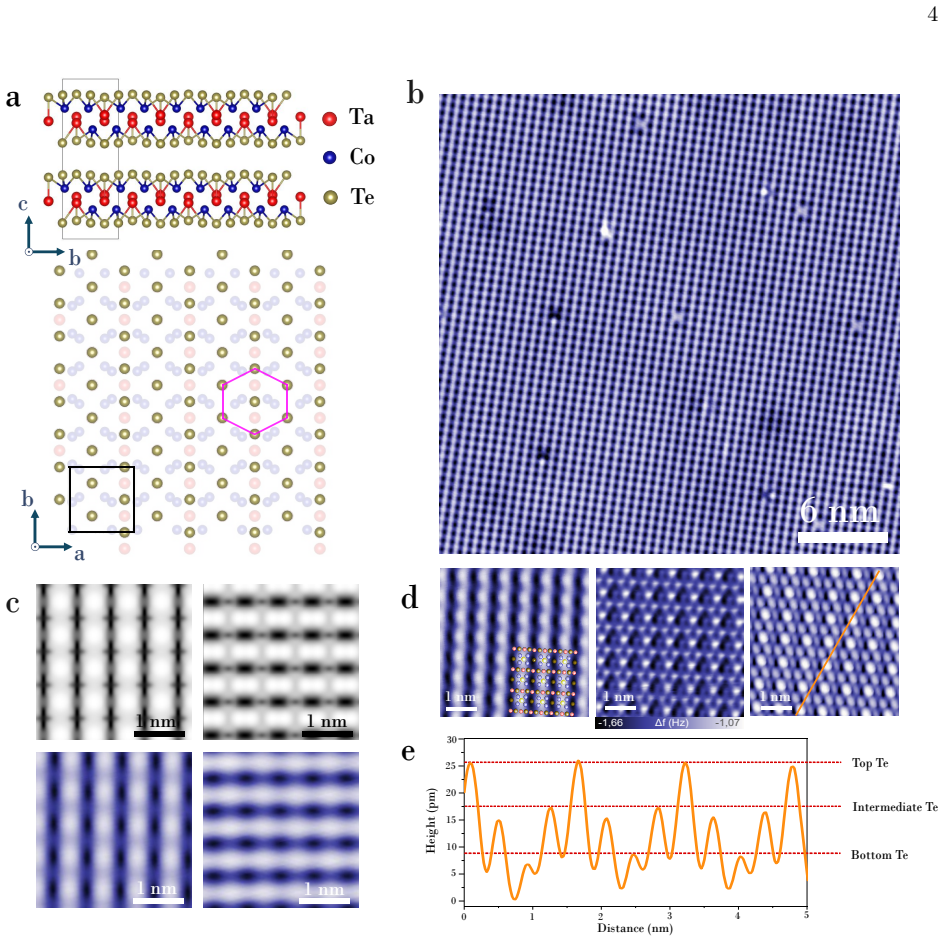
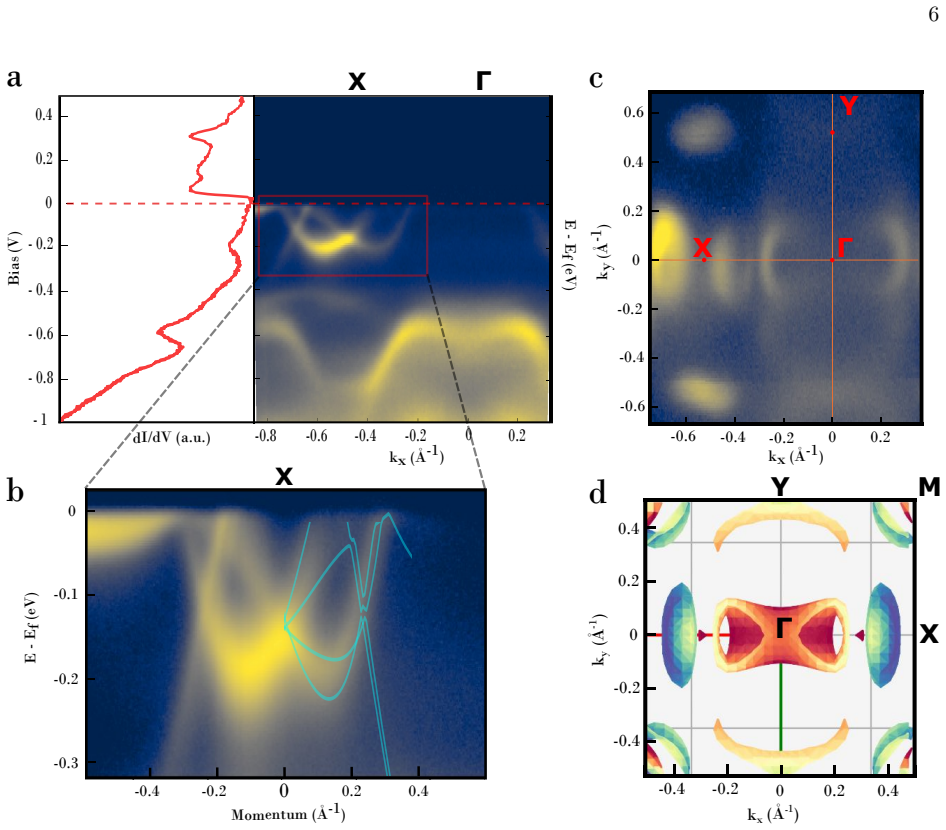
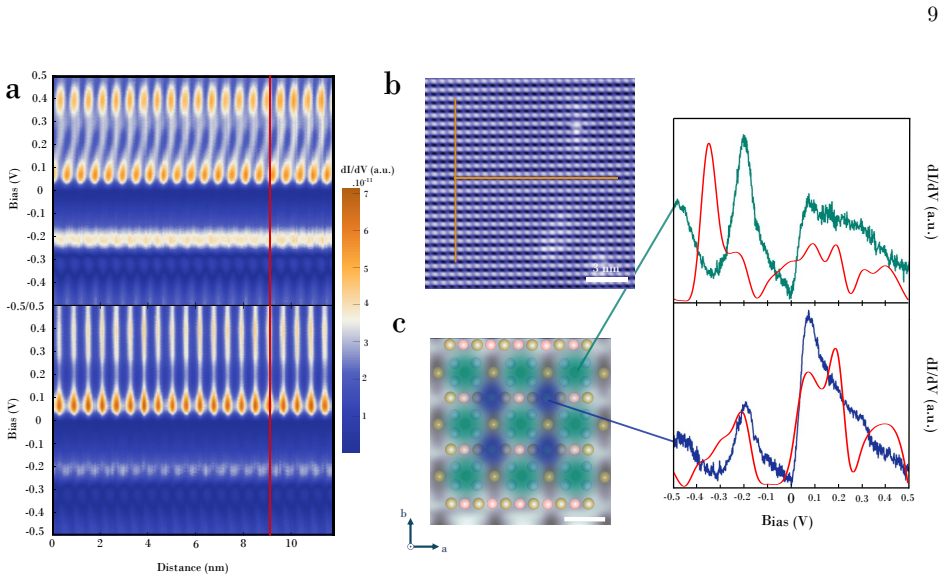
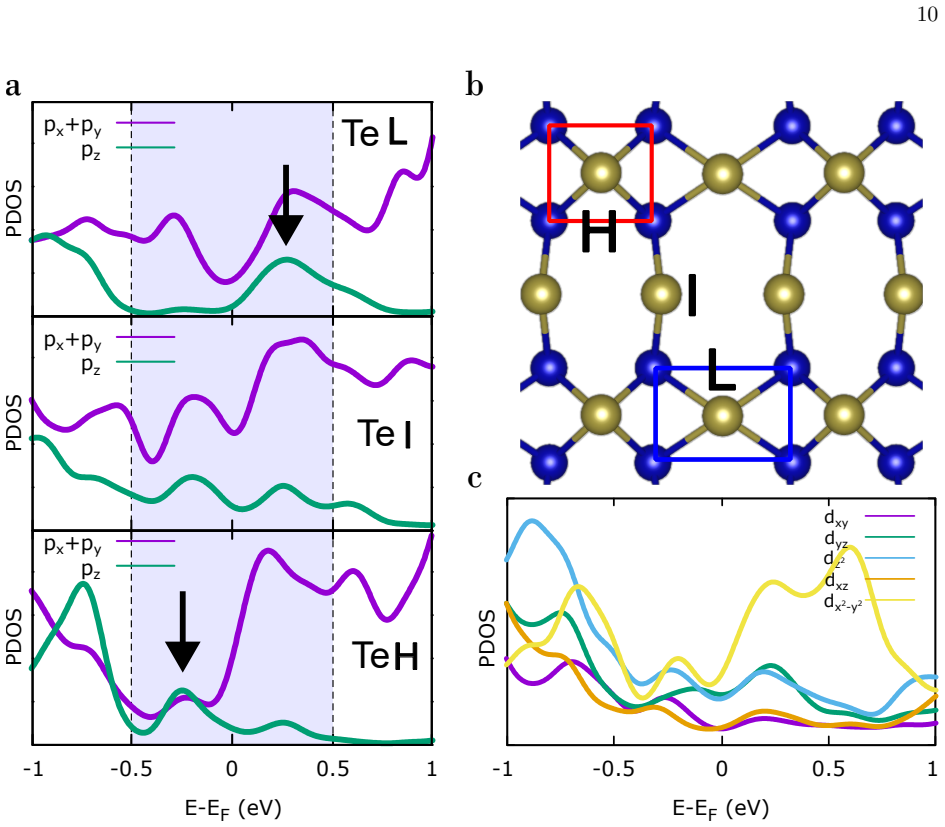
Structural reconstruction in low-dimensional quantum materials can strongly modify electronic symmetry and magnetic stability through orbital hybridization. Here, we investigate the interplay between lattice reconstruction, electronic structure, and magnetic instability in the layered van der Waals compound TaCo$_2$Te$_2$ using scanning tunneling microscopy and spectroscopy (STM/STS), non-contact atomic force microscopy (nc-AFM), angle-resolved photoemission spectroscopy (ARPES), and density functional theory (DFT). While nc-AFM resolves a distorted hexagonal Te surface lattice, STM/STS reveal a pronounced square-like electronic symmetry that does not directly follow the atomic structure. ARPES further shows a strongly anisotropic Fermi surface and reconstructed low-energy states. Spatially resolved spectroscopy and orbital-projected DFT demonstrate that the bias-dependent STM contrast does not arise from a simple reversal between occupied and unoccupied states, but from the energy-integrated local density of states dominated by electronic states exhibiting opposite spatial contrast at selected energies. DFT calculations further show that reconstruction suppresses the magnetic instability present in the undistorted structure, stabilizing a nonmagnetic ground state through enhanced orbital hybridization. These results establish TaCo$_2$Te$_2$ as a model system in which lattice reconstruction reorganizes electronic symmetry and suppresses magnetism, highlighting structural reconstruction as a route for controlling correlated and magnetic phases in low-dimensional quantum materials.
Editorial analysis
A structured set of objections, weighed in public.
Referee Report
Summary. The manuscript reports a multi-technique study (STM/STS, nc-AFM, ARPES, DFT) of the van der Waals compound TaCo₂Te₂. nc-AFM resolves a distorted hexagonal Te lattice, STM shows square-like electronic symmetry, ARPES shows an anisotropic Fermi surface with reconstructed states, and DFT is used to argue that this reconstruction suppresses a magnetic instability present in the undistorted structure, stabilizing a non-magnetic ground state via enhanced orbital hybridization.
Significance. If the central DFT claim holds, the work positions TaCo₂Te₂ as a model system in which lattice reconstruction controls electronic symmetry and quenches magnetism in a low-dimensional quantum material. The combination of real-space imaging, momentum-space spectroscopy, and theory is a positive feature; the result would illustrate structural reconstruction as a control knob for correlated phases.
major comments (2)
- [DFT calculations (abstract and results)] Abstract and DFT results section: the claim that 'reconstruction suppresses the magnetic instability present in the undistorted structure' is load-bearing for the central conclusion, yet the text does not state whether the atomic coordinates supplied to the magnetic-instability calculation are the precise positions resolved by nc-AFM or a separately relaxed theoretical structure. Without this explicit link, the reported suppression could be an artifact of geometry choice rather than a direct consequence of the observed distortion.
- [Orbital-projected DFT (results)] Orbital-projected DFT analysis: the mechanism 'enhanced orbital hybridization' is invoked to explain moment quenching, but no quantitative metric (e.g., change in orbital overlap integrals, integrated DOS overlap, or energy lowering attributable to specific hybridizations) is provided to demonstrate that hybridization, rather than other reconstruction-induced band shifts, is the dominant factor. This comparison must be shown for both distorted and undistorted geometries under identical convergence settings.
minor comments (2)
- [Abstract] Abstract: no error bars, raw-data statistics, or convergence details are supplied for the STM/STS or DFT results; these should be added for reproducibility.
- [STM/STS results] Notation: the manuscript should clarify whether the 'square-like electronic symmetry' is quantified by Fourier analysis of STM images or by direct comparison of LDOS maps at specific bias voltages.
Simulated Author's Rebuttal
We thank the referee for the careful reading and constructive comments on our manuscript. We address each major comment point by point below and have revised the manuscript to improve clarity and provide the requested details.
read point-by-point responses
-
Referee: [DFT calculations (abstract and results)] Abstract and DFT results section: the claim that 'reconstruction suppresses the magnetic instability present in the undistorted structure' is load-bearing for the central conclusion, yet the text does not state whether the atomic coordinates supplied to the magnetic-instability calculation are the precise positions resolved by nc-AFM or a separately relaxed theoretical structure. Without this explicit link, the reported suppression could be an artifact of geometry choice rather than a direct consequence of the observed distortion.
Authors: We acknowledge that the original manuscript did not explicitly describe the provenance of the atomic coordinates. The distorted-structure coordinates were generated by relaxing the experimentally resolved nc-AFM lattice parameters and distortions, while the undistorted reference used the ideal hexagonal cell; both calculations employed identical convergence settings. We have revised the DFT methods and results sections to state this procedure explicitly and added a supplementary note confirming that the magnetic-moment suppression remains robust when the precise experimental nc-AFM coordinates are used without additional relaxation. revision: yes
-
Referee: [Orbital-projected DFT (results)] Orbital-projected DFT analysis: the mechanism 'enhanced orbital hybridization' is invoked to explain moment quenching, but no quantitative metric (e.g., change in orbital overlap integrals, integrated DOS overlap, or energy lowering attributable to specific hybridizations) is provided to demonstrate that hybridization, rather than other reconstruction-induced band shifts, is the dominant factor. This comparison must be shown for both distorted and undistorted geometries under identical convergence settings.
Authors: We agree that a quantitative comparison is necessary to isolate the hybridization contribution. In the revised manuscript we add a dedicated panel and text in the DFT results section that reports the changes in orbital-projected DOS and selected orbital overlap integrals (Ta–Co and Ta–Te) between the two geometries, all computed under identical settings. The analysis shows that the additional hybridization in the reconstructed structure produces the dominant energy lowering responsible for moment quenching. revision: yes
Circularity Check
No circularity: magnetism suppression is a direct DFT outcome on observed structure, not a fitted or self-referential quantity.
full rationale
The central claim is a first-principles DFT result comparing magnetic instability in undistorted vs. reconstructed lattices via orbital hybridization. No equations, parameters, or self-citations reduce this outcome to its inputs by construction. The calculation uses experimental atomic positions as input and produces an independent total-energy comparison; it is not a renaming, ansatz smuggling, or fitted prediction. This is the most common honest non-finding for computational materials papers.
Axiom & Free-Parameter Ledger
Reference graph
Works this paper leans on
-
[1]
Huang, G
B. Huang, G. Clark, E. Navarro-Moratalla, D. R. Klein, R. Cheng, K. L. Seyler, D. Zhong, E. Schmidgall, M. A. McGuire, D. H. Cobden, W. Yao, D. Xiao, P. Jarillo-Herrero, X. Xu,Nature 2017,546, 270–273
2017
-
[2]
C. Gong, L. Li, Z. Li, H. Ji, A. Stern, Y. Xia, T. Cao, W. Bao, C. Wang, Y. Wang, Z. Q. Qiu, R. J. Cava, S. G. Louie, J. Xia, X. Zhang,Nature2017,546, 265–269
-
[3]
K. S. Burch, D. Mandrus, J.-G. Park,Nature2018,563, 47–52
-
[4]
Gibertini, M
M. Gibertini, M. Koperski, A. F. Morpurgo, K. S. Novoselov,Nature Nanotechnology2019,14, 408– 419
-
[5]
M. Mi, H. Xiao, L. Yu, Y. Zhang, Y. Wang, Q. Cao, Y. Wang,Materials Today Nano2023,24, 100408
-
[6]
Z. Zhao, Y. Lin, A. Avsar,npj 2D Mater Appl2025,9, 30
-
[7]
Algarni,Nanomaterials2025,15, 1569
M. Algarni,Nanomaterials2025,15, 1569
-
[8]
Witte, A
P. Witte, A. M. Van Koten, M. E. Kamminga,Mater. Adv.2024,5, 6702–6718
2024
-
[9]
Cheon, V
C.-Y. Cheon, V. Multian, K. Watanabe, T. Taniguchi, A. F. Morpurgo, D. Lebedev,Nat Commun 2025,17, 60
2025
-
[10]
Jiang, L
S. Jiang, L. Li, Z. Wang, K. F. Mak, J. Shan,Nature Nanotechnology2018,13, 549–553
-
[11]
T. Song, X. Cai, M. W.-Y. Tu, X. Zhang, B. Huang, N. P. Wilson, K. L. Seyler, L. Zhu, T. Taniguchi, K. Watanabe, M. A. McGuire, D. H. Cobden, D. Xiao, W. Yao, X. Xu,Science2018,360, 1214–1218
-
[12]
H. Wang, H. Lu, Z. Guo, A. Li, P. Wu, J. Li, W. Xie, Z. Sun, P. Li, H. Damas, A. M. Friedel, S. Migot, J. Ghanbaja, L. Moreau, Y. Fagot-Revurat, S. Petit-Watelot, T. Hauet, J. Robertson, S. Mangin, W. Zhao, T. Nie,Nature Communications2023,14, 2483
-
[13]
Zhang, J
Z. Zhang, J. Shang, C. Jiang, A. Rasmita, W. Gao, T. Yu,Nano Lett.2019,19, 3138–3142
2019
-
[14]
Iturriaga, L
H. Iturriaga, L. M. Martinez, T. T. Mai, A. J. Biacchi, M. Augustin, A. R. Hight Walker, M. Noufal, S. T. Sreenivasan, Y. Liu, E. J. G. Santos, C. Petrovic, S. R. Singamaneni,npj 2D Mater Appl2023, 7, 56
-
[15]
H. Wang, H. Lu, Z. Guo, A. Li, P. Wu, J. Li, W. Xie, Z. Sun, P. Li, H. Damas, A. M. Friedel, S. Migot, J. Ghanbaja, L. Moreau, Y. Fagot-Revurat, S. Petit-Watelot, T. Hauet, J. Robertson, S. Mangin, W. Zhao, T. Nie,Nat Commun2023,14, 2483. 16
-
[16]
P. Li, C. Wang, J. Zhang, S. Chen, D. Guo, W. Ji, D. Zhong,Science Bulletin2020,65, 1064–1071
-
[17]
W. Chen, Z. Sun, Z. Wang, L. Gu, X. Xu, S. Wu, C. Gao,Science2019,366, 983–987
-
[18]
Kezilebieke, M
S. Kezilebieke, M. N. Huda, V. Vaˇ no, M. Aapro, S. C. Ganguli, O. J. Silveira, S. G lodzik, A. S. Foster, T. Ojanen, P. Liljeroth,Nature2020,588, 424–428
-
[19]
Kezilebieke, O
S. Kezilebieke, O. J. Silveira, M. N. Huda, V. Vaˇ no, M. Aapro, S. C. Ganguli, J. Lahtinen, R. Mansell, S. van Dijken, A. S. Foster, P. Liljeroth,Advanced Materials2021,33, 2006850
-
[20]
W. Xie, J. Zhang, Y. Bai, Y. Liu, H. Wang, P. Yu, J. Li, H. Chang, Z. Wang, F. Gao, G. Wei, W. Zhao, T. Nie,APL Materials2024,12, 031102
-
[21]
H. Rong, Z. Huang, X. Zhang, S. Kumar, F. Zhang, C. Zhang, Y. Wang, Z. Hao, Y. Cai, L. Wang, others,npj Quantum Materials2023,8, 29
-
[22]
W.-H. Jiao, Y. Liu, P. Tao, J. Lu, X. Liang, W. Yang, Z. Zhang, S. Xu, Y. Luo, Z.-W. Zhu, D. Qian, X. Xu, Z. Ren, G.-H. Cao, S. Xiao,Phys. Rev. B2025,111, 045109
-
[23]
N. Mathur, G. Cheng, F. Ballester, G. Carrel, V. M. Plisson, F. Yuan, J. Zheng, C. Chen, S. B. Lee, R. Singha, S. Chatterjee, K. S. Burch, B. J¨ ack, I. Errea, M. G. Vergniory, N. Yao, L. M. Schoop, Emergence of reentrant structural modulations far beyond the thermal limit,2024,https://arxiv. org/abs/2409.19783, eprint: 2409.19783
Pith/arXiv arXiv 2024
-
[24]
Singha, F
R. Singha, F. Yuan, G. Cheng, T. H. Salters, Y. M. Oey, G. V. Villalpando, M. Jovanovic, N. Yao, L. M. Schoop,Advanced Functional Materials2022,32, 2108920
-
[25]
L. Wang, J. Tian, C. Kang, H. Gu, R. Pang, M. Shen, L. She, Y. Song, X. Liu, W. Zhang,Inorg. Chem.2022,61, 18899–18906
2022
-
[26]
S. K. Pradhan, X. Ma, J. Wang, W. Liu, Y. Dai, W. Chen, X. Ma, W. Yang, Y. Wu, Z. Luo, R. Datta, A. Bera, S. DuttaGupta, J. Yang, Y. Hou, C. Liu, R. Wu,Magnetic field-induced non-trivial Lifshitz transition in TaCo2Te2,2026,https://arxiv.org/abs/2601.18160, Version Number: 1
arXiv 2026
-
[27]
Bonilla, S
M. Bonilla, S. Kolekar, Y. Ma, H. C. Diaz, V. Kalappattil, R. Das, T. Eggers, H. R. Gutierrez, M.-H. Phan, M. Batzill,Nature Nanotech2018,13, 289–293
-
[28]
Kezilebieke, M
S. Kezilebieke, M. N. Huda, P. Dreher, I. Manninen, Y. Zhou, J. Sainio, R. Mansell, M. M. Ugeda, S. Van Dijken, H.-P. Komsa, P. Liljeroth,Commun Phys2020,3, 116
-
[29]
A. O. Fumega, M. Gobbi, P. Dreher, W. Wan, C. Gonz´ alez-Orellana, M. Pe˜ na-D´ ıaz, C. Rogero, J. Herrero-Mart´ ın, P. Gargiani, M. Ilyn, M. M. Ugeda, V. Pardo, S. Blanco-Canosa,J. Phys. Chem. C 2019,123, 27802–27810
2019
-
[30]
Shishidou, D
T. Shishidou, D. F. Agterberg, M. Weinert,Commun Phys2018,1, 8
-
[31]
M. Zhu, D. Do, C. Dela Cruz, Z. Dun, H. Zhou, S. Mahanti, X. Ke,Phys. Rev. Lett.2014,113, 076406
2014
-
[32]
Neuhausen, V
J. Neuhausen, V. K. Evstaf’iev, T. Block, E. W. Finckh, W. Tremel, L. Augustin, H. Fuchs, D. Voss, P. Kr¨ uger, A. Mazur, others,Chemistry of materials1998,10, 3870–3878
-
[33]
Kresse, J
G. Kresse, J. Furthm¨ uller,Phys. Rev. B1996,54, 11169–11186
-
[34]
Kresse, J
G. Kresse, J. Furthm¨ uller,Computational Materials Science1996,6, 15–50
-
[35]
J. P. Perdew, K. Burke, M. Ernzerhof,Phys. Rev. Lett.1996,77, 3865–3868. 17
1996
-
[36]
Grimme, J
S. Grimme, J. Antony, S. Ehrlich, H. Krieg,The Journal of Chemical Physics2010,132, 154104
-
[37]
S. L. Dudarev, G. A. Botton, S. Y. Savrasov, C. J. Humphreys, A. P. Sutton,Phys. Rev. B1998,57, 1505–1509
-
[38]
Tersoff, D
J. Tersoff, D. R. Hamann,Phys. Rev. B1985,31, 805–813
-
[39]
A. O. de-la Roza, E. R. Johnson, V. Lua˜ na,Computer Physics Communications2014,185, 1007–1018
-
[40]
A. O. de-la Roza, M. Blanco, A. M. Pend´ as, V. Lua˜ na,Computer Physics Communications2009,180, 157–166
-
[41]
Momma, F
K. Momma, F. Izumi,Journal of Applied Crystallography2011,44, 1272–1276. T ABLE OF CONTENTS undistorted distorted TaCo2Te2 Orbital hybridization Cobalt spin Electronic reconstruction Magnetism ? Using a combination of low-temperature STM, AFM, ARPES, and DFT, we uncover a coupled electronic and structural reconstruction in TaCo2Te2. The reconstruction is ...
discussion (0)
Sign in with ORCID, Apple, or X to comment. Anyone can read and Pith papers without signing in.