Calibrated Harmonic Overlaid Implicit Neural Representations for Multi-Dimensional Data
Pith reviewed 2026-06-26 05:13 UTC · model grok-4.3
The pith
Coordinated harmonic superposition and spectrum calibration enable stable deep implicit neural representations for multidimensional data.
A machine-rendered reading of the paper's core claim, the machinery that carries it, and where it could break.
Core claim
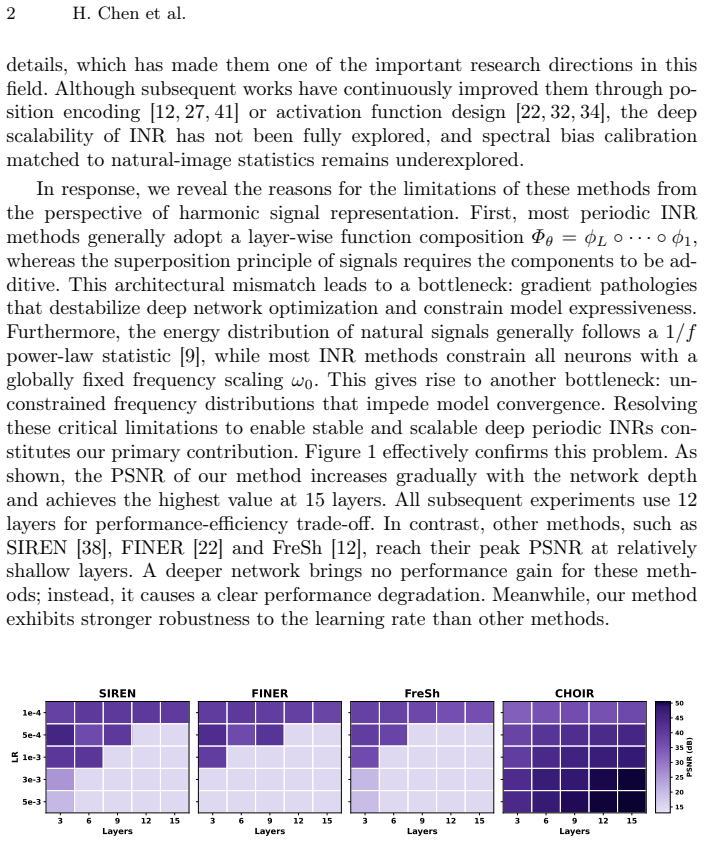
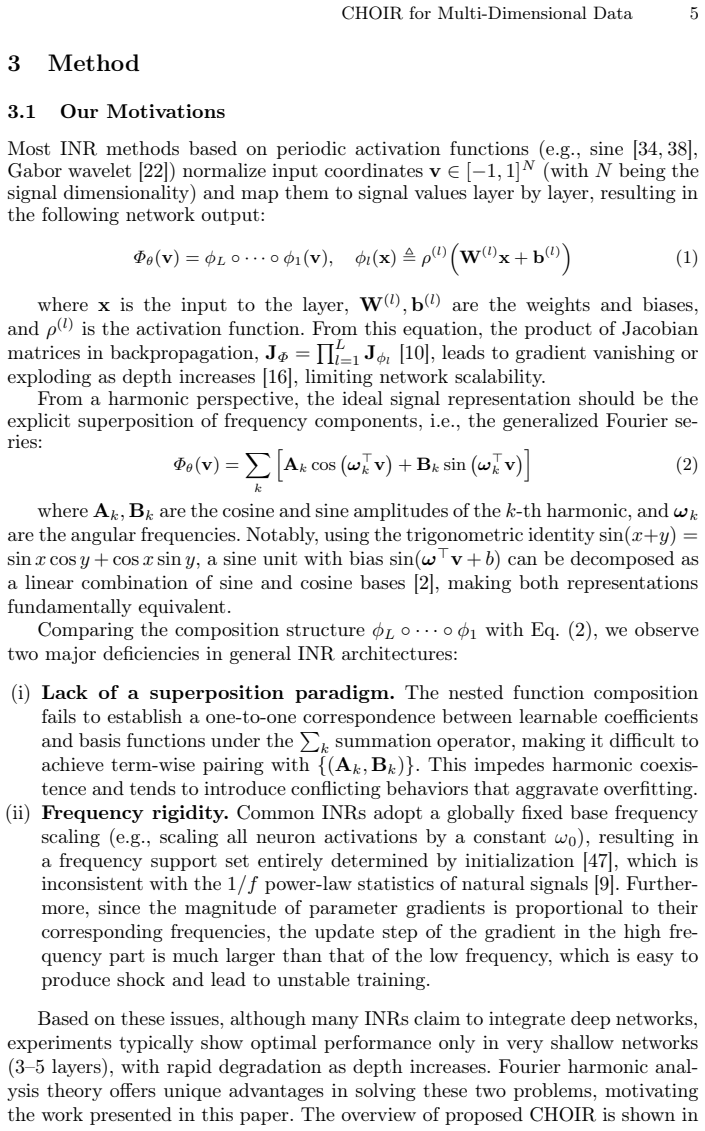
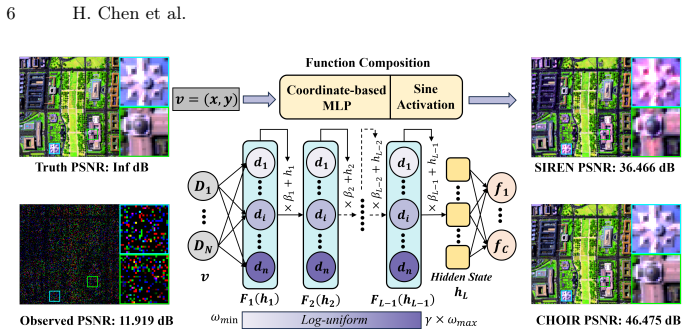
The central discovery is that Coordinated Harmonic Superposition (CHS) replaces conventional function composition in implicit neural representations to ensure optimization stability when scaling network depth, while Perceptual Spectrum Calibration (PSC) embeds the power-law spectrum prior of natural images to adjust the spectrum to a physically plausible log-uniform distribution, leading to superior performance on various multidimensional data recovery problems.
What carries the argument
Coordinated Harmonic Superposition (CHS) to overlay harmonics in place of function composition for stability, combined with Perceptual Spectrum Calibration (PSC) to embed power-law priors and adjust spectrum bias.
If this is right
- Deep periodic networks can scale in depth without the usual optimization instabilities.
- The spectrum of represented data can be calibrated to better match natural distributions.
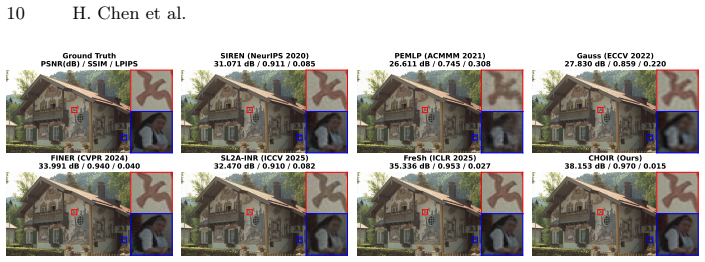
- Performance improves on tasks involving recovery of multispectral images and videos.
- The method generalizes across different types of multidimensional data recovery problems.
Where Pith is reading between the lines
- Similar harmonic superposition techniques might apply to other activation functions beyond periodic ones.
- Connections to Fourier series could allow borrowing more tools from signal processing for INR design.
- Testing on even higher dimensional data like 3D volumes could reveal further benefits.
Load-bearing premise
That coordinated harmonic superposition will ensure optimization stability when scaling network depth, and that perceptual spectrum calibration will adjust outputs to a log-uniform distribution without introducing instabilities.
What would settle it
Observe if increasing network depth in the CHOIR model leads to the same instability issues as in standard sine-based INRs on a benchmark multidimensional dataset.
Figures
read the original abstract
Implicit neural representation (INR) has emerged as a powerful prior for multi-dimensional data (e.g., multispectral images and videos). However, most INR methods employing periodic activation functions (e.g., Sine) predominantly rely on function composition. This mechanism introduces optimization instability as network depth increases, thereby limiting their performance. Meanwhile, these methods fail to incorporate proper physical priors to effectively alleviate spectrum bias. To address these issues, inspired by the commonalities between deep periodic networks and generalized Fourier series, we propose a novel Calibrated Harmonic Overlaid Implicit Neural Representation (CHOIR). Specifically, we utilize Coordinated Harmonic Superposition (CHS) to replace the conventional function composition used in most INRs, thereby ensuring optimization stability when scaling network depth. Furthermore, we introduce a Perceptual Spectrum Calibration (PSC) to mitigate spectrum bias. This calibration embeds the ubiquitous power-law spectrum prior of natural images and adjusts the globally fixed spectrum towards a physically plausible log-uniform distribution. Extensive experiments on various multidimensional data recovery problems demonstrate that our method achieves superior performance over state-of-the-art approaches. Code is available at https://github.com/chorl0229/CHOIR.
Editorial analysis
A structured set of objections, weighed in public.
Referee Report
Summary. The paper proposes Calibrated Harmonic Overlaid Implicit Neural Representation (CHOIR) for multi-dimensional data such as images and videos. It replaces standard function composition in periodic INRs (e.g., SIREN) with Coordinated Harmonic Superposition (CHS) to stabilize optimization at increased depths, drawing an analogy to generalized Fourier series, and adds Perceptual Spectrum Calibration (PSC) to embed a power-law spectrum prior and shift outputs toward a log-uniform distribution. The central claim is that these changes yield superior performance over state-of-the-art methods on various data recovery tasks, with code released.
Significance. If the stability and spectrum-calibration claims are substantiated with explicit constructions, convergence arguments, and ablations, the work could meaningfully extend INR techniques by mitigating two well-known practical limitations. The availability of code is a positive factor for reproducibility.
major comments (2)
- [Abstract, §3] Abstract and §3: The headline claim of superior performance on multidimensional recovery tasks rests on CHS replacing function composition to ensure stability at scale and PSC embedding a power-law prior without new instabilities, yet neither the explicit layer-wise coordination rule for harmonics in CHS nor any convergence analysis is supplied; the Fourier-series analogy is invoked but not turned into a derivation or bound.
- [§4] §4 (Experiments): No ablation results on depth scaling, no output-spectrum histograms comparing PSC-adjusted vs. baseline distributions, and no quantitative tables with metrics, baselines, or stability measures (e.g., loss curves or gradient norms) are referenced, leaving the empirical support for the two core assumptions unverified.
minor comments (2)
- [§3] Notation for the harmonic coordination operator and the precise form of the PSC loss term should be introduced with an equation number in §3 to allow direct inspection.
- [Abstract] The abstract states 'extensive experiments' but supplies no numbers; a short quantitative summary sentence would improve readability.
Simulated Author's Rebuttal
We thank the referee for the constructive feedback. We address the major comments point by point below, agreeing where revisions are needed to strengthen the presentation of CHS and empirical support.
read point-by-point responses
-
Referee: [Abstract, §3] Abstract and §3: The headline claim of superior performance on multidimensional recovery tasks rests on CHS replacing function composition to ensure stability at scale and PSC embedding a power-law prior without new instabilities, yet neither the explicit layer-wise coordination rule for harmonics in CHS nor any convergence analysis is supplied; the Fourier-series analogy is invoked but not turned into a derivation or bound.
Authors: We agree that §3 would benefit from an expanded, explicit statement of the layer-wise coordination rule used in CHS. The current text defines CHS as the replacement of composition by coordinated harmonic superposition motivated by generalized Fourier series, but does not supply a formal algorithmic listing or convergence bound. The analogy is used motivationally. In revision we will add a precise layer-wise rule and additional stability experiments, while acknowledging the lack of a theoretical derivation or bound. revision: partial
-
Referee: [§4] §4 (Experiments): No ablation results on depth scaling, no output-spectrum histograms comparing PSC-adjusted vs. baseline distributions, and no quantitative tables with metrics, baselines, or stability measures (e.g., loss curves or gradient norms) are referenced, leaving the empirical support for the two core assumptions unverified.
Authors: We agree that the empirical support in §4 can be strengthened. The manuscript reports superior performance but does not include the requested depth-scaling ablations, spectrum histograms, or stability tables in the main text. We will revise §4 to incorporate these elements, including depth ablations, PSC-adjusted vs. baseline histograms, and quantitative tables with metrics, baselines, and stability measures such as loss curves and gradient norms. revision: yes
- Formal convergence analysis or bound deriving from the Fourier-series analogy for the CHS mechanism
Circularity Check
No significant circularity; new mechanisms introduced as independent proposals
full rationale
The paper introduces Coordinated Harmonic Superposition (CHS) and Perceptual Spectrum Calibration (PSC) as novel design choices explicitly motivated by external analogies to generalized Fourier series, without any reduction of the claimed stability or spectrum properties to fitted parameters, self-citations, or definitional loops. No load-bearing self-citation chains, uniqueness theorems from prior author work, or renaming of known results appear in the provided text. Performance claims rest on experimental results rather than internal construction, rendering the derivation self-contained against external benchmarks.
Axiom & Free-Parameter Ledger
axioms (2)
- domain assumption Deep periodic networks share commonalities with generalized Fourier series that can be leveraged for stable superposition
- domain assumption Natural images exhibit a ubiquitous power-law spectrum prior that can be adjusted toward log-uniform distribution
Forward citations
Cited by 1 Pith paper
-
Temporal and Cross-Modal Alignment for Enhanced Audiovisual Video Captioning
TCA-Captioner introduces an Observer-Checker-Corrector refinement loop and TCA-Bench to address modality detachment and temporal incoherence in audiovisual video captioning.
Reference graph
Works this paper leans on
-
[1]
In: Uncertainty in Artificial Intelligence
Bachlechner, T., Majumder, B.P., Mao, H., Cottrell, G., McAuley, J.: Rezero is all you need: Fast convergence at large depth. In: Uncertainty in Artificial Intelligence. pp. 1352–1361. PMLR (2021) 16 H. Chen et al
2021
-
[2]
In: Proceedings of the IEEE/CVF Winter Conference on Applications of Computer Vision
Benbarka, N., Höfer, T., Riaz, H.u.M., Zell, A.: Seeing implicit neural represen- tations as fourier series. In: Proceedings of the IEEE/CVF Winter Conference on Applications of Computer Vision. pp. 2041–2050 (2022)
2041
-
[3]
In: Pro- ceedings of the 26th annual International Conference on Machine Learning
Bengio, Y., Louradour, J., Collobert, R., Weston, J.: Curriculum learning. In: Pro- ceedings of the 26th annual International Conference on Machine Learning. pp. 41–48 (2009)
2009
-
[4]
IEEE Transactions on Image Processing26(5), 2466–2479 (2017)
Bengua, J.A., Phien, H.N., Tuan, H.D., Do, M.N.: Efficient tensor completion for color image and video recovery: Low-rank tensor train. IEEE Transactions on Image Processing26(5), 2466–2479 (2017)
2017
-
[5]
In: Proceedings of the IEEE/CVF Conference on Computer Vision and Pattern Recognition
Cai, Z., Zhu, H., Shen, Q., Wang, X., Cao, X.: Batch normalization alleviates the spectral bias in coordinate networks. In: Proceedings of the IEEE/CVF Conference on Computer Vision and Pattern Recognition. pp. 25160–25171 (2024)
2024
-
[6]
Dataset (1993), photo CD PCD0992
Eastman Kodak Company: Kodak lossless true color image suite. Dataset (1993), photo CD PCD0992
1993
-
[7]
In: International Conference on Learning Representations (2021),https: //openreview.net/forum?id=OmtmcPkkhT
Fathony, R., Sahu, A.K., Willmott, D., Kolter, J.Z.: Multiplicative filter net- works. In: International Conference on Learning Representations (2021),https: //openreview.net/forum?id=OmtmcPkkhT
2021
-
[8]
In: Proceedings of the IEEE/CVF Conference on Com- puter Vision and Pattern Recognition
Feng, H., Aldana, D., Novello, T., De Floriani, L.: Sasnet: Spatially-adaptive sinu- soidal networks for inrs. In: Proceedings of the IEEE/CVF Conference on Com- puter Vision and Pattern Recognition. pp. 41964–41973 (2026)
2026
-
[9]
Journal of the Optical Society of America A4(12), 2379–2394 (1987)
Field, D.J.: Relations between the statistics of natural images and the response properties of cortical cells. Journal of the Optical Society of America A4(12), 2379–2394 (1987)
1987
-
[10]
In: Proceedings of the thirteenth international Conference on Artificial Intelligence and Statistics
Glorot, X., Bengio, Y.: Understanding the difficulty of training deep feedforward neural networks. In: Proceedings of the thirteenth international Conference on Artificial Intelligence and Statistics. pp. 249–256. JMLR Workshop and Conference Proceedings (2010)
2010
-
[11]
In: Proceedings of the IEEE Conference on Computer Vision and Pattern Recognition
Jayasundara, D., Zhao, H., Labate, D., Patel, V.M.: Mire: Matched implicit neural representations. In: Proceedings of the IEEE Conference on Computer Vision and Pattern Recognition. pp. 8279–8288 (2025)
2025
-
[12]
In: The Thirteenth Interna- tional Conference on Learning Representations (2025)
Kania, A., Mihajlovic, M., Prokudin, S., Tabor, J., Spurek, P.: Fresh: Frequency shifting for accelerated neural representation learning. In: The Thirteenth Interna- tional Conference on Learning Representations (2025)
2025
-
[13]
In: Proceedings of the IEEE/CVF Winter Conference on Applications of Computer Vision
Kazerouni, A., Azad, R., Hosseini, A., Merhof, D., Bagci, U.: Incode: Implicit neural conditioning with prior knowledge embeddings. In: Proceedings of the IEEE/CVF Winter Conference on Applications of Computer Vision. pp. 1298– 1307 (2024)
2024
-
[14]
arXiv preprint arXiv:1412.6980 (2014)
Kingma, D.P., Ba, J.: Adam: A method for stochastic optimization. arXiv preprint arXiv:1412.6980 (2014)
Pith/arXiv arXiv 2014
-
[15]
Advances in Neural Information Processing Systems23(2010)
Kumar, M., Packer, B., Koller, D.: Self-paced learning for latent variable models. Advances in Neural Information Processing Systems23(2010)
2010
-
[16]
Nature521(7553), 436–444 (2015)
LeCun, Y., Bengio, Y., Hinton, G.: Deep learning. Nature521(7553), 436–444 (2015)
2015
-
[17]
In: European Conference on Computer Vision
Li,J.,Zhao,X.,Wang,J.,Wang,C.,Wang,M.:Superpixel-informedimplicitneural representation for multi-dimensional data. In: European Conference on Computer Vision. pp. 258–276. Springer (2024)
2024
-
[18]
IEEE Transactions on Image Processing 13(11), 1459–1472 (2004) CHOIR for Multi-Dimensional Data 17
Li, L., Huang, W., Gu, I.Y.H., Tian, Q.: Statistical modeling of complex back- grounds for foreground object detection. IEEE Transactions on Image Processing 13(11), 1459–1472 (2004) CHOIR for Multi-Dimensional Data 17
2004
-
[19]
In: Proceedings of the AAAI Conference on Artificial Intelligence
Li, Y., Zhang, X., Luo, Y., Meng, D.: Deep rank-one tensor functional factorization for multi-dimensional data recovery. In: Proceedings of the AAAI Conference on Artificial Intelligence. vol. 39(17), pp. 18539–18547 (2025)
2025
-
[20]
In: Proceedings of the IEEE/CVF Conference on Computer Vision and Pattern Recognition
Lindell, D.B., Van Veen, D., Park, J.J., Wetzstein, G.: Bacon: Band-limited co- ordinate networks for multiscale scene representation. In: Proceedings of the IEEE/CVF Conference on Computer Vision and Pattern Recognition. pp. 16252– 16262 (2022)
2022
-
[21]
IEEE Transactions on Pattern Analysis and Machine Intelligence35(1), 208–220 (2012)
Liu, J., Musialski, P., Wonka, P., Ye, J.: Tensor completion for estimating miss- ing values in visual data. IEEE Transactions on Pattern Analysis and Machine Intelligence35(1), 208–220 (2012)
2012
-
[22]
In: Proceedings of the IEEE/CVF Conference on Computer Vision and Pattern Recognition
Liu, Z., Zhu, H., Zhang, Q., Fu, J., Deng, W., Ma, Z., Guo, Y., Cao, X.: Finer: Flexible spectral-bias tuning in implicit neural representation by variable-periodic activation functions. In: Proceedings of the IEEE/CVF Conference on Computer Vision and Pattern Recognition. pp. 2713–2722 (2024)
2024
-
[23]
IEEE Transactions on Pattern Analysis and Machine Intelligence46(5), 3351–3369 (2023)
Luo, Y., Zhao, X., Li, Z., Ng, M.K., Meng, D.: Low-rank tensor function represen- tation for multi-dimensional data recovery. IEEE Transactions on Pattern Analysis and Machine Intelligence46(5), 3351–3369 (2023)
2023
-
[24]
IEEE Transactions on Pattern Analysis and Machine Intelligence 47(1), 450–468 (2024)
Luo, Y., Zhao, X., Meng, D.: Revisiting nonlocal self-similarity from continuous representation. IEEE Transactions on Pattern Analysis and Machine Intelligence 47(1), 450–468 (2024)
2024
-
[25]
arXiv preprint arXiv:2505.15222 (2025)
Luo, Y., Zhao, X., Meng, D.: Continuous representation methods, theories, and ap- plications: An overview and perspectives. arXiv preprint arXiv:2505.15222 (2025)
arXiv 2025
-
[26]
In: Proceedings of the IEEE/CVF International Conference on Computer Vision
Mehta, I., Gharbi, M., Barnes, C., Shechtman, E., Ramamoorthi, R., Chandraker, M.: Modulated periodic activations for generalizable local functional representa- tions. In: Proceedings of the IEEE/CVF International Conference on Computer Vision. pp. 14214–14223 (2021)
2021
-
[27]
Commu- nications of the ACM65(1), 99–106 (2021)
Mildenhall, B., Srinivasan, P.P., Tancik, M., Barron, J.T., Ramamoorthi, R., Ng, R.: Nerf: Representing scenes as neural radiance fields for view synthesis. Commu- nications of the ACM65(1), 99–106 (2021)
2021
-
[28]
arXiv preprint arXiv:2502.00869 (2025)
Morsali, A., Vaez, M., Soltani, M., Kazerouni, A., Taati, B., Mohammad-Noori, M.: Staf: Sinusoidal trainable activation functions for implicit neural representation. arXiv preprint arXiv:2502.00869 (2025)
arXiv 2025
-
[29]
ACM transactions on graphics (TOG)41(4), 1–15 (2022)
Müller,T.,Evans,A.,Schied,C.,Keller,A.:Instantneuralgraphicsprimitiveswith a multiresolution hash encoding. ACM transactions on graphics (TOG)41(4), 1–15 (2022)
2022
-
[30]
In: International Conference on Machine Learning
Rahaman, N., Baratin, A., Arpit, D., Draxler, F., Lin, M., Hamprecht, F., Ben- gio, Y., Courville, A.: On the spectral bias of neural networks. In: International Conference on Machine Learning. pp. 5301–5310. PMLR (2019)
2019
-
[31]
In: European Conference on Computer Vision
Ramasinghe, S., Lucey, S.: Beyond periodicity: Towards a unifying framework for activations in coordinate-mlps. In: European Conference on Computer Vision. pp. 142–158. Springer (2022)
2022
-
[32]
In: Proceedings of the IEEE/CVF International Conference on Computer Vision
Rezaeian, R., Heidari, M., Azad, R., Merhof, D., Soltanian-Zadeh, H., Haci- haliloglu, I.: Sl2a-inr: Single-layer learnable activation for implicit neural represen- tation. In: Proceedings of the IEEE/CVF International Conference on Computer Vision. pp. 26065–26074 (2025)
2025
-
[33]
In: The Physics Behind Electronics, pp
Ricci, L., Perinelli, A., Prevedelli, M.: Nyquist–shannon sampling theorem. In: The Physics Behind Electronics, pp. 199–212. Springer (2024)
2024
-
[34]
In: Proceedings of the IEEE/CVF Conference on Computer Vision and Pattern Recognition
Saragadam, V., LeJeune, D., Tan, J., Balakrishnan, G., Veeraraghavan, A., Bara- niuk, R.G.: Wire: Wavelet implicit neural representations. In: Proceedings of the IEEE/CVF Conference on Computer Vision and Pattern Recognition. pp. 18507– 18516 (2023) 18 H. Chen et al
2023
-
[35]
In: Proceedings of the IEEE/CVF Conference on Computer Vision and Pattern Recognition
Shabanov, A., Govindarajan, S., Reading, C., Goli, L., Rebain, D., Yi, K.M., Tagliasacchi, A.: Banf: Band-limited neural fields for levels of detail reconstruction. In: Proceedings of the IEEE/CVF Conference on Computer Vision and Pattern Recognition. pp. 20571–20580 (2024)
2024
-
[36]
In: Forty-second International Conference on Machine Learning (2025)
Shi, K., Chen, H., Zhang, L., Gu, S.: Inductive gradient adjustment for spectral bias in implicit neural representations. In: Forty-second International Conference on Machine Learning (2025)
2025
-
[37]
In: Proceedings of the IEEE/CVF Conference on Com- puter Vision and Pattern Recognition
Shi, K., Zhou, X., Gu, S.: Improved implicit neural representation with fourier reparameterized training. In: Proceedings of the IEEE/CVF Conference on Com- puter Vision and Pattern Recognition. pp. 25985–25994 (2024)
2024
-
[38]
Advances in Neural Information Processing Systems33, 7462–7473 (2020)
Sitzmann, V., Martel, J., Bergman, A., Lindell, D., Wetzstein, G.: Implicit neural representations with periodic activation functions. Advances in Neural Information Processing Systems33, 7462–7473 (2020)
2020
-
[39]
Julius Smith, Stanford, 2nd ed
Smith, J.O.: Mathematics of the Discrete Fourier Transform (DFT): With Audio Applications. Julius Smith, Stanford, 2nd ed. edn. (2007)
2007
-
[40]
IEEE Transactions on Computational Imaging7, 1400–1412 (2021)
Sun, Y., Liu, J., Xie, M., Wohlberg, B., Kamilov, U.S.: Coil: Coordinate-based internal learning for tomographic imaging. IEEE Transactions on Computational Imaging7, 1400–1412 (2021)
2021
-
[41]
Advances in Neural Infor- mation Processing Systems33, 7537–7547 (2020)
Tancik, M., Srinivasan, P., Mildenhall, B., Fridovich-Keil, S., Raghavan, N., Sing- hal, U., Ramamoorthi, R., Barron, J., Ng, R.: Fourier features let networks learn high frequency functions in low dimensional domains. Advances in Neural Infor- mation Processing Systems33, 7537–7547 (2020)
2020
-
[42]
In: Proceedings of the IEEE Conference on Computer Vision and Pattern Recognition
Ulyanov, D., Vedaldi, A., Lempitsky, V.: Deep image prior. In: Proceedings of the IEEE Conference on Computer Vision and Pattern Recognition. pp. 9446–9454 (2018)
2018
-
[43]
In: The thirty-seventh asilomar Conference on Signals, Systems & Computers, 2003
Wang, Z., Simoncelli, E.P., Bovik, A.C.: Multiscale structural similarity for image quality assessment. In: The thirty-seventh asilomar Conference on Signals, Systems & Computers, 2003. vol. 2, pp. 1398–1402. IEEE (2003)
2003
-
[44]
arXiv preprint arXiv:1901.06523 (2019)
Xu, Z.Q.J., Zhang, Y., Luo, T., Xiao, Y., Ma, Z.: Frequency principle: Fourier anal- ysis sheds light on deep neural networks. arXiv preprint arXiv:1901.06523 (2019)
arXiv 1901
-
[45]
Advances in Neural Information Processing Systems35, 4401–4415 (2022)
Yang, G., Benaim, S., Jampani, V., Genova, K., Barron, J., Funkhouser, T., Har- iharan, B., Belongie, S.: Polynomial neural fields for subband decomposition and manipulation. Advances in Neural Information Processing Systems35, 4401–4415 (2022)
2022
-
[46]
IEEE Transac- tions on Image Processing19(9), 2241–2253 (2010)
Yasuma,F.,Mitsunaga,T.,Iso,D.,Nayar,S.K.:Generalizedassortedpixelcamera: postcapture control of resolution, dynamic range, and spectrum. IEEE Transac- tions on Image Processing19(9), 2241–2253 (2010)
2010
-
[47]
In: Proceedings of the IEEE/CVF Conference on Computer Vision and Pattern Recognition
Yüce, G., Ortiz-Jiménez, G., Besbinar, B., Frossard, P.: A structured dictionary perspective on implicit neural representations. In: Proceedings of the IEEE/CVF Conference on Computer Vision and Pattern Recognition. pp. 19228–19238 (2022)
2022
-
[48]
In: Proceedings of the IEEE/CVF Conference on Computer Vision and Pattern Recognition
Zhan, X., Jiang, R., Gupta, V., Swaminathan, T., Wang, Y., Zhang, G., Wang, H., Xu, M.: Microfm: Physics-guided flow matching for isotropic microscopy re- construction. In: Proceedings of the IEEE/CVF Conference on Computer Vision and Pattern Recognition. pp. 15639–15648 (2026)
2026
-
[49]
In: Proceedings of the IEEE Conference on Computer Vision and Pattern Recognition
Zhang, R., Isola, P., Efros, A.A., Shechtman, E., Wang, O.: The unreasonable effectiveness of deep features as a perceptual metric. In: Proceedings of the IEEE Conference on Computer Vision and Pattern Recognition. pp. 586–595 (2018)
2018
-
[50]
Zhou, T.W., Zhao, X.L., Wu, W.H., Wang, J.L., Luo, Y.S.: Frequency-aware im- plicitneuralrepresentationformulti-dimensionaldatarecovery.IEEETransactions on Circuits and Systems for Video Technology35(11), 10862–10874 (2025)
2025
discussion (0)
Sign in with ORCID, Apple, or X to comment. Anyone can read and Pith papers without signing in.