Emergence of Gamma-Type Upward-Phase Statistics in the Collatz Map: An Effective Poisson Process Mechanism
Pith reviewed 2026-06-26 02:01 UTC · model grok-4.3
The pith
Modeling Collatz upward phases as a homogeneous Poisson process produces a Gamma distribution whose scale stays fixed while shape grows logarithmically with starting value.
A machine-rendered reading of the paper's core claim, the machinery that carries it, and where it could break.
Core claim
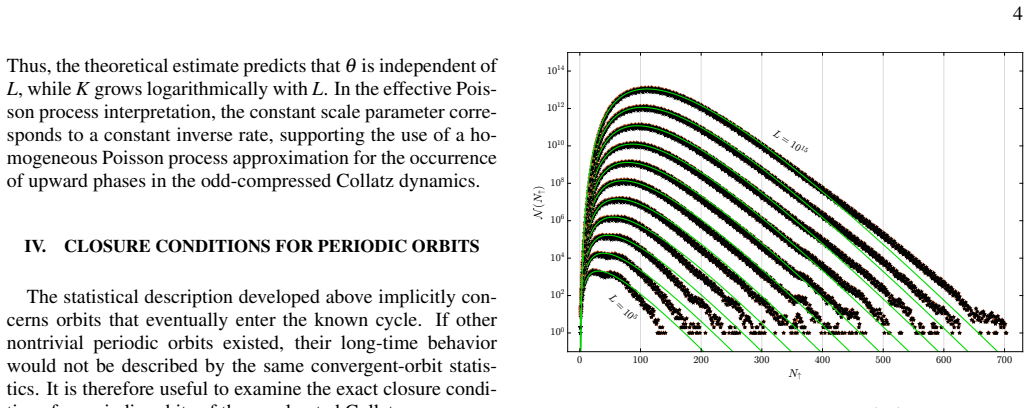
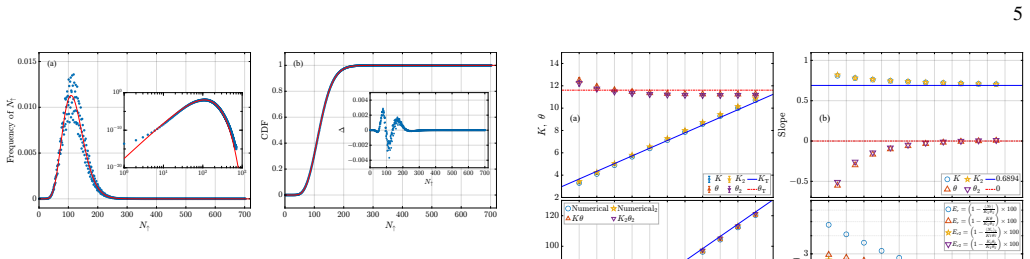
In the odd-compressed Syracuse version of the Collatz map, upward phases occur according to a homogeneous Poisson process whose intensity is set by the average logarithmic growth rate and the geometric law of 2-adic valuations; the resulting count N↑ therefore follows a Gamma distribution whose scale θ equals 2/(2−log₂3)² and whose shape K grows logarithmically with the maximal initial value X₀ = 2L+1. Closure conditions on periodic orbits further limit nontrivial cycles, supporting the statistical description.
What carries the argument
Homogeneous Poisson process for upward-phase occurrences, with rate fixed by mean-field logarithmic balance and geometric 2-adic valuations.
If this is right
- The scale parameter remains constant at approximately 11.61 for any initial value.
- The shape parameter grows logarithmically with the largest starting odd integer.
- Nontrivial periodic orbits are severely constrained by the orbit-closure conditions.
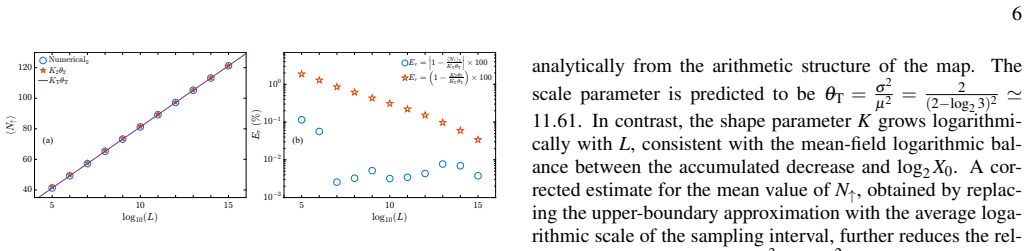
- Numerical agreement holds with relative error below 3 percent up to starting values of 10^15 and improves further with bias correction.
Where Pith is reading between the lines
- The same Poisson construction may apply directly to other integer maps that share the same mean-field growth and valuation statistics.
- If the model is accurate, orbit-length statistics in the full Collatz dynamics become accessible through standard Gamma tail bounds.
- The constraint on cycle closure could be used to bound the density of any hypothetical cycles at very large scales.
Load-bearing premise
The occurrences of upward phases in the Syracuse Collatz map behave as draws from a homogeneous Poisson process whose rate is determined by the mean-field logarithmic balance and the geometric distribution of 2-adic valuations.
What would settle it
A direct enumeration of upward phases for a large ensemble of starting values near 2×10^15 whose empirical distribution deviates from the predicted Gamma form by more than a few percent would falsify the Poisson-process mechanism.
Figures
read the original abstract
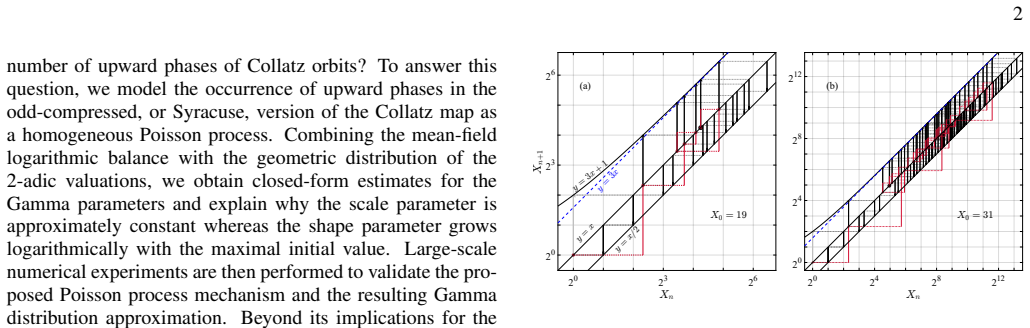
The Collatz map is a simple deterministic transformation whose orbit structure remains highly nontrivial. A recent direction-phase decomposition partitions each orbit into upward and downward steps, and numerical observations indicate that the number of upward phases, $N_{\uparrow}$, follows an approximate Gamma distribution. In this work, we provide a mechanistic explanation for this statistical regularity by modeling the occurrence of upward phases in the odd-compressed, or Syracuse, version of the Collatz map as a homogeneous Poisson process. From the mean-field logarithmic balance and the geometric distribution of $2$-adic valuations, we derive closed-form expressions for the Gamma parameters: the scale parameter $\theta = 2/(2-\log_2 3)^2 \approx 11.61$ is constant, whereas the shape parameter $K$ grows logarithmically with the maximal initial value $X_0=2L+1$. We also analyze the closure conditions for periodic orbits, showing that nontrivial cycles are severely constrained, which supports the plausibility of the statistical framework. Numerical validation for $L$ ranging from $10^5$ to $10^{15}$ confirms the theory with relative errors below $3\%$, and a bias-corrected mean estimate reduces the error to $10^{-3}$--$10^{-2}\%$. These results establish a quantitative link between the arithmetic properties of the Collatz map and Gamma-type statistics, and suggest possible extensions to generalized Collatz-type problems.
Editorial analysis
A structured set of objections, weighed in public.
Referee Report
Summary. The manuscript claims that the number of upward phases N↑ in Collatz orbits follows an approximate Gamma distribution, derived by modeling upward-phase occurrences in the Syracuse (odd-compressed) map as a homogeneous Poisson process. The scale parameter is obtained in closed form as θ = 2/(2 − log₂ 3)² ≈ 11.61 (constant), while the shape K grows logarithmically with the maximal initial value X₀ = 2L + 1; the derivation uses mean-field logarithmic balance together with the geometric law of 2-adic valuations. Numerical checks for L from 10^5 to 10^15 report relative errors below 3 % (bias-corrected to 10^{-3}–10^{-2} %), and closure conditions for periodic orbits are analyzed to support the framework.
Significance. If the Poisson modeling is valid, the work supplies a parameter-free mechanistic link between the arithmetic structure of the Collatz map (logarithmic balance and 2-adic valuations) and the emergence of Gamma statistics for N↑, with explicit predictions for both parameters. The numerical validation spans ten orders of magnitude in L and the absence of free parameters in the scale derivation are notable strengths.
major comments (1)
- [mechanistic explanation section] Mechanistic explanation section (paragraph deriving the Poisson process): the central claim that upward phases constitute a homogeneous Poisson process with constant rate rests on an unverified mean-field assumption; the deterministic recurrence x_{n+1} = (3x_n + 1)/2^{v_2(3x_n+1)} can introduce position-dependent drift and long-range correlations once the trajectory leaves the initial scale, yet no diagnostic (e.g., exponential distribution of inter-event gaps in log-height or step count, or orbit-independent rate test) is supplied. This assumption is load-bearing for the Gamma derivation and the constancy of θ.
minor comments (2)
- [abstract] Abstract and numerical validation paragraph: the reported relative errors are stated for the Gamma fit, but it is unclear whether they refer to the shape K, the scale θ, or the full distribution; explicit definition of the error metric would improve clarity.
- Notation: the maximal initial value is written both as X₀ = 2L + 1 and as the upper limit L; consistent use of a single symbol throughout would reduce ambiguity.
Simulated Author's Rebuttal
We thank the referee for the careful and constructive report. The single major comment concerns the lack of direct diagnostics supporting the homogeneous Poisson assumption in the mechanistic derivation. We address this point below and will revise the manuscript accordingly.
read point-by-point responses
-
Referee: [mechanistic explanation section] Mechanistic explanation section (paragraph deriving the Poisson process): the central claim that upward phases constitute a homogeneous Poisson process with constant rate rests on an unverified mean-field assumption; the deterministic recurrence x_{n+1} = (3x_n + 1)/2^{v_2(3x_n+1)} can introduce position-dependent drift and long-range correlations once the trajectory leaves the initial scale, yet no diagnostic (e.g., exponential distribution of inter-event gaps in log-height or step count, or orbit-independent rate test) is supplied. This assumption is load-bearing for the Gamma derivation and the constancy of θ.
Authors: We acknowledge that the manuscript presents the Poisson modeling via mean-field logarithmic balance and the geometric law of 2-adic valuations but does not supply explicit diagnostics such as inter-event gap distributions or orbit-segment rate tests. The constant rate follows from averaging the expected logarithmic increment per step, which is independent of position under the mean-field closure; local deterministic correlations are assumed to be washed out by the memoryless valuation statistics over long trajectories. The close numerical agreement with the predicted Gamma (relative errors <3 %, bias-corrected to 10^{-3}–10^{-2} %) across ten orders of magnitude in L supplies indirect support for the effective Poisson regime. Nevertheless, we agree that direct verification would strengthen the claim. In the revised version we will insert a new subsection that numerically examines the distribution of inter-arrival times in log-height and tests rate constancy across orbit segments. revision: yes
Circularity Check
No circularity: parameters derived from map arithmetic, not fitted or redefined
full rationale
The derivation models upward phases as a homogeneous Poisson process whose rate follows from the mean-field logarithmic balance (involving the factor 2-log₂3) together with the standard geometric law on 2-adic valuations. The resulting closed-form θ = 2/(2-log₂3)² and logarithmic K are therefore direct consequences of those arithmetic inputs rather than a re-expression of the target N↑ histogram. No self-citation, ansatz smuggling, or renaming of an empirical pattern occurs; numerical checks are presented as validation, not as the source of the parameters. The modeling step is an external assumption whose validity can be tested independently of the Gamma claim.
Axiom & Free-Parameter Ledger
axioms (2)
- domain assumption 2-adic valuations in the Syracuse Collatz map follow a geometric distribution
- domain assumption Mean-field logarithmic balance governs the average orbit growth
invented entities (1)
-
Homogeneous Poisson process for upward phases
no independent evidence
Reference graph
Works this paper leans on
-
[1]
100 102 104 106 108 1010 1012 1014 N(N
Hence, 1< 2N↓ 3M < 10 9 M .(32) Taking logarithms, we obtain the necessary condition log2 3< N↓ M <log 2 10 3 .(33) Moreover, ifm=min{X 0,X1, . . . ,XM−1}, then 0< N↓ M −log 2 3<log 2 1+ 1 3m < 1 3mln2 .(34) Thus, any large nontrivial cycle would require the rational numberN ↓/Mto approximate the irrational number log 2 3 from above with extremely high ac...
2047
-
[2]
R. E. Crandall, On the “3x +1 ” problem, Math. Comput.32, 1281 (1978)
1978
-
[3]
J. J. Kozak, M. K. Musho, and M. D. Hatlee, Chaos, periodic chaos, and the random-walk problem, Phys. Rev. Lett.49, 1801 (1982)
1982
-
[4]
Krasikov, How many numbers satisfy the 3x + 1 conjecture?, Internat
I. Krasikov, How many numbers satisfy the 3x + 1 conjecture?, Internat. J. Math. & Math. Sci.12, 791 (1989)
1989
-
[5]
R. H. Abraham, L. Gardini, and C. Mira,Chaos in Discrete Dynamical Systems, 1st ed. (Springer New York, NY , 1997)
1997
-
[6]
G. J. Wirsching,The Dynamical System Generated by the 3n+1 Function, 1st ed., Lecture Notes in Mathematics, V ol. 1681 (Springer Berlin, Heidelberg, 1998)
1998
-
[7]
G. J. Wirsching,The dynamical system generated by the 3n+ 1 function(Springer, 2006)
2006
-
[8]
M. C. Siegel, The collatz conjecture & non-archimedean spec- tral theory - part i - arithmetic dynamical systems and non- archimedean value distribution theory, p-Adic Numbers, Ultra- metric Analysis and Applications16, 143 (2024)
2024
-
[9]
Akin, Why is the 3x+ 1 problem hard?, Contemporary Math- ematics356, 1 (2004)
E. Akin, Why is the 3x+ 1 problem hard?, Contemporary Math- ematics356, 1 (2004)
2004
-
[10]
J. C. Lagarias, ed.,The ultimate challenge: the 3x+1 problem (American Mathematical Society, Providence, R.I., 2010)
2010
-
[11]
M. Wang, Y . Yang, Z. He, and M. Wang, The proof of the 3x + 1 conjecture, Advances in Pure Mathematics12, 10 (2022)
2022
-
[12]
K. A. Borovkov and D. Pfeifer, Estimates for the syracuse prob- lem via a probabilistic model, Theory of Probability & Its Ap- plications45, 300 (2001)
2001
-
[13]
Y . G. Sinai, Statistical (3x + 1) problem, Commun. Pure Appl. Math.56, 1016 (2003)
2003
-
[14]
Terras, A stopping time problem on the positive integers, Acta Arithmetica30, 241 (1976)
R. Terras, A stopping time problem on the positive integers, Acta Arithmetica30, 241 (1976)
1976
-
[15]
J. C. Lagarias, The 3x + 1 problem and its generalizations, The American Mathematical Monthly92, 3 (1985)
1985
-
[16]
Tao, Almost all orbits of the collatz map attain almost bounded values, Forum of Mathematics, Pi10, e12 (2022)
T. Tao, Almost all orbits of the collatz map attain almost bounded values, Forum of Mathematics, Pi10, e12 (2022)
2022
-
[17]
J. G. Polli, E. P. Raposo, G. M. Viswanathan, and M. G. E. da Luz, Stochastic-like characteristics of arithmetic dynamical systems: the collatz hailstone sequences, Journal of Physics: Complexity5, 015011 (2024)
2024
-
[18]
Barina, Convergence verification of the collatz problem, J
D. Barina, Convergence verification of the collatz problem, J. Supercomput.77, 2681 (2021)
2021
-
[19]
Barina, Improved verification limit for the convergence of the collatz conjecture, J
D. Barina, Improved verification limit for the convergence of the collatz conjecture, J. Supercomput.81, 810 (2025)
2025
-
[20]
Fu and Y
W. Fu and Y . Wang, The structure of the route to the period- three orbit in the collatz map, Mathematical and Computational Applications31, 23 (2026)
2026
-
[21]
W. Wang, Z. Liu, and B. Hu, Phase order in chaotic maps and in coupled map lattices, Phys. Rev. Lett.84, 2610 (2000)
2000
discussion (0)
Sign in with ORCID, Apple, or X to comment. Anyone can read and Pith papers without signing in.