Quantization in Federated Learning: Methods, Challenges and Future Directions
Pith reviewed 2026-06-26 04:53 UTC · model grok-4.3
The pith
Quantization in federated learning must be treated as a systems component that interacts with client drift, partial participation, and privacy mechanisms, not just as a compression technique.
A machine-rendered reading of the paper's core claim, the machinery that carries it, and where it could break.
Core claim
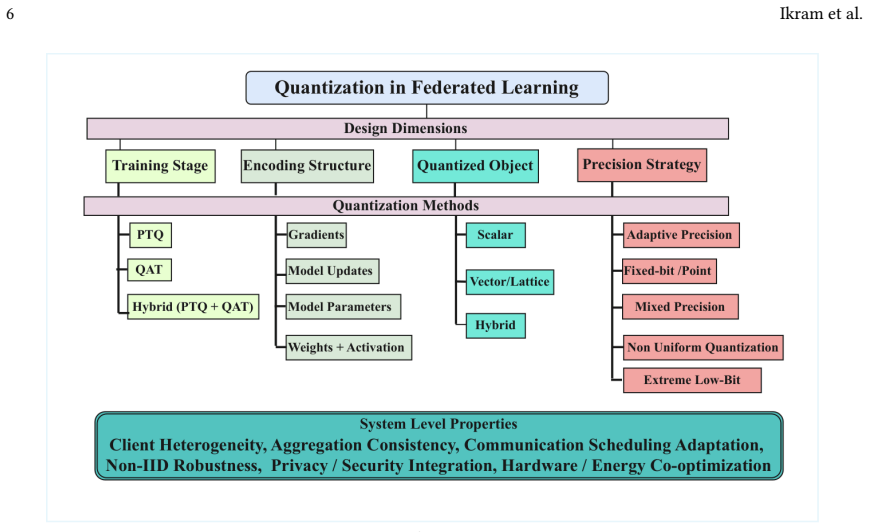
The paper claims to be the first FL-centric systematic review that introduces a novel taxonomy for quantization methods organized around FL-specific dimensions including client heterogeneity, aggregation consistency, communication-scheduling adaptation, non-IID robustness, privacy/security integration, and hardware/energy co-optimization, while analyzing interactions with FL behaviors such as client drift, partial participation, convergence stability, secure aggregation, and differential privacy.
What carries the argument
A novel taxonomy for quantization in FL organized around six FL-specific dimensions that captures how quantization methods address client heterogeneity, aggregation consistency, and related challenges.
If this is right
- Quantization methods can be assessed for their robustness to non-IID data distributions in federated settings.
- Design choices in quantization must consider integration with secure aggregation protocols.
- Hardware and energy co-optimization becomes a key factor in selecting quantization strategies for edge devices.
- Communication scheduling can be adapted based on quantization levels to improve overall FL efficiency.
Where Pith is reading between the lines
- Practitioners could use the taxonomy to select quantization methods that balance privacy and performance in specific FL deployments.
- Future work might extend the taxonomy to include emerging FL variants like vertical federated learning.
- The analysis suggests that ignoring FL-specific dimensions in quantization could lead to suboptimal convergence in heterogeneous environments.
Load-bearing premise
The review assumes that all existing quantization methods in federated learning can be meaningfully captured and organized by the six proposed FL-specific dimensions without significant omissions.
What would settle it
Discovery of a quantization technique used in federated learning that cannot be classified under any of the six dimensions of client heterogeneity, aggregation consistency, communication-scheduling adaptation, non-IID robustness, privacy/security integration, or hardware/energy co-optimization.
Figures
read the original abstract
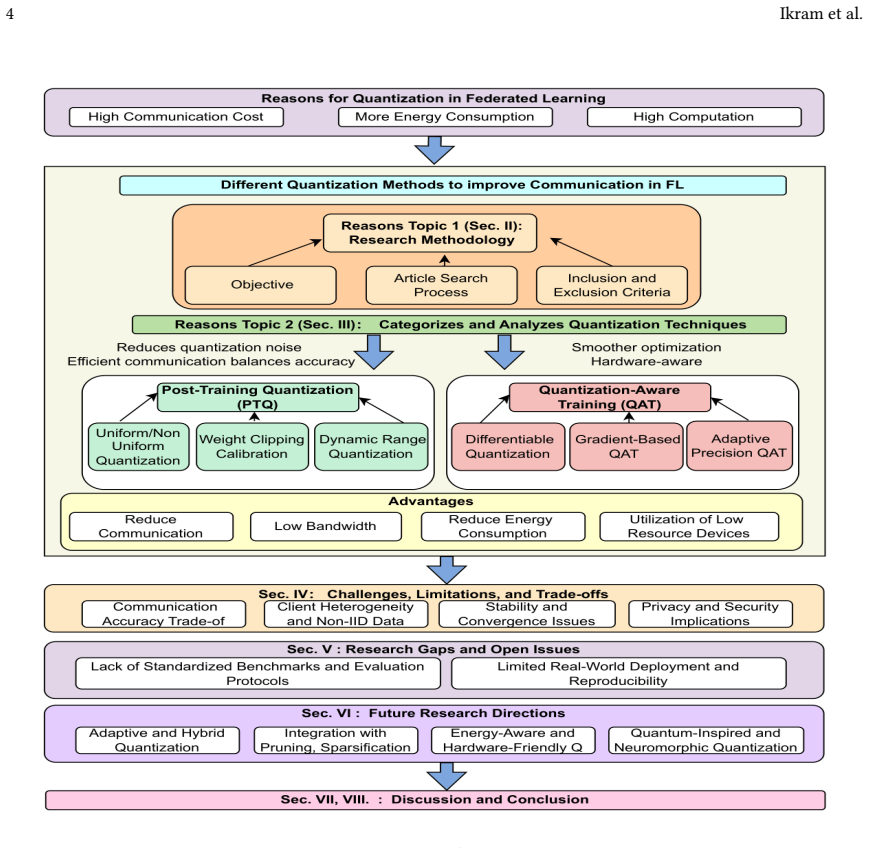
Federated Learning (FL) has become a foundational paradigm for privacy-preserving distributed intelligence, yet its scalability remains fundamentally constrained by communication bottlenecks, device heterogeneity, and the challenges of training under statistically non-IID data. Quantization is one of the most effective mechanisms for mitigating these limitations, reducing both uplink/downlink payloads and on-device computation. This paper provides the first FL-centric systematic review of quantization, introducing a novel taxonomy organized around FL-specific dimensions, including client heterogeneity, aggregation consistency, communication-scheduling adaptation, non-IID robustness, privacy/security integration, and hardware/energy co-optimization. Beyond cataloging existing methods, we analyze how quantization interacts with core FL behaviors such as client drift, partial participation, convergence stability, secure aggregation, and differential privacy. We further identify cross-method insights, open research gaps, and design guidelines for practitioners deploying quantized FL on mobile, IoT, and edge platforms. This survey thus establishes quantization not merely as a compression technique, but as a fundamental systems component shaping the performance, robustness, and practicality of modern FL.
Editorial analysis
A structured set of objections, weighed in public.
Referee Report
Summary. This manuscript is a systematic literature survey on quantization techniques applied to Federated Learning (FL). It claims to be the first FL-centric review, proposing a novel taxonomy organized around six FL-specific dimensions (client heterogeneity, aggregation consistency, communication-scheduling adaptation, non-IID robustness, privacy/security integration, and hardware/energy co-optimization). The paper catalogs existing methods, analyzes interactions with FL phenomena such as client drift, partial participation, convergence, secure aggregation, and differential privacy, identifies cross-method insights and research gaps, and offers design guidelines for deployment on mobile/IoT/edge platforms.
Significance. If the taxonomy successfully organizes the literature without major omissions and the interaction analysis yields actionable insights, the survey could become a useful reference for the FL community. The emphasis on FL-specific dimensions rather than generic quantization categories is a potential strength, as is the explicit treatment of how quantization affects core FL behaviors. Reproducible aspects are limited to the survey methodology itself; no machine-checked proofs or code artifacts are mentioned.
minor comments (3)
- [Abstract] Abstract: the claim of being the 'first FL-centric systematic review' would benefit from a brief footnote or sentence contrasting the scope against the closest prior surveys on FL compression or quantization (e.g., those focused on general model compression).
- [Taxonomy section (inferred from abstract)] The six taxonomy dimensions are introduced in the abstract and presumably detailed in the main taxonomy section; a short table mapping each dimension to the specific FL challenges it addresses would improve readability and help readers quickly locate relevant methods.
- [Future directions / gaps section] The discussion of open research gaps is valuable but would be strengthened by indicating, for each gap, whether it is primarily a methodological, empirical, or systems-integration issue.
Simulated Author's Rebuttal
We thank the referee for the constructive review and the recommendation of minor revision. The report accurately summarizes the manuscript's contributions and does not raise any specific major comments or concerns requiring detailed rebuttal.
Circularity Check
No significant circularity in survey structure
full rationale
This is a literature survey paper whose central contribution is a taxonomy organizing existing external quantization methods in FL. No derivations, equations, fitted parameters, predictions, or self-citation chains appear in the provided abstract or description. The taxonomy is presented as an organizational framework for prior work rather than a derived result that reduces to its own inputs. All content references external literature without load-bearing self-referential steps.
Axiom & Free-Parameter Ledger
Reference graph
Works this paper leans on
-
[1]
Abdelmoniem and Marco Canini
Ahmed M. Abdelmoniem and Marco Canini. 2021. Towards Mitigating Device Heterogeneity in Federated Learning via Adaptive Model Quantization. InProceedings of the 1st Workshop on Machine Learning and Systems(Online, United Kingdom)(EuroMLSys ’21). Association for Computing Machinery, New York, NY, USA, 96–103
2021
-
[2]
Mohammed Aledhari, Rehma Razzak, Reza M Parizi, and Fahad Saeed. 2020. Federated learning: A survey on enabling technologies, protocols, and applications.IEEE Access8 (2020), 140699–140725
2020
-
[3]
Li, Ryota Tomioka, and Milan Vojnovic
Dan Alistarh, Demjan Grubic, Jerry Z. Li, Ryota Tomioka, and Milan Vojnovic. 2017. QSGD: communication-efficient SGD via gradient quantization and encoding. InProceedings of the 31st International Conference on Neural Information Processing Systems(Long Beach, California, USA)(NIPS’17). 1707–1718
2017
-
[4]
Omair Rashed Abdulwareth Almanifi, Chee-Onn Chow, Mau-Luen Tham, Joon Huang Chuah, and Jeevan Kanesan. 2023. Communication and computation efficiency in federated learning: A survey.Internet of Things22 (2023), 100742
2023
-
[5]
Mohammad Mohammadi Amiri, Deniz Gunduz, Sanjeev R. Kulkarni, and H. Vincent Poor. 2020. Federated Learning With Quantized Global Model Updates. arXiv:2006.10672 [cs.IT] https://arxiv.org/abs/2006.10672
-
[6]
Emre Ardiç and Yakup Genç. 2025. Enhanced Privacy and Communication Efficiency in Non-IID Federated Learning With Adaptive Quantization and Differential Privacy.IEEE Access13 (2025), 54322–54337
2025
-
[7]
Hesham Ayman, Shaimaa Haridy, Yasmine M Afify, and Walaa Gad. 2026. FedEnsemble: federated learning model for efficient sentiment analysis. Computing108, 1 (2026), 11. Manuscript submitted to ACM Quantization in Federated Learning: Methods, Challenges and Future Directions 31
2026
- [8]
- [9]
-
[10]
Ron Banner, Yury Nahshan, and Daniel Soudry. 2019. Post training 4-bit quantization of convolutional networks for rapid-deployment. InAdvances in Neural Information Processing Systems, H. Wallach, H. Larochelle, A. Beygelzimer, F. d'Alché-Buc, E. Fox, and R. Garnett (Eds.), Vol. 32. Curran Associates, Inc., Article 714, 9 pages
2019
-
[11]
Yoshua Bengio, Nicholas Léonard, and Aaron Courville. 2013. Estimating or Propagating Gradients Through Stochastic Neurons for Conditional Computation. InarXiv preprint arXiv:1308.3432
work page internal anchor Pith review Pith/arXiv arXiv 2013
-
[12]
Brendan McMahan, Sarvar Patel, Daniel Ramage, Aaron Segal, and Karn Seth
Keith Bonawitz, Vladimir Ivanov, Ben Kreuter, Antonio Marcedone, H. Brendan McMahan, Sarvar Patel, Daniel Ramage, Aaron Segal, and Karn Seth. 2017. Practical Secure Aggregation for Privacy-Preserving Machine Learning. InProceedings of the 2017 ACM SIGSAC Conference on Computer and Communications Security(Dallas, Texas, USA)(CCS ’17). 1175–1191
2017
-
[13]
Pavlos S Bouzinis, Panagiotis D Diamantoulakis, and George K Karagiannidis. 2023. Wireless quantized federated learning: A joint computation and communication design.IEEE Transactions on Communications71, 5 (2023), 2756–2770
2023
-
[14]
Zavareh Bozorgasl and Hao Chen. 2025. Communication-Efficient Federated Learning via Clipped Uniform Quantization. In59th Annual Conference on Information Sciences and Systems (CISS). IEEE, 1–6
2025
-
[15]
Sebastian Caldas, Peter Wu, Tian Li, Jakub Konečný, Brendan McMahan, Virginia Smith, and Ameet Talwalkar. 2018. LEAF: A Benchmark for Federated Settings. InProceedings of the 2nd Workshop on Federated Learning for Data Privacy and Confidentiality
2018
-
[16]
Guojun Chen, Kaixuan Xie, Yuheng Tu, Tiecheng Song, Yinfei Xu, Jing Hu, and Lun Xin. 2024. NQFL: Nonuniform Quantization for Communication Efficient Federated Learning.IEEE Communications Letters28, 2 (2024), 332–336
2024
-
[17]
Huancheng Chen and Haris Vikalo. 2024. Mixed-precision quantization for federated learning on resource-constrained heterogeneous devices. In Proceedings of the IEEE/CVF Conference on Computer Vision and Pattern Recognition. 6138–6148
2024
-
[18]
Huiqiang Chen, Tianqing Zhu, Tao Zhang, Wanlei Zhou, and Philip S. Yu. 2023. Privacy and Fairness in Federated Learning: On the Perspective of Tradeoff.ACM Comput. Surv.56, 2, Article 39 (Sept. 2023), 37 pages
2023
-
[19]
Li Chen, Wei Liu, Yunfei Chen, and Weidong Wang. 2024. Communication-efficient design for quantized decentralized federated learning.IEEE Transactions on Signal Processing72 (2024), 1175–1188
2024
-
[20]
Longfei Chen, Zhenyu Wu, and Yang Ji. 2023. Two-Stage Adaptive Gradient Quantization in Federated Learning. In2023 8th IEEE International Conference on Network Intelligence and Digital Content (IC-NIDC). IEEE, 441–445
2023
-
[21]
Mingzhe Chen, Nir Shlezinger, H Vincent Poor, Yonina C Eldar, and Shuguang Cui. 2021. Communication-efficient federated learning.Proceedings of the National Academy of Sciences118, 17 (2021), e2024789118
2021
-
[22]
Shengbo Chen, Le Li, Guanghui Wang, Meng Pang, and Cong Shen. 2023. Federated learning with heterogeneous quantization bit allocation and aggregation for internet of things.IEEE Internet of Things Journal11, 2 (2023), 3132–3143
2023
-
[23]
Zichao Chen and Jun Zhang. 2025. Efficient Communication Method for Hierarchical Federated Learning Based on 1-Bit Compressed Sensing. In 5th International Conference on Consumer Electronics and Computer Engineering (ICCECE). IEEE, 675–678
2025
-
[24]
Jungwook Choi, Kailash Gopalakrishnan, Swagath Venkataramani, and Vijayalakshmi Srinivasan. 2021. A Survey on Mixed-Precision Quantization for Deep Neural Networks.IEEE Transactions on Neural Networks and Learning Systems33, 4 (2021), 1452–1468
2021
-
[25]
Jungwook Choi, Zhuo Wang, Swagath Venkataramani, Po-Han Chuang, Vijayalakshmi Srinivasan, and Kailash Gopalakrishnan. 2018. PACT: Parameterized Clipping Activation for Quantized Neural Networks. InProceedings of the European Conference on Computer Vision (ECCV). 730–746
2018
-
[26]
J. H. Conway and N. J. A. Sloane. 1999.Sphere Packings, Lattices and Groups. Springer
1999
- [27]
-
[28]
de Lamare, and Vítor H
Alireza Danaee, Rodrigo C. de Lamare, and Vítor H. Nascimento. 2022. Quantization-Aware Federated Learning with Coarsely Quantized Measurements. In30th European Signal Processing Conference (EUSIPCO). 1691–1695
2022
-
[29]
Mahoney, and Kurt Keutzer
Zhen Dong, Zhewei Yao, Amir Gholami, Michael W. Mahoney, and Kurt Keutzer. 2019. HAWQ: Hessian Aware Quantization of Neural Networks With Mixed-Precision. InProceedings of the IEEE International Conference on Computer Vision (ICCV). 293–302
2019
-
[30]
Qiang Duan, Jun Huang, Shijing Hu, Ruijun Deng, Zhihui Lu, and Shui Yu. 2023. Combining Federated Learning and Edge Computing Toward Ubiquitous Intelligence in 6G Network: Challenges, Recent Advances, and Future Directions.IEEE Communications Surveys & Tutorials25, 4 (2023), 2892–2950
2023
-
[31]
Praveer Dubey and Mohit kumar. 2024. Quantization Strategies in Federated Learning: Comparative Assessment of Methods and Challenges. (Aug. 2024). https://doi.org/10.36227/techrxiv.172503571.10768521/v1
-
[32]
Anis Elgabli. 2025. PP-QADMM: A Dual-Driven Perturbation and Quantized ADMM for Privacy Preserving and Communication-Efficient Federated Learning.IEEE Open Journal of the Communications Society6 (2025), 4156–4175
2025
-
[33]
Ahmed Roushdy Elkordy and A Salman Avestimehr. 2022. HeteroSAg: Secure aggregation with heterogeneous quantization in federated learning. IEEE Transactions on Communications70, 4 (2022), 2372–2386
2022
-
[34]
Esser, Jeffrey L
Steven K. Esser, Jeffrey L. McKinstry, Deepika Bablani, Raja Appuswamy, and Dharmendra S. Modha. 2020. Learned Step Size Quantization. In ICLR. Manuscript submitted to ACM 32 Ikram et al
2020
-
[35]
Xiang Fang, Li Chen, Huarui Yin, Xiaohui Chen, and Weidong Wang. 2026. Communication Efficient Federated Learning With Quantization-Aware Training Design.IEEE Transactions on Machine Learning in Communications and Networking4 (2026), 45–59
2026
-
[36]
Wenjun Feng and Xian Zhang. 2022. Wireless federated learning with dynamic quantization and bandwidth adaptation.IEEE Wireless Communica- tions Letters11, 11 (2022), 2335–2339
2022
-
[37]
Jonas Geiping, Hartmut Bauermeister, Hannah Dröge, and Michael Moeller. 2020. Inverting gradients - how easy is it to break privacy in federated learning?. InProceedings of the 34th International Conference on Neural Information Processing Systems(Vancouver, BC, Canada)(NIPS ’20). Article 1421, 11 pages
2020
-
[38]
Amir Gholami, Sehoon Kim, Zhen Dong, Zhewei Yao, Michael W. Mahoney, and Kurt Keutzer. 2021. A Survey of Quantization Methods for Efficient Neural Network Inference. arXiv:2103.13630 [cs.CV] https://arxiv.org/abs/2103.13630
-
[39]
Shinya Gongyo, Jinrong Liang, Mitsuru Ambai, Rei Kawakami, and Ikuro Sato. 2024. Learning Non-Uniform Step Sizes for Neural Network Quantization. InProceedings of the Asian Conference on Computer Vision (ACCV). 4385–4402
2024
-
[40]
Kartik Gupta, Marios Fournarakis, Matthias Reisser, Christos Louizos, and Markus Nagel. 2023. Quantization Robust Federated Learning for Efficient Inference on Heterogeneous Devices.Transactions on Machine Learning Research(2023)
2023
-
[41]
Shayan Mohajer Hamidi and Ali Bereyhi. 2025. Rate-Constrained Quantization for Communication-Efficient Federated Learning. InICASSP 2025 - 2025 IEEE International Conference on Acoustics, Speech and Signal Processing (ICASSP). 1–5
2025
-
[42]
Song Han, Huizi Mao, and William J. Dally. 2016. Deep Compression: Compressing Deep Neural Networks with Pruning, Trained Quantization and Huffman Coding.International Conference on Learning Representations (ICLR)(2016)
2016
-
[43]
Muhammad Abdullah Hanif, Giuseppe Maria Sarda, Alberto Marchisio, Guido Masera, Maurizio Martina, and Muhammad Shafique. 2022. CoNLoCNN: Exploiting Correlation and Non-Uniform Quantization for Energy-Efficient Low-precision Deep Convolutional Neural Networks. In 2022 International Joint Conference on Neural Networks (IJCNN). 1–8
2022
-
[44]
Nan He, Yiming Chen, Zheng Jiang, Song Yang, and Lifeng Sun. 2025. DynFed: Adaptive Federated Learning via Quantization-Aware Knowledge Distillation. InProceedings of the 33rd ACM International Conference on Multimedia(Dublin, Ireland)(MM ’25). Association for Computing Machinery, New York, NY, USA, 11844–11852
2025
-
[45]
Zixiao He, Gengming Zhu, Shaobo Zhang, Entao Luo, and Yijiang Zhao. 2025. FedDT: A Communication-Efficient Federated Learning via Knowledge Distillation and Ternary Compression.Electronics14, 11 (2025), 2183
2025
-
[46]
Robert Hönig, Yiren Zhao, and Robert Mullins. 2022. DAdaQuant: Doubly-adaptive quantization for communication-efficient federated learning. In International Conference on Machine Learning. PMLR, 8852–8866
2022
-
[47]
Benoit Jacob, Skirmantas Kligys, Bo Chen, Menglong Zhu, Matthew Tang, Andrew Howard, Hartwig Adam, and Dmitry Kalenichenko. 2018. Quantization and Training of Neural Networks for Efficient Integer-Arithmetic-Only Inference. InProceedings of the IEEE Conference on Computer Vision and Pattern Recognition (CVPR). 2704–2713
2018
-
[48]
Eric Jang, Shixiang Gu, and Ben Poole. 2017. Categorical Reparameterization with Gumbel-Softmax. InProceedings of the International Conference on Learning Representations (ICLR)
2017
-
[49]
Herve Jégou, Matthijs Douze, and Cordelia Schmid. 2011. Product Quantization for Nearest Neighbor Search.IEEE Transactions on Pattern Analysis and Machine Intelligence33, 1 (2011), 117–128
2011
-
[50]
Divyansh Jhunjhunwala, Advait Gadhikar, Gauri Joshi, and Yonina C Eldar. 2021. Adaptive quantization of model updates for communication- efficient federated learning. InIEEE International Conference on Acoustics, Speech and Signal Processing (ICASSP). IEEE, 3110–3114
2021
-
[51]
Yu Ji and Lan Chen. 2022. FedQNN: A computation–communication-efficient federated learning framework for IoT with low-bitwidth neural network quantization.IEEE Internet of Things Journal10, 3 (2022), 2494–2507
2022
-
[52]
Ninghui Jia, Zhihao Qu, Baoliu Ye, Yanyan Wang, Shihong Hu, and Song Guo. 2025. A Comprehensive Survey on Communication-Efficient Federated Learning in Mobile Edge Environments.IEEE Communications Surveys & Tutorials(2025), 1–1
2025
-
[53]
Brendan McMahan, Brendan Avent, Aurélien Bellet, Mehdi Bennis, Arjun Nitin Bhagoji, Kallista Bonawit, Zachary Charles, Graham Cormode, et al
Peter Kairouz, H. Brendan McMahan, Brendan Avent, Aurélien Bellet, Mehdi Bennis, Arjun Nitin Bhagoji, Kallista Bonawit, Zachary Charles, Graham Cormode, et al. 2021
2021
-
[54]
Khan, Walid Saad, Zhu Han, Ekram Hossain, and Choong Seon Hong
Latif U. Khan, Walid Saad, Zhu Han, Ekram Hossain, and Choong Seon Hong. 2021. Federated Learning for Internet of Things: Recent Advances, Taxonomy, and Open Challenges.IEEE Communications Surveys & Tutorials23, 3 (2021), 1759–1799
2021
-
[55]
Ansam Khraisat, Ammar Alazab, Sarabjot Singh, Tony Jan, and Alfredo Jr. Gomez. 2024. Survey on Federated Learning for Intrusion Detection System: Concept, Architectures, Aggregation Strategies, Challenges, and Future Directions.ACM Comput. Surv.57, 1, Article 7 (Oct. 2024), 38 pages
2024
-
[56]
Minsu Kim, Walid Saad, Mohammad Mozaffari, and Merouane Debbah. 2022. On the tradeoff between energy, precision, and accuracy in federated quantized neural networks. InIEEE International Conference on Communications. IEEE, 2194–2199
2022
- [57]
-
[58]
You Jun Kim and Choong Seon Hong. 2020. Optimized quantization for convolutional deep neural networks in federated learning. In21st Asia-Pacific Network Operations and Management Symposium (APNOMS). IEEE, 150–154
2020
-
[59]
Federated Learning: Strategies for Improving Communication Efficiency
Jakub Konečný, H. Brendan McMahan, Felix X. Yu, Peter Richtárik, Ananda Theertha Suresh, and Dave Bacon. 2017. Federated Learning: Strategies for Improving Communication Efficiency. arXiv:1610.05492 [cs.LG] https://arxiv.org/abs/1610.05492
work page internal anchor Pith review Pith/arXiv arXiv 2017
-
[60]
Raghuraman Krishnamoorthi. 2018. Quantizing Deep Convolutional Networks for Efficient Inference: A Whitepaper.arXiv preprint arXiv:1806.08342 (2018). Manuscript submitted to ACM Quantization in Federated Learning: Methods, Challenges and Future Directions 33
work page internal anchor Pith review Pith/arXiv arXiv 2018
-
[61]
Kummari Naveen Kumar, Chalavadi Krishna Mohan, and Linga Reddy Cenkeramaddi. 2024. The Impact of Adversarial Attacks on Federated Learning: A Survey.IEEE Transactions on Pattern Analysis and Machine Intelligence46, 5 (2024), 2672–2691
2024
-
[62]
Natalie Lang, Elad Sofer, Tomer Shaked, and Nir Shlezinger. 2023. Joint privacy enhancement and quantization in federated learning.IEEE Transactions on Signal Processing71 (2023), 295–310
2023
-
[63]
Sangmin Lee and Hyeryung Jang. 2025. BiPruneFL: Computation and Communication Efficient Federated Learning With Binary Quantization and Pruning.IEEE Access13 (2025), 42441–42456
2025
-
[64]
Hao Li, Asim Kadav, Igor Durdanovic, Hanan Samet, and Hans Peter Graf. 2020. Additive Powers-of-Two Quantization: An Efficient Non-Uniform Discretization for Neural Networks. InICLR
2020
-
[65]
Tian Li, Anit Kumar Sahu, Ameet Talwalkar, and Virginia Smith. 2020. Federated learning: Challenges, methods, and future directions.IEEE signal processing magazine37, 3 (2020), 50–60
2020
-
[66]
Tian Li, Anit Kumar Sahu, Manzil Zaheer, Maziar Sanjabi, Ameet Talwalkar, and Virginia Smith. 2019. Federated Optimization in Heterogeneous Networks. InProceedings of the 1st Adaptive & Multitask Learning Workshop, Long Beach, California, 2019
2019
-
[67]
Yangchen Li, Ying Cui, and Vincent Lau. 2024. GQFedWAvg: Optimization-Based Quantized Federated Learning in General Edge Computing Systems.IEEE Transactions on Wireless Communications23, 7 (2024), 6856–6872
2024
-
[68]
Yifei Li, Yijia Guo, Mamoun Alazab, Shengbo Chen, Cong Shen, and Keping Yu. 2022. Joint optimal quantization and aggregation of federated learning scheme in VANETs.IEEE Transactions on Intelligent Transportation Systems23, 10 (2022), 19852–19863
2022
-
[69]
Yawen Li, Wenling Li, and Zhe Xue. 2022. Federated learning with stochastic quantization.International Journal of Intelligent Systems37, 12 (2022), 11600–11621
2022
-
[70]
Zirui Lian, Jing Cao, Yanru Zuo, Weihong Liu, and Zongwei Zhu. 2021. AGQFL: communication-efficient federated learning via automatic gradient quantization in edge heterogeneous systems. In2021 IEEE 39th International Conference on Computer Design (ICCD). IEEE, 551–558
2021
-
[71]
Wei Yang Bryan Lim, Nguyen Cong Luong, Dinh Thai Hoang, Yutao Jiao, Ying-Chang Liang, Qiang Yang, Dusit Niyato, and Chunyan Miao. 2020. Federated learning in mobile edge networks: A comprehensive survey.IEEE communications surveys & tutorials22, 3 (2020), 2031–2063
2020
-
[72]
Xiaohan Lin, Yuan Liu, and Fangjiong Chen. 2021. Channel-adaptive quantization for wireless federated learning. In2021 IEEE/CIC International Conference on Communications in China (ICCC). IEEE, 457–462
2021
-
[73]
Yujun Lin, Song Han, Huizi Mao, Yu Wang, and William Dally. 2018. Deep Gradient Compression: Reducing the Communication Bandwidth for Distributed Training. InInternational Conference on Learning Representations (ICLR)
2018
-
[74]
Heting Liu, Fang He, and Guohong Cao. 2023. Communication-efficient federated learning for heterogeneous edge devices based on adaptive gradient quantization. InIEEE INFOCOM 2023-IEEE Conference on Computer Communications. IEEE, 1–10
2023
-
[75]
Ji Liu, Jizhou Huang, Yang Zhou, Xuhong Li, Shilei Ji, Haoyi Xiong, and Dejing Dou. 2022. From distributed machine learning to federated learning: A survey.Knowledge and Information Systems64, 4 (2022), 885–917
2022
-
[76]
Xiaonan Liu, Yansha Deng, Arumugam Nallanathan, and Mehdi Bennis. 2024. Federated Learning and Meta Learning: Approaches, Applications, and Directions.IEEE Communications Surveys & Tutorials26, 1 (2024), 571–618
2024
-
[77]
Yi Liu, Xingliang Yuan, Zehui Xiong, Jiawen Kang, Xiaofei Wang, and Dusit Niyato. 2020. Federated learning for 6G communications: Challenges, methods, and future directions.China Communications17, 9 (2020), 105–118
2020
-
[78]
Sin Kit Lo, Qinghua Lu, Chen Wang, Hye-Young Paik, and Liming Zhu. 2021. A systematic literature review on federated machine learning: From a software engineering perspective.Comput. Surveys54, 5 (2021), 1–39
2021
-
[79]
2020.Threats to Federated Learning
Lingjuan Lyu, Han Yu, Jun Zhao, and Qiang Yang. 2020.Threats to Federated Learning. Springer International Publishing, Cham, 3–16
2020
-
[80]
Yuzhu Mao, Zihao Zhao, Guangfeng Yan, Yang Liu, Tian Lan, Linqi Song, and Wenbo Ding. 2022. Communication-efficient federated learning with adaptive quantization.ACM Transactions on Intelligent Systems and Technology (TIST)13, 4 (2022), 1–26
2022
discussion (0)
Sign in with ORCID, Apple, or X to comment. Anyone can read and Pith papers without signing in.