Liquid Fusion of Heterogeneous Representations Towards General Salient Object Detection
Pith reviewed 2026-06-26 05:40 UTC · model grok-4.3
The pith
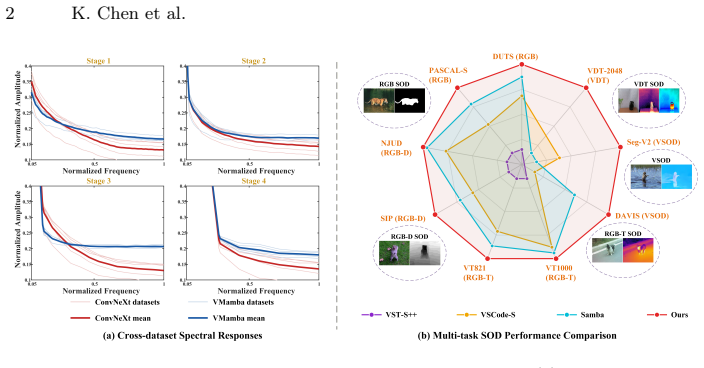
Harmonizing complementary frequency preferences of CNNs and SSMs through dynamic liquid fusion yields state-of-the-art general salient object detection.
A machine-rendered reading of the paper's core claim, the machinery that carries it, and where it could break.
Core claim
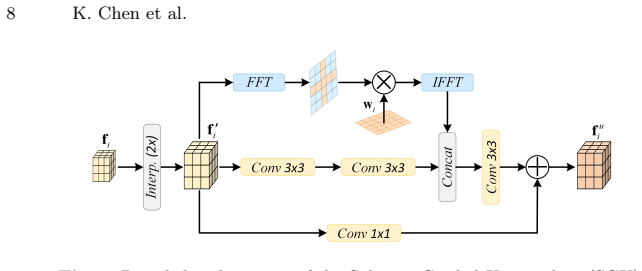
Dataset-level spectral analysis reveals that CNN and SSM representations are inherently complementary due to their frequency preferences. LFNet therefore fuses VMamba (treated as continuous evolving states) and ConvNeXt (treated as exogenous stimulus) via a content-aware dynamic gating mechanism drawn from liquid neural networks; the resulting state-stimulus paradigm extends directly to multi-modal inputs. A Saliency-Guided Upsampling operator then propagates the fused features to shallow layers using a spectral-spatial co-design. Experiments across the five tasks confirm that this construction attains state-of-the-art detection accuracy while preserving computational efficiency.
What carries the argument
Liquid fusion: a dynamic gating mechanism that aggregates continuous SSM features (evolving states) with CNN features (exogenous stimulus) in a content-aware manner.
If this is right
- The state-stimulus paradigm scales directly to additional modalities without architectural redesign.
- Saliency-Guided Upsampling reduces upsampling artifacts while retaining semantic content from the fused representation.
- The accuracy-efficiency trade-off improves relative to prior single-paradigm or multi-stage SOD models.
- The fusion preserves the spectral complementarity observed in the initial analysis.
Where Pith is reading between the lines
- The same frequency-bias analysis could guide hybrid designs in other dense-prediction tasks such as segmentation or depth estimation.
- Extending the liquid fusion idea to additional backbone pairs (for example, different SSM variants) is a direct next experiment.
- If the dynamic gating learns modality-specific stimulus weights, the method may generalize to unseen input combinations not present in the current training sets.
Load-bearing premise
The complementary frequency preferences identified by dataset-level spectral analysis can be preserved and usefully combined by the liquid fusion mechanism without loss of either bias.
What would settle it
A controlled ablation that replaces the dynamic gating with static concatenation or single-backbone baselines and measures whether performance on the five tasks drops by more than the reported margin.
Figures



read the original abstract
General Salient Object Detection (SOD) aims to identify and segment visually interesting objects from uni-modality or multi-modality scenes, recently advanced by cutting-edge State Space Models (SSMs). However, a critical limitation of current approaches is their neglect of the inherent spectral biases exhibited by different neural network paradigms. By digging to the dataset-level spectral analysis of Convolutional Neural Networks (CNNs) and SSMs, their semantic representations are inherently complementary based on their complementary frequency preferences. Inspired by this, we harmonize heterogeneous representations from SSMs and CNNs to bridge their spectral biases for general salient object detection. To this end, inspired by the dynamic information propagation of Liquid Neural Networks (LNNs), we introduce a liquid fusion to dynamically integrates features from two backbones, including VMamba and ConvNeXt, referred to Liquid Fusion Network (LFNet). Concretely, by treating the continuous VMamba features and ConvNeXt features as evolving states and exogenous stimulus, respectively, LFNet employs a dynamic gating mechanism for content-aware feature aggregation. Crucially, this state-stimulus paradigm enables to scale to multi-modal cues, resulting in flexibility in general SOD. Besides, a Saliency-Guided Upsampling (SGU) operator to propagate the features to the shallow layer, which leverages a spectral-spatial co-design to suppress upsampling artifacts while preserving semantics. Extensive experiments across five diverse tasks (RGB, RGB-D, RGB-T, VSOD, and VDT) demonstrate that LFNet achieves state-of-the-art performance, offering a superior trade-off between detection accuracy and model efficiency. Code has been released at https://github.com/cke520/LFNet.
Editorial analysis
A structured set of objections, weighed in public.
Referee Report
Summary. The manuscript proposes LFNet for general salient object detection across uni- and multi-modal tasks. It performs dataset-level spectral analysis to identify complementary frequency biases between CNN (ConvNeXt) and SSM (VMamba) backbones, then introduces a liquid fusion module (state-stimulus dynamic gating inspired by Liquid Neural Networks) to aggregate heterogeneous features in a content-aware manner, plus a Saliency-Guided Upsampling operator. The approach is claimed to scale to five tasks (RGB, RGB-D, RGB-T, VSOD, VDT) while delivering SOTA accuracy-efficiency trade-offs; code is released.
Significance. If the spectral complementarity is empirically shown to be preserved through fusion and causally responsible for gains (rather than capacity or ensembling), the work could offer a principled route to combining heterogeneous architectures for multi-modal SOD. The code release aids reproducibility.
major comments (2)
- [Abstract / Introduction] Abstract and motivating analysis: the dataset-level spectral analysis establishing inherent complementarity of CNN and SSM frequency preferences is not reported as having been performed on the exact training distributions of the five tasks; this is load-bearing for the central premise that the liquid fusion bridges spectral biases.
- [Method (liquid fusion description)] Liquid fusion mechanism: no post-fusion spectral analysis or targeted ablation is described to confirm that the dynamic gating retains the complementary biases (as opposed to the observed gains arising from simple capacity increase); this directly affects whether the motivating observation is causal.
minor comments (1)
- [Abstract] Abstract claims 'extensive experiments' and 'SOTA performance' without any quantitative metrics, baselines, or error analysis; while common, this reduces immediate verifiability of the central claim.
Simulated Author's Rebuttal
We thank the referee for the constructive comments on the spectral analysis and the causal role of the liquid fusion module. We address each point below and will incorporate clarifications and additional analyses in the revised manuscript.
read point-by-point responses
-
Referee: [Abstract / Introduction] Abstract and motivating analysis: the dataset-level spectral analysis establishing inherent complementarity of CNN and SSM frequency preferences is not reported as having been performed on the exact training distributions of the five tasks; this is load-bearing for the central premise that the liquid fusion bridges spectral biases.
Authors: We performed the spectral analysis on representative training distributions drawn from the primary datasets of each task (e.g., DUTS for RGB, NJU2K for RGB-D, etc.). To remove any ambiguity, we will explicitly document the exact datasets and splits used for the frequency analysis in Section 3.1 of the revision and confirm their alignment with the training sets employed for each of the five tasks. revision: yes
-
Referee: [Method (liquid fusion description)] Liquid fusion mechanism: no post-fusion spectral analysis or targeted ablation is described to confirm that the dynamic gating retains the complementary biases (as opposed to the observed gains arising from simple capacity increase); this directly affects whether the motivating observation is causal.
Authors: We agree that post-fusion spectral analysis and a targeted ablation isolating the retention of frequency complementarity would strengthen the causal argument. We will add (i) a post-fusion frequency analysis comparing pre- and post-liquid-fusion spectra and (ii) an ablation that replaces the dynamic gating with a static concatenation of equal capacity in the revised manuscript. revision: yes
Circularity Check
No significant circularity; derivation is empirically grounded
full rationale
The paper's core chain consists of (1) performing a dataset-level spectral analysis to observe frequency preferences of CNN vs. SSM backbones, (2) designing a new liquid fusion module (state-stimulus gating) inspired by LNN dynamics to aggregate them, and (3) reporting empirical SOTA results on five tasks. None of these steps reduce to self-definition, fitted parameters renamed as predictions, or load-bearing self-citations. The complementarity observation is an external measurement, not a tautology, and the fusion mechanism is a novel architectural choice whose effectiveness is tested rather than assumed by construction. No equations or claims equate the output to the input by definition.
Axiom & Free-Parameter Ledger
free parameters (1)
- dynamic gating mechanism parameters
axioms (1)
- domain assumption CNNs and SSMs exhibit complementary frequency preferences in their semantic representations
invented entities (2)
-
Liquid fusion mechanism
no independent evidence
-
Saliency-Guided Upsampling operator
no independent evidence
Reference graph
Works this paper leans on
-
[1]
IEEE Transactions on Circuits and Systems for Video Technology32(9), 6308–6323 (2022)
Chen, G., Shao, F., Chai, X., Chen, H., Jiang, Q., Meng, X., Ho, Y.S.: Cgmdrnet: Cross-guided modality difference reduction network for rgb-t salient object detec- tion. IEEE Transactions on Circuits and Systems for Video Technology32(9), 6308–6323 (2022)
2022
-
[2]
In: Proceedings of the AAAI Conference on Artificial Intelligence
Chen, S., Luo, Y., Ma, Y., Qiao, Y., Wang, Y.: H-mba: Hierarchical mamba adap- tation for multi-modal video understanding in autonomous driving. In: Proceedings of the AAAI Conference on Artificial Intelligence. vol. 39, pp. 2212–2220 (2025)
2025
-
[3]
IEEE Transactions on Image Processing30, 7012–7024 (2020)
Chen, Z., Cong, R., Xu, Q., Huang, Q.: Dpanet: Depth potentiality-aware gated attention network for rgb-d salient object detection. IEEE Transactions on Image Processing30, 7012–7024 (2020)
2020
-
[4]
Chi,L.,Jiang,B.,Mu,Y.:Fastfourierconvolution.AdvancesinNeuralInformation Processing Systems33, 4479–4488 (2020)
2020
-
[5]
Cong, R., Zhang, K., Zhang, C., Zheng, F., Zhao, Y., Huang, Q., Kwong, S.: Does thermal really always matter for rgb-t salient object detection? IEEE Transactions on Multimedia25, 6971–6982 (2022)
2022
-
[6]
In: 2025 IEEE High Performance Extreme Computing Conference (HPEC)
Coskun, T., Vishwamith, H., Isik, M., Naoukin, J., Dikmen, I.C.: Exploring neu- romorphic computing with loihi-2 for high-performance cfd simulations. In: 2025 IEEE High Performance Extreme Computing Conference (HPEC). pp. 1–7. IEEE (2025)
2025
-
[7]
IEEE Transactions on Intelligent Vehicles9(1), 2624–2635 (2023)
Ding, N., Zhang, C., Eskandarian, A.: Saliendet: A saliency-based feature enhance- ment algorithm for object detection for autonomous driving. IEEE Transactions on Intelligent Vehicles9(1), 2624–2635 (2023)
2023
-
[8]
IEEE Transactions on neural networks and learning systems32(5), 2075–2089 (2020) 16 K
Fan, D.P., Lin, Z., Zhang, Z., Zhu, M., Cheng, M.M.: Rethinking rgb-d salient ob- ject detection: Models, data sets, and large-scale benchmarks. IEEE Transactions on neural networks and learning systems32(5), 2075–2089 (2020) 16 K. Chen et al
2075
-
[9]
In: Proceedings of the IEEE/CVF conference on computer vision and pattern recognition
Fan, D.P., Wang, W., Cheng, M.M., Shen, J.: Shifting more attention to video salient object detection. In: Proceedings of the IEEE/CVF conference on computer vision and pattern recognition. pp. 8554–8564 (2019)
2019
-
[10]
In: European conference on computer vision
Fan, D.P., Zhai, Y., Borji, A., Yang, J., Shao, L.: Bbs-net: Rgb-d salient object detection with a bifurcated backbone strategy network. In: European conference on computer vision. pp. 275–292. Springer (2020)
2020
-
[11]
In: Proceedings of the IEEE/CVF conference on computer vision and pattern recognition
Fu, K., Fan, D.P., Ji, G.P., Zhao, Q.: Jl-dcf: Joint learning and densely-cooperative fusion framework for rgb-d salient object detection. In: Proceedings of the IEEE/CVF conference on computer vision and pattern recognition. pp. 3052–3062 (2020)
2020
-
[12]
In: European conference on com- puter vision
Gao, S.H., Tan, Y.Q., Cheng, M.M., Lu, C., Chen, Y., Yan, S.: Highly efficient salient object detection with 100k parameters. In: European conference on com- puter vision. pp. 702–721. Springer (2020)
2020
-
[13]
Mamba: Linear-Time Sequence Modeling with Selective State Spaces
Gu, A., Dao, T.: Mamba: Linear-time sequence modeling with selective state spaces. arXiv preprint arXiv:2312.00752 (2023)
work page internal anchor Pith review Pith/arXiv arXiv 2023
-
[14]
Efficiently Modeling Long Sequences with Structured State Spaces
Gu, A., Goel, K., Ré, C.: Efficiently modeling long sequences with structured state spaces. arXiv preprint arXiv:2111.00396 (2021)
work page internal anchor Pith review Pith/arXiv arXiv 2021
-
[15]
In: Proceedings of the 1st international workshop on pervasive eye tracking & mobile eye-based interaction
Hagiwara, A., Sugimoto, A., Kawamoto, K.: Saliency-based image editing for guid- ing visual attention. In: Proceedings of the 1st international workshop on pervasive eye tracking & mobile eye-based interaction. pp. 43–48 (2011)
2011
-
[16]
Nature Machine Intelligence4(11), 992–1003 (2022)
Hasani, R., Lechner, M., Amini, A., Liebenwein, L., Ray, A., Tschaikowski, M., Teschl, G., Rus, D.: Closed-form continuous-time neural networks. Nature Machine Intelligence4(11), 992–1003 (2022)
2022
-
[17]
7657–7666 (2021)
Hasani, R., Lechner, M., Amini, A., Rus, D., Grosu, R.: Liquid time-constant networks.In:ProceedingsoftheAAAIConferenceonArtificialIntelligence.vol.35, pp. 7657–7666 (2021)
2021
-
[18]
In: Proceedings of the Computer Vision and Pat- tern Recognition Conference
He, J., Fu, K., Liu, X., Zhao, Q.: Samba: A unified mamba-based framework for general salient object detection. In: Proceedings of the Computer Vision and Pat- tern Recognition Conference. pp. 25314–25324 (2025)
2025
-
[19]
He,K.,Zhang,X.,Ren,S.,Sun,J.:Deepresiduallearningforimagerecognition.In: Proceedings of the IEEE conference on computer vision and pattern recognition. pp. 770–778 (2016)
2016
-
[20]
International Journal of Com- puter Vision132(8), 3067–3085 (2024)
Hu, X., Sun, F., Sun, J., Wang, F., Li, H.: Cross-modal fusion and progressive decoding network for rgb-d salient object detection. International Journal of Com- puter Vision132(8), 3067–3085 (2024)
2024
-
[21]
In: Proceedings of the IEEE/CVF international conference on computer vision
Ji, G.P., Fu, K., Wu, Z., Fan, D.P., Shen, J., Shao, L.: Full-duplex strategy for video object segmentation. In: Proceedings of the IEEE/CVF international conference on computer vision. pp. 4922–4933 (2021)
2021
-
[22]
In: Proceedings of the IEEE/CVF conference on computer vision and pattern recognition
Ji, W., Li, J., Yu, S., Zhang, M., Piao, Y., Yao, S., Bi, Q., Ma, K., Zheng, Y., Lu, H., et al.: Calibrated rgb-d salient object detection. In: Proceedings of the IEEE/CVF conference on computer vision and pattern recognition. pp. 9471–9481 (2021)
2021
-
[23]
Expert Systems with Applications247, 123222 (2024)
Jin, D., Shao, F., Xie, Z., Mu, B., Chen, H., Jiang, Q.: Cafcnet: Cross-modality asymmetric feature complement network for rgb-t salient object detection. Expert Systems with Applications247, 123222 (2024)
2024
-
[24]
In: 2014 IEEE international conference on image pro- cessing (ICIP)
Ju, R., Ge, L., Geng, W., Ren, T., Wu, G.: Depth saliency based on anisotropic center-surround difference. In: 2014 IEEE international conference on image pro- cessing (ICIP). pp. 1115–1119. IEEE (2014)
2014
-
[25]
Kao, P.: Robust flight navigation with liquid neural networks. Ph.D. thesis, Mas- sachusetts Institute of Technology (2022) LFNet 17
2022
-
[26]
In: European conference on computer vision
Lee, M., Park, C., Cho, S., Lee, S.: Spsn: Superpixel prototype sampling network for rgb-d salient object detection. In: European conference on computer vision. pp. 630–647. Springer (2022)
2022
-
[27]
In: Proceedings of the Com- puter Vision and Pattern Recognition Conference
Li, B., Zhao, H., Wang, W., Hu, P., Gou, Y., Peng, X.: Mair: A locality-and continuity-preserving mamba for image restoration. In: Proceedings of the Com- puter Vision and Pattern Recognition Conference. pp. 7491–7501 (2025)
2025
-
[28]
In: Proceedings of the IEEE international conference on computer vision
Li,F.,Kim,T.,Humayun,A.,Tsai,D.,Rehg,J.M.:Videosegmentationbytracking many figure-ground segments. In: Proceedings of the IEEE international conference on computer vision. pp. 2192–2199 (2013)
2013
-
[29]
In: Proceedings of the IEEE conference on computer vision and pattern recognition
Li, G., Yu, Y.: Visual saliency based on multiscale deep features. In: Proceedings of the IEEE conference on computer vision and pattern recognition. pp. 5455–5463 (2015)
2015
-
[30]
IEEE Transactions on Image Processing27(1), 349–364 (2017)
Li, J., Xia, C., Chen, X.: A benchmark dataset and saliency-guided stacked au- toencoders for video-based salient object detection. IEEE Transactions on Image Processing27(1), 349–364 (2017)
2017
-
[31]
In: Proceedings of the IEEE conference on computer vision and pattern recognition
Li, Y., Hou, X., Koch, C., Rehg, J.M., Yuille, A.L.: The secrets of salient object segmentation. In: Proceedings of the IEEE conference on computer vision and pattern recognition. pp. 280–287 (2014)
2014
-
[32]
arXiv preprint arXiv:2501.15330 (2025)
Liu, M., Geißler, D., Bian, S., Zhou, B., Lukowicz, P.: Assessing the impact of sampling irregularity in time series data: Human activity recognition as a case study. arXiv preprint arXiv:2501.15330 (2025)
-
[33]
IEEE Transactions on Pattern Analysis and Machine Intelligence 46(11), 7300–7316 (2024)
Liu, N., Luo, Z., Zhang, N., Han, J.: Vst++: Efficient and stronger visual saliency transformer. IEEE Transactions on Pattern Analysis and Machine Intelligence 46(11), 7300–7316 (2024)
2024
-
[34]
IEEE Transactions on Neural Networks and Learning Systems35(8), 10663–10673 (2023)
Liu, N., Nan, K., Zhao, W., Yao, X., Han, J.: Learning complementary spatial– temporal transformer for video salient object detection. IEEE Transactions on Neural Networks and Learning Systems35(8), 10663–10673 (2023)
2023
-
[35]
In: Proceedings of the IEEE/CVF international conference on computer vision
Liu, N., Zhang, N., Wan, K., Shao, L., Han, J.: Visual saliency transformer. In: Proceedings of the IEEE/CVF international conference on computer vision. pp. 4722–4732 (2021)
2021
-
[36]
IEEE Transactions on Geo- science and Remote Sensing61, 1–16 (2023)
Liu, Y., Xiong, Z., Yuan, Y., Wang, Q.: Transcending pixels: Boosting saliency detection via scene understanding from aerial imagery. IEEE Transactions on Geo- science and Remote Sensing61, 1–16 (2023)
2023
-
[37]
International Journal of Computer Vision133(7), 4483–4503 (2025)
Liu, Y., Li, C., Xu, S., Han, J.: Part-whole relational fusion towards multi-modal scene understanding. International Journal of Computer Vision133(7), 4483–4503 (2025)
2025
-
[38]
Advances in neural information processing systems37, 103031–103063 (2024)
Liu, Y., Tian, Y., Zhao, Y., Yu, H., Xie, L., Wang, Y., Ye, Q., Jiao, J., Liu, Y.: Vmamba: Visual state space model. Advances in neural information processing systems37, 103031–103063 (2024)
2024
-
[39]
IEEE Transactions on Circuits and Systems for Video Technology32(7), 4486–4497 (2021)
Liu,Z.,Tan,Y.,He,Q.,Xiao,Y.:Swinnet:Swintransformerdrivesedge-awarergb- d and rgb-t salient object detection. IEEE Transactions on Circuits and Systems for Video Technology32(7), 4486–4497 (2021)
2021
-
[40]
IEEE Transactions on Circuits and Systems for Video Technology34(11), 10662– 10677 (2024)
Luo, Y., Shao, F., Mu, B., Chen, H., Li, Z., Jiang, Q.: Dynamic weighted fusion and progressive refinement network for visible-depth-thermal salient object detection. IEEE Transactions on Circuits and Systems for Video Technology34(11), 10662– 10677 (2024)
2024
-
[41]
In: Proceedings of the IEEE/CVF conference on computer vision and pattern recognition
Luo, Z., Liu, N., Zhao, W., Yang, X., Zhang, D., Fan, D.P., Khan, F., Han, J.: Vscode: General visual salient and camouflaged object detection with 2d prompt learning. In: Proceedings of the IEEE/CVF conference on computer vision and pattern recognition. pp. 17169–17180 (2024) 18 K. Chen et al
2024
-
[42]
IEEE Transactions on Image Processing32, 1026–1038 (2023)
Ma, M., Xia, C., Xie, C., Chen, X., Li, J.: Boosting broader receptive fields for salient object detection. IEEE Transactions on Image Processing32, 1026–1038 (2023)
2023
-
[43]
IEEE Signal Processing Letters29, 1674–1678 (2022)
Min, D., Zhang, C., Lu, Y., Fu, K., Zhao, Q.: Mutual-guidance transformer- embedding network for video salient object detection. IEEE Signal Processing Letters29, 1674–1678 (2022)
2022
-
[44]
In: 2012 IEEE conference on computer vision and pattern recognition
Niu, Y., Geng, Y., Li, X., Liu, F.: Leveraging stereopsis for saliency analysis. In: 2012 IEEE conference on computer vision and pattern recognition. pp. 454–461. IEEE (2012)
2012
-
[45]
IEEE transactions on pattern analysis and machine intelligence36(6), 1187–1200 (2013)
Ochs, P., Malik, J., Brox, T.: Segmentation of moving objects by long term video analysis. IEEE transactions on pattern analysis and machine intelligence36(6), 1187–1200 (2013)
2013
-
[46]
In: European conference on computer vision
Peng, H., Li, B., Xiong, W., Hu, W., Ji, R.: Rgbd salient object detection: A benchmark and algorithms. In: European conference on computer vision. pp. 92–
-
[47]
In: Proceedings of the IEEE conference on computer vision and pattern recognition
Perazzi, F., Pont-Tuset, J., McWilliams, B., Van Gool, L., Gross, M., Sorkine- Hornung, A.: A benchmark dataset and evaluation methodology for video object segmentation. In: Proceedings of the IEEE conference on computer vision and pattern recognition. pp. 724–732 (2016)
2016
-
[48]
In: Proceedings of the IEEE/CVF inter- national conference on computer vision
Piao, Y., Ji, W., Li, J., Zhang, M., Lu, H.: Depth-induced multi-scale recurrent attention network for saliency detection. In: Proceedings of the IEEE/CVF inter- national conference on computer vision. pp. 7254–7263 (2019)
2019
-
[49]
Advances in neural information processing systems35, 5614–5627 (2022)
Piao, Y., Lu, C., Zhang, M., Lu, H.: Semi-supervised video salient object detec- tion based on uncertainty-guided pseudo labels. Advances in neural information processing systems35, 5614–5627 (2022)
2022
-
[50]
In: Proceedings of the IEEE/CVF con- ference on computer vision and pattern recognition
Qin, X., Zhang, Z., Huang, C., Gao, C., Dehghan, M., Jagersand, M.: Basnet: Boundary-aware salient object detection. In: Proceedings of the IEEE/CVF con- ference on computer vision and pattern recognition. pp. 7479–7489 (2019)
2019
-
[51]
In: Unmanned Systems Technology XIV
Roberts, R., Ta, D.N., Straub, J., Ok, K., Dellaert, F.: Saliency detection and model-based tracking: a two part vision system for small robot navigation in forested environment. In: Unmanned Systems Technology XIV. vol. 8387, pp. 306–
-
[52]
In: Proceedings of the IEEE/CVF international conference on computer vision
Siris, A., Jiao, J., Tam, G.K., Xie, X., Lau, R.W.: Scene context-aware salient object detection. In: Proceedings of the IEEE/CVF international conference on computer vision. pp. 4156–4166 (2021)
2021
-
[53]
IEEE Transactions on Circuits and Systems for Video Technology33(7), 3104– 3118 (2022)
Song, K., Huang, L., Gong, A., Yan, Y.: Multiple graph affinity interactive net- work and a variable illumination dataset for rgbt image salient object detection. IEEE Transactions on Circuits and Systems for Video Technology33(7), 3104– 3118 (2022)
2022
-
[54]
IEEE/ASME Transactions on Mechatronics28(3), 1558–1569 (2022)
Song, K., Wang, J., Bao, Y., Huang, L., Yan, Y.: A novel visible-depth-thermal im- age dataset of salient object detection for robotic visual perception. IEEE/ASME Transactions on Mechatronics28(3), 1558–1569 (2022)
2022
-
[55]
IEEE Transactions on Multimedia26, 313–325 (2023)
Su, Y., Deng, J., Sun, R., Lin, G., Su, H., Wu, Q.: A unified transformer framework for group-based segmentation: Co-segmentation, co-saliency detection and video salient object detection. IEEE Transactions on Multimedia26, 313–325 (2023)
2023
-
[56]
IEEE Transactions on Mul- timedia26, 2249–2262 (2023)
Sun, F., Ren, P., Yin, B., Wang, F., Li, H.: Catnet: A cascaded and aggregated transformer network for rgb-d salient object detection. IEEE Transactions on Mul- timedia26, 2249–2262 (2023)
2023
-
[57]
IEEE transactions on pattern anal- ysis and machine intelligence47(3), 1958–1974 (2024) LFNet 19
Tang, H., Li, Z., Zhang, D., He, S., Tang, J.: Divide-and-conquer: Confluent triple- flow network for rgb-t salient object detection. IEEE transactions on pattern anal- ysis and machine intelligence47(3), 1958–1974 (2024) LFNet 19
1958
-
[58]
IEEE Transactions on Multimedia25, 4163– 4176 (2022)
Tu, Z., Ma, Y., Li, Z., Li, C., Xu, J., Liu, Y.: Rgbt salient object detection: A large-scale dataset and benchmark. IEEE Transactions on Multimedia25, 4163– 4176 (2022)
2022
-
[59]
IEEE Transactions on Multimedia22(1), 160–173 (2019)
Tu, Z., Xia, T., Li, C., Wang, X., Ma, Y., Tang, J.: Rgb-t image saliency detection via collaborative graph learning. IEEE Transactions on Multimedia22(1), 160–173 (2019)
2019
-
[60]
IEEE Trans- actions on Multimedia26, 2069–2081 (2023)
Wan, B., Zhou, X., Sun, Y., Wang, T., Lv, C., Wang, S., Yin, H., Yan, C.: Mffnet: Multi-modal feature fusion network for vdt salient object detection. IEEE Trans- actions on Multimedia26, 2069–2081 (2023)
2069
-
[61]
Pattern Recognition147, 110074 (2024)
Wan, B., Zhou, X., Sun, Y., Zhu, Z., Wang, H., Yan, C., et al.: Tmnet: Triple- modal interaction encoder and multi-scale fusion decoder network for vdt salient object detection. Pattern Recognition147, 110074 (2024)
2024
-
[62]
In: 2025 IEEE/CVF Winter Conference on Applications of Computer Vision (WACV)
Wan, Z., Zhang, P., Wang, Y., Yong, S., Stepputtis, S., Sycara, K., Xie, Y.: Sigma: Siamese mamba network for multi-modal semantic segmentation. In: 2025 IEEE/CVF Winter Conference on Applications of Computer Vision (WACV). pp. 1734–1744. IEEE (2025)
2025
-
[63]
In: Chinese Confer- ence on Image and Graphics Technologies
Wang, G., Li, C., Ma, Y., Zheng, A., Tang, J., Luo, B.: Rgb-t saliency detection benchmark: Dataset, baselines, analysis and a novel approach. In: Chinese Confer- ence on Image and Graphics Technologies. pp. 359–369. Springer (2018)
2018
-
[64]
In: Proceedings of the AAAI conference on artificial intelligence
Wang, K., Chen, K., Li, C., Tu, Z., Luo, B.: Alignment-free rgb-t salient object de- tection: A large-scale dataset and progressive correlation network. In: Proceedings of the AAAI conference on artificial intelligence. vol. 39, pp. 7780–7788 (2025)
2025
-
[65]
In: Proceedings of the IEEE conference on computer vision and pattern recognition
Wang, L., Lu, H., Wang, Y., Feng, M., Wang, D., Yin, B., Ruan, X.: Learning to detect salient objects with image-level supervision. In: Proceedings of the IEEE conference on computer vision and pattern recognition. pp. 136–145 (2017)
2017
-
[66]
In: Proceedings of the IEEE/CVF conference on computer vision and pattern recognition
Wang, Y., Wang, R., Fan, X., Wang, T., He, X.: Pixels, regions, and objects: Mul- tiple enhancement for salient object detection. In: Proceedings of the IEEE/CVF conference on computer vision and pattern recognition. pp. 10031–10040 (2023)
2023
-
[67]
arXiv preprint arXiv:2301.00808 (2023)
Woo, S., Debnath, S., Hu, R., Chen, X., Liu, Z., Kweon, I.S., Xie, S.: Convnext v2: Co-designing and scaling convnets with masked autoencoders. arXiv preprint arXiv:2301.00808 (2023)
-
[68]
IEEE Transactions on Image Processing31, 3125–3136 (2022)
Wu, Y.H., Liu, Y., Zhang, L., Cheng, M.M., Ren, B.: Edn: Salient object detection via extremely-downsampled network. IEEE Transactions on Image Processing31, 3125–3136 (2022)
2022
-
[69]
In: Proceedings of the IEEE conference on computer vision and pattern recognition
Yan, Q., Xu, L., Shi, J., Jia, J.: Hierarchical saliency detection. In: Proceedings of the IEEE conference on computer vision and pattern recognition. pp. 1155–1162 (2013)
2013
-
[70]
arXiv preprint arXiv:2403.17695 (2024)
Yang, C., Chen, Z., Espinosa, M., Ericsson, L., Wang, Z., Liu, J., Crowley, E.J.: Plainmamba: Improving non-hierarchical mamba in visual recognition. arXiv preprint arXiv:2403.17695 (2024)
-
[71]
In: Proceedings of the IEEE conference on computer vision and pattern recognition
Yang, C., Zhang, L., Lu, H., Ruan, X., Yang, M.H.: Saliency detection via graph- based manifold ranking. In: Proceedings of the IEEE conference on computer vision and pattern recognition. pp. 3166–3173 (2013)
2013
-
[72]
In: Proceedings of the IEEE/CVF international conference on computer vision
Zhang, M., Liu, J., Wang, Y., Piao, Y., Yao, S., Ji, W., Li, J., Lu, H., Luo, Z.: Dynamic context-sensitive filtering network for video salient object detection. In: Proceedings of the IEEE/CVF international conference on computer vision. pp. 1553–1563 (2021)
2021
-
[73]
Zhang, Z., Wang, J., Han, Y.: Saliency prototype for rgb-d and rgb-t salient object detection.In:Proceedingsofthe31stACMinternationalconferenceonmultimedia. pp. 3696–3705 (2023) 20 K. Chen et al
2023
-
[74]
IEEE Transactions on Geoscience and Remote Sensing62, 1–14 (2024)
Zhao, S., Chen, H., Zhang, X., Xiao, P., Bai, L., Ouyang, W.: Rs-mamba for large remote sensing image dense prediction. IEEE Transactions on Geoscience and Remote Sensing62, 1–14 (2024)
2024
-
[75]
IEEE Transactions on Image Processing33, 709–721 (2024)
Zhao, X., Liang, H., Li, P., Sun, G., Zhao, D., Liang, R., He, X.: Motion-aware memory network for fast video salient object detection. IEEE Transactions on Image Processing33, 709–721 (2024)
2024
-
[76]
In: Proceedings of the IEEE/CVF international confer- ence on computer vision
Zhou, T., Fu, H., Chen, G., Zhou, Y., Fan, D.P., Shao, L.: Specificity-preserving rgb-d saliency detection. In: Proceedings of the IEEE/CVF international confer- ence on computer vision. pp. 4681–4691 (2021)
2021
-
[77]
IEEE Transactions on Image Processing32, 1329–1340 (2023)
Zhou, W., Zhu, Y., Lei, J., Yang, R., Yu, L.: Lsnet: Lightweight spatial boosting network for detecting salient objects in rgb-thermal images. IEEE Transactions on Image Processing32, 1329–1340 (2023)
2023
-
[78]
In: Proceedings of the IEEE/CVF international conference on computer vision
Zhou, Z., Pei, W., Li, X., Wang, H., Zheng, F., He, Z.: Saliency-associated object tracking. In: Proceedings of the IEEE/CVF international conference on computer vision. pp. 9866–9875 (2021)
2021
-
[79]
IEEE Geoscience and Remote Sensing Letters22, 1–5 (2024)
Zhu, E., Chen, Z., Wang, D., Shi, H., Liu, X., Wang, L.: Unetmamba: An efficient unet-like mamba for semantic segmentation of high-resolution remote sensing im- ages. IEEE Geoscience and Remote Sensing Letters22, 1–5 (2024)
2024
-
[80]
Vision Mamba: Efficient Visual Representation Learning with Bidirectional State Space Model
Zhu, L., Liao, B., Zhang, Q., Wang, X., Liu, W., Wang, X.: Vision mamba: Efficient visual representation learning with bidirectional state space model. arXiv preprint arXiv:2401.09417 (2024)
work page internal anchor Pith review Pith/arXiv arXiv 2024
discussion (0)
Sign in with ORCID, Apple, or X to comment. Anyone can read and Pith papers without signing in.