Accelerated sampling using SamAdams variable timesteps and position-adaptive Langevin dynamics
Pith reviewed 2026-06-26 04:16 UTC · model grok-4.3
The pith
SamAdams variable timesteps combined with position-adaptive Langevin dynamics accelerate sampling while preserving the canonical distribution.
A machine-rendered reading of the paper's core claim, the machinery that carries it, and where it could break.
Core claim
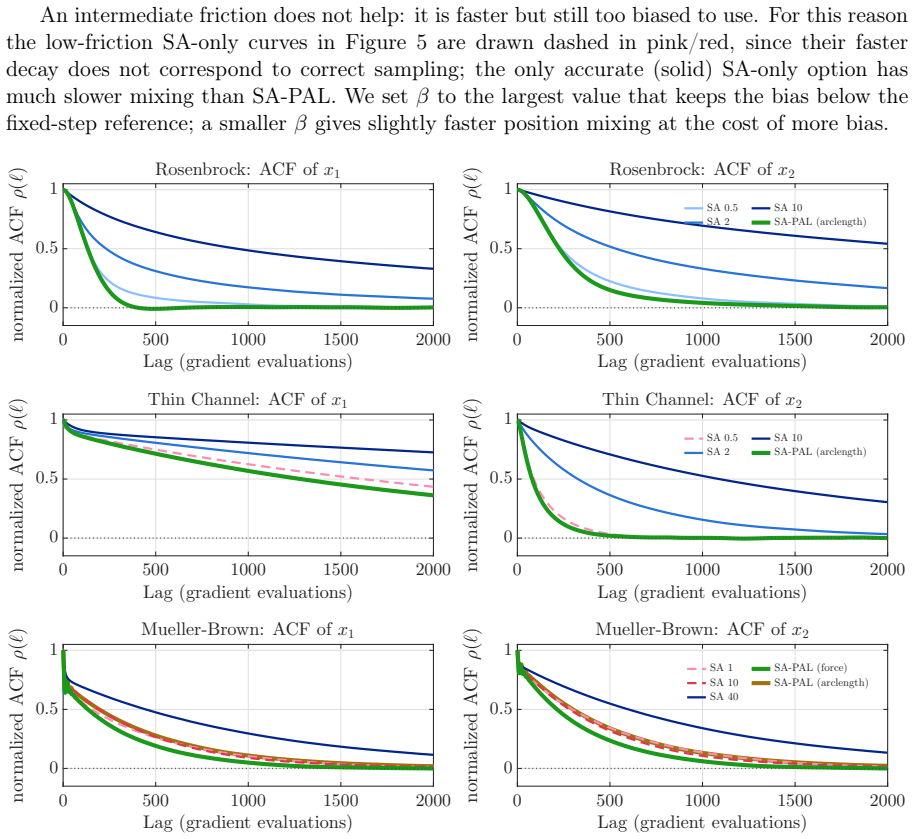
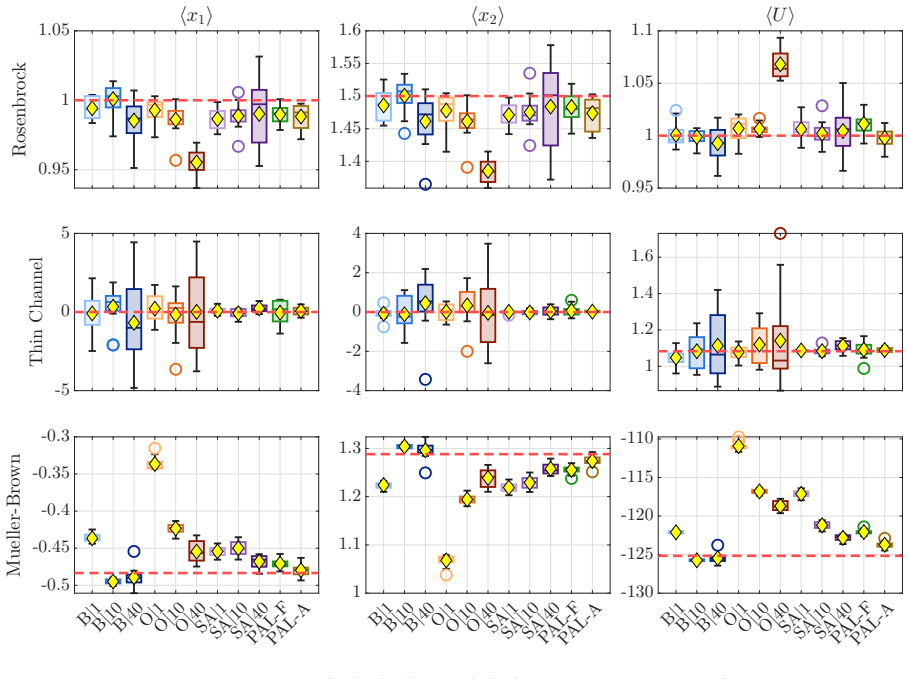
The SA-PAL scheme integrates SamAdams adaptive timestepping, which shrinks the effective step using a relaxed stiffness monitor, with position-adaptive Langevin dynamics that concentrates friction along the force direction while keeping the canonical distribution as the exact invariant measure; implemented via a palindromic integrator, the method improves mixing rates by 1.5-3 times on Rosenbrock and Mueller-Brown potentials and yields efficiency gains exceeding an order of magnitude on the remaining examples.
What carries the argument
SamAdams adaptive timestepping, which automatically shrinks the effective integration step in stiff regions using a relaxed stiffness monitor, together with position-adaptive Langevin dynamics, which concentrates friction along the local force direction while preserving the canonical distribution.
If this is right
- The palindromic integrator requires only one force evaluation per iteration because of the rank-one-plus-scalar structure of the PAL friction tensor.
- Mixing rates improve by factors between 1.5 and 3 relative to fixed-stepsize integration on the Rosenbrock and Mueller-Brown potentials.
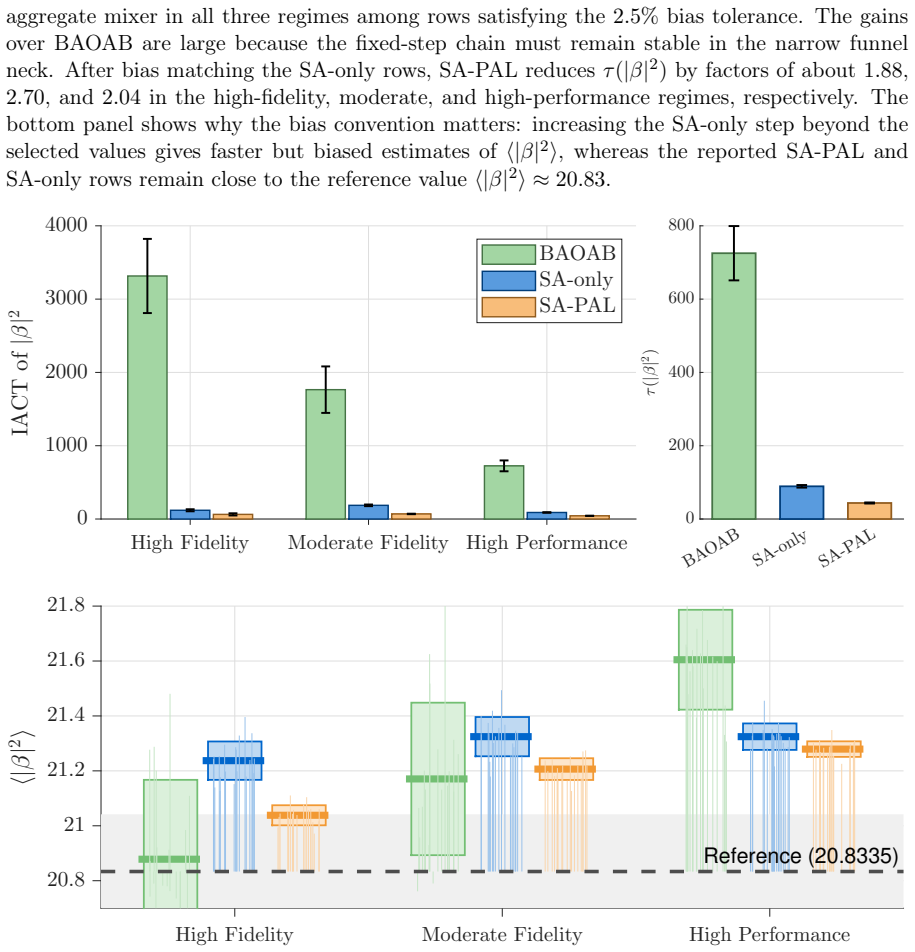
- Efficiency gains of more than an order of magnitude appear on the thin entropic channel and the Bayesian parameterisation problem with sparsity-inducing prior.
- The canonical distribution remains exactly invariant under the combined dynamics.
Where Pith is reading between the lines
- The same adaptive friction idea could be tested on molecular-dynamics systems whose stiffness varies strongly with conformation.
- Variable-timestep schemes of this type might reduce the amount of manual step-size tuning required for reliable sampling.
- Applying the method to larger Bayesian models with many parameters would test whether the efficiency gains persist at higher dimension.
Load-bearing premise
Position-adaptive Langevin dynamics concentrates friction along the local force direction while preserving the canonical distribution as the exact invariant measure.
What would settle it
A simulation in which the long-time distribution generated by the PAL dynamics deviates measurably from the canonical distribution on any of the tested potentials, or in which the combined SA-PAL integrator fails to improve mixing rates over fixed-stepsize integration on the Rosenbrock potential.
Figures
read the original abstract
We introduce an accelerated Langevin-based sampling method that is based on two complementary devices: \emph{SamAdams} adaptive timestepping, which automatically shrinks the effective integration step in stiff regions of phase space using a relaxed stiffness monitor, and \emph{position-adaptive Langevin} (PAL) dynamics, which concentrates friction along the local force direction while preserving the canonical distribution as the exact invariant measure. The resulting combined scheme (SA-PAL) is implemented in a palindromic integrator which requires only one force evaluation per iteration through suitable organisation of the integration steps and by exploiting the rank-one-plus-scalar structure of the PAL friction tensor. We test the method on various model problems: the Rosenbrock function, a thin entropic channel, the Mueller-Brown potential, and a Bayesian parameterisation problem with a sparsity-inducing shrinkage prior. On the Rosenbrock and Mueller-Brown potentials mixing rates are improved by 1.5-3 times compared to fixed stepsize integration. Efficiency gains of more than an order of magnitude are documented in the other examples.
Editorial analysis
A structured set of objections, weighed in public.
Referee Report
Summary. The paper introduces SamAdams adaptive timestepping combined with position-adaptive Langevin (PAL) dynamics for accelerated sampling. PAL concentrates friction along the local force direction while preserving the canonical distribution exactly as the invariant measure; the combined SA-PAL scheme is realized via a palindromic integrator exploiting the rank-one-plus-scalar friction structure (one force evaluation per step) and is tested on the Rosenbrock function, a thin entropic channel, the Mueller-Brown potential, and a Bayesian shrinkage-prior problem, reporting 1.5–3 imes mixing-rate improvements on the first two and efficiency gains exceeding an order of magnitude on the others.
Significance. If the exact invariance claim holds and the reported speed-ups are reproducible, the method would constitute a practically useful advance in adaptive Langevin sampling for stiff or anisotropic potentials, with direct relevance to molecular dynamics and Bayesian computation. The palindromic splitting and exploitation of the friction tensor’s low-rank structure are computationally attractive features.
major comments (2)
- [Abstract and PAL-dynamics construction] The assertion that PAL dynamics exactly preserves the canonical measure (abstract and the PAL-dynamics section) is load-bearing for every performance claim. The manuscript must supply the explicit Itô–Stratonovich conversion, the verification that the rank-one-plus-scalar friction tensor plus palindromic splitting introduces no spurious drift, and a statement of the precise conditions under which the stationary density remains exp(−V). Without this derivation the numerical speed-ups compare samplers whose invariant measures may differ.
- [Numerical experiments] § on numerical experiments: the 1.5–3 imes mixing-rate gains on Rosenbrock and Mueller-Brown and the >10 imes efficiency gains elsewhere are stated relative to fixed-stepsize integration, yet no table or figure reports the effective sample size, integrated autocorrelation time, or statistical uncertainty on these ratios. In addition, it is unclear whether the fixed-stepsize baseline employs the identical PAL friction or the standard isotropic Langevin dynamics.
minor comments (2)
- [SamAdams adaptive timestepping] Clarify the precise definition of the “relaxed stiffness monitor” used by SamAdams timestepping and state whether it introduces any additional bias when the timestep becomes position-dependent.
- All model potentials (Rosenbrock, Mueller-Brown, entropic channel) should be written explicitly with their functional forms and parameters in the main text rather than only in figure captions.
Simulated Author's Rebuttal
We thank the referee for the careful and constructive report. The two major comments identify important points that we will address directly in revision. We provide point-by-point responses below.
read point-by-point responses
-
Referee: [Abstract and PAL-dynamics construction] The assertion that PAL dynamics exactly preserves the canonical measure (abstract and the PAL-dynamics section) is load-bearing for every performance claim. The manuscript must supply the explicit Itô–Stratonovich conversion, the verification that the rank-one-plus-scalar friction tensor plus palindromic splitting introduces no spurious drift, and a statement of the precise conditions under which the stationary density remains exp(−V). Without this derivation the numerical speed-ups compare samplers whose invariant measures may differ.
Authors: We agree that an explicit derivation is required to substantiate the invariance claim. In the revised manuscript we will add, in the PAL-dynamics section, the full Itô–Stratonovich conversion for the position-dependent friction, a direct verification that the rank-one-plus-scalar structure together with the palindromic integrator produces no additional drift terms, and a precise statement of the conditions (smoothness of V and the friction coefficients) under which the unique invariant measure is exactly exp(−V). revision: yes
-
Referee: [Numerical experiments] § on numerical experiments: the 1.5–3 times mixing-rate gains on Rosenbrock and Mueller-Brown and the >10 times efficiency gains elsewhere are stated relative to fixed-stepsize integration, yet no table or figure reports the effective sample size, integrated autocorrelation time, or statistical uncertainty on these ratios. In addition, it is unclear whether the fixed-stepsize baseline employs the identical PAL friction or the standard isotropic Langevin dynamics.
Authors: We will revise the numerical-experiments section to state explicitly that all fixed-stepsize comparisons use the identical PAL friction tensor (not isotropic Langevin). We will also add a table (or extended figure caption) that reports effective sample sizes, integrated autocorrelation times, and bootstrap or batch-means estimates of uncertainty on the reported speed-up ratios for each test problem. revision: yes
Circularity Check
No significant circularity; derivation self-contained
full rationale
The abstract presents PAL dynamics as constructed to concentrate friction along the local force direction while preserving the canonical distribution exactly as invariant measure, with the combined SA-PAL scheme implemented via palindromic integrator exploiting the friction tensor structure. Performance claims (1.5-3x mixing improvement on Rosenbrock/Mueller-Brown, >10x efficiency elsewhere) are supported by direct empirical tests on specified model problems rather than by any reduction to fitted parameters or self-citations. No load-bearing step in the given text reduces by construction to its inputs, self-definition, or author-overlapping citations; the invariance property is stated as following from the dynamics design and is externally falsifiable via the reported sampling experiments. This is the normal case of a self-contained numerical methods paper.
Axiom & Free-Parameter Ledger
Reference graph
Works this paper leans on
-
[1]
N. Bou-Rabee and J. M. Sanz-Serna. Geometric integrators and the Hamiltonian Monte Carlo method.Acta Numerica, 27:113–206, 2018. doi:10.1017/S0962492917000101
-
[2]
Y. Cao, J. Lu, and L. Wang. On explicitL 2-convergence rate estimate for under- damped Langevin dynamics.Archive for Rational Mechanics and Analysis, 247(5):90, 2023. doi:10.1007/s00205-023-01922-4. 22
-
[3]
C. M. Carvalho, N. G. Polson, and J. G. Scott. The horseshoe estimator for sparse signals. Biometrika, 97(2):465–480, 2010. doi:10.1093/biomet/asq017
-
[4]
M. Chak, N. Kantas, T. Lelièvre, and G. A. Pavliotis. Optimal friction matrix for under- damped Langevin sampling.ESAIM Math. Model. Numer. Anal., 57(6):3335–3371, 2023. doi:10.1051/m2an/2023083
-
[5]
J. M. Flegal and G. L. Jones. Batch means and spectral variance estimators in Markov chain Monte Carlo.Annals of Statistics, 38(2):1034–1070, 2010. doi:10.1214/09-AOS735
-
[6]
M. Girolami and B. Calderhead. Riemann manifold Langevin and Hamiltonian Monte Carlo methods.J. R. Stat. Soc. B, 73(2):123–214, 2011. doi:10.1111/j.1467-9868.2010.00765.x
-
[7]
W. Huang and B. Leimkuhler. The adaptive Verlet method.SIAM Journal on Scientific Computing, 18(1):239–256, 1997. doi:10.1137/S1064827595284658
-
[8]
Z. Jia and B. Leimkuhler. A projective thermostatting dynamics technique.Multiscale Model. Simul., 4(2):563–583, 2005. doi:10.1137/040603863
-
[9]
A. Jones and B. Leimkuhler. Adaptive stochastic methods for sampling driven molecular systems.Journal of Chemical Physics, 135(8):084125, 2011. doi:10.1063/1.3626941
-
[10]
A. Karoni, B. Leimkuhler, and G. Stoltz. Friction-adaptive descent: A family of dynamics- based optimization methods.Journal of Computational Dynamics, 10(4):450–484, 2023. doi:10.3934/jcd.2023007
- [11]
-
[12]
B. Leimkuhler and C. Matthews. Rational construction of stochastic numerical methods for molecular sampling.Appl. Math. Res. eXpress, 2013(1):34–56, 2013. doi:10.1093/amrx/abs010
-
[13]
Leimkuhler, D
B. Leimkuhler, D. Paulin, and P. A. Whalley. Contraction and convergence rates for dis- cretizedkineticLangevindynamics.SIAM Journal on Numerical Analysis, 62(3):1226–1258,
-
[14]
doi:10.1137/23M1556289
-
[15]
B. Leimkuhler, R. Lohmann, and P. A. Whalley. A Langevin sampling algorithm inspired by the Adam optimizer.ACM Trans. Probab. Mach. Learn., 1, 2026. doi:10.1145/3806203
-
[16]
K. Lim and M. Tao. Appropriate state-dependent friction coefficient accelerates kinetic Langevin dynamics.SIAM J. Appl. Math., 85(1):1–26, 2025. doi:10.1137/23M1625810
-
[17]
J. Lu. A sharp hypocoercive entropy decay estimate for underdamped Langevin dynamics. arXiv preprint arXiv:2605.01933, 2026
Pith/arXiv arXiv 2026
-
[18]
C. Matthews, J. Weare, and B. Leimkuhler. Ensemble preconditioning for Markov chain Monte Carlo simulation.Stat. Comput., 28(2):277–290, 2018. doi:10.1007/s11222-017-9730- 1
-
[19]
K. Müller and L. D. Brown. Location of saddle points and minimum energy paths by a constrained simplex optimization procedure.Theoret. Chim. Acta, 53(1):75–93, 1979. doi:10.1007/BF00547608
-
[20]
G. A. Pavliotis.Stochastic Processes and Applications: Diffusion Processes, the Fokker- Planck and Langevin Equations, volume 60 ofTexts in Applied Mathematics. Springer, New York, 2014. doi:10.1007/978-1-4939-1323-7. 23
-
[21]
V. Roy, A. Tan, and J. M. Flegal. Estimating standard errors for importance sam- pling estimators with multiple Markov chains.Statistica Sinica, 28(2):1079–1101, 2018. doi:10.5705/ss.202016.0003
-
[22]
Sachs, B
M. Sachs, B. Leimkuhler, and V. Danos. Langevin dynamics with variable coefficients and nonconservative forces: From stationary states to numerical methods.Entropy, 19(12):647,
-
[23]
doi:10.3390/e19120647
-
[24]
A. D. Sokal. Monte Carlo methods in statistical mechanics: Foundations and new al- gorithms. InFunctional Integration: Basics and Applications, pages 131–192. Springer, Boston, MA, 1997. doi:10.1007/978-1-4899-0319-8_6
-
[25]
K. F. Sundman. Memoir on the three-body problem.Acta Mathematica, 36(1):105–179, 1913
1913
-
[26]
G. Vilmart. Weak second order multirevolution composition methods for highly oscillatory stochastic differential equations with additive or multiplicative noise.SIAM Journal on Scientific Computing, 36(4):A1770–A1796, 2014. doi:10.1137/130935331. 24
discussion (0)
Sign in with ORCID, Apple, or X to comment. Anyone can read and Pith papers without signing in.