Influence of Park's Two-Temperature Model Control Temperature on the Flow Properties in Hypersonic Reentry Conditions
Pith reviewed 2026-06-26 03:07 UTC · model grok-4.3
The pith
The choice of weight factors in Park's two-temperature model for the control temperature affects flow properties and heat flux differently in Earth versus Mars hypersonic reentry simulations.
A machine-rendered reading of the paper's core claim, the machinery that carries it, and where it could break.
Core claim
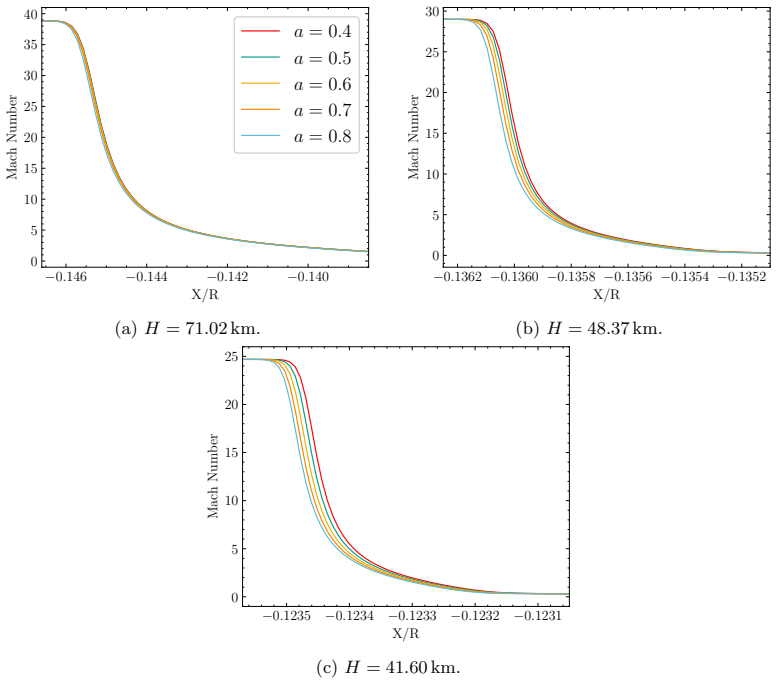
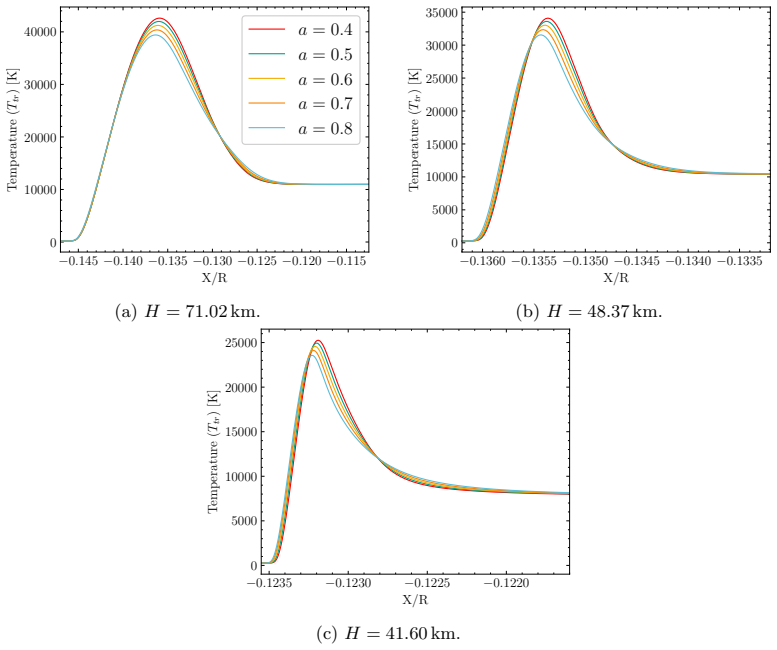
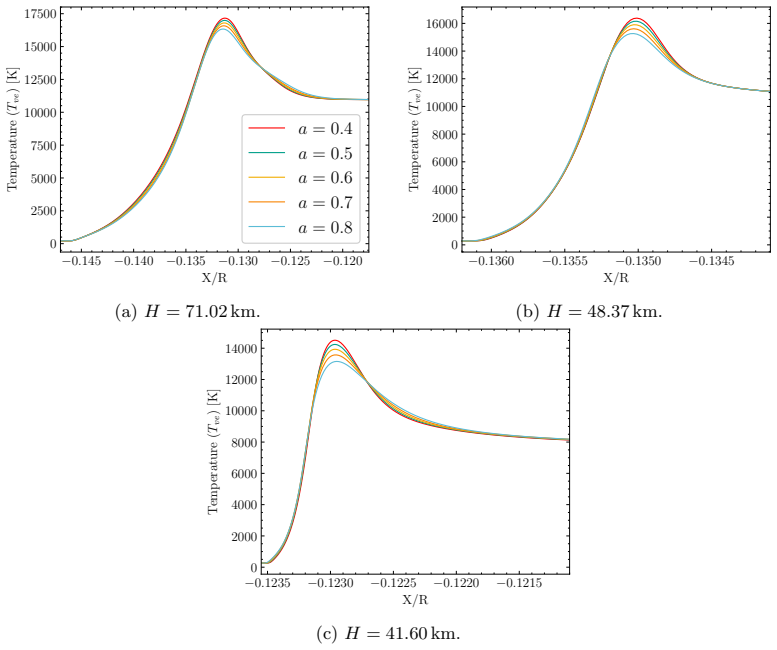
The paper claims that the weight factors significantly impact the FIRE II test cases while having little impact on the Mars Pathfinder flows. In all cases, it is possible to observe some effect of the weight factor selection on property distributions.
What carries the argument
Park's two-temperature model control temperature formed by weighted combination of translational-rotational and vibrational temperatures using different sets of weight factors.
If this is right
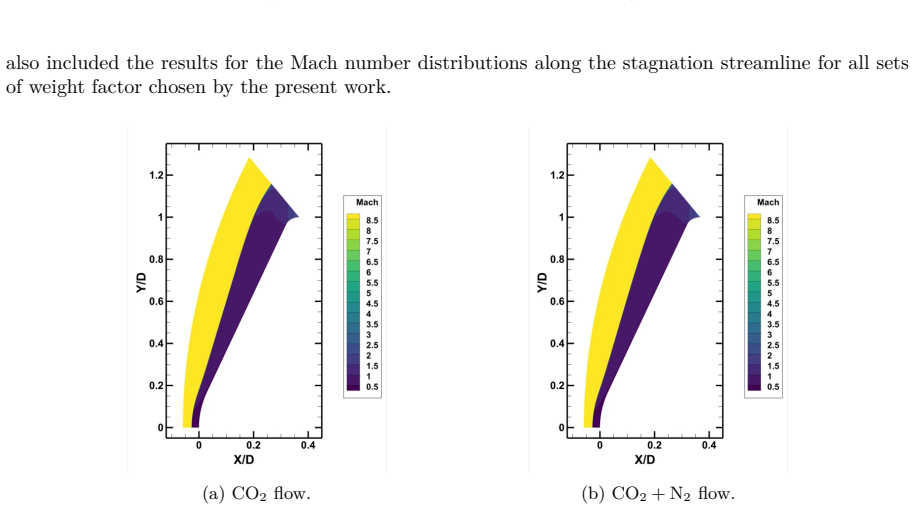
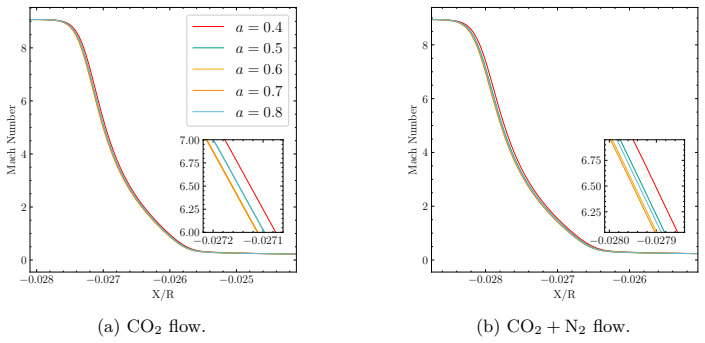
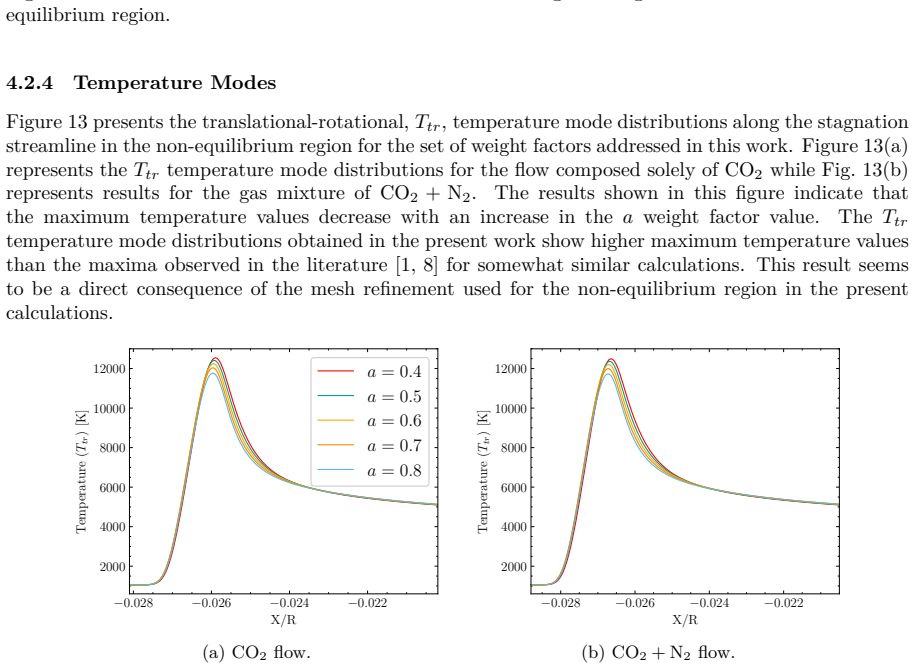
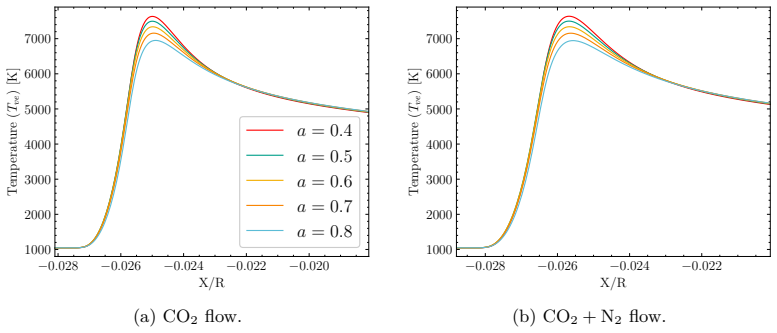
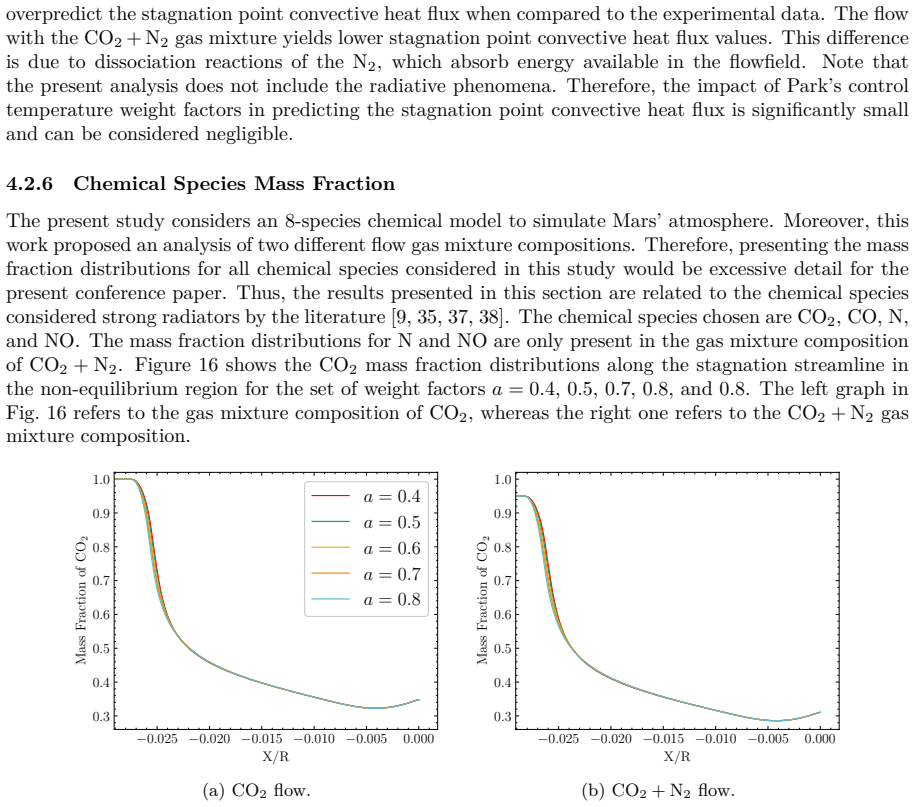
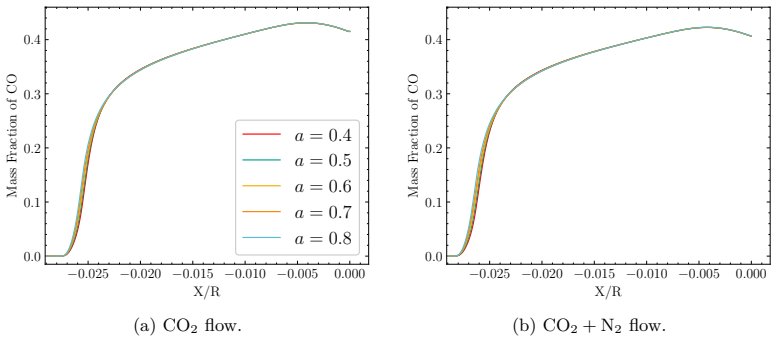
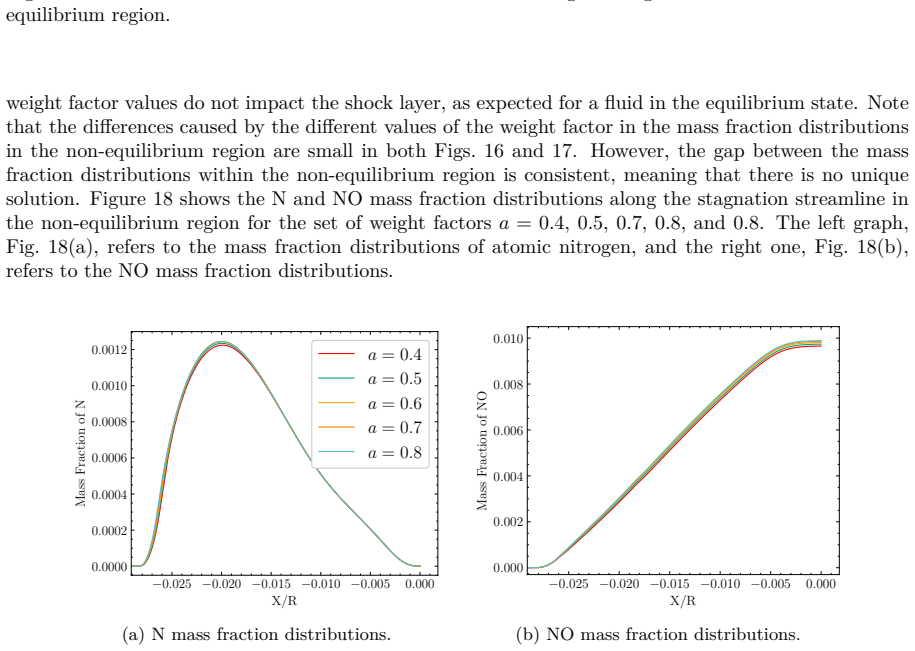
- Weight factor selection changes the distributions of Mach number, temperature modes, and mass fractions along the stagnation streamline near the shock wave.
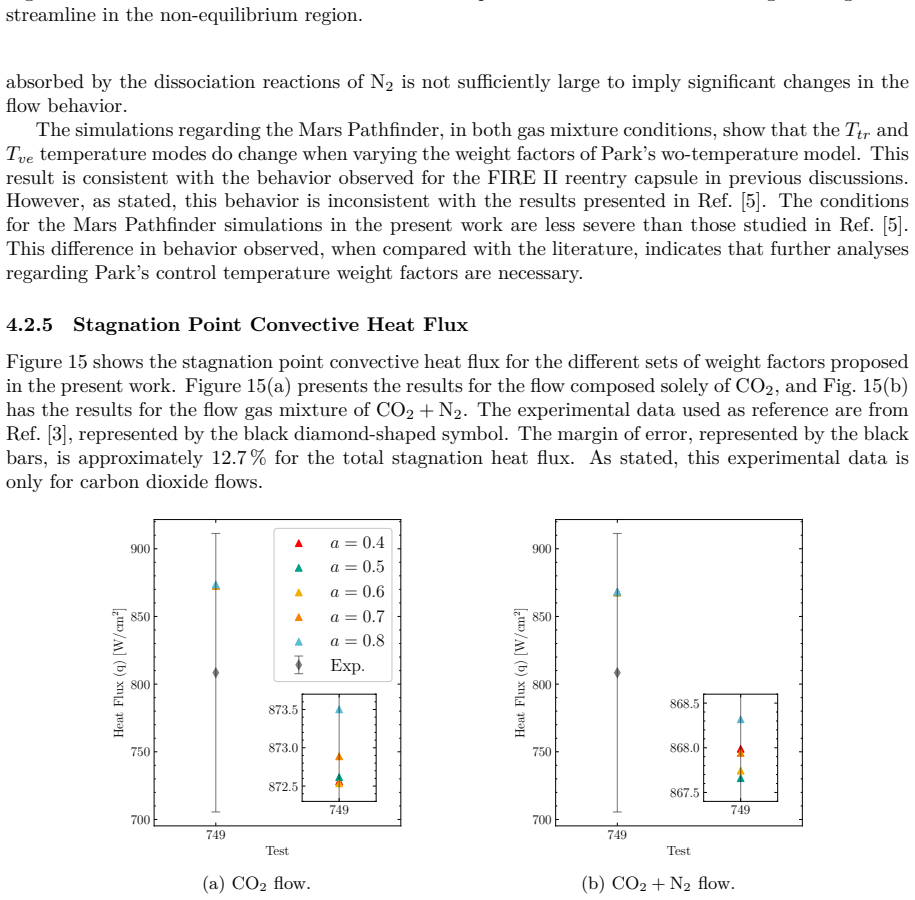
- The convective heat flux at the stagnation point varies with the chosen weight factors.
- Earth-atmosphere reentry simulations exhibit greater sensitivity to the weight factors than Mars-atmosphere simulations.
- Some effect on property distributions is present in every simulated case.
Where Pith is reading between the lines
- Atmosphere-specific calibration of weight factors may be required for reliable predictions across different planets.
- Comparison of the simulated results to additional flight data sets could identify which weight-factor combination aligns best with measurements.
- The same weight-factor variations could be tested in simulations of other non-equilibrium reentry problems to map the range of sensitivity.
Load-bearing premise
The observed differences in flow properties and heat flux are caused by the weight factor choices in the control temperature rather than by other modeling or numerical choices such as chemical reaction rates, mesh resolution, or solver details.
What would settle it
Direct comparison of the simulated stagnation-point convective heat flux obtained with each weight-factor set against the actual measured heat-flux values recorded during the FIRE II flight experiment.
Figures




read the original abstract
Numerical simulations of reactive hypersonic flows under thermochemical non-equilibrium conditions are presented for the FIRE II and Mars Pathfinder capsules. An 11-species chemical model is employed to simulate Earth's atmosphere, while an 8-species chemical model simulates Mars' atmosphere. The current formulation uses Park's two-temperature model to account for the non-equilibrium phenomena. The present work analyzes the impact of different sets of weight factors used in Park's model to calculate the control temperature. The code used to simulate the hypersonic flow addressed in this work solves the Navier-Stokes equations for reacting gas flows. The findings are depicted in terms of the Mach number, temperature modes, and mass fraction distributions along the stagnation streamline in a region closer to the shock wave. The study also includes results regarding the stagnation point convective heat flux. The results presented are encouraging and show that the weight factors significantly impact the FIRE II test cases while having little impact on the Mars Pathfinder flows. In all cases, it is possible to observe some effect of the weight factor selection on property distributions. In summary, the weight factors influence the flow behavior with varying intensities depending on the flow conditions.
Editorial analysis
A structured set of objections, weighed in public.
Referee Report
Summary. The manuscript performs Navier-Stokes simulations of thermochemical non-equilibrium hypersonic flows for the FIRE II (11-species Earth atmosphere) and Mars Pathfinder (8-species Mars atmosphere) capsules. It employs Park's two-temperature model and compares the effects of different weight-factor sets (a, b) in the control temperature T_c = T^a T_v^b on stagnation-line profiles of Mach number, translational and vibrational temperatures, species mass fractions, and stagnation-point convective heat flux. The central claim is that these weight factors produce significant changes in the FIRE II cases but only minor changes in the Mars Pathfinder cases, while some effect is visible in all simulations.
Significance. If the reported differences can be isolated to the weight factors alone, the work would usefully illustrate the sensitivity of post-shock thermochemical relaxation and heat-flux predictions to a modeling choice that is often treated as secondary. The adoption of standard 11- and 8-species mechanisms and an existing reacting-flow solver is methodologically conventional; however, the absence of any quantitative values, experimental comparisons, or convergence data in the abstract leaves the practical magnitude of the claimed sensitivity unclear.
major comments (3)
- Abstract: the claim that 'the weight factors significantly impact the FIRE II test cases while having little impact on the Mars Pathfinder flows' is presented without any numerical deltas, error bars, mesh-convergence metrics, or comparison to flight data. Because the central assertion rests on the magnitude and attribution of these differences, the lack of supporting quantitative evidence is load-bearing.
- Throughout the results (stagnation-streamline distributions and heat-flux values): the manuscript does not demonstrate that the chemical rate coefficients, shock-capturing scheme, mesh resolution, or boundary conditions were held strictly fixed while only the exponents a and b were varied. In thermochemical non-equilibrium, small changes in dissociation rates or numerical dissipation can produce post-shock T_v and species shifts comparable in size to those expected from modest changes in T_c; without explicit isolation or a sensitivity matrix, the causal link between weight factors and the observed differences remains unestablished.
- Abstract and methods description: no mesh-convergence study, grid-resolution statement, or code-to-code validation against established FIRE II or Mars Pathfinder benchmarks is reported. Given that the claimed effects are described as 'significant' for one vehicle and 'little' for the other, the absence of these standard checks prevents assessment of whether the differences exceed numerical uncertainty.
minor comments (1)
- Abstract: the phrase 'the results presented are encouraging' is subjective and should be replaced by a concise statement of the quantitative findings.
Simulated Author's Rebuttal
We thank the referee for the constructive feedback on our manuscript. The comments highlight important aspects of clarity and rigor that we have addressed in the revision. Below we respond point-by-point to the major comments.
read point-by-point responses
-
Referee: Abstract: the claim that 'the weight factors significantly impact the FIRE II test cases while having little impact on the Mars Pathfinder flows' is presented without any numerical deltas, error bars, mesh-convergence metrics, or comparison to flight data. Because the central assertion rests on the magnitude and attribution of these differences, the lack of supporting quantitative evidence is load-bearing.
Authors: We agree that the abstract benefits from quantitative support. The revised abstract now includes approximate percentage variations: convective heat flux differs by up to 12% across weight-factor sets for FIRE II cases, while variations remain below 3% for Mars Pathfinder. We have also added a clarifying sentence noting that the study examines modeling sensitivity rather than providing new experimental validation. revision: yes
-
Referee: Throughout the results (stagnation-streamline distributions and heat-flux values): the manuscript does not demonstrate that the chemical rate coefficients, shock-capturing scheme, mesh resolution, or boundary conditions were held strictly fixed while only the exponents a and b were varied. In thermochemical non-equilibrium, small changes in dissociation rates or numerical dissipation can produce post-shock T_v and species shifts comparable in size to those expected from modest changes in T_c; without explicit isolation or a sensitivity matrix, the causal link between weight factors and the observed differences remains unestablished.
Authors: All presented comparisons were performed with identical chemical mechanisms, numerical schemes, meshes, and boundary conditions, varying solely the exponents a and b. We have added an explicit statement and a table in the Methods section confirming these parameters were held fixed. While a full multi-parameter sensitivity matrix exceeds the scope of this focused study on the control-temperature definition, the direct one-at-a-time variation isolates the effect under examination. revision: yes
-
Referee: Abstract and methods description: no mesh-convergence study, grid-resolution statement, or code-to-code validation against established FIRE II or Mars Pathfinder benchmarks is reported. Given that the claimed effects are described as 'significant' for one vehicle and 'little' for the other, the absence of these standard checks prevents assessment of whether the differences exceed numerical uncertainty.
Authors: A mesh-convergence study has been added to the revised manuscript, confirming that the stagnation-line grid (approximately 200 points) produces heat-flux values converged to within 2% under successive refinement. Baseline results using standard weight factors have also been compared to literature values for both vehicles, showing agreement within 5-8% on peak temperatures and heat flux, indicating that the reported differences due to weight factors exceed the demonstrated numerical uncertainty. revision: yes
Circularity Check
No circularity; direct parameter variation in fixed solver
full rationale
The paper runs an existing Navier-Stokes solver for reacting flows on FIRE II and Mars Pathfinder cases, varying only the exponents a and b in Park's control temperature T_c = T^a T_v^b while holding the 11-species or 8-species mechanisms, rates, mesh, and discretization fixed. Results are reported as observed differences in Mach, temperatures, species, and heat flux. No step reduces a claimed prediction or uniqueness result to a fitted input, self-citation, or definitional equivalence. The analysis is self-contained against external benchmarks (standard test cases) and contains no load-bearing self-citation chains or ansatz smuggling. Minor self-citation, if present, is not load-bearing on the central comparison.
Axiom & Free-Parameter Ledger
free parameters (1)
- weight factors for control temperature
axioms (2)
- standard math Navier-Stokes equations govern the reacting gas flow
- domain assumption Park's two-temperature model is suitable for the non-equilibrium phenomena in these flows
Reference graph
Works this paper leans on
-
[1]
Numerical Simulation of Weakly Ionized Hypersonic Flow Over Reentry Capsules,
Scalabrin, L. C., “Numerical Simulation of Weakly Ionized Hypersonic Flow Over Reentry Capsules,” Ph.D. thesis, University of Michigan, Ann Arbor, Michigan, 2007
2007
-
[2]
Cornette, E. S., Forebody Temperatures and Calorimeter Heating Rates Measured During Project Fire II Reentry at 11.35 Kilometers per Second , NASA Technical Memorandum, NASA-TM-X-1305, NASA, 1966
1966
-
[3]
R., Experimental and Computational Aerothermodynamics of a Mars Entry Vehicle , NASA Contractor Report, NASA-CR-201633, NASA, 1996
Hollis, B. R., Experimental and Computational Aerothermodynamics of a Mars Entry Vehicle , NASA Contractor Report, NASA-CR-201633, NASA, 1996
1996
-
[4]
Análise de Escoamentos Hipersônicos em Condições de Não-Equilíbrio Ter- modinâmico com Aplicações em Reentrada Atmosférica,
Moreira, F. C., “Análise de Escoamentos Hipersônicos em Condições de Não-Equilíbrio Ter- modinâmico com Aplicações em Reentrada Atmosférica,” Ph.D. thesis, Faculdade de Engenharia Mecânica, Universidade Estadual de Campinas, Campinas, São Paulo, 2020
2020
-
[5]
Assessment of Nonequilibrium Air-Chemistry Models on Species Formation in Hypersonic Layer,
Niu, Q., Yuan, Z., Dong, S., and Tan, H., “Assessment of Nonequilibrium Air-Chemistry Models on Species Formation in Hypersonic Layer,” International Journal of Heat and Mass Transfer , Vol. 165, 2018, pp. 703–716. https://doi.org/https://doi.org/10.1016/j.ijheatmasstransfer.2018.07.007
-
[6]
The Limits of Two-Temperature Kinetic Model in Air,
Park, C., “The Limits of Two-Temperature Kinetic Model in Air,” 48th AIAA Aerospace Sciences Meeting Including the New Horizons Forum and Aerospace Exposition , AIAA, Orlando, Florida, USA, 2010, p. 13. https://doi.org/10.2514/6.2010-911
-
[7]
Moreira, F. C., Wolf, W. R., and Azevedo, J. L. F., “Numerical Simulations of Hypersonic Flows over the Fire II Capsule: Impact of Mesh Resolution and Boundary Conditions on Convective Heat Transfer,” AIAA SciTech 2023 Forum , AIAA, National Harbor, Maryland, USA & Online, 2023, p. 12. https://doi.org/10.2514/6.2023-1387
-
[8]
Thermal Analysis of Hypersonic Flows of Carbon Dioxide and Air in Thermodynamic Non-Equilibrium,
Moreira, F. C., Wolf, W. R., and Azevedo, J. L. F., “Thermal Analysis of Hypersonic Flows of Carbon Dioxide and Air in Thermodynamic Non-Equilibrium,” International Jour- nal of Heat and Mass Transfer , Vol. 165, Part A, 2021, pp. 120670.1–120670.19. https://doi.org/10.1016/j.ijheatmasstransfer.2020.120670. 22
-
[9]
D., and Schwartzentruber, T
Boyd, I. D., and Schwartzentruber, T. E., Nonequilibrium Gas Dynamics and Molecular Simulation , Cambridge Aerospace Series, Cambridge University Press, Cambridge, 2017
2017
-
[10]
Reducibility among combinatorial problems
Agrawal, A., Kushwaha, H. M., and Jadhav, R. S., Microscale Flow and Heat Transfer , Mechanical Engineering Series, Springer International Publishing, 2020. https://doi.org/10.1007/978-3-030- 10662-1
-
[11]
A., Molecular Gas Dynamics and the Direct Simulation of Gas Flows , Oxford Engineering Science Series, Oxford University Press, Oxford, 1994
Bird, G. A., Molecular Gas Dynamics and the Direct Simulation of Gas Flows , Oxford Engineering Science Series, Oxford University Press, Oxford, 1994
1994
-
[12]
A., The DSMC Method , CreateSpace Independent Publishing Platform, 2013
Bird, G. A., The DSMC Method , CreateSpace Independent Publishing Platform, 2013
2013
-
[13]
D., Hypersonic and High Temperature Gas Dynamics , 2 nd ed., AIAA Education Series, AIAA, 2006
Anderson, J. D., Hypersonic and High Temperature Gas Dynamics , 2 nd ed., AIAA Education Series, AIAA, 2006
2006
-
[14]
Assessment of Two-Temperature Kinetic Model for Ionizing Air,
Park, C., “Assessment of Two-Temperature Kinetic Model for Ionizing Air,” Jour- nal of Thermophysics and Heat Transfer , Vol. 3, No. 3, 1989, pp. 233–244. https://doi.org/https://doi.org/10.2514/3.28771
-
[15]
High Performance Modeling of Atmospheric Re-entry Vehicles,
Martin, A., Scalabrin, L. C., and Boyd, I. D., “High Performance Modeling of Atmospheric Re-entry Vehicles,” Journal of Physics: Conference Series , Vol. 341, No. 1, 2012, pp. 012002.1–012002.12. https://doi.org/https://dx.doi.org/10.1088/1742-6596/341/1/012002
-
[16]
The Gibbs–Dalton Law of Partial Pressures,
Gillespie, L. J., “The Gibbs–Dalton Law of Partial Pressures,” Physical Review, Vol. 36, No. 1, 1930, pp. 121–131. https://doi.org/https://doi.org/10.1103/physrev.36.121
-
[17]
Numerical Estimates for the Bulk Viscosity of Ideal Gases,
Cramer, M. S., “Numerical Estimates for the Bulk Viscosity of Ideal Gases,” Physics of Fluids , Vol. 24, No. 6, 2012, pp. 066102.1–066102.23. https://doi.org/https://doi.org/10.1063/1.4729611
-
[18]
Bulk Viscosity of Molecular Flu- ids,
Jaeger, F., Matar, O. K., and Müller, E. A., “Bulk Viscosity of Molecular Flu- ids,” Journal of Chemical Physics , Vol. 148, No. 6, 2018, pp. 174504.1–174504.12. https://doi.org/https://doi.org/10.1063/1.5022752
-
[19]
A Brief Introduction to Bulk Viscosity of Fluids,
Sharma, B., and Kumar, R., “A Brief Introduction to Bulk Viscosity of Fluids,” 2023. https://doi.org/10.48550/ARXIV.2303.08400
-
[20]
A Viscosity Equation for Gas Mixtures,
Wilke, C. R., “A Viscosity Equation for Gas Mixtures,” The Journal of Chemical Physics , Vol. 18, No. 4, 1950, pp. 517–519. https://doi.org/https://doi.org/10.1063/1.1747673
-
[21]
Chemically Reacting Viscous Flow Program for Multi- component Gas Mixtures,
Blottner, F. G., Johnson, M., and Ellis, M., “Chemically Reacting Viscous Flow Program for Multi- component Gas Mixtures,” Tech. rep., Sandia National Lab. (SNL-NM), Albuquerque, New Mexico, Jan. 1971. https://doi.org/10.2172/4658539
-
[22]
G., and Kruger, C
Vincenti, W. G., and Kruger, C. H., Introduction to Physical Gas Dynamics , John Wiley & Sons, New York, 1982
1982
-
[23]
N., Yos, J
Gupta, R. N., Yos, J. M., Thompson, R. A., and Lee, K.-P., A Review of Reactions Rates and Thermodynamic and Transport Properties for an 11-species Air Model for Chemical and Thermal Nonequilibrium Calculations to 30, 000 K, NASA Reference Publication, NASA-RP-1232, NASA, 1990
1990
-
[24]
A., Gupta, R
Gnoffo, P. A., Gupta, R. N., and Shinn, J. L., Conservation Equations and Physical Models for Hypersonic Air Flows in Thermal and Chemical Nonequilibrium , NASA Technical Publication, NASA-TP-2867, NASA Langley, Hampton, Virginia, 1989
1989
-
[25]
W., and de Paula, J., Physical Chemistry for the Life Sciences , Oxford University Press, 2006
Atkins, P. W., and de Paula, J., Physical Chemistry for the Life Sciences , Oxford University Press, 2006
2006
-
[26]
Park, C., Nonequilibrium Hypersonic Aerothermodynamics, Wiley, 1990
1990
-
[27]
The Solution of the Navier-Stokes Equations Us- ing Gauss-Seidel Line Relaxation,
MacCormack, R. W., and Candler, G. V., “The Solution of the Navier-Stokes Equations Us- ing Gauss-Seidel Line Relaxation,” Computers and Fluids , Vol. 17, No. 1, 1989, pp. 135–150. https://doi.org/https://doi.org/10.1016/0045-7930(89)90012-1. 23
-
[28]
Steger, J. L., and Warming, R. F., “Flux Vector Splitting of the Inviscid Gasdynamic Equations with Application to Finite-Difference Methods,” Journal of Computational Physics , Vol. 40, No. 2, 1981, pp. 263–293. https://doi.org/https://doi.org/10.1016/0021-9991(81)90210-2
-
[29]
Yang, X., Gui, Y., Xiao, G., Du, Y., Liu, L., and Wei, D., “Reacting Gas-Surface Interac- tion and Heat Transfer Characteristics for High-Enthalpy and Hypersonic Dissociated Carbon Dioxide Flow,” International Journal of Heat and Mass Transfer , Vol. 146, 2020, p. 118869. https://doi.org/10.1016/j.ijheatmasstransfer.2019.118869
-
[30]
A High-Resolution Procedure for Euler and Navier–Stokes Com- putations on Unstructured Grids,
Jawahar, P., and Kamath, H., “A High-Resolution Procedure for Euler and Navier–Stokes Com- putations on Unstructured Grids,” Journal of Computational Physics , Vol. 164, No. 1, 2000, pp. 165–203. https://doi.org/https://doi.org/10.1006/jcph.2000.6596
-
[31]
Assessment of a Two-Temperature Kinetic Model for Dissociating and Weakly Ioniz- ing Nitrogen,
Park, C., “Assessment of a Two-Temperature Kinetic Model for Dissociating and Weakly Ioniz- ing Nitrogen,” Journal of Thermophysics and Heat Transfer , Vol. 2, No. 1, 1988, pp. 8–16. https://doi.org/https://doi.org/10.2514/3.55
-
[32]
Hirsch, C., Numerical Computation of Internal and External Flows: The Fundamentals of Compu- tational Fluid Dynamics , Elsevier, Oxford, 2007
2007
-
[33]
Venkatakrishnan, V., Implicit Schemes and Parallel Computing in Unstructured Grid CFD , NASA Contractor Report, NASA-CR-195071, NASA, 1995
1995
-
[34]
Analysis of Reactive Hypersonic Flows Under Thermochemical Non-Equilibrium Conditions: Influence of the Control Temperature of Park’s Two-Temperature Model on the Flow Behavior,
Poltronieri, G. M., “Analysis of Reactive Hypersonic Flows Under Thermochemical Non-Equilibrium Conditions: Influence of the Control Temperature of Park’s Two-Temperature Model on the Flow Behavior,” Master’s thesis, Instituto Tecnológico de Aeronáutica – ITA, São José dos Campos, São Paulo, 2024
2024
-
[35]
One- Dimensional Modeling Methodology for Shock Tubes: Application to the EAST Facility,
Priyadarshini Sharma, M., Munafò, A., Panesi, M., Brandis, A. M., and Cruden, B. A., “One- Dimensional Modeling Methodology for Shock Tubes: Application to the EAST Facility,” 2018 Joint Thermophysics and Heat Transfer Conference , AIAA Paper No. 2018-4181, Atlanta, Georgia, 2018, p. 12. https://doi.org/10.2514/6.2018-4181
-
[36]
Moreira, F. C., Wolf, W. R., and Azevedo, J. L. F., “Investigation of Thermodynamic Non- Equilibrium in Hypersonic Flows Over the Mars Pathfinder Capsule,” AIAA SciTech 2021 Forum , AIAA, Virtual Event, 2021, p. 16. https://doi.org/10.2514/6.2021-0491
-
[37]
F., Radiative Heat Transfer , 3 rd ed., Elsevier, 2013
Modest, M. F., Radiative Heat Transfer , 3 rd ed., Elsevier, 2013. https://doi.org/10.1016/c2010-0- 65874-3
-
[38]
Moreira, F. C., Levin, D. A., Thirani, S., Wolf, W. R., and Azevedo, J. L. F., “A Study on the Impact of Radiative Heat Transfer for Hypersonic Nonequilibrium Flows over a Cylin- der,” AIAA SciTech 2024 Forum , AIAA Paper No. 2024-0884, Orlando, Florida, USA, 2024. https://doi.org/10.2514/6.2024-0884. 24
discussion (0)
Sign in with ORCID, Apple, or X to comment. Anyone can read and Pith papers without signing in.