Coexistence of static order and spin dynamics in an S = 5/2 frustrated triangular antiferromagnet
Pith reviewed 2026-06-26 02:52 UTC · model grok-4.3
The pith
Muon spin rotation detects static magnetic order coexisting with persistent spin dynamics in the S=5/2 triangular antiferromagnet MnSnB2O6 below 1 K.
A machine-rendered reading of the paper's core claim, the machinery that carries it, and where it could break.
Core claim
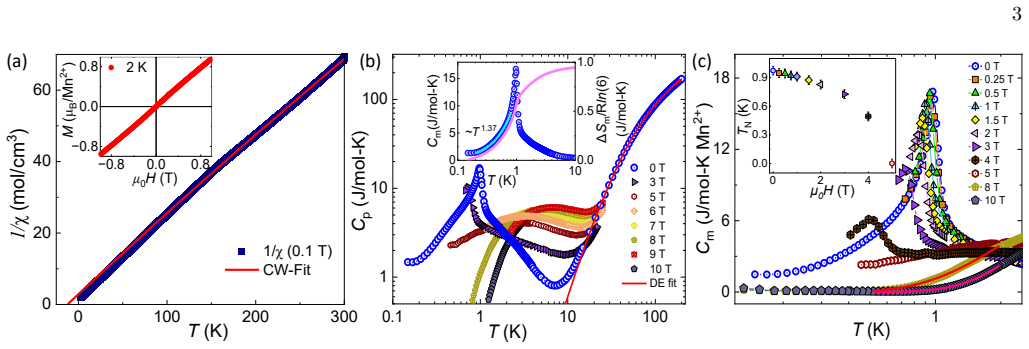
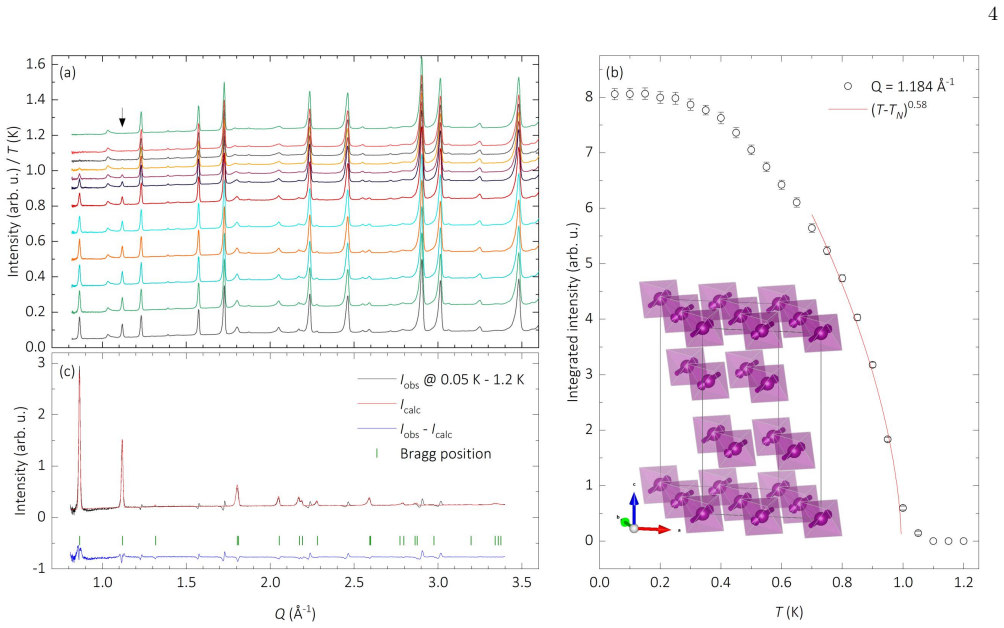
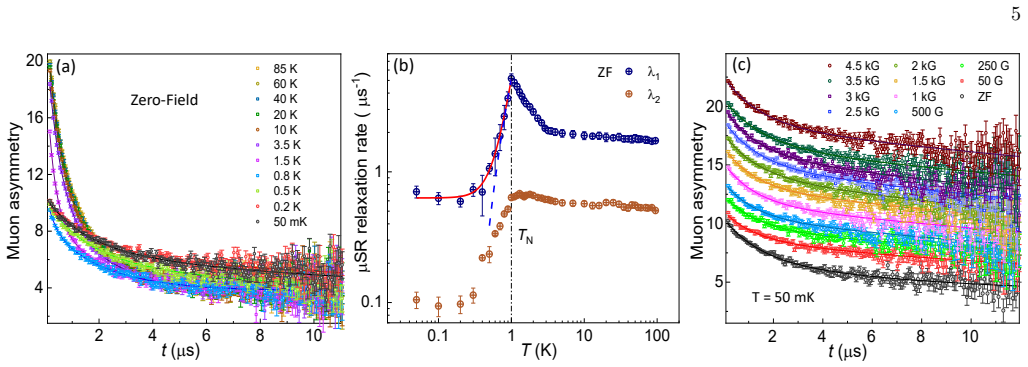
In MnSnB2O6 the Mn2+ moments order antiferromagnetically below approximately 1 K. Neutron diffraction and specific-heat data confirm the transition to long-range order. Zero-field muon spin rotation spectra show that a static internal field develops below TN while a dynamic relaxation component remains present down to 50 mK. The order parameter extracted from neutron data follows a power law consistent with three-dimensional Ising criticality. Specific heat below TN decays as T^1.37, indicating additional low-energy excitations beyond conventional spin waves.
What carries the argument
Zero-field muon spin rotation that separates the development of a static local field from a remaining dynamic relaxation channel at the muon site.
If this is right
- Persistent spin dynamics inside long-range order are compatible with the classical high-spin triangular lattice once disorder is removed.
- The T^1.37 specific-heat law implies gapless or weakly gapped excitations that survive deep inside the ordered phase.
- Weak interplane couplings dictate three-dimensional Ising critical behavior despite the two-dimensional lattice geometry.
- The clean triangular network isolates the effects of geometric frustration on low-energy excitations without random-bond complications.
Where Pith is reading between the lines
- Similar coexistence of order and dynamics may appear in other high-spin triangular compounds once anti-site disorder is minimized.
- Inelastic neutron scattering at millikelvin temperatures could test whether the specific-heat exponent arises from magnon decay or from an emergent continuum of excitations.
- The system offers a reference point for numerical simulations of classical frustrated magnets that must reproduce both static order and residual fluctuations.
Load-bearing premise
The triangular Mn network is free of significant anti-site disorder, allowing the observed dynamics to be interpreted as intrinsic rather than disorder-induced.
What would settle it
A controlled introduction of anti-site disorder that eliminates the dynamic muon relaxation component while preserving the static order would falsify the claim that the coexistence is intrinsic to the clean frustrated lattice.
Figures
read the original abstract
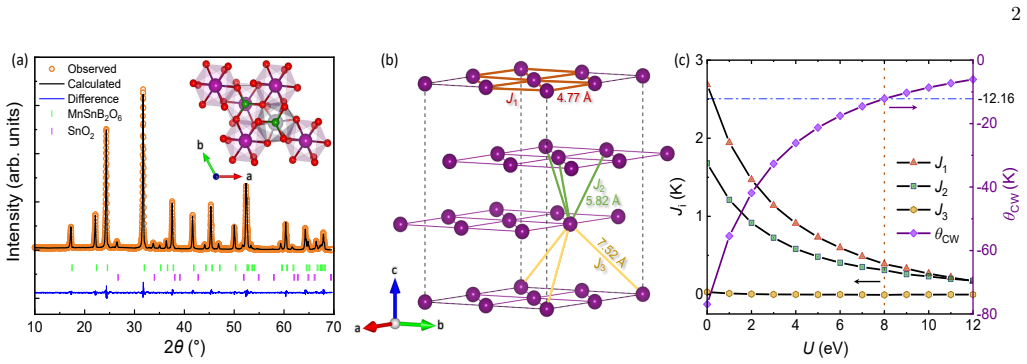
Frustrated triangular-lattice antiferromagnets in the classical high-spin limit provide a paradigmatic setting in which the interplay of competing exchange interactions, anisotropy, and collective degrees of freedom can lead to unconventional low-energy excitations, anomalous criticality, and persistent dynamical responses. Here, we present comprehensive thermodynamic, $\mu$SR, and neutron diffraction experiments, along with first-principles calculations, on a triangular-lattice antiferromagnet, MnSnB$_2$O$_6$, where Mn$^{2+}$ ($S=5/2$) moments form a nearly perfect 2D triangular network without any anti-site disorder. The Curie-Weiss fit to the magnetic susceptibility yields a moderate Curie-Weiss temperature of $-12$ K, indicating dominant antiferromagnetic interactions between Mn$^{2+}$ moments, which is supported by first-principles calculations. Specific-heat measurements reveal the onset of long-range magnetic order at $T_{\rm N}\approx 1$ K, which is ascribed to intraplane exchange interactions. The specific heat exhibits pronounced short-range correlations above $T_{\rm N}$ and an unconventional power-law behavior, $C\propto T^{1.37}$, deep in the ordered state, suggesting the presence of non-trivial low-energy excitations. Zero-field $\mu$SR experiments down to 50~mK confirm the presence of magnetic ordering below $T_{\rm N}$, in agreement with thermodynamic and neutron diffraction experiments. The $\mu$SR measurements detect persistent spin dynamics coexisting with static magnetic order. The temperature evolution of the order parameter down to 50~mK from neutron diffraction suggests that the ordered state is consistent with a 3D Ising-like antiferromagnet. This family of archetypal frustrated magnets offers a promising venue for the experimental realization of emergent phenomena governed by competing exchange interactions and exotic low-energy excitations.
Editorial analysis
A structured set of objections, weighed in public.
Referee Report
Summary. The manuscript presents thermodynamic, μSR, and neutron diffraction measurements, together with DFT calculations, on the S=5/2 triangular antiferromagnet MnSnB2O6. It reports a Curie-Weiss temperature of −12 K, long-range order at TN≈1 K, an unconventional specific-heat power law C∝T^1.37 below TN, μSR evidence for static order coexisting with persistent spin dynamics down to 50 mK, and an order-parameter temperature dependence consistent with 3D Ising antiferromagnetism. The central claim is that these features occur in a clean, nearly perfect 2D triangular lattice free of anti-site disorder.
Significance. If the lattice cleanliness is quantitatively established, the work supplies a well-characterized classical high-spin example in which static order and persistent dynamics coexist, with multiple independent probes converging on TN and the order-parameter evolution. The combination of thermodynamics, local-probe dynamics, and diffraction data on a geometrically frustrated S=5/2 system would be a useful addition to the literature on low-energy excitations in triangular antiferromagnets.
major comments (1)
- [Abstract] Abstract (and structural characterization section): the assertion that the Mn2+ moments form a 'nearly perfect 2D triangular network without any anti-site disorder' is stated as fact but is not accompanied by quantitative site-occupancy refinements or upper limits (with error bars) from neutron diffraction. This information is load-bearing for the interpretation that the observed μSR relaxation arises from intrinsic dynamics rather than from local random fields or inhomogeneity induced by even modest Mn/Sn mixing.
minor comments (2)
- [Abstract] Abstract: numerical values (TN, CW temperature, exponent 1.37) are given without uncertainties or explicit statements of data-selection criteria.
- The specific-heat power-law fit and the μSR relaxation-rate analysis would benefit from explicit statements of the temperature ranges used and goodness-of-fit metrics.
Simulated Author's Rebuttal
We thank the referee for their careful reading and constructive comments on our manuscript. We address the single major comment below.
read point-by-point responses
-
Referee: [Abstract] Abstract (and structural characterization section): the assertion that the Mn2+ moments form a 'nearly perfect 2D triangular network without any anti-site disorder' is stated as fact but is not accompanied by quantitative site-occupancy refinements or upper limits (with error bars) from neutron diffraction. This information is load-bearing for the interpretation that the observed μSR relaxation arises from intrinsic dynamics rather than from local random fields or inhomogeneity induced by even modest Mn/Sn mixing.
Authors: We agree that quantitative site-occupancy refinements with error bars are necessary to substantiate the claim of a clean lattice and to support the interpretation of the μSR data. Although the original manuscript asserted the absence of anti-site disorder on the basis of synthesis conditions and the quality of the diffraction patterns, explicit numerical limits were not provided. In the revised manuscript we have added the Rietveld refinement results from the neutron diffraction data, including refined site occupancies together with their uncertainties and a stated upper bound on Mn/Sn anti-site mixing. These additions directly address the referee’s concern and reinforce that the persistent dynamics are intrinsic. The abstract has been updated to incorporate the quantitative characterization. revision: yes
Circularity Check
No circularity; central claims are direct experimental observations
full rationale
The paper reports thermodynamic, μSR, neutron diffraction, and first-principles results on MnSnB2O6. Its strongest claims (persistent spin dynamics coexisting with static order below TN ≈ 1 K, order-parameter temperature dependence consistent with 3D Ising antiferromagnetism) are stated as direct measurements without any model equations, parameter fitting, or predictions that reduce to the fitted inputs by construction. No self-citation load-bearing steps, uniqueness theorems, or ansatz smuggling appear in the provided text. The assertion of a clean 2D triangular network without anti-site disorder is presented as a structural premise rather than a derived result, and the paper does not contain any derivation chain that would trigger the enumerated circularity patterns.
Axiom & Free-Parameter Ledger
axioms (1)
- domain assumption Standard condensed-matter assumptions that μSR relaxation rates and neutron diffraction intensities can be unambiguously partitioned into static and dynamic contributions
Reference graph
Works this paper leans on
-
[1]
Balents, Spin liquids in frustrated magnets, Nature 464, 199 (2010)
L. Balents, Spin liquids in frustrated magnets, Nature 464, 199 (2010)
2010
-
[2]
Khatua, B
J. Khatua, B. Sana, A. Zorko, M. Gomilˇ sek, K. Sethu- pathi, M. R. Rao, M. Baenitz, B. Schmidt, and P. Khuntia, Experimental signatures of quantum and topological states in frustrated magnetism, Physics Re- ports1041, 1 (2023)
2023
-
[3]
Khuntia, M
P. Khuntia, M. Vel´ azquez, Q. Barth´ elemy, F. Bert, E. Kermarrec, A. Legros, B. Bernu, L. Messio, A. Zorko, and P. Mendels, Gapless ground state in the archetypal quantum kagome antiferromagnet ZnCu 3(OH)6Cl2, Na- ture Physics16, 469 (2020)
2020
-
[4]
Khuntia, F
P. Khuntia, F. Bert, P. Mendels, B. Koteswararao, A. V. Mahajan, M. Baenitz, F. C. Chou, C. Baines, A. Amato, and Y. Furukawa, Spin Liquid State in the 3D Frustrated Antiferromagnet PbCuTe2O6: NMR and Muon Spin Re- laxation Studies, Phys. Rev. Lett.116, 107203 (2016)
2016
-
[5]
Khuntia, Novel magnetism and spin dynamics of strongly correlated electron systems: Microscopic in- sights, Journal of Magnetism and Magnetic Materials 489, 165435 (2019)
P. Khuntia, Novel magnetism and spin dynamics of strongly correlated electron systems: Microscopic in- sights, Journal of Magnetism and Magnetic Materials 489, 165435 (2019)
2019
-
[6]
D. A. Huse and V. Elser, Simple Variational Wave Func- tions for Two-Dimensional Heisenberg Spin-½Antiferro- magnets, Phys. Rev. Lett.60, 2531 (1988)
1988
-
[7]
Facheris, K
L. Facheris, K. Y. Povarov, S. D. Nabi, D. G. Mazzone, J. Lass, B. Roessli, E. Ressouche, Z. Yan, S. Gvasaliya, and A. Zheludev, Spin density wave versus fractional magnetization plateau in a triangular antiferromagnet, Phys. Rev. Lett.129, 087201 (2022)
2022
-
[8]
Takagi and M
T. Takagi and M. Mekata, New partially disordered phases with commensurate spin density wave in frus- trated triangular lattice, Journal of the Physical Society of Japan64, 4609 (1995)
1995
-
[9]
Kumar, P
R. Kumar, P. Khuntia, D. Sheptyakov, P. G. Freeman, H. M. Rønnow, B. Koteswararao, M. Baenitz, M. Jeong, and A. V. Mahajan, Sc 2Ga2CuO7: A possible quantum spin liquid near the percolation threshold, Phys. Rev. B 92, 180411(R) (2015)
2015
-
[10]
Shimizu, K
Y. Shimizu, K. Miyagawa, K. Kanoda, M. Maesato, and G. Saito, Spin Liquid State in an Organic Mott Insulator with a Triangular Lattice, Phys. Rev. Lett.91, 107001 (2003)
2003
-
[11]
Yamashita, N
M. Yamashita, N. Nakata, Y. Senshu, M. Nagata, H. M. Yamamoto, R. Kato, T. Shibauchi, and Y. Matsuda, Highly mobile gapless excitations in a two-dimensional candidate quantum spin liquid, Science328, 1246 (2010)
2010
-
[12]
J. M. Ni, B. L. Pan, B. Q. Song, Y. Y. Huang, J. Y. Zeng, Y. J. Yu, E. J. Cheng, L. S. Wang, D. Z. Dai, R. Kato, and S. Y. Li, Absence of Magnetic Ther- mal Conductivity in the Quantum Spin Liquid Candi- date EtMe3Sb[Pd(dmit)2]2, Phys. Rev. Lett.123, 247204 (2019)
2019
-
[13]
Sibille, E
R. Sibille, E. Lhotel, V. Pomjakushin, C. Baines, T. Fen- nell, and M. Kenzelmann, Candidate Quantum Spin Liq- uid in the Ce 3+ Pyrochlore Stannate Ce 2Sn2O7, Phys. Rev. Lett.115, 097202 (2015)
2015
-
[14]
Khatua, M
J. Khatua, M. Pregelj, A. Elghandour, Z. Jagliˇ cic, R. Klingeler, A. Zorko, and P. Khuntia, Magnetic properties of the triangular-lattice antiferromagnets Ba3RB9O18 (R= Yb,Er), Phys. Rev. B106, 104408 (2022)
2022
-
[15]
Yadav, A
A. Yadav, A. Elghandour, T. Arh, D. T. Adroja, M. D. Le, G. B. G. Stenning, M. Aouane, S. Luther, F. Hotz, T. J. Hicken, H. Luetkens, A. Zorko, R. Klingeler, and P. Khuntia, Magnetism in theJ eff = 1 2 kagome antiferro- magnet Nd3BWO9: Thermodynamics, nuclear magnetic resonance, muon spin resonance, and inelastic neutron scattering studies, Phys. Rev. B11...
2025
-
[16]
P. A. Maksimov, Z. Zhu, S. R. White, and A. L. Cherny- shev, Anisotropic-Exchange Magnets on a Triangular Lattice: Spin Waves, Accidental Degeneracies, and Dual Spin Liquids, Phys. Rev. X9, 021017 (2019)
2019
-
[17]
C. A. Pocs, P. E. Siegfried, J. Xing, A. S. Sefat, M. Her- mele, B. Normand, and M. Lee, Systematic extraction of crystal electric-field effects and quantum magnetic model parameters in triangular rare-earth magnets, Phys. Rev. Res.3, 043202 (2021)
2021
-
[18]
T. Arh, B. Sana, M. Pregelj, P. Khuntia, Z. Jagliˇ ci´ c, M. Le, P. Biswas, P. Manuel, L. Mangin-Thro, A. Ozarowski,et al., The Ising triangular-lattice antifer- romagnet neodymium heptatantalate as a quantum spin liquid candidate, Nature Materials21, 416 (2022)
2022
-
[19]
Melting upon cooling in a quantum magnet
K. Jaksetiˇ c, T. Arh, M. Pregelj, M. Gomilˇ sek, M. Dragomir, P. Prelovˇ sek, M. Ulaga, L.ˇSibav, M. Mal- ovrh, K. ˇZeleznikar,et al., Melting upon cooling in a quantum magnet, arXiv preprint arXiv:2605.04611 10.48550/arXiv.2605.04611 (2026)
work page internal anchor Pith review Pith/arXiv arXiv doi:10.48550/arxiv.2605.04611 2026
-
[20]
K. Boya, K. Nam, A. K. Manna, J. Kang, C. Lyi, A. Jain, S. M. Yusuf, P. Khuntia, B. Sana, V. Kumar, A. V. Mahajan, D. R. Patil, K. H. Kim, S. K. Panda, and B. Koteswararao, Magnetic properties of theS= 5 2 anisotropic triangular chain compound Bi 3FeMo2O12, Phys. Rev. B104, 184402 (2021)
2021
-
[21]
Villain, R
J. Villain, R. Bidaux, J.-P. Carton, and R. Conte, Order as an effect of disorder, Journal de Physique41, 1263 (1980). 8
1980
-
[22]
Collins and O
M. Collins and O. Petrenko, Review/synth` ese: triangular antiferromagnets, Canadian Journal of Physics75, 605 (1997)
1997
-
[23]
Seabra, T
L. Seabra, T. Momoi, P. Sindzingre, and N. Shannon, Phase diagram of the classical heisenberg antiferromag- net on a triangular lattice in an applied magnetic field, Phys. Rev. B84, 214418 (2011)
2011
-
[24]
D. T. Liu, F. J. Burnell, L. D. C. Jaubert, and J. T. Chalker, Classical spin liquids in stacked triangular- lattice ising antiferromagnets, Phys. Rev. B94, 224413 (2016)
2016
-
[25]
Struck, C
J. Struck, C. ¨Olschl¨ ager, R. Le Targat, P. Soltan- Panahi, A. Eckardt, M. Lewenstein, P. Windpassinger, and K. Sengstock, Quantum simulation of frustrated clas- sical magnetism in triangular optical lattices, Science 333, 996 (2011)
2011
-
[26]
J. T. Haraldsen, M. Swanson, G. Alvarez, and R. S. Fish- man, Spin-wave instabilities and noncollinear magnetic phases of a geometrically frustrated triangular-lattice an- tiferromagnet, Phys. Rev. Lett.102, 237204 (2009)
2009
-
[27]
C. A. Gallegos, S. Jiang, S. R. White, and A. L. Cherny- shev, Phase diagram of the easy-axis triangular-lattice J1−J2 model, Phys. Rev. Lett.134, 196702 (2025)
2025
-
[28]
A. V. Chubukov and T. Jolicoeur, Order-from-disorder phenomena in heisenberg antiferromagnets on a triangu- lar lattice, Phys. Rev. B46, 11137 (1992)
1992
-
[29]
H. Kawamura, Spin-wave analysis of the antiferromag- netic plane rotator model on the triangular lattice– symmetry breaking in a magnetic field, Journal of the Physical Society of Japan53, 2452 (1984)
1984
-
[30]
Gvozdikova, P
M. Gvozdikova, P. Melchy, and M. Zhitomirsky, Mag- netic phase diagrams of classical triangular and kagome antiferromagnets, Journal of Physics: Condensed Matter 23, 164209 (2011)
2011
-
[31]
Kenzelmann, G
M. Kenzelmann, G. Lawes, A. B. Harris, G. Gasparovic, C. Broholm, A. P. Ramirez, G. A. Jorge, M. Jaime, S. Park, Q. Huang, A. Y. Shapiro, and L. A. Demi- anets, Direct Transition from a Disordered to a Multi- ferroic Phase on a Triangular Lattice, Phys. Rev. Lett. 98, 267205 (2007)
2007
-
[32]
A. J. Hearmon, F. Fabrizi, L. C. Chapon, R. D. Johnson, D. Prabhakaran, S. V. Streltsov, P. J. Brown, and P. G. Radaelli, Electric Field Control of the Magnetic Chirali- ties in Ferroaxial Multiferroic RbFe(MoO4)2, Phys. Rev. Lett.108, 237201 (2012)
2012
-
[33]
Hwang, E
J. Hwang, E. S. Choi, F. Ye, C. R. Dela Cruz, Y. Xin, H. D. Zhou, and P. Schlottmann, Successive Magnetic Phase Transitions and Multiferroicity in the Spin-One Triangular-Lattice Antiferromagnet Ba3NiNb2O9, Phys. Rev. Lett.109, 257205 (2012)
2012
-
[34]
M. Lee, J. Hwang, E. S. Choi, J. Ma, C. R. Dela Cruz, M. Zhu, X. Ke, Z. L. Dun, and H. D. Zhou, Series of phase transitions and multiferroicity in the quasi- two-dimensional spin- 1 2 triangular-lattice antiferromag- net Ba3CoNb2O9, Phys. Rev. B89, 104420 (2014)
2014
-
[35]
Z. Tian, C. Zhu, Z. Ouyang, J. Wang, W. Tong, Y. Liu, Z. Xia, and S. Yuan, Susceptibility, high-field magnetiza- tion and ESR studies in a spin-5/2 triangular-lattice an- tiferromagnet Ba 3MnSb2O9, Journal of Magnetism and Magnetic Materials360, 10 (2014)
2014
-
[36]
T. Xie, S. Gozel, J. Xing, N. Zhao, S. M. Avdoshenko, L. Wu, A. S. Sefat, A. L. Chernyshev, A. M. L¨ auchli, A. Podlesnyak, and S. E. Nikitin, Quantum Spin Dynam- ics Due to Strong Kitaev Interactions in the Triangular- Lattice Antiferromagnet CsCeSe2, Phys. Rev. Lett.133, 096703 (2024)
2024
-
[37]
Legros, S.-S
A. Legros, S.-S. Zhang, X. Bai, H. Zhang, Z. Dun, W. A. Phelan, C. D. Batista, M. Mourigal, and N. P. Armitage, Observation of 4- and 6-Magnon Bound States in the Spin-Anisotropic Frustrated Antiferromagnet FeI2, Phys. Rev. Lett.127, 267201 (2021)
2021
-
[38]
P. Park, K. Park, J. Oh, K. H. Lee, J. C. Leiner, H. Sim, T. Kim, J. Jeong, K. C. Rule, K. Kamazawa,et al., Spin texture induced by non-magnetic doping and spin dy- namics in 2D triangular lattice antiferromagnet h-Y (Mn, Al)O3, Nature Communications12, 2306 (2021)
2021
-
[39]
P. Park, E. A. Ghioldi, A. F. May, J. A. Kolopus, A. A. Podlesnyak, S. Calder, J. A. Paddison, A. E. Trumper, L. O. Manuel, C. D. Batista,et al., Anomalous contin- uum scattering and higher-order van Hove singularity in the strongly anisotropicS= 1/2 triangular lattice anti- ferromagnet, Nature Communications15, 7264 (2024)
2024
-
[40]
Khatua, D
J. Khatua, D. Tay, T. Shiroka, M. Pregelj, K. Kargeti, S. K. Panda, G. B. G. Stenning, P. Manuel, M. D. Le, D. T. Adroja, and P. Khuntia, Spin-liquid-like spin dy- namics in the frustrated antiferromagnet tbbo 3, Phys. Rev. B113, 174406 (2026)
2026
-
[41]
Nakatsuji, Y
S. Nakatsuji, Y. Nambu, H. Tonomura, O. Sakai, S. Jonas, C. Broholm, H. Tsunetsugu, Y. Qiu, and Y. Maeno, Spin disorder on a triangular lattice, Science 309, 1697 (2005)
2005
-
[42]
S.-H. Lee, C. Broholm, W. Ratcliff, G. Gasparovic, Q. Huang, T. Kim, and S.-W. Cheong, Emergent excita- tions in a geometrically frustrated magnet, Nature418, 856 (2002)
2002
-
[43]
M. A. Cooper, F. C. Hawthorne, M. Novak, and M. C. Taylor, The crystal structure of tusionite, Mn2+Sn4+(BO3)2, a dolomite-structure borate, The Canadian Mineralogist32, 903 (1994)
1994
-
[44]
See supplemental material for additional experimental details, analysis, and supporting figures,Submitted as a part of this manuscript
-
[45]
Bergman, J
D. Bergman, J. Alicea, E. Gull, S. Trebst, and L. Ba- lents, Order-by-disorder and spiral spin-liquid in frus- trated diamond-lattice antiferromagnets, Nature Physics 3, 487 (2007)
2007
-
[46]
Plumb, H
K. Plumb, H. J. Changlani, A. Scheie, S. Zhang, J. Krizan, J. Rodriguez-Rivera, Y. Qiu, B. Winn, R. J. Cava, and C. L. Broholm, Continuum of quantum fluctu- ations in a three-dimensionalS= 1 Heisenberg magnet, Nature Physics15, 54 (2019)
2019
-
[47]
A. P. Ramirez, B. Hessen, and M. Winklemann, Entropy balance and evidence for local spin singlets in a kagom´ e- like magnet, Phys. Rev. Lett.84, 2957 (2000)
2000
-
[48]
Zhitomirsky and H
M. Zhitomirsky and H. Tsunetsugu, High field properties of geometrically frustrated magnets, Progress of Theoret- ical Physics Supplement160, 361 (2005)
2005
-
[49]
Hagiwara, Z
M. Hagiwara, Z. Honda, K. Katsumata, A. K. Kolezhuk, and H.-J. Mikeska, Zeeman Levels with Exotic Field De- pendence in the High Field Phase of anS= 1 Heisenberg Antiferromagnetic Chain, Phys. Rev. Lett.91, 177601 (2003)
2003
-
[50]
J. Rodriguez-Carvajal, Fullprof: A program for rietveld refinement and pattern matching analysis, inAbstract of the Satellite Meeting on Powder Diffraction of the XV Congress of the IUCr(Toulouse, France, 1990) p. 127
1990
-
[51]
Campostrini, M
M. Campostrini, M. Hasenbusch, A. Pelissetto, P. Rossi, 9 and E. Vicari, Critical exponents and equation of state of the three-dimensional Heisenberg universality class, Phys. Rev. B65, 144520 (2002)
2002
-
[52]
Pelissetto and E
A. Pelissetto and E. Vicari, Critical phenomena and renormalization-group theory, Physics Reports368, 549 (2002)
2002
-
[53]
H. C. Chauhan, B. Kumar, A. Tiwari, J. K. Tiwari, and S. Ghosh, Different Critical Exponents on Two Sides of a Transition: Observation of Crossover from Ising to Heisenberg Exchange in Skyrmion Host Cu 2OSeO3, Phys. Rev. Lett.128, 015703 (2022)
2022
-
[54]
Akutsu and H
N. Akutsu and H. Ikeda, Specific heat capacities of CoF2, MnF2 and KMnF3 near the N´ eel temperatures, Journal of the Physical Society of Japan50, 2865 (1981)
1981
-
[55]
McClarty, J
P. McClarty, J. Cosman, A. Del Maestro, and M. Gin- gras, Calculation of the expected zero-field muon relax- ation rate in the geometrically frustrated rare earth py- rochlore Gd2Sn2O7 antiferromagnet, Journal of Physics: Condensed Matter23, 164216 (2011)
2011
-
[56]
Zorko, M
A. Zorko, M. Pregelj, M. Klanjˇ sek, M. Gomilˇ sek, Z. Jagliˇ ci´ c, J. S. Lord, J. A. T. Verezhak, T. Shang, W. Sun, and J.-X. Mi, Coexistence of magnetic order and persistent spin dynamics in a quantum kagome anti- ferromagnet with no intersite mixing, Phys. Rev. B99, 214441 (2019)
2019
-
[57]
Yoshida, M
M. Yoshida, M. Takigawa, H. Yoshida, Y. Okamoto, and Z. Hiroi, Phase Diagram and Spin Dynamics in Volbor- thite with a Distorted Kagome Lattice, Phys. Rev. Lett. 103, 077207 (2009)
2009
-
[58]
Pregelj, A
M. Pregelj, A. Zorko, O. Zaharko, D. Arˇ con, M. Komelj, A. D. Hillier, and H. Berger, Persistent Spin Dynamics Intrinsic to Amplitude-Modulated Long-Range Magnetic Order, Phys. Rev. Lett.109, 227202 (2012)
2012
-
[59]
Auerbach,Interacting electrons and quantum mag- netism(Springer Science & Business Media, 2012)
A. Auerbach,Interacting electrons and quantum mag- netism(Springer Science & Business Media, 2012)
2012
-
[60]
Olariu, P
A. Olariu, P. Mendels, F. Bert, B. G. Ueland, P. Schiffer, R. F. Berger, and R. J. Cava, Unconventional Dynam- ics in Triangular Heisenberg Antiferromagnet NaCrO 2, Phys. Rev. Lett.97, 167203 (2006)
2006
discussion (0)
Sign in with ORCID, Apple, or X to comment. Anyone can read and Pith papers without signing in.