On the simple derivation of the Casimir effect
Pith reviewed 2026-06-26 04:45 UTC · model grok-4.3
The pith
Addressing subtle nuances in Casimir's original derivation produces a complete and mathematically sound account of the force between conducting plates.
A machine-rendered reading of the paper's core claim, the machinery that carries it, and where it could break.
Core claim
By addressing subtle nuances in Casimir's original derivation, a complete and mathematically sound derivation of the Casimir effect is obtained.
What carries the argument
The careful regularization of the infinite sum over electromagnetic modes between the plates, with explicit handling of the cutoff procedure and the difference between finite and infinite separations.
If this is right
- The force per unit area between the plates is recovered as minus pi squared h-bar c over 240 a to the fourth without hidden divergences.
- The same mode-counting procedure applies directly to the introductory treatment of the effect in quantum optics courses.
- The derivation remains valid when the plates are treated as perfect conductors at all frequencies.
Where Pith is reading between the lines
- The same scrutiny of summation procedures could be applied to other classic vacuum-energy calculations that rely on mode differences.
- Textbook presentations that skip the nuances may inadvertently pass on an incomplete justification to students.
- The clarified steps might simplify extensions to time-dependent plate separations or finite-temperature corrections.
Load-bearing premise
Casimir's original steps contain subtle mathematical issues that, if left unaddressed, leave the derivation without full rigor.
What would settle it
A side-by-side recalculation of the vacuum energy that either reproduces the accepted force without the extra steps or produces an inconsistent result when those steps are omitted.
Figures
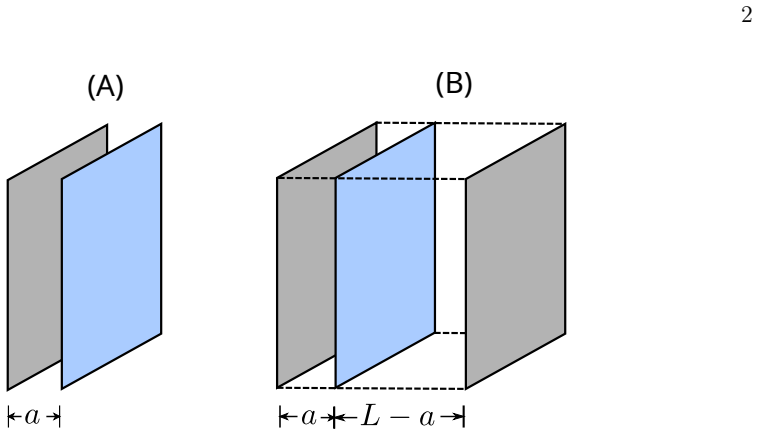
read the original abstract
The Casimir effect in its simplest form describes the attraction of two parallel conducting plates at close distance due to the vacuum fluctuation of the electromagnetic field. Its derivation can be found in many introductory works on quantum optics. Here we return to the original paper by Casimir and find subtle nuances in his derivation that are worth discussing to give a complete picture of a mathematically sound derivation of the effect.
Editorial analysis
A structured set of objections, weighed in public.
Referee Report
Summary. The paper claims that by addressing subtle nuances in Casimir's 1948 mode-sum derivation of the Casimir effect between parallel conducting plates—specifically the need for symmetric limits on the cutoff function and the independence of the finite remainder from the detailed shape of an even, sufficiently smooth cutoff—a complete and mathematically sound derivation is obtained without circularity or hidden divergences.
Significance. If the result holds, the manuscript supplies a pedagogically transparent and cutoff-independent version of the standard zero-point energy subtraction for the Casimir force. It explicitly demonstrates that the physical result is insensitive to the precise regularization provided the cutoff satisfies the stated symmetry and smoothness conditions, which strengthens the logical foundation of an often-repeated introductory calculation in quantum optics and QFT.
minor comments (2)
- [Abstract] The abstract mentions 'subtle nuances' but does not name them; a single sentence listing the two key technical points (symmetric limits and even-cutoff independence) would improve immediate clarity.
- In the derivation of the regularized sum, the transition from the continuum integral to the subtracted finite part should explicitly reference the evenness condition on the cutoff function when stating independence.
Simulated Author's Rebuttal
We thank the referee for their positive evaluation of the manuscript and for recommending acceptance. The report accurately captures our aim of clarifying the mathematical conditions (symmetric cutoff limits and even, smooth cutoff functions) that render Casimir's original mode-sum derivation free of hidden divergences or circularity.
Circularity Check
No significant circularity identified
full rationale
The paper revisits Casimir's 1948 mode-sum derivation, regularizes the zero-point energy sum with a cutoff function, requires symmetric limits, subtracts the free-space contribution, and shows that the resulting finite attractive force is independent of the specific even, smooth cutoff shape. These steps are explicit, follow the original logic without reduction to fitted inputs or self-definitional loops, and contain no load-bearing self-citations, uniqueness theorems imported from the authors' prior work, or ansatze smuggled via citation. The derivation is self-contained against the standard regularization benchmark and does not rename known results as new organization.
Axiom & Free-Parameter Ledger
Reference graph
Works this paper leans on
-
[1]
H. B. G. Casimir, On the attraction between two perfectly conducting plates, Proc. K. Ned. Akad. Wet.51, 793 (1948)
1948
-
[2]
W. P. Schleich,Quantum Optics in Phase Space(Wiley-VCH, Weinheim, Germany, 2001)
2001
-
[3]
C. C. Gerry and P. L. Knight,Introductory Quantum Optics(Cambridge University Press, Cambridge, UK, 2005)
2005
-
[4]
Leonhardt,Essential Quantum Optics: From Quantum Measurements to Black Holes, 1st ed
U. Leonhardt,Essential Quantum Optics: From Quantum Measurements to Black Holes, 1st ed. (Cambridge University Press, Cambridge, UK, 2010)
2010
-
[5]
S. M. Dutra,Cavity Quantum Electrodynamics: The Strange Theory of Light in a Box, Wiley Series in Lasers and Applications (John Wiley & Sons, Hoboken, NJ, USA, 2005)
2005
-
[6]
P. W. Milonni,The Quantum Vacuum: An Introduction to Quantum Electrodynamics(Aca- demic Press, Boston, MA, USA, 1993)
1993
-
[7]
M. D. Schwartz,Quantum Field Theory and the Standard Model(Cambridge University Press, Cambridge, UK, 2013)
2013
-
[8]
S. Y. Buhmann,Dispersion Forces I: Macroscopic Quantum Electrodynamics and Ground-State Casimir, Casimir–Polder and van der Waals Forces, Springer Tracts in Modern Physics, Vol. 247 (Springer Berlin Heidelberg, Berlin, Germany, 2013)
2013
-
[9]
R. L. Jaffe, Unnatural acts: Unphysical consequences of imposing boundary conditions on quantum fields, inAIP Conference Proceedings, Vol. 687 (2003) pp. 3–12
2003
-
[10]
N. Graham, R. L. Jaffe, V. Khemani, M. Quandt, M. Scandurra, and H. Weigel, Casimir energies in light of quantum field theory, Phys. Lett. B572, 196 (2003), arXiv:hep-th/0207205
Pith/arXiv arXiv 2003
-
[11]
N. Graham, R. L. Jaffe, V. Khemani, M. Quandt, M. Scandurra, and H. Weigel, Calculating vacuum energies in renormalizable quantum field theories: A new approach to the Casimir problem, Nucl. Phys. B645, 49 (2002), arXiv:hep-th/0207120
Pith/arXiv arXiv 2002
-
[12]
K. A. Milton, The Casimir effect: Recent controversies and progress, J. Phys. A: Math. Gen. 37, R209 (2004), arXiv:hep-th/0406024
Pith/arXiv arXiv 2004
-
[13]
M. Bordag, U. Mohideen, and V. M. Mostepanenko, New developments in the Casimir effect, Phys. Rep.353, 1 (2001), arXiv:quant-ph/0106045
Pith/arXiv arXiv 2001
discussion (0)
Sign in with ORCID, Apple, or X to comment. Anyone can read and Pith papers without signing in.