High temperature transitions in Ruddlesden-Popper nickelates La_(n+1)Ni_(n)O_(3n+1)
Pith reviewed 2026-06-26 02:10 UTC · model grok-4.3
The pith
High-quality single crystals reveal a distinct high-temperature phase transition in the full series of Ruddlesden-Popper nickelates La_{n+1}Ni_n O_{3n+1}.
A machine-rendered reading of the paper's core claim, the machinery that carries it, and where it could break.
Core claim
By studying high-quality single crystals, we identify a previously underappreciated high-temperature phase transition in Ruddlesden-Popper nickelates La_{n+1}Ni_n O_{3n+1} distinct from the one going to a tetragonal phase.
What carries the argument
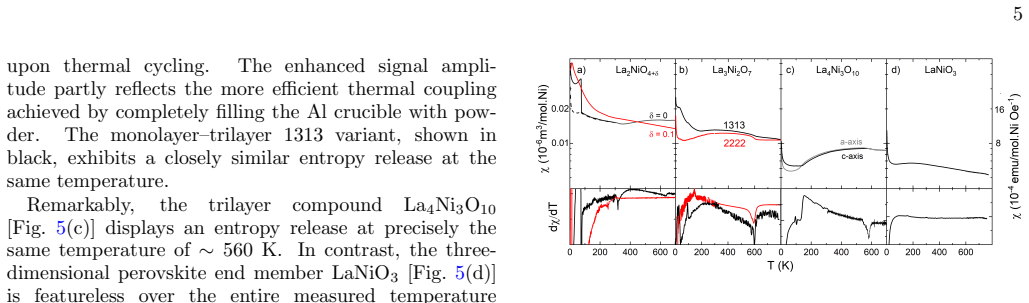
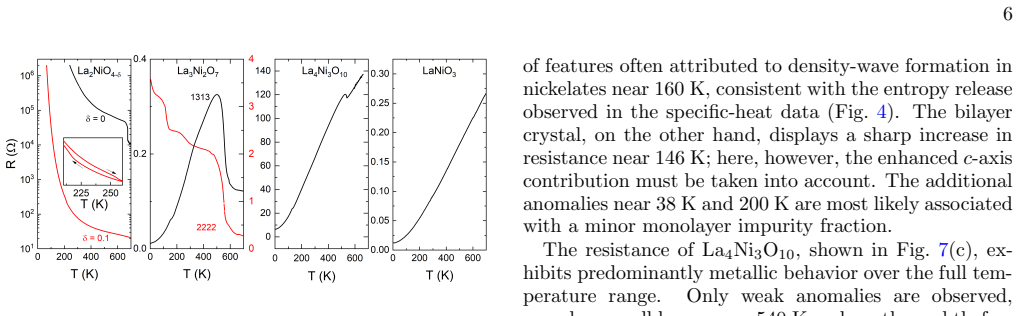
The high-temperature phase transition, detected as anomalies in calorimetry, susceptibility, and transport measurements on single crystals across the n series.
If this is right
- Phase diagrams for the entire La_{n+1}Ni_n O_{3n+1} family must incorporate this additional transition above room temperature.
- Transport and magnetic data collected up to 1000 K require reinterpretation in light of the new transition.
- Discrepancies among earlier reports on these nickelates are at least partly attributable to the transition being missed in lower-quality samples.
Where Pith is reading between the lines
- The transition temperature may set an upper limit on the temperature window relevant for studying the emergence of superconductivity in doped variants.
- Systematic mapping of how the transition temperature varies with n could reveal whether it tracks the same structural motifs that enable superconductivity at n=2.
- If the transition involves oxygen rearrangement, it would imply that oxygen stoichiometry must be controlled even at high temperatures during crystal growth.
Load-bearing premise
The observed anomalies correspond to an intrinsic bulk phase transition rather than extrinsic effects such as oxygen loss, surface reconstruction, or minor impurity phases.
What would settle it
Absence of the high-temperature anomalies in additional single crystals prepared with stricter oxygen stoichiometry control or in measurements that isolate surface versus bulk response.
Figures

read the original abstract
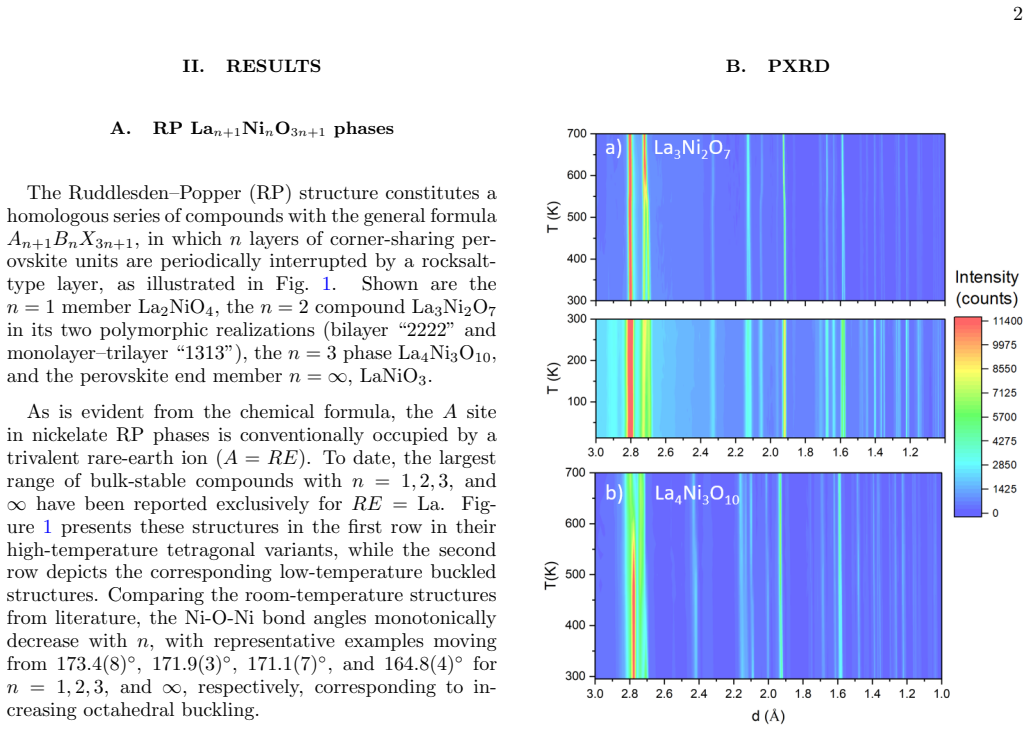
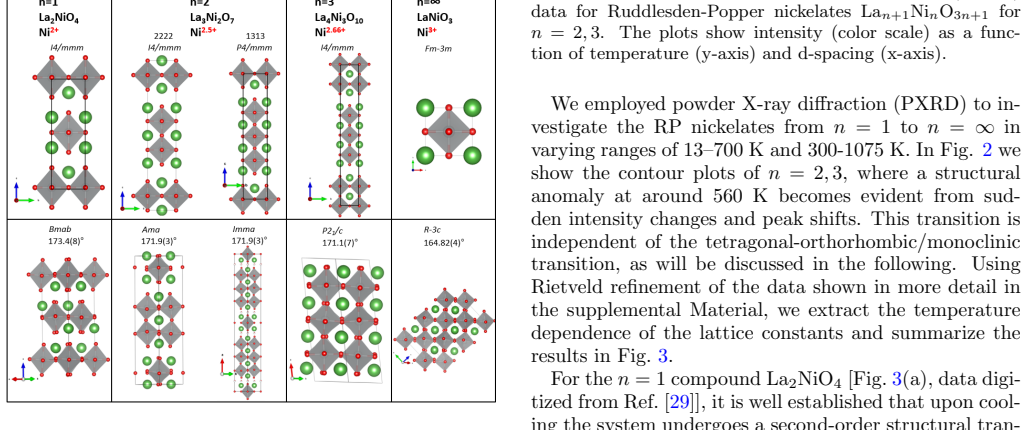
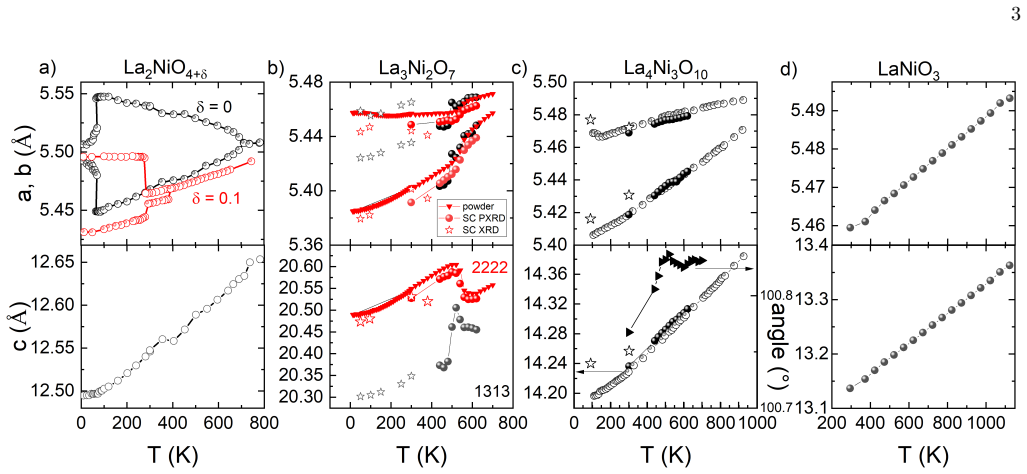
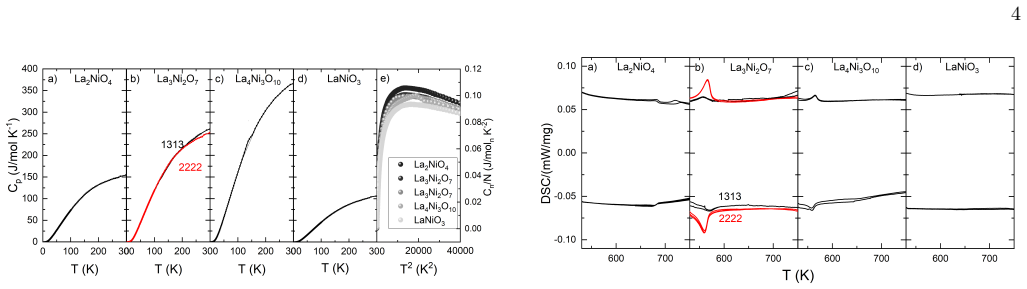
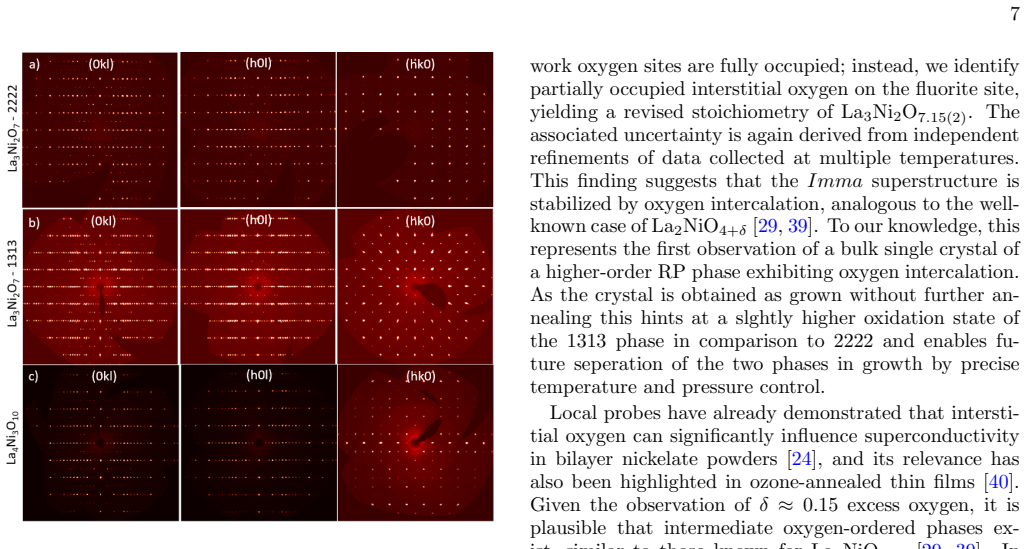
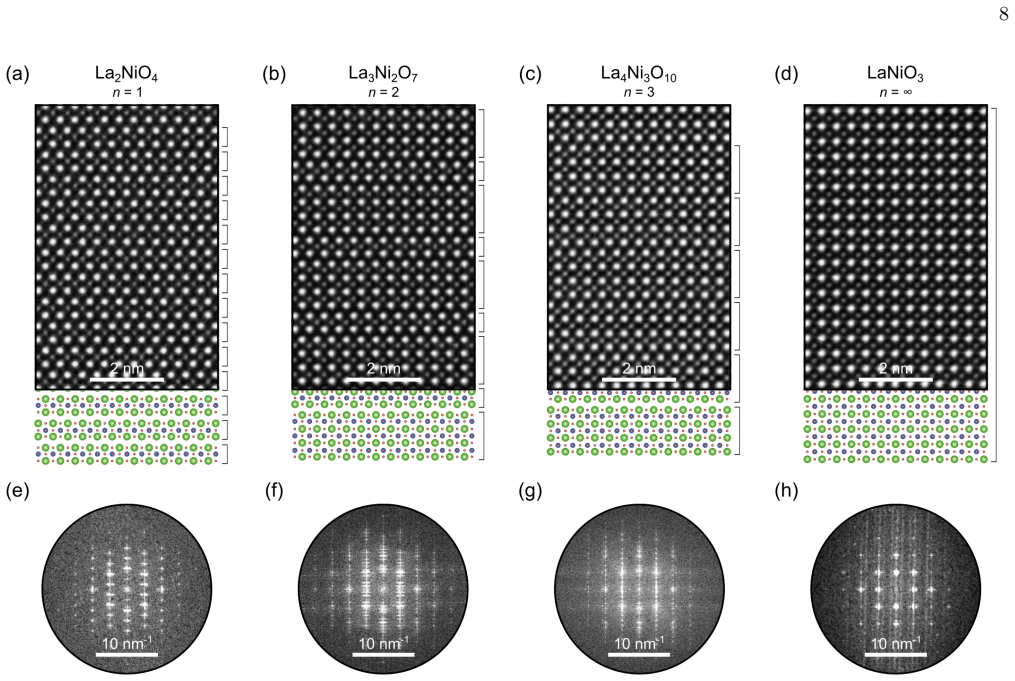
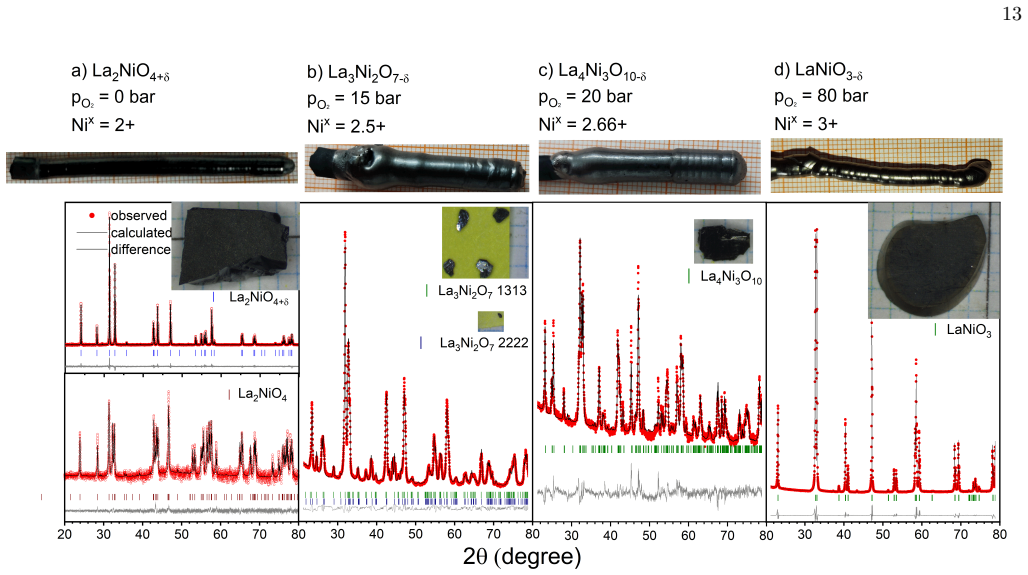
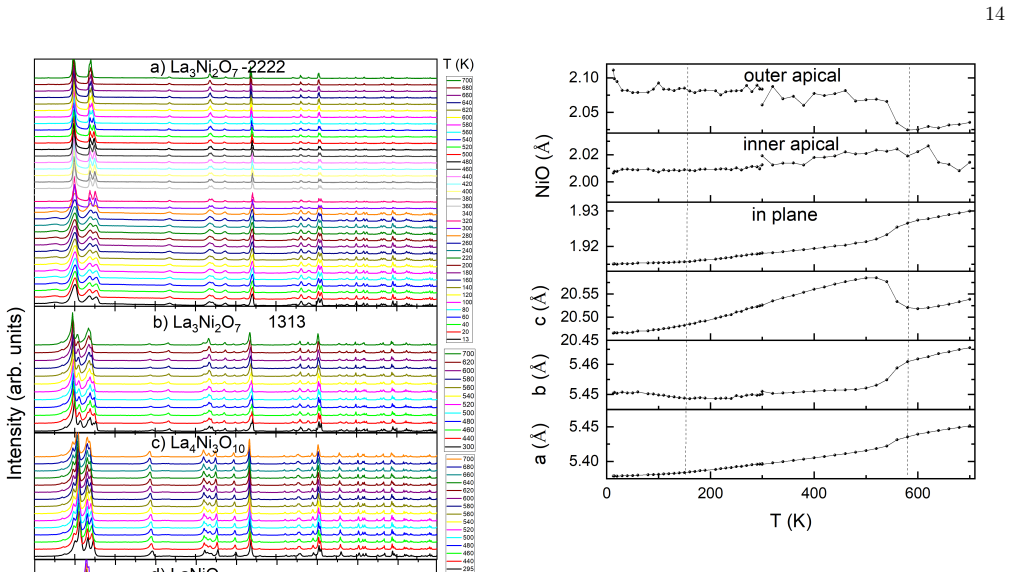
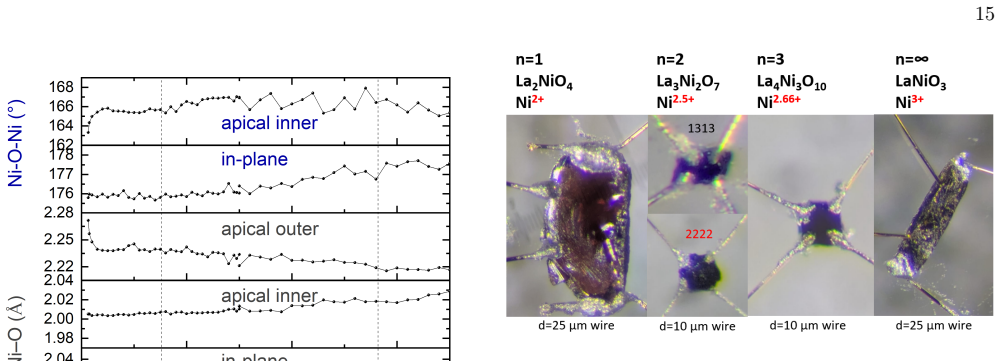
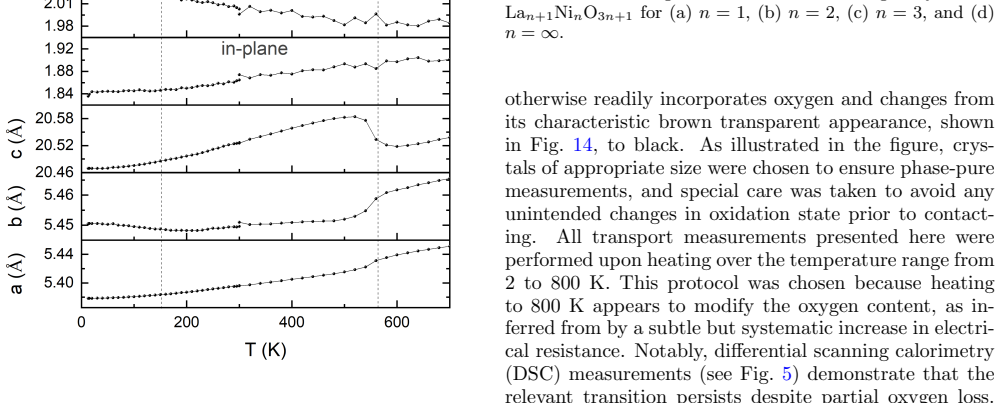
The discovery of superconductivity at $15\,\mathrm{K}$ in the infinite-layer nickelate $(\mathrm{Nd},\mathrm{Sr})\mathrm{NiO}_2$, followed by superconductivity at $80\,\mathrm{K}$ in the Ruddlesden--Popper phase $\mathrm{La}_3\mathrm{Ni}_2\mathrm{O}_7$, has ushered in a new era of nickelate research. Despite this progress, large discrepancies between reports exist. Here, we investigate the complete series of bulk-stable $\mathrm{La}_{n+1}\mathrm{Ni}_n\mathrm{O}_{3n+1}$ compounds using a comprehensive set of experimental techniques, including PXRD, single-crystal XRD, electron microscopy, heat capacity, differential scanning calorimetry, magnetic susceptibility, and transport measurements, over a broad temperature range from $2$ to $1000\,\mathrm{K}$. By studying high-quality single crystals, we identify a previously underappreciated high-temperature phase transition in Ruddlesden--Popper nickelates $\mathrm{La}_{n+1}\mathrm{Ni}_n\mathrm{O}_{3n+1}$ distinct from the one going to a tetragonal phase.
Editorial analysis
A structured set of objections, weighed in public.
Referee Report
Summary. The manuscript investigates the full series of bulk-stable Ruddlesden-Popper nickelates La_{n+1}Ni_nO_{3n+1} using PXRD, single-crystal XRD, electron microscopy, heat capacity, DSC, magnetic susceptibility, and transport measurements from 2 to 1000 K on high-quality single crystals. It claims to identify a previously underappreciated high-temperature phase transition distinct from the transition to the tetragonal phase.
Significance. If the reported anomalies are shown to be intrinsic bulk transitions rather than extrinsic effects, the result would clarify the high-temperature phase diagram of these nickelates and inform the conditions under which superconductivity emerges in related reduced phases. The use of single crystals across the n series is a strength, but the absence of quantitative data, error analysis, or explicit controls in the provided abstract limits assessment of impact.
major comments (2)
- [Abstract / Results] The central claim that the observed anomalies correspond to an intrinsic bulk phase transition (distinct from the tetragonal one) rests on the weakest assumption that they survive controls for oxygen stoichiometry, surface effects, or minor impurities. No specific section, figure, or table is cited in the abstract to demonstrate such controls (e.g., post-measurement oxygen content analysis or comparison to deliberately off-stoichiometric samples).
- [Abstract] Without presented data, figures, or quantitative analysis (e.g., transition temperatures, latent heats, or susceptibility jumps with error bars), it is not possible to evaluate whether the anomalies are reproducible across the n series or distinguishable from known literature transitions.
minor comments (1)
- [Abstract] The abstract would benefit from a brief statement of the key quantitative signatures (e.g., transition temperature range or magnitude of specific-heat anomaly) to allow readers to assess novelty immediately.
Simulated Author's Rebuttal
We thank the referee for their careful review and constructive feedback. We address the major comments point-by-point below, with revisions to improve clarity in the abstract while preserving the manuscript's focus on the experimental evidence from single-crystal studies.
read point-by-point responses
-
Referee: [Abstract / Results] The central claim that the observed anomalies correspond to an intrinsic bulk phase transition (distinct from the tetragonal one) rests on the weakest assumption that they survive controls for oxygen stoichiometry, surface effects, or minor impurities. No specific section, figure, or table is cited in the abstract to demonstrate such controls (e.g., post-measurement oxygen content analysis or comparison to deliberately off-stoichiometric samples).
Authors: We agree the abstract does not cite specific controls or figures, as is conventional for brevity. The full manuscript details high-quality single-crystal growth and characterization via PXRD, single-crystal XRD, electron microscopy, and multiple physical property measurements (heat capacity, DSC, susceptibility, transport) from 2-1000 K, with consistency across the n series supporting intrinsic bulk behavior. We have revised the abstract to reference the relevant methods and results sections demonstrating sample quality and reproducibility. revision: yes
-
Referee: [Abstract] Without presented data, figures, or quantitative analysis (e.g., transition temperatures, latent heats, or susceptibility jumps with error bars), it is not possible to evaluate whether the anomalies are reproducible across the n series or distinguishable from known literature transitions.
Authors: The abstract is intentionally concise and does not contain quantitative details or figures. The manuscript body includes quantitative transition temperatures, calorimetric data (latent heats via DSC), susceptibility jumps, and error analysis across multiple n values, with explicit distinction from the tetragonal transition based on temperature ranges and structural data. We have updated the abstract to summarize key quantitative findings and their distinction from literature transitions, with citations to the corresponding figures and tables. revision: yes
Circularity Check
No circularity: experimental report with no derivation chain
full rationale
The manuscript is a purely experimental study reporting PXRD, single-crystal XRD, calorimetry, susceptibility, and transport data on La_{n+1}Ni_nO_{3n+1} crystals. No equations, ansatzes, fitted parameters, or theoretical derivations appear. Claims rest on direct laboratory measurements benchmarked against external standards and prior independent literature; no self-referential reduction of any result to its own inputs is present.
Axiom & Free-Parameter Ledger
Forward citations
Cited by 1 Pith paper
-
Density waves in low-pressure bilayer nickelates
Unrestricted Hartree-Fock calculations show the second density-wave transition in La3Ni2O7 originates from double-stripe spin order becoming unstable toward a commensurate charge-density wave, yielding intertwined spi...
Reference graph
Works this paper leans on
-
[1]
The X-ray source was a 9 kW ro- tating anode tube with Cu K α1,2 (G¨ obel mirror filtered, λ= 1.54 ˚A) radiation
Rigaku SmartLab SE operating in a parallel beam reflection geometry with HyPix-3000 semiconductor de- tector in 1D mode. The X-ray source was a 9 kW ro- tating anode tube with Cu K α1,2 (G¨ obel mirror filtered, λ= 1.54 ˚A) radiation. The sample was packed into a single-crystal Si 911 sampleholder with 0.4 mm cavity. Before the measurement the sample was ...
-
[2]
Greenblatt, Ruddlesden-popper Ln n+1NinO3n+1 nickelates: structure and properties, Curr
M. Greenblatt, Ruddlesden-popper Ln n+1NinO3n+1 nickelates: structure and properties, Curr. Opin. Solid State Mater. Sci.2, 174 (1997)
1997
-
[3]
J. G. Bednorz and K. A. M¨ uller, Perovskite-Type Ox- ides—the New Approach to High-T C Superconductivity. Nobel Lecture, Angewandte Chemie International Edi- tion in English27, 735 (1988)
1988
-
[4]
Acrivos, M
J. Acrivos, M. Lei, C. Jiang, H. Nguyen, P. Metcalf, and J. Honig, Paramagnetism, antiferromagnetism, and su- perconductivity in La 2NiO4, J. Solid State Chem.111, 343 (1994)
1994
-
[5]
Sachan, D
V. Sachan, D. J. Buttrey, J. M. Tranquada, J. E. Lorenzo, and G. Shirane, Charge and spin ordering in La2−xSrxNiO4.00 with x=0.135 and 0.20, Phys. Rev. B 51, 12742 (1995)
1995
-
[6]
Sugai, M
S. Sugai, M. Sato, T. Kobayashi, J. Akimitsu, T. Ito, H. Takagi, S. Uchida, S. Hosoya, T. Kajitani, and T. Fukuda, High-energy spin excitations in the insu- lating phases of high-T c superconducting cuprates and La2NiO4, Phys. Rev. B42, 1045 (1990)
1990
-
[7]
H. Sun, M. Huo, X. Hu, J. Li, Z. Liu, Y. Han, L. Tang, Z. Mao, P. Yang, B. Wang, J. Cheng, D.-X. Yao, G.-M. Zhang, and M. Wang, Signatures of superconductivity near 80 K in a nickelate under high pressure, Nature621, 493 (2023)
2023
-
[8]
Z. Luo, X. Hu, M. Wang, W. W´ u, and D.-X. Yao, Bilayer Two-Orbital Model of La 3Ni2O7 under Pressure, Phys. Rev. Lett.131, 126001 (2023)
2023
-
[9]
Zhang, L.-F
Y. Zhang, L.-F. Lin, A. Moreo, and E. Dagotto, Elec- tronic structure, dimer physics, orbital-selective behav- ior, and magnetic tendencies in the bilayer nickelate su- perconductor La 3Ni2O7 under pressure, Phys. Rev. B 108, L180510 (2023)
2023
-
[10]
Wang, H.-H
M. Wang, H.-H. Wen, T. Wu, D.-X. Yao, and T. Xiang, Normal and Superconducting Properties of La 3Ni2O7, Chinese Physics Letters41, 077402 (2024)
2024
-
[11]
Sakakibara, M
H. Sakakibara, M. Ochi, H. Nagata, Y. Ueki, H. Saku- rai, R. Matsumoto, K. Terashima, K. Hirose, H. Ohta, M. Kato, Y. Takano, and K. Kuroki, Theoretical analy- sis on the possibility of superconductivity in the trilayer Ruddlesden-Popper nickelate La 4Ni3O10 under pressure and its experimental examination: Comparison with La3Ni2O7, Phys. Rev. B109, 144511 (2024)
2024
-
[12]
Y. Zhu, D. Peng, E. Zhang, B. Pan, X. Chen, L. Chen, H. Ren, F. Liu, Y. Hao, N. Li, Z. Xing, F. Lan, J. Han, J. Wang, D. Jia, H. Wo, Y. Gu, Y. Gu, L. Ji, W. Wang, H. Gou, Y. Shen, T. Ying, X. Chen, W. Yang, H. Cao, C. Zheng, Q. Zeng, J.-g. Guo, and J. Zhao, Superconduc- tivity in pressurized trilayer La4Ni3O10−δ single crystals, Nature631, 531 (2024)
2024
-
[13]
X. Chen, J. Zhang, A. S. Thind, S. Sharma, H. LaBol- lita, G. Peterson, H. Zheng, D. P. Phelan, A. S. Botana, R. F. Klie, and J. F. Mitchell, Polymorphism in the Ruddlesden–Popper Nickelate La 3Ni2O7: Discovery of a Hidden Phase with Distinctive Layer Stacking, Journal of the American Chemical Society146, 3640 (2024). [13]Puphal, P., P. Reiss, N. Enderlei...
2024
-
[14]
H. Wang, L. Chen, A. Rutherford, H. Zhou, and W. Xie, Long-Range Structural Order in a Hidden Phase of Ruddlesden–Popper Bilayer Nickelate La 3Ni2O7, Inor- ganic Chemistry63, 5020 (2024)
2024
-
[15]
F. Li, N. Guo, Q. Zheng, Y. Shen, S. Wang, Q. Cui, C. Liu, S. Wang, X. Tao, G.-M. Zhang, and J. Zhang, Design and synthesis of three-dimensional hy- brid Ruddlesden-Popper nickelate single crystals, Physi- cal Review Materials8, 053401 (2024)
2024
-
[16]
M. Shi, D. Peng, K. Fan, Z. Xing, S. Yang, Y. Wang, H. Li, R. Wu, M. Du, B. Ge, Z. Zeng, Q. Zeng, J. Ying, T. Wu, and X. Chen, Pressure induced superconductivity in hybrid Ruddlesden–Popper La5Ni3O11 single crystals, Nature Physics21, 1780 (2025)
2025
-
[17]
Huang, J
C. Huang, J. Li, X. Huang, H. Zhang, D. Hu, M. Huo, X. Chen, Z. Chen, H. Sun, and M. Wang, Superconduc- tivity in monolayer-trilayer phase of la 3ni2o7 under high pressure (2025)
2025
-
[18]
E. K. Ko, Y. Yu, Y. Liu, L. Bhatt, J. Li, V. Thampy, C.-T. Kuo, B. Y. Wang, Y. Lee, K. Lee, J.-S. Lee, B. H. Goodge, D. A. Muller, and H. Y. Hwang, Signa- tures of ambient pressure superconductivity in thin film La3Ni2O7, Nature638, 935 (2024)
2024
-
[19]
G. Zhou, W. Lv, H. Wang, Z. Nie, Y. Chen, Y. Li, H. Huang, W.-Q. Chen, Y.-J. Sun, Q.-K. Xue, and Z. Chen, Ambient-pressure superconductivity onset above 40 K in (La,Pr) 3Ni2O7 films, Nature640, 641 (2025)
2025
-
[20]
Y. Liu, E. K. Ko, Y. Tarn, L. Bhatt, J. Li, V. Thampy, B. H. Goodge, D. A. Muller, S. Raghu, Y. Yu, and H. Y. Hwang, Superconductivity and normal-state transport in compressively strained La 2PrNi2O7 thin films, Nature Materials24, 1221–1227 (2025)
2025
-
[21]
Puphal, T
P. Puphal, T. Sch¨ afer, B. Keimer, and M. Hepting, Su- perconductivity in infinite-layer and ruddlesden–popper nickelates, Nature Reviews Physics8, 70 (2025)
2025
-
[22]
S. V. Mandyam, E. Wang, Z. Wang, B. Chen, N. C. Jayarama, A. Gupta, E. A. Riesel, V. I. Levitas, C. R. Laumann, and N. Y. Yao, Uncovering origins of hetero- geneous superconductivity in La 3Ni2O7, Nature651, 54 (2026)
2026
-
[23]
Z. Dong, M. Huo, J. Li, J. Li, P. Li, H. Sun, L. Gu, Y. Lu, M. Wang, Y. Wang, and Z. Chen, Visualization of oxy- gen vacancies and self-doped ligand holes in La3Ni2O7−δ, Nature630, 847 (2024)
2024
-
[24]
Z. Dong, G. Wang, N. Wang, W.-H. Dong, L. Gu, Y. Xu, J. Cheng, Z. Chen, and Y. Wang, Interstitial oxy- gen order and its competition with superconductivity in La2PrNi2O7+δ, Nature Materials24, 1927 (2025)
1927
-
[25]
Kobayashi, S
Y. Kobayashi, S. Taniguchi, M. Kasai, M. Sato, T. Nish- ioka, and M. Kontani, Transport and Magnetic Proper- ties of La 3Ni2O7−δ and La4Ni3O10−δ, J. Phys. Soc. Jpn. 65, 3978 (1996)
1996
-
[26]
G. AMOW, I. DAVIDSON, and S. SKINNER, A comparative study of the Ruddlesden-Popper series, Lan+1NinO3n+1 (n=1, 2 and 3), for solid-oxide fuel-cell cathode applications, Solid State Ionics177, 1205 (2006)
2006
-
[27]
Zinkevich, N
M. Zinkevich, N. Solak, H. Nitsche, M. Ahrens, and F. Aldinger, Stability and thermodynamic functions of 12 lanthanum nickelates, Journal of Alloys and Compounds 438, 92 (2007)
2007
-
[28]
Sasaki, H
H. Sasaki, H. Harashina, S. Taniguchi, M. Kasai, Y. Kobayashi, M. Sato, T. Kobayashi, T. Ikeda, M. Takata, and M. Sakata, Structural Studies on the Phase Transition of La3Ni2O6.92 at about 550 K, Journal of the Physical Society of Japan66, 1693 (1997)
1997
-
[29]
Tamura, A
H. Tamura, A. Hayashi, and Y. Ueda, Phase diagram of La2NiO4+δ (0≤δ≤0.18) II. Thermodynamics of excess oxygen, phase transitions (0.06≤δ <0.11) and phase segregation (0.03≤6<0.06), Physica C: Superconduc- tivity258, 61 (1996)
1996
-
[30]
Hayashi, H
A. Hayashi, H. Tamura, and Y. Ueda, Successive struc- tural phase transitions in stoichiometric La 2NiO4 ob- served by X-ray diffraction, Physica C: Superconductiv- ity216, 77 (1993)
1993
-
[31]
Zhang, H
J. Zhang, H. Zheng, Y.-S. Chen, Y. Ren, M. Yonemura, A. Huq, and J. F. Mitchell, High oxygen pressure floating zone growth and crystal structure of the metallic nicke- latesR 4Ni3O10 (R=La,Pr ), Physical Review Materials 4, 083402 (2020)
2020
-
[32]
M. L. Medarde, Structural, magnetic and electronic prop- erties of perovskites (r = rare earth), Journal of Physics: Condensed Matter9, 1679 (1997)
1997
-
[33]
G. Wu, J. J. Neumeier, and M. F. Hundley, Magnetic sus- ceptibility, heat capacity, and pressure dependence of the electrical resistivity of La 3Ni2O7 and La 4Ni3O10, Phys. Rev. B63, 245120 (2001)
2001
-
[34]
Taniguchi, T
S. Taniguchi, T. Nishikawa, Y. Yasui, Y. Kobayashi, J. Takeda, S.-i. Shamoto, and M. Sato, Transport, Mag- netic and Thermal Properties of La 3Ni2O7−δ, J. Phys. Soc. Jpn.64, 1644 (1995)
1995
-
[35]
Khasanov, T
R. Khasanov, T. J. Hicken, H. Luetkens, Z. Guguchia, D. J. Gawryluk, V. Sundaramurthy, A. Suthar, M. Isobe, B. Keimer, G. Khaliullin, M. Hepting, and P. Puphal, Magnetism of the alternating monolayer-trilayer phase of La3Ni2O7 (2025)
2025
-
[36]
Z. Liu, H. Sun, M. Huo, X. Ma, Y. Ji, E. Yi, L. Li, H. Liu, J. Yu, Z. Zhang, Z. Chen, F. Liang, H. Dong, H. Guo, D. Zhong, B. Shen, S. Li, and M. Wang, Evidence for charge and spin density waves in single crystals of La3Ni2O7 and La3Ni2O6, Sci. China Phys. Mech. Astron. 66, 217411 (2022)
2022
-
[37]
Misawa, S
R. Misawa, S. Kitou, J.-P. Sun, Y. Yu, C. Koyama, Y. Nakamura, T.-h. Arima, J.-G. Cheng, and M. Hirschberger, Polar, checkerboard charge order in bilayer nickelate La 3Ni2O7 (2026)
2026
-
[38]
See Supplemental Material at [URL will be inserted by publisher] for further details, which includes Refs xxx
-
[39]
H¨ ucker, K
M. H¨ ucker, K. Chung, M. Chand, T. Vogt, J. M. Tran- quada, and D. J. Buttrey, Oxygen and strontium codop- ing of La 2NiO4: Room-temperature phase diagrams, Physical Review B70, 064105 (2004)
2004
-
[40]
Ferenc Segedin, J
D. Ferenc Segedin, J. Kim, H. LaBollita, N. K. Taylor, K.-Y. Baek, S. H. Sung, A. B. Turkiewicz, G. A. Pan, A. Y. Jiang, M. Bambrick-Santoyo, T. Schwaigert, C. K. Kim, A. Tenneti, A. J. Grutter, S. Muramoto, A. T. N’Diaye, I. El Baggari, D. A. Walko, C. M. Brooks, A. S. Botana, D. G. Schlom, H. Zhou, and J. A. Mundy, Topochemical oxidation of ruddlesden–p...
2026
-
[41]
N. Yuan, A. Elghandour, J. Arneth, K. Dey, and R. Klin- geler, High-pressure crystal growth and investigation of the metal-to-metal transition of Ruddlesden–Popper tri- layer nickelates La 4Ni3O10, Journal of Crystal Growth 627, 127511 (2024)
2024
-
[42]
M. Shi, Y. Li, Y. Wang, D. Peng, S. Yang, H. Li, K. Fan, K. Jiang, J. He, Q. Zeng, D. Song, B. Ge, Z. Xiang, Z. Wang, J. Ying, T. Wu, and X. Chen, Absence of su- perconductivity and density-wave transition in ambient- pressure tetragonal La 4Ni3O10, Nature Communications 16, 10.1038/s41467-025-57264-0 (2025)
-
[43]
V. M. Goldschmidt, Die Gesetze der Krystallochemie, Die Naturwissenschaften14, 477 (1926)
1926
-
[44]
Pauling, The principles determining the structure of complex ionic crystals, Journal of the American Chemical Society51, 1010 (1929)
L. Pauling, The principles determining the structure of complex ionic crystals, Journal of the American Chemical Society51, 1010 (1929)
1929
-
[45]
Herlihy, W.-T
A. Herlihy, W.-T. Chen, C. Ritter, Y.-C. Chuang, and M. S. Senn, Interplay between jahn–teller distortions and structural phase transitions in ruddlesden–poppers, Jour- nal of the American Chemical Society147, 7209 (2025)
2025
-
[46]
Zheng, B.-X
H. Zheng, B.-X. Wang, D. Phelan, J. Zhang, Y. Ren, M. Krogstad, S. Rosenkranz, R. Osborn, and J. Mitchell, Oxygen Inhomogeneity and Reversibility in Single Crys- tal LaNiO3−δ, Crystals10, 557 (2020). IV. SUPPLEMENTAL MATERIAL A. Growth For perovskite nickelates withn=∞,RENiO 3, it is well established that the degree of octahedral buck- ling strongly depen...
2020
discussion (0)
Sign in with ORCID, Apple, or X to comment. Anyone can read and Pith papers without signing in.