GPU-accelerated superiorization on constrained physical problems with SupPy
Pith reviewed 2026-06-26 01:57 UTC · model grok-4.3
The pith
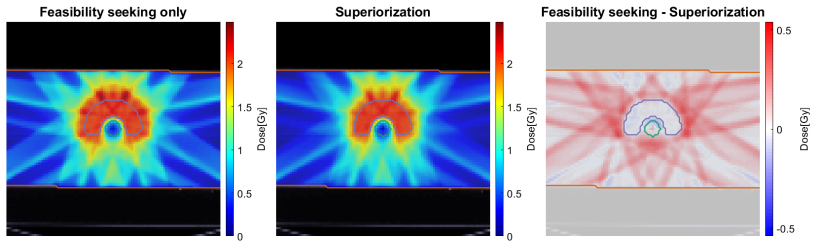
Superiorization produces lower-noise images and lower-dose radiotherapy plans than feasibility-seeking alone, even on infeasible constraints.
A machine-rendered reading of the paper's core claim, the machinery that carries it, and where it could break.
Core claim
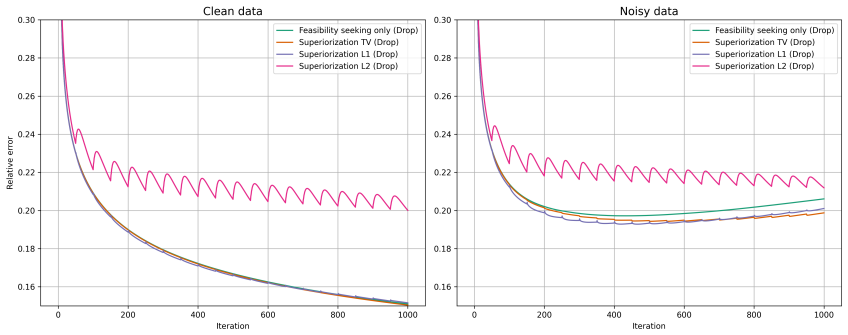
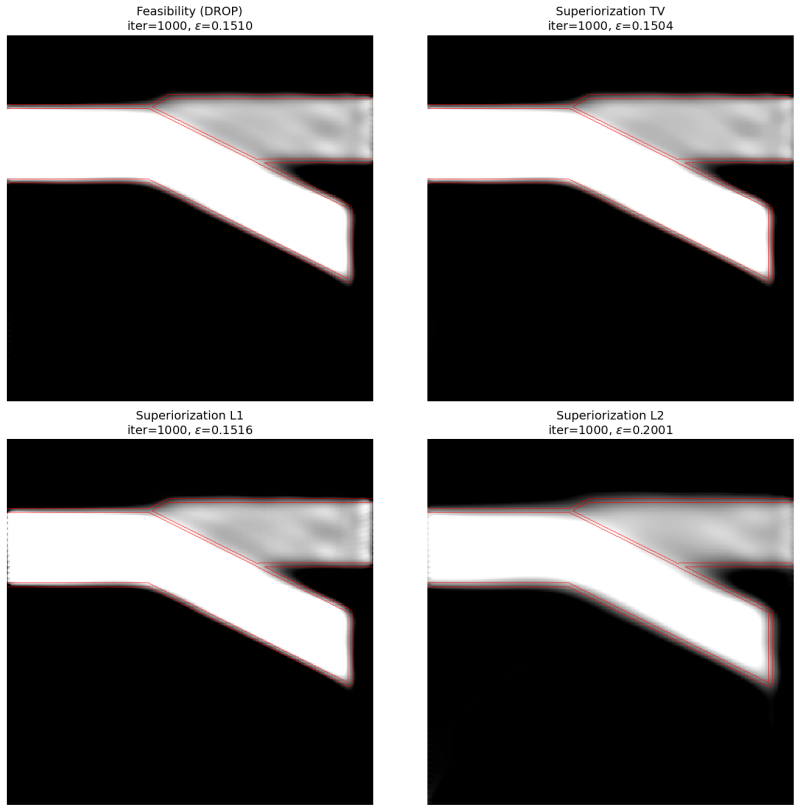
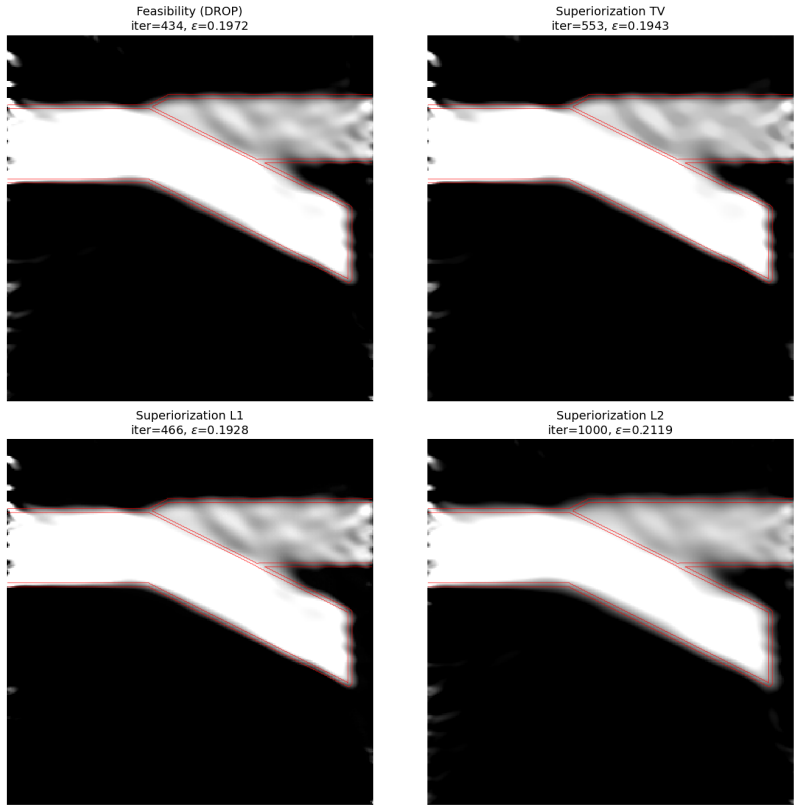
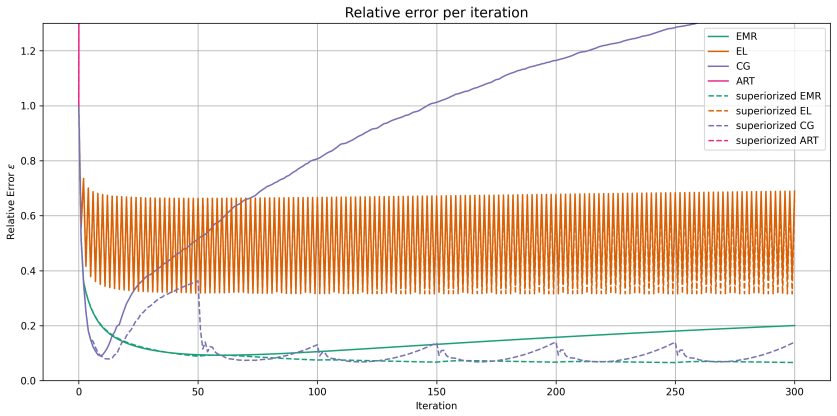
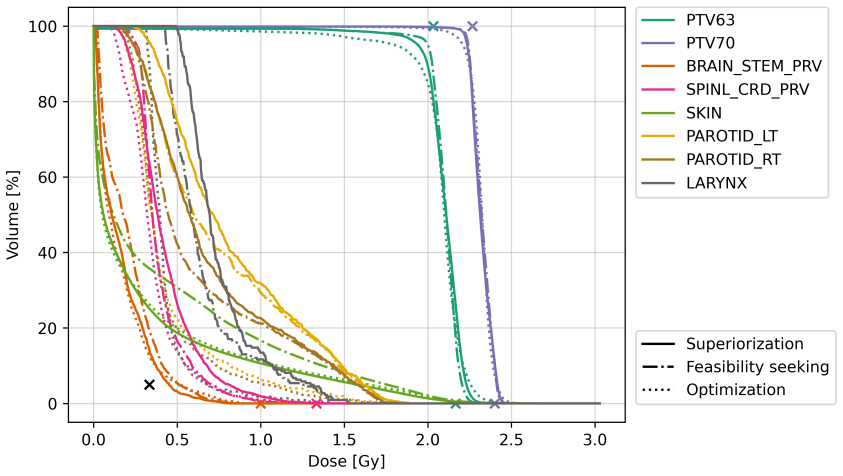
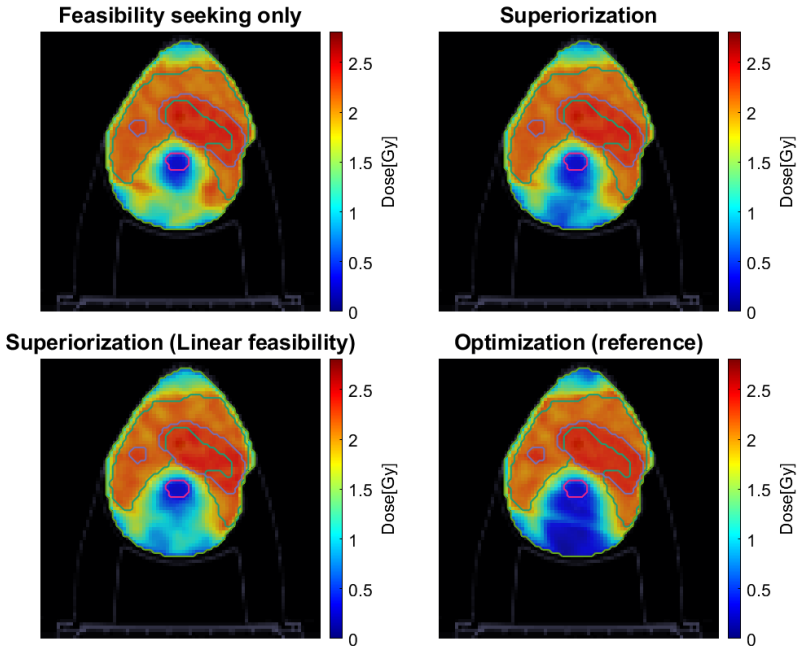
When the superiorization method is applied through the SupPy toolbox, the resulting algorithms return feasible points with lower objective values than those obtained by feasibility-seeking alone; this yields reduced noise in seismic and CT reconstructions and reduced body dose in radiotherapy plans, and it produces clinically viable radiotherapy plans even when the underlying constraint set is infeasible.
What carries the argument
The superiorization method, which perturbs the iterates of a feasibility-seeking algorithm to decrease a chosen objective function while preserving feasibility.
If this is right
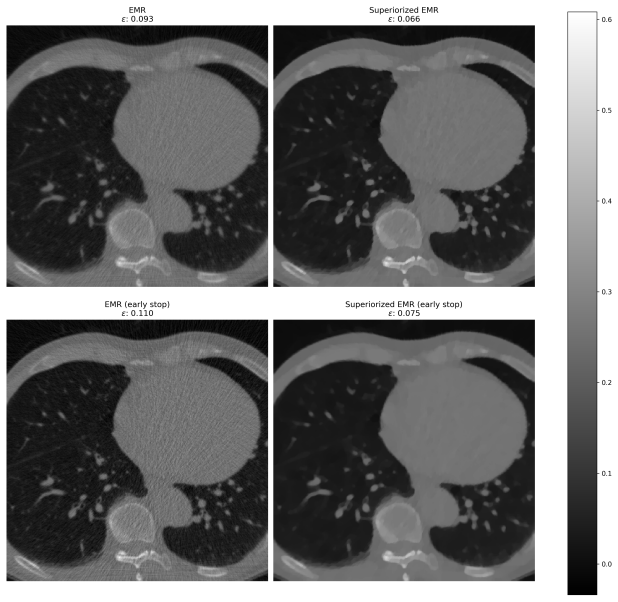
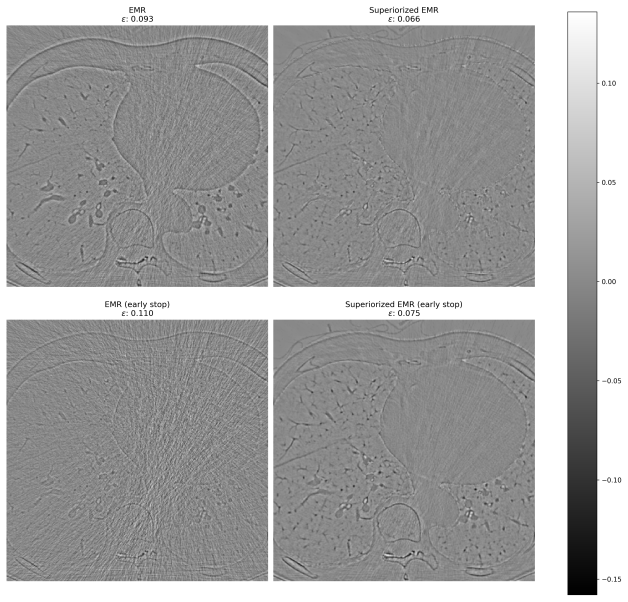
- Seismic and CT images reconstructed with superiorization exhibit lower noise than those from feasibility-seeking alone.
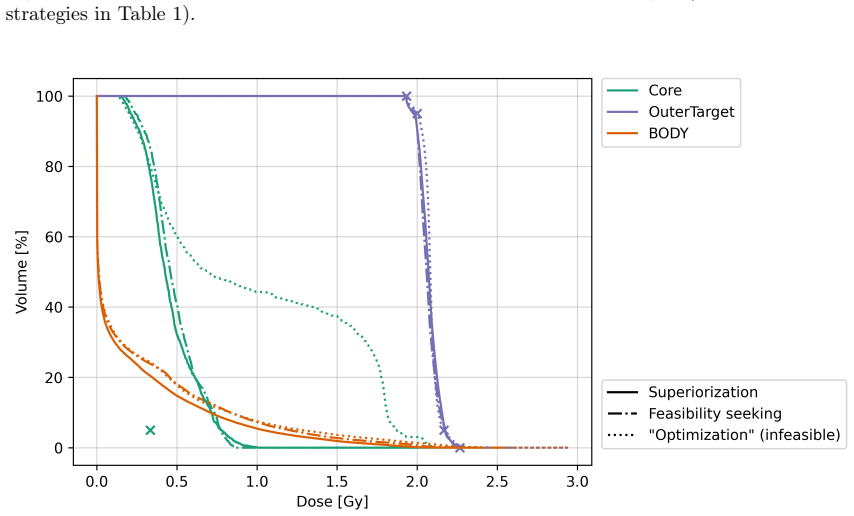
- Intensity-modulated radiotherapy plans from superiorization deliver lower dose to the body than those from feasibility-seeking alone.
- Superiorization can return clinically viable radiotherapy plans when the full set of dose and geometry constraints is infeasible.
- The open modular Python implementation with GPU support makes the method immediately usable on standard hardware for these physical problems.
Where Pith is reading between the lines
- An open toolbox such as SupPy could make it straightforward to test superiorization on other inverse problems that currently rely only on feasibility-seeking or full optimization.
- GPU execution opens the possibility of applying superiorization inside time-critical loops such as online adaptive radiotherapy or real-time seismic monitoring.
- The ability to work with infeasible constraint sets may reduce the amount of manual constraint tuning required in clinical planning workflows.
Load-bearing premise
The measured gains in noise, dose, and viability on infeasible sets are caused by the superiorization perturbations themselves rather than by unstated choices in code or data handling inside SupPy.
What would settle it
An independent re-implementation of the same three superiorized algorithms that shows no consistent reduction in noise or dose relative to the corresponding feasibility-seeking versions.
Figures
read the original abstract
The superiorization method (SM) is situated between feasibility-seeking and constrained optimization. Instead of aiming at the minimum of a given objective function over a constraint set, it seeks a feasible point at which the objective function value is reduced - though not necessarily minimal - rather than hard targets, or in which a mathematically optimal solution is not strictly required. While the method has been investigated for several applications in physics, its broader use has been limited, in part due to the lack of openly available software for researchers wishing to explore it. In this work we apply superiorization to three problems from applied physics: seismic image reconstruction, low-dose CT reconstruction and intensity-modulated radiotherapy treatment planning. These experiments are conducted with SupPy, an open-source modularized Python toolbox developed for this work, which supports execution of feasibility-seeking algorithms and their superiorized version on both the CPU and the GPU. In all three cases the superiorized algorithms achieve favorable results compared to feasibility-seeking alone, with reduced noise in the imaging examples and lowered body dose in the radiotherapy plans. For the radiotherapy case we further observe that superiorization produces clinically viable plans on infeasible constraint sets.
Editorial analysis
A structured set of objections, weighed in public.
Referee Report
Summary. The paper introduces SupPy, an open-source modular Python toolbox for feasibility-seeking and superiorization algorithms with CPU/GPU support, and applies it to three constrained problems in applied physics: seismic image reconstruction, low-dose CT reconstruction, and intensity-modulated radiotherapy (IMRT) treatment planning. It claims that in all cases the superiorized versions produce favorable outcomes relative to feasibility-seeking alone (reduced noise in imaging; lowered body dose in radiotherapy) and that superiorization yields clinically viable plans even on infeasible constraint sets.
Significance. If the empirical claims hold with proper controls, the work supplies a reusable, GPU-accelerated implementation of an established method (superiorization) that sits between feasibility-seeking and constrained optimization. The open modular toolbox itself is a concrete contribution that could lower the barrier for physicists to test superiorization on new problems; the radiotherapy observation on infeasible sets, if quantified, would be a practically relevant demonstration.
major comments (2)
- [Abstract, §§3–5] Abstract and §3–5 (results sections): the central claim that superiorized algorithms achieve 'favorable results' (reduced noise, lowered dose, viable plans on infeasible sets) is stated without any quantitative metrics, error bars, baseline iteration counts, stopping criteria, or explicit definitions of the objective functions and infeasibility measures. This prevents verification that the reported gains are produced by the superiorization perturbations rather than by unstated differences in implementation, data handling, or GPU kernels between SupPy and the feasibility-seeking baselines.
- [§2, §4] §2 (SupPy description) and §4 (radiotherapy experiments): no explicit statement that the feasibility-seeking and superiorized runs use identical iteration budgets, identical constraint operators, and identical GPU kernels. Without this control, the attribution of improvements to the superiorization method (as opposed to modular implementation choices) cannot be assessed.
minor comments (2)
- [Abstract, §1] The abstract and introduction would benefit from a short table or bullet list summarizing the three test problems, the constraint sets, and the objective functions being reduced.
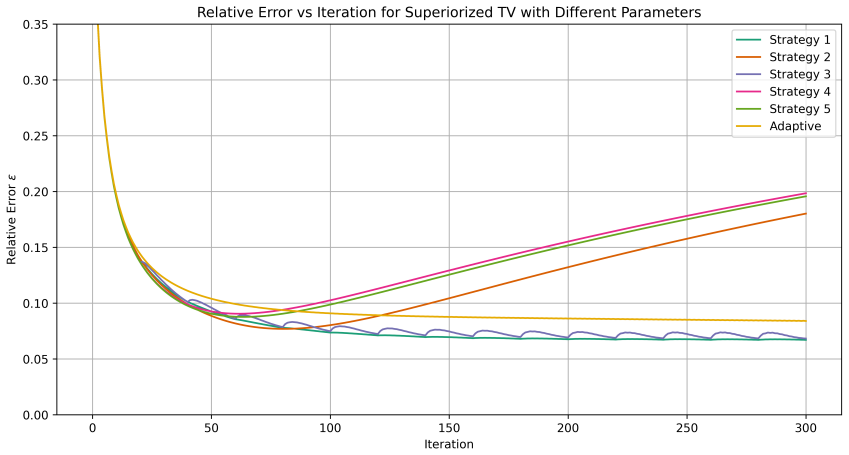
- [Figures 2–5] Figure captions and axis labels in the imaging and dose-volume results should explicitly state the quantitative improvement (e.g., noise standard deviation or mean body dose) rather than relying on visual comparison alone.
Simulated Author's Rebuttal
We thank the referee for the constructive comments, which help strengthen the clarity and verifiability of our claims. We address each major point below and will incorporate the requested details in a revised manuscript.
read point-by-point responses
-
Referee: [Abstract, §§3–5] Abstract and §3–5 (results sections): the central claim that superiorized algorithms achieve 'favorable results' (reduced noise, lowered dose, viable plans on infeasible sets) is stated without any quantitative metrics, error bars, baseline iteration counts, stopping criteria, or explicit definitions of the objective functions and infeasibility measures. This prevents verification that the reported gains are produced by the superiorization perturbations rather than by unstated differences in implementation, data handling, or GPU kernels between SupPy and the feasibility-seeking baselines.
Authors: We agree that quantitative support is necessary to substantiate the claims and enable verification. In the revised manuscript we will augment the abstract and §§3–5 with explicit numerical metrics (e.g., noise-reduction percentages or RMSE values with standard deviations where repeated runs permit, mean body-dose reductions, and feasibility-gap measures), iteration budgets, stopping criteria, and precise definitions of the objective functions and infeasibility measures used in each experiment. These additions will make clear that the reported improvements arise from the superiorization perturbations rather than implementation differences. revision: yes
-
Referee: [§2, §4] §2 (SupPy description) and §4 (radiotherapy experiments): no explicit statement that the feasibility-seeking and superiorized runs use identical iteration budgets, identical constraint operators, and identical GPU kernels. Without this control, the attribution of improvements to the superiorization method (as opposed to modular implementation choices) cannot be assessed.
Authors: We accept that an explicit control statement is required. The SupPy implementation already enforces identical iteration budgets, constraint operators, and GPU kernels for paired feasibility-seeking and superiorized runs, differing only by the addition of the superiorization perturbation step. In the revised §2 and §4 we will insert a dedicated paragraph documenting these identical controls and confirming that the only algorithmic difference is the superiorization perturbation itself. revision: yes
Circularity Check
No circularity: empirical application of established method
full rationale
The paper applies the pre-existing superiorization method (SM) to three physics problems via new open-source software SupPy. The abstract and provided text contain no derivations, equations, fitted parameters, or predictions that reduce to inputs by construction. Results are empirical comparisons of superiorized vs. feasibility-seeking runs; the central claims rest on observed outcomes rather than any self-referential definition or self-citation chain that would force the reported improvements. This is a standard non-circular empirical software/application paper.
Axiom & Free-Parameter Ledger
axioms (1)
- domain assumption Superiorization seeks a feasible point with reduced objective value rather than a mathematically optimal solution.
Reference graph
Works this paper leans on
-
[1]
URL:https:// dx.doi.org/10.1088/0266-5611/26/6/065008
Y.Censor, R.Davidi, G.T.Herman, Perturbationresilienceandsuperiorization of iterative algorithms, Inverse Problems 26 (2010) 065008. URL:https:// dx.doi.org/10.1088/0266-5611/26/6/065008. doi:10.1088/0266-5611/26/ 6/065008
-
[2]
Y. Censor, Superiorization and Perturbation Resilience of Algorithms: A Con- tinuously Updated Bibliography, 2023. URL:http://arxiv.org/abs/1506. 04219. doi:10.48550/arXiv.1506.04219, arXiv:1506.04219 [math]. 34
-
[3]
E. Y. Sidky, X. Pan, Image reconstruction in circular cone-beam computed tomography by constrained, total-variation minimization, Physics in Medicine & Biology 53 (2008) 4777. URL:https://doi.org/10.1088/0031-9155/53/ 17/021. doi:10.1088/0031-9155/53/17/021
-
[4]
S. N. Penfold, R. W. Schulte, Y. Censor, A. B. Rosenfeld, Total variation superiorization schemes in proton computed tomography image reconstruc- tion, Medical Physics 37 (2010) 5887–5895. URL:https://onlinelibrary. wiley.com/doi/abs/10.1118/1.3504603. doi:10.1118/1.3504603, _eprint: https://onlinelibrary.wiley.com/doi/pdf/10.1118/1.3504603
-
[5]
G. T. Herman, E. Garduño, R. Davidi, Y. Censor, Superior- ization: An optimization heuristic for medical physics, Medical Physics 39 (2012) 5532–5546. URL:https://onlinelibrary.wiley. com/doi/abs/10.1118/1.4745566. doi:10.1118/1.4745566, _eprint: https://onlinelibrary.wiley.com/doi/pdf/10.1118/1.4745566
-
[6]
Y. Censor, K. E. Schubert, R. W. Schulte, Developments in Mathematical Algorithms and Computational Tools for Proton CT and Particle Therapy Treatment Planning, IEEE Transactions on Radiation and Plasma Medical Sciences 6 (2022) 313–324. URL:https://ieeexplore.ieee.org/abstract/ document/9521582. doi:10.1109/TRPMS.2021.3107322
-
[7]
T. Nikazad, M. Abbasi, L. Afzalipour, T. Elfving, A new step size rule for the superiorization method and its application in computerized tomography, NumericalAlgorithms90(2022)1253–1277.URL:https://doi.org/10.1007/ s11075-021-01229-z. doi:10.1007/s11075-021-01229-z
-
[8]
F. Barkmann, Y. Censor, N. Wahl, Superiorization of projection algorithms for linearly constrained inverse radiotherapy treatment planning, Frontiers in On- cology 13 (2023) 1238824. URL:https://www.frontiersin.org/articles/ 10.3389/fonc.2023.1238824/full. doi:10.3389/fonc.2023.1238824
-
[9]
A. Gibali, K.-H. Küfer, D. Reem, P. Süss, A generalized projection-based scheme for solving convex constrained optimization problems, Computational Optimization and Applications 70 (2018) 737–762. URL:https://doi.org/ 10.1007/s10589-018-9991-4. doi:10.1007/s10589-018-9991-4
-
[10]
Bonacker, Perturbed Projection Methods in Convex Optimization - Ap- plied to Radiotherapy Planning, Ph.D
E. Bonacker, Perturbed Projection Methods in Convex Optimization - Ap- plied to Radiotherapy Planning, Ph.D. thesis, Fraunhofer Verlag, 2020. 35 URL:https://publica.fraunhofer.de/handle/publica/282962. doi:10. 24406/publica-fhg-282962
2020
-
[11]
D. Borys, J. Gajewski, T. Becher, Y. Censor, R. Kopeć, M. Rydygier, A. Schi- avi, T. Skóra, A. Spaleniak, N. Wahl, A. Wochnik, A. Ruciński, GPU- accelerated FREDopt package for simultaneous dose and LETd proton radio- therapy plan optimization via superiorization methods, Physics in Medicine & Biology 70 (2025) 155011. URL:https://doi.org/10.1088/1361-656...
-
[12]
Y. Nie, M. Wang, Y. Wang, J. Lin, B. Liu, T. Yin, Z. Liu, S. Zhang, Su- periorized model-based real-time inversion for cross-sectional magnetoacoustic tomography combined with magnetic induction, Physics in Medicine & Biol- ogy 71 (2026) 015040. URL:https://doi.org/10.1088/1361-6560/ae2cdd. doi:10.1088/1361-6560/ae2cdd
-
[13]
S. Yu, Y. Censor, G. Luo, Floorplanning With I/O Assignment via Feasibility- Seeking and Superiorization Methods, IEEE Transactions on Computer-Aided Design of Integrated Circuits and Systems 44 (2025) 317–330. URL:https: //ieeexplore.ieee.org/abstract/document/10543062. doi:10.1109/TCAD. 2024.3408106
-
[14]
A. Cegielski, Iterative Methods for Fixed Point Problems in Hilbert Spaces, volume 2057 ofLecture Notes in Mathematics, Springer Berlin Heidel- berg, Berlin, Heidelberg, 2013. URL:http://link.springer.com/10.1007/ 978-3-642-30901-4. doi:10.1007/978-3-642-30901-4
-
[15]
Y. Censor, An automatic relaxation method for solving interval lin- ear inequalities, Journal of Mathematical Analysis and Applications 106 (1985) 19–25. URL:https://www.sciencedirect.com/science/article/ pii/0022247X85901271. doi:10.1016/0022-247X(85)90127-1
-
[16]
URL:https://linkinghub.elsevier
G.T.Herman, W.Chen, Afastalgorithmforsolvingalinearfeasibilityproblem with application to intensity-modulated radiation therapy, Linear Algebra and its Applications 428 (2008) 1207–1217. URL:https://linkinghub.elsevier. com/retrieve/pii/S0024379506005106. doi:10.1016/j.laa.2006.11.009
-
[17]
Y. Censor, T. Elfving, G. T. Herman, T. Nikazad, On Diagonally Re- laxed Orthogonal Projection Methods, SIAM Journal on Scientific Computing 30 (2008) 473–504. URL:http://epubs.siam.org/doi/10.1137/050639399. doi:10.1137/050639399. 36
-
[18]
T. Nikazad, M. Abbasi, T. Elfving, Error minimizing relaxation strate- gies in Landweber and Kaczmarz type iterations, Journal of In- verse and Ill-posed Problems 25 (2017) 35–56. URL:https://www. degruyterbrill.com/document/doi/10.1515/jiip-2015-0082/html. doi:10.1515/jiip-2015-0082
-
[19]
Kaczmarz, Przyblizone rozwiazywanie ukladów równan liniowych
S. Kaczmarz, Przyblizone rozwiazywanie ukladów równan liniowych. – An- genäherte Auflösung von Systemen linearer Gleichungen., Bulletin Interna- tional de l’Académie Polonaise des Sciences et des Lettres. Classe des Sciences Mathématiques et Naturelles. (1937) 355–357
1937
-
[20]
S. Agmon, The Relaxation Method for Linear Inequalities, Cana- dian Journal of Mathematics 6 (1954) 382–392. URL:https://www. cambridge.org/core/journals/canadian-journal-of-mathematics/ article/relaxation-method-for-linear-inequalities/ 7C0393A9DDB5EBB9FA5F1E78C591D820. doi:10.4153/CJM-1954-037-2
-
[21]
T. S. Motzkin, I. J. Schoenberg, The Relaxation Method for Linear Inequali- ties, Canadian Journal of Mathematics 6 (1954) 393–404. URL:https://www. cambridge.org/core/journals/canadian-journal-of-mathematics/ article/relaxation-method-for-linear-inequalities/ 8EDDF8B5F08B146AC71A5CF4F304A560. doi:10.4153/CJM-1954-038-x
-
[22]
H. H. Bauschke, J. M. Borwein, On Projection Algorithms for Solv- ing Convex Feasibility Problems, SIAM Review 38 (1996) 367–426. URL:https://epubs.siam.org/doi/10.1137/S0036144593251710. doi:10. 1137/S0036144593251710
-
[23]
D. Butnariu, R. Davidi, G. T. Herman, I. G. Kazantsev, Stable Convergence Behavior Under Summable Perturbations of a Class of Projection Methods for Convex Feasibility and Optimization Problems, IEEE Journal of Selected Topics in Signal Processing 1 (2007) 540–547. URL:https://ieeexplore. ieee.org/abstract/document/4407758. doi:10.1109/JSTSP.2007.910263
-
[24]
G. T. Herman, R. Davidi, Image reconstruction from a small num- ber of projections, Inverse Problems 24 (2008) 045011. URL:https: //iopscience.iop.org/article/10.1088/0266-5611/24/4/045011. doi:10. 1088/0266-5611/24/4/045011
-
[25]
R. Davidi, G. Herman, Y. Censor, Perturbation-resilient block-iterative projection methods with application to image reconstruction from projections, 37 International Transactions in Operational Research 16 (2009) 505–524. URL: https://onlinelibrary.wiley.com/doi/abs/10.1111/j.1475-3995. 2009.00695.x. doi:10.1111/j.1475-3995.2009.00695.x, _eprint: https:/...
-
[26]
Cegielski, On linear convergence of Landweber-type methods, Nu- merical Algorithms (2025)
A. Cegielski, On linear convergence of Landweber-type methods, Nu- merical Algorithms (2025). URL:https://link.springer.com/10.1007/ s11075-025-02163-0. doi:10.1007/s11075-025-02163-0
-
[27]
M. V. W. Zibetti, C. Lin, G. T. Herman, Total Variation Superiorized Conju- gate Gradient Method for Image Reconstruction, Inverse Problems 34 (2018) 034001. URL:http://arxiv.org/abs/1709.04912. doi:10.1088/1361-6420/ aaa49b, arXiv:1709.04912 [math]
work page internal anchor Pith review Pith/arXiv arXiv doi:10.1088/1361-6420/ 2018
-
[28]
Y. Censor, T. Elfving, N. Kopf, T. Bortfeld, The multiple-sets split feasibil- ity problem and its applications for inverse problems, Inverse Problems 21 (2005) 2071–2084. URL:https://iopscience.iop.org/article/10.1088/ 0266-5611/21/6/017. doi:10.1088/0266-5611/21/6/017
-
[29]
F. J. Aragón-Artacho, Y. Censor, A. Gibali, D. Torregrosa-Belén, The superi- orization method with restarted perturbations for split minimization problems with an application to radiotherapy treatment planning, Applied Mathemat- ics and Computation 440 (2023) 127627. URL:https://www.sciencedirect. com/science/article/pii/S0096300322007007. doi:10.1016/j.a...
-
[30]
C. L. Byrne, A. Moudafi, Extensions of the CQ Algorithm for the split fea- sibility and split equality problems (10th draft) (2012). URL:https://hal. univ-antilles.fr/hal-00776640/document
2012
-
[31]
C. Byrne, Bounds on the largest singular value of a matrix and the convergence of simultaneous and block-iterative algorithms for sparse linear systems, International Transactions in Operational Re- search 16 (2009) 465–479. URL:https://onlinelibrary.wiley.com/doi/ abs/10.1111/j.1475-3995.2009.00692.x. doi:10.1111/j.1475-3995.2009. 00692.x, _eprint: https...
-
[32]
Censor, E
Y. Censor, E. Garduño, E. S. Helou, G. T. Herman, Derivative-free supe- riorization: principle and algorithm, Numerical Algorithms 88 (2021) 227– 38
2021
-
[33]
doi:10.1007/ s11075-020-01038-w
URL:https://doi.org/10.1007/s11075-020-01038-w. doi:10.1007/ s11075-020-01038-w
-
[34]
E. Bonacker, A. Gibali, K.-H. Küfer, Accelerating Two Projection Meth- ods via Perturbations with Application to Intensity-Modulated Radia- tion Therapy, Applied Mathematics & Optimization 83 (2021) 881–914. URL:http://link.springer.com/10.1007/s00245-019-09571-4. doi:10. 1007/s00245-019-09571-4
-
[35]
Becher, DKFZ-OpenMedPhys/SupPy: v0.4.0 (2026)
T. Becher, DKFZ-OpenMedPhys/SupPy: v0.4.0 (2026). URL:https:// zenodo.org/records/20085222. doi:10.5281/zenodo.20085222
-
[36]
Y. Censor, H. Heaton, R. Schulte, Derivative-free superiorization with component-wise perturbations, Numerical Algorithms 80 (2019) 1219–1240. URL:http://link.springer.com/10.1007/s11075-018-0524-0. doi:10. 1007/s11075-018-0524-0
-
[37]
I. Loris, H. Douma, G. Nolet, I. Daubechies, C. Regone, Nonlinear regulariza- tion techniques for seismic tomography, Journal of Computational Physics 229 (2010) 890–905. URL:https://www.sciencedirect.com/science/article/ pii/S0021999109005725. doi:10.1016/j.jcp.2009.10.020
-
[38]
J. Charléty, S. Voronin, G. Nolet, I. Loris, F. J. Simons, K. Sigloch, I. C. Daubechies, Global seismic tomography with sparsity constraints: Comparison with smoothing and damping regularization, Journal of Geophysical Research: Solid Earth 118 (2013) 4887–4899. URL:https://onlinelibrary.wiley. com/doi/abs/10.1002/jgrb.50326. doi:10.1002/jgrb.50326, _epri...
-
[39]
P. C. Hansen, J. S. Jørgensen, AIR Tools II: algebraic iterative re- construction methods, improved implementation, Numerical Algorithms 79 (2018) 107–137. URL:https://doi.org/10.1007/s11075-017-0430-x. doi:10.1007/s11075-017-0430-x
-
[40]
P. Combettes, J. Luo, An adaptive level set method for nondifferen- tiable constrained image recovery, IEEE Transactions on Image Process- ing 11 (2002) 1295–1304. URL:https://ieeexplore.ieee.org/document/ 1097765/. doi:10.1109/TIP.2002.804527
-
[41]
J. Hsieh, B. Nett, Z. Yu, K. Sauer, J.-B. Thibault, C. A. Bouman, Recent Advances in CT Image Reconstruction, Current Radiology Reports 1 (2013) 39 39–51. URL:https://doi.org/10.1007/s40134-012-0003-7. doi:10.1007/ s40134-012-0003-7
-
[42]
T. P. Szczykutowicz, G. V. Toia, A. Dhanantwari, B. Nett, A Review of Deep Learning CT Reconstruction: Concepts, Limitations, and Promise in Clinical Practice, Current Radiology Reports 10 (2022) 101–115. URL:https://doi. org/10.1007/s40134-022-00399-5. doi:10.1007/s40134-022-00399-5
-
[43]
J. Leuschner, M. Schmidt, D. O. Baguer, P. Maass, LoDoPaB-CT, a benchmark dataset for low-dose computed tomography reconstruction, Scientific Data 8 (2021) 109. URL:https://www.nature.com/articles/ s41597-021-00893-z. doi:10.1038/s41597-021-00893-z
-
[44]
W. van Aarle, W. J. Palenstijn, J. De Beenhouwer, T. Altantzis, S. Bals, K. J. Batenburg, J. Sijbers, The ASTRA Toolbox: A platform for ad- vanced algorithm development in electron tomography, Ultramicroscopy 157 (2015) 35–47. URL:https://www.sciencedirect.com/science/article/ pii/S0304399115001060. doi:10.1016/j.ultramic.2015.05.002
-
[45]
W. v. Aarle, W. J. Palenstijn, J. Cant, E. Janssens, F. Bleichrodt, A. Dabravol- ski, J. D. Beenhouwer, K. J. Batenburg, J. Sijbers, Fast and flexi- ble X-ray tomography using the ASTRA toolbox, Optics Express 24 (2016) 25129–25147. URL:https://opg.optica.org/oe/abstract.cfm?uri= oe-24-22-25129. doi:10.1364/OE.24.025129
-
[46]
G. T. Herman, Fundamentals of Computerized Tomography, Advances in Pat- tern Recognition, Springer, London, 2009. URL:http://link.springer.com/ 10.1007/978-1-84628-723-7. doi:10.1007/978-1-84628-723-7
-
[47]
Y. Lievens, J. M. Borras, C. Grau, Provision and use of radiotherapy in Europe, Molecular Oncology 14 (2020) 1461–1469. doi:10.1002/1878-0261.12690
-
[48]
D. Craft, M. Bangert, T. Long, D. Papp, J. Unkelbach, Shared data for in- tensity modulated radiation therapy (IMRT) optimization research: the CORT dataset, GigaScience 3 (2014) 2047–217X–3–37. URL:https://doi.org/10. 1186/2047-217X-3-37. doi:10.1186/2047-217X-3-37
-
[49]
B. Ackermann, M. Bangert, A. B. A. Bennan, L. Burigo, G. Cabal, E. Cis- ternas, L. Charton, E. Christiansen, E. Doerner, S. Ecker, M. Ellerbrock, H. Gabryś, J. Handrack, E. Heath, C. Hermann, N. Homolka, O. Jäkel, 40 T. Klinge, A. Mairani, H. Mescher, L.-R. Müller, A. Neishabouri, M. Palkow- itsch, K. Parodi, G. Pezzano, D. Ramirez, A. Stadler, S. Ulrich,...
-
[50]
H.-P. Wieser, E. Cisternas, N. Wahl, S. Ulrich, A. Stadler, H. Mescher, L.-R. Müller, T. Klinge, H. Gabrys, L. Burigo, A. Mairani, S. Ecker, B. Ackermann, M. Ellerbrock, K. Parodi, O. Jäkel, M. Bangert, Development of the open- source dose calculation and optimization toolkit matRad, Medical Physics 44 (2017) 2556–2568. URL:https://aapm.onlinelibrary.wile...
-
[51]
Mathematical Programming 106(1): 25--57
A. Wächter, L. T. Biegler, On the implementation of an interior-point filter line-search algorithm for large-scale nonlinear programming, Mathe- matical Programming 106 (2006) 25–57. URL:https://doi.org/10.1007/ s10107-004-0559-y. doi:10.1007/s10107-004-0559-y
-
[52]
S. Penfold, R. Zalas, M. Casiraghi, M. Brooke, Y. Censor, R. Schulte, Spar- sity constrained split feasibility for dose-volume constraints in inverse planning of intensity-modulated photon or proton therapy, Physics in Medicine & Biol- ogy 62 (2017) 3599. URL:https://dx.doi.org/10.1088/1361-6560/aa602b. doi:10.1088/1361-6560/aa602b. 41
discussion (0)
Sign in with ORCID, Apple, or X to comment. Anyone can read and Pith papers without signing in.