fTNN: a tensor neural network for fractional PDEs
Pith reviewed 2026-06-26 05:07 UTC · model grok-4.3
The pith
A tensor neural network with geometry-adapted quadrature solves fractional PDEs accurately by handling singularities deterministically.
A machine-rendered reading of the paper's core claim, the machinery that carries it, and where it could break.
Core claim
We develop the fTNN as a deterministic tensor neural network subspace method for the fractional Laplacian on bounded domains. The geometry-adapted integration split with spatially dependent near-field radius decomposes the operator into singular near-field, regular interior far-field, and analytical exterior far-field contributions. These are integrated using Gauss-Jacobi quadrature for singular radial integrals, Gauss quadrature for regular ones, and deterministic angular quadrature. Boundary-singularity-aware trial functions enriched with explicit boundary features, along with automatic selection of leading exponent and loss evaluation from singularity structure, are used to resolve low-re
What carries the argument
Geometry-adapted integration split featuring a spatially dependent near-field radius that decomposes the fractional Laplacian into three integrable contributions, paired with boundary-singularity-aware trial functions.
Load-bearing premise
The geometry-adapted integration split with a spatially dependent near-field radius decomposes the fractional Laplacian such that the chosen quadrature rules integrate the contributions accurately without errors that dominate the solution accuracy.
What would settle it
Numerical experiments on a benchmark fractional Poisson problem with strong boundary singularity showing that the solution error does not decrease below Monte Carlo baselines or fails to improve with refined quadrature.
Figures




read the original abstract
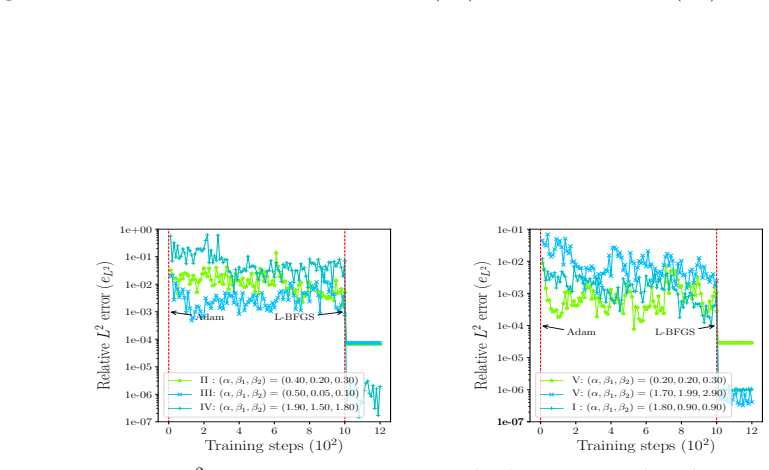
We develop the fTNN, a deterministic tensor neural network subspace method for problems involving the fractional Laplacian on bounded domains, taking the fractional Poisson equation and time-dependent fractional advection-diffusion equation as typical representatives. The work employs a geometry-adapted integration split featuring a spatially dependent near-field radius, which decomposes the fractional Laplacian into three contributions: a singular near field, a regular interior far field, and an analytical exterior far field. Then the singular radial integrals are treated by Gauss-Jacobi quadrature, the regular radial integrals by Gauss quadrature, and the angular variables by deterministic angular quadrature, yielding a fully deterministic integration framework of the fractional Laplacian operator. To accurately resolve low-regularity solutions and the associated loss functional, we construct boundary-singularity-aware trial functions enriched with explicit boundary features, and propose two strategies for automatically selecting the leading exponent and evaluating the loss function from the singularity structure induced by the fractional operator, or jointly by the fractional operator and the source term. For time-dependent fractional PDEs, we design a spatiotemporally separable neural network that factorizes the time-space residual into a sum of low-dimensional temporal and spatial integrals, and we integrate this representation with an alternating neural network subspace optimization strategy for efficient training. Numerical experiments show that the proposed framework attains high accuracy on the tested benchmarks and improves substantially over existing fPINN and Monte Carlo baselines, particularly for problems with strong boundary singularities and long-time simulations.
Editorial analysis
A structured set of objections, weighed in public.
Referee Report
Summary. The manuscript presents fTNN, a tensor neural network approach for solving fractional partial differential equations involving the fractional Laplacian on bounded domains. Key components include a geometry-adapted integration split with spatially dependent near-field radius decomposing the operator into near-field (Gauss-Jacobi quadrature), interior far-field (Gauss quadrature), and exterior analytical parts; boundary-singularity-aware trial functions with strategies for selecting singularity exponents; and for time-dependent problems, a spatiotemporally separable neural network combined with alternating subspace optimization. The authors claim that this framework achieves high accuracy on benchmarks, outperforming fPINN and Monte Carlo methods, especially for problems with strong boundary singularities and long-time simulations.
Significance. If the numerical performance claims are substantiated, the work offers a deterministic alternative to stochastic methods for fractional PDEs, potentially improving accuracy and reproducibility in handling singular solutions. The explicit incorporation of boundary features and the separable structure for time-dependent cases are notable technical contributions that could influence subsequent developments in neural methods for nonlocal operators.
major comments (2)
- [Abstract and integration framework description] The central accuracy claim depends on the spatially dependent near-field radius ensuring that the interior far-field integrand is sufficiently regular (C^∞ or high-order) for accurate Gauss quadrature at every collocation point. No a-priori analysis, adaptive criterion, or numerical check confirming this regularity—particularly near the domain boundary where the radius decreases—is provided, raising the risk that quadrature errors dominate the loss and affect solution accuracy for singular problems.
- [Numerical experiments] The asserted high accuracy and substantial improvements over fPINN and Monte Carlo baselines are presented without error bars on the reported errors, convergence tables (e.g., vs. number of quadrature points or network parameters), or detailed descriptions of the benchmark problems, exact solutions, and datasets used. This absence prevents independent assessment of the performance claims.
Simulated Author's Rebuttal
We thank the referee for the constructive feedback on the integration framework and numerical validation. We address each major comment below, indicating where revisions will be made to strengthen the manuscript.
read point-by-point responses
-
Referee: [Abstract and integration framework description] The central accuracy claim depends on the spatially dependent near-field radius ensuring that the interior far-field integrand is sufficiently regular (C^∞ or high-order) for accurate Gauss quadrature at every collocation point. No a-priori analysis, adaptive criterion, or numerical check confirming this regularity—particularly near the domain boundary where the radius decreases—is provided, raising the risk that quadrature errors dominate the loss and affect solution accuracy for singular problems.
Authors: We agree that the manuscript lacks an explicit a-priori regularity analysis or adaptive criterion for the far-field integrand under the spatially dependent radius. While the split is constructed so that the far-field kernel remains integrable and the radius choice excludes the singularity, no formal proof or boundary-specific numerical verification of quadrature accuracy is included. In the revised manuscript we will add a short subsection with a brief theoretical argument based on the kernel decay and radius scaling, together with numerical checks (e.g., quadrature-error tables near the boundary) to confirm that the far-field contribution remains below the target tolerance. revision: yes
-
Referee: [Numerical experiments] The asserted high accuracy and substantial improvements over fPINN and Monte Carlo baselines are presented without error bars on the reported errors, convergence tables (e.g., vs. number of quadrature points or network parameters), or detailed descriptions of the benchmark problems, exact solutions, and datasets used. This absence prevents independent assessment of the performance claims.
Authors: We acknowledge that the current numerical section does not report error bars, systematic convergence tables with respect to quadrature points or network parameters, or sufficiently detailed benchmark descriptions. In the revision we will expand the experiments section to include these elements: error bars from repeated runs where stochastic elements are present, convergence tables versus quadrature resolution and network size, and complete specifications of the benchmark problems, exact solutions, and data-generation procedures. revision: yes
Circularity Check
No significant circularity; construction from standard quadrature and NN components is self-contained
full rationale
The paper presents fTNN as a deterministic tensor NN method built from a geometry-adapted integration split (singular near-field via Gauss-Jacobi, regular far-field via Gauss, exterior analytic), boundary-singularity-aware trial functions, and spatiotemporally separable networks with alternating optimization. Accuracy claims rest on numerical experiments against fPINN and Monte Carlo baselines rather than any prediction or uniqueness result that reduces by construction to fitted parameters or self-citations. No equations or steps in the provided description equate outputs to inputs via definition, renaming, or load-bearing self-reference; the derivation chain remains independent of the target accuracy metrics.
Axiom & Free-Parameter Ledger
axioms (2)
- domain assumption The fractional Laplacian on bounded domains admits a decomposition into singular near-field, regular interior far-field, and analytical exterior far-field contributions via a spatially dependent near-field radius.
- domain assumption Gauss-Jacobi quadrature for singular radial integrals, Gauss quadrature for regular radial integrals, and deterministic angular quadrature together produce an accurate fully deterministic representation of the fractional operator.
Reference graph
Works this paper leans on
-
[1]
A short FE imple- mentation for a 2d homogeneous Dirichlet problem of a fractional Laplacian.Computers & Mathematics with Applications, 74(4):784–816, 2017
Gabriel Acosta, Francisco M Bersetche, and Juan Pablo Borthagaray. A short FE imple- mentation for a 2d homogeneous Dirichlet problem of a fractional Laplacian.Computers & Mathematics with Applications, 74(4):784–816, 2017
2017
-
[2]
Towards an efficient finite element method for the integral fractional Laplacian on polygonal domains
Mark Ainsworth and Christian Glusa. Towards an efficient finite element method for the integral fractional Laplacian on polygonal domains. InContemporary Computational Mathematics-A Celebration of the 80th Birthday of Ian Sloan, pages 17–57. Springer, 2018
2018
-
[3]
Numerical methods for fractional diffusion.Computing and Visualization in Science, 19(5):19–46, 2018
Andrea Bonito, Juan Pablo Borthagaray, Ricardo H Nochetto, Enrique Ot´ arola, and Ab- ner J Salgado. Numerical methods for fractional diffusion.Computing and Visualization in Science, 19(5):19–46, 2018
2018
-
[4]
QMC designs: optimal order quasi Monte Carlo integration schemes on the sphere.Mathematics of Computation, 83(290):2821–2851, 2014
Johann Brauchart, E Saff, I Sloan, and R Womersley. QMC designs: optimal order quasi Monte Carlo integration schemes on the sphere.Mathematics of Computation, 83(290):2821–2851, 2014
2014
-
[5]
Computation of Gauss-Jacobi quadrature nodes and weights with arbitrary precision
Dariusz W Brzezinski. Computation of Gauss-Jacobi quadrature nodes and weights with arbitrary precision. In2018 Federated Conference on Computer Science and Information Systems (FedCSIS), pages 297–306. IEEE, 2018
2018
-
[6]
An extension problem related to the fractional Laplacian
Luis Caffarelli and Luis Silvestre. An extension problem related to the fractional Laplacian. Communications in Partial Differential Equations, 32(8):1245–1260, 2007
2007
-
[7]
Numerical methods for nonlocal and fractional models.Acta Numerica, 29:1–124, 2020
Marta D’Elia, Qiang Du, Christian Glusa, Max Gunzburger, Xiaochuan Tian, and Zhi Zhou. Numerical methods for nonlocal and fractional models.Acta Numerica, 29:1–124, 2020
2020
-
[8]
Jing Gao, Meng Zhao, Ning Du, Xu Guo, Hong Wang, and Jiwei Zhang. A finite element method for space–time directional fractional diffusion partial differential equations in the plane and its error analysis.Journal of Computational and Applied Mathematics, 362:354– 365, 2019
2019
-
[9]
Upper and lower estimates for numerical integration errors on spheres of arbitrary dimension.Journal of Complexity, 53:113–132, 2019
Peter J Grabner and Tetiana A Stepanyuk. Upper and lower estimates for numerical integration errors on spheres of arbitrary dimension.Journal of Complexity, 53:113–132, 2019
2019
-
[10]
Fractional Laplacians on domains, a development of H¨ ormander’s theory of µ-transmission pseudodifferential operators.Advances in Mathematics, 268:478–528, 2015
Gerd Grubb. Fractional Laplacians on domains, a development of H¨ ormander’s theory of µ-transmission pseudodifferential operators.Advances in Mathematics, 268:478–528, 2015. 28
2015
-
[11]
Ling Guo, Hao Wu, Xiaochen Yu, and Tao Zhou. Monte Carlo fPINNs: deep learning method for forward and inverse problems involving high dimensional fractional partial dif- ferential equations.Computer Methods in Applied Mechanics and Engineering, 400:115523, 2022
2022
-
[12]
A deep learning method for computing eigenvalues of the fractional Schr¨ odinger operator.Journal of Systems Science and Complexity, 37(2):391– 412, 2024
Yixiao Guo and Pingbing Ming. A deep learning method for computing eigenvalues of the fractional Schr¨ odinger operator.Journal of Systems Science and Complexity, 37(2):391– 412, 2024
2024
-
[13]
Zheyuan Hu, Kenji Kawaguchi, Zhongqiang Zhang, and George Em Karniadakis. Tack- ling the curse of dimensionality in fractional and tempered fractional PDEs with physics- informed neural networks.Computer Methods in Applied Mechanics and Engineering, 432:117448, 2024
2024
-
[14]
A grid-overlay finite difference method for the frac- tional Laplacian on arbitrary bounded domains.SIAM Journal on Scientific Computing, 46(2):A744–A769, 2024
Weizhang Huang and Jinye Shen. A grid-overlay finite difference method for the frac- tional Laplacian on arbitrary bounded domains.SIAM Journal on Scientific Computing, 46(2):A744–A769, 2024
2024
-
[15]
Artificial neural networks for solving ordinary and partial differential equations.IEEE Transactions on Neural Networks, 9(5):987–1000, 1998
Isaac E Lagaris, Aristidis Likas, and Dimitrios I Fotiadis. Artificial neural networks for solving ordinary and partial differential equations.IEEE Transactions on Neural Networks, 9(5):987–1000, 1998
1998
-
[16]
Tensor neural network interpola- tion and its applications.arXiv preprint arXiv:2404.07805, 2024
Yongxin Li, Zhongshuo Lin, Yifan Wang, and Hehu Xie. Tensor neural network interpola- tion and its applications.arXiv preprint arXiv:2404.07805, 2024
-
[17]
Solving Schr¨ odinger equation using tensor neural network.arXiv preprint arXiv:2209.12572, 2022
Yangfei Liao, Zhongshuo Lin, Jianghao Liu, Qingyuan Sun, Yifan Wang, Teng Wu, and Hehu Xie. Solving Schr¨ odinger equation using tensor neural network.arXiv preprint arXiv:2209.12572, 2022
-
[18]
Solving time-fractional partial integro-differential equations using tensor neural network.SIAM Journal on Scientific Computing, 48(1):C164–C189, 2026
Zhongshuo Lin, Qingkui Ma, Hehu Xie, and Xiaobo Yin. Solving time-fractional partial integro-differential equations using tensor neural network.SIAM Journal on Scientific Computing, 48(1):C164–C189, 2026
2026
-
[19]
What is the fractional Laplacian? A comparative review with new results.Journal of Computational Physics, 404:109009, 2020
Anna Lischke, Guofei Pang, Mamikon Gulian, Fangying Song, Christian Glusa, Xiaoning Zheng, Zhiping Mao, Wei Cai, Mark M Meerschaert, Mark Ainsworth, et al. What is the fractional Laplacian? A comparative review with new results.Journal of Computational Physics, 404:109009, 2020
2020
-
[20]
DeepXDE: a deep learning library for solving differential equations.SIAM Review, 63(1):208–228, 2021
Lu Lu, Xuhui Meng, Zhiping Mao, and George Em Karniadakis. DeepXDE: a deep learning library for solving differential equations.SIAM Review, 63(1):208–228, 2021
2021
-
[21]
Bi-Orthogonal fPINN: a physics-informed neural network method for solving time-dependent stochastic fractional PDEs.Communications in Computational Physics, 34(4):1133–1176, 2023
Lei Ma, Fanhai Zeng, Ling Guo, George Em Karniadakis, et al. Bi-Orthogonal fPINN: a physics-informed neural network method for solving time-dependent stochastic fractional PDEs.Communications in Computational Physics, 34(4):1133–1176, 2023
2023
-
[22]
Quadrature-Enhanced Monte Carlo fPINN Method for High-Dimensional Fractional PDEs
Qingkui Ma, Hehu Xie, and Xiaobo Yin. Quadrature-Enhanced Monte Carlo fPINN method for high-dimensional fractional PDEs.arXiv preprint arXiv:2604.19601, 2026
work page internal anchor Pith review Pith/arXiv arXiv 2026
-
[23]
Finite difference meth- ods for two-dimensional fractional dispersion equation.Journal of Computational Physics, 211(1):249–261, 2006
Mark M Meerschaert, Hans-Peter Scheffler, and Charles Tadjeran. Finite difference meth- ods for two-dimensional fractional dispersion equation.Journal of Computational Physics, 211(1):249–261, 2006
2006
-
[24]
Space-fractional advection–dispersion equations by the Kansa method.Journal of Computational Physics, 293:280–296, 2015
Guofei Pang, Wen Chen, and Zhuojia Fu. Space-fractional advection–dispersion equations by the Kansa method.Journal of Computational Physics, 293:280–296, 2015. 29
2015
-
[25]
fPINNs: fractional physics-informed neural networks.SIAM Journal on Scientific Computing, 41(4):A2603–A2626, 2019
Guofei Pang, Lu Lu, and George Em Karniadakis. fPINNs: fractional physics-informed neural networks.SIAM Journal on Scientific Computing, 41(4):A2603–A2626, 2019
2019
-
[26]
Maziar Raissi, Paris Perdikaris, and George E Karniadakis. Physics-informed neural net- works: a deep learning framework for solving forward and inverse problems involving non- linear partial differential equations.Journal of Computational Physics, 378:686–707, 2019
2019
-
[27]
Boundary regularity for fully nonlinear integro- differential equations.Duke Mathematical Journal, 165(11):2079–2154, 2016
Xavier Ros-Oton and Joaquim Serra. Boundary regularity for fully nonlinear integro- differential equations.Duke Mathematical Journal, 165(11):2079–2154, 2016
2079
-
[28]
Springer Science & Business Media, 2011
Jie Shen, Tao Tang, and Li-Lian Wang.Spectral methods: algorithms, analysis and appli- cations, volume 41. Springer Science & Business Media, 2011
2011
-
[29]
Efficient Monte Carlo method for inte- gral fractional Laplacian in multiple dimensions.SIAM Journal on Numerical Analysis, 61(5):2035–2061, 2023
Changtao Sheng, Bihao Su, and Chenglong Xu. Efficient Monte Carlo method for inte- gral fractional Laplacian in multiple dimensions.SIAM Journal on Numerical Analysis, 61(5):2035–2061, 2023
2035
-
[30]
Fast implementation of FEM for integral fractional Laplacian on rectangular meshes.Communications in Compu- tational Physics, 36(3):673–710, 2024
Changtao Sheng, Li-Lian Wang, Hongbin Chen, and Huiyuan Li. Fast implementation of FEM for integral fractional Laplacian on rectangular meshes.Communications in Compu- tational Physics, 36(3):673–710, 2024
2024
-
[31]
A second-order accurate numerical method for the two-dimensional fractional diffusion equation.Journal of Computational Physics, 220(2):813–823, 2007
Charles Tadjeran and Mark M Meerschaert. A second-order accurate numerical method for the two-dimensional fractional diffusion equation.Journal of Computational Physics, 220(2):813–823, 2007
2007
-
[32]
GMC-PINNs: a new general Monte Carlo PINNs method for solving fractional partial differential equations on irregular domains
Shupeng Wang and George Em Karniadakis. GMC-PINNs: a new general Monte Carlo PINNs method for solving fractional partial differential equations on irregular domains. Computer Methods in Applied Mechanics and Engineering, 429:117189, 2024
2024
-
[33]
Tensor neural network and its numerical inte- gration.Journal of Computational Mathematics, 42(6):1714–1742, 2024
Yifan Wang, Pengzhan Jin, and Hehu Xie. Tensor neural network and its numerical inte- gration.Journal of Computational Mathematics, 42(6):1714–1742, 2024
2024
-
[34]
Solving high- dimensional partial differential equations using tensor neural network and a posteriori error estimators.Journal of Scientific Computing, 101(3):67, 2024
Yifan Wang, Zhongshuo Lin, Yangfei Liao, Haochen Liu, and Hehu Xie. Solving high- dimensional partial differential equations using tensor neural network and a posteriori error estimators.Journal of Scientific Computing, 101(3):67, 2024
2024
-
[35]
Computing multi-eigenpairs of high-dimensional eigenvalue problems using tensor neural networks.Journal of Computational Physics, 506:112928, 2024
Yifan Wang and Hehu Xie. Computing multi-eigenpairs of high-dimensional eigenvalue problems using tensor neural networks.Journal of Computational Physics, 506:112928, 2024
2024
-
[36]
Spectral-fPINNs: spectral method based fractional physics-informed neural networks for solving fractional partial differential equations.Nonlinear Dynamics, 113(11):12565, 2025
Tianxin Zhang, Dazhi Zhang, Shengzhu Shi, and Zhichang Guo. Spectral-fPINNs: spectral method based fractional physics-informed neural networks for solving fractional partial differential equations.Nonlinear Dynamics, 113(11):12565, 2025. 30
2025
discussion (0)
Sign in with ORCID, Apple, or X to comment. Anyone can read and Pith papers without signing in.