REVIEW 2 major objections 34 references
Evidence for possible N2 basal flow beneath Pluto northern Sputnik Planitia
T0 review · 2 major / 0 minor · reviewed 2026-06-26 · grok-4.3
Pith's one-line read Sharp darkened boundaries in northern Sputnik Planitia indicate liquid nitrogen flowing from basal melt beneath the ice.
desk verdict The paper puts forward a morphological hypothesis for basal liquid N2 flow in northern Sputnik Planitia but does not test it against the convective flows already used to explain the same terrain. read the letter →
The pith
A machine-rendered reading of the paper's core claim, the machinery that carries it, and where it could break.
The reading
What carries the argument
The interpretation of sharp darkened boundaries bordered by diffuse less-darkened zones as signatures of upward-transiting and surface-flowing liquid N2 from basal melt.
What would settle it
Spectral or imaging data showing the boundary zones lack the expected N2 liquid composition or thermal signatures, or detailed convection modeling that reproduces the exact sharp-plus-diffuse pattern without any liquid component.
Extended reading notes
Core claim
We hypothesize that these patterns may be explained as evidence of the flow of liquid molecular nitrogen sourced from beneath the glacier. This hypothesis suggests that basal melt of the ice sheet occurs, that this melt reaches the surface before it freezes in transit upward through colder ice, and that the melt has sufficient time before it freezes during flow across the ice surface to fill topographic lows.
Load-bearing premise
The sharp darkened boundaries bordered by diffuse less-darkened zones cannot be produced by convective ice flows or other surface processes alone.
Editorial extensions
If this is right
- Basal melting must occur at the base of the northern Sputnik Planitia ice sheet under current conditions.
- Melt water reaches the surface before fully refreezing during upward passage through the ice.
- The liquid N2 remains mobile long enough on the surface to pond in topographic lows.
- Heat flow or insulation conditions at the base enable melting despite the cold surface environment.
Reading between the lines
- Similar basal melt and surface flow signatures could appear in other large N2 ice deposits elsewhere on Pluto if the same thermal conditions hold.
- Detection of these patterns would require updates to thermal evolution models to include localized basal melting in Sputnik Planitia.
- Future close-range imaging could test whether the flow features correlate with specific topographic lows or heat sources.
Signed reviews
Editorial analysis
A structured set of objections, weighed in public.
Referee Report
Summary. The manuscript hypothesizes that sharp darkened boundaries bordered by diffuse less-darkened zones observed in convection cells within northern Sputnik Planitia on Pluto constitute evidence for liquid molecular nitrogen flow sourced from basal melt beneath the N2 ice sheet. This interpretation implies that basal melting occurs, the melt reaches the surface before refreezing, and the liquid has time to flow across the surface and fill topographic lows before freezing.
Significance. If the morphological interpretation is substantiated and alternatives are excluded, the result would provide indirect evidence for basal melting and liquid N2 flow on Pluto, with implications for the thermal structure, heat flow, and volatile cycling within the Sputnik Planitia ice sheet. The manuscript offers no machine-checked derivations, reproducible code, or falsifiable quantitative predictions.
major comments (2)
- [Abstract] Abstract: The central hypothesis that the observed sharp darkened boundaries with diffuse zones require an additional liquid N2 basal-flow component is not supported by any quantitative comparison or scaling analysis demonstrating that convective ice flows (already invoked for other northern SP features) or dust-concentration gradients cannot produce equivalent albedo patterns.
- [Abstract] Abstract: The claim to 'constrain the required physical conditions' is unsupported, as the text contains no equations, parameter values, error analysis, or calculations that would allow such constraints to be evaluated or reproduced.
Simulated Author's Rebuttal
We thank the referee for their review. The manuscript is an interpretive hypothesis paper based on morphological observations, and we agree that it lacks quantitative modeling or calculations. We address each major comment below and will revise the manuscript to correct overstated claims and add discussion of alternatives.
read point-by-point responses
-
Referee: [Abstract] Abstract: The central hypothesis that the observed sharp darkened boundaries with diffuse zones require an additional liquid N2 basal-flow component is not supported by any quantitative comparison or scaling analysis demonstrating that convective ice flows (already invoked for other northern SP features) or dust-concentration gradients cannot produce equivalent albedo patterns.
Authors: We agree that no quantitative comparison or scaling analysis is provided to demonstrate that the observed albedo patterns cannot arise from convective ice flows or dust-concentration gradients. The hypothesis is based on qualitative morphological interpretation of the sharp boundaries bordered by diffuse zones. In revision we will add explicit discussion of why the morphology favors a fluid-flow interpretation over the alternatives already invoked for other SP features, while acknowledging that modeling is required to test this. revision: yes
-
Referee: [Abstract] Abstract: The claim to 'constrain the required physical conditions' is unsupported, as the text contains no equations, parameter values, error analysis, or calculations that would allow such constraints to be evaluated or reproduced.
Authors: The referee is correct; the manuscript contains no equations, parameter values, error analysis, or calculations, so the abstract claim to constrain physical conditions is not supported. We will revise the abstract to remove this phrasing and describe the paper as discussing qualitative implications of the hypothesized flow rather than providing quantitative constraints. revision: yes
Circularity Check
No circularity: observational hypothesis with no derivations or self-referential reductions
full rationale
The paper advances an interpretive hypothesis linking observed albedo patterns in Sputnik Planitia to possible basal N2 melt and flow. No equations, fitted parameters, scaling derivations, or uniqueness theorems appear in the provided text. The central claim rests on qualitative interpretation of New Horizons imagery rather than any calculation that reduces to its own inputs by construction. Self-citations (if present in the full text) are not load-bearing for any derivation because none exists. This is a standard non-circular observational paper.
Assumptions & free parameters
assumptions (2)
- domain assumption The lack of detected craters in SP argues that these processes are ongoing.
- domain assumption The geomorphological features can be interpreted as evidence for convective flows in the basin-filling ice sheet.
invented entities (1)
-
basal liquid molecular nitrogen flow
Cite this review
Pith. "Pith review of Evidence for possible N2 basal flow beneath Pluto northern Sputnik Planitia." pith.science (2026). https://pith.science/paper/CJG5BUEQ
@misc{pith2026260627200,
  author       = {Pith},
  title        = {Pith review of: Evidence for possible N2 basal flow beneath Pluto northern Sputnik Planitia},
  year         = {2026},
  howpublished = {\url{https://pith.science/paper/CJG5BUEQ}},
  note         = {Machine review of arXiv:2606.27200}
}
read the original abstract
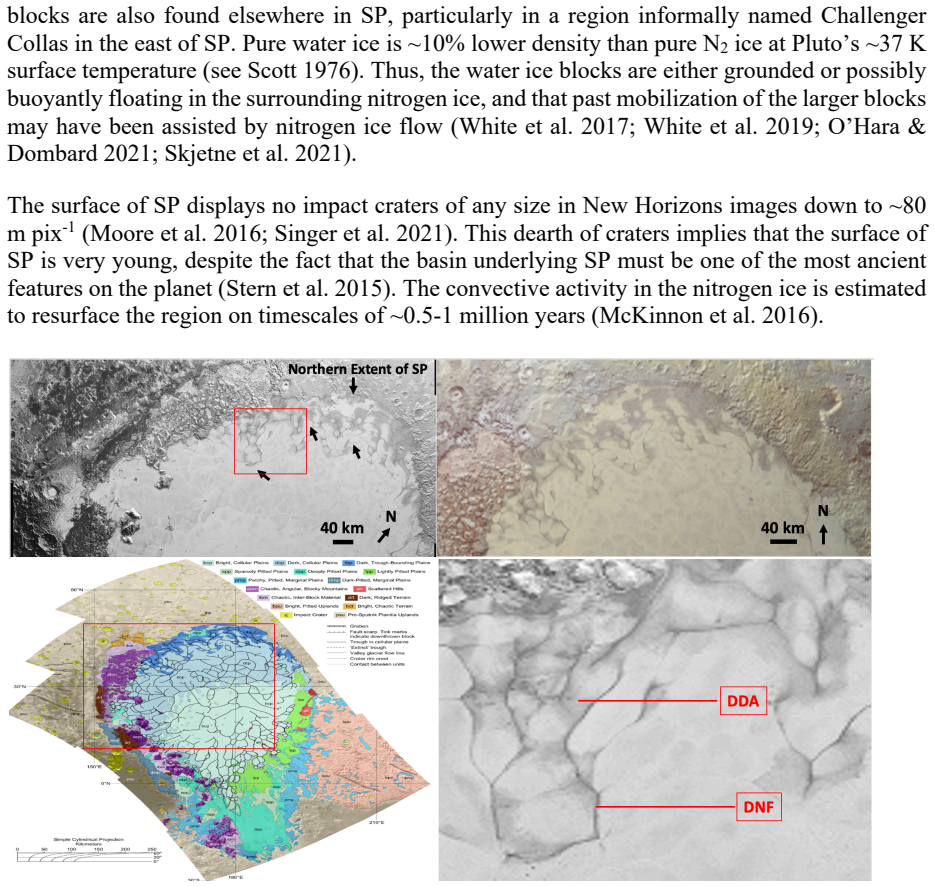
Sputnik Planitia (SP) on Pluto is a large, predominantly N2 ice-filled basin with a surface area of one million square kilometers; it is among the most spectacular surface features on the planet. The northern extent of SP displays a variety of geomorphological features that can be interpreted as evidence for convective flows in the basin-filling ice sheet. The complete lack of detected craters in SP argues that these processes are ongoing. The convection cells in northern SP also display sharp, darkened boundaries that are bordered by more diffuse, less darkened zones. We hypothesize that these patterns may be explained as evidence of the flow of liquid molecular nitrogen sourced from beneath the glacier. This hypothesis suggests that basal melt of the ice sheet occurs, that this melt reaches the surface before it freezes in transit upward through colder ice, and that the melt has sufficient time before it freezes during flow across the ice surface to fill topographic lows. Here we discuss the evidence on which we base these interpretations, constrain the required physical conditions to create them, and briefly discuss some of their implications.
Figures


Figures from the paper (2 more)


Reference graph
Works this paper leans on
-
[1]
4.1 Mechanisms for flow of liquid N2 toward the surface
Regarding Basal Melt: Theoretical Considerations, Clues, and Constraints. 4.1 Mechanisms for flow of liquid N2 toward the surface. Liquid N2 is positively buoyant relative to N2’s solid state. Any melt will therefore rise through the solid, given an avenue through which to pass. This is the essence of volcanism on any planetary body in which the melt has ...
2007
-
[2]
Under sufficient overburden pressure, N2 remains solid even if the temperature within the bedrock layer exceeds Ttp
of the H2O ice bedrock beneath the SP ice sheet. Under sufficient overburden pressure, N2 remains solid even if the temperature within the bedrock layer exceeds Ttp. However, sudden depressurization due to deep fracturing in the bedrock and/or the slow reduction of overburden pressure due to the net removal of overlying N2 ice in northern SP could allow N...
2018
-
[3]
collector area
is tempered by grain destruction due to the dynamic stress σ resulting from solid-state convection. A statistically steady equilibrium grain size de(σ,T) can be estimated as a function of typical interior temperatures and stresses, noting that the typical interior stress σ increases with layer thickness H. This way, as the northern portion of SP significa...
2016
-
[4]
Panel A: Map view showing detail in one representative, stylized polygonal cell, domed in the center (contours are dashed)
Schematic illustrating basal melt rising from collection area at depth toward the surface of SP. Panel A: Map view showing detail in one representative, stylized polygonal cell, domed in the center (contours are dashed). Once on the surface, melt flows down gradient toward the cell margins, in a manner akin to flank eruptions on shield volcanoes. Whereas ...
1990
-
[5]
(2000) g Pluto’s surface gravity 0.617 m s-2 Stern et al
Adopted Model Parameters Symbol Description Measured Values/Formula Source/Comment N2 solid ice density 995 kg m-3 Scott (1976), Umurhan et al (2021) (3 7 K )Tr = –16– N2 solid ice conductivity 0.21 W m-1 K-1 Scott (1976), Umurhan et al (2021) (T = Ttp) N2 liquid density 867 kg m-3 Span et al. (2000) g Pluto’s surface gravity 0.617 m s-2 Stern et al. (201...
1976
-
[6]
modern epoch
Summary and Discussion We have posited that the striking, dark, irregular linear and diffuse features prevalent at the northern margin of Sputnik Planitia are manifestations of the upwelling of liquids or liquid slurries from beneath the SP ice sheet. We have further posited that these liquids were created as a basal melt at depth below the glacier, and w...
2016
-
[7]
2023), and eruptive formation of pits and depressions (Howard et al
and gaseous emissions of CH4 (Howard et al. 2023), and eruptive formation of pits and depressions (Howard et al. 2017; Manogaran et al. 2026). The eruptive style of N2 through fissures on Sputnik Planitia is likely analogous to fountain eruptions of lava through tensional fractures in Iceland and mid-oceanic ridges. Cryovolcanic fissure eruptions occur th...
2023
-
[8]
2024; Spencer et al
or as the energetic plumes of Enceladus (Mitchell et al. 2024; Spencer et al. 2009). Although no other locales on the well-mapped portions of Pluto display similar evidence for current epoch liquid or basal flows, over half the planet remains unmapped at high resolution (Stern et al. 2019). A more thorough assessment of whether other such flows exist on P...
2024
Show all 34 references
-
[9]
46, 5055–5064
Geophysical research letters. 46, 5055–5064. Barr, A. C. & McKinnon, W. B. 2007, JGRE, 112, E02012, doi: 10.1029/2006JE002781 Bertrand, T., Forget, F., Umurhan, O. M., et al. 2018, Icar, 309, 277, doi:10.1016/j.icarus.2018.03.012 Bohren, C. F. & Huffman, D. R. 1983, Absorption...
2007 doi
-
[10]
RvGeo, 20, 45, doi:10.1029/RG020i001p00045 Colbeck, S. C. 1986, Statistics of coarsening in water-saturated snow, Acta Metall., 34, 347-352. Cruikshank, D. P., M. U. Orkan, R. A. Beyer, et al. 2019, Icar, 330, 155, doi:10.1016/j.icarus.2019.04.023 Cruikshank, D. P., et al.,
1986 doi
-
[11]
356, 113786, doi:10.1016/j.icarus.2020.113786
Icarus. 356, 113786, doi:10.1016/j.icarus.2020.113786. Cuffey, K. M. & Paterson, W. S. B. 2010, The Physics of Glaciers (4th ed.; Elsevier) Dang, C., Brandt, R. E., & Warren, S. G. 2015, JGRD, 120, 5446, doi:10.1002/2014JD022646 Dell, R. L., Willis, I. C., Arnold, N. S., et al...
2020 doi
-
[12]
1991, JGR, 96, 19217, doi:10.1029/91JA01858 Emran, A., Dalle Ore, C
doi:10.1029/GL017i010p01753 Eluszkiewicz, J. 1991, JGR, 96, 19217, doi:10.1029/91JA01858 Emran, A., Dalle Ore, C. M., Cruikshank, D. P., Cook, J. C.,
1991 doi
-
[13]
404, 115653, doi:10.1016/j.icarus.2023.115653
Icarus. 404, 115653, doi:10.1016/j.icarus.2023.115653. Fagents, S. A.,
2023 doi
-
[14]
JAChS, 55(12), 4875, doi:10.1021/ja01339a024 –20– Grenfell, T. C. & Maykut, G. A. 1977, J. Glaciol, 18, 445, doi:10.3189/S0022143000021122 Grenfell, T. C., Perovich, D. K., & Ogren, J. A. 1981, CRST, 4, 121, doi:10.1016/0165-232X(81)90016-1 Griffiths, R. W. 2000, AnRFM, 32, 47...
1977 doi
-
[15]
D., Buratti, B
Hofgartner, J. D., Buratti, B. J., Beyer, R. A., et al. 2023, Bolometric Hemispherical Albedo Map of Pluto from New Horizons Observations, PSJ, 4, 132, doi:10.3847/PSJ/ace3ab Holmgren, B. 1971, Climate and Energy Exchange on a Sub-Polar Ice Cap in Summer, Part E, Radiation Cli...
2023 doi
-
[16]
293, 218–230, doi:10.1016/j.icarus.2017.02.027
Icarus. 293, 218–230, doi:10.1016/j.icarus.2017.02.027. Howard, A. D., Moore, J. M., Umurhan, O. M., et al. 2017, Icar, 287, 287, doi:10.1016/j.icarus.2016.07.006 Howard, A. D., Moore, J., M., Umurhan, O. M., White, O. L., Singer, K. N., Schenk, P. M.,
2017 doi
-
[17]
Howat, I
405, 115719, doi:10.1016/j.icarus.2023.115719. Howat, I. M., de la Pena, S., van Angelen, J. H., et al. 2013, TCry, 7, 201, doi:10.5194/tc-7-201-2013 Johnson, B. C., Sori, M. M., Evans, A. J.,
2023 doi
-
[18]
Kaempfer, T
Nature Astronomy 4, 41-44. Kaempfer, T. U., & Schneeeli, M. 2007, JRG, 112, D24101, doi:10.1029/2007JD009047 Kamata, S., Nimmo, F., Sekine, Y., et al
2007 doi
-
[19]
S., Croft, S
NatGe, 12, 407, doi:10.1038/s41561-019-0369-8 Kargel, J. S., Croft, S. K., Lunine, J. I., et al. 1991, Icar, 89, 93,doi:10.1016/0019-1035(91)90090-G Khuller, A. R., Christensen, P. R., & Warren, S. G. 2021, JGRE, 126, e2021JE006910, doi:10.1029/2021JE006910 Laine, V. 2008, RSE...
1991 doi
-
[20]
16, 1886, 2041–1723
Nature Communications. 16, 1886, 2041–1723. –21– Manogaran, R., Poh, G., Ahrens, C., Mandt, K., Karunaltillake, S.,
-
[21]
131, e2025JE009252, doi:10.1029/2025JE009252
Journal of Geophysical Research Planets. 131, e2025JE009252, doi:10.1029/2025JE009252. Marsh, P. 1987, Grain growth in a wet arctic snow cover, Cold Regions Science and Technology, 14, 23-31. McKinnon, W. B., Nimmo, F., Wong, T., et al. 2016, Nature, 534, 82, doi:10.1038/natur...
1987 doi
-
[22]
129, e2023JE007977, 2169–9097
Journal of Geophysical Research: Planets. 129, e2023JE007977, 2169–9097. Moore, J. M., Howard, A. D., Schenk, P. M, et al. 2015, Icar, 246, 65, doi:10.1016/j.icarus.2014.04.028 Moore, J. M., McKinnon, W. B., Spencer, J. R., et al. 2016, Sci, 351, 1284, doi:10.1126/science.aad7...
2015 doi
-
[23]
246, 48–64
Icarus. 246, 48–64. Nimmo, F., Hamilton, D., McKinnon, W., et al. 2016, Natur 540,
2016
-
[24]
B., Spencer, J
doi:10.1038/nature20148 Olkin, C. B., Spencer, J. R. Spencer, Grundy, W. M., et al. 2017, AJ, 154, 258, doi:10.3847/1538-3881/aa965b O'Hara, S. T. & Dombard, A. J. 2021, Icar, 356, 113829, doi:10.1016/j.icarus.2020.113829 Orlandi, P., Bernardini, M., & Pirozzoli, S. 2015, JFM,...
2017 doi
-
[25]
N., Greenstreet, S., Schenk, P
GeoRL, 25, 4237, doi:10.1029/1998GL900136 Singer, K. N., Greenstreet, S., Schenk, P. M., et al. 2021, in The Pluto System After New Horizons, ed. S. A. Stern et al. (Tucson, AZ: Univ. of Arizona Press) 121, doi:10.2458/azu_uapress_9780816540945-ch007 Singer, K. N., et al.,
2021 doi
-
[26]
13, doi:10.1038/s41467–022–29056–3
Nature Communications. 13, doi:10.1038/s41467–022–29056–3. Skjetne, H. L., Singer, K. N., Hynek, B. M., et al. 2021, Icar, 356, 113866, doi:10.1016/j.icarus.2020.113866 Soderblom, L. A., Kieffer, S. W., Becker, T. L., et al. 1990, Sci, 250, 410, doi:10.1126/science.250.4979.41...
2021 doi
-
[27]
839, L18 %@ 2041–8205
The Astrophysical Journal Letters. 839, L18 %@ 2041–8205. Spencer, J. R., et al.,
-
[28]
Evidence for Possible N2 Basal Flow Beneath Pluto’s Northern Sputnik Planitia
Springer, pp. 683–724. Stern, S. A., Bagenal, F., Ennico, K., et al. 2015, Sci, 350, id.aad1815, doi:10.1126/science.aad1815 Stern, S. A., Grundy, W. M., McKinnon, W.B., et al. 2018, ARA&A, 56, 357, doi:10.1146/annurev-astro-081817-05193 Stern, S. A., Keeney, B., Hoover, R., e...
2015 doi
-
[29]
Assuming SP ef- ficiently convects its basal heat, we follow the approach of Desch et al
while that of SP’s N2 ice is KN2 = 0.2 W m−1 K−1 (Table A1). Assuming SP ef- ficiently convects its basal heat, we follow the approach of Desch et al. (2009) and Miller et al. (2025) and treat the SP N2 ice layer as purely conducting but with an effective conductivity that sca...
2009
-
[30]
and a deeper depth of about 200km (e.g., Kamata et al. 2019). The models yield a more realistic range of Fg ∈ (4 –18) mW m−2. This prediction is strongly sensitive to the clathrate thickness showing that higher Fg values correspond to relatively thin values of Hc. Overall, the...
2019
-
[31]
Thus, for our simple model, the bottom to- pography is assumed to be flat and we consider a generalized steady-state scenario (i.e., the left- hand side of the equation is zero) in which the northern parts of SP steadily lose an amount of ice H˙loss, which for simplicity is as...
2018
-
[32]
While we generally consider these two ranging values (2/7, 1/3) in our further analyses, we will focus on the upper asymptotic limiting form hereafter
and in infinite Prandtl number temperature-dependent Newtonian viscosity convection (Sotin & Labrosse, 1999). While we generally consider these two ranging values (2/7, 1/3) in our further analyses, we will focus on the upper asymptotic limiting form hereafter. Since convectio...
1999
-
[33]
relating the equilibrium grain size de to the shear stress σ experienced by the medium, 𝑑𝑒=𝐾𝑚 𝑏(σµ)−𝑚, (𝐶11) where b and µ are the Burgers vector and shear modulus of N2 ice, respectively. While the values of b and µ are known for N2 ice (Eluszkiewicz, 1991; Umurhan et al., 20...
1991 doi
-
[34]
P., McKinnon, W
doi:10.1029/2025JE009120 Nimmo, F., Hamilton, D. P., McKinnon, W. B., et al. 2016, Natur, 540(7631), 94 doi:10.1038/nature20148 Orlandi, P., Bernardini, M., & Pirozzoli, S. 2015, JFM, 770, 424, doi:10.1017/jfm.2015.138 Robuchon, G., & Nimmo, F. 2011, Icar, 216(2), 426, doi:10....
2016 doi
Reviewed June 26, 2026 · model on record in the stance chip above.
Discussion (0). Continue with ORCID to comment.