Methodological Frontiers in 21-cm Intensity Mapping: the Treatment of Systematics and Foreground Contamination
Pith reviewed 2026-06-26 03:44 UTC · model grok-4.3
The pith
Developing robust algorithms for instrumental effects and sky-model uncertainties is essential to exploit the cosmological potential of HI intensity-mapping surveys with SKA-Mid.
A machine-rendered reading of the paper's core claim, the machinery that carries it, and where it could break.
Core claim
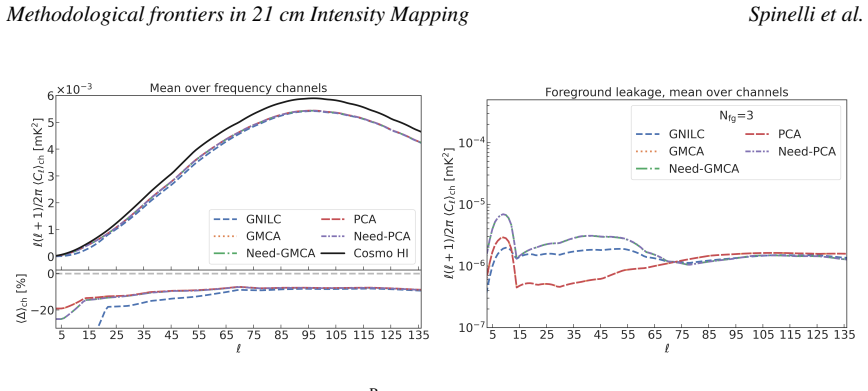
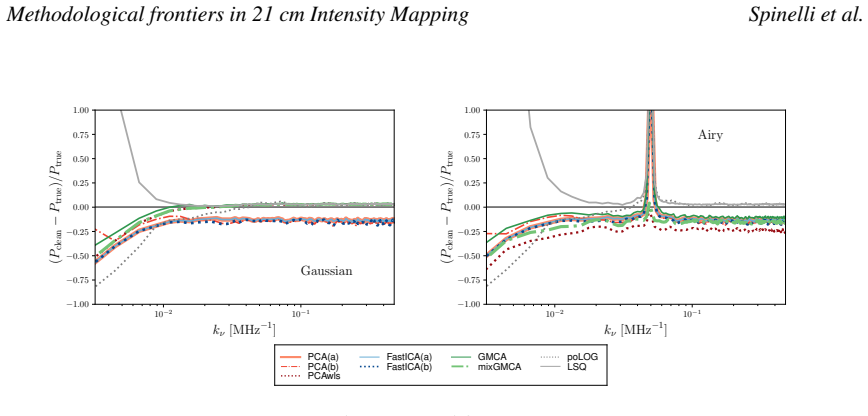
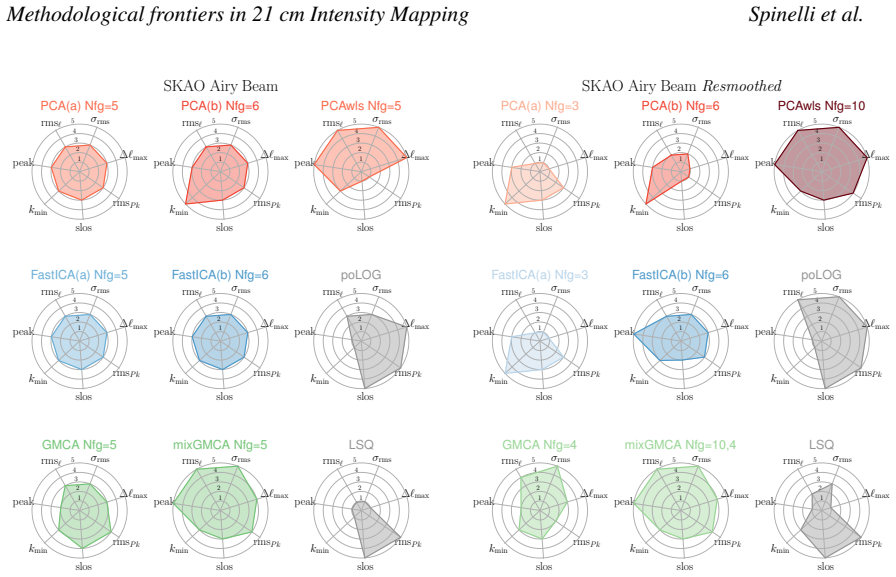
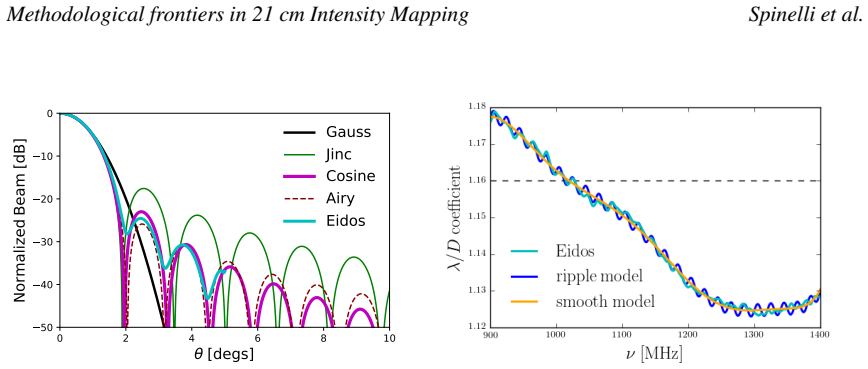
The distribution of neutral hydrogen traces large-scale structure, but extracting the 21 cm signal requires overcoming foregrounds orders of magnitude stronger and instrumental systematics. Advances in data-analysis techniques, particularly map-making and component separation tailored to SKA-Mid specifics, have been developed and tested in simulations over the past decade.
What carries the argument
Map-making and component-separation techniques that account for beam response, correlated noise, and sky-model uncertainties.
If this is right
- These techniques enable isolation of the 21 cm signal without introducing biases in cosmological measurements.
- Simulations offer a framework to evaluate and improve different data-analysis approaches before real data arrives.
- Accurate handling of systematics supports use of HI intensity mapping to probe dark matter and dark energy.
- Ongoing innovations in these methods are required to maximize the scientific return from SKA-Mid surveys.
Where Pith is reading between the lines
- Methods that perform well in simulations may require additional calibration steps when applied to real data containing effects absent from the models.
- Combining these intensity-mapping techniques with other large-scale structure probes could tighten constraints on cosmological parameters.
- The same simulation-testing approach could be adapted for other radio intensity-mapping experiments beyond SKA.
Load-bearing premise
That results from controlled simulation environments accurately predict performance on real SKA-Mid observations, where unmodeled sky-model uncertainties and instrumental effects may differ from the simulated cases.
What would settle it
A direct comparison of foreground removal performance between the reviewed simulation-based methods and actual SKA-Mid observations that reveals large discrepancies due to unmodeled effects.
Figures
read the original abstract
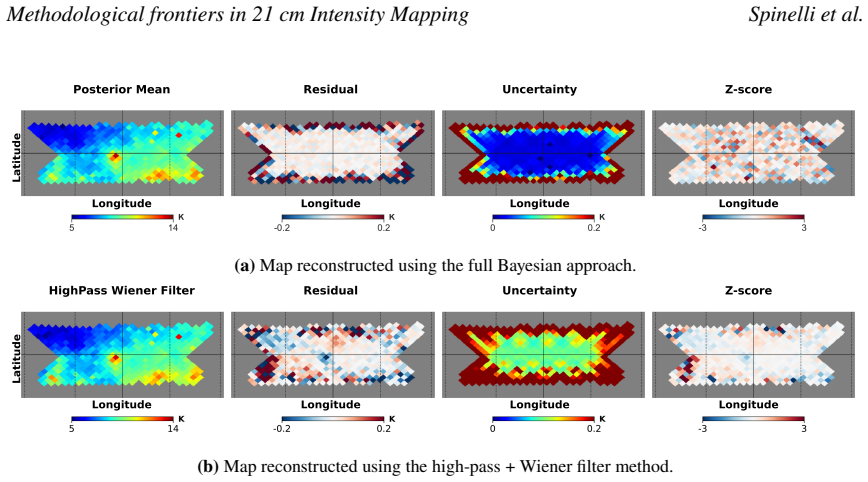
The distribution of neutral hydrogen (HI) in the post-reionization universe traces the cosmic large-scale structure and therefore serves as a powerful cosmological probe. An efficient way to measure its distribution over wide sky areas and redshift ranges is through single-dish intensity mapping, which exploits the autocorrelation signal of each dish in a telescope array while scanning the same sky patch. Thanks to its broad frequency coverage and technical capabilities, SKA-Mid will enable measurements of the integrated 21 cm emission from HI up to redshift $z\sim3$, making single-dish intensity mapping a key observable for probing dark matter and dark energy. Isolating the faint 21 cm cosmological signal without introducing biases is, however, challenging. The 21 cm signal is several orders of magnitude weaker than the astrophysical foregrounds, and its analysis is further affected by instrumental systematics. Overcoming these difficulties requires detailed modelling together with continuous improvements and innovations in data-analysis techniques. Over the past decade, the international community has developed and tested new methods to address current observational challenges and prepare for forthcoming SKA-Mid observations. This chapter reviews recent advances in map-making and component-separation techniques, with particular emphasis on telescope-specific systematics such as beam response and correlated noise. We focus on results obtained in controlled simulation environments, providing a valuable framework for assessing the strengths and limitations of different approaches. Developing robust algorithms capable of accurately handling instrumental effects and sky-model uncertainties is a crucial step toward fully exploiting the cosmological potential of HI intensity-mapping surveys in the SKA Observatory era.
Editorial analysis
A structured set of objections, weighed in public.
Referee Report
Summary. The manuscript is a review chapter summarizing recent advances in map-making and component-separation techniques for single-dish 21-cm intensity mapping with SKA-Mid. It emphasizes challenges from astrophysical foregrounds (orders of magnitude brighter than the HI signal) and instrumental systematics such as beam response and correlated noise. The review focuses exclusively on results obtained in controlled simulation environments and concludes that developing robust algorithms to handle instrumental effects and sky-model uncertainties is a crucial preparatory step for exploiting the cosmological potential of HI intensity-mapping surveys.
Significance. If the review accurately and comprehensively captures the simulation-based literature, it provides a useful consolidated framework for assessing the strengths and limitations of different foreground-mitigation and systematics-handling approaches. This is valuable for the 21-cm community preparing for SKA-Mid observations, even though the paper presents no new derivations, quantitative forecasts, or real-data results.
minor comments (2)
- [Abstract] Abstract: the statement that the 21 cm signal is 'several orders of magnitude weaker' than foregrounds would benefit from a specific numerical range (e.g., 10^4–10^6) with a supporting reference to set expectations for readers.
- The manuscript should explicitly state the time period covered by the 'past decade' review (e.g., 2014–2024) and list the key simulation pipelines or codes whose results are synthesized, to improve reproducibility of the literature survey.
Simulated Author's Rebuttal
We thank the referee for their positive assessment of the manuscript as a useful consolidated framework for the 21-cm community and for recommending minor revision. No specific major comments were provided in the report.
Circularity Check
No significant circularity: review paper with no derivations or predictions
full rationale
This is a literature review summarizing map-making and component-separation methods tested in controlled simulations. It contains no original equations, derivations, fitted parameters, or quantitative predictions that could reduce to inputs by construction. The central claim—that developing robust algorithms is a crucial preparatory step—is a qualitative statement about the field, not a result derived from any internal logic or self-citation chain. No load-bearing steps match the enumerated circularity patterns.
Axiom & Free-Parameter Ledger
Reference graph
Works this paper leans on
-
[1]
2026 ,publisher =
Laura Wolz and author2 and author3 and author4 and author5 , title =. 2026 ,publisher =
2026
-
[2]
2026 ,publisher =
Steven Cunnington&Wang and author2 and author3 and author4 and author5 ,title =. 2026 ,publisher =
2026
-
[3]
2026 ,publisher =
José Fonseca and author2 and author3 and author4 and author5 ,title =. 2026 ,publisher =
2026
-
[4]
2026 ,publisher =
Stefano Camera and author2 and author3 and author4 and author5 ,title =. 2026 ,publisher =
2026
-
[5]
2026 ,publisher =
Khandakar Md Asif Elahi and author2 and author3 and author4 and author5 ,title =. 2026 ,publisher =
2026
-
[6]
2026 ,publisher =
Tommaso Ronconi and author2 and author3 and author4 and author5 ,title =. 2026 ,publisher =
2026
-
[7]
2026 ,publisher =
Suman Majumdar and author2 and author3 and author4 and author5 ,title =. 2026 ,publisher =
2026
-
[8]
2026 ,publisher =
Suman Chatterjee and author2 and author3 and author4 and author5 ,title =. 2026 ,publisher =
2026
-
[9]
2018 , eprint=
Square Kilometre Array Science Data Challenge 1 , author=. 2018 , eprint=
2018
-
[10]
Square Kilometre Array Science Data Challenge 1: analysis and results , volume=
Bonaldi, A and An, T and Brüggen, M and Burkutean, S and Coelho, B and Goodarzi, H and Hartley, P and Sandhu, P K and Wu, C and Yu, L and Zhoolideh Haghighi, M H and Antón, S and Bagheri, Z and Barbosa, D and Barraca, J P and Bartashevich, D and Bergano, M and Bonato, M and Brand, J and de Gasperin, F and Giannetti, A and Dodson, R and Jain, P and Jaiswal...
-
[11]
2019 , eprint=
Anticipated Performance of the Square Kilometre Array -- Phase 1 (SKA1) , author=. 2019 , eprint=
2019
-
[12]
2015 , publisher=
Advancing Astrophysics with the Square Kilometre Array (AASKA14) , author=. 2015 , publisher=
2015
-
[13]
H I intensity mapping with MeerKAT: calibration pipeline for multidish autocorrelation observations. MNRAS , keywords =. doi:10.1093/mnras/stab1365 , archivePrefix =. 2011.13789 , primaryClass =
-
[14]
MeerKLASS L-band deep-field intensity maps: entering the H I dominated regime. MNRAS , keywords =. doi:10.1093/mnras/staf195 , archivePrefix =. 2407.21626 , primaryClass =
-
[15]
Impact of 1/f noise on cosmological parameter constraints for SKA intensity mapping. MNRAS , keywords =. doi:10.1093/mnras/stz3307 , archivePrefix =. 1907.12132 , primaryClass =
-
[16]
Simulations for single-dish intensity mapping experiments
Simulations for single-dish intensity mapping experiments. MNRAS , keywords =. doi:10.1093/mnras/stv2153 , archivePrefix =. 1507.04561 , primaryClass =
work page internal anchor Pith review Pith/arXiv arXiv doi:10.1093/mnras/stv2153
-
[17]
Potential Impact of Global Navigation Satellite Services on Total Power HI Intensity Mapping Surveys
Potential impact of global navigation satellite services on total power H I intensity mapping surveys. MNRAS , keywords =. doi:10.1093/mnras/sty1495 , archivePrefix =. 1803.06314 , primaryClass =
work page internal anchor Pith review Pith/arXiv arXiv doi:10.1093/mnras/sty1495
-
[18]
The BINGO project. II. Instrument description. AAP , keywords =. doi:10.1051/0004-6361/202039962 , archivePrefix =. 2107.01634 , primaryClass =
-
[19]
1/f noise analysis for FAST H I intensity mapping drift-scan experiment. MNRAS , keywords =. doi:10.1093/mnras/stab2728 , archivePrefix =. 2109.06447 , primaryClass =
-
[20]
H I intensity mapping with MeerKAT: 1/f noise analysis. MNRAS , keywords =. doi:10.1093/mnras/staa3856 , archivePrefix =. 2007.01767 , primaryClass =
-
[21]
Mitigating the effect of 1/f noise on the detection of the H I intensity mapping power spectrum from single-dish measurements. MNRAS , keywords =. doi:10.1093/mnras/stad3457 , archivePrefix =. 2302.02683 , primaryClass =
-
[22]
Impact of Simulated 1/f Noise for HI Intensity Mapping Experiments
Impact of simulated 1/f noise for HI intensity mapping experiments. MNRAS , keywords =. doi:10.1093/mnras/sty1238 , archivePrefix =. 1711.07843 , primaryClass =
work page internal anchor Pith review Pith/arXiv arXiv doi:10.1093/mnras/sty1238
-
[23]
Lucas Makinen and Lachlan Lancaster and Francisco Villaescusa-Navarro and others , title =
T. Lucas Makinen and Lachlan Lancaster and Francisco Villaescusa-Navarro and others , title =. jcap. doi:10.1088/1475-7516/2021/04/081 , year = 2021, month =
-
[24]
Shulei Ni and Yichao Li and Li-Yang Gao and Xin Zhang , title =. apj. doi:10.3847/1538-4357/ac7a34 , year = 2022, month =
-
[25]
Li-Yang Gao and Yichao Li and Shulei Ni and Xin Zhang , title =. mnras. doi:10.1093/mnras/stad2646 , year = 2023, month =
-
[26]
Monthly Notices of the Royal Astronomical Society , volume =
Chen, T and Bianco, M and Tolley, E and Spinelli, M and Forero-Sanchez, D and Kneib, J P , title =. Monthly Notices of the Royal Astronomical Society , volume =. 2024 , month =. doi:10.1093/mnras/stae1676 , url =
-
[27]
Joint Bayesian component separation and CMB power spectrum estimation
Joint Bayesian Component Separation and CMB Power Spectrum Estimation. APJ , keywords =. doi:10.1086/525277 , archivePrefix =. 0709.1058 , primaryClass =
work page internal anchor Pith review Pith/arXiv arXiv doi:10.1086/525277
-
[28]
zeus: a PYTHON implementation of ensemble slice sampling for efficient Bayesian parameter inference. MNRAS , keywords =. doi:10.1093/mnras/stab2867 , archivePrefix =. 2105.03468 , primaryClass =
-
[29]
Physics Letters B , year = 1987, month = sep, volume =
Hybrid Monte Carlo. Physics Letters B , year = 1987, month = sep, volume =. doi:10.1016/0370-2693(87)91197-X , adsurl =
-
[30]
A Conceptual Introduction to Hamiltonian Monte Carlo
A Conceptual Introduction to Hamiltonian Monte Carlo. arXiv e-prints , keywords =. doi:10.48550/arXiv.1701.02434 , archivePrefix =. 1701.02434 , primaryClass =
work page internal anchor Pith review Pith/arXiv arXiv doi:10.48550/arxiv.1701.02434
-
[31]
Application of Monte Carlo Algorithms to the Bayesian Analysis of the Cosmic Microwave Background
Application of Monte Carlo Algorithms to the Bayesian Analysis of the Cosmic Microwave Background. APJ , keywords =. doi:10.1086/383515 , archivePrefix =. astro-ph/0209560 , primaryClass =
work page internal anchor Pith review Pith/arXiv arXiv doi:10.1086/383515
-
[32]
Global, Exact Cosmic Microwave Background Data Analysis Using Gibbs Sampling
Global, exact cosmic microwave background data analysis using Gibbs sampling. PRD , keywords =. doi:10.1103/PhysRevD.70.083511 , archivePrefix =. astro-ph/0310080 , primaryClass =
work page internal anchor Pith review Pith/arXiv arXiv doi:10.1103/physrevd.70.083511
-
[33]
The joint large-scale foreground-CMB posteriors of the 3-year WMAP data
The Joint Large-Scale Foreground-CMB Posteriors of the 3 Year WMAP Data. APJL , keywords =. doi:10.1086/526545 , archivePrefix =. 0709.1037 , primaryClass =
work page internal anchor Pith review Pith/arXiv arXiv doi:10.1086/526545
-
[34]
RAS Techniques and Instruments , keywords =
Statistical estimation of full-sky radio maps from 21 cm array visibility data using Gaussian constrained realizations. RAS Techniques and Instruments , keywords =. doi:10.1093/rasti/rzae041 , archivePrefix =. 2403.13766 , primaryClass =
-
[35]
Statistical Recovery of 21 cm Visibilities and Their Power Spectra with Gaussian-constrained Realizations and Gibbs Sampling. APJS , keywords =. doi:10.3847/1538-4365/acc324 , archivePrefix =. 2211.05088 , primaryClass =
-
[36]
RAS Techniques and Instruments , keywords =
Joint Bayesian calibration and map-making for intensity mapping experiments. RAS Techniques and Instruments , keywords =. doi:10.1093/rasti/rzag024 , archivePrefix =. 2509.10992 , primaryClass =
-
[37]
A general polynomial emulator for cosmology via moment projection. MNRAS , keywords =. doi:10.1093/mnras/staf2039 , archivePrefix =. 2507.02179 , primaryClass =
-
[38]
Introduction to Applied Bayesian Statistics and Estimation for Social Scientists
Lynch, Scott M. Introduction to Applied Bayesian Statistics and Estimation for Social Scientists
-
[39]
Removing systematics-induced 21-cm foreground residuals by cross-correlating filtered data , volume=
Wang, Haochen and Mena-Parra, Juan and Chen, Tianyue and Masui, Kiyoshi , year=. Removing systematics-induced 21-cm foreground residuals by cross-correlating filtered data , volume=. Physical Review D , publisher=. doi:10.1103/physrevd.106.043534 , number=
-
[40]
de Villiers, Dirk I. L. , journal=. Prediction of Aperture Efficiency Ripple in Clear Aperture Offset Gregorian Antennas , year=
-
[41]
21 cm observation of LSS at z~1 Instrument sensitivity and foreground subtraction
21 cm observation of large-scale structures at z -0.5ex 1. Instrument sensitivity and foreground subtraction. AAP , keywords =. doi:10.1051/0004-6361/201117837 , archivePrefix =. 1108.1474 , primaryClass =
work page internal anchor Pith review Pith/arXiv arXiv doi:10.1051/0004-6361/201117837
-
[42]
Modelling MeerKAT L-band beams
Primary beam effects of radio astronomy antennas - II. Modelling MeerKAT L-band beams. MNRAS , keywords =. doi:10.1093/mnras/stab104 , archivePrefix =. 1904.07155 , primaryClass =
-
[43]
H I intensity mapping with MeerKAT: primary beam effects on foreground cleaning. MNRAS , keywords =. doi:10.1093/mnras/stab1688 , archivePrefix =. 2011.10815 , primaryClass =
-
[44]
Emission-line Stacking of 21 cm Intensity Maps with MeerKLASS: Inference Pipeline and Application to the L-band Deep-field Data. APJS , keywords =. doi:10.3847/1538-4365/add897 , archivePrefix =. 2504.03908 , primaryClass =
-
[45]
A quadratic estimator view of the transfer function correction in intensity mapping surveys. MNRAS , keywords =. doi:10.1093/mnrasl/slaf058 , archivePrefix =. 2504.13070 , primaryClass =
-
[46]
Gaussian process foreground subtraction and power spectrum estimation for 21 cm cosmology. MNRAS , keywords =. doi:10.1093/mnras/staa3736 , archivePrefix =. 2010.15892 , primaryClass =
-
[47]
Joint Multichannel Deconvolution and Blind Source Separation
Joint Multichannel Deconvolution and Blind Source Separation. arXiv e-prints , keywords =. doi:10.48550/arXiv.1703.02650 , archivePrefix =. 1703.02650 , primaryClass =
work page internal anchor Pith review Pith/arXiv arXiv doi:10.48550/arxiv.1703.02650
-
[48]
D. I. L. IEEE Transactions on Antennas and Propagation , title=. 2013 , volume=
2013
-
[49]
Tools of Radio Astronomy
-
[50]
Essential Radio Astronomy
-
[51]
Digital Signal Processing , keywords =
Joint deconvolution and unsupervised source separation for data on the sphere. Digital Signal Processing , keywords =. doi:10.1016/j.dsp.2020.102946 , archivePrefix =. 2012.12740 , primaryClass =
-
[52]
Radio frequency interference from radio navigation satellite systems: simulations and comparison to MeerKAT single-dish data. MNRAS , keywords =. doi:10.1093/mnras/stae2649 , archivePrefix =. 2404.17908 , primaryClass =
-
[53]
SKAO H I intensity mapping: blind foreground subtraction challenge. MNRAS , keywords =. doi:10.1093/mnras/stab3064 , archivePrefix =. 2107.10814 , primaryClass =
-
[54]
First Year Wilkinson Microwave Anisotropy Probe (WMAP) Observations: Foreground Emission
First-Year Wilkinson Microwave Anisotropy Probe (WMAP) Observations: Foreground Emission. APJS , keywords =. doi:10.1086/377252 , archivePrefix =. astro-ph/0302208 , primaryClass =
work page internal anchor Pith review Pith/arXiv arXiv doi:10.1086/377252
-
[55]
CMB and SZ effect separation with constrained Internal Linear Combinations. MNRAS , keywords =. doi:10.1111/j.1365-2966.2010.17624.x , archivePrefix =. 1006.5599 , primaryClass =
-
[56]
Planck intermediate results. XLVIII. Disentangling Galactic dust emission and cosmic infrared background anisotropies. AAP , keywords =. doi:10.1051/0004-6361/201629022 , archivePrefix =. 1605.09387 , primaryClass =
work page internal anchor Pith review Pith/arXiv arXiv doi:10.1051/0004-6361/201629022
-
[57]
Extracting HI cosmological signal with Generalized Needlet Internal Linear Combination
Extracting H I cosmological signal with generalized needlet internal linear combination. MNRAS , keywords =. doi:10.1093/mnras/stv2884 , archivePrefix =. 1509.00742 , primaryClass =
work page internal anchor Pith review Pith/arXiv arXiv doi:10.1093/mnras/stv2884
-
[58]
, archivePrefix = "arXiv", eprint =
The pre-launch Planck Sky Model: a model of sky emission at submillimetre to centimetre wavelengths. AAP , archivePrefix = "arXiv", eprint =. doi:10.1051/0004-6361/201220019 , url =
-
[59]
The BINGO project. V. Further steps in component separation and bispectrum analysis. AAP , keywords =. doi:10.1051/0004-6361/202141707 , archivePrefix =. 2107.01637 , primaryClass =
-
[60]
IEEE Transactions on Automatic Control , keywords =
A New Look at the Statistical Model Identification. IEEE Transactions on Automatic Control , keywords =
-
[61]
Thirty systems with space-based light curves
Foreground component separation with generalized Internal Linear Combination. MNRAS , keywords =. doi:10.1111/j.1365-2966.2011.19497.x , archivePrefix =. 1103.1166 , primaryClass =
-
[62]
Narcowich, F. J. and Petrushev, P. and Ward, J. D. , title =. SIAM Journal on Mathematical Analysis , volume =. 2006 , doi =
2006
-
[63]
Baldi, P. and Kerkyacharian, G. and Marinucci, D. and Picard, D. , TITLE =. Ann. Statist. , FJOURNAL =. 2009 , NUMBER =. doi:10.1214/08-AOS601 , URL =
-
[64]
Marinucci, Domenico and Peccati, Giovanni , TITLE =. 2011 , PAGES =. doi:10.1017/CBO9780511751677 , URL =
-
[65]
Integrated Sachs-Wolfe effect from the cross correlation of WMAP 3year and the NRAO VLA sky survey data: New results and constraints on dark energy. PRD , keywords =. doi:10.1103/PhysRevD.74.043524 , archivePrefix =. astro-ph/0606475 , primaryClass =
work page internal anchor Pith review Pith/arXiv arXiv doi:10.1103/physrevd.74.043524
-
[66]
and Cole, Shaun and Eisenstein, Daniel J
Spherical needlets for cosmic microwave background data analysis. MNRAS , keywords =. 2008 , volume =. doi:10.1111/j.1365-2966.2007.12550.x , archivePrefix =. 0707.0844 , primaryClass =
-
[67]
Needlets and foreground removal for SKAO hydrogen intensity maps. arXiv e-prints , keywords =. doi:10.48550/arXiv.2509.02644 , archivePrefix =. 2509.02644 , primaryClass =
-
[68]
HEALPix: A Framework for High-Resolution Discretization and Fast Analysis of Data Distributed on the Sphere. APJ , keywords =. doi:10.1086/427976 , archivePrefix =. astro-ph/0409513 , primaryClass =
work page internal anchor Pith review Pith/arXiv arXiv doi:10.1086/427976
-
[69]
Foreground removal in HI 21 cm intensity mapping under frequency-dependent beam distortions. AAP , keywords =. doi:10.1051/0004-6361/202557229 , archivePrefix =. 2511.13328 , primaryClass =
-
[70]
HI as a probe of the large-scale structure in the post-reionization universe. MNRAS , keywords =. doi:10.1111/j.1365-2966.2010.16933.x , archivePrefix =. 0908.3796 , primaryClass =
-
[71]
Advancing Astrophysics with the Square Kilometre Array (AASKA14) , year = 2015, month = apr, eid =
Cosmology from a SKA HI intensity mapping survey. Advancing Astrophysics with the Square Kilometre Array (AASKA14) , year = 2015, month = apr, eid =
2015
-
[72]
and Cole, Shaun and Eisenstein, Daniel J
Fluctuations in 21-cm emission after reionization. MNRAS , keywords =. doi:10.1111/j.1365-2966.2007.12568.x , archivePrefix =. 0708.3392 , primaryClass =
-
[73]
ArXiv e-prints , archivePrefix = "arXiv", eprint =
MeerKLASS: MeerKAT Large Area Synoptic Survey. ArXiv e-prints , archivePrefix = "arXiv", eprint =
-
[74]
HI intensity mapping : a single dish approach
H I intensity mapping: a single dish approach. MNRAS , keywords =. doi:10.1093/mnras/stt1082 , archivePrefix =. 1209.0343 , primaryClass =
work page internal anchor Pith review Pith/arXiv arXiv doi:10.1093/mnras/stt1082
-
[75]
Fast simulations for intensity mapping experiments
Fast simulations for intensity mapping experiments. MNRAS , keywords =. doi:10.1093/mnras/stu1666 , archivePrefix =. 1405.1751 , primaryClass =
work page internal anchor Pith review Pith/arXiv arXiv doi:10.1093/mnras/stu1666
-
[76]
Coaxing Cosmic 21cm Fluctuations from the Polarized Sky using m-mode Analysis
Coaxing cosmic 21 cm fluctuations from the polarized sky using m -mode analysis. PRD , keywords =. doi:10.1103/PhysRevD.91.083514 , archivePrefix =. 1401.2095 , primaryClass =
work page internal anchor Pith review Pith/arXiv arXiv doi:10.1103/physrevd.91.083514 2095
-
[77]
Cosmology with Phase 1 of the Square Kilometre Array Red Book 2018: Technical specifications and performance forecasts. PASA , keywords =. doi:10.1017/pasa.2019.51 , archivePrefix =. 1811.02743 , primaryClass =
-
[78]
Using HI to Probe Large Scale Structures at z \ 3. J. Astrophys. Astron. , eprint =. doi:10.1007/BF02933588 , adsurl =
-
[79]
HI Fluctuations at Large Redshifts: I--Visibility correlation. J. Astrophys. Astron. , eprint =. doi:10.1007/BF02702273 , adsurl =
-
[80]
On using visibility correlations to probe the HI distribution from the dark ages to the present epoch - I. Formalism and the expected signal. MNRAS , eprint =. doi:10.1111/j.1365-2966.2004.08604.x , adsurl =
discussion (0)
Sign in with ORCID, Apple, or X to comment. Anyone can read and Pith papers without signing in.