Beyond Objects
Pith reviewed 2026-06-26 02:57 UTC · model grok-4.3
The pith
Object orientation's core principle of partitioning functionality by domain individuals inevitably produces fragmented and conflated code.
A machine-rendered reading of the paper's core claim, the machinery that carries it, and where it could break.
Core claim
A core principle of object orientation -- that the functionality of a system can be partitioned amongst objects that correspond to individuals in the problem domain -- has influenced how software has been specified, designed and implemented for more than fifty years. Later developments in software engineering sought to build on this principle. But in fact this partitioning is neither natural nor straightforward, and the problems that these later developments sought to mitigate -- the fragmentation and conflation of functionality -- were often, in fact, the inevitable consequences of this founding principle. An easier path to addressing these problems therefore starts by going back, abandonin
What carries the argument
The partitioning principle that assigns system functionality to objects mirroring problem-domain individuals.
If this is right
- Any design that follows the object-orientation partitioning rule will continue to exhibit scattered functionality and mixed responsibilities.
- Extensions such as design patterns or aspect-oriented techniques cannot eliminate the root problems because they retain the original partitioning.
- Adopting an approach that decouples domain individuals from functional modules will produce partitions of behavior that are both more coherent and easier to maintain.
- Software specifications and implementations can be organized without forcing every functional grouping to align with a single domain entity.
Where Pith is reading between the lines
- If the claim holds, many observed difficulties in large codebases may trace back to the initial choice of partitioning rule rather than to later implementation errors.
- The argument points toward exploring alternative ways of grouping behavior that treat domain modeling as a separate concern from functional decomposition.
- One could test the idea by taking an existing object-oriented system, re-partitioning its functions without reference to domain individuals, and checking whether measurable reductions in scattering or mixing occur.
Load-bearing premise
That the fragmentation and conflation problems are inevitable consequences of the object-orientation partitioning principle itself rather than arising from other factors in how systems are specified or implemented.
What would settle it
A working large-scale software system built on the object-orientation partitioning principle that nevertheless shows neither fragmentation of related functions across modules nor conflation of unrelated functions inside modules would falsify the central claim.
Figures
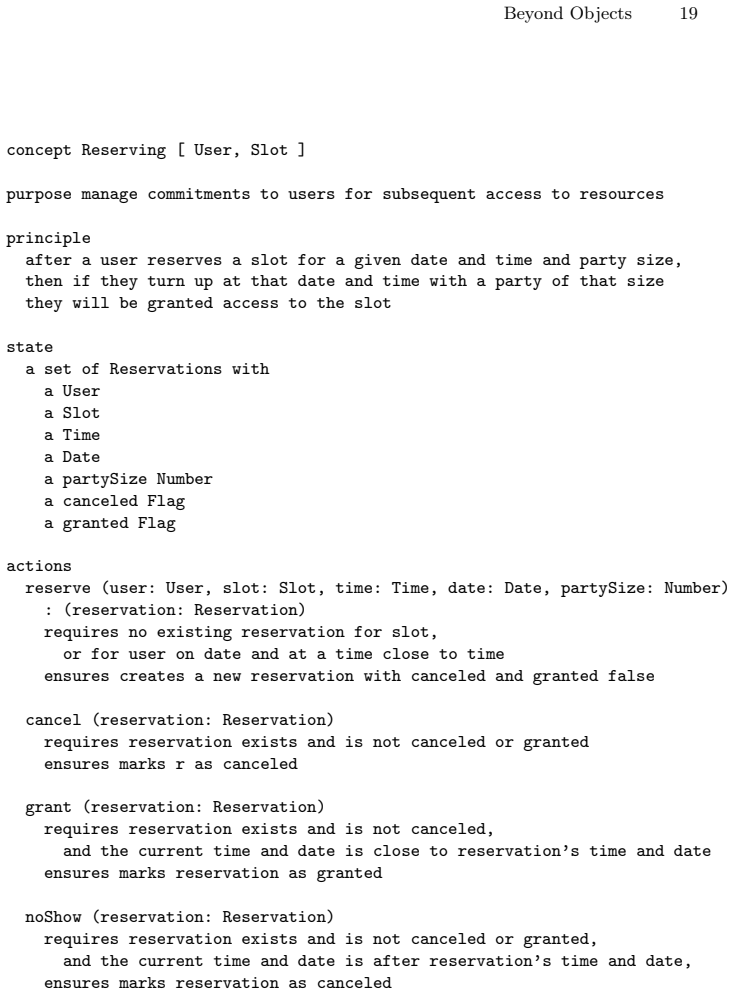
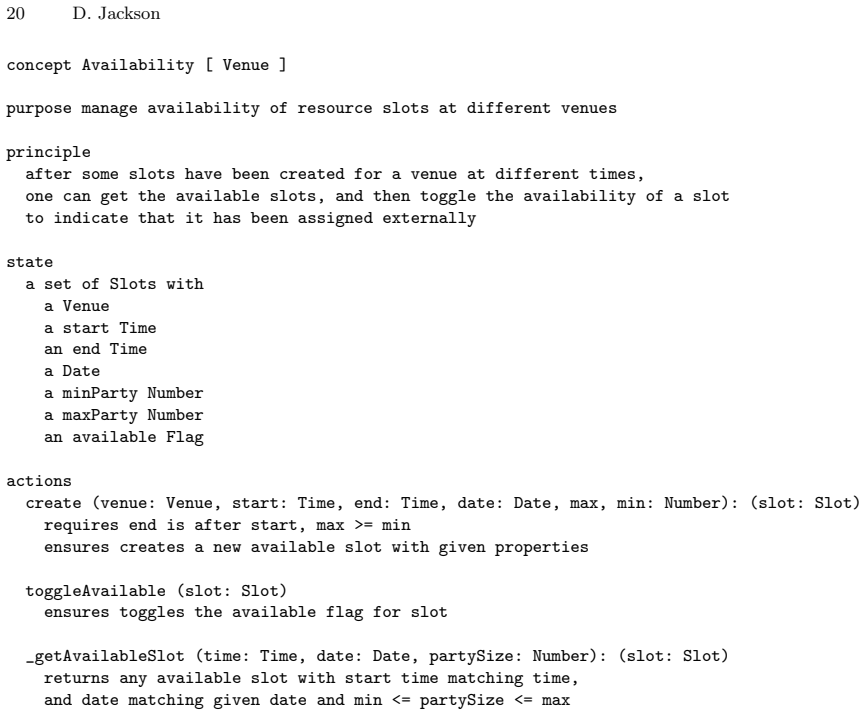
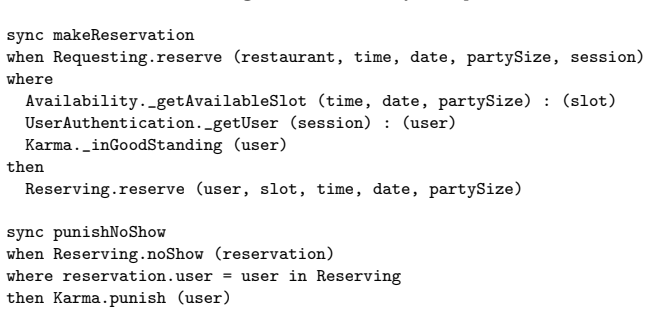
read the original abstract
A core principle of object orientation -- that the functionality of a system can be partitioned amongst objects that correspond to individuals in the problem domain -- has influenced how software has been specified, designed and implemented for more than fifty years. Later developments in software engineering sought to build on this principle. But in fact this partitioning is neither natural nor straightforward, and the problems that these later developments sought to mitigate -- the fragmentation and conflation of functionality -- were often, in fact, the inevitable consequences of this founding principle. An easier path to addressing these problems therefore starts by going back, abandoning object orientation, and replacing it with an alternative approach that decouples the individuals of the problem domain from the modules that partition functionality.
Editorial analysis
A structured set of objections, weighed in public.
Referee Report
Summary. The manuscript argues that the foundational principle of object orientation—partitioning system functionality among objects that correspond to individuals in the problem domain—has shaped software specification, design, and implementation for over fifty years. It claims this partitioning is neither natural nor straightforward, and that the fragmentation and conflation of functionality (which later developments sought to mitigate) are inevitable consequences of the principle itself. The paper concludes that addressing these issues requires abandoning object orientation in favor of an alternative approach that decouples domain individuals from the modules that partition functionality.
Significance. If the central claim holds, the result would have substantial significance for software engineering by providing a foundational critique of object-oriented design and motivating a paradigm-level shift away from domain-individual-based modularization toward decoupled alternatives. This could influence long-term methodology development, tool design, and education in the field.
major comments (1)
- [Abstract] Abstract: The assertion that fragmentation and conflation 'were often, in fact, the inevitable consequences of this founding principle' is presented without derivation, logical steps, enumeration of possible realizations of the partitioning principle, or counterfactual analysis showing why non-fragmenting or non-conflating module structures are impossible while still obeying the core principle of correspondence to domain individuals. This makes the necessity claim difficult to assess as demonstrated rather than interpretive.
Simulated Author's Rebuttal
We thank the referee for their review and the opportunity to clarify the presentation of our central claim. We address the single major comment below.
read point-by-point responses
-
Referee: [Abstract] Abstract: The assertion that fragmentation and conflation 'were often, in fact, the inevitable consequences of this founding principle' is presented without derivation, logical steps, enumeration of possible realizations of the partitioning principle, or counterfactual analysis showing why non-fragmenting or non-conflating module structures are impossible while still obeying the core principle of correspondence to domain individuals. This makes the necessity claim difficult to assess as demonstrated rather than interpretive.
Authors: The abstract is intentionally concise, but the full manuscript supplies the requested derivation through concrete examples of domain-individual correspondence (e.g., the forced distribution of cross-cutting concerns and the forced bundling of unrelated behaviors) together with an enumeration of alternative module structures that remain consistent with the core principle yet still produce fragmentation or conflation. We agree that the abstract would benefit from a brief pointer to this supporting reasoning. We will therefore revise the abstract to include a short indication of the logical steps and a reference to the relevant sections. revision: yes
Circularity Check
No circularity; interpretive historical argument lacks derivation chain or self-referential reductions
full rationale
The paper advances a conceptual critique of object orientation as a partitioning principle, asserting that fragmentation and conflation are inevitable consequences. No equations, fitted parameters, predictions, or self-citations appear in the provided text. The central claim is presented as an interpretive conclusion from historical developments rather than a reduction by construction to inputs, self-definition, or author-prior uniqueness theorems. The argument is self-contained as a position paper without load-bearing steps that equate outputs to inputs by fiat.
Axiom & Free-Parameter Ledger
axioms (1)
- domain assumption Object orientation is founded on the principle that functionality can be partitioned amongst objects corresponding to individuals in the problem domain
Reference graph
Works this paper leans on
-
[1]
In: IFIP Working Conference on Data Base Manage- ment
Abrial, J.R.: Data semantics. In: IFIP Working Conference on Data Base Manage- ment. pp. 1–60. North-Holland (1974)
1974
-
[2]
Cambridge University Press (1996)
Abrial, J.R.: The B-Book: Assigning Programs to Meanings. Cambridge University Press (1996)
1996
-
[3]
Cambridge University Press, Cambridge, UK (2010)
Abrial, J.R.: Modeling in Event-B: System and Software En- gineering. Cambridge University Press, Cambridge, UK (2010). https://doi.org/10.1017/CBO9781139195885
-
[4]
In: On the Con- struction of Programs
Abrial, J.R., Schuman, S.A., Meyer, B.: Specification language. In: On the Con- struction of Programs. Cambridge University Press (1980)
1980
-
[5]
Information and Software Technology36(1), 43–51 (1994)
Ainsworth, M., Cruickshank, A.H., Wallis, P.J.L., Groves, L.J.: Viewpoint spec- ification and z. Information and Software Technology36(1), 43–51 (1994). https://doi.org/10.1016/0950-5849(94)90007-8
-
[6]
https://github.com/winterrrrrff/realWorld-server
Anonymous: Realworld example app repository. https://github.com/winterrrrrff/realWorld-server
-
[7]
Bierman, G.M., Wren, A.: First-class relationships in an object-oriented language. In: Black, A.P. (ed.) ECOOP 2005 – Object-Oriented Programming. Lecture Notes in Computer Science, vol. 3586, pp. 262–286. Springer, Glasgow, UK (2005). https://doi.org/10.1007/11531142_12
-
[8]
Game Developers Conference (GDC) (2002), http://gamedevs.org/uploads/data-driven-game-object-system.pdf, slides available online
Bilas, S.: A data-driven game object system. Game Developers Conference (GDC) (2002), http://gamedevs.org/uploads/data-driven-game-object-system.pdf, slides available online
2002
-
[9]
Springer (2005)
Bjørner, D.: Software Engineering 1: Abstraction and Modeling. Springer (2005)
2005
-
[10]
Ben- jamin/Cummings (1991) Beyond Objects 25
Booch, G.: Object-Oriented Analysis and Design with Applications. Ben- jamin/Cummings (1991) Beyond Objects 25
1991
-
[11]
BusinessWeek Magazine (September 30, 1991)
BusinessWeek: Software made simple. BusinessWeek Magazine (September 30, 1991)
1991
-
[12]
ACM Transactions on Database Systems1(1), 9–36 (1976)
Chen, P.P.S.: The entity-relationship model: Toward a unified view of data. ACM Transactions on Database Systems1(1), 9–36 (1976). https://doi.org/10.1145/320434.320440
-
[13]
Codd, E.F.: A relational model of data for large shared data banks. Communica- tions of the ACM13(6), 377–387 (1970). https://doi.org/10.1145/362384.362685
-
[14]
Codd, E.F.: Further normalization of the data base relational model. Tech. Rep. RJ909, IBM Research (1972)
1972
-
[15]
Cook,W.R.:Object-orientedprogrammingversusabstractdatatypes.In:Proceed- ings of the REX School/Workshop on Foundations of Object-Oriented Languages. p. 151–178. Springer-Verlag, Berlin, Heidelberg (1990)
1990
-
[16]
Coplien, J.O., Reenskaug, T.: Dci architecture: A new vision of object-oriented programming. In: ACM Queue (2009). https://doi.org/10.1145/1594209.1594214
-
[17]
(eds.): Structured Programming
Dahl, O.J., Dijkstra, E.W., Hoare, C.A.R. (eds.): Structured Programming. Aca- demic Press (1972)
1972
-
[18]
In: IFIP Working Conference on Simulation Programming Languages
Dahl, O.J., Nygaard, K.: Simula: An algol-based simulation language. In: IFIP Working Conference on Simulation Programming Languages. North-Holland (1966)
1966
-
[19]
In: IFIP International Conference on Open Distributed Processing (1995)
Derrick, J., Bowman, H., Steen, M.: Maintaining cross-viewpoint consistency using z. In: IFIP International Conference on Open Distributed Processing (1995)
1995
-
[20]
In: Selected Writings on Com- puting: A Personal Perspective
Dijkstra, E.W.: On the role of scientific thought. In: Selected Writings on Com- puting: A Personal Perspective. Springer (1982), originally presented at the IFIP Congress 1974
1982
-
[21]
Addison-Wesley (2003)
Evans, E.: Domain-Driven Design: Tackling Complexity in the Heart of Software. Addison-Wesley (2003)
2003
-
[22]
International Journal of Software Engineering and Knowledge Engineering2(1), 31–57 (1992)
Finkelstein, A., Kramer, J., Nuseibeh, B., Finkelstein, L., Goedicke, M.: View- points: A framework for integrating multiple perspectives in system development. International Journal of Software Engineering and Knowledge Engineering2(1), 31–57 (1992). https://doi.org/10.1142/S0218194092000038
-
[23]
Addison-Wesley (1994)
Gamma, E., Helm, R., Johnson, R., Vlissides, J.: Design Patterns: Elements of Reusable Object-Oriented Software. Addison-Wesley (1994)
1994
-
[24]
https://codebase.show/projects/realworld
Gothinkster: Realworld example apps. https://codebase.show/projects/realworld
-
[25]
MIT Press (1986)
Guttag, J.V., Liskov, B.: Abstraction and Specification in Program Development. MIT Press (1986)
1986
-
[26]
(ed.): Specification Case Studies
Hayes, I.J. (ed.): Specification Case Studies. Prentice Hall, second edn. (2001)
2001
-
[27]
In: Proceedings of the Z User Meeting
Hayes, I.J., Wildman, L.: Towards libraries for z. In: Proceedings of the Z User Meeting. Workshops in Computing, Springer (1992)
1992
-
[28]
In: Proceedings of the 3rd International Joint Conference on Artificial Intelligence
Hewitt, C., Bishop, P., Steiger, R.: A universal modular actor formalism for ar- tificial intelligence. In: Proceedings of the 3rd International Joint Conference on Artificial Intelligence. p. 235–245. IJCAI’73, Morgan Kaufmann Publishers Inc., San Francisco, CA, USA (1973)
1973
-
[29]
Prentice Hall (1985)
Hoare, C.A.R.: Communicating Sequential Processes. Prentice Hall (1985)
1985
-
[30]
In: Jackson, D
Hoare, C.A.R.: The michael jackson design technique: A study of the theory with applications. In: Jackson, D. (ed.) ICSE Workshop: A Tribute to Michael Jack- son (2009), workshop held in conjunction with the International Conference on Software Engineering (ICSE)
2009
-
[31]
https://essenceofsoftware.com, blog post (2025) 26 D
Jackson, D.: What you see is what it does. https://essenceofsoftware.com, blog post (2025) 26 D. Jackson
2025
-
[32]
ACM Transac- tions on Software Engineering and Methodology4(4), 335–372 (1995)
Jackson, D.: Structuring z specifications with views. ACM Transac- tions on Software Engineering and Methodology4(4), 335–372 (1995). https://doi.org/10.1145/226241.226249
-
[33]
Princeton, Princeton, NJ (2021)
Jackson, D.: The Essence of Software: Why Concepts Matter for Great Design. Princeton, Princeton, NJ (2021)
2021
-
[34]
In: Proceedings of the 17th international conference on Software engineering
Jackson, M.: The world and the machine. Proceedings of the 17th Inter- national Conference on Software Engineering (ICSE) pp. 283–292 (1995). https://doi.org/10.1145/225014.225041
-
[35]
Academic Press, London (1975)
Jackson, M.A.: Principles of Program Design. Academic Press, London (1975)
1975
-
[36]
Prentice Hall, Englewood Cliffs, NJ (1983)
Jackson, M.A.: System Development. Prentice Hall, Englewood Cliffs, NJ (1983)
1983
-
[37]
https://doi.org/10.1145/154766.155364, https://doi.org/10.1145/154766.155364
Kay, A.C.: The early history of smalltalk (1993). https://doi.org/10.1145/154766.155364, https://doi.org/10.1145/154766.155364
-
[38]
In: ECOOP
Kiczales, G., Lamping, J., Mendhekar, A., Maeda, C., Lopes, C., Loingtier, J.M., Irwin, J.: Aspect-oriented programming. In: ECOOP. LNCS, vol. 1241, pp. 220–
-
[39]
https://doi.org/10.1007/BFb0053381
Springer (1997). https://doi.org/10.1007/BFb0053381
-
[40]
Computers & Mathematics with Applications 23(2), 1–50 (1992)
Lehmann, F.: Semantic networks. Computers & Mathematics with Applications 23(2), 1–50 (1992). https://doi.org/https://doi.org/10.1016/0898-1221(92)90135- 5, https://www.sciencedirect.com/science/article/pii/0898122192901355
-
[41]
Communications of the ACM20(8), 564–576 (1977)
Liskov, B., Snyder, A., Atkinson, R., Schaffert, C.: Abstraction mech- anisms in clu. Communications of the ACM20(8), 564–576 (1977). https://doi.org/10.1145/359763.359789
-
[42]
In: ACM SIGPLAN Symposium on Very High Level Languages
Liskov, B., Zilles, S.: Programming with abstract data types. In: ACM SIGPLAN Symposium on Very High Level Languages. pp. 50–59 (1974)
1974
-
[43]
Liskov, B.H., Wing, J.M.: A behavioral notion of subtyping. ACM Trans- actions on Programming Languages and Systems16(6), 1811–1841 (1994). https://doi.org/10.1145/197320.197383
-
[44]
Meng,E.,Jackson,D.:Whatyouseeiswhatitdoes:Astructuralpatternforlegible software. In: Proceedings of the 2025 ACM SIGPLAN International Symposium on New Ideas, New Paradigms, and Reflections on Programming and Software. p. 178–193. Onward! ’25, Association for Computing Machinery, New York, NY, USA (2025). https://doi.org/10.1145/3759429.3762628
-
[45]
Prentice Hall (1988)
Meyer, B.: Object-Oriented Software Construction. Prentice Hall (1988)
1988
-
[46]
Neighbors, J.M.: Software Construction Using Components. Ph.D. thesis, Univer- sity of California, Irvine (1980)
1980
-
[47]
Ossher, H., Harrison, W.: Subject-oriented programming: A cri- tique of pure objects. Proceedings of OOPSLA pp. 411–428 (1993). https://doi.org/10.1145/165854.165932
-
[48]
Communications of the ACM15(12), 1053–1058 (1972)
Parnas, D.L.: On the criteria to be used in decomposing systems into modules. Communications of the ACM15(12), 1053–1058 (1972). https://doi.org/10.1145/361598.361623
-
[49]
IEEE Transactions on Software EngineeringSE-5(2), 128–138 (1979)
Parnas, D.L.: Designing software for ease of extension and contrac- tion. IEEE Transactions on Software EngineeringSE-5(2), 128–138 (1979). https://doi.org/10.1109/TSE.1979.234169
-
[50]
Manning (1996)
Reenskaug,T.,Wold,P.,Lehne,O.A.:WorkingwithObjects:TheOOramSoftware Engineering Method. Manning (1996)
1996
-
[51]
Prentice Hall (1991)
Rumbaugh, J., Blaha, M., Premerlani, W., Eddy, F., Lorensen, W.: Object- Oriented Modeling and Design. Prentice Hall (1991)
1991
-
[52]
In: In- ternational Conference on Formal Engineering Methods
Silva, R., Butler, M.: Shared event composition/decomposition in event-b. In: In- ternational Conference on Formal Engineering Methods. LNCS, Springer (2010)
2010
-
[53]
Sutherland, I.E.: Sketchpad: A Man-Machine Graphical Communication System. Ph.D. thesis, MIT (1963) Beyond Objects 27
1963
-
[54]
In: Boehm, B.W., Gar- lan, D., Kramer, J
Tarr, P.L., Ossher, H., Harrison, W.H., Sutton, S.M.J.: N degrees of sep- aration: Multi-dimensional separation of concerns. In: Boehm, B.W., Gar- lan, D., Kramer, J. (eds.) Proceedings of the 21st International Conference on Software Engineering. pp. 107–119. ACM, Los Angeles, CA, USA (1999). https://doi.org/10.1145/302405.302457
-
[55]
In: Conference Proceedings on Object-Oriented Programming Systems, Languages and Applications
Wirfs-Brock, R., Wilkerson, B.: Object-oriented design: a responsibility-driven ap- proach. In: Conference Proceedings on Object-Oriented Programming Systems, Languages and Applications. p. 71–75. OOPSLA ’89, Association for Comput- ing Machinery, New York, NY, USA (1989). https://doi.org/10.1145/74877.74885, https://doi.org/10.1145/74877.74885
-
[56]
Prentice Hall (1989)
Yourdon, E.: Modern Structured Analysis. Prentice Hall (1989)
1989
discussion (0)
Sign in with ORCID, Apple, or X to comment. Anyone can read and Pith papers without signing in.