Revised orbital parameters of the gamma2 Velorum system
Pith reviewed 2026-06-26 02:58 UTC · model grok-4.3
The pith
New interferometric data revise the eccentricity of the gamma2 Velorum binary to 0.322 and tighten mass and radius constraints on its components.
A machine-rendered reading of the paper's core claim, the machinery that carries it, and where it could break.
Core claim
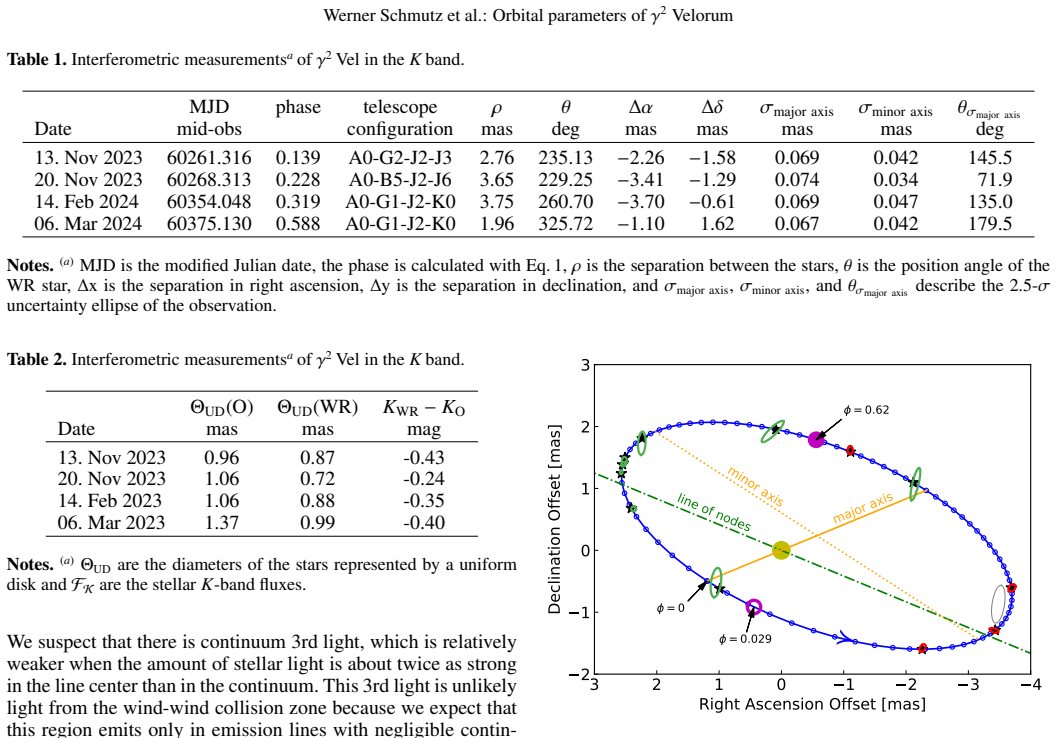
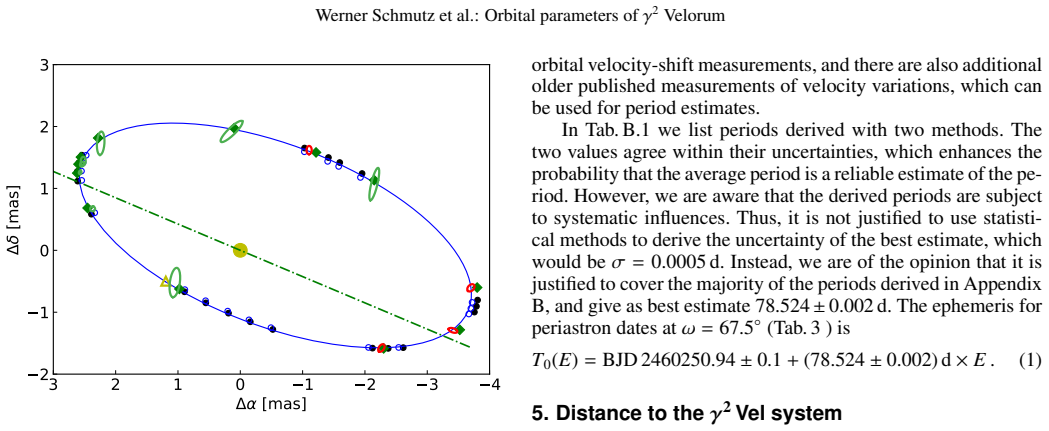
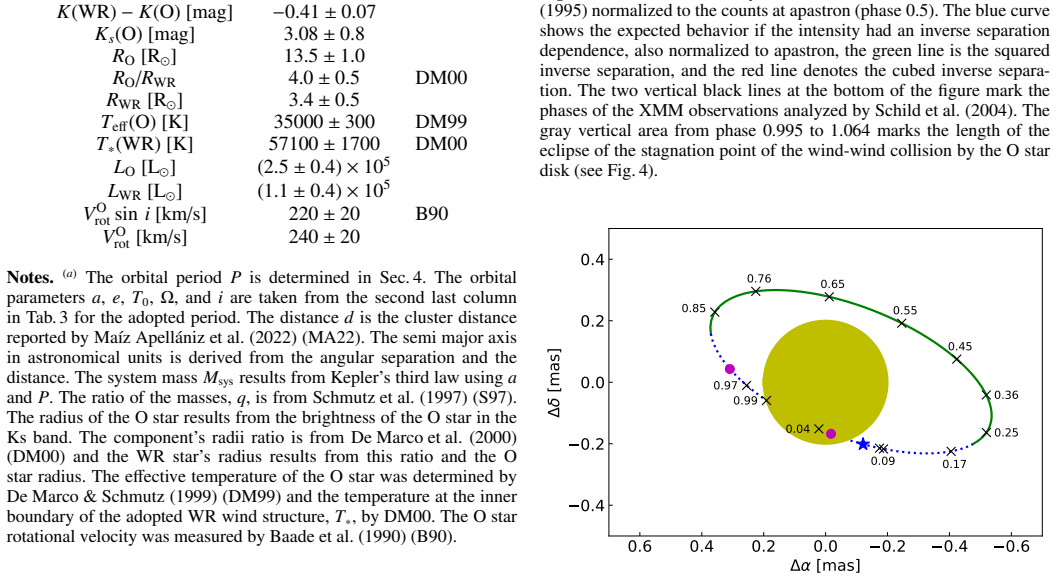
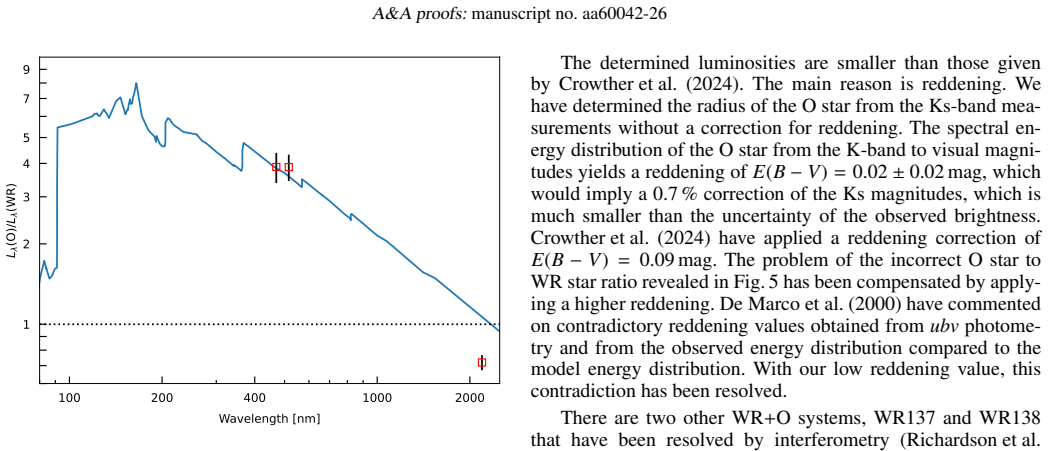
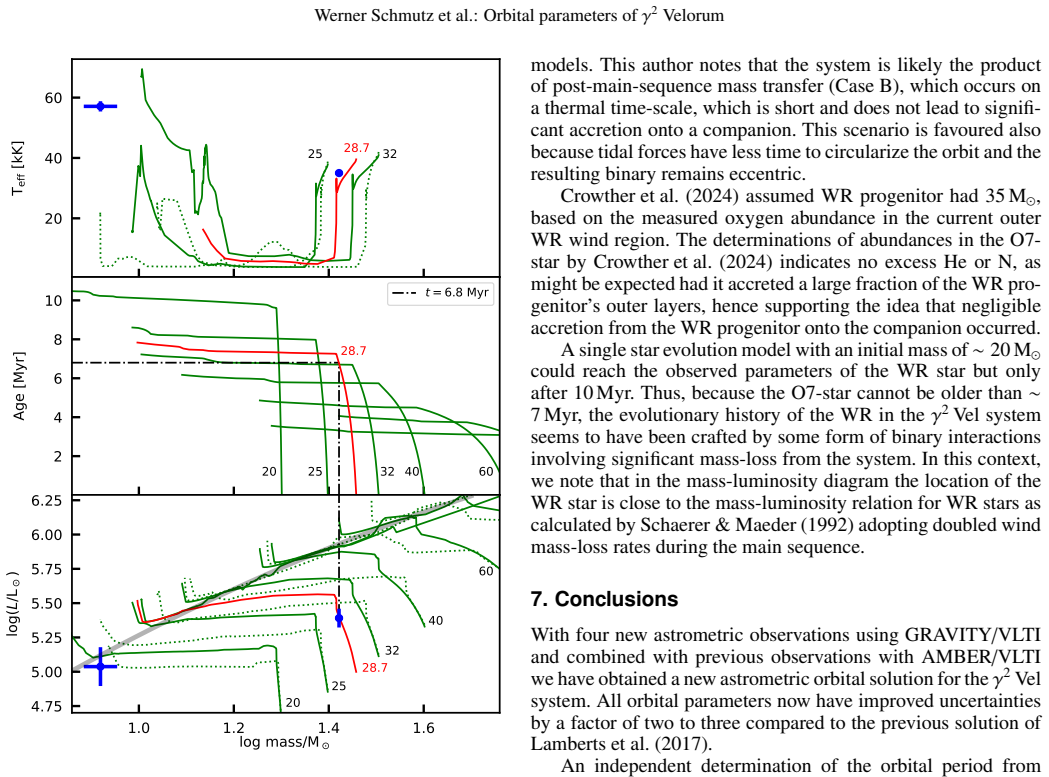
Combining GRAVITY interferometric observations with prior spatially resolved data produces tight constraints on the orbital parameters of gamma2 Velorum, in particular an eccentricity of 0.322 that aligns with emission-line results. The K-band brightness discrepancy is traced to the Wolf-Rayet wind models, leading to a reddening value of E(B-V) equal to 0.02 plus or minus 0.02 magnitudes. Updated masses and radii combined with effective temperatures impose strong constraints on evolutionary models, with the closest matches being a 28.7 solar-mass rotationally mixed track for the O star and a 32 solar-mass track for the Wolf-Rayet star, although the observed O-star temperature is higher and t
What carries the argument
Spatially resolved interferometric observations at multiple orbital phases that directly measure the changing separation between the two stars and enable a precise orbital fit.
If this is right
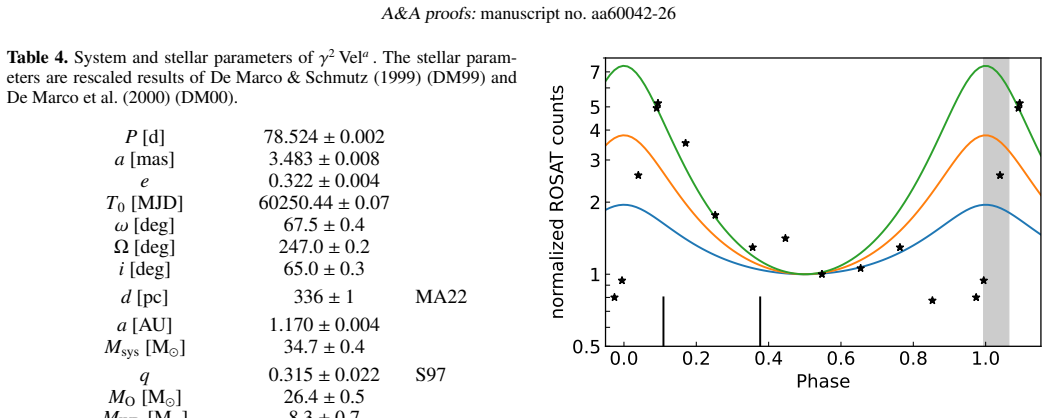
- The X-ray light curve declines proportionally to the inverse cube of the separation after periastron.
- X-ray modulation at other phases is likely affected by absorption and occultation of the emitting region.
- The reddening is E(B-V) = 0.02 plus or minus 0.02 magnitudes.
- Initial masses of 28.7 solar masses for the O star and 32 solar masses for the Wolf-Rayet star provide the closest match to the data, with negligible accretion during the prior Roche-lobe overflow phase.
Where Pith is reading between the lines
- The refined separation-dependent X-ray decline law could be checked against multi-epoch X-ray data taken near other orbital phases to isolate absorption effects.
- The persistent mismatch with evolutionary tracks suggests that similar interferometric campaigns on other Wolf-Rayet binaries might reveal whether the mass-discrepancy problem is common.
Load-bearing premise
The K-band magnitude discrepancy is caused entirely by inaccuracies in the Wolf-Rayet wind models rather than by unaccounted systematics in the interferometric or photometric data.
What would settle it
An independent measurement of the K-band magnitude or reddening that deviates substantially from the value predicted by the wind models while preserving the same orbital solution would falsify the reddening conclusion.
Figures
read the original abstract
Context. gamma2 Velorum is the closest and visually brightest Wolf-Rayet binary system. Its eccentric orbit modulates the X-rays observed from the wind-wind interaction, and its large separation allows for spatially resolving both components. Aims. We aim to strengthen the constraints on gamma2 Velorum's properties and, in particular, solve the discrepancy between the eccentricity determined from the emission lines and that from the absorption lines. Methods. We obtained VLT/GRAVITY observations and combined them with earlier spatially-resolved data at different orbital phases. Results. Strong constraints on all orbital parameters were determined and, in particular, we find that e=0.322, close to what was derived from the emission lines. The X-ray light curve declines as s to power -3 after periastron, where s is the separation of the two stars, but its modulation is likely affected by absorption and occultation of the X-ray emitting region at other orbital phases. We find that previous discrepancies in the reddening value can be traced to a brighter K-band magnitude than that predicted by the WR wind models. We conclude E(B-V)=0.02+-0.02 mag. Our now more precise mass and radius values combined with previously determined effective temperatures provide very strong constraints on evolutionary models. The closest match for the O-star is provided by an initial mass M=28.7 Mo rotationally mixed model and a M=32 Mo model for the WR star, with negligible accretion onto the O-star during the WR progenitor's Roche Lobe overflow phase. However, the temperature of the O star is higher and the mass of the WR star is found to be smaller than predicted by the evolutionary tracks for the current epoch, consistent with the well-known "mass-discrepancy problem" in massive stars.
Editorial analysis
A structured set of objections, weighed in public.
Referee Report
Summary. The manuscript reports new VLT/GRAVITY interferometric observations of the gamma2 Velorum Wolf-Rayet + O binary, combined with earlier spatially resolved data at multiple orbital phases. It derives revised orbital elements (notably e = 0.322, consistent with emission-line values), models the X-ray light curve decline as s^{-3} post-periastron, attributes a K-band magnitude discrepancy to WR wind model inaccuracies to obtain E(B-V) = 0.02 ± 0.02 mag, and combines the resulting masses/radii with prior effective temperatures to constrain evolutionary tracks (closest match: 28.7 M⊙ rotationally mixed model for the O star and 32 M⊙ for the WR star), while noting the persistent mass-discrepancy tension.
Significance. If the orbital fit and reddening derivation are robust, the work supplies improved parameters for the nearest WR binary, resolves the long-standing eccentricity discrepancy between absorption and emission lines, and offers a concrete test of massive-star evolutionary models including rotational mixing and Roche-lobe overflow. The combination of new GRAVITY data with archival interferometry is a methodological strength that enables the claimed precision.
major comments (2)
- [Abstract, Results] Abstract, Results paragraph: the claim of 'strong constraints on all orbital parameters' and the quoted precision on e = 0.322 is not supported by any reported quantitative diagnostics (reduced χ^{2}, covariance matrix, residual plots, or explicit tests for zero-point offsets between the new GRAVITY and earlier datasets). These statistics are required to substantiate that the solution is not dominated by unaccounted systematics.
- [Abstract, Results] Abstract, Results paragraph on reddening: the adopted E(B-V) = 0.02 ± 0.02 mag rests on the assumption that the entire K-band excess is due to inaccuracies in the WR wind models rather than possible systematics in the interferometric or photometric data. No quantitative test of this attribution is presented; because the reddening directly sets the luminosity and therefore the radii used for the evolutionary-track comparison, this choice is load-bearing for the 'very strong constraints on evolutionary models' claim.
minor comments (1)
- [Abstract] The phrase 'declines as s to power -3' should be written in standard mathematical notation (s^{-3}) for clarity.
Simulated Author's Rebuttal
We thank the referee for their constructive and detailed comments, which help clarify the presentation of our results. We address each major comment below and will revise the manuscript accordingly to include the requested quantitative support.
read point-by-point responses
-
Referee: [Abstract, Results] Abstract, Results paragraph: the claim of 'strong constraints on all orbital parameters' and the quoted precision on e = 0.322 is not supported by any reported quantitative diagnostics (reduced χ^{2}, covariance matrix, residual plots, or explicit tests for zero-point offsets between the new GRAVITY and earlier datasets). These statistics are required to substantiate that the solution is not dominated by unaccounted systematics.
Authors: We agree that explicit fit diagnostics strengthen the claim. The orbital solution was obtained via a global least-squares fit to all interferometric data points, but these metrics were not highlighted in the abstract or results summary. In the revised manuscript we will report the reduced χ², the covariance matrix for the key parameters (including e), residual plots, and a direct comparison of GRAVITY versus archival zero-points to demonstrate that systematics do not dominate the solution. revision: yes
-
Referee: [Abstract, Results] Abstract, Results paragraph on reddening: the adopted E(B-V) = 0.02 ± 0.02 mag rests on the assumption that the entire K-band excess is due to inaccuracies in the WR wind models rather than possible systematics in the interferometric or photometric data. No quantitative test of this attribution is presented; because the reddening directly sets the luminosity and therefore the radii used for the evolutionary-track comparison, this choice is load-bearing for the 'very strong constraints on evolutionary models' claim.
Authors: The attribution follows from the fact that the observed K-band magnitude exceeds all current WR wind-model predictions by a consistent amount, while the interferometric visibilities themselves are insensitive to the absolute flux scale. Nevertheless, we accept that a more explicit test is warranted. The revision will add a quantitative section comparing the excess against alternative wind prescriptions and against possible calibration offsets in the photometry and interferometry, thereby justifying the adopted reddening and its propagation to the luminosities and radii. revision: yes
Circularity Check
No circularity: orbital fit and parameter derivation are independent of self-defined inputs
full rationale
The paper derives orbital elements (including e=0.322) by fitting spatially resolved position measurements from GRAVITY and prior interferometric data at multiple phases. Masses follow directly from the Keplerian solution; radii are obtained from luminosity (using the adopted E(B-V)) plus prior Teff values. The E(B-V) choice is an interpretive attribution of K-band excess to wind-model inaccuracy rather than a fitted parameter renamed as a prediction or a self-citation chain. No equation or step reduces the reported masses, radii, or evolutionary-model constraints to quantities defined by the authors' own prior fits. The derivation chain remains self-contained against external data and tracks.
Axiom & Free-Parameter Ledger
free parameters (2)
- eccentricity e =
0.322
- reddening E(B-V) =
0.02
axioms (2)
- standard math Standard two-body Keplerian orbital mechanics governs the relative positions measured by interferometry
- domain assumption Published Wolf-Rayet wind models accurately predict K-band magnitude except for the discrepancy used to infer reddening
Reference graph
Works this paper leans on
-
[1]
, keywords =
Short-term activity in the gamma2 Velorum system : the O-type supergiant is a nonradially pulsating star. , keywords =
-
[2]
Analysis of apsidal motion in eclipsing binaries using TESS data. I. A test of gravitational theories. , keywords =. doi:10.1051/0004-6361/202040004 , archivePrefix =. 2103.03140 , primaryClass =
-
[3]
Oxygen abundance of Vel from [O III] 88 m Herschel/PACS spectroscopy. , keywords =. doi:10.1093/mnras/stae145 , archivePrefix =. 2310.15170 , primaryClass =
-
[4]
The instrument
The Sydney University Stellar Interferometer - I. The instrument. , keywords =
-
[5]
The Velorum binary system. I. O star parameters and light ratio. , keywords =
-
[6]
Interacting Winds from Massive Stars , year = 2002, editor =
Optical Line-Variability in the O+WR Binary Vel. Interacting Winds from Massive Stars , year = 2002, editor =
2002
-
[7]
The Velorum binary system. II. WR stellar parameters and the photon loss mechanism. , keywords =
-
[8]
, keywords =
Quantitative analysis of WC stars: constraints on neon abundances from ISO-SWS spectroscopy. , keywords =
-
[9]
Grids of stellar models with rotation. I. Models from 0.8 to 120 M _ ☉ at solar metallicity (Z = 0.014). , keywords =. 2012
2012
-
[10]
A new-age determination for ^ 2 Velorum from binary stellar evolution models. , keywords =. doi:10.1111/j.1745-3933.2009.00753.x , archivePrefix =. 0909.0504 , primaryClass =
-
[11]
Astrometric and photometric star catalogues derived from the ESA HIPPARCOS Space Astrometry Mission
The HIPPARCOS and TYCHO catalogues. Astrometric and photometric star catalogues derived from the ESA HIPPARCOS Space Astrometry Mission. ESA Special Publication , year = 1997, series =
1997
-
[12]
Line profile variations in WR+O binary systems. I. The code and basic predictions. , keywords =. doi:10.1051/0004-6361:200400030 , adsurl =
-
[13]
, year = 1970, month = jan, volume =
A study of ^ 2 Velorum with a stellar intensity interferometer. , year = 1970, month = jan, volume =. doi:10.1093/mnras/148.1.103 , adsurl =
-
[14]
, keywords =
Probing the wind-wind collision in ^ 2 Velorum with high-resolution Chandra X-ray spectroscopy: evidence for sudden radiative braking and non-equilibrium ionization. , keywords =
-
[15]
The Atmospheres of Early-Type Stars , year = 1992, editor =
The mass and helium discrepancy in massive young stars. The Atmospheres of Early-Type Stars , year = 1992, editor =
1992
-
[16]
Modelling the spectra of colliding winds in the Wolf-Rayet WC7+O binaries WR 42 and WR 79. , keywords =. doi:10.1046/j.1365-8711.2000.03705.x , adsurl =
-
[17]
Visual Orbits of Wolf─Rayet Stars. II. The Orbit of the Nitrogen-rich Wolf─Rayet Binary WR 138 Measured with the CHARA Array. , keywords =
-
[18]
Modelling forbidden line emission profiles from colliding wind binaries. , keywords =. doi:10.1111/j.1365-2966.2009.14586.x , archivePrefix =. 0902.0527 , primaryClass =
-
[19]
, keywords =
J - K DENIS photometry of a VLTI-selected sample of bright southern stars. , keywords =
-
[20]
, keywords =
Mass-loss rate determination for the massive binary V444 Cygni using 3-D Monte-Carlo simulations of line and polarization variability. , keywords =
-
[21]
, archivePrefix = "arXiv", eprint =
Numerical simulations and infrared spectro-interferometry reveal the wind collision region in ^ 2 Velorum. , archivePrefix = "arXiv", eprint =
-
[22]
A Colliding-Wind Model for the Wolf-Rayet System HD 152270. , keywords =. doi:10.1086/133907 , adsurl =
-
[23]
ArXiv e-prints , archivePrefix = "arXiv", eprint =
A reanalysis of the Gaia Data Release 2 photometric sensitivity curves using HST/STIS spectrophotometry. ArXiv e-prints , archivePrefix = "arXiv", eprint =
-
[24]
Photometric and Spectroscopic Studies of Massive Binaries in the Large Magellanic Cloud. I. Introduction and Orbits for Two Detached Systems: Evidence for a Mass Discrepancy?. , keywords =. doi:10.1088/0004-637X/748/2/96 , archivePrefix =. 1201.3280 , primaryClass =
work page internal anchor Pith review Pith/arXiv arXiv doi:10.1088/0004-637x/748/2/96
-
[25]
, keywords =
Direct constraint on the distance of ^ 2 Velorum from AMBER/VLTI observations. , keywords =
-
[26]
, year = 1950, month = sep, volume =
A Spectrographic Study of HD 193576. , year = 1950, month = sep, volume =
1950
-
[27]
, keywords =
The orbital elements of gam2 Vel. , keywords =
-
[28]
, keywords =
^ 2 Velorum: orbital solution and fundamental parameter determination with SUSI. , keywords =
-
[29]
, keywords =
The VizieR database of astronomical catalogues. , keywords =
-
[30]
, year = 1920, month = jul, volume =
Temporary shifting absorption at the heads of helium bands in the spectrum of Argus. , year = 1920, month = jul, volume =
1920
-
[31]
The Observatory , year = 1983, month = jun, volume =
The orbit of gamma 2 Velorum. The Observatory , year = 1983, month = jun, volume =
1983
-
[32]
The First Dynamical Mass Determination of a Nitrogen-rich Wolf-Rayet Star Using a Combined Visual and Spectroscopic Orbit. , keywords =. doi:10.3847/2041-8213/abd722 , archivePrefix =. 2101.04232 , primaryClass =
-
[33]
Photometric and spectroscopic evidence for colliding winds
The variability of the BRITE-est Wolf-Rayet binary, ^ 2 Velorum-I. Photometric and spectroscopic evidence for colliding winds. , archivePrefix = "arXiv", eprint =
-
[34]
Visual Orbits of Wolf─Rayet Stars. I. The Orbit of the Dust-producing Wolf─Rayet Binary WR 137 Measured with the CHARA Array. , keywords =
-
[35]
, keywords =
The CHARA Array resolves the long-period Wolf-Rayet binaries WR 137 and WR 138. , keywords =
-
[36]
Stellar parameters from spectral analyses indicate a new evolutionary sequence
The Galactic WC stars. Stellar parameters from spectral analyses indicate a new evolutionary sequence. , keywords =
-
[37]
, keywords =
Basic relations between physical parameters of Wolf-Rayet stars. , keywords =
-
[38]
XMM-Newton observations at high and low state
Wind clumping and the wind-wind collision zone in the Wolf-Rayet binary ^ 2 Velorum observations at high and low state. XMM-Newton observations at high and low state. , keywords =
-
[39]
, keywords =
Photon loss from the helium Ly line - the key to the acceleration of Wolf-Rayet winds. , keywords =
-
[40]
, keywords =
The orbital motion of gamma\^2 Velorum. , keywords =
-
[41]
, keywords =
Chandra Detection of a Close X-Ray Companion and Rich Emission-Line Spectrum in the Wolf-Rayet Binary Velorum. , keywords =
-
[42]
, keywords =
Colliding Winds from Early-Type Stars in Binary Systems. , keywords =
-
[43]
, keywords =
ASCA observations of ^ 2 Velorum (WC8+O9I): the variable X-ray spectrum of colliding winds. , keywords =
-
[44]
Conditions in the WR 140 wind-collision region revealed by the 1.083- m He I line profile. , keywords =. doi:10.1093/mnras/stab508 , archivePrefix =. 2102.09445 , primaryClass =
-
[45]
The Villafranca catalog of Galactic OB groups. II. From Gaia DR2 to EDR3 and ten new systems with O stars. , keywords =
-
[46]
, keywords =
Grids of stellar models with rotation VII: models from 0.8 to 300 M _ at supersolar metallicity (Z = 0.020). , keywords =
-
[47]
Rotating massive main-sequence stars. I. Grids of evolutionary models and isochrones. , keywords =
-
[48]
ROSAT observations of Velorum (WC8+O9I). I. The discovery of colliding-wind X-ray emission. , keywords =
discussion (0)
Sign in with ORCID, Apple, or X to comment. Anyone can read and Pith papers without signing in.