Strong coupling between propagating spin wave and microwave photons in a superconducting resonator
Pith reviewed 2026-06-26 02:08 UTC · model grok-4.3
The pith
Strong coupling is demonstrated between propagating spin waves and microwave photons in a superconducting resonator fabricated on a magnetic film.
A machine-rendered reading of the paper's core claim, the machinery that carries it, and where it could break.
Core claim
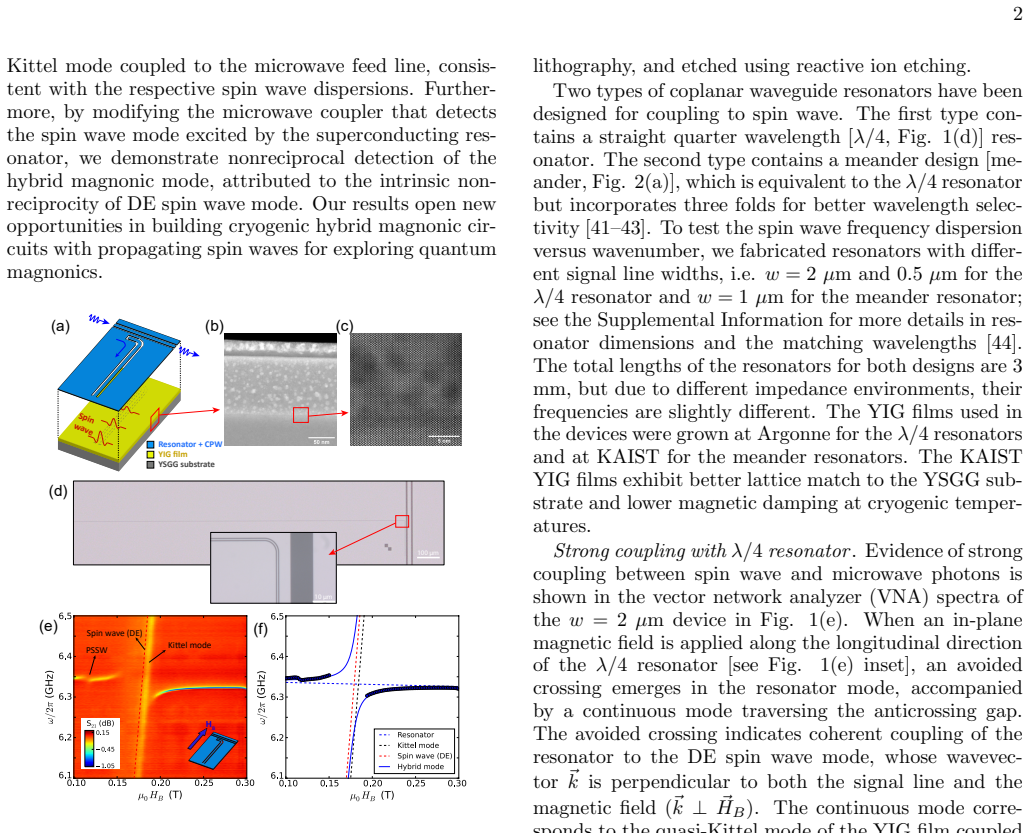
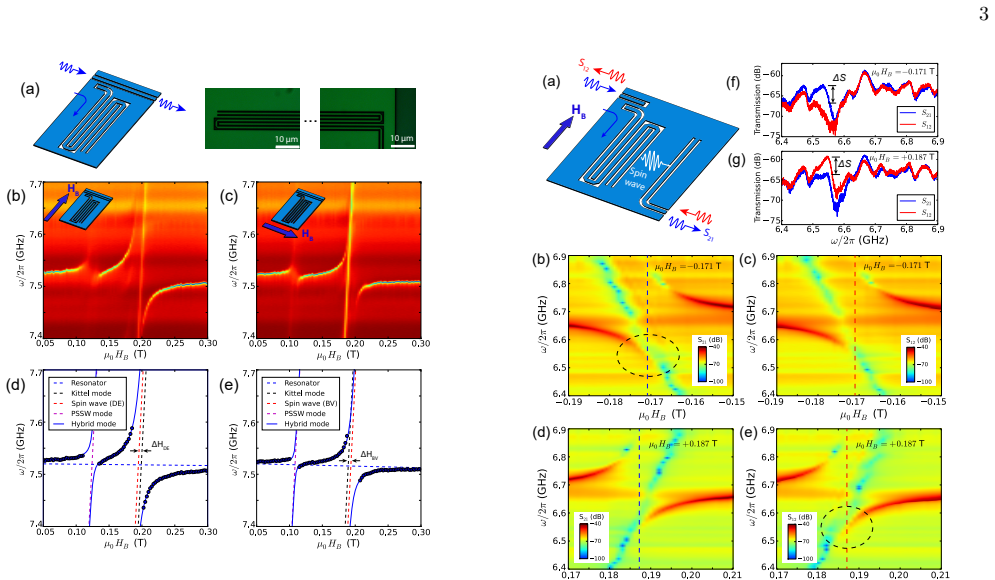
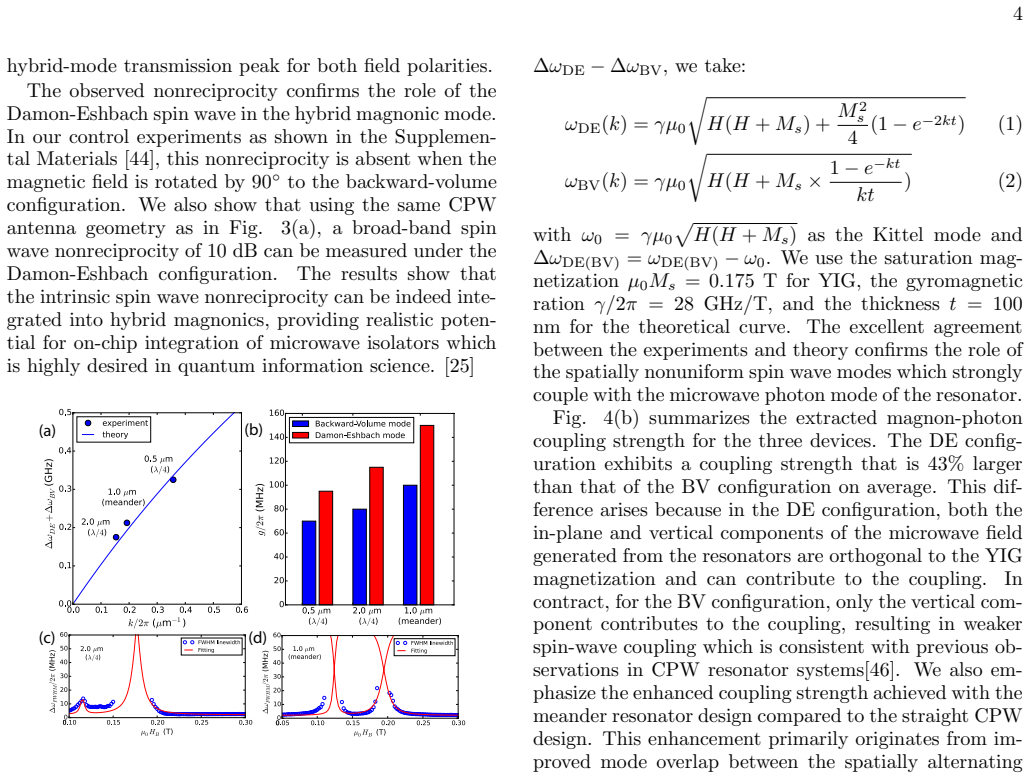
By fabricating the resonator directly on yttrium iron garnet thin films grown on rare-earth-free Y3Sc2Ga3O12 substrates, we achieve strong coupling of both Damon-Eshbach and backward-volume spin wave modes to the resonator, with coupling strengths exceeding both the magnon and photon damping rates. Furthermore, we observe nonreciprocal spin wave radiation of the hybrid magnonic mode in the Damon-Eshbach configuration.
What carries the argument
The hybrid magnonic mode arising from the interaction between propagating spin waves in the YIG film and photons in the superconducting resonator, identified by avoided crossings where the coupling rate surpasses damping rates.
If this is right
- Spin-wave magnonics can be integrated with cavity magnonics in hybrid circuits.
- Intrinsic spin-wave nonreciprocity can be incorporated into hybrid magnonic systems.
- Spin waves become viable for applications in quantum information science.
- New devices combining propagating spin waves with superconducting circuits are enabled.
Where Pith is reading between the lines
- This approach might allow spin waves to mediate coherent interactions between multiple quantum elements.
- Extending the method to other magnetic materials could broaden the range of frequencies or properties accessible.
- The nonreciprocity observed could be used to design directional magnonic components without additional elements.
Load-bearing premise
The claim of strong coupling rests on the extracted coupling rate exceeding the measured damping rates of the separate modes, assuming fabrication and substrate effects do not introduce unaccounted losses that change this comparison.
What would settle it
Measuring the spectrum and finding that the splitting or linewidth behavior does not match the expected strong-coupling regime when accounting for all loss channels would falsify the interpretation.
Figures
read the original abstract
We demonstrate strong coupling between propagating spin wave modes and microwave photons in superconducting resonator-magnetic thin film hybrid circuits. By fabricating the resonator directly on yttrium iron garnet thin films grown on rare-earth-free Y$_3$Sc$_2$Ga$_3$O$_{12}$ substrates, we achieve strong coupling of both Damon-Eshbach and backward-volume spin wave modes to the resonator, with coupling strengths exceeding both the magnon and photon damping rates. Furthermore, we observe nonreciprocal spin wave radiation of the hybrid magnonic mode in the Damon-Eshbach configuration, highlighting the potential for incorporating intrinsic spin-wave nonreciprocity into hybrid magnonic systems. These results open new avenues for integrating spin-wave magnonics with cavity magnonics, and for harnessing spin waves for potential applications in quantum information science.
Editorial analysis
A structured set of objections, weighed in public.
Referee Report
Summary. The manuscript reports an experimental demonstration of strong coupling between propagating spin-wave modes (both Damon-Eshbach and backward-volume) in a YIG thin film and microwave photons confined in a superconducting resonator fabricated directly on the film. Coupling rates are stated to exceed the separately measured magnon and photon damping rates, and nonreciprocal spin-wave radiation is reported for the hybrid mode in the Damon-Eshbach geometry. The work positions itself as bridging propagating magnonics with cavity magnonics for potential quantum-information applications.
Significance. If the central claim of strong coupling is substantiated by the data, the result would be significant for hybrid magnonic systems because it incorporates propagating modes (rather than only localized Kittel modes) and adds intrinsic nonreciprocity. The use of a rare-earth-free substrate is a practical strength for integration.
major comments (2)
- [Abstract / Results (spectral fitting)] Abstract and Results section on coupling extraction: the headline claim that the system enters the strong-coupling regime rests on the numerical comparison g > γ_m and g > κ_ph, where γ_m and κ_ph are taken from separate measurements of the bare magnon and photon modes. The integrated geometry (resonator fabricated directly on the YIG film) can introduce additional interface scattering, vortex losses, or radiation channels absent from the reference samples; no control data or discussion of whether these channels alter the effective linewidths inside the hybrid device is provided. This comparison is load-bearing for the strong-coupling assertion.
- [Results (avoided-crossing data)] Results section on spectral data: the manuscript does not supply the raw transmission spectra, the explicit fitting model (e.g., input-output theory or coupled-oscillator lineshape), the extracted parameter uncertainties, or the χ² values used to determine that the observed splitting exceeds the sum of the linewidths. Without these elements it is not possible to verify that the data support g exceeding the damping rates rather than being consistent with the intermediate-coupling regime.
minor comments (1)
- [Figure captions] Figure captions should explicitly state the microwave power, temperature, and bias-field sweep direction used for each panel to allow direct comparison with the damping-rate reference measurements.
Simulated Author's Rebuttal
We thank the referee for the careful reading and constructive comments. We address the two major points below and will revise the manuscript to improve clarity and verifiability of the strong-coupling claim.
read point-by-point responses
-
Referee: Abstract / Results (spectral fitting)] Abstract and Results section on coupling extraction: the headline claim that the system enters the strong-coupling regime rests on the numerical comparison g > γ_m and g > κ_ph, where γ_m and κ_ph are taken from separate measurements of the bare magnon and photon modes. The integrated geometry (resonator fabricated directly on the YIG film) can introduce additional interface scattering, vortex losses, or radiation channels absent from the reference samples; no control data or discussion of whether these channels alter the effective linewidths inside the hybrid device is provided. This comparison is load-bearing for the strong-coupling assertion.
Authors: We agree the integrated geometry could in principle add loss channels not captured by the separate bare-mode measurements. The manuscript currently presents the comparison without explicit discussion of this possibility. We will revise the text to include a dedicated paragraph estimating the magnitude of interface and radiation losses (using available film and resonator characterization data) and will add any relevant control spectra or bounds that can be extracted from existing measurements. revision: yes
-
Referee: [Results (avoided-crossing data)] Results section on spectral data: the manuscript does not supply the raw transmission spectra, the explicit fitting model (e.g., input-output theory or coupled-oscillator lineshape), the extracted parameter uncertainties, or the χ² values used to determine that the observed splitting exceeds the sum of the linewidths. Without these elements it is not possible to verify that the data support g exceeding the damping rates rather than being consistent with the intermediate-coupling regime.
Authors: The referee is correct that the current manuscript does not present the raw spectra, the precise lineshape model, parameter uncertainties, or goodness-of-fit metrics. We will add these elements in the revised version (raw data and fit details in the main text or supplementary information, together with the functional form used and reported uncertainties/χ² values) so that readers can independently assess whether the splitting satisfies the strong-coupling criterion. revision: yes
Circularity Check
No circularity: experimental demonstration with no derivations or self-referential reductions
full rationale
The paper is an experimental report on fabricating and measuring hybrid superconducting resonator-YIG devices. Claims of strong coupling rest on observed avoided crossings in spectra and extracted g values compared to separately measured damping rates of bare modes. No equations, ansatzes, uniqueness theorems, or fitted parameters are presented as predictions that reduce by construction to the inputs. No self-citations are invoked as load-bearing mathematical facts. The result is self-contained against external benchmarks (measured spectra) and receives the default non-circularity finding.
Axiom & Free-Parameter Ledger
Reference graph
Works this paper leans on
-
[1]
Kurizki, P
G. Kurizki, P. Bertet, Y. Kubo, K. Mølmer, D. Pet- rosyan, P. Rabl, and J. Schmiedmayer, Quantum tech- nologies with hybrid systems, Proc. Natl. Acad. Sci.112, 3866 (2015)
2015
-
[2]
A. A. Clerk, K. W. Lehnert, P. Bertet, J. R. Petta, and Y. Nakamura, Hybrid quantum systems with circuit quantum electrodynamics, Nature Phys.16, 257 (2020)
2020
-
[3]
Y. Li, W. Zhang, V. Tyberkevych, W.-K. Kwok, A. Hoff- mann, and V. Novosad, Hybrid magnonics: Physics, cir- cuits, and applications for coherent information process- ing, J. Appl. Phys.128, 130902 (2020)
2020
-
[4]
Zare Rameshti, S
B. Zare Rameshti, S. Viola Kusminskiy, J. A. Haigh, K. Usami, D. Lachance-Quirion, Y. Nakamura, C.-M. Hu, H. X. Tang, G. E. Bauer, and Y. M. Blanter, Cavity magnonics, Phys. Rep.979, 1 (2022)
2022
-
[5]
Y.-Y. Wang, S. van Geldern, T. Connolly, Y.-X. Wang, A. Shilcusky, A. McDonald, A. A. Clerk, and C. Wang, Low-loss ferrite circulator as a tunable chiral quantum system, Phys. Rev. Appl.16, 064066 (2021)
2021
-
[6]
Li, J.-C
Y. Li, J.-C. Qian, Z.-H. Jiang, T.-H. Lo, D. Ding, T. Dra- her, T. Polakovic, W. Pfaff, A. Schleife, J.-M. Zuo, W.- K. Kwok, V. Novosad, and A. Hoffmann, Hybrid-magnon quantum devices: Strategies and approaches, in2022 In- 6 ternational Electron Devices Meeting(2022) pp. 14.6.1– 14.6.4
2022
-
[7]
J. C. Owens, M. G. Panetta, B. Saxberg, G. Roberts, S. Chakram, R. Ma, A. Vrajitoarea, J. Simon, and D. I. Schuster, Chiral cavity quantum electrodynamics, Nature Physics18, 1048–1052 (2022)
2022
-
[8]
Hisatomi, A
R. Hisatomi, A. Osada, Y. Tabuchi, T. Ishikawa, A. Noguchi, R. Yamazaki, K. Usami, and Y. Nakamura, Bidirectional conversion between microwave and light via ferromagnetic magnons, Phys. Rev. B93, 174427 (2016)
2016
-
[9]
Osada, R
A. Osada, R. Hisatomi, A. Noguchi, Y. Tabuchi, R. Ya- mazaki, K. Usami, M. Sadgrove, R. Yalla, M. Nomura, and Y. Nakamura, Cavity optomagnonics with spin-orbit coupled photons, Phys. Rev. Lett.116, 223601 (2016)
2016
-
[10]
Zhang, N
X. Zhang, N. Zhu, C.-L. Zou, and H. X. Tang, Opto- magnonic whispering gallery microresonators, Phys. Rev. Lett.117, 123605 (2016)
2016
-
[11]
J. A. Haigh, A. Nunnenkamp, A. J. Ramsay, and A. J. Ferguson, Triple-resonant brillouin light scattering in magneto-optical cavities, Phys. Rev. Lett.117, 133602 (2016)
2016
-
[12]
Viola Kusminskiy, H
S. Viola Kusminskiy, H. X. Tang, and F. Marquardt, Coupled spin-light dynamics in cavity optomagnonics, Phys. Rev. A94, 033821 (2016)
2016
-
[13]
Kostylev and A
M. Kostylev and A. Stashkevich, Proposal for a mi- crowave photon to optical photon converter based on traveling magnons in thin magnetic films, J. Magn. and Magn. Mater.484, 329 (2019)
2019
-
[14]
N. Zhu, X. Zhang, X. Han, C.-L. Zou, C. Zhong, C.-H. Wang, L. Jiang, and H. X. Tang, Waveguide cavity op- tomagnonics for microwave-to-optics conversion, Optica 7, 1291 (2020)
2020
-
[15]
Tabuchi, S
Y. Tabuchi, S. Ishino, A. Noguchi, T. Ishikawa, R. Ya- mazaki, K. Usami, and Y. Nakamura, Coherent coupling between a ferromagnetic magnon and a superconducting qubit, Science349, 405–408 (2015)
2015
-
[16]
Lachance-Quirion, S
D. Lachance-Quirion, S. P. Wolski, Y. Tabuchi, S. Kono, K. Usami, and Y. Nakamura, Entanglement-based single- shot detection of a single magnon with a superconducting qubit, Science367, 425–428 (2020)
2020
-
[17]
Xu, X.-K
D. Xu, X.-K. Gu, H.-K. Li, Y.-C. Weng, Y.-P. Wang, J. Li, H. Wang, S.-Y. Zhu, and J. Q. You, Quantum control of a single magnon in a macroscopic spin system, Phys. Rev. Lett.130, 193603 (2023)
2023
-
[18]
S. Rani, X. Cao, A. E. Baptista, A. Hoffmann, and W. Pfaff, High-dynamic-range quantum sensing of magnons and their dynamics using a superconducting qubit, Phys. Rev. Appl.23, 064032 (2025)
2025
-
[19]
Lachance-Quirion, Y
D. Lachance-Quirion, Y. Tabuchi, A. Gloppe, K. Usami, and Y. Nakamura, Hybrid quantum systems based on magnonics, Appl. Phys. Express12, 070101 (2019)
2019
-
[20]
Trickle, Z
T. Trickle, Z. Zhang, and K. M. Zurek, Detecting light dark matter with magnons, Phys. Rev. Lett.124, 201801 (2020)
2020
- [21]
-
[22]
Schneider, A
T. Schneider, A. A. Serga, T. Neumann, B. Hillebrands, and M. P. Kostylev, Phase reciprocity of spin-wave exci- tation by a microstrip antenna, Phys. Rev. B77, 214411 (2008)
2008
-
[23]
Jamali, J
M. Jamali, J. H. Kwon, S.-M. Seo, K.-J. Lee, and H. Yang, Spin wave nonreciprocity for logic device ap- plications, Sci. Rep.3, 3160 (2013)
2013
-
[24]
Li, T.-H
Y. Li, T.-H. Lo, J. Lim, J. E. Pearson, R. Divan, W. Zhang, U. Welp, W.-K. Kwok, A. Hoffmann, and V. Novosad, Unidirectional microwave transduction with chirality selected short-wavelength magnon excitations, Appl. Phys. Lett.123, 022406 (2023)
2023
-
[25]
Jiang, J
Z. Jiang, J. Lim, Y. Li, W. Pfaff, T.-H. Lo, J. Qian, A. Schleife, J.-M. Zuo, V. Novosad, and A. Hoffmann, In- tegrating magnons for quantum information, Appl. Phys. Lett.123, 130501 (2023)
2023
-
[26]
Trifunovic, F
L. Trifunovic, F. L. Pedrocchi, and D. Loss, Long- distance entanglement of spin qubits via ferromagnet, Phys. Rev. X3, 041023 (2013)
2013
-
[27]
Andrich, C
P. Andrich, C. F. de las Casas, X. Liu, H. L. Bretscher, J. R. Berman, F. J. Heremans, P. F. Nealey, and D. D. Awschalom, Long-range spin wave mediated control of defect qubits in nanodiamonds, npj Quantum Informa- tion3, 28 (2017)
2017
-
[28]
S. Yuan, C. Liu, J. Chen, S. Liu, J. Lan, H. Yu, J. Wu, F. Yan, M.-H. Yung, J. Xiao, L. Jiang, and D. Yu, Spin-wave-based tunable coupler between superconduct- ing flux qubits, Phys. Rev. A107, 012434 (2023)
2023
-
[29]
Fukami, J
M. Fukami, J. Marcks, D. Candido, L. Weiss, B. Soloway, S. Sullivan, N. Delegan, F. Heremans, M. Flatt´ e, and D. Awschalom, Magnon-mediated qubit coupling deter- mined via dissipation measurements, Proc. Natl. Acad. Sci.121, e2313754120 (2024)
2024
-
[30]
N. Zhu, X. Zhang, X. Han, C.-L. Zou, and H. X. Tang, In- verse faraday effect in an optomagnonic waveguide, Phys. Rev. Appl.18, 024046 (2022)
2022
-
[31]
Sekine, M
A. Sekine, M. Ohfuchi, and Y. Doi, Microwave-to- optical quantum transduction utilizing the topological faraday effect of topological-insulator heterostructures, Phys. Rev. Appl.22, 024071 (2024)
2024
-
[32]
L. Bai, M. Harder, Y. P. Chen, X. Fan, J. Q. Xiao, and C.-M. Hu, Spin pumping in electrodynamically coupled magnon-photon systems, Phys. Rev. Lett.114, 227201 (2015)
2015
-
[33]
Zhang, C
X. Zhang, C. Zou, L. Jiang, and H. X. Tang, Superstrong coupling of thin film magnetostatic waves with microwave cavity, J. Appl. Phys.119, 023905 (2016)
2016
-
[34]
Kambersk´ y, On the landau–lifshitz relaxation in fer- romagnetic metals, Can
V. Kambersk´ y, On the landau–lifshitz relaxation in fer- romagnetic metals, Can. J. Phys.48, 2906 (1970)
1970
-
[35]
Gilmore, Y
K. Gilmore, Y. U. Idzerda, and M. D. Stiles, Identifica- tion of the dominant precession-damping mechanism in fe, co, and ni by first-principles calculations, Phys. Rev. Lett.99, 027204 (2007)
2007
-
[36]
Khodadadi, A
B. Khodadadi, A. Rai, A. Sapkota, A. Srivastava, B. Nepal, Y. Lim, D. A. Smith, C. Mewes, S. Bud- hathoki, A. J. Hauser, M. Gao, J.-F. Li, D. D. Viehland, Z. Jiang, J. J. Heremans, P. V. Balachandran, T. Mewes, and S. Emori, Conductivitylike gilbert damping due to intraband scattering in epitaxial iron, Phys. Rev. Lett. 124, 157201 (2020)
2020
-
[37]
C. Liu, S. M. Wu, J. E. Pearson, J. S. Jiang, N. d’Ambrumenil, and A. Bhattacharya, Probing short- range magnetic order in a geometrically frustrated mag- net by means of the spin seebeck effect, Phys. Rev. B98, 060415 (2018)
2018
-
[38]
Kosen, A
S. Kosen, A. F. van Loo, D. A. Bozhko, L. Mihalceanu, and A. D. Karenowska, Microwave magnon damping in yig films at millikelvin temperatures, APL Materials7, 101120 (2019). 7
2019
-
[39]
R. O. Serha, A. A. Voronov, D. Schmoll, R. Verba, K. O. Levchenko, S. Koraltan, K. Dav´ ıdkov´ a, B. Budinsk´ a, Q. Wang, O. V. Dobrovolskiy, M. Urb´ anek, M. Lindner, T. Reimann, C. Dubs, C. Gonzalez-Ballestero, C. Abert, D. Suess, D. A. Bozhko, S. Knauer, and A. V. Chumak, Magnetic anisotropy and ggg substrate stray field in yig films down to millikelvi...
2024
-
[40]
A. I. Buzdin, Proximity effects in superconductor- ferromagnet heterostructures, Rev. Mod. Phys.77, 935 (2005)
2005
-
[41]
Vlaminck and M
V. Vlaminck and M. Bailleul, Current-induced spin-wave doppler shift, Science322, 410 (2008)
2008
-
[42]
Neusser, G
S. Neusser, G. Duerr, H. G. Bauer, S. Tacchi, M. Madami, G. Woltersdorf, G. Gubbiotti, C. H. Back, and D. Grundler, Anisotropic propagation and damping of spin waves in a nanopatterned antidot lattice, Phys. Rev. Lett.105, 067208 (2010)
2010
-
[43]
C. Liu, J. Chen, T. Liu, F. Heimbach, H. Yu, Y. Xiao, J. Hu, M. Liu, H. Chang, T. Stueckler, S. Tu, Y. Zhang, Y. Zhang, P. Gao, Z. Liao, D. Yu, K. Xia, N. Lei, W. Zhao, and M. Wu, Long-distance propagation of short-wavelength spin waves, Nature Communi.9, 738 (2018)
2018
-
[44]
See the Supplemental Information for details
-
[45]
Li and W
Y. Li and W. E. Bailey, Wave-number-dependent gilbert damping in metallic ferromagnets, Phys. Rev. Lett.116, 117602 (2016)
2016
-
[46]
Y. Li, T. Draher, A. H. Comstock, Y. Xiong, M. A. Haque, E. Easy, J. Qian, T. Polakovic, J. E. Pear- son, R. Divan, J.-M. Zuo, X. Zhang, U. Welp, W.-K. Kwok, A. Hoffmann, J. M. Luther, M. C. Beard, D. Sun, W. Zhang, and V. Novosad, Probing intrinsic magnon bandgap in a layered hybrid perovskite antiferromag- net by a superconducting resonator, Phys. Rev. ...
2023
-
[47]
Xiong, Y
Y. Xiong, Y. Li, M. Hammami, R. Bidthanapally, J. Sklenar, X. Zhang, H. Qu, G. Srinivasan, J. Pear- son, A. Hoffmann, V. Novosad, and W. Zhang, Prob- ing magnon–magnon coupling in exchange coupled y3fe5o12/permalloy bilayers with magneto-optical effects, Sci. Rep.10, 12548 (2020)
2020
-
[48]
C. W. Zollitsch, S. Khan, N. V. T. Trung, I. A. Verzh- bitskiy, D. Sagkovits, J. O’Sullivan, O. W. Kennedy, M. Strungaru, E. J. G. Santos, J. J. L. Morton, G. Eda, and H. Kurebayashi, Probing spin dynamics of ultra-thin van der waals magnets via photon-magnon coupling, Na- ture Commun.14, 2619 (2023)
2023
-
[49]
C. Guguschev, C. Dubs, R. Blukis, O. Surzhenko, M. Br¨ utzam, R. Koc, C. Rhode, K. Berger, C. Richter, C. Berryman, R. O. Serha, and A. V. Chumak, Novel diamagnetic garnet-type substrate single crystals for ultralow-damping yttrium iron garnet Y3Fe5O12 films at cryogenic temperatures, (2025), arXiv:2508.18101
arXiv 2025
-
[50]
R. O. Serha, C. Dubs, C. Guguschev, B. Aichner, D. Schmoll, J. Panda, M. Weiler, P. Pirro, M. Urb´ anek, and A. V. Chumak, YSGAG: The Ideal Substrate for YIG in Quantum Magnonics, (2025), arXiv:2508.19044
Pith/arXiv arXiv 2025
-
[51]
J. Ben Youssef, N. Beaulieu, R. Schlitz, D. Pet- rosyan, M. Lammel, and W. Legrand, Low-temperature- compatible iron garnet films grown by liquid phase epi- taxy, (2025), arXiv:2509.06242
arXiv 2025
-
[52]
H. Wang, W. Legrand, D. Petrosyan, M.-G. Kang, E. Karad˘ za, H. Matsumoto, R. Schlitz, M. Lammel, M. H. Aguirre, and P. Gambardella, Ultrathin bismuth- yttrium iron garnet films with tunable and compensated magnetic anisotropy, (2025), arXiv:2510.07465
arXiv 2025
-
[53]
Burkard, T
G. Burkard, T. D. Ladd, A. Pan, J. M. Nichol, and J. R. Petta, Semiconductor spin qubits, Rev. Mod. Phys.95, 025003 (2023)
2023
-
[54]
Koolstra, G
G. Koolstra, G. Yang, and D. I. Schuster, Coupling a single electron on superfluid helium to a superconducting resonator, Nature Communi.10, 5323 (2019)
2019
-
[55]
X. Zhou, G. Koolstra, X. Zhang, G. Yang, X. Han, B. Dizdar, X. Li, R. Divan, W. Guo, K. W. Murch, D. I. Schuster, and D. Jin, Single electrons on solid neon as a solid-state qubit platform, Nature605, 46 (2022)
2022
discussion (0)
Sign in with ORCID, Apple, or X to comment. Anyone can read and Pith papers without signing in.