Simulation-based inference for rapid Bayesian parameter estimation in epidemiological models: a comparison with MCMC
Pith reviewed 2026-06-26 04:24 UTC · model grok-4.3
The pith
Simulation-based inference recovers MCMC posteriors for an SECIR epidemiological model while requiring far less computation.
A machine-rendered reading of the paper's core claim, the machinery that carries it, and where it could break.
Core claim
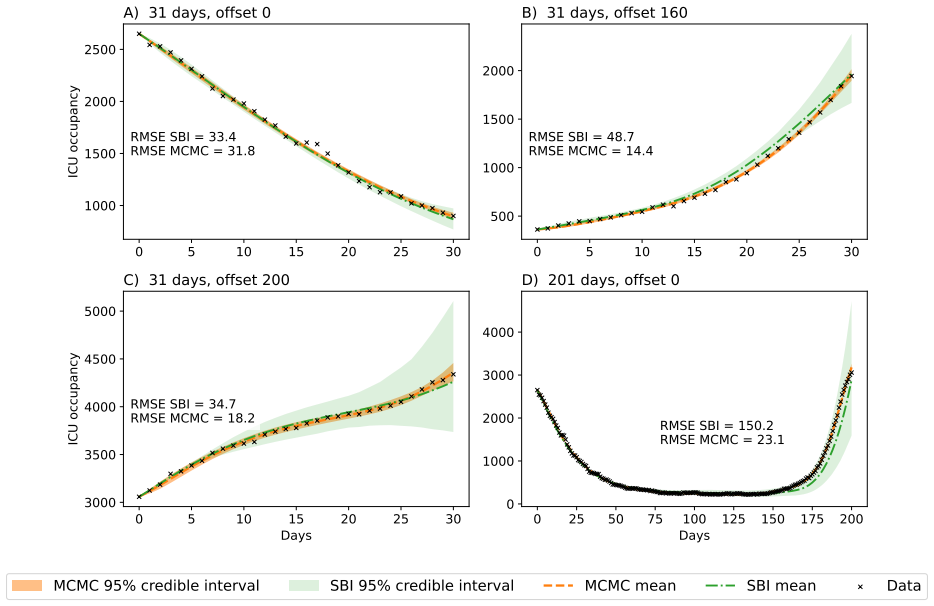
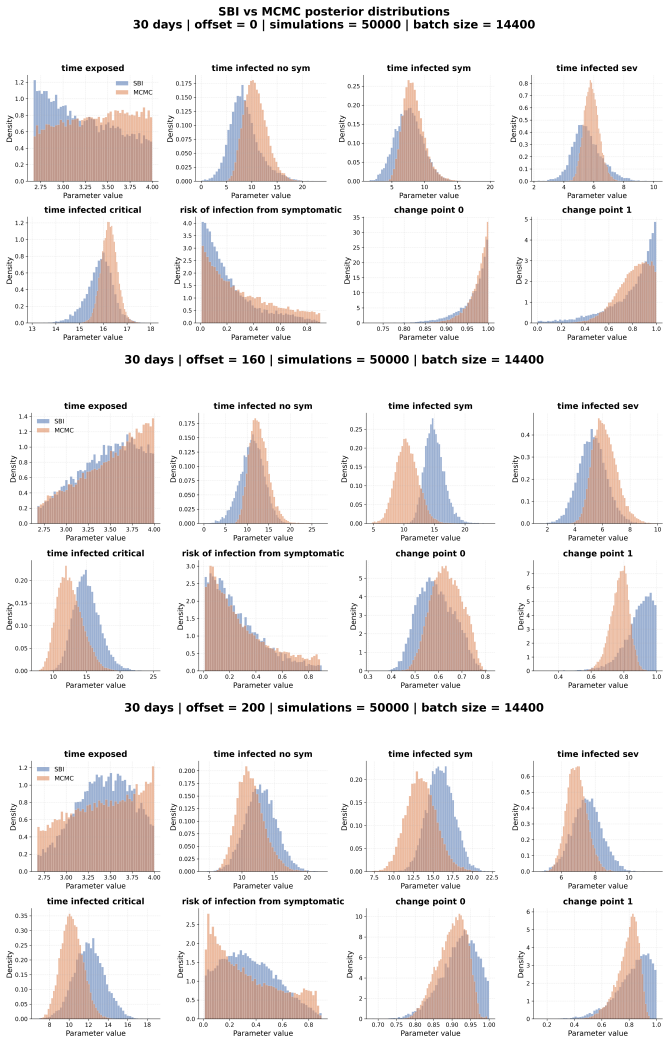
Neural posterior estimation recovers posterior distributions for SECIR model parameters that show strong quantitative agreement with MCMC results, measured by Wasserstein distances and Kullback-Leibler divergences, and that produce posterior predictive checks matching observed ICU trajectories; the agreement holds for both 31-day and 201-day periods, with SBI preserving the main posterior features even under higher uncertainty in the longer window.
What carries the argument
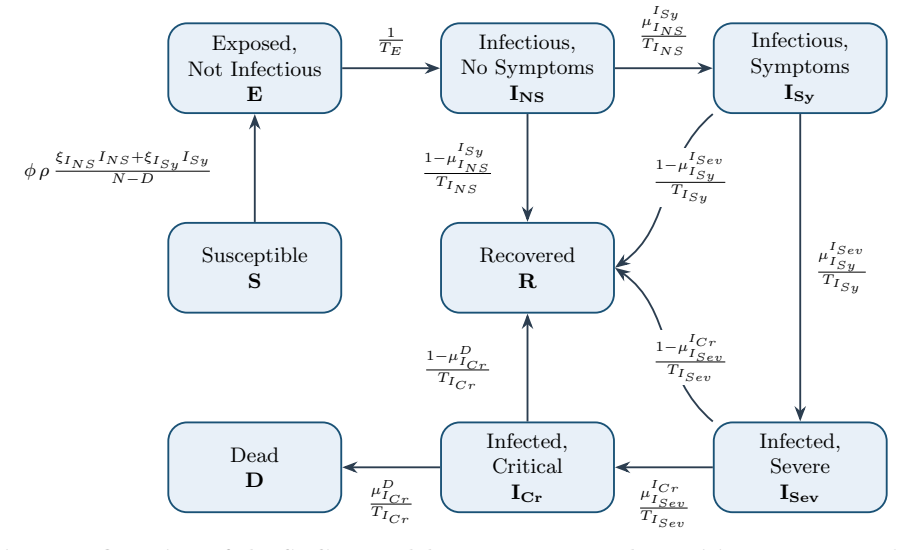
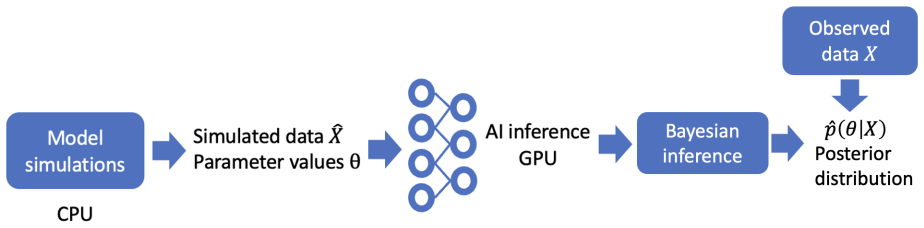
Neural posterior estimation, which trains a neural network on simulated data from the SECIR model to approximate the posterior over parameters given ICU observations.
If this is right
- SBI supports repeated near-real-time Bayesian analyses for infectious disease forecasting.
- Computational runtime drops by factors of 15 to over 100 compared to MCMC on the tested problems.
- The method maintains performance when extending to longer time series with multiple change points.
- Posterior predictive checks confirm that inferred parameters reproduce the observed ICU occupancy data.
Where Pith is reading between the lines
- The speed advantage could allow ensemble forecasting or integration with additional data streams in public health applications.
- Similar gains may appear when applying the approach to other mechanistic models or different observation types.
- Further tests on data with known ground-truth parameters would quantify any residual approximation error in the neural network.
Load-bearing premise
The trained neural network provides an accurate enough approximation to the true posterior for the observed ICU data in the tested time windows.
What would settle it
Finding a dataset or time window where SBI posteriors show large discrepancies from MCMC posteriors in Wasserstein distance or where the predicted trajectories deviate substantially from observed ICU occupancy.
Figures
read the original abstract
Mechanistic epidemiological models are widely used to support infectious disease forecasting and public-health decision making. Bayesian calibration of such models is commonly performed using Markov chain Monte Carlo (MCMC), which can become computationally expensive for high-dimensional nonlinear systems and repeated near-real-time analyses. Here, we investigate simulation-based inference (SBI) using neural posterior estimation as a scalable alternative for Bayesian calibration of a mechanistic SECIR epidemiological model using COVID-19 intensive care unit (ICU) occupancy data from Germany during 2020. We compared SBI and MCMC across multiple epidemic phases using both 31-day inference windows and a substantially more challenging 201-day reconstruction problem involving multiple transmission change points. Posterior agreement was evaluated quantitatively using Wasserstein distances and Kullback-Leibler divergences together with posterior predictive checks. Across the 31-day windows, SBI recovered posterior distributions in strong agreement with MCMC while accurately reproducing observed ICU trajectories. In the 201-day setting, SBI preserved the dominant posterior structure despite increased uncertainty. SBI, by combining CPU and GPU resources, substantially reduced computational runtime compared with MCMC, which was restricted to running on CPUs. Whereas MCMC required approximately 1000 seconds for the 31-day inference problems, SBI achieved comparable posterior and predictive performance in approximately 60-70 seconds on a single GPU. For the 201-day inference problem, SBI required an average of 157 seconds, while the MCMC runs took over 19,000 seconds. Our results demonstrate that SBI provides a rapid and computationally efficient framework for Bayesian calibration of mechanistic epidemiological models, supporting repeated near-real-time inference and rapid outbreak analysis.
Editorial analysis
A structured set of objections, weighed in public.
Referee Report
Summary. The manuscript compares simulation-based inference (SBI) via neural posterior estimation against MCMC for Bayesian calibration of a SECIR epidemiological model to German COVID-19 ICU occupancy data. It reports quantitative agreement between SBI and MCMC posteriors (via Wasserstein distances, KL divergences, and posterior predictive checks) across 31-day windows and a 201-day multi-change-point reconstruction, while claiming SBI achieves comparable results in far less time (60-70 s vs ~1000 s for 31-day; 157 s vs >19000 s for 201-day).
Significance. If the reported posterior agreement holds without substantial approximation bias, the work supplies a concrete, scalable alternative to MCMC for repeated Bayesian calibration of nonlinear mechanistic models. The runtime numbers and agreement metrics on real ICU data would be directly useful for near-real-time epidemiological applications.
major comments (2)
- [abstract and §5] The central claim that SBI recovers posteriors in strong agreement with MCMC for the 201-day multi-change-point case (abstract and §5) rests on the unverified assumption that the 10^5–10^6 training simulations densely cover the relevant region of parameter space. No prior-predictive coverage diagnostics, amortized posterior calibration on held-out simulations, or effective-sample-size comparisons are reported that would confirm this coverage for the transmission change-point parameters.
- [§4.2] §4.2 and the methods description of the NPE network provide no quantitative assessment of approximation bias (e.g., via simulation-based calibration or posterior coverage probabilities) that would be required to interpret the reported Wasserstein and KL distances as evidence of faithful posterior recovery rather than under-sampling artifacts.
minor comments (2)
- [abstract and §5] The hardware specifications and parallelization details for the MCMC runs (beyond “restricted to CPUs”) are not stated, making the runtime comparison in the abstract and §5 difficult to interpret.
- [§2] Notation for the SECIR parameters and change-point priors is introduced without a consolidated table; a single reference table would improve readability.
Simulated Author's Rebuttal
We thank the referee for the constructive comments, which correctly identify opportunities to strengthen the validation of the SBI approximation. We address each major comment below.
read point-by-point responses
-
Referee: [abstract and §5] The central claim that SBI recovers posteriors in strong agreement with MCMC for the 201-day multi-change-point case (abstract and §5) rests on the unverified assumption that the 10^5–10^6 training simulations densely cover the relevant region of parameter space. No prior-predictive coverage diagnostics, amortized posterior calibration on held-out simulations, or effective-sample-size comparisons are reported that would confirm this coverage for the transmission change-point parameters.
Authors: We agree that the manuscript would benefit from explicit coverage diagnostics for the 201-day case. The reported agreement with MCMC (Wasserstein distances, KL divergences, and posterior predictive checks) provides supporting evidence that the training simulations were sufficient, but this is indirect. In the revised version we will add prior-predictive coverage diagnostics and simulation-based calibration on held-out simulations, with particular attention to the change-point parameters. revision: yes
-
Referee: [§4.2] §4.2 and the methods description of the NPE network provide no quantitative assessment of approximation bias (e.g., via simulation-based calibration or posterior coverage probabilities) that would be required to interpret the reported Wasserstein and KL distances as evidence of faithful posterior recovery rather than under-sampling artifacts.
Authors: We acknowledge the absence of direct approximation-bias diagnostics in the current text. The manuscript currently uses agreement with MCMC as the primary validation. We will incorporate quantitative assessments of approximation bias, including simulation-based calibration and posterior coverage probabilities, into §4.2 and the methods description in the revision. revision: yes
Circularity Check
No circularity: empirical benchmark comparison of SBI vs MCMC
full rationale
The paper reports runtime and posterior-agreement metrics (Wasserstein, KL, predictive checks) between two independent inference methods applied to the same SECIR model and ICU data. MCMC is treated as an external reference, not derived from SBI outputs or vice versa. No equations reduce a claimed result to a fitted parameter by construction, no self-citation chain supports a uniqueness claim, and no ansatz or renaming is presented as a derivation. The work is a self-contained empirical study whose central claims rest on observable performance differences rather than internal re-derivation.
Axiom & Free-Parameter Ledger
axioms (1)
- domain assumption The SECIR mechanistic model is an adequate representation of COVID-19 transmission dynamics in Germany during 2020
Reference graph
Works this paper leans on
-
[1]
Lingcai Kong, Mengwei Duan, Jin Shi, Jie Hong, Zhaorui Chang, and Zhijie Zhang. Compart- mental structures used in modeling covid-19: a scoping review.Infectious Diseases of Poverty, 11(1):72, Jun 2022. ISSN 2049-9957. doi: 10.1186/s40249-022-01001-y
-
[2]
Eduard Campillo-Funollet, James Van Yperen, Phil Allman, Michael Bell, Warren Beresford, Jacqueline Clay, Matthew Dorey, Graham Evans, Kate Gilchrist, Anjum Memon, Gurprit Pannu, Ryan Walkley, Mark Watson, and Anotida Madzvamuse. Predicting and forecasting the impact of local outbreaks of covid-19: use of seir-d quantitative epidemiological modelling for ...
-
[3]
Differential effects of intervention timing on covid-19 spread in the united states.Science Advances, 6(49):eabd6370, 2020
Sen Pei, Sasikiran Kandula, and Jeffrey Shaman. Differential effects of intervention timing on covid-19 spread in the united states.Science Advances, 6(49):eabd6370, 2020. doi: 10.1126/ sciadv.abd6370
2020
-
[4]
Jonas Gilg, Johann F. Jadebeck, Mariama Jaiteh, David Kerkmann, Niklas Medinger, Shabaz Memon, Anna Clara Wendler, Moritz Zeumer, Henrik Zunker, Maximilian Franz Betz, Ralf Hannemann-Tamas, Jonas Heinicke, Julian Litz, Achim Basermann, Cas Cremers, Manuel Dahmen, Andreas Gerndt, Jens Henrik G¨ obbert, Bj¨ orn Hagemeier, Carolina J. Klett-Tammen, Berit Lan...
2026
-
[5]
Paul Spitzner, Michael Wibral, Joao Pinheiro Neto, Michael Wilczek, and Viola Priesemann
Jonas Dehning, Johannes Zierenberg, F. Paul Spitzner, Michael Wibral, Joao Pinheiro Neto, Michael Wilczek, and Viola Priesemann. Inferring change points in the spread of covid-19 reveals the effectiveness of interventions.Science, 369(6500):eabb9789, 2020. doi: 10.1126/ science.abb9789
2020
-
[6]
Seth Flaxman, Swapnil Mishra, Axel Gandy, H. Juliette T. Unwin, Thomas A. Mellan, Helen Coupland, Charles Whittaker, Harrison Zhu, Tresnia Berah, Jeffrey W. Eaton, M´ elodie Monod, Pablo N. Perez-Guzman, Nora Schmit, Lucia Cilloni, Kylie E. C. Ainslie, Marc Baguelin, Adhiratha Boonyasiri, Olivia Boyd, Lorenzo Cattarino, Laura V. Cooper, Zulma Cucunub´ a, ...
-
[7]
Sebastian Funk, Anton Camacho, Adam J. Kucharski, Rosalind M. Eggo, and W. John Edmunds. Real-time forecasting of infectious disease dynamics with a stochastic semi-mechanistic model. Epidemics, 22:56–61, 2018. ISSN 1755-4365. doi: 10.1016/j.epidem.2016.11.003. The RAPIDD Ebola Forecasting Challenge
-
[8]
The rapidd ebola forecasting challenge: Synthesis and lessons learnt.Epidemics, 22:13–21, 2018
C´ ecile Viboud, Kaiyuan Sun, Robert Gaffey, Marco Ajelli, Laura Fumanelli, Stefano Merler, Qian Zhang, Gerardo Chowell, Lone Simonsen, and Alessandro Vespignani. The rapidd ebola forecasting challenge: Synthesis and lessons learnt.Epidemics, 22:13–21, 2018. ISSN 1755-4365. doi: 10.1016/j.epidem.2017.08.002. The RAPIDD Ebola Forecasting Challenge
-
[9]
Nicholas G. Reich, Logan C. Brooks, Spencer J. Fox, Sasikiran Kandula, Craig J. McGowan, Evan Moore, Dave Osthus, Evan L. Ray, Abhinav Tushar, Teresa K. Yamana, Matthew Bigger- staff, Michael A. Johansson, Roni Rosenfeld, and Jeffrey Shaman. A collaborative multiyear, multimodel assessment of seasonal influenza forecasting in the united states.Proceedings...
-
[10]
Radu V. Craiu and Jeffrey S. Rosenthal. Bayesian computation via markov chain monte carlo.Annual Review of Statistics and Its Application, 1(Volume 1, 2014):179–201, 2014. ISSN 2326-831X. doi: 10.1146/annurev-statistics-022513-115540
-
[11]
Jewell, Theodoros Kypraios, Paul Neal, and Gareth O
Nicholas P. Jewell, Theodoros Kypraios, Paul Neal, and Gareth O. Roberts. Bayesian analysis for emerging infectious diseases.Journal of the Royal Statistical Society: Series C (Applied Statistics), 58(2):317–336, 2009
2009
-
[12]
Fitting mechanistic epidemic models to data: A comparison of simple markov chain monte carlo approaches.Stat Methods Med Res, 27(7):1956–1967, July 2018
Michael Li, Jonathan Dushoff, and Benjamin M Bolker. Fitting mechanistic epidemic models to data: A comparison of simple markov chain monte carlo approaches.Stat Methods Med Res, 27(7):1956–1967, July 2018
1956
-
[13]
Bayesian uncertainty quantification for transmissibility of influenza, norovirus and ebola using information geometry.J R Soc Interface, 13(121), August 2016
Thomas House, Ashley Ford, Shiwei Lan, Samuel Bilson, Elizabeth Buckingham-Jeffery, and Mark Girolami. Bayesian uncertainty quantification for transmissibility of influenza, norovirus and ebola using information geometry.J R Soc Interface, 13(121), August 2016
2016
-
[14]
Craiu and Jeffrey S
Radu V. Craiu and Jeffrey S. Rosenthal. Bayesian computation via markov chain monte carlo.Annual Review of Statistics and Its Application, 1:179–201, 2014. doi: 10.1146/ annurev-statistics-022513-115540
2014
-
[15]
Lorenzo Contento, Noemi Castelletti, Elba Raim´ undez, Ronan Le Gleut, Yannik Sch¨ alte, Paul Stapor, Ludwig Christian Hinske, Michael Hoelscher, Andreas Wieser, Katja Radon, Christiane Fuchs, Jan Hasenauer, and the KoCo19 study group. Integrative modelling of reported case numbers and seroprevalence reveals time-dependent test efficiency and infectious c...
-
[16]
The frontier of simulation-based inference
Kyle Cranmer, Johann Brehmer, and Gilles Louppe. The frontier of simulation-based inference. Proceedings of the National Academy of Sciences, 117(48):30055–30062, 2020. doi: 10.1073/ pnas.1912789117
2020
-
[17]
Greenberg, Pedro J
Jan-Matthis Lueckmann, Jan Boelts, David S. Greenberg, Pedro J. Gon¸ calves, and Jakob H. Macke. Benchmarking simulation-based inference, 2021. 22
2021
-
[18]
Flexible bayesian inference on partially observed epidemics.J Complex Netw, 12(2):cnae017, March 2024
Maxwell H Wang and Jukka-Pekka Onnela. Flexible bayesian inference on partially observed epidemics.J Complex Netw, 12(2):cnae017, March 2024
2024
-
[19]
Simulation based- inference of epidemiological and phylodynamic models via neural posterior estimation.bioRxiv,
Francesco Pinotti, Julien Th´ ez´ e, Xavier Bailly, and Guillaume Fourni´ e. Simulation based- inference of epidemiological and phylodynamic models via neural posterior estimation.bioRxiv,
-
[20]
doi: 10.1101/2025.11.25.690436
-
[21]
Assessment of simulation-based inference methods for stochastic compartmental models in epidemiological research, 2026
Vincent Wieland, Nils Wassmuth, Lorenzo Contento, Martin K¨ uhn, and Jan Hasenauer. Assessment of simulation-based inference methods for stochastic compartmental models in epidemiological research, 2026
2026
-
[22]
Manzano-Patr´ on, Michael Deistler, Cornelius Schr¨ oder, Theodore Kypraios, Pedro J
J.P. Manzano-Patr´ on, Michael Deistler, Cornelius Schr¨ oder, Theodore Kypraios, Pedro J. Gon¸ calves, Jakob H. Macke, and Stamatios N. Sotiropoulos. Uncertainty mapping and probabilistic tractography using simulation-based inference in diffusion mri: A compari- son with classical bayes.Medical Image Analysis, 103:103580, 2025. ISSN 1361-8415. doi: 10.10...
-
[23]
Martin J. K¨ uhn, Daniel Abele, Tanmay Mitra, Wadim Koslow, Majid Abedi, Kathrin Rack, Martin Siggel, Sahamoddin Khailaie, Margrit Klitz, Sebastian Binder, Luca Spataro, Jonas Gilg, Jan Kleinert, Matthias H¨ aberle, Lena Pl¨ otzke, Christoph D. Spinner, Melanie Stecher, Xiao Xiang Zhu, Achim Basermann, and Michael Meyer-Hermann. Assessment of effective mi...
-
[24]
Julia Bicker, Carlotta Gerstein, David Kerkmann, Sascha Korf, Ren´ e Schmieding, Anna Wendler, Henrik Zunker, Daniel Abele, Maximilian Betz, Khoa Nguyen, Lena Pl¨ otzke, Kilian Volmer, Agatha Schmidt, Nils Waßmuth, Patrick Lenz, Daniel Richter, Hannah Tritzschak, Ralf Hannemann-Tamas, Julian Litz, Paul Johannssen, Marielena Borges, Annika Jungklaus, Manue...
2026
-
[25]
Intensivkapazit¨ aten und covid-19-intensivbettenbelegung in deutschland, November 2025
Robert Koch-Institut. Intensivkapazit¨ aten und covid-19-intensivbettenbelegung in deutschland, November 2025
2025
-
[26]
Hendrik Streeck, Bianca Schulte, Beate M. K¨ ummerer, Enrico Richter, Tobias H¨ oller, Christine Fuhrmann, Eva Bartok, Ramona Dolscheid-Pommerich, Moritz Berger, Lukas Wessendorf, Monika Eschbach-Bludau, Angelika Kellings, Astrid Schwaiger, Martin Coenen, Per Hoffmann, Birgit Stoffel-Wagner, Markus M. N¨ othen, Anna M. Eis-H¨ ubinger, Martin Exner, Ricard...
-
[27]
Sars-cov-2 seroprevalence in germany.Deutsches ¨Arzteblatt international, December 2021
Daniela Gornyk, Manuela Harries, Stephan Gl¨ ockner, Monika Strengert, Tobias Kerrinnes, Jana- Kristin Heise, Henrike Maaß, Julia Ortmann, Barbora Kessel, Yvonne Kemmling, Berit Lange, and G´ erard Krause. Sars-cov-2 seroprevalence in germany.Deutsches ¨Arzteblatt international, December 2021. ISSN 1866-0452. doi: 10.3238/arztebl.m2021.0364. 23
-
[28]
Henrik Zunker, Ren´ e Schmieding, David Kerkmann, Alain Schengen, Sophie Diexer, Rafael Mikolajczyk, Michael Meyer-Hermann, and Martin J. K¨ uhn. Novel travel time aware metapop- ulation models and multi-layer waning immunity for late-phase epidemic and endemic scenarios. PLOS Computational Biology, 20(12), Dez 2024. doi: 10.1371/journal.pcbi.1012630
-
[29]
Sars-cov-2 infektionen in deutschland, 2025
Robert Koch-Institut. Sars-cov-2 infektionen in deutschland, 2025
2025
-
[30]
Fortschreibung des Bev¨ olkerungsstandes: 12411-02-03-4 Bev¨ olkerung nach Geschlecht und Altersgruppen (17) - Stichtag 31.12
Regionaldatenbank Deutschland. Fortschreibung des Bev¨ olkerungsstandes: 12411-02-03-4 Bev¨ olkerung nach Geschlecht und Altersgruppen (17) - Stichtag 31.12. - regionale Tiefe: Kreise und krfr. St¨ adte, 2022. URLhttps://www.regionalstatistik.de/genesis/online? operation=statistic&levelindex=0&levelid=1646144362683&code=12411#abreadcrumb
2022
-
[31]
Julia Schilling, Ann-Sophie Lehfeld, Dirk Schumacher, Alexander Ullrich, Michaela Diercke, Silke Buda, Walter Haas, and RKI COVID-19 Study Group. Krankheitsschwere der ersten COVID-19-welle in deutschland basierend auf den meldungen gem¨ aß infektionsschutzgesetz. Journal of Health Monitoring, 5(S11):2–20, 2020. doi: 10.25646/7169
-
[32]
Oyungerel Byambasuren, Magnolia Cardona, Katy Bell, Justin Clark, Mary-Louise McLaws, and Paul Glasziou. Estimating the extent of asymptomatic COVID-19 and its potential for community transmission: Systematic review and meta-analysis.Journal of the Association of Medical Microbiology and Infectious Disease Canada, 5(4):223–234, 2020. doi: 10.3138/ jammi-2020-0030
2020
-
[33]
Wafa Dhouib, Jihen Maatoug, Imen Ayouni, Nawel Zammit, Rim Ghammem, Sihem Ben Fredj, and Hassen Ghannem. The incubation period during the pandemic of COVID- 19: A systematic review and meta-analysis.Systematic Reviews, 10(1):101, 2021. doi: 10.1186/s13643-021-01648-y
-
[34]
Mohr, Sebastian Contreras, Philipp D¨ onges, Emil N
Jonas Dehning, Sebastian B. Mohr, Sebastian Contreras, Philipp D¨ onges, Emil N. Iftekhar, Oliver Schulz, Philip Bechtle, and Viola Priesemann. Impact of the Euro 2020 cham- pionship on the spread of COVID-19.Nature Communications, 14(1):122, 2023. doi: 10.1038/s41467-022-35512-x
-
[35]
C. J. F. ter Braak and J. A. Vrugt. Differential evolution markov chain with snooker updater and fewer chains.Statistics and Computing, 18(4):435–446, 2008. doi: 10.1007/s11222-008-9104-9
-
[36]
Fonnesbeck and Maxim Kochurov and Ravin Kumar and Junpeng Lao and Christian C
Oriol Abril-Pla, Virgile Andreani, Colin Carroll, Larry Dong, Christopher J. Fonnesbeck, Maxim Kochurov, Ravin Kumar, Junpeng Lao, Christian C. Luhmann, Osvaldo A. Martin, Michael Osthege, Ricardo Vieira, Thomas Wiecki, and Robert Zinkov. PyMC: A modern and comprehensive probabilistic programming framework in Python.PeerJ Computer Science, 9 (e1516), 2023...
-
[37]
Aki Vehtari, Andrew Gelman, Daniel Simpson, Bob Carpenter, and Paul-Christian B¨ urkner. Rank-normalization, folding, and localization: An improved bR for assessing convergence of MCMC (with discussion).Bayesian Analysis, 16(2):667–718, 2021. doi: 10.1214/20-BA1221
-
[38]
Jan-Matthis Lueckmann, Giacomo Bassetto, Theofanis Karaletsos, and Jakob H. Macke. Likelihood-free inference with emulator networks, 2019
2019
-
[39]
Masked autoregressive flow for density estimation, 2018
George Papamakarios, Theo Pavlakou, and Iain Murray. Masked autoregressive flow for density estimation, 2018. 24
2018
-
[40]
Y. Lecun, L. Bottou, Y. Bengio, and P. Haffner. Gradient-based learning applied to document recognition.Proceedings of the IEEE, 86(11):2278–2324, 1998. doi: 10.1109/5.726791
-
[41]
Greenberg, Marcel Nonnenmacher, and Jakob H
David S. Greenberg, Marcel Nonnenmacher, and Jakob H. Macke. Automatic posterior transformation for likelihood-free inference, 2019
2019
-
[42]
Alvaro Tejero-Cantero, Jan Boelts, Michael Deistler, Jan-Matthis Lueckmann, Conor Durkan, Pedro J. Gon¸ calves, David S. Greenberg, and Jakob H. Macke. sbi: A toolkit for simulation- based inference.Journal of Open Source Software, 5(52):2505, 2020. doi: 10.21105/joss.02505
-
[43]
Vollert, Christopher Drovandi, Cailan Jeynes-Smith, Luz V
Sarah A. Vollert, Christopher Drovandi, Cailan Jeynes-Smith, Luz V. Pascal, and Matthew P. Adams. Beyond data: Leveraging non-empirical information and expert knowledge in bayesian model calibration, 2025
2025
-
[44]
Henrik Zunker, Philipp D¨ onges, Patrick Lenz, Seba Contreras, and Martin J. K¨ uhn. Risk- mediated dynamic regulation of effective contacts de-synchronizes outbreaks in metapopulation epidemic models.Chaos, Solitons & Fractals, 199:116782, 2025. ISSN 0960-0779. doi: 10.1016/ j.chaos.2025.116782
arXiv 2025
-
[45]
Fast ϵ-free inference of simulation models with bayesian conditional density estimation, 2018
George Papamakarios and Iain Murray. Fast ϵ-free inference of simulation models with bayesian conditional density estimation, 2018
2018
-
[46]
On large-batch training for deep learning: Generalization gap and sharp minima
Nitish Shirish Keskar, Dheevatsa Mudigere, Jorge Nocedal, Mikhail Smelyanskiy, and Ping Tak Peter Tang. On large-batch training for deep learning: Generalization gap and sharp minima. InInternational Conference on Learning Representations, 2017. URL https:// openreview.net/forum?id=H1oyRlYgg
2017
-
[47]
Revisiting small batch training for deep neural networks,
Dominic Masters and Carlo Luschi. Revisiting small batch training for deep neural networks,
-
[48]
URLhttps://arxiv.org/abs/1804.07612
-
[49]
J¨ ulich Supercomputing Centre. JURECA: Data Centric and Booster Modules implementing the Modular Supercomputing Architecture at J¨ ulich Supercomputing Centre.Journal of large-scale research facilities, 7(A182), 2021. doi: 10.17815/jlsrf-7-182. URL http://dx.doi.org/10. 17815/jlsrf-7-182
-
[50]
Made: Masked autoencoder for distribution estimation, 2015
Mathieu Germain, Karol Gregor, Iain Murray, and Hugo Larochelle. Made: Masked autoencoder for distribution estimation, 2015. arXiv:1502.03509. 25 Supplementary information S1 Mean Autoregressive Flows Generally, normalizing flows learn the distribution of the data X p X(x; ϕ) through a mapping fϕ : Rn →R n between the latent variables Z and the data X, wh...
Pith/arXiv arXiv 2015
discussion (0)
Sign in with ORCID, Apple, or X to comment. Anyone can read and Pith papers without signing in.