Engineering of non-Hermitian interactions in digital qudit quantum simulators
Pith reviewed 2026-06-29 02:05 UTC · model grok-4.3
The pith
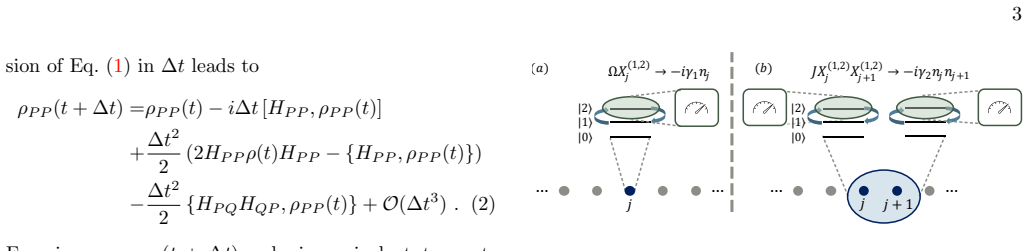
Measurements on a qutrit chain confine its evolution to an effective non-Hermitian Hamiltonian with two-body interactions among pseudo-spins.
A machine-rendered reading of the paper's core claim, the machinery that carries it, and where it could break.
Core claim
Within the Zeno subspace enforced by the measurements, the qutrit dynamics reduces to an effective non-Hermitian Hamiltonian for pseudo-spins 1/2 that supports non-Hermitian two-body interactions with the same connectivity as the full chain; an explicit analytical relation connects the monitored evolution to a desired target non-Hermitian Hamiltonian.
What carries the argument
The Zeno subspace created by projective measurements on the qutrit chain, which reduces the monitored dynamics to an effective non-Hermitian pseudo-spin Hamiltonian.
If this is right
- A broad class of interacting non-Hermitian many-body Hamiltonians becomes realizable in multilevel quantum platforms.
- The effective interactions inherit the spatial connectivity of the original qudit chain.
- The scheme applies directly to experimental systems such as trapped ions and superconducting circuits.
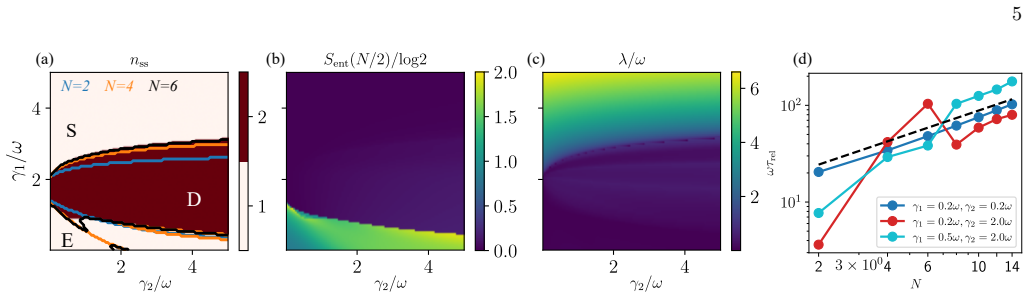
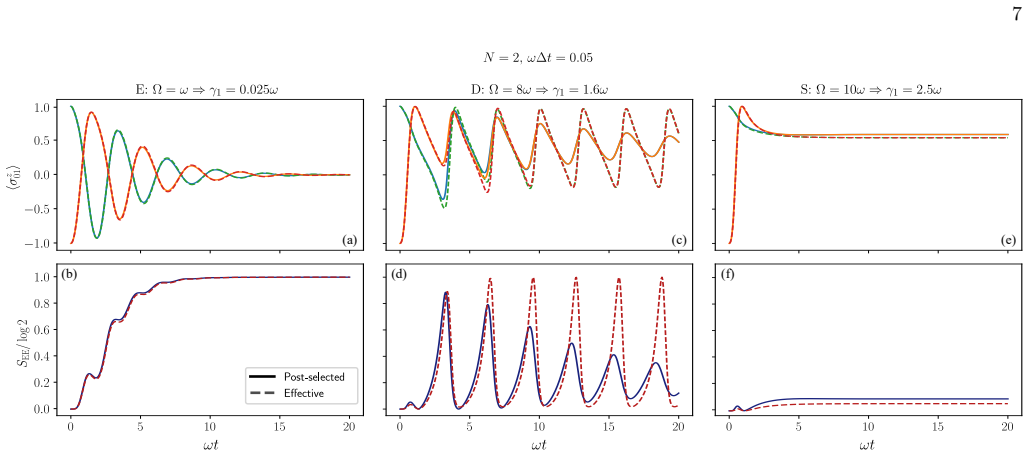
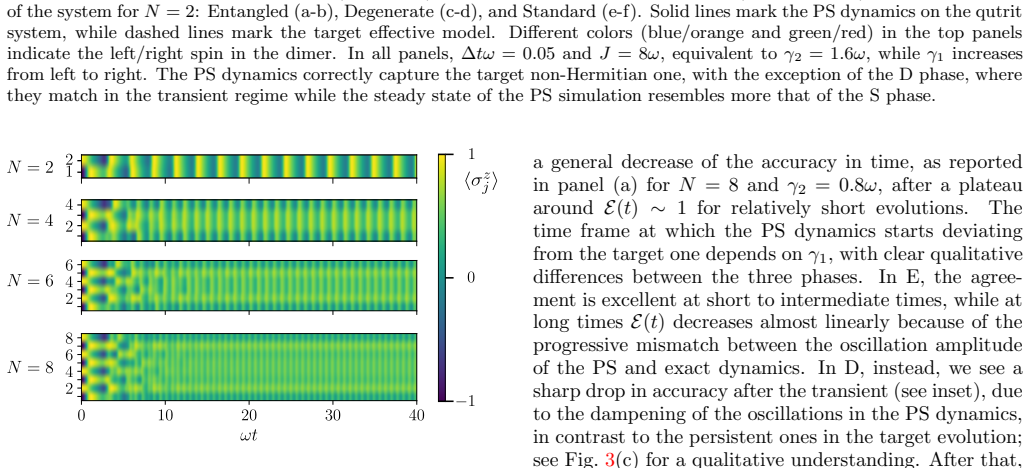
- Numerical checks confirm the effective description for representative models.
Where Pith is reading between the lines
- The same measurement protocol could be tested on small chains to extract effective non-Hermitian spectra or decay rates.
- Extensions to higher-dimensional lattices or longer-range interactions would follow the same Zeno-subspace construction.
- The approach may be combined with existing digital simulation techniques for open quantum systems.
Load-bearing premise
The measurements can be designed and performed so that the system remains confined to the chosen Zeno subspace with negligible leakage.
What would settle it
Numerical or experimental time evolution of the monitored qutrits that deviates from the predicted trajectories of the target non-Hermitian pseudo-spin Hamiltonian under the stated measurement protocol.
Figures
read the original abstract
Non-Hermitian Hamiltonians are a fascinating class of many-body models that describe the effective dynamics of quantum systems interacting with the environment through particle, energy, or information exchange. Although their theoretical framework is well established, the controlled engineering of such Hamiltonians in the context of quantum simulations remains challenging, even more so when the non-Hermitian part describes a $k$-body interaction. Qudit quantum simulators offer a compelling framework to implement such models. We theoretically investigate the dynamics of a one-dimensional chain of qudits undergoing hybrid unitary-projective evolution, where suitably designed measurements constrain the dynamics to a Zeno subspace. As we illustrate for the case of qutrits, within the Zeno subspace the dynamics is governed by an effective non-Hermitian Hamiltonian for an ensemble of pseudo-spins $1/2$, which can inherit non-Hermitian two-body interactions with the same connectivity as the full qutrit chain. We derive an analytical relation linking the monitored qutrits' evolution to a desired target non-Hermitian Hamiltonian and validate the effective description through numerical simulations of a representative model. Our scheme provides a constructive route for the realization of a large class of interacting non-Hermitian many-body Hamiltonians in experimentally relevant multilevel quantum platforms, including trapped ions and superconducting circuits.
Editorial analysis
A structured set of objections, weighed in public.
Referee Report
Summary. The manuscript proposes a scheme to engineer non-Hermitian many-body interactions in digital qudit quantum simulators. It considers a 1D chain of qutrits undergoing hybrid unitary-projective evolution with suitably designed measurements that confine the dynamics to a Zeno subspace. Within this subspace the effective dynamics is shown to be governed by a non-Hermitian Hamiltonian acting on an ensemble of pseudo-spins 1/2 that inherits two-body interactions with the same connectivity as the original qutrit chain. An analytical relation mapping the monitored qutrit evolution to a target non-Hermitian Hamiltonian is derived and validated through numerical simulations of a representative model. The approach is presented as a constructive route for experimental platforms such as trapped ions and superconducting circuits.
Significance. If the central derivation holds, the work supplies a concrete, analytically controlled method for realizing interacting non-Hermitian Hamiltonians that are otherwise difficult to engineer directly. The explicit construction via measurement operators and second-order perturbation within the Zeno subspace, together with direct numerical comparison to the non-Hermitian Schrödinger equation, provides a falsifiable and reproducible protocol that could be implemented on existing multilevel quantum hardware.
minor comments (3)
- [§3] §3 (Zeno-subspace derivation): the second-order perturbative expression for the effective non-Hermitian Hamiltonian is stated without an explicit intermediate step showing the cancellation of first-order terms; adding one line of algebra would improve traceability.
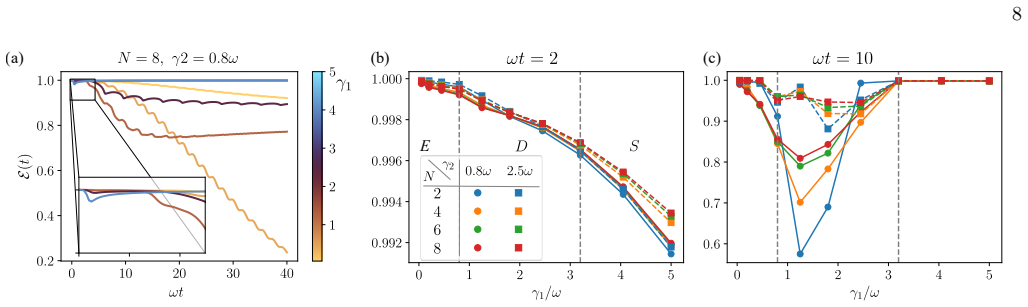
- [Figure 2] Figure 2 caption and associated text: the plotted quantity is described as 'overlap with target evolution' but the precise definition (e.g., whether it is the fidelity of the full state or of the projected pseudo-spin state) is not restated; a brief reminder would aid readers.
- [Numerical validation section] The numerical parameters (measurement strength, time step, system size) used in the representative model are given only in the figure legends; listing them once in the main text would improve reproducibility.
Simulated Author's Rebuttal
We thank the referee for their positive assessment of our work, the supportive significance statement, and the recommendation for minor revision. No specific major comments were provided in the report.
Circularity Check
No significant circularity; derivation self-contained
full rationale
The paper presents an explicit analytical construction mapping monitored qutrit evolution (via measurement operators projecting to a Zeno subspace and second-order perturbation for the effective non-Hermitian Hamiltonian) to a target Hamiltonian, followed by direct numerical comparison of trajectories to the non-Hermitian Schrödinger equation. No quoted equations reduce a claimed prediction or uniqueness result to a fitted input, self-citation chain, or definitional tautology; the central mapping is constructed from the measurement protocol and perturbation theory with independent numerical validation on a representative model. The derivation stands on its own equations and simulations without load-bearing self-referential steps.
Axiom & Free-Parameter Ledger
axioms (1)
- domain assumption Suitably designed measurements constrain the dynamics to a Zeno subspace
Reference graph
Works this paper leans on
-
[1]
Non-Hermitian East model The protocol we described in the main text is not re- stricted to purely dissipative non-Hermitian terms. By carefully combining different coupling terms between the qutrits, one can design more exotic Hamiltonians, such as a non-Hermitian version of the East model [79, 80], de- scribing (non-Hermitian) Rabi oscillations activated...
-
[2]
Non-Hermitian Skin effect As a third example, we consider an effective Hamilto- nian that displays the non-Hermitian skin effect [8, 85]. The simplest setting in which this effect appears is given by free-particle models with a non-reciprocal hopping term, leading to an exponential localization of all eigen- states on the edges of a one-dimensional chain ...
-
[3]
Ashida, Z
Y. Ashida, Z. Gong, and M. Ueda, Non-hermitian physics, Advances in Physics69, 249–435 (2020)
2020
-
[4]
F. Roccati and F. Balducci, Perspective: Interac- tions and nonlinearity in non-hermitian physics (2026), arXiv:2603.13526 [quant-ph]
arXiv 2026
-
[5]
H. Meng, Y. S. Ang, and C. H. Lee, Exceptional points in non-hermitian systems: Applications and recent devel- opments, Applied Physics Letters124, 060502 (2024)
2024
-
[6]
Minganti, A
F. Minganti, A. Miranowicz, R. W. Chhajlany, and F. Nori, Quantum exceptional points of non-hermitian hamiltonians and liouvillians: The effects of quantum jumps, Phys. Rev. A100, 062131 (2019)
2019
-
[7]
L. G. C. Lakkaraju, S. Bandyopadhyay, S. Singho Roy, and P. Hauke, Non-analytic non-hermiticity scores in the xy model with complex anisotropy and magnetic field. in preparation (2026)
2026
-
[8]
Wang and A.-X
Y.-P. Wang and A.-X. Chen, Exploring non-hermitian phase transitions and reentrant localization in one- dimensional doubly-coupled lattices with asymmetric hopping, Phys. Rev. A113, 013726 (2026)
2026
-
[9]
Rosso, A
L. Rosso, A. Biella, J. De Nardis, and L. Mazza, Dy- namical theory for one-dimensional fermions with strong two-body losses: Universal non-hermitian zeno physics and spin-charge separation, Phys. Rev. A107, 013303 (2023)
2023
-
[10]
X. Zhang, T. Zhang, M.-H. Lu, and Y.-F. Chen, A review on non-hermitian skin effect, Advances in Physics: X7, 2109431 (2022), https://doi.org/10.1080/23746149.2022.2109431
-
[11]
J. T. Gohsrich, A. Banerjee, and F. K. Kunst, The non- hermitian skin effect: A perspective, Europhysics Letters 150, 60001 (2025)
2025
-
[12]
E. J. Bergholtz, J. C. Budich, and F. K. Kunst, Ex- ceptional topology of non-hermitian systems, Rev. Mod. Phys.93, 015005 (2021)
2021
-
[13]
Fleckenstein, A
C. Fleckenstein, A. Zorzato, D. Varjas, E. J. Bergholtz, J. H. Bardarson, and A. Tiwari, Non-hermitian topol- ogy in monitored quantum circuits, Phys. Rev. Res.4, L032026 (2022)
2022
-
[14]
H. Jia, J. Hu, R.-Y. Zhang, Y. Xiao, D. Wang, M. Wang, S. Ma, X. Ouyang, Y. Zhu, and C. T. Chan, Uncon- ventional topological edge states in one-dimensional non- hermitian gapless systems stemming from nonisolated hy- persurface singularities, Phys. Rev. Lett.134, 206603 (2025)
2025
-
[15]
L. Xiao, K. Wang, D. Qu, H. Gao, Q. Lin, Z. Bian, X. Zhan, and P. Xue, Non-Hermitian physics in photonic systems, Photonics Insights4, R09 (2025)
2025
-
[16]
C.-X. Guo, L. Su, Y. Wang, L. Li, J. Wang, X. Ruan, Y. Du, D. Zheng, S. Chen, and H. Hu, Scale-tailored lo- calization and its observation in non-hermitian electrical circuits, Nature Communications15, 9120 (2024)
2024
-
[17]
X. Chen, J. Wu, X. Chen, Z. Pu, Y. Hu, J. Lu, M. Ke, W. Deng, and Z. Liu, Implementing non-abelian hatano- nelson model in electric circuits, Physical Review Letters 136, 10.1103/48wx-5gmj (2026)
-
[18]
Y.-J. Wang, J. Zhang, and D.-S. Ding, Non-hermitian physics in the many-body system of rydberg atoms (2026), arXiv:2602.07372 [cond-mat.quant-gas]
arXiv 2026
-
[19]
Y. Luo, N. Liu, and J.-Q. Liang, Quantum phase tran- sition and exceptional points of a non-hermitian hamil- tonian for cold atoms in a dissipative optical cavity with nonlinear atom-photon interactions, Phys. Rev. A110, 063320 (2024)
2024
-
[20]
P. Song, X. Ruan, H. Ding, S. Li, M. Chen, R. Huang, L.- M. Kuang, Q. Zhao, J.-S. Tsai, H. Jing, L. Yang, F. Nori, D. Zheng, Y.-x. Liu, J. Zhang, and Z. Peng, Experimental realization of on-chip few-photon control around excep- tional points, Nature Communications15, 9848 (2024)
2024
-
[21]
Wang, Y.-J
H. Wang, Y.-J. Zhao, and X.-W. Xu, Controllable non- hermitian qubit–qubit coupling in superconducting quan- tum circuit, APL Quantum1, 046125 (2024)
2024
-
[22]
Turkeshi, A
X. Turkeshi, A. Biella, R. Fazio, M. Dalmonte, and M. Schir´ o, Measurement-induced entanglement transi- tions in the quantum ising chain: From infinite to zero clicks, Phys. Rev. B103, 224210 (2021)
2021
-
[23]
Minganti, Fabrizio and Biella, Alberto, Open quantum systems - a brief introduction, Cahiers de l´IPa2, 2 (2026)
2026
-
[24]
Fazio, J
R. Fazio, J. Keeling, L. Mazza, and M. Schir` o, Many- body open quantum systems, SciPost Phys. Lect. Notes , 99 (2025)
2025
-
[25]
T. E. Lee and C.-K. Chan, Heralded magnetism in non-hermitian atomic systems, Phys. Rev. X4, 041001 (2014)
2014
-
[26]
Labouvie, B
R. Labouvie, B. Santra, S. Heun, and H. Ott, Bistability in a driven-dissipative superfluid, Phys. Rev. Lett.116, 235302 (2016)
2016
-
[27]
Morsch and I
O. Morsch and I. Lesanovsky, Dissipative many-body physics of cold rydberg atoms, La Rivista del Nuovo Ci- mento41, 383 (2018)
2018
-
[28]
Sponselee, L
K. Sponselee, L. Freystatzky, B. Abeln, M. Diem, B. Hundt, A. Kochanke, T. Ponath, B. Santra, L. Mathey, K. Sengstock, and C. Becker, Dynamics of ul- tracold quantum gases in the dissipative fermi–hubbard model, Quantum Science and Technology4, 014002 (2018)
2018
-
[29]
W. Cao, X. Lu, X. Meng, J. Sun, H. Shen, and Y. Xiao, Reservoir-mediated quantum correlations in non-hermitian optical system, Phys. Rev. Lett.124, 030401 (2020)
2020
-
[30]
Okuma and Y
N. Okuma and Y. O. Nakagawa, Nonnormal hamilto- nian dynamics in quantum systems and its realization on quantum computers, Phys. Rev. B105, 054304 (2022)
2022
-
[31]
Z. Lin, L. Zhang, X. Long, Y.-a. Fan, Y. Li, K. Tang, J. Li, X. Nie, T. Xin, X.-J. Liu, and D. Lu, Experimental quantum simulation of non-hermitian dynamical topo- logical states using stochastic schr¨ odinger equation, npj Quantum Information8, 77 (2022)
2022
-
[32]
Kamakari, S.-N
H. Kamakari, S.-N. Sun, M. Motta, and A. J. Minnich, Digital quantum simulation of open quantum systems us- ing quantum imaginary–time evolution, PRX Quantum 3, 010320 (2022)
2022
-
[33]
K. T. Geier and P. Hauke, From non-hermitian lin- ear response to dynamical correlations and fluctuation- dissipation relations in quantum many-body systems, PRX Quantum3, 030308 (2022)
2022
-
[34]
H. Liu, X. Yang, K. Tang, L. Che, X. Nie, T. Xin, J. Li, and D. Lu, Practical quantum simulation of small- scale non-hermitian dynamics, Phys. Rev. A107, 062608 (2023)
2023
-
[35]
R. Shen, T. Chen, B. Yang, and C. H. Lee, Observa- 12 tion of the non-hermitian skin effect and fermi skin on a digital quantum computer, Nature Communications16, 1340 (2025)
2025
-
[36]
Das Agarwal, T
K. Das Agarwal, T. K. Konar, L. G. C. Lakkaraju, and A. Sen(De), Recognizing critical lines via entanglement in non-hermitian systems, Phys. Rev. A113, 022201 (2026)
2026
-
[37]
Yamamoto, M
K. Yamamoto, M. Nakagawa, K. Adachi, K. Takasan, M. Ueda, and N. Kawakami, Theory of non-hermitian fermionic superfluidity with a complex-valued interac- tion, Phys. Rev. Lett.123, 123601 (2019)
2019
-
[38]
Fossati, F
M. Fossati, F. Ares, and P. Calabrese, Symmetry-resolved entanglement in critical non-hermitian systems, Phys. Rev. B107, 205153 (2023)
2023
-
[39]
Turkeshi, M
X. Turkeshi, M. Dalmonte, R. Fazio, and M. Schir` o, En- tanglement transitions from stochastic resetting of non- hermitian quasiparticles, Phys. Rev. B105, L241114 (2022)
2022
-
[40]
Biella and M
A. Biella and M. Schir´ o, Many-Body Quantum Zeno Ef- fect and Measurement-Induced Subradiance Transition, Quantum5, 528 (2021)
2021
-
[41]
R. Shen, T. Chen, T. Tai, J. M. Koh, P. Ghaemi, and C. H. Lee, Simulating condensed matter physics on quan- tum hardware (2026), arXiv:2606.02721 [cond-mat.str- el]
Pith/arXiv arXiv 2026
-
[42]
The zeno’s paradox in quantum theory
B. Misra and E. C. G. Sudarshan, The zeno’s paradox in quantum theory, Journal of Mathematical Physics18, 756 (1977), https://doi.org/10.1063/1.523304
-
[43]
A. Peres, Zeno paradox in quantum theory, American Journal of Physics48, 931 (1980), https://doi.org/10.1119/1.12204
-
[44]
W. M. Itano, D. J. Heinzen, J. J. Bollinger, and D. J. Wineland, Quantum zeno effect, Phys. Rev. A41, 2295 (1990)
1990
-
[45]
Facchi, V
P. Facchi, V. Gorini, G. Marmo, S. Pascazio, and E. Su- darshan, Quantum zeno dynamics, Physics Letters A 275, 12 (2000)
2000
-
[46]
Facchi, H
P. Facchi, H. Nakazato, and S. Pascazio, From the quan- tum zeno to the inverse quantum zeno effect, Phys. Rev. Lett.86, 2699 (2001)
2001
-
[47]
Facchi and S
P. Facchi and S. Pascazio, Quantum zeno subspaces, Phys. Rev. Lett.89, 080401 (2002)
2002
-
[48]
Signoles, A
A. Signoles, A. Facon, D. Grosso, I. Dotsenko, S. Haroche, J.-M. Raimond, M. Brune, and S. Gleyzes, Confined quantum zeno dynamics of a watched atomic arrow, Nature Physics10, 715 (2014)
2014
-
[49]
Snizhko, P
K. Snizhko, P. Kumar, and A. Romito, Quantum zeno effect appears in stages, Phys. Rev. Research2, 033512 (2020)
2020
-
[50]
Y. Wang, Z. Hu, B. C. Sanders, and S. Kais, Qudits and high-dimensional quantum computing, Frontiers in Physics8, 10.3389/fphy.2020.589504 (2020)
-
[51]
P. J. Barge, Q. Cao, N. H¨ ornedal, A. Chenu, and K. W. Murch, Measurement and control of the complex berry phase in a quantum system (2026), arXiv:2605.16559 [quant-ph]
Pith/arXiv arXiv 2026
-
[52]
P. J. Low, B. M. White, A. A. Cox, M. L. Day, and C. Senko, Practical trapped-ion protocols for univer- sal qudit-based quantum computing, Phys. Rev. Res.2, 033128 (2020)
2020
-
[53]
Y. Chi, J. Huang, Z. Zhang, J. Mao, Z. Zhou, X. Chen, C. Zhai, J. Bao, T. Dai, H. Yuan, M. Zhang, D. Dai, B. Tang, Y. Yang, Z. Li, Y. Ding, L. K. Oxenløwe, M. G. Thompson, J. L. O’Brien, Y. Li, Q. Gong, and J. Wang, A programmable qudit-based quantum processor, Nature Communications13, 1166 (2022)
2022
-
[54]
Ringbauer, M
M. Ringbauer, M. Meth, L. Postler, R. Stricker, R. Blatt, P. Schindler, and T. Monz, A universal qudit quan- tum processor with trapped ions, Nature Physics18, 1053–1057 (2022)
2022
-
[55]
P. Liu, R. Wang, J.-N. Zhang, Y. Zhang, X. Cai, H. Xu, Z. Li, J. Han, X. Li, G. Xue, W. Liu, L. You, Y. Jin, and H. Yu, Performing SU(d) operations and rudimentary al- gorithms in a superconducting transmon qudit ford= 3 andd= 4, Phys. Rev. X13, 021028 (2023)
2023
-
[56]
Fischer, A
L. Fischer, A. Chiesa, F. Tacchino, D. Egger, S. Car- retta, and I. Tavernelli, Universal qudit gate synthesis for transmons, PRX Quantum4(2023)
2023
-
[57]
Burshtein, S
A. Burshtein, S. Fraenkel, M. Goldstein, and R. Finkel- stein, Robust control and entanglement of qudits in neu- tral atom arrays, Phys. Rev. Res.8, 013055 (2026)
2026
-
[58]
P. Hrmo, B. Wilhelm, L. Gerster, M. W. van Mourik, M. Huber, R. Blatt, P. Schindler, T. Monz, and M. Ring- bauer, Native qudit entanglement in a trapped ion quan- tum processor, Nature Communications14, 2242 (2023)
2023
-
[59]
P. W. Shor, Scheme for reducing decoherence in quantum computer memory, Phys. Rev. A52, R2493(R) (1995)
1995
-
[60]
A. M. Steane, Error correcting codes in quantum theory, Phys. Rev. Lett.77, 793 (1996)
1996
-
[61]
Z. Cai, R. Babbush, S. C. Benjamin, S. Endo, W. J. Hug- gins, Y. Li, J. R. McClean, and T. E. O’Brien, Quantum error mitigation, Rev. Mod. Phys.95, 045005 (2023)
2023
-
[62]
Ballini, J
E. Ballini, J. Mildenberger, M. M. Wauters, and P. Hauke, Symmetry verification for noisy quantum sim- ulations of non-Abelian lattice gauge theories, Quantum 9, 1802 (2025)
2025
-
[63]
Raussendorf and H
R. Raussendorf and H. J. Briegel, A one-way quantum computer, Physical Review Letters86, 5188 (2001)
2001
-
[64]
Y. Li, X. Chen, and M. P. A. Fisher, Quantum zeno ef- fect and the many-body entanglement transition, Physi- cal Review B98, 205136 (2018)
2018
-
[65]
Skinner, J
B. Skinner, J. Ruhman, and A. Nahum, Measurement- induced phase transitions in the dynamics of entangle- ment, Phys. Rev. X9, 031009 (2019)
2019
-
[66]
C. Noel, P. Niroula, D. Zhu, A. Risinger, L. Egan, D. Biswas, M. Cetina, A. V. Gorshkov, M. J. Gullans, D. A. Huse, and C. Monroe, Measurement-induced quan- tum phases realized in a trapped-ion quantum computer, Nature Physics18, 760 (2022)
2022
-
[67]
Rudinger, G
K. Rudinger, G. J. Ribeill, L. C. Govia, M. Ware, E. Nielsen, K. Young, T. A. Ohki, R. Blume-Kohout, and T. Proctor, Characterizing midcircuit measurements on a superconducting qubit using gate set tomography, Phys. Rev. Appl.17, 014014 (2022)
2022
-
[68]
Deist, Y.-H
E. Deist, Y.-H. Lu, J. Ho, M. K. Pasha, J. Zeiher, Z. Yan, and D. M. Stamper-Kurn, Mid-circuit cavity measure- ment in a neutral atom array, Phys. Rev. Lett.129, 203602 (2022)
2022
-
[69]
J. M. Koh, S.-N. Sun, M. Motta, and A. J. Minnich, Measurement-induced entanglement phase transition on a superconducting quantum processor with mid-circuit readout, Nature Physics19, 1314 (2023)
2023
-
[70]
T. M. Graham, L. Phuttitarn, R. Chinnarasu, Y. Song, C. Poole, K. Jooya, J. Scott, A. Scott, P. Eichler, and M. Saffman, Midcircuit measurements on a single-species neutral alkali atom quantum processor, Phys. Rev. X13, 041051 (2023)
2023
-
[71]
Y. Yu, K. Yan, D. Biswas, V. N. Zhang, B. Harraz, C. Noel, C. Monroe, and A. Kozhanov, In situ mid- 13 circuit qubit measurement and reset in a single-species trapped-ion quantum computing system, Phys. Rev. Res. 7, 043355 (2025)
2025
-
[72]
Y. Chi, C. Pan, X. Lu, Y. Zhu, and F. Wang, Experi- mental qudit-assisted quantum operations by dimension expansion and partial measurement, APL Photonics11, 056108 (2026)
2026
-
[73]
Facchi and S
P. Facchi and S. Pascazio, Quantum zeno dynamics: mathematical and physical aspects, Journal of Physics A: Mathematical and Theoretical41, 493001 (2008)
2008
-
[74]
Iemini, A
F. Iemini, A. Russomanno, J. Keeling, M. Schir` o, M. Dal- monte, and R. Fazio, Boundary time crystals, Phys. Rev. Lett.121, 035301 (2018)
2018
-
[75]
O. V. Zhirov and D. L. Shepelyansky, Quantum synchro- nization, The European Physical Journal D - Atomic, Molecular, Optical and Plasma Physics38, 375 (2006)
2006
-
[76]
Schmolke and E
F. Schmolke and E. Lutz, Noise-induced quantum syn- chronization, Phys. Rev. Lett.129, 250601 (2022)
2022
-
[77]
Stannigel, P
K. Stannigel, P. Hauke, D. Marcos, M. Hafezi, S. Diehl, M. Dalmonte, and P. Zoller, Constrained dynamics via the zeno effect in quantum simulation: Implementing non-abelian lattice gauge theories with cold atoms, Phys. Rev. Lett.112, 120406 (2014)
2014
-
[78]
M. M. Wauters, E. Ballini, A. Biella, and P. Hauke, Symmetry-protection zeno phase transition in monitored lattice gauge theories, Phys. Rev. B111, 094315 (2025)
2025
- [79]
-
[80]
Sørensen and K
A. Sørensen and K. Mølmer, Entanglement and quantum computation with ions in thermal motion, Phys. Rev. A 62, 022311 (2000)
2000
discussion (0)
Sign in with ORCID, Apple, or X to comment. Anyone can read and Pith papers without signing in.