Critical collapse of vacuum spacetimes: Nakamura wave initial data
Pith reviewed 2026-06-29 01:46 UTC · model grok-4.3
The pith
Simulations of critical collapse in vacuum gravitational waves find only approximate discrete self-similarity.
A machine-rendered reading of the paper's core claim, the machinery that carries it, and where it could break.
Core claim
Adopting Nakamura wave initial data allows fine-tuning to the onset of black hole formation slightly better than before, making one more echo visible in the approximately self-similar threshold solution. The self-similarity remains inexact, no unique critical solution appears, and alternating maxima in the polar and equatorial directions recur across different threshold solutions.
What carries the argument
Nakamura wave initial data, which encode the gravitational wave content in the extrinsic curvature and are adjusted to satisfy the nonlinear Einstein constraints.
If this is right
- Threshold solutions exhibit approximate discrete self-similarity.
- The self-similarity is not exact.
- No evidence supports the existence of a unique critical solution.
- Different threshold solutions share the feature of alternating maxima toward the poles and the equator.
Where Pith is reading between the lines
- The degree of self-similarity may depend on the specific family of initial data chosen.
- Further improvements in resolution could test whether the observed deviations from exact self-similarity remain stable.
- Recurring features across families point to some aspects of the critical approach that are independent of the initial data construction.
Load-bearing premise
The numerical resolution, gauge choices, and evolution methods suffice to distinguish approximate from exact discrete self-similarity without introducing mimicking artifacts.
What would settle it
A higher-resolution simulation or different gauge choice that produces exact discrete self-similarity together with a unique critical solution would contradict the reported observations.
Figures
read the original abstract
We report on numerical simulations of critical phenomena in the collapse of axisymmetric vacuum gravitational waves, adopting families of initial data that, to the best of our knowledge, have not been used in this context before. Like Teukolsky waves, the data are based on linear wave solutions to the Einstein equations. We follow Nakamura's construction and encode the wave content in the extrinsic curvature rather than the spatial curvature, which leads to several simplifications when the data are "dressed up" so that they satisfy the nonlinear constraint equations. We are able to fine-tune these data to the onset of black hole formation slightly better than in our previous simulations, allowing us to observe and examine one more echo in the approximately self-similar threshold solution. Our findings are consistent with earlier studies: while we find threshold solutions that are approximately discretely self-similar, the self-similarity is not exact, and we find no evidence for a unique critical solution. We discuss common features between the different threshold solutions, including the appearance of alternating maxima in the direction of the poles and the equator.
Editorial analysis
A structured set of objections, weighed in public.
Referee Report
Summary. The manuscript reports numerical simulations of critical collapse for axisymmetric vacuum gravitational waves using a new family of initial data based on Nakamura's construction, in which the wave content is encoded in the extrinsic curvature. The authors achieve slightly improved fine-tuning to the black-hole formation threshold relative to prior work, permitting observation of one additional echo. They conclude that the resulting threshold solutions are approximately but not exactly discretely self-similar, exhibit no evidence for a unique critical solution, and display common features such as alternating maxima along the poles and equator; these findings are stated to be consistent with earlier studies that used Teukolsky-wave data.
Significance. If the reported numerical observations hold, the work supplies an independent cross-check on the approximate discrete self-similarity of vacuum critical solutions using a distinct initial-data construction that simplifies the constraint-solving step. The modest advance in fine-tuning (one extra echo) is a concrete technical contribution that strengthens the empirical case against exact self-similarity and uniqueness. The manuscript also supplies the expected details on initial-data construction, constraint solving, evolution, and standard convergence checks, so the stress-test concern about numerical resolution and gauge artifacts does not appear to land.
minor comments (3)
- The abstract states consistency with prior results and improved tuning but supplies no details on numerical methods, convergence tests, or error estimates; a single sentence summarizing these aspects would improve readability for readers who consult only the abstract.
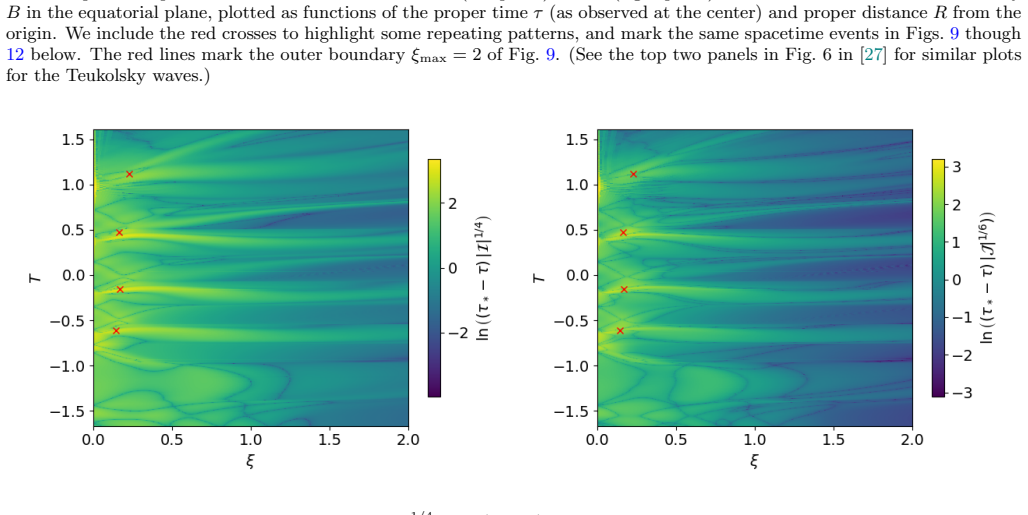
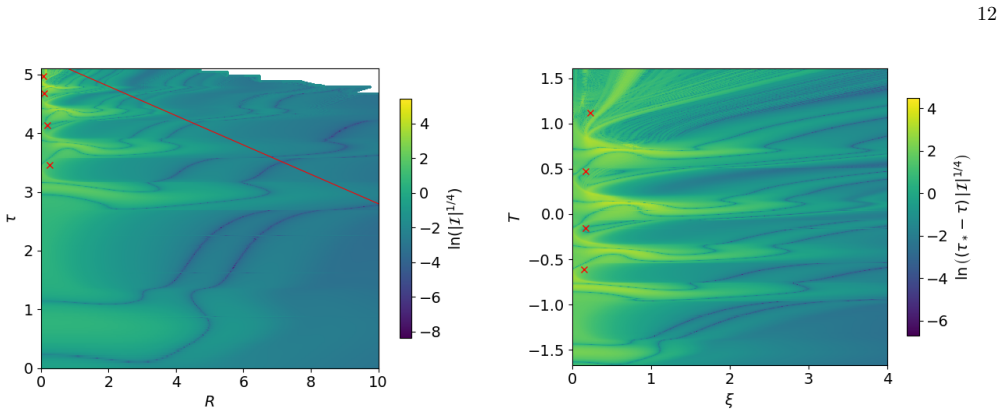
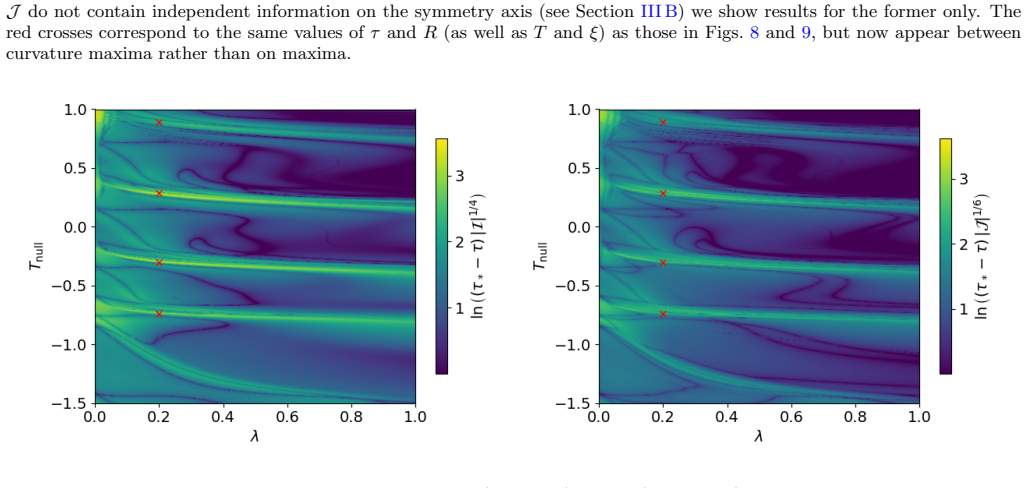
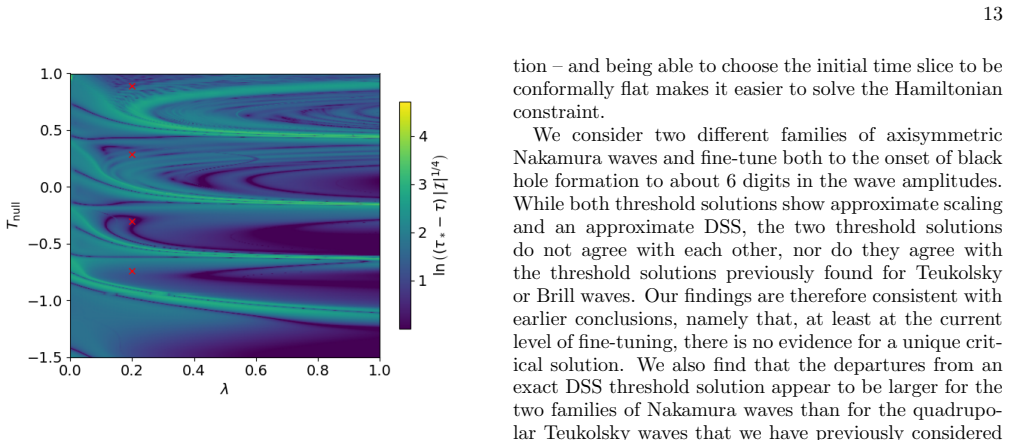
- Figure captions and axis labels should explicitly state the grid resolution and the number of echoes shown so that the visual evidence for approximate (but not exact) discrete self-similarity can be assessed without returning to the text.
- A short table or paragraph comparing the achieved fine-tuning parameter value and the number of observed echoes with the corresponding quantities from the authors' previous Teukolsky-wave runs would make the claimed improvement quantitative.
Simulated Author's Rebuttal
We thank the referee for their positive assessment of our manuscript and for recommending minor revision. The report raises no specific major comments, so we have nothing to address point by point. We are pleased that the work is recognized as supplying an independent cross-check on approximate discrete self-similarity using a distinct initial-data family.
Circularity Check
No significant circularity
full rationale
This is a numerical relativity study that constructs initial data from linear wave solutions (Nakamura waves encoded in extrinsic curvature), solves constraints, evolves the system with standard methods, and reports observations of approximate discrete self-similarity in threshold solutions. The central claims rest on direct simulation output and comparison to prior literature rather than any derivation that reduces a result to its own fitted inputs or self-citations by construction. No equations or steps exhibit self-definitional, fitted-prediction, or uniqueness-imported circularity; the work is self-contained against external benchmarks.
Axiom & Free-Parameter Ledger
free parameters (1)
- Wave amplitude tuning parameter
axioms (2)
- standard math Vacuum Einstein equations govern the spacetime evolution
- domain assumption Axial symmetry of the spacetime
Reference graph
Works this paper leans on
-
[1]
for scalar fields. Given these observations, it became generally expected that the properties of critical collapse in spherical symmetry – in particular the existence of a unique self-similar critical solution with an associated unique critical exponent – should continue to hold even in the absence of spherical symmetry. As we will discuss in more detail ...
Pith/arXiv arXiv 2026
-
[2]
dressed up
but are then “dressed up” to satisfy the non-linear constraint equations (see Section II A below). The lat- ter step typically involves inverting curved and non-linear Laplace operators, which can be complicated (see also the discussion in [29, 34]). Many authors therefore adopted Brill wave initial data [35] instead, which entails solving a flat and line...
-
[3]
off-centered
for details). We chose the seed functionFto be a linear combination ofF + andF − so that the time deriva- tive of the combination vanishes att= 0, meaning that the initial slice represents a moment of time symmetry. 1 We use a hat to distinguish this choice of conformal rescaling, which is commonly adopted in the context of the initial value problem, from...
-
[4]
Here we focus on axisymmetric solutions and therefore construct new solutions form= 0
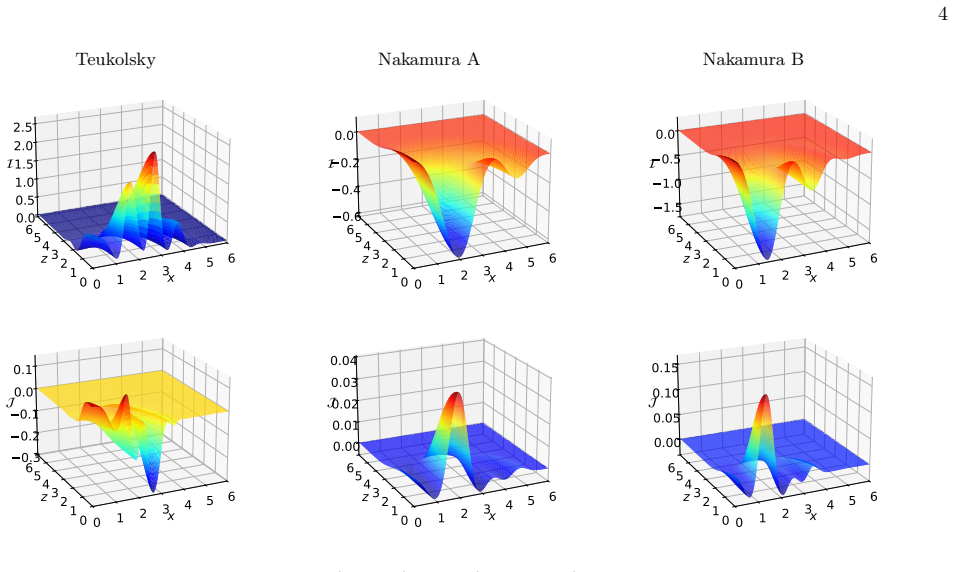
Family A Explicit solutions for ˆANak ij are provided in [36, 37] for quadrupolar waves (ℓ= 2) withm= 2. Here we focus on axisymmetric solutions and therefore construct new solutions form= 0. Adopting seed functions similar to 5 those of [36, 37], P20 =A 4π 5 1/2 ∂ ∂t exp −(r−t) 2/2 (6a) Q20 =−A 4π 5 1/2 ∂ ∂t exp −(r+t) 2/2 ,(6b) whereAis the amplitude, w...
-
[5]
Family B We build a second family of quadrupolar waves from the functions (compare [36, 37]) P20 =A 4π 5 1/2 ∂ ∂t (r−t) 2 + 1 exp −(r−t) 2/2 (8a) Q20 =−A 4π 5 1/2 ∂ ∂t (r+t) 2 −1 exp −(r+t) 2/2 ,(8b) in which case the extrinsic curvature becomes ˆANak rr =Ae −r2/2(5−r 2)(1−3 cos 2 θ) (9a) ˆANak rθ =Ae −r2/2r(15−10r 2 +r 4) sinθcosθ(9b) ˆANak rφ = 0 (9c) ˆ...
arXiv 2022
-
[6]
M. W. Choptuik, Universality and scaling in gravita- tional collapse of a massless scalar field, Phys. Rev. Lett. 70, 9 (1993)
1993
-
[7]
D. Garfinkle and G. C. Duncan, Scaling of curvature in subcritical gravitational collapse, Phys. Rev. D58, 064024 (1998), arXiv:gr-qc/9802061 [gr-qc]
Pith/arXiv arXiv 1998
-
[8]
T. Koike, T. Hara, and S. Adachi, Critical Behavior in Gravitational Collapse of Radiation Fluid: A Renormal- ization Group (Linear Perturbation) Analysis, Phys. Rev. Lett.74, 5170 (1995), arXiv:gr-qc/9503007 [gr-qc]
Pith/arXiv arXiv 1995
-
[9]
D. Maison, Non-universality of critical behaviour in spherically symmetric gravitational collapse, Physics Let- ters B366, 82 (1996), arXiv:gr-qc/9504008 [gr-qc]
Pith/arXiv arXiv 1996
-
[10]
C. R. Evans and J. S. Coleman, Critical phenomena and self-similarity in the gravitational collapse of radi- ation fluid, Phys. Rev. Lett.72, 1782 (1994), arXiv:gr- qc/9402041 [gr-qc]
arXiv 1994
- [11]
-
[12]
Gundlach, Understanding critical collapse of a scalar field, Phys
C. Gundlach, Understanding critical collapse of a scalar field, Phys. Rev. D , 695 (1997), arXiv:gr-qc/9604019 [gr- qc]
Pith/arXiv arXiv 1997
-
[13]
C. Gundlach, D. Hilditch, and J. M. Mart´ ın-Garc´ ıa, Crit- ical Phenomena in Gravitational Collapse, arXiv e-prints , arXiv:2507.07636 (2025), arXiv:2507.07636 [gr-qc]. 4 As in Sect. II A we adopt the notation and convention of [38] here, so that some expressions differ from those of [33] by constant factors
arXiv 2025
-
[14]
A. M. Abrahams and C. R. Evans, Critical behavior and scaling in vacuum axisymmetric gravitational collapse, Phys. Rev. Lett.70, 2980 (1993)
1993
-
[15]
A. M. Abrahams and C. R. Evans, Universality in ax- isymmetric vacuum collapse, Phys. Rev. D49, 3998 (1994)
1994
-
[16]
M. W. Choptuik, E. W. Hirschmann, S. L. Liebling, and F. Pretorius, Critical collapse of the massless scalar field in axisymmetry, Phys. Rev. D68, 044007 (2003), arXiv:gr-qc/0305003 [gr-qc]
Pith/arXiv arXiv 2003
-
[17]
T. W. Baumgarte, Aspherical deformations of the Choptuik spacetime, Phys. Rev. D98, 084012 (2018), arXiv:1807.10342 [gr-qc]
Pith/arXiv arXiv 2018
-
[18]
K. Marouda, D. Cors, H. R. R¨ uter, F. Atteneder, and D. Hilditch, Twist-free axisymmetric critical collapse of a complex scalar field, Phys. Rev. D109, 124042 (2024), arXiv:2402.06724 [gr-qc]
arXiv 2024
-
[19]
C. Gundlach, T. W. Baumgarte, and D. Hilditch, Sim- ulations of gravitational collapse in null coordinates. II. Critical collapse of an axisymmetric scalar field, Phys. Rev. D110, 024019 (2024), arXiv:2404.15839 [gr-qc]
arXiv 2024
-
[20]
T. W. Baumgarte, C. Gundlach, and D. Hilditch, Criti- cal Phenomena in the Gravitational Collapse of Electro- magnetic Waves, Phys. Rev. Lett.123, 171103 (2019), arXiv:1909.00850 [gr-qc]
arXiv 2019
-
[21]
M. F. Perez Mendoza and T. W. Baumgarte, Critical phenomena in the gravitational collapse of electromag- netic dipole and quadrupole waves, Phys. Rev. D103, 124048 (2021), arXiv:2104.03980 [gr-qc]
arXiv 2021
-
[22]
G. D. Reid and M. W. Choptuik, Universality in the crit- ical collapse of the Einstein-Maxwell system, Phys. Rev. 15 D108, 104021 (2023), arXiv:2308.03943 [gr-qc]
arXiv 2023
-
[23]
M. Alcubierre, G. Allen, B. Br¨ ugmann, G. Lanfermann, E. Seidel, W.-M. Suen, and M. Tobias, Gravitational col- lapse of gravitational waves in 3D numerical relativity, Phys. Rev. D61, 041501 (2000), arXiv:gr-qc/9904013 [gr-qc]
Pith/arXiv arXiv 2000
-
[24]
D. Garfinkle and G. C. Duncan, Numerical evolution of Brill waves, Phys. Rev. D63, 044011 (2001), arXiv:gr- qc/0006073 [gr-qc]
arXiv 2001
-
[25]
O. Rinne, Constrained evolution in axisymmetry and the gravitational collapse of prolate Brill waves, Classical and Quantum Gravity25, 135009 (2008), arXiv:0802.3791 [gr-qc]
Pith/arXiv arXiv 2008
-
[26]
E. Sorkin, On critical collapse of gravitational waves, Classical and Quantum Gravity28, 025011 (2011), arXiv:1008.3319 [gr-qc]
Pith/arXiv arXiv 2011
-
[27]
D. Hilditch, T. W. Baumgarte, A. Weyhausen, T. Di- etrich, B. Br¨ ugmann, P. J. Montero, and E. M¨ uller, Collapse of nonlinear gravitational waves in moving- puncture coordinates, Phys. Rev. D88, 103009 (2013), arXiv:1309.5008 [gr-qc]
Pith/arXiv arXiv 2013
-
[28]
C. Bona, J. Mass´ o, E. Seidel, and J. Stela, New Formal- ism for Numerical Relativity, Phys. Rev. Lett.75, 600 (1995), arXiv:gr-qc/9412071 [gr-qc]
Pith/arXiv arXiv 1995
-
[29]
Alcubierre, Appearance of coordinate shocks in hy- perbolic formalisms of general relativity, Phys
M. Alcubierre, Appearance of coordinate shocks in hy- perbolic formalisms of general relativity, Phys. Rev. D 55, 5981 (1997), arXiv:gr-qc/9609015 [gr-qc]
Pith/arXiv arXiv 1997
-
[30]
M. Alcubierre and J. Mass´ o, Pathologies of hyperbolic gauges in general relativity and other field theories, Phys. Rev. D57, R4511 (1998), arXiv:gr-qc/9709024 [gr-qc]
Pith/arXiv arXiv 1998
-
[31]
M. Alcubierre, Are gauge shocks really shocks?, Clas- sical and Quantum Gravity22, 4071 (2005), arXiv:gr- qc/0503030 [gr-qc]
arXiv 2005
-
[32]
T. W. Baumgarte, C. Gundlach, and D. Hilditch, Critical phenomena in the collapse of quadrupolar and hexade- capolar gravitational waves, Phys. Rev. D107, 084012 (2023), arXiv:2303.05530 [gr-qc]
arXiv 2023
-
[33]
A. Khirnov and T. Ledvinka, Slicing conditions for axisymmetric gravitational collapse of Brill waves, Classical and Quantum Gravity35, 215003 (2018), arXiv:1908.06034 [gr-qc]
arXiv 2018
-
[34]
T. Ledvinka and A. Khirnov, Universality of Curvature Invariants in Critical Vacuum Gravitational Collapse, Phys. Rev. Lett.127, 011104 (2021), arXiv:2102.09579 [gr-qc]
arXiv 2021
-
[35]
Su´ arez Fern´ andez, S
I. Su´ arez Fern´ andez, S. Renkhoff, D. Cors Agull´ o, B. Br¨ ugmann, and D. Hilditch, Evolution of Brill waves with an adaptive pseudospectral method, Phys. Rev. D 106, 024036 (2022)
2022
-
[36]
M. Alcubierre, Hyperbolic slicings of spacetime: singular- ity avoidance and gauge shocks, Classical and Quantum Gravity20, 607 (2003), arXiv:gr-qc/0210050 [gr-qc]
Pith/arXiv arXiv 2003
-
[37]
T. W. Baumgarte, B. Br¨ ugmann, D. Cors, C. Gund- lach, D. Hilditch, A. Khirnov, T. Ledvinka, S. Renkhoff, and I. S. Fern´ andez, Critical Phenomena in the Collapse of Gravitational Waves, Phys. Rev. Lett.131, 181401 (2023), arXiv:2305.17171 [gr-qc]
arXiv 2023
-
[38]
S. A. Teukolsky, Linearized quadrupole waves in general relativity and the motion of test particles, Phys. Rev. D 26, 745 (1982)
1982
-
[39]
Rostworowski, Vacuum axisymmetric gravitational collapse revisited: Preliminary investigation, Phys
A. Rostworowski, Vacuum axisymmetric gravitational collapse revisited: Preliminary investigation, Phys. Rev. D111, 104067 (2025), arXiv:2503.17549 [gr-qc]
arXiv 2025
-
[40]
D. R. Brill, On the positive definite mass of the Bondi- Weber-Wheeler time-symmetric gravitational waves, An- nals of Physics7, 466 (1959)
1959
-
[41]
T. Nakamura, General Solutions to the Linearized Ein- stein Equations and Initial Data for Three Dimensional Time Evolution of Pure Gravitational Waves, Progress of Theoretical Physics72, 746 (1984)
1984
-
[42]
Shibata and T
M. Shibata and T. Nakamura, Evolution of three- dimensional gravitational waves: Harmonic slicing case, Phys. Rev. D52, 5428 (1995)
1995
-
[43]
Rinne, Explicit solution of the linearized Einstein equations in TT gauge for all multipoles, Classical and Quantum Gravity29, 048003 (2009)
O. Rinne, Explicit solution of the linearized Einstein equations in TT gauge for all multipoles, Classical and Quantum Gravity29, 048003 (2009)
2009
-
[44]
T. W. Baumgarte and S. L. Shapiro, Numerical inte- gration of Einstein’s field equations, Phys. Rev. D59, 024007 (1998), arXiv:gr-qc/9810065 [gr-qc]
Pith/arXiv arXiv 1998
-
[45]
T. W. Baumgarte, P. J. Montero, I. Cordero-Carri´ on, and E. M¨ uller, Numerical relativity in spherical polar co- ordinates: Evolution calculations with the BSSN formu- lation, Phys. Rev. D87, 044026 (2013), arXiv:1211.6632 [gr-qc]
Pith/arXiv arXiv 2013
-
[46]
Nakamura, K
T. Nakamura, K. Oohara, and Y. Kojima, General Rela- tivistic Collapse to Black Holes and Gravitational Waves from Black Holes, Progress of Theoretical Physics Sup- plement90, 1 (1987)
1987
-
[47]
J. D. Brown, Covariant formulations of Baumgarte, Shapiro, Shibata, and Nakamura and the standard gauge, Phys. Rev. D79, 104029 (2009), arXiv:0902.3652 [gr-qc]
Pith/arXiv arXiv 2009
-
[48]
Gourgoulhon,3+1 Formalism in General Relativity, Vol
E. Gourgoulhon,3+1 Formalism in General Relativity, Vol. 846 (Springer, 2012)
2012
-
[49]
I. Ruchlin, Z. B. Etienne, and T. W. Baumgarte, SENR /NRPy+: Numerical relativity in singular curvilinear coordinate systems, Phys. Rev. D97, 064036 (2018), arXiv:1712.07658 [gr-qc]
Pith/arXiv arXiv 2018
-
[50]
T. W. Baumgarte and D. Hilditch, Shock-avoiding slicing conditions: Tests and calibrations, Phys. Rev. D106, 044014 (2022), arXiv:2207.06376 [gr-qc]
arXiv 2022
-
[51]
R. Beig, P. T. Chru´ sciel, and W. Cong, Who’s afraid of a negative lapse?, arXiv e-prints , arXiv:2505.03516 (2025), arXiv:2505.03516 [gr-qc]
arXiv 2025
-
[52]
Stephani, D
H. Stephani, D. Kramer, M. MacCallum, C. Hoenselaers, and E. Herlt,Exact solutions of Einstein’s field equations (Cambridge University Press, 2003)
2003
discussion (0)
Sign in with ORCID, Apple, or X to comment. Anyone can read and Pith papers without signing in.