The Dynamical Origin of Millimetre-Sized Sporadic Meteoroids
Pith reviewed 2026-06-29 01:20 UTC · model grok-4.3
The pith
Meteoroids below 17 km/s impacting Earth are mostly asteroidal when released within the last 200,000 years.
A machine-rendered reading of the paper's core claim, the machinery that carries it, and where it could break.
Core claim
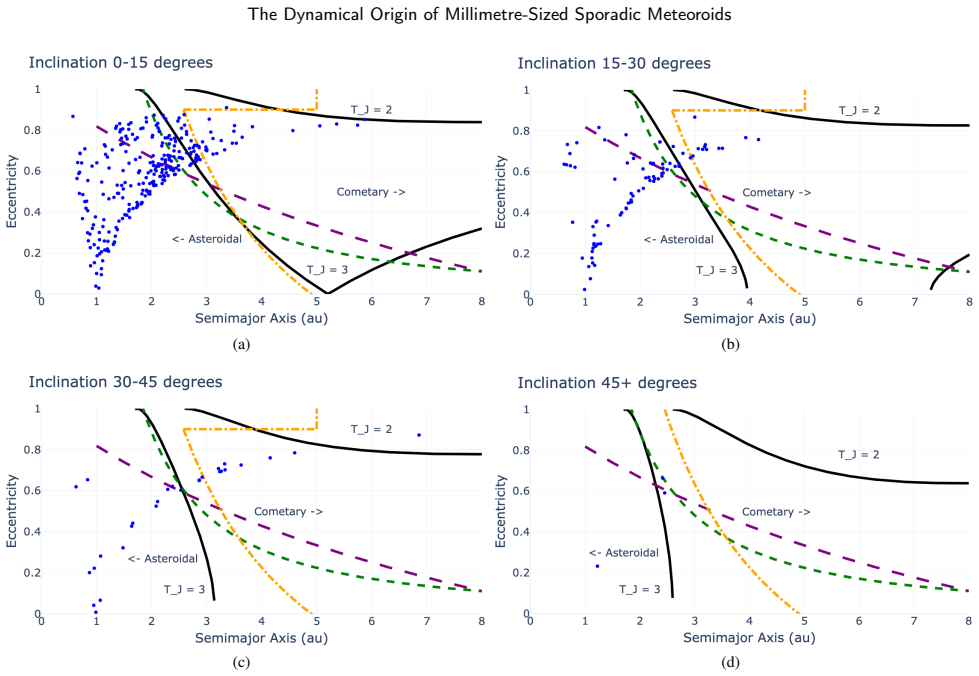
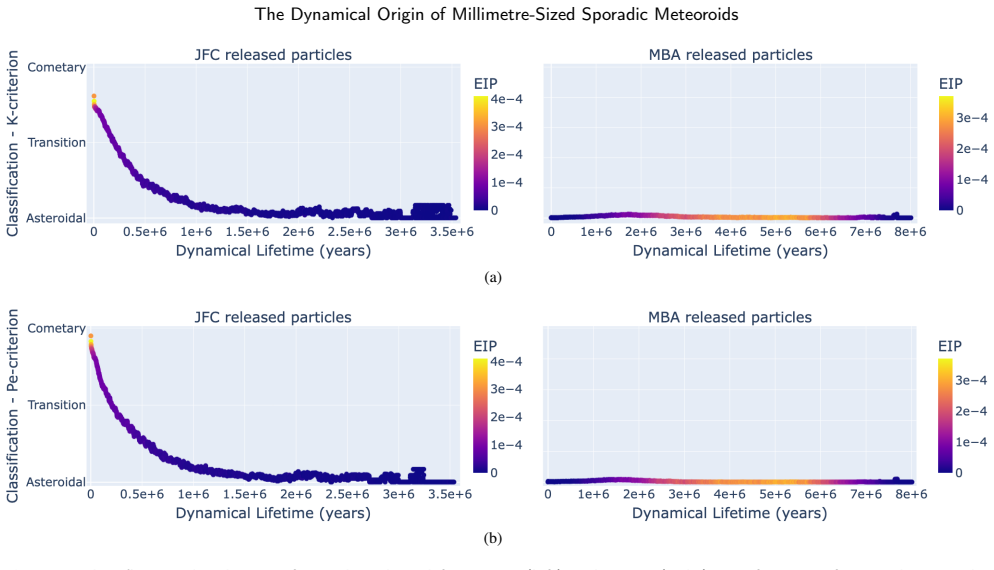
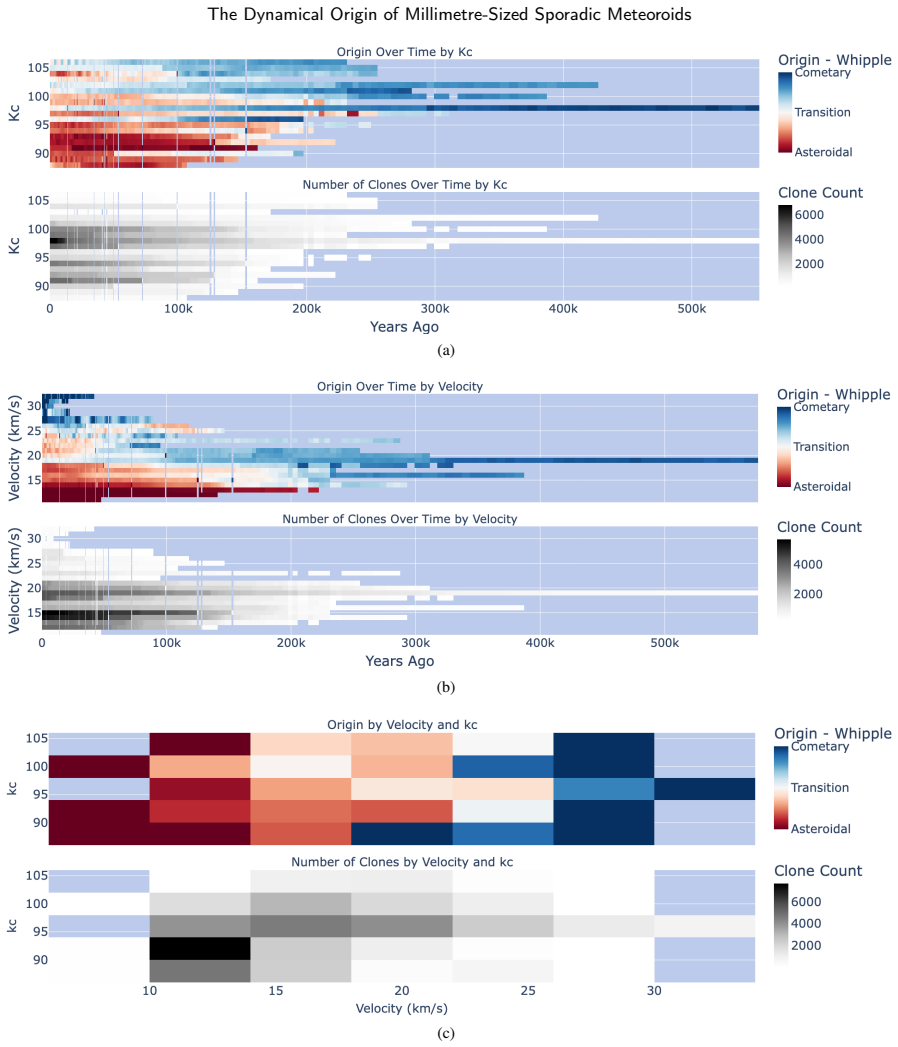
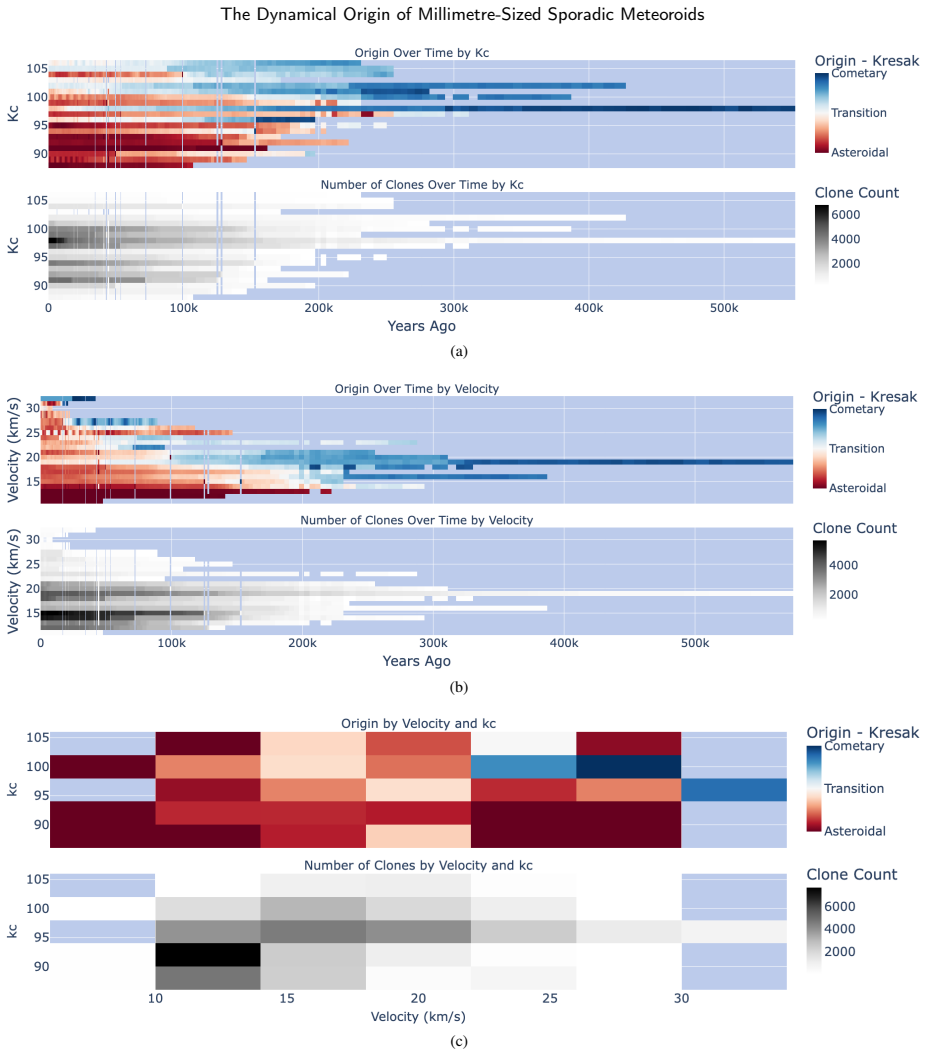
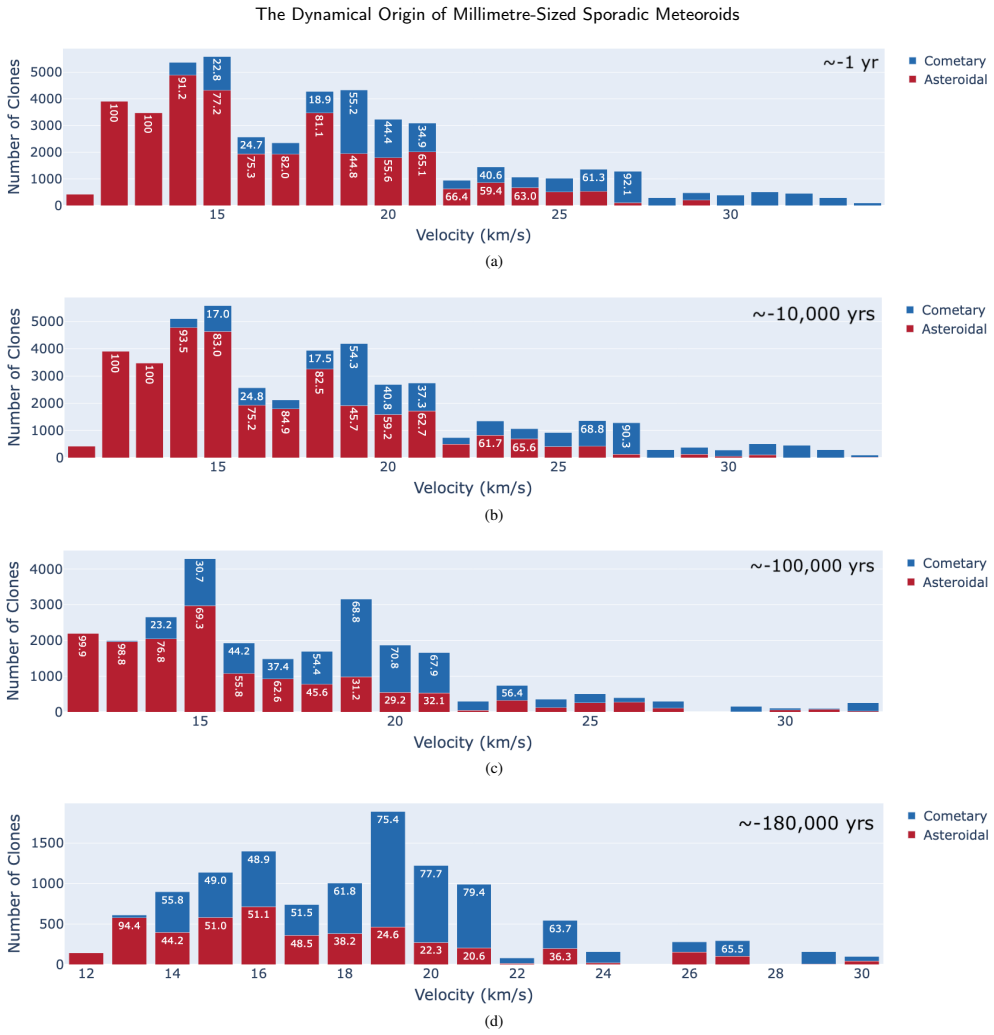
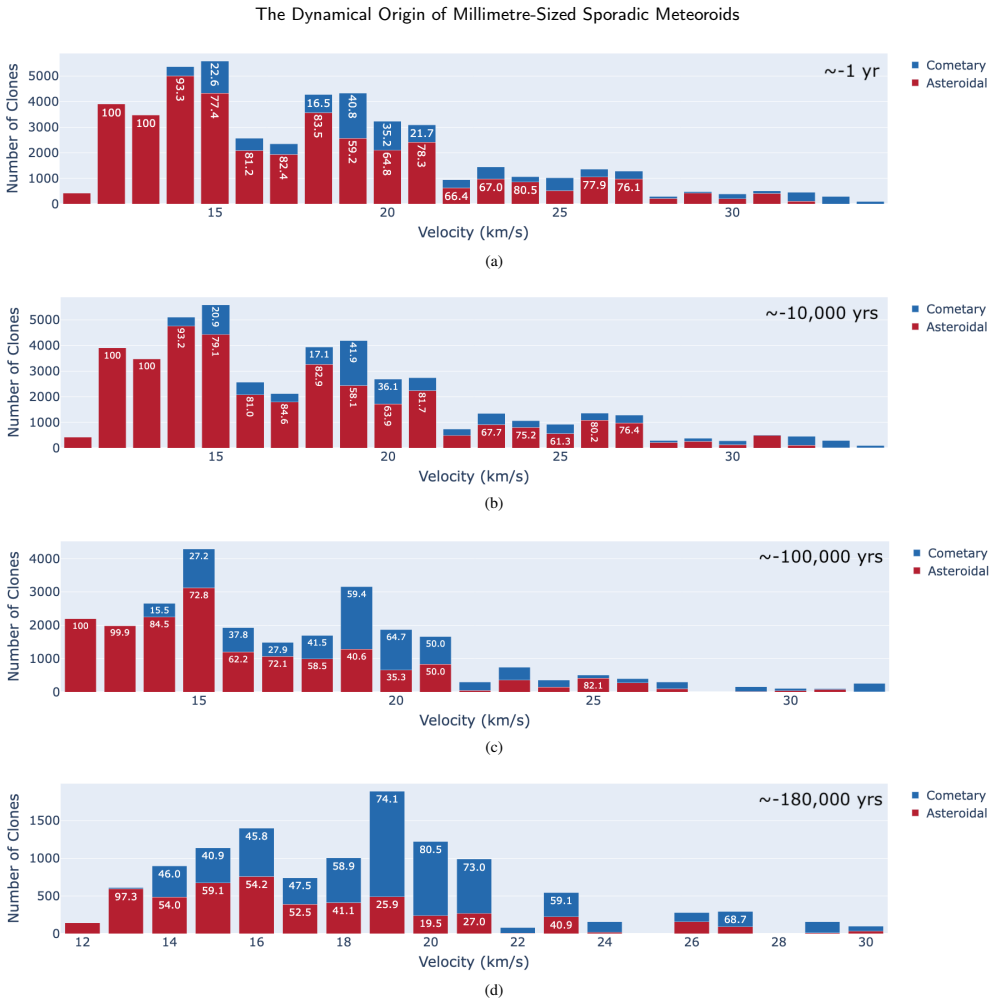
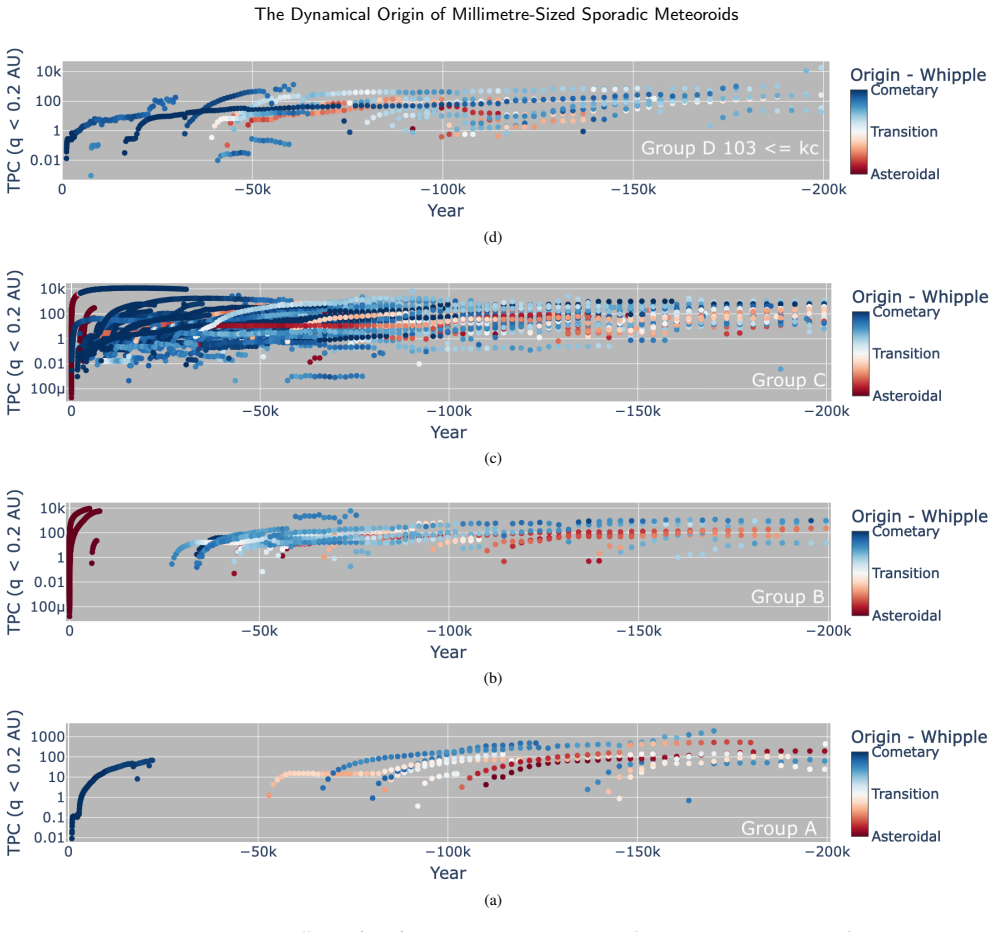
If meteoroids are released in the last 150-200 kyr, meteoroids in the millimetre to centimetre size range impacting Earth below 17 km/s are predominantly asteroidal in origin independent of the orbital criteria used. Above 17 km/s the fraction of dynamically cometary meteoroids increases, although a definitively cometary dominated population does not arise until velocities of 27 km/s or higher. For ages older than 200 kyr, lower velocity meteoroids at Earth in the mm-sized range may be a mix of either cometary or asteroidal.
What carries the argument
Backward integration of orbital clones sampled from observed co-variances, classified by the K and Pe criteria.
If this is right
- Below 17 km/s, mm-cm meteoroids are asteroidal regardless of which orbital criterion is applied.
- The cometary fraction rises steadily above 17 km/s but only exceeds 50 percent above 27 km/s.
- Releases older than 200 kyr allow both origins to appear at low arrival speeds.
- The Tisserand invariant and aphelion-distance methods recover source type less accurately than K and Pe.
Where Pith is reading between the lines
- If the velocity threshold survives further tests, arrival speed could become a rapid first-order proxy for source population in large meteoroid surveys.
- Models of the sporadic background may need to assign greater weight to recent asteroidal dust ejection at low encounter speeds.
- Composition measurements on recovered low-velocity mm particles could provide an independent check on the dynamical assignments.
Load-bearing premise
The K and Pe orbit criteria continue to correctly identify the parent body type even after 150-200 kyr of dynamical evolution for mm-sized bodies.
What would settle it
Discovery of even one mm-sized meteoroid whose parent body is known to be a recent comet yet whose Earth-impact speed is below 17 km/s would falsify the claimed velocity divide.
Figures
read the original abstract
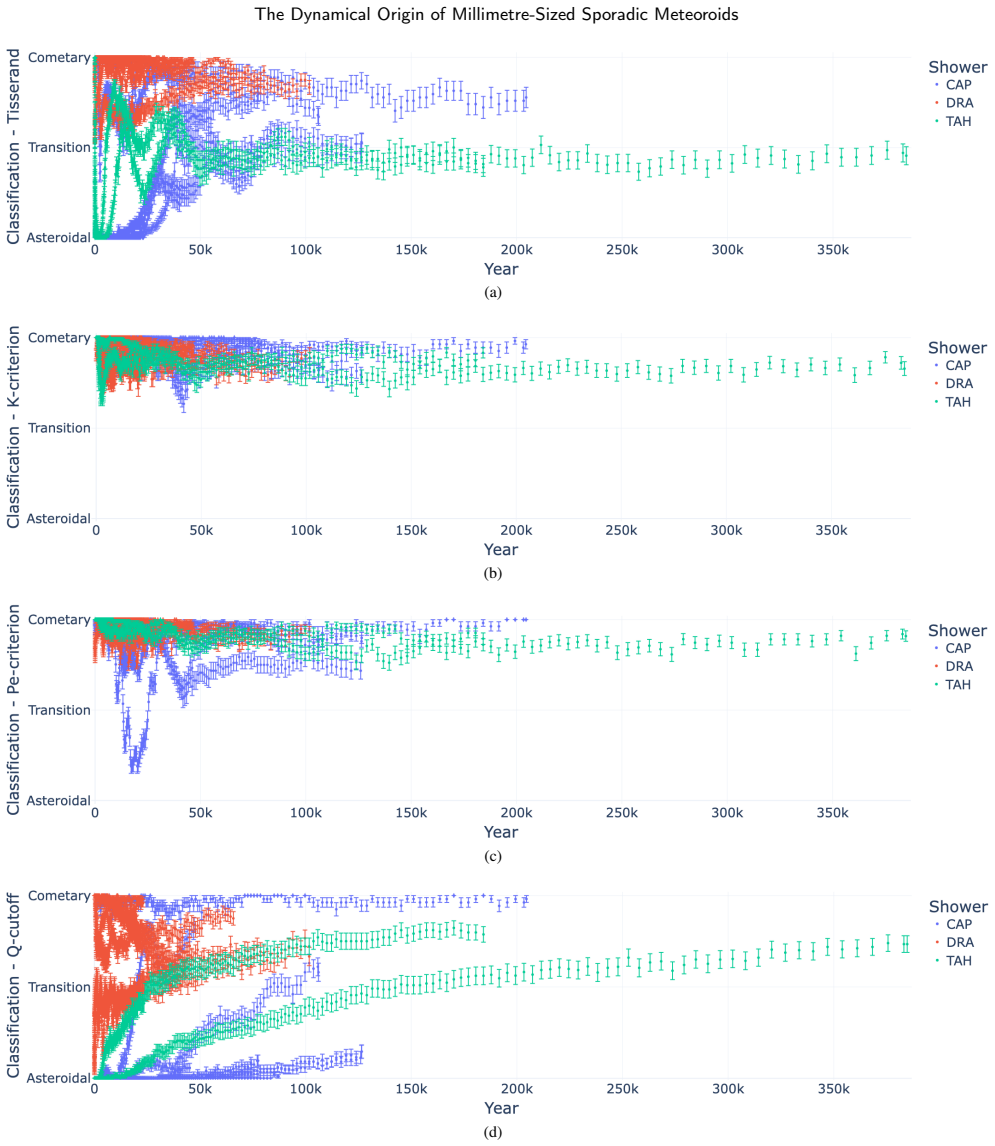
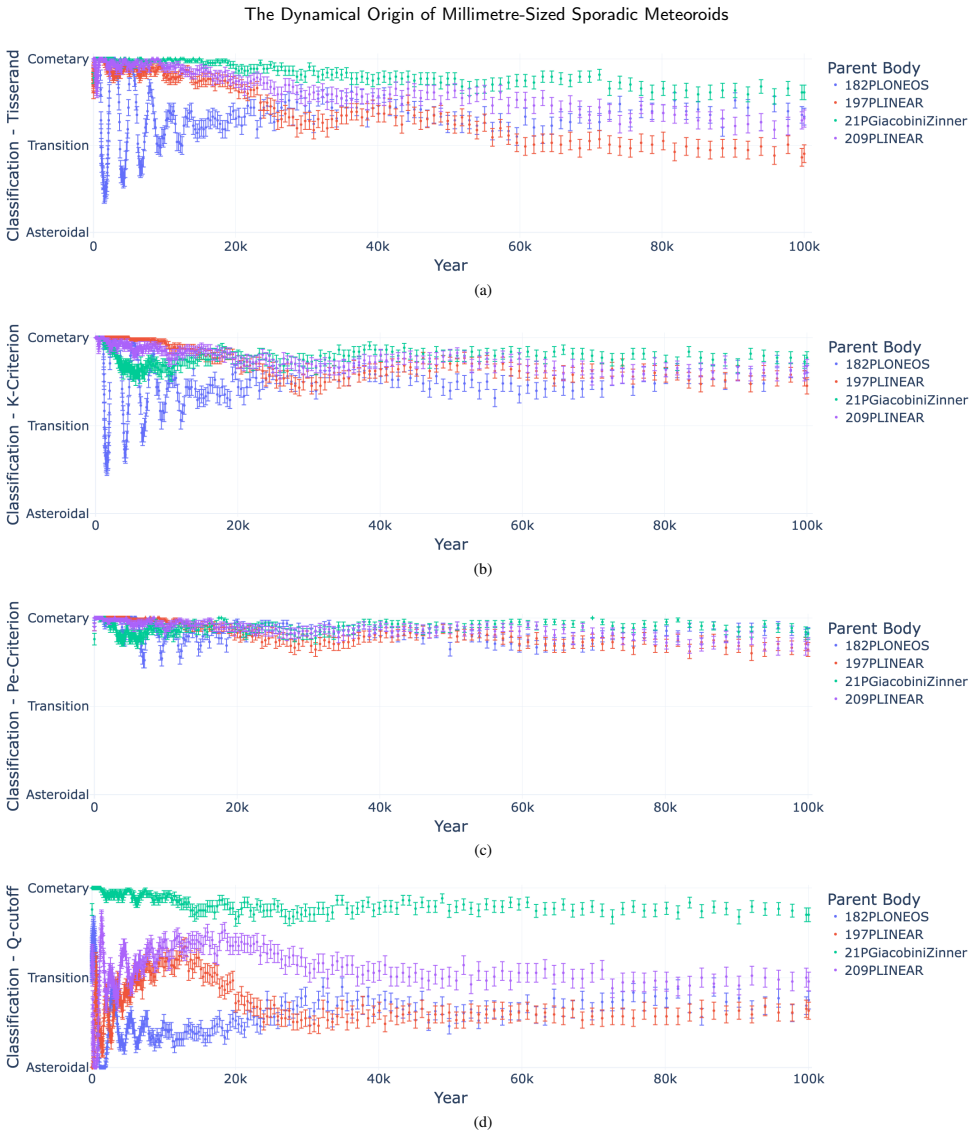
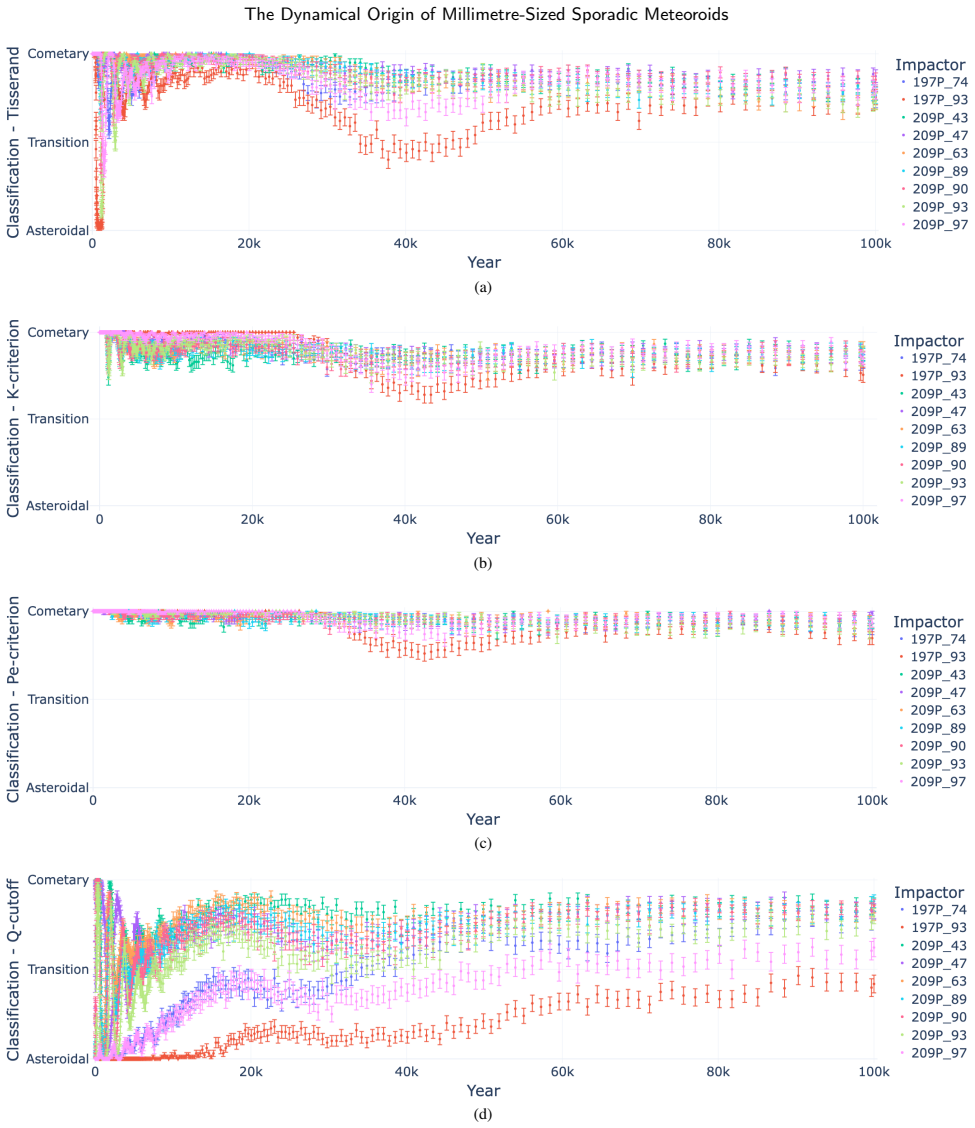
Determining the relative contributions of cometary and asteroidal sources to the sporadic meteoroid population remains a longstanding challenge, particularly because commonly used orbit-based classification criteria have not been rigorously validated for meteoroids. We evaluate the efficacy of several established orbit-based criteria for meteoroid classification. These include the Whipple $K$-criterion, Kres\'ak $Pe$-criterion, the Tisserand invariant with respect to Jupiter (T$_J$), and a recent classification based on aphelion distance proposed by Borovi\v{c}ka. Our validations suggest that $K$ and $Pe$ are most reliable at recovering whether a meteoroid was released from a cometary or asteroidal parent. We applied these criteria to a suite of 386 observed millimetre-sized meteoroids to try to constrain their original source populations. Our analysis used the observed orbit co-variances to backward integrate a suite of clones for each meteoroid to statistically evaluate their dynamical origin. We find that if meteoroids are released in the last ~150-200 kyr, there is a dividing velocity of below 17 km/s where meteoroids in the millimetre to centimetre size range impacting Earth are predominantly asteroidal in origin, independent of the orbital criteria used. Above 17 km/s, the fraction of dynamically cometary meteoroids increases, although a definitively cometary dominated population does not arise until velocities of 27 km/s or higher. For ages older than 200 kyr, lower velocity meteoroids at Earth in the mm-sized range may be a mix of either cometary or asteroidal.
Editorial analysis
A structured set of objections, weighed in public.
Referee Report
Summary. The paper validates several orbit-based classification criteria (Whipple K, Kresák Pe, Tisserand TJ, and Borovička aphelion) against dynamical origin for meteoroids, concluding that K and Pe are most reliable. It then applies these to 386 observed mm-sized meteoroids by generating clones from observed orbit covariances and performing backward gravitational N-body integrations over ~150-200 kyr, finding a velocity threshold: below 17 km/s the population is predominantly asteroidal independent of criteria, with cometary fraction rising above 17 km/s and cometary dominance only above 27 km/s (for recent release); older releases allow mixing at low velocities.
Significance. If the dynamical classifications remain robust, the work supplies observationally grounded velocity thresholds separating asteroidal and cometary contributions to the sporadic mm-cm meteoroid flux at Earth, directly constraining source models of the meteoroid complex without introducing fitted parameters.
major comments (2)
- [Methods (clone integrations)] Methods (clone integrations and non-gravitational forces): the backward integrations are performed with standard gravitational N-body from observed covariances, but omit Poynting-Robertson drag and radiation pressure. For mm-sized particles the PR timescale is ~10^4-10^5 yr, comparable to the adopted 150-200 kyr window; secular decay in a and e can move orbits across the K=0 or Pe=0.5 boundaries, systematically biasing the reported low-velocity (<17 km/s) asteroidal fraction. No quantification or sensitivity test of this effect is provided.
- [Results (velocity thresholds)] Results (velocity thresholds and statistical robustness): the central dividing velocity of 17 km/s (and the 27 km/s cometary-dominance threshold) is derived from K/Pe classifications on the integrated clones, yet the manuscript does not report integration timestep, number of clones per meteoroid, handling of close encounters, or formal statistical significance tests on the origin fractions. These omissions leave the load-bearing claim that the thresholds are independent of criteria and robust to dynamical uncertainties only partially supported.
minor comments (2)
- [Abstract and Methods] The abstract and text refer to 'a suite of clones' without specifying the exact number or convergence criteria; this detail should be added for reproducibility.
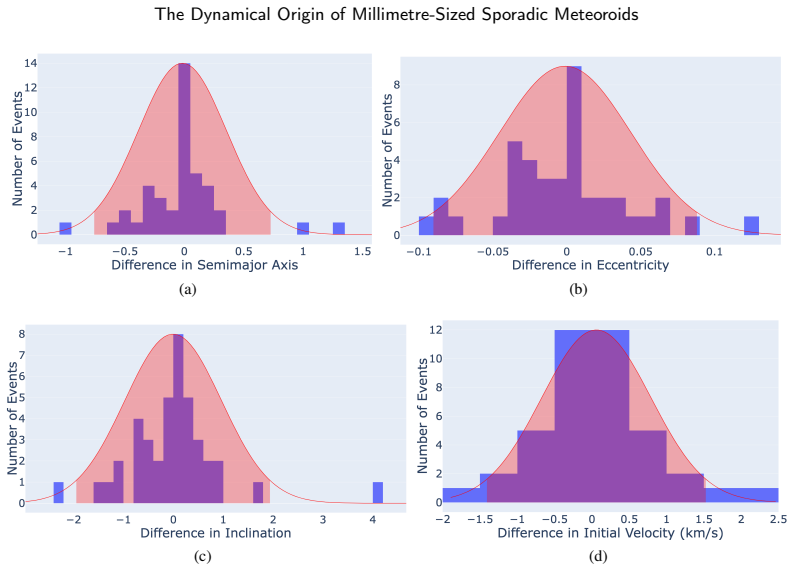
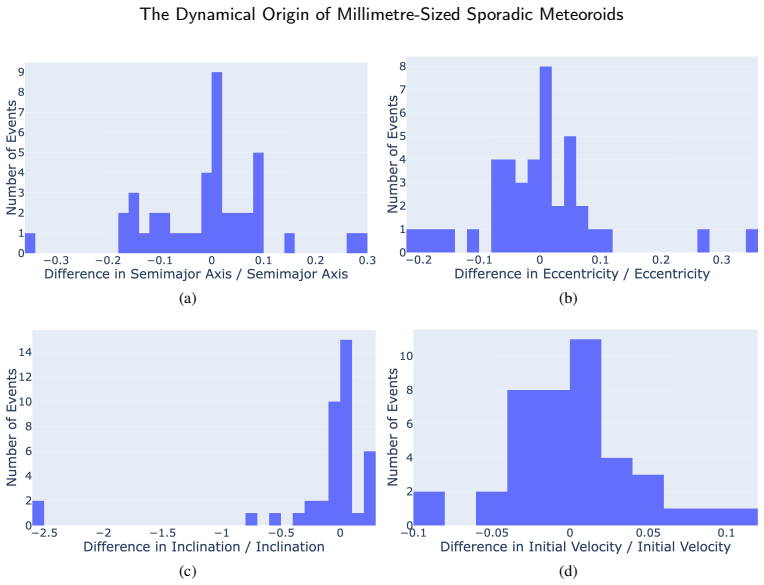
- [Figures] Figure captions and axis labels for the velocity-fraction plots should explicitly state the integration duration and criteria used in each panel.
Simulated Author's Rebuttal
We thank the referee for their constructive and detailed review. We address each major comment point by point below, indicating where revisions will be made to the manuscript.
read point-by-point responses
-
Referee: Methods (clone integrations and non-gravitational forces): the backward integrations are performed with standard gravitational N-body from observed covariances, but omit Poynting-Robertson drag and radiation pressure. For mm-sized particles the PR timescale is ~10^4-10^5 yr, comparable to the adopted 150-200 kyr window; secular decay in a and e can move orbits across the K=0 or Pe=0.5 boundaries, systematically biasing the reported low-velocity (<17 km/s) asteroidal fraction. No quantification or sensitivity test of this effect is provided.
Authors: We agree that the omission of non-gravitational forces is a limitation of the current analysis. The PR drag timescale for mm-sized particles overlaps with the 150-200 kyr integration window, and secular orbital decay could affect classifications near the K=0 and Pe=0.5 boundaries. In the revised manuscript we will add an explicit discussion of this potential bias on the low-velocity asteroidal fraction. We will also perform a limited sensitivity test by re-integrating a representative subset of clones with PR drag included to quantify the magnitude of any systematic shift. revision: partial
-
Referee: Results (velocity thresholds and statistical robustness): the central dividing velocity of 17 km/s (and the 27 km/s cometary-dominance threshold) is derived from K/Pe classifications on the integrated clones, yet the manuscript does not report integration timestep, number of clones per meteoroid, handling of close encounters, or formal statistical significance tests on the origin fractions. These omissions leave the load-bearing claim that the thresholds are independent of criteria and robust to dynamical uncertainties only partially supported.
Authors: We accept that these methodological details should have been reported. In the revised manuscript we will specify the integration timestep, the number of clones generated per meteoroid from the observed covariances, the treatment of close encounters, and the results of formal statistical tests (including uncertainty estimates) on the origin fractions. These additions will strengthen the support for the reported velocity thresholds being independent of classification criteria. revision: yes
Circularity Check
No circularity: results derived from observed orbits via standard integrations and pre-existing criteria
full rationale
The paper feeds observed mm-sized meteoroid orbits and their covariances into standard N-body backward integrations over 150-200 kyr, then applies the pre-existing Whipple K and Kresák Pe criteria (plus TJ and Borovička) to the clone endpoints. The reported velocity thresholds (17 km/s asteroidal dominance, 27 km/s cometary dominance) are statistical outputs of that process, not inputs. No parameters are fitted to reproduce the thresholds, no self-definitional loops appear, and the classification criteria are treated as external. The derivation chain is therefore self-contained against external benchmarks.
Axiom & Free-Parameter Ledger
axioms (2)
- standard math Newtonian gravitational dynamics with planetary perturbations govern meteoroid orbital evolution over 150-200 kyr timescales
- domain assumption The K and Pe criteria correctly recover cometary versus asteroidal parentage for mm-sized meteoroids
Reference graph
Works this paper leans on
-
[1]
, author Emel’Yanenko, V
author Bailey, M. , author Emel’Yanenko, V. , year 1996 . title Dynamical evolution of halley-type comets . journal Monthly Notices of the Royal Astronomical Society volume 278 , pages 1087–1110
1996
-
[2]
, author Chambers, J.E
author Bailey, M.E. , author Chambers, J.E. , author Hahn, G. , year 1992 . title Origin of sungrazers - a frequent cometary end-state. journal Astronomy and Astrophysics volume 257 , pages 315–322
1992
-
[3]
A&A 667, A158,10.1051/0004-6361/202244197
author Borovi c ka, J. , author Spurn \' y , P. , author Shrben \' y , L. , year 2022 . title Data on 824 fireballs observed by the digital cameras of the European Fireball Network in 2017–2018: II. Analysis of orbital and physical properties of centimeter-sized meteoroids . journal Astronomy & Astrophysics volume 667 , pages A158 . https://www.aanda.org/...
-
[4]
author Borovi c ka , J. , author Koten , P. , author Spurn \'y , P. , author Bo c ek , J. , author S tork , R. , year 2005 . title A survey of meteor spectra and orbits: evidence for three populations of Na-free meteoroids . journal volume 174 , pages 15--30 . :10.1016/j.icarus.2004.09.011
-
[5]
author Borovi c ka , J. , author Spurn \'y , P. , author Shrben \'y , L. , author S tork , R. , author Kotkov \'a , L. , author Fuchs , J. , author Kecl \' kov \'a , J. , author Zichov \'a , H. , author M \'a nek , J. , author V \'a chov \'a , P. , author Macourkov \'a , I. , author Svore n , J. , author Mucke , H. , year 2022 . title Data on 824 fireball...
-
[6]
, author Macke, R.J
author Borovička, J. , author Macke, R.J. , author Campbell-Brown, M. , author Levasseur-Regourd, A.C. , author Rietmeijer, F.J.M. , author Kohout, T. , year 2019 . title Physical and chemical properties of meteoroids . publisher Cambridge Univ Press . p. pages 37–62 . note Citation Key: Borovicka2019a
2019
-
[7]
author Brown , P. , author Jones , J. , year 1998 . title Simulation of the Formation and Evolution of the Perseid Meteoroid Stream . journal volume 133 , pages 36--68 . :10.1006/icar.1998.5920
-
[8]
author Burns, J.A. , author Lamy, P.L. , author Soter, S. , year 1979 . title Radiation forces on small particles in the solar system . journal Icarus volume 40 , pages 1--48 . https://www.sciencedirect.com/science/article/pii/0019103579900502, :https://doi.org/10.1016/0019-1035(79)90050-2
-
[9]
, author G \'o mez-Mart \' n , J.C
author Carrillo-S \'a nchez , J.D. , author G \'o mez-Mart \' n , J.C. , author Bones , D.L. , author Nesvorn \'y , D. , author Pokorn \'y , P. , author Benna , M. , author Flynn , G.J. , author Plane , J.M.C. , year 2020 . title Cosmic dust fluxes in the atmospheres of Earth, Mars, and Venus . journal volume 335 , pages 113395 . :10.1016/j.icarus.2019.113395
-
[10]
author Carrillo-Sanchez, J.D. , author Nesvorny, D. , author Pokorny, P. , author Janches, D. , author Plane, J. , year 2016 . title Sources of cosmic dust in the earth's atmosphere . journal Geophysical Research Letters volume 43 , pages 11,979--11,986 . http://doi.wiley.com/10.1002/2016GL071697, :10.1002/2016GL071697
-
[11]
, year 1967
author Ceplecha, Z. , year 1967 . title Classification of meteor orbits . journal Smithsonian Contr. Astrophys volume 11 , pages 35–60 . note Citation Key: Ceplecha1967a
1967
-
[12]
, year 1988
author Ceplecha, Z. , year 1988 . title Earth's influx of different populations of sporadic meteoroids from photographic and television data . journal Astronomical Institutes of Czechoslovakia, Bulletin (ISSN 0004-6248) volume 39 , pages 221--236 . http://adsabs.harvard.edu/full/1988BAICz..39..221C
1988
-
[13]
Space Science Reviews 84, 327-471,10.1023/A:1005069928850
author Ceplecha , Z. , author Borovi c ka , J. , author Elford , W.G. , author Revelle , D.O. , author Hawkes , R.L. , author Porub c an , V. , author S imek , M. , year 1998 . title Meteor Phenomena and Bodies . journal volume 84 , pages 327--471 . :10.1023/A:1005069928850
-
[14]
author Ceplecha , Z. , author McCrosky , R.E. , year 1976 . title Fireball end heights: A diagnostic for the structure of meteoric material . journal volume 81 , pages 6257--6275 . :10.1029/JB081i035p06257
-
[15]
author Clark , D.L. , author Wiegert , P.A. , year 2011 . title A numerical comparison with the Ceplecha analytical meteoroid orbit determination method . journal volume 46 , pages 1217--1225 . :10.1111/j.1945-5100.2011.01226.x
-
[16]
author Delbo , M. , author Libourel , G. , author Wilkerson , J. , author Murdoch , N. , author Michel , P. , author Ramesh , K.T. , author Ganino , C. , author Verati , C. , author Marchi , S. , year 2014 . title Thermal fatigue as the origin of regolith on small asteroids . journal volume 508 , pages 233--236 . :10.1038/nature13153
-
[17]
, year 2002
author Dermott, S. , year 2002 . title Asteroids III . publisher University of Arizona Press . http://www.jstor.org/stable/j.ctv1v7zdn4
2002
-
[18]
, author Durda, D.D
author Dermott, S.F. , author Durda, D.D. , author Grogan, K. , author Kehoe, T.J. , year 2002 . title Asteroidal dust . journal Asteroids III , pages 423–442
2002
-
[19]
, author Nicholson, P.D
author Dermott, S.F. , author Nicholson, P.D. , year 1989 . title Iras dust bands and the origin of the zodiacal cloud . journal Highlights of Astronomy volume 8 , pages 259–266
1989
-
[20]
author Dohnanyi , J.S. , year 1970 . title On the origin and distribution of meteoroids. journal volume 75 , pages 3468--3493 . :10.1029/JB075i017p03468
-
[21]
author Dohnanyi, J.S. , year 1976 . title 2.1.8 sources of interplanetary dust: Asteroids . journal International Astronomical Union Colloquium volume 31 , pages 187–205 . :10.1017/S0252921100051708
-
[22]
author Dones , L. , author Brasser , R. , author Kaib , N. , author Rickman , H. , year 2015 . title Origin and Evolution of the Cometary Reservoirs . journal volume 197 , pages 191--269 . :10.1007/s11214-015-0223-2
-
[23]
, author Dermott, S.F
author Durda, D.D. , author Dermott, S.F. , year 1997 . title The collisional evolution of the asteroid belt and its contribution to the zodiacal cloud . journal Icarus volume 130 , pages 140–164
1997
-
[24]
author Fern \'a ndez, J.A. , author Gallardo, T. , author Brunini, A. , year 2002 . title Are there many inactive jupiter-family comets among the near-earth asteroid population? journal Icarus volume 159 , pages 358--368 . https://www.sciencedirect.com/science/article/pii/S0019103502969034, :https://doi.org/10.1006/icar.2002.6903
-
[25]
author Genge , M.J. , year 2008 . title Micrometeorites and Their Implications for Meteors . journal Earth Moon and Planets volume 102 , pages 525--535 . :10.1007/s11038-007-9185-z
-
[26]
author Genge , M.J. , year 2017 . title The entry heating and abundances of basaltic micrometeorites . journal volume 52 , pages 1000--1013 . :10.1111/maps.12830
-
[27]
author Granvik, M. , author Morbidelli, A. , author Jedicke, R. , author Bolin, B. , author Bottke, W. , author Beshore, E. , author Vokrouhlický, D. , author Delbò, M. , author Michel, P. , year 2016 . title Super-catastrophic disruption of asteroids at small perihelion distances . journal Nature volume 530 , pages 303–306 . :10.1038/nature16934. note ci...
-
[28]
author Grun , E. , author Zook , H.A. , author Fechtig , H. , author Giese , R.H. , year 1985 . title Collisional balance of the meteoritic complex . journal volume 62 , pages 244--272 . :10.1016/0019-1035(85)90121-6
-
[29]
author Gural , P. , author Mills , T. , author Mazur , M. , author Brown , P. , year 2022 . title Development of a very faint meteor detection system based on an EMCCD sensor and matched filter processing . journal Experimental Astronomy volume 53 , pages 1085--1126 . :10.1007/s10686-021-09828-3, arXiv:2112.15507 http://arxiv.org/abs/2112.15507
-
[30]
author Gural , P.S. , author Jenniskens , P.M. , author Varros , G. , year 2004 . title Results from the AIM-IT Meteor Tracking System . journal Earth Moon and Planets volume 95 , pages 541--552 . :10.1007/s11038-005-1255-5
-
[31]
author Hughes, D. , year 1994 . title Comets and asteroids . journal Contemporary Physics volume 35 , pages 75–93 . :10.1080/00107519408224452
-
[32]
author Jenniskens, P. , author Baggaley, J. , author Crumpton, I. , author Aldous, P. , author Pokorny, P. , author Janches, D. , author Gural, P.S. , author Samuels, D. , author Albers, J. , author Howell, A. , author Johannink, C. , author Breukers, M. , author Odeh, M. , author Moskovitz, N. , author Collison, J. , author Ganju, S. , year 2018 . title ...
-
[33]
author Jenniskens, P. , author Nenon, Q. , author Albers, J. , author Gural, P. , author Haberman, B. , author Holman, D. , author Morales, R. , author Grigsby, B. , author Samuels, D. , author Johannink, C. , year 2016 a. title The established meteor showers as observed by cams . journal Icarus volume 266 , pages 331--354 . https://www.sciencedirect.com/...
-
[34]
author Jenniskens, P. , author Nenon, Q. , author Gural, P. , author Albers, J. , author Haberman, B. , author Johnson, B. , author Morales, R. , author Grigsby, B. , author Samuels, D. , author Johannink, C. , year 2016 b. title Cams newly detected meteor showers and the sporadic background . journal Icarus volume 266 , pages 384--409 . http://linkinghub...
-
[35]
author Jenniskens, P. , author Vaubaillon, J. , year 2010 . title Minor planet 2002 ex12 (=169p/neat) and the alpha capricornid shower . journal The Astronomical Journal volume 139 , pages 1822 . https://doi.org/10.1088/0004-6256/139/5/1822, :10.1088/0004-6256/139/5/1822
-
[36]
author Jopek, T.J. , author Bronikowska, M. , year 2017 . title Probability of coincidental similarity among the orbits of small bodies – I. Pairing . journal Planetary and Space Science volume 143 , pages 43--52 . :10.1016/j.pss.2016.12.004
-
[37]
author Jopek, T.J. , author Rudawska, R. , author Bartczak, P. , year 2008 . title Meteoroid Stream Searching : The Use of the Vectorial Elements . journal Earth, Moon, and Planets volume 102 , pages 73--78 . http://link.springer.com/10.1007/s11038-007-9197-8, :10.1007/s11038-007-9197-8. note publisher: Springer Netherlands
-
[38]
author Kessler , D.J. , year 1981 . title Derivation of the collision probability between orbiting objects: the lifetimes of jupiter's outer moons . journal volume 48 , pages 39--48 . :10.1016/0019-1035(81)90151-2
-
[39]
author Kinoshita , H. , author Nakai , H. , year 2007 . title General solution of the Kozai mechanism . journal Celestial Mechanics and Dynamical Astronomy volume 98 , pages 67--74 . :10.1007/s10569-007-9069-6
-
[40]
, year 1933
author Kolmogorov, A.N. , year 1933 . title Sulla determinazione empirica di una legge di distribuzione . journal Giornale dell'Istituto Italiano degli Attuari volume 4 , pages 83--91
1933
-
[41]
author Kortenkamp, S.J. , author Dermott, S.F. , author Fogle, D. , author Grogan, K. , year 2001 . title Sources and Orbital Evolution of Interplanetary Dust Accreted by Earth . publisher Springer US , address Boston, MA . p. pages 13–30 . https://doi.org/10.1007/978-1-4419-8694-8_2, :10.1007/978-1-4419-8694-8_2
-
[42]
author Kozai , Y. , year 1962 . title Secular perturbations of asteroids with high inclination and eccentricity . journal volume 67 , pages 591--598 . :10.1086/108790
-
[43]
, year 1967
author Kres \'a k , L . , year 1967 . title Relation of meteor orbits to the orbits of comets and asteroids . journal Smithson. Contrib. Astrophys volume 11 , pages 9--34 . http://adsabs.harvard.edu/full/1967SCoA...11....9K
1967
-
[44]
, year 1969
author Kres \'a k , L . , year 1969 . title The discrimination between cometary and asteroidal meteors. i. the orbital criteria . journal Bull. Astron. Inst. Czech volume 20 , pages 177‚188 . http://adsabs.harvard.edu/full/1969BAICz..20..177K
1969
-
[45]
author Levasseur-Regourd , A.C. , author Agarwal , J. , author Cottin , H. , author Engrand , C. , author Flynn , G. , author Fulle , M. , author Gombosi , T. , author Langevin , Y. , author Lasue , J. , author Mannel , T. , author Merouane , S. , author Poch , O. , author Thomas , N. , author Westphal , A. , year 2018 . title Cometary Dust . journal volu...
-
[46]
, year 1996
author Levison, H. , year 1996 . title Comet taxonomy , in: editor Rettig, T. , editor Hahn, J. (Eds.), booktitle Completing the Inventory of the Solar System, ASP Conference Series, Vol. 107 , publisher Astronomical Society of the Pacific . p. pages 173–191 . note Citation Key: Levison1996
1996
-
[47]
author Levison, H. , year 1997 . title From the kuiper belt to jupiter-family comets: The spatial distribution of ecliptic comets . journal Icarus volume 127 , pages 13–32 . :10.1006/icar.1996.5637. note citation Key: Levison1997
-
[48]
, author Duncan, M
author Levison, H. , author Duncan, M. , year 1994 . title The long-term dynamical behavior of short-period comets . journal Icarus volume 108 . http://linkinghub.elsevier.com/retrieve/pii/S0019103584710396
1994
-
[49]
, author Duncan , M.J
author Levison , H.F. , author Duncan , M.J. , year 2013 . title SWIFT: A solar system integration software package . howpublished Astrophysics Source Code Library, record ascl:1303.001 . arXiv:1303.001 http://arxiv.org/abs/1303.001
2013
-
[50]
author Libourel, G. , author Ganino, C. , author Delbo, M. , author Niezgoda, M. , author Remy, B. , author Aranda, L. , author Michel, P. , year 2021 . title Network of thermal cracks in meteorites due to temperature variations: new experimental evidence and implications for asteroid surfaces . journal Monthly Notices of the Royal Astronomical Society vo...
-
[51]
author Marsden , B.G. , author Sekanina , Z. , year 1971 . title Comets and Nongravitational Forces. IV . journal volume 76 , pages 1135 . :10.1086/111232
-
[52]
, year 1972
author Millman , P.M. , year 1972 . title The meteoritic complex , in: editor Elvius , A. (Ed.), booktitle From Plasma to Planet , p. pages 367
1972
-
[53]
Cometary Origin of the Zodiacal Cloud and Carbonaceous Micrometeorites
author Nesvorn \'y , D. , author Jenniskens , P. , author Levison , H.F. , author Bottke , W.F. , author Vokrouhlick \'y , D. , author Gounelle , M. , year 2010 . title Cometary Origin of the Zodiacal Cloud and Carbonaceous Micrometeorites. Implications for Hot Debris Disks . journal volume 713 , pages 816--836 . :10.1088/0004-637X/713/2/816, arXiv:0909.4...
work page internal anchor Pith review Pith/arXiv arXiv doi:10.1088/0004-637x/713/2/816 2010
-
[54]
Origin and Evolution of Short-Period Comets
author Nesvorn \'y , D. , author Vokrouhlick \'y , D. , author Dones , L. , author Levison , H.F. , author Kaib , N. , author Morbidelli , A. , year 2017 . title Origin and Evolution of Short-period Comets . journal volume 845 , pages 27 . :10.3847/1538-4357/aa7cf6, arXiv:1706.07447 http://arxiv.org/abs/1706.07447
work page internal anchor Pith review Pith/arXiv arXiv doi:10.3847/1538-4357/aa7cf6 2017
-
[55]
author Nesvorný, D. , author Janches, D. , author Vokrouhlický, D. , author Pokorný, P. , author Bottke, W. , author Jenniskens, P. , year 2011 . title Dynamical Model for the Zodiacal Cloud and Sporadic Meteors . journal The Astrophysical Journal volume 743 , pages 129 . http://stacks.iop.org/0004-637X/743/i=2/a=129?key=crossref.f61a0c2ea05ded753d6a1bef3...
-
[56]
, author Gladman, B
author Pauls, A. , author Gladman, B. , year 2005 . title Decoherence Time Scales for Meteoroid Streams . journal Meteoritics and Planetary Science volume 40 , pages 1241--1256 . http://adsabs.harvard.edu/abs/2004M&PSA..39.5228G
2005
-
[57]
author Picone , J.M. , author Hedin , A.E. , author Drob , D.P. , author Aikin , A.C. , year 2002 . title NRLMSISE-00 empirical model of the atmosphere: Statistical comparisons and scientific issues . journal Journal of Geophysical Research (Space Physics) volume 107 , pages 1468 . :10.1029/2002JA009430
-
[58]
author Pokorn \'y , P. , author Moorhead , A.V. , author Kuchner , M.J. , author Szalay , J.R. , author Malaspina , D.M. , year 2024 . title How Long-lived Grains Dominate the Shape of the Zodiacal Cloud . journal volume 5 , pages 82 . :10.3847/PSJ/ad2de8, arXiv:2401.13776 http://arxiv.org/abs/2401.13776
-
[59]
author Pokorn \'y , P. , author Vokrouhlick \'y , D. , year 2013 . title \"O pik-type collision probability for high-inclination orbits: Targets on eccentric orbits . journal Icarus volume 226 , pages 682--693 . https://www.sciencedirect.com/science/article/pii/S0019103513002716, :https://doi.org/10.1016/j.icarus.2013.06.015
-
[60]
author Pokorn \'y , P. , author Vokrouhlick \'y , D. , author Nesvorn \'y , D. , author Campbell-Brown , M. , author Brown , P. , year 2014 . title Dynamical Model for the Toroidal Sporadic Meteors . journal volume 789 , pages 25 . :10.1088/0004-637X/789/1/25
-
[61]
author Pokorný, P. , author Janches, D. , author Sarantos, M. , author Szalay, J.R. , author Horányi, M. , author Nesvorný, D. , author Kuchner, M.J. , year 2019 . title Meteoroids at the moon: Orbital properties, surface vaporization, and impact ejecta production . journal Journal of Geophysical Research: Planets http://doi.wiley.com/10.1029/2018JE005912...
-
[62]
author Poppe , A.R. , year 2016 . title An improved model for interplanetary dust fluxes in the outer Solar System . journal volume 264 , pages 369--386 . :10.1016/j.icarus.2015.10.001
-
[63]
author Rein , H. , author Spiegel , D.S. , year 2015 . title IAS15: a fast, adaptive, high-order integrator for gravitational dynamics, accurate to machine precision over a billion orbits . journal volume 446 , pages 1424--1437 . :10.1093/mnras/stu2164, arXiv:1409.4779 http://arxiv.org/abs/1409.4779
work page internal anchor Pith review Pith/arXiv arXiv doi:10.1093/mnras/stu2164 2015
-
[64]
, author Courtot, A
author Shober, P.M. , author Courtot, A. , author Vaubaillon, J. , year 2025 a. title Near-earth stream decoherence revisited: the limits of orbital similarity . journal Astronomy & Astrophysics volume 693 , pages A23
2025
-
[65]
author Shober, P.M. , author Devillepoix, H.A.R. , author Vaubaillon, J. , author Anghel, S. , author Deam, S.E. , author Sansom, E.K. , author Colas, F. , author Zanda, B. , author Vernazza, P. , author Bland, P. , year 2025 b. title Perihelion history and atmospheric survival as primary drivers of the earth’s meteorite record . journal Nature Astronomy ...
-
[66]
author Shober , P.M. , author Sansom , E.K. , author Bland , P.A. , author Devillepoix , H.A.R. , author Towner , M.C. , author Cup \'a k , M. , author Howie , R.M. , author Hartig , B.A.D. , author Anderson , S.L. , year 2021 . title The Main Asteroid Belt: The Primary Source of Debris on Comet-like Orbits . journal volume 2 , pages 98 . :10.3847/PSJ/abd...
-
[67]
author Shober , P.M. , author Tancredi , G. , author Vaubaillon , J. , author Devillepoix , H.A.R. , author Deam , S. , author Anghel , S. , author Sansom , E.K. , author Colas , F. , author Martino , S. , year 2024 . title Comparing the dynamics of Jupiter-family Comets and comet-like fireballs . journal arXiv e-prints , pages arXiv:2405.08224 :10.48550/...
-
[68]
, author Vaubaillon, J
author Shober, P.M. , author Vaubaillon, J. , year 2024 . title A generalizable method for estimating meteor shower false positives . journal Astronomy & Astrophysics volume 686 , pages A130
2024
-
[69]
author Smirnov, N.V. , year 1948 . title Table for estimating the goodness of fit of empirical distributions . journal Annals of Mathematical Statistics volume 19 , pages 279--281 . :10.1214/aoms/1177730256
-
[70]
, author Hawkins , G.S
author Southworth , R.B. , author Hawkins , G.S. , year 1963 . title Statistics of meteor streams . journal Smithsonian Contributions to Astrophysics volume 7 , pages 261--285
1963
-
[71]
A New Algorithm for Self-Consistent 3-D Modeling of Collisions in Dusty Debris Disks
author Stark , C.C. , author Kuchner , M.J. , year 2009 . title A New Algorithm for Self-consistent Three-dimensional Modeling of Collisions in Dusty Debris Disks . journal volume 707 , pages 543--553 . :10.1088/0004-637X/707/1/543, arXiv:0909.2227 http://arxiv.org/abs/0909.2227
work page internal anchor Pith review Pith/arXiv arXiv doi:10.1088/0004-637x/707/1/543 2009
-
[72]
author Steel, D.I. , author Elford, W.G. , year 1986 . title Collisions in the solar system – iii. meteoroid survival times . journal Monthly Notices of the Royal Astronomical Society volume 218 , pages 185--199 . https://doi.org/10.1093/mnras/218.2.185, :10.1093/mnras/218.2.185
-
[73]
author Subasinghe, D. , author Campbell-Brown, M. , author Stokan, E. , year 2017 . title Luminous efficiency estimates of meteors - I . Uncertainty analysis . journal Planetary and Space Science volume 143 , pages 71--77 . http://dx.doi.org/10.1016/j.pss.2016.12.009, :10.1016/j.pss.2016.12.009. note publisher: Elsevier Ltd
-
[74]
, author Grün, E
author Sykes, M. , author Grün, E. , author Reach, W. , author Jenniskens, P. , year 2004 . title The interplanetary dust complex and comets . journal Comets II , pages 677–693 note Citation Key: Sykes2004
2004
-
[75]
author Tamayo , D. , author Rein , H. , author Shi , P. , author Hernandez , D.M. , year 2020 . title REBOUNDx: a library for adding conservative and dissipative forces to otherwise symplectic N-body integrations . journal volume 491 , pages 2885--2901 . :10.1093/mnras/stz2870, arXiv:1908.05634 http://arxiv.org/abs/1908.05634
-
[76]
author Tancredi , G. , year 2014 . title A criterion to classify asteroids and comets based on the orbital parameters . journal volume 234 , pages 66--80 . :10.1016/j.icarus.2014.02.013
-
[77]
, year 1890
author Tisserand , F. , year 1890 . title Trait \'e de m \'e canique c \'e leste . journal Bulletin Astronomique, Serie I volume 7 , pages 184.1--184.8
-
[78]
author Toliou, A. , author Granvik, M. , year 2023 . title Resonant mechanisms that produce near-sun asteroids . journal Monthly Notices of the Royal Astronomical Society volume 521 , pages 4819--4837 . https://doi.org/10.1093/mnras/stad862, :10.1093/mnras/stad862, arXiv:https://academic.oup.com/mnras/article-pdf/521/4/4819/58057941/stad862.pdf http://arx...
-
[79]
author Toliou, A. , author Granvik, M. , author Tsirvoulis, G. , year 2021 . title Minimum perihelion distances and associated dwell times for near-earth asteroids . journal Monthly Notices of the Royal Astronomical Society volume 506 , pages 3301--3312 . https://doi.org/10.1093/mnras/stab1934, :10.1093/mnras/stab1934, arXiv:https://academic.oup.com/mnras...
-
[80]
author Tsirvouils , G. , author Granvik , M. , author Schirner , L. , author Toliou , A. , author Geem , J. , author Hagermann , A. , year 2026 . title Instantaneous thermally-driven erosion can explain dearth of dark near-Sun asteroids . journal volume 448 , pages 116942 . :10.1016/j.icarus.2026.116942, arXiv:2601.07471 http://arxiv.org/abs/2601.07471
discussion (0)
Sign in with ORCID, Apple, or X to comment. Anyone can read and Pith papers without signing in.