REVIEW 1 major objections 1 minor 32 references
A dielectric waveguide with varactor-tuned leaks forms an electronically adjustable antenna that can route millimeter-wave signals around obstacles.
Reviewed by Pith at T0; open to challenge. T0 means a machine referee read the full paper against a public rubric. the ladder, T0–T4 →
T0 review · grok-4.3
2026-06-29 01:04 UTC pith:DMR4JEYH
load-bearing objection Simulation-only study of a varactor-tuned pinching antenna for mm-wave blockage mitigation, with no hardware validation. the 1 major comments →
Electronically Reconfigurable Pinching Antennas for Millimeter-Wave Communication in LoS and NLoS Environments
The pith
A machine-rendered reading of the paper's core claim, the machinery that carries it, and where it could break.
Core claim
The E-pinching antenna consists of a rectangular dielectric waveguide that leaks energy through varactor-loaded elements to form tunable radiation points, with a copper reflector for unidirectional radiation. By dynamically adjusting the varactor capacitances, the radiated power and transmission to a receiving antenna can be tuned. In a multi-user scenario with two activated modules serving receivers on either side of a blockage, simulations confirm links with minimal losses to both LoS and NLoS users.
What carries the argument
The electronically reconfigurable pinching antenna, which uses varactor-loaded modular elements on a dielectric waveguide to create tunable radiation points.
Load-bearing premise
Full-wave simulations accurately capture the real-world behavior of the varactor-loaded elements, waveguide leakage, and reflector without significant unmodeled effects like fabrication tolerances.
What would settle it
Fabricating the antenna and measuring its radiation patterns and transmission coefficients under real conditions would show if the simulated tuning and low losses hold, or if discrepancies appear due to practical losses.
If this is right
- Radiation power and transmission coefficients can be tuned by changing the varactor capacitances.
- Links can be established to both LoS and NLoS users with minimal propagation losses.
- The design enables a scalable and electronically controllable distributed antenna platform.
- Blockage mitigation improves in reconfigurable millimeter-wave wireless systems.
Where Pith is reading between the lines
- Arrays of such waveguides could be mounted along indoor surfaces to maintain connectivity as users move behind obstacles.
- The tuning mechanism might combine with other beam control methods to increase spatial selectivity.
- Real deployments would require checking how varactor non-idealities affect overall efficiency beyond simulation.
- The modular element approach could scale to serve more users or adapt to changing environments in future systems.
Editorial analysis
A structured set of objections, weighed in public.
Referee Report
Summary. The manuscript presents the design of an electronically reconfigurable pinching antenna (E-pinching antenna) consisting of a rectangular dielectric waveguide that leaks energy through varactor-loaded elements, with a copper reflector for unidirectional radiation. Full-wave simulations are used to demonstrate dynamic tuning of radiated power and transmission coefficients by adjusting varactor capacitances. A multi-user scenario is simulated to show the ability to serve both LoS and NLoS users separated by a blockage with minimal propagation losses, positioning the architecture as a scalable platform for reconfigurable mmWave systems.
Significance. Should the simulation fidelity hold, this work offers a novel electronically tunable distributed antenna concept for mmWave communications that can mitigate blockages through reconfigurable radiation points. The approach combines waveguide leakage with varactor tuning and reflector, providing a potentially scalable solution for reconfigurable wireless systems. Credit is given for the multi-user blockage scenario simulation.
major comments (1)
- [Abstract] The central claim that the proposed architecture 'enables a scalable and electronically controllable distributed antenna platform for reconfigurable wireless systems with enhanced blockage mitigation' is supported solely by full-wave simulations without any experimental validation or discussion of discrepancies between simulated and expected real-world performance due to fabrication tolerances or additional losses in varactor bias lines. This assumption is load-bearing for translating simulation results to practical capability.
minor comments (1)
- [Abstract] The abstract refers to 'modular varactor-loaded elements' but does not specify the number or spacing of these elements in the described simulations.
Simulated Author's Rebuttal
We thank the referee for the positive assessment of our work and the constructive feedback. We address the major comment below.
read point-by-point responses
-
Referee: [Abstract] The central claim that the proposed architecture 'enables a scalable and electronically controllable distributed antenna platform for reconfigurable wireless systems with enhanced blockage mitigation' is supported solely by full-wave simulations without any experimental validation or discussion of discrepancies between simulated and expected real-world performance due to fabrication tolerances or additional losses in varactor bias lines. This assumption is load-bearing for translating simulation results to practical capability.
Authors: We agree that the work relies on full-wave simulations without experimental validation. As this letter presents a design concept and its simulated performance, we have revised the abstract to qualify the central claim as 'Full-wave simulation results suggest that the proposed architecture enables a scalable and electronically controllable distributed antenna platform...' We have also added a short discussion in the conclusion section on simulation assumptions, including potential effects of fabrication tolerances and bias-line losses, while noting that experimental validation remains future work. These revisions ensure the claims accurately reflect the simulation-based scope. revision: yes
Circularity Check
No circularity detected; simulation-based design study
full rationale
The manuscript describes an antenna design consisting of a dielectric waveguide with varactor-loaded elements and a reflector, then reports full-wave simulation outcomes for tunable radiation and multi-user links. No equations, derivations, or first-principles results appear in the provided text. There are no fitted parameters presented as predictions, no self-citations invoked as uniqueness theorems, and no ansatzes or renamings of known results. The work is a forward engineering and simulation study whose claims rest on direct numerical modeling rather than any reduction to its own inputs.
Axiom & Free-Parameter Ledger
read the original abstract
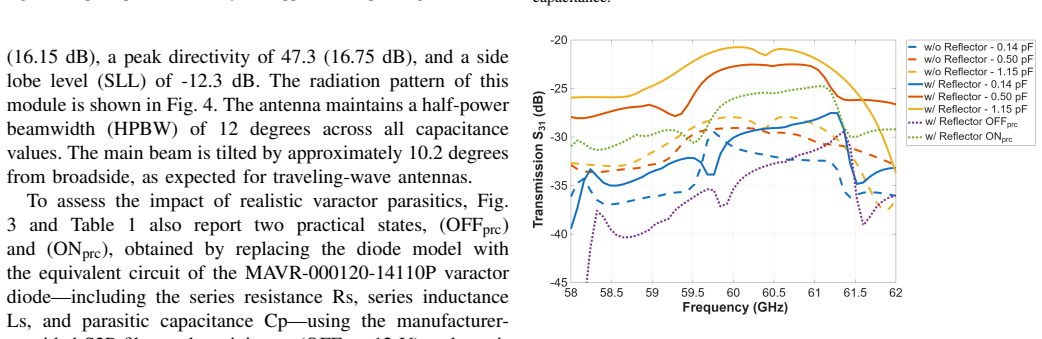
This letter presents the design and operation of an electronically reconfigurable pinching antenna (E-pinching antenna) and examines its capability to establish controllable millimeter-wave links that can circumvent blockages. The antenna consists of a low-loss rectangular dielectric waveguide that leaks energy through modular varactor-loaded elements to form tunable radiation points. A copper reflector ensures unidirectional radiation, thereby boosting forward-link efficiency and spatial selectivity. Full-wave simulations demonstrate that the radiated power and transmission coefficient to a receiving patch antenna can be dynamically tuned by adjusting the varactor capacitances. A multi-user scenario is investigated by activating two radiation modules along the waveguide to serve spatially separated receiving antennas isolated by a metallic partition (blockage). Simulation results confirm the capability to establish links to both LoS and NLoS users with minimal propagation losses. The proposed architecture enables a scalable and electronically controllable distributed antenna platform for reconfigurable wireless systems with enhanced blockage mitigation.
Figures



Reference graph
Works this paper leans on
-
[1]
A vision of 6g wireless systems: Applications, trends, technologies, and open research problems,
W. Saad, M. Bennis, and M. Chen, “A vision of 6g wireless systems: Applications, trends, technologies, and open research problems,”IEEE network, vol. 34, no. 3, pp. 134–142, 2019
2019
-
[2]
Nextg communications research and development gaps report,
N. T. Golmie, M. Leh, and M. Higgins, “Nextg communications research and development gaps report,” 2023-11-15 05:11:00
2023
-
[3]
Available: https://tsapps.nist.gov/publication/get pdf
[Online]. Available: https://tsapps.nist.gov/publication/get pdf. cfm?pub id=956201
-
[4]
Wireless communications and applications above 100 ghz: Opportunities and challenges for 6g and beyond,
T. S. Rappaport, Y . Xing, O. Kanhere, S. Ju, A. Madanayake, S. Mandal, A. Alkhateeb, and G. C. Trichopoulos, “Wireless communications and applications above 100 ghz: Opportunities and challenges for 6g and beyond,”IEEE access, vol. 7, pp. 78 729–78 757, 2019
2019
-
[5]
Reconfigurable intelligent surfaces: Principles and opportunities,
Y . Liu, X. Liu, X. Mu, T. Hou, J. Xu, M. Di Renzo, and N. Al-Dhahir, “Reconfigurable intelligent surfaces: Principles and opportunities,”IEEE Communications Surveys & Tutorials, vol. 23, no. 3, pp. 1546–1577, 2021
2021
-
[6]
Dynamic metasurface antennas for 6g extreme massive mimo communications,
N. Shlezinger, G. C. Alexandropoulos, M. F. Imani, Y . C. Eldar, and D. R. Smith, “Dynamic metasurface antennas for 6g extreme massive mimo communications,”IEEE Wireless Communications, vol. 28, no. 2, pp. 106–113, 2021
2021
-
[7]
Emerging technologies in intelligent metasurfaces: Shaping the future of wireless communications,
J. An, M. Debbah, T. J. Cui, Z. N. Chen, and C. Yuen, “Emerging technologies in intelligent metasurfaces: Shaping the future of wireless communications,” 2025. [Online]. Available: https://arxiv.org/abs/2411.19754
-
[8]
Fluid antenna systems,
K.-K. Wong, A. Shojaeifard, K.-F. Tong, and Y . Zhang, “Fluid antenna systems,”IEEE Transactions on Wireless Communications, vol. 20, no. 3, pp. 1950–1962, 2021
1950
-
[9]
A vision to smart radio environment: Surface wave communication superhighways,
K.-K. Wong, K.-F. Tong, Z. Chu, and Y . Zhang, “A vision to smart radio environment: Surface wave communication superhighways,”IEEE Wireless Communications, vol. 28, no. 1, pp. 112–119, 2021
2021
-
[10]
Design and evaluation of reconfigurable intelligent surfaces in real- world environment,
G. C. Trichopoulos, P. Theofanopoulos, B. Kashyap, A. Shekhawat, A. Modi, T. Osman, S. Kumar, A. Sengar, A. Chang, and A. Alkhateeb, “Design and evaluation of reconfigurable intelligent surfaces in real- world environment,”IEEE Open Journal of the Communications Society, vol. 3, pp. 462–474, 2022
2022
-
[11]
Wireless communications through reconfigurable intelligent surfaces,
E. Basar, M. Di Renzo, J. De Rosny, M. Debbah, M.-S. Alouini, and R. Zhang, “Wireless communications through reconfigurable intelligent surfaces,”IEEE Access, vol. 7, pp. 116 753–116 773, 2019
2019
-
[12]
Fluid antenna systems: Redefining reconfigurable wireless communications,
W. K. New, K.-K. Wong, C. Wang, C.-B. Chae, R. Murch, H. Jafarkhani, and Y . Hao, “Fluid antenna systems: Redefining reconfigurable wireless communications,”IEEE Journal on Selected Areas in Communications, vol. 44, pp. 1013–1044, 2026
2026
-
[13]
Reconfigurable antennas for 6g: Technologies, prototypes, architectures, and signal processing,
P. Zheng, R. Wang, Y . Zhang, M. J. Hossain, A. Chaaban, A. Shamim, and T. Y . Al-Naffouri, “Reconfigurable antennas for 6g: Technologies, prototypes, architectures, and signal processing,” 2025. [Online]. Available: https://arxiv.org/abs/2506.00657
-
[14]
Coverage and capacity of millimeter-wave cellular networks,
T. Bai, A. Alkhateeb, and R. W. Heath, “Coverage and capacity of millimeter-wave cellular networks,”IEEE Communications Magazine, vol. 52, no. 9, pp. 70–77, 2014
2014
-
[15]
Directional radio propagation path loss models for millimeter-wave wireless networks in the 28-, 60-, and 73-ghz bands,
A. I. Sulyman, A. Alwarafy, G. R. MacCartney, T. S. Rappaport, and A. Alsanie, “Directional radio propagation path loss models for millimeter-wave wireless networks in the 28-, 60-, and 73-ghz bands,” IEEE Transactions on Wireless Communications, vol. 15, no. 10, pp. 6939–6947, 2016
2016
-
[16]
Location based beamforming in 5g ultra-dense networks,
P. Kela, M. Costa, J. Turkka, M. Koivisto, J. Werner, A. Hakkarainen, M. Valkama, R. Jantti, and K. Leppanen, “Location based beamforming in 5g ultra-dense networks,” in2016 IEEE 84th V ehicular Technology Conference (VTC-Fall). IEEE, 2016, pp. 1–7
2016
-
[17]
Flexible-antenna systems: A pinching-antenna perspective,
Z. Ding, R. Schober, and H. Vincent Poor, “Flexible-antenna systems: A pinching-antenna perspective,”IEEE Transactions on Communications, vol. 73, no. 10, pp. 9236–9253, 2025
2025
-
[18]
Pinching antenna: Using a dielectric waveguide as an antenna,
H. O. Y . Suzuki and K. Kawai, “Pinching antenna: Using a dielectric waveguide as an antenna,”NTT DOCOMO Technical J, vol. 23, no. 3, pp. 5–12, 2022
2022
-
[19]
Pinching antennas: Principles, applications and challenges,
Z. Yang, N. Wang, Y . Sun, Z. Ding, R. Schober, G. K. Karagiannidis, V . W. S. Wong, and O. A. Dobre, “Pinching antennas: Principles, applications and challenges,”arXiv preprint arXiv:2501.10753, 2025
-
[20]
Multi-pin and movable-pin enabled discretely-activated pinching antenna systems,
L. Cao, H. Yin, X. Pei, R. Song, and Y . Liu, “Multi-pin and movable-pin enabled discretely-activated pinching antenna systems,”IEEE Wireless Communications Letters, vol. 15, pp. 590–594, 2026
2026
-
[21]
Dual-polarized polymer dielectric rod waveg- uide for 60 ghz band,
Y . Li and J. Hesselbarth, “Dual-polarized polymer dielectric rod waveg- uide for 60 ghz band,” in2024 15th German Microwave Conference (GeMiC), 2024, pp. 171–174
2024
-
[22]
Dielectric slab waveguide based millimeter- wave leaky-wave antennas,
U. Dey and J. Hesselbarth, “Dielectric slab waveguide based millimeter- wave leaky-wave antennas,” in12th European Conference on Antennas and Propagation (EuCAP 2018), 2018, pp. 1–5
2018
-
[23]
C. Yeh and F. I. Shimabukuro,The essence of dielectric waveguides. Springer, 2008. [23]Rectangular Cross-Section Waveguides and Cavities. John Wiley & Sons, Ltd, 2023, ch. 8, pp. 365–478. [Online]. Available: https://onlinelibrary.wiley.com/doi/abs/10.1002/9781394180042.ch8
-
[24]
High-gain dielectric lens antenna fed by circular dielectric waveguide for applications in d-band,
A. Pal, D. Dutta, and M. Schneider, “High-gain dielectric lens antenna fed by circular dielectric waveguide for applications in d-band,” in2025 19th European Conference on Antennas and Propagation (EuCAP), 2025, pp. 1–5
2025
-
[25]
A te01-he11 mode conversion system,
X.-J. Niu, L.-X. Wang, Y .-H. Liu, H. Wang, and H.-f. Li, “A te01-he11 mode conversion system,”Journal of Infrared, Millimeter , and Terahertz Waves, vol. 36, no. 11, pp. 1101–1111, 2015
2015
-
[26]
A comprehensive analysis of a te11 to he11 mode converter for an oversized f-band corrugated waveg- uide,
M. S. Choe, K. H. Kim, and E. Choi, “A comprehensive analysis of a te11 to he11 mode converter for an oversized f-band corrugated waveg- uide,”Journal of Electromagnetic Waves and Applications, vol. 27, no. 17, pp. 2221–2238, 2013
2013
-
[27]
A metal-to-dielectric waveguide transition with application to millimeter-wave integrated circuits,
T. Trinh, J. Malherbe, and R. Mittra, “A metal-to-dielectric waveguide transition with application to millimeter-wave integrated circuits,” in 1980 IEEE MTT-S International Microwave symposium Digest, 1980, pp. 205–207
1980
-
[28]
Investigation of metal to dielectric waveguide transition and the coupling characteristics of dielectric waveguides of rectangular cross section
T. N. Trinh, “Investigation of metal to dielectric waveguide transition and the coupling characteristics of dielectric waveguides of rectangular cross section.” Tech. Rep., 1980
1980
-
[29]
Millimeter-wave leaky-wave antennas based on polymer rod with periodic annular metal strips,
U. Dey, J. Tonn, and J. Hesselbarth, “Millimeter-wave leaky-wave antennas based on polymer rod with periodic annular metal strips,” in 2019 12th German Microwave Conference (GeMiC), 2019, pp. 9–12
2019
-
[30]
A fixed-frequency beam-steerable half- mode substrate integrated waveguide leaky-wave antenna,
A. Suntives and S. V . Hum, “A fixed-frequency beam-steerable half- mode substrate integrated waveguide leaky-wave antenna,”IEEE Trans- actions on Antennas and Propagation, vol. 60, no. 5, pp. 2540–2544, 2012
2012
-
[31]
Millimeter-wave reconfigurable intelli- gent surface with independent and continuous amplitude-phase control: Unit cell design and circuit model,
Y . Zhu, A. R. Vilenskiy, O. A. Iupikov, P. S. Krasov, T. Emanuelsson, G. Lasser, and M. V . Ivashina, “Millimeter-wave reconfigurable intelli- gent surface with independent and continuous amplitude-phase control: Unit cell design and circuit model,”IEEE Transactions on Antennas and Propagation, vol. 73, no. 10, pp. 7627–7641, 2025
2025
-
[32]
Pinching-antenna system design with los blockage: Does in-waveguide attenuation matter?
Y . Xu, Z. Ding, O. A. Dobre, and T.-H. Chang, “Pinching-antenna system design with los blockage: Does in-waveguide attenuation matter?” 2025. [Online]. Available: https://arxiv.org/abs/2508.07131
discussion (0)
Sign in with ORCID, Apple, or X to comment. Anyone can read and Pith papers without signing in.