Exploring the physics behind the observed magnetic filaments in large scale radio galaxies
Pith reviewed 2026-06-29 00:37 UTC · model grok-4.3
The pith
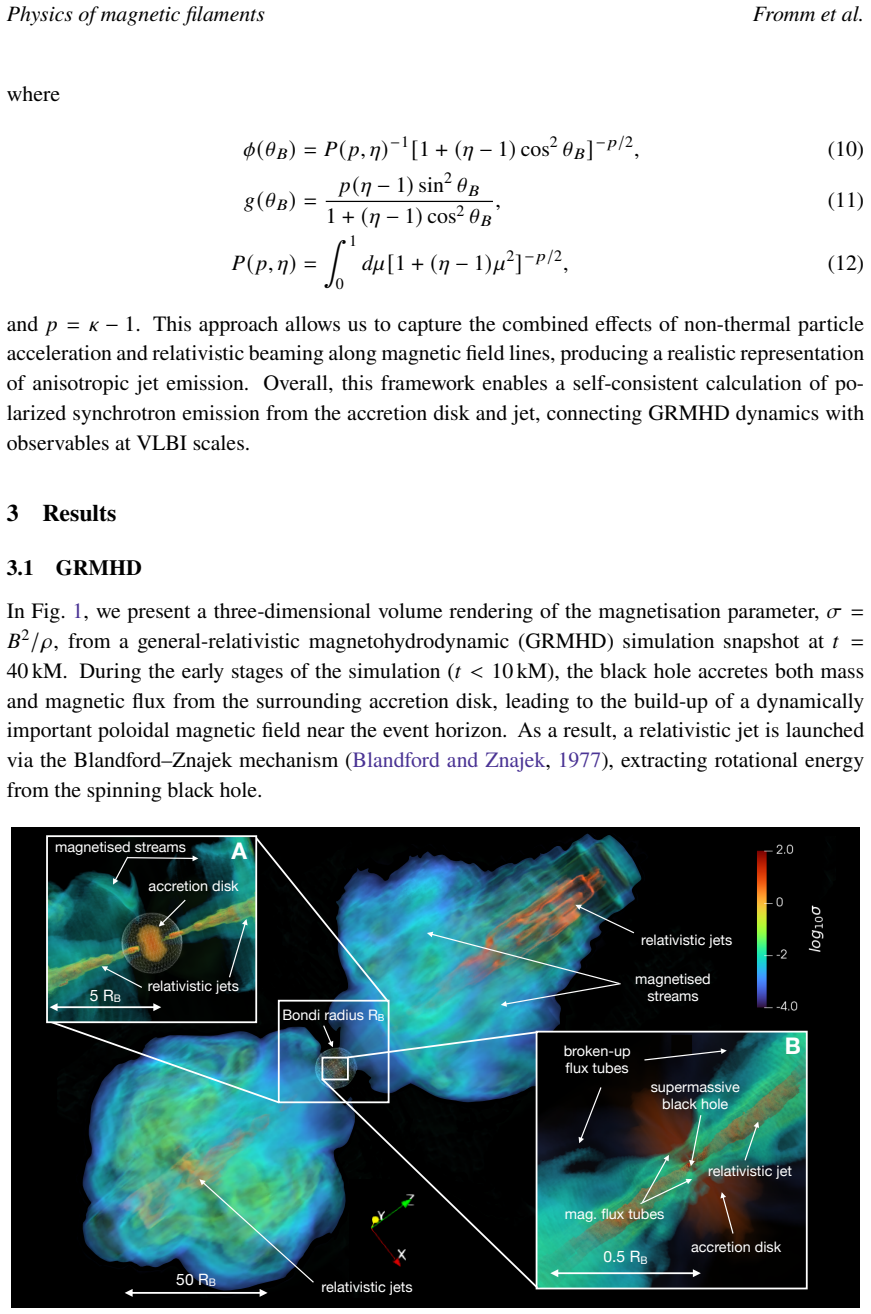
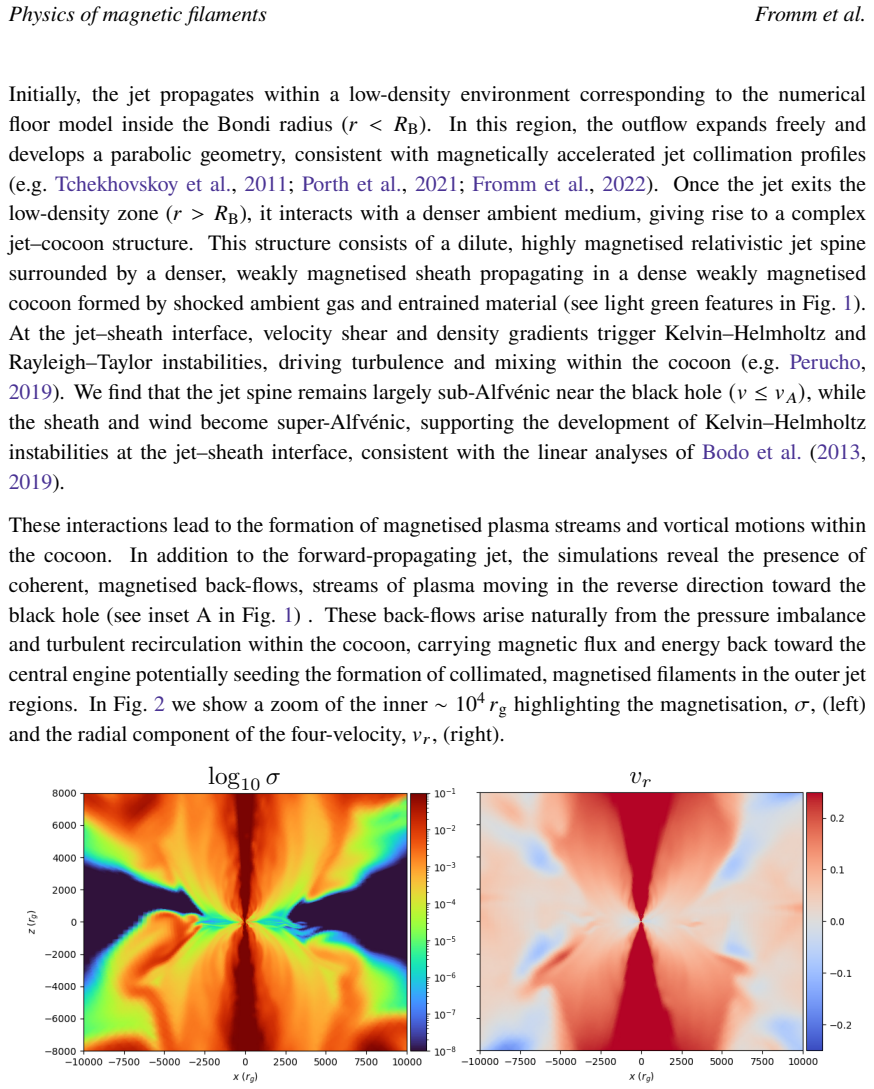
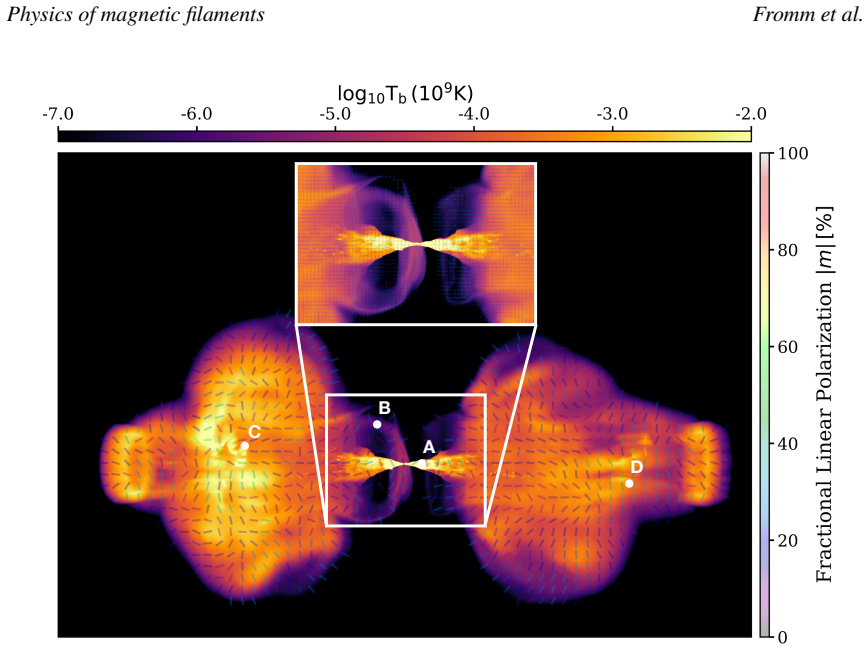
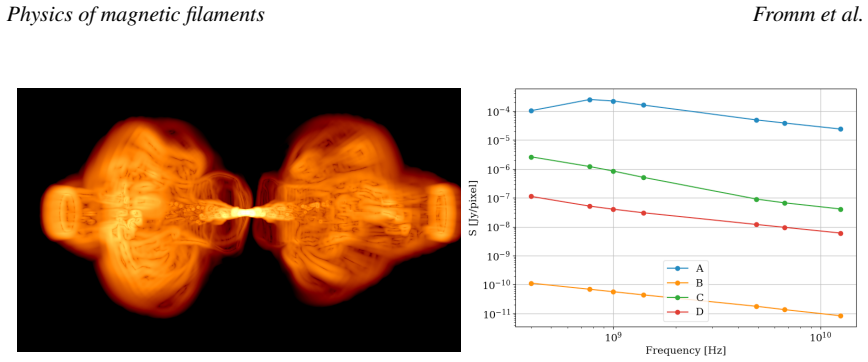
Three-dimensional simulations of jets launched from black holes can reproduce the thin magnetic filaments observed in radio galaxies.
A machine-rendered reading of the paper's core claim, the machinery that carries it, and where it could break.
Core claim
Three-dimensional two-temperature general relativistic magnetohydrodynamic simulations of realistically launched jets from supermassive black holes can predict the observable characteristics of magnetic filaments including morphology, brightness profiles, and polarisation patterns.
What carries the argument
Three-dimensional two-temperature general relativistic magnetohydrodynamic simulations of jet launching, which evolve the magnetic field and plasma to produce synthetic synchrotron emission and polarization maps.
If this is right
- The simulations reproduce the range of filament shapes, including narrow links between jets and lobes as well as ring- or ribbon-like features inside the lobes.
- Synthetic brightness profiles and polarization signatures provide testable predictions that can separate the jet-launching origin from other proposed mechanisms.
- The models indicate that upcoming sensitive observations can measure the magnetic structure inside the filaments and thereby constrain the jet-launching physics.
Where Pith is reading between the lines
- If the simulated filaments match observations, the same setup could be used to predict how filament properties change with black hole spin or accretion rate.
- The approach suggests that filament detectability depends on viewing angle and frequency, which could guide searches in existing survey data.
- Extending the models to include different ambient media might reveal whether external interactions are still needed to explain the most stable filaments.
Load-bearing premise
The chosen initial conditions and setup for launching the jets in the simulations accurately capture the real formation and stability of the observed filaments.
What would settle it
High-resolution polarization maps from future observations that show patterns inconsistent with those generated by the simulations would falsify the claim that the modeled jet launching reproduces the filaments.
Figures
read the original abstract
Recent low-frequency MeerKAT observations of radio galaxies have revealed an unexpected population of thin, highly collimated synchrotron threads, whose numbers continue to grow with increasing survey depth and sensitivity. These intricate structures display a remarkable diversity of morphologies -- appearing as narrow filaments linking jets and lobes, as well as ring- or ribbon-like features embedded within the jets and radio lobes. Despite their ubiquity, the physical origin and stability of these collimated synchrotron threads remain poorly understood. Proposed mechanisms include shock compression and interactions with the magneto-ionic intracluster medium, magnetic flux tube formation, and reconnection-driven magnetic filaments. In this work, we investigate the formation and evolution of such magnetic filaments using three-dimensional, two-temperature general relativistic magnetohydrodynamic (GRMHD) simulations of realistically launched jets from supermassive black holes. From these simulations, we compute synthetic synchrotron emission maps and polarisation signatures, allowing us to predict the observable characteristics including morphology, brightness profiles, and polarisation patterns. Finally, we assess the detectability and diagnostic potential of these signatures with the Square Kilometre Array Observatory (SKAO), outlining how upcoming SKA observations can distinguish between competing physical models and illuminate the magnetic origin of the collimated synchrotron threads revealed by MeerKAT observations.
Editorial analysis
A structured set of objections, weighed in public.
Referee Report
Summary. The manuscript outlines a planned study of magnetic filaments in radio galaxies via three-dimensional two-temperature GRMHD simulations of jet launching from supermassive black holes. It describes computing synthetic synchrotron emission maps and polarization signatures to predict filament morphology, brightness profiles, and polarization patterns, then assessing their detectability with SKAO to distinguish physical models against MeerKAT observations.
Significance. If the described simulations were performed and successfully reproduced observed filament properties with falsifiable predictions matching data, the work would offer a valuable forward-modeling framework for interpreting magnetic structures in radio galaxies. However, the manuscript contains no simulation outputs, synthetic maps, extracted properties, or comparisons, so no such result is demonstrated.
major comments (2)
- [Abstract] Abstract: The central claim that the GRMHD simulations 'can predict the observable characteristics including morphology, brightness profiles, and polarisation patterns' is not supported by any presented results, figures, or analysis. The text frames the work as an investigation that computes these signatures, yet provides only a methodology outline with no outputs or validation.
- [Results (absent)] No results section or equivalent: The manuscript lacks any simulation outputs, synthetic emission maps, brightness profile extractions, polarization patterns, or direct comparisons to MeerKAT data. Without these, the assertion that the chosen setup reproduces filament formation and stability mechanisms cannot be evaluated.
Simulated Author's Rebuttal
We thank the referee for their detailed assessment. The manuscript is framed as a methodological outline for GRMHD-based forward modeling of magnetic filaments, rather than a presentation of completed simulation results. We agree that the current wording in the abstract and body can be read as implying executed computations and outputs that are not present, and we will revise the text to accurately reflect the planned nature of the study while preserving its scientific motivation.
read point-by-point responses
-
Referee: [Abstract] Abstract: The central claim that the GRMHD simulations 'can predict the observable characteristics including morphology, brightness profiles, and polarisation patterns' is not supported by any presented results, figures, or analysis. The text frames the work as an investigation that computes these signatures, yet provides only a methodology outline with no outputs or validation.
Authors: We accept this criticism. The abstract employs present-tense phrasing ('we investigate', 'we compute', 'allowing us to predict') that implies completed work and delivered predictions. This was an imprecise choice of wording for a methods-oriented paper. We will rewrite the abstract to state that the work describes the simulation setup and the planned computation of synthetic maps and polarization signatures, without claiming that such outputs are shown or validated here. revision: yes
-
Referee: [Results (absent)] No results section or equivalent: The manuscript lacks any simulation outputs, synthetic emission maps, brightness profile extractions, polarization patterns, or direct comparisons to MeerKAT data. Without these, the assertion that the chosen setup reproduces filament formation and stability mechanisms cannot be evaluated.
Authors: The manuscript intentionally omits a results section because its scope is the description of the numerical approach, jet-launching setup, and analysis pipeline that will be used to generate the synthetic observables. No claim is made that filament formation has already been reproduced or that specific maps have been produced. We will add an explicit 'Scope and Limitations' paragraph (or equivalent) early in the text to clarify that this is a methods paper outlining a forward-modeling framework, with the actual simulation outputs and comparisons reserved for follow-up work. revision: yes
Circularity Check
No circularity: forward modeling from GRMHD simulations to synthetic observables
full rationale
The paper's central claim rests on running 3D two-temperature GRMHD simulations of jet launching from SMBHs, then post-processing to produce synthetic synchrotron emission maps, brightness profiles, and polarization signatures. This is a standard forward-modeling workflow with no parameter fitting to observed filament data, no equations that define outputs in terms of themselves, and no load-bearing self-citations or uniqueness theorems invoked. The abstract explicitly frames the work as computing predictions from the simulations rather than fitting or renaming known results. No derivation step reduces to its own inputs by construction.
Axiom & Free-Parameter Ledger
Reference graph
Works this paper leans on
-
[1]
doi: 10.1093/mnras/179.3
-
[2]
doi: 10.1093/mnras/stt1225. G. Bodo, G. Mamatsashvili, P. Rossi, and A. Mignone.MNRAS, 485(2):2909–2921, May
-
[3]
doi: 10.1093/mnras/stz591. A. Botteon et al.A&A, 698:A55, June
-
[4]
doi: 10.1051/0004-6361/202554695. L. Comisso.ApJ, 972(1):9, Sept
-
[5]
doi: 10.3847/1538-4357/ad51fe. J. J. Condon et al.ApJ, 917(1):18, Aug
-
[6]
doi: 10.3847/1538-4357/ac0880. L. G. Fishbone and V. Moncrief.ApJ, 207:962–976, Aug
-
[7]
doi: 10.1086/154565. C. M. Fromm et al.A&A, 660:A107, Apr
-
[8]
doi: 10.1051/0004-6361/202142295. C. F. Gammie.ApJ, 980(2):193, Feb
-
[9]
doi: 10.3847/1538-4357/adaea3. A. Lalakos et al.ApJ, 964(1):79, Mar
-
[10]
1https://i4ds.github.io/Karabo-Pipeline/index.html 10 Physics of magnetic filaments Fromm et al
doi: 10.3847/1538-4357/ad0974. 1https://i4ds.github.io/Karabo-Pipeline/index.html 10 Physics of magnetic filaments Fromm et al. C. Meringolo, A. Cruz-Osorio, L. Rezzolla, and S. Servidio.ApJ, 944(2):122, Feb
-
[11]
doi: 10.3847/1538-4357/acaefe. Y. Mizuno et al.MNRAS, 506(1):741–758, Sept
-
[12]
doi: 10.1093/mnras/stab1753. M. Mościbrodzka and C. F. Gammie.MNRAS, 475(1):43–54, Mar
-
[13]
doi: 10.1093/mnras/ stx3162. A. Pandya, Z. Zhang, M. Chandra, and C. F. Gammie.ApJ, 822(1):34, May
-
[14]
doi: 10.3390/galaxies7030070. O. Porth, Y. Mizuno, Z. Younsi, and C. M. Fromm.MNRAS, 502(2):2023–2032, Apr
-
[15]
doi: 10.1093/mnras/stab163. B. S. Prather.arXiv e-prints, art. arXiv:2408.01361, Aug
-
[16]
doi: 10.48550/arXiv.2408.01361. M. Ramatsoku, T. Oosterloo, P. Serra, et al.A&A, 640:A22,
-
[18]
doi: 10.3847/2041-8213/ad24fc. L. Rudnick et al.ApJ, 935(2):168, Aug
-
[19]
doi: 10.3847/1538-4357/ac7c76. A. Tchekhovskoy, R. Narayan, and J. C. McKinney.MNRAS, 418:L79–L83,
-
[20]
doi: 10.1111/j. 1745-3933.2011.01147.x. Y. Tsunetoe et al.ApJ, 984(1):35, May
work page doi:10.1111/j 2011
-
[21]
N.Upreti,B.Vaidya,andA.Shukla.JournalofHighEnergyAstrophysics,44:146–163,Nov.2024
doi: 10.3847/1538-4357/adc37a. N.Upreti,B.Vaidya,andA.Shukla.JournalofHighEnergyAstrophysics,44:146–163,Nov.2024. doi: 10.1016/j.jheap.2024.09.007. T. Venturi, S. Giacintucci, D. Dallacasa, et al.A&A, 658:A38,
-
[22]
doi: 10.1051/0004-6361/ 202142593. V.Zhdankin, M.W.Kunz, andD.A.Uzdensky.ApJ,944(1):24, Feb.2023. ISSN1538-4357. doi: 10.3847/1538-4357/acaf54. URLhttp://dx.doi.org/10.3847/1538-4357/acaf54. 11
discussion (0)
Sign in with ORCID, Apple, or X to comment. Anyone can read and Pith papers without signing in.