Entropy engineering of BF-BT-based high-entropy ceramics for ultra-high energy storage performance
Pith reviewed 2026-06-29 01:02 UTC · model grok-4.3
The pith
High-entropy substitution in BF-BT ceramics yields 10.55 J/cm³ recoverable energy density at 840 kV/cm breakdown strength.
A machine-rendered reading of the paper's core claim, the machinery that carries it, and where it could break.
Core claim
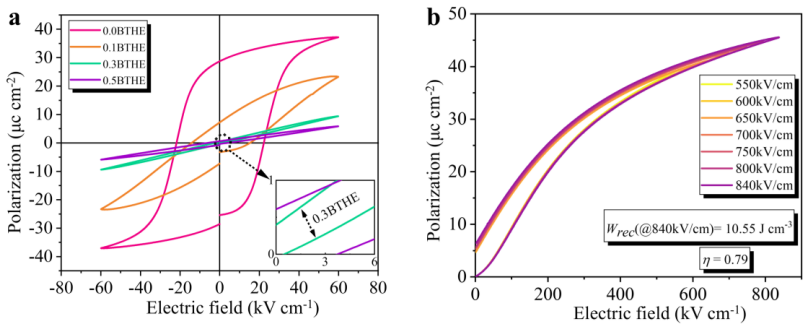
Multicomponent B-site substitution in the BF-BT matrix induces lattice distortion, enhanced pseudocubic characteristics, relaxor behavior, and grain refinement that suppress polarization hysteresis and electrical conduction, resulting in a maximum breakdown strength of 840 kV/cm and recoverable energy density of 10.55 J/cm³ through entropy-induced microstructural heterogeneity that distributes the electric field more uniformly.
What carries the argument
Entropy-induced microstructural heterogeneity that promotes uniform electric-field distribution and delays dielectric breakdown.
If this is right
- Reduced hysteresis directly raises the fraction of stored energy that can be recovered.
- Grain refinement and lattice distortion both contribute to higher breakdown fields.
- Lower conduction losses allow sustained operation at elevated voltages.
- The same entropy route can be applied to other lead-free perovskite families to improve capacitor metrics.
Where Pith is reading between the lines
- The heterogeneity mechanism may also improve fatigue resistance in repeated high-field cycling.
- Similar entropy mixing could be tested in thin-film geometries where grain-size effects are even stronger.
- Varying the number or identity of B-site species offers a knob for tuning the relaxor transition temperature.
Load-bearing premise
The gains in breakdown strength and energy density arise primarily from the multicomponent B-site substitution and resulting lattice distortion rather than from differences in sintering conditions, electrode quality, or measurement protocols.
What would settle it
Control samples prepared under identical sintering and electrode conditions but using only single-component or low-entropy B-site doping would show whether comparable breakdown strength and energy density can be reached without the high-entropy addition.
Figures
read the original abstract
Dielectric capacitors are promising for pulsed power applications, but the energy storage performance of lead-free bulk ceramics is often limited by low breakdown strength and large ferroelectric hysteresis. Herein, a high entropy perovskite oxide BaTi0.2Zr0.2Sn0.2Hf0.2Nb0.1Sc0.1O3 was introduced into the BF-BT matrix to develop lead free high entropy ferroelectric ceramics. Multicomponent B-site substitution induces lattice distortion, enhanced pseudocubic characteristics, relaxor behavior, and grain refinement. These effects suppress polarization hysteresis and electrical conduction, resulting in a significant increase in breakdown strength. A maximum breakdown strength of 840 kV/cm1 and a recoverable energy density of 10.55 J/cm3 were achieved. Entropy-induced microstructural heterogeneity promotes a more uniform electric-field distribution and delays dielectric breakdown. This work demonstrates entropy engineering as an effective route to achieving high breakdown strength and superior energy-storage performance in lead-free ferroelectric ceramics.
Editorial analysis
A structured set of objections, weighed in public.
Referee Report
Summary. The manuscript reports the development of lead-free high-entropy ferroelectric ceramics by incorporating the multicomponent perovskite BaTi0.2Zr0.2Sn0.2Hf0.2Nb0.1Sc0.1O3 into a BF-BT matrix. Multicomponent B-site substitution is claimed to induce lattice distortion, enhanced pseudocubic character, relaxor behavior, grain refinement, and microstructural heterogeneity, which suppress polarization hysteresis and conduction, yielding a maximum breakdown strength of 840 kV/cm and recoverable energy density of 10.55 J/cm³. The performance is attributed to entropy-induced uniform electric-field distribution that delays dielectric breakdown.
Significance. If the reported gains can be isolated to the entropy-specific structural changes rather than processing variables, the work would offer a new materials-design route for high-performance lead-free dielectrics in pulsed-power applications. The numerical values are competitive, but their attribution requires rigorous controls.
major comments (2)
- [Abstract / Experimental Methods] The central claim that the 840 kV/cm breakdown strength and 10.55 J/cm³ energy density arise from entropy-induced microstructural heterogeneity (Abstract) cannot be evaluated without explicit demonstration that baseline BF-BT and lower-entropy compositions were synthesized, sintered, electroded, and measured under identical conditions. No such statement or comparative data set is indicated in the abstract or described full-text structure.
- [Abstract / Results] The abstract states performance numbers without reference to raw P-E loop data, error bars, number of samples, or exclusion criteria. The full manuscript must supply these statistics to support the claim that the gains are reproducible and attributable to the multicomponent substitution rather than measurement variability.
minor comments (2)
- [Abstract] Abstract contains a likely formatting error: '840 kV/cm1' should be corrected to '840 kV/cm'.
- [Abstract] Energy-density units are written as 'J/cm3' without proper superscript; consistent formatting (J/cm³) is needed throughout.
Simulated Author's Rebuttal
We thank the referee for the constructive comments. We address each major point below and will revise the manuscript accordingly to improve clarity on controls and statistics.
read point-by-point responses
-
Referee: [Abstract / Experimental Methods] The central claim that the 840 kV/cm breakdown strength and 10.55 J/cm³ energy density arise from entropy-induced microstructural heterogeneity (Abstract) cannot be evaluated without explicit demonstration that baseline BF-BT and lower-entropy compositions were synthesized, sintered, electroded, and measured under identical conditions. No such statement or comparative data set is indicated in the abstract or described full-text structure.
Authors: We agree that the abstract would benefit from an explicit statement. The Experimental Methods section details that the baseline BF-BT and all substituted compositions (including lower-entropy variants) were prepared by identical solid-state reaction, calcined at 1100 °C, sintered at 1200 °C, and electroded with the same Ag paste and poling protocol. Comparative performance data appear in Figures 2–5 and Table 1. We will add a clarifying sentence to the abstract and a short paragraph in Methods confirming identical processing conditions to strengthen attribution to the entropy-induced effects. revision: yes
-
Referee: [Abstract / Results] The abstract states performance numbers without reference to raw P-E loop data, error bars, number of samples, or exclusion criteria. The full manuscript must supply these statistics to support the claim that the gains are reproducible and attributable to the multicomponent substitution rather than measurement variability.
Authors: We accept this point. The manuscript presents raw P-E loops in Figure 3 and energy-density values averaged from five independently prepared and measured samples per composition, with standard deviations shown as error bars in Figure 5. No samples were excluded beyond those with visible electrode defects. We will revise the abstract to include a brief qualifier on reproducibility and add a short statistical-methods paragraph in the revised manuscript. revision: yes
Circularity Check
No circularity: purely experimental report with no derivations or self-referential claims
full rationale
The manuscript is an experimental materials science study reporting synthesis, structural characterization, and dielectric measurements on BF-BT-based high-entropy ceramics. No equations, models, or derivation chains appear in the provided text. Performance metrics (840 kV/cm breakdown strength, 10.55 J/cm³ energy density) are presented as direct experimental outcomes rather than predictions derived from fitted parameters or self-citations. No load-bearing steps reduce to self-definition, renamed known results, or author-specific uniqueness theorems. The work is self-contained against external benchmarks of processing and measurement, warranting a zero circularity score.
Axiom & Free-Parameter Ledger
Reference graph
Works this paper leans on
-
[1]
Institute of Applied Physics and Materials Engineering, University of Macau, Avenida da Universidade, Taipa, Macao Special Administrative Region of the People’s Republic of China 999078, P.R. China
-
[2]
China *Corresponding author
Precision Acousto-optic Instrument Institute, School of Instrumentation Science and Engineering, Harbin Institute of Technology, Harbin 150080, P.R. China *Corresponding author. E-mail address: yc27825@um.edu.mo 2 Abstract Dielectric capacitors are critical components in pulsed power and advanced electronic systems; however, most lead-free bulk ceramic di...
-
[3]
The continuous miniaturization and performance advancement of modern electronic systems demand dielectric materials
Introduction Dielectric capacitors play a pivotal role in pulsed power systems, electric vehicles, renewable energy conversion, and advanced electronics owing to their rapid charge – discharge capability and high power density [1]. The continuous miniaturization and performance advancement of modern electronic systems demand dielectric materials . These m...
-
[4]
Experimental BaCO3, Bi2O3, TiO2, Fe2O3, HfO2, ZrO2, SnO2, Nb2O5, and Sc2O3 were used as starting materials. Starting materials were weighed according to the designed stoichiometric ratios ((0.7BiFeO3–0.3BaTiO3)–xBa(Ti0.2Zr0.2Sn0.2Hf0.2Nb0.1Sc0.1)O3, x= 0, 0.1, 0.3, 0.5) and dispersed in ethanol and subjected to wet ball milling with zirconia milling media...
2000
-
[5]
entropy effect
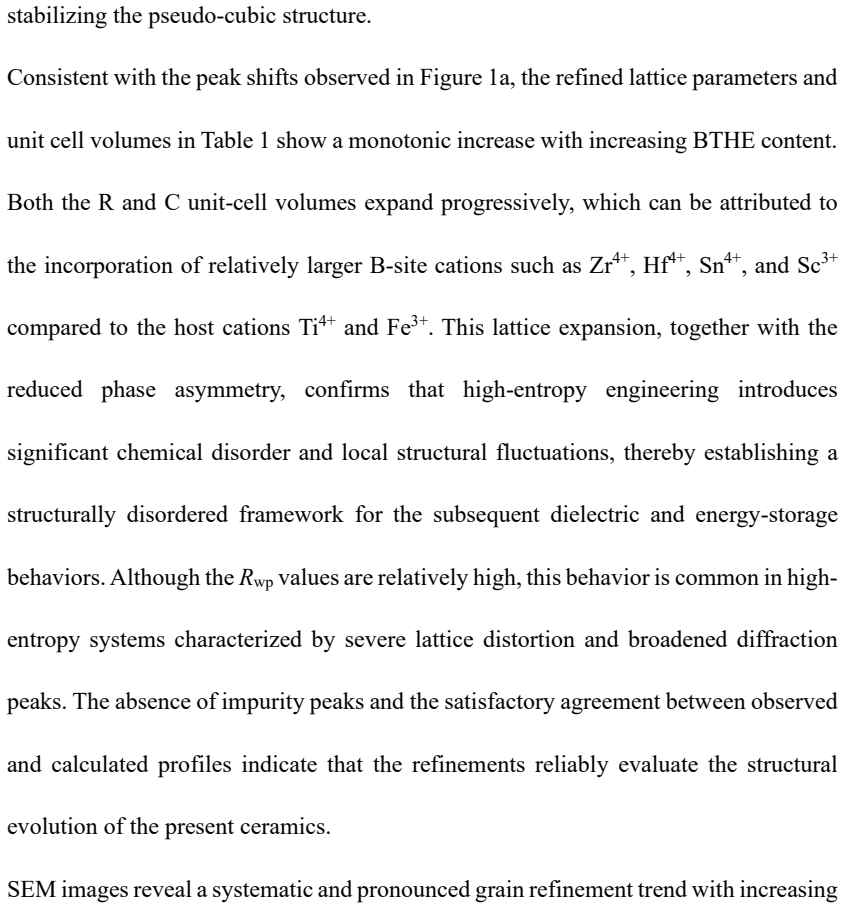
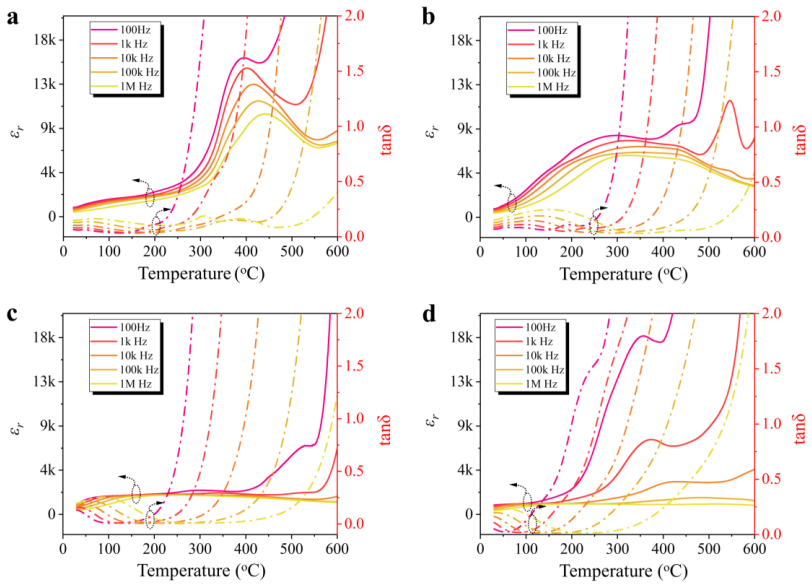
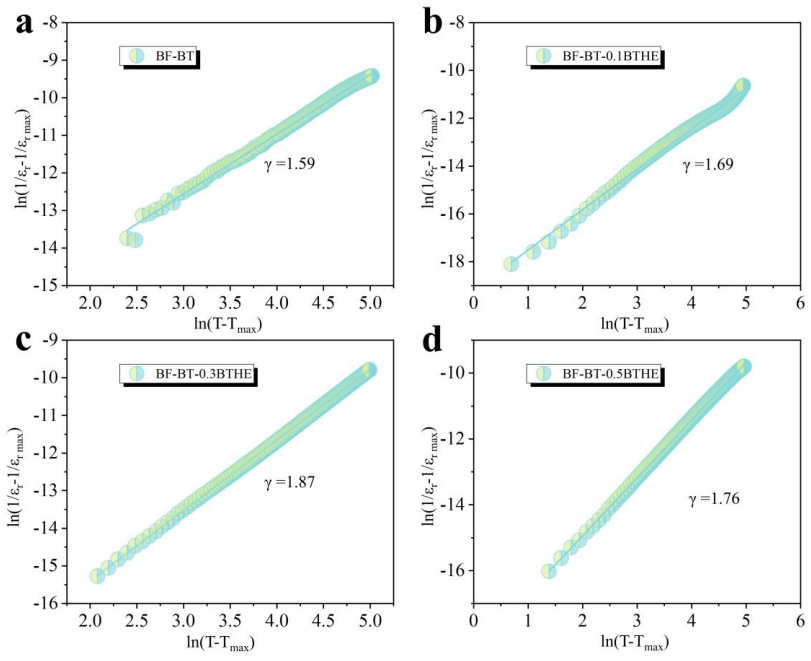
Results and Discussion Figure 1a presents the XRD patterns of BF–BT and BF–BT–xBTHE (x = 0.1, 0.3, and 0.5) ceramics, together with enlarged views of selected diffraction peaks. According to the actual chemical formula, the average B-site configurational entropy increases from 1.14R (x = 0.1) to 1.69R (x = 0.5), w hile the x = 0.3 composition reach es the...
-
[6]
Conclusion In conclusion, we successfully employed an entropy-engineering strategy to develop BF–BT–xBTHE lead-free high-entropy ferroelectric ceramics with outstanding energy storage performance. The introduction of multicomponent B-site cations induces severe lattice distortion, relaxor ferroelectric behavior, and significant grain refinement, collectiv...
-
[7]
Q.K. Feng, S.L. Zhong, J.Y . Pei, Y . Zhao, D.L. Zhang, D.F. Liu, Y .X. Zhang, Z.M. Dang, Recent Progress and Future Prospects on All-Organic Polymer Dielectrics for Energy Storage Capacitors, Chem. Rev. 122 (2021) 3820–3878. https://doi.org/10.1021/ACS.CHEMREV .1C00793
-
[9]
Y . Wang, B. Zhang, M. Mao, L. Cao, A.A. Mohamad, A.A. Alshoaibi, G. Abdurakhmanov, X. Lou, D. Wang, K. Song, Optimization strategies of filler morphology and spatial design in polymer nanocomposites for next-generation energy storage, Https://Doi.Org/10.1142/S2010135X25300014 15 (2025). https://doi.org/10.1142/S2010135X25300014
-
[10]
H. Zubairi, Z. Lu, Y . Zhu, I.M. Reaney, G. Wang, Current development, optimisation strategies and future perspectives for lead-free dielectric ceramics in high field and high energy density capacitors, Chem. Soc. Rev. 53 (2024) 10761–10790. https://doi.org/10.1039/D4CS00536H
-
[11]
Y . Song, W. Yue, F. Huang, Y . Deng, Y . Zhang, J. Ming, F. Hussain, A. Alshoaibi, G. Abdurakhmanov, J. Wang, D. Wang, Effect of Annealing Temperature on Energy Storage Performance of SrBi3.25La0.75Ti4O15 Thin Films, Ceramic 9 (2026) 20. https://doi.org/10.3390/ceramics9020020
-
[12]
H. Li, S. Zhou, J. Zhao, T. Yan, Y . Du, H. Zhou, Y . Pu, D. Wang, Dielectric temperature stability and energy storage performance of NBT-based lead-free ceramics for Y9P capacitors, J. Adv. Dielectr. 13 (2023). 19 https://doi.org/10.1142/S2010135X22420073
-
[13]
F. Yan, J. Qian, S. Wang, J. Zhai, Progress and outlook on lead-free ceramics for energy storage applications, Nano Energy 123 (2024) 109394. https://doi.org/10.1016/J.NANOEN.2024.109394
-
[14]
H. Qin, J. Zhao, X. Chen, H. Li, S. Wang, Y . Du, H. Zhou, P. Li, D. Wang, Investigation of BiFeO 3 -BaTiO 3 lead-free piezoelectric ceramics with nonstoichiometric bismuth , Microstructures 3 (2023). https://doi.org/10.20517/MICROSTRUCTURES.2023.34
-
[15]
H. Qin, J. Zhao, X. Chen, H. Li, S. Wang, Y . Du, P. Li, H. Zhou, D. Wang, Investigation of lead-free BiFeO3–BaTiO3 piezoelectric ceramics through precise composition control, J. Adv. Dielectr. 13 (2023) 2350018. https://doi.org/10.1142/S2010135X23500182
-
[16]
B. Wang, W. Liu, T. Zhao, W. Peng, P. Ci, S. Dong, Promising Lead-Free BiFeO3-BaTiO3 Ferroelectric Ceramics: Optimization Strategies and Diverse Device Applications, Prog. Mater. Sci. 146 (2024) 101333. https://doi.org/10.1016/J.PMATSCI.2024.101333
-
[17]
S. Chen, T. Wang, S. Xie, J. Leng, Q. Zhu, K. Li, W. Gong, J. Zhu, Q. Wang, High-Entropy Strategy for Improved Mechanical and Energy Storage Properties in BaTiO3-BiFeO3-Based Ceramics, ACS Appl. Mater. Interfaces 16 (2024) 12521–12533. https://doi.org/10.1021/ACSAMI.3C18262/SUPPL_FILE/AM3C18262_SI_00 1.PDF
work page doi:10.1021/acsami.3c18262/suppl_file/am3c18262_si_00 2024
-
[18]
T. Wang, X. Wu, S. Chen, X. Li, J. Zhao, W. Gong, S. V . Prabhakar Vattikuti, S. Song, P. Rosaiah, Q. Zhang, Improved energy storage properties of BaTiO3- (Na0.5Bi0.5)TiO3 ceramics via additive of linear dielectric Ca0.7La0.2TiO3, Ceram. Int. 52 (2026) 5878–5887. https://doi.org/10.1016/J.CERAMINT.2025.12.348. 20
-
[19]
D. Wang, G. Wang, S. Murakami, Z. Fan, A. Feteira, D. Zhou, S. Sun, Q. Zhao, I.M. Reaney, BiFeO3-BaTiO3: A new generation of lead-free electroceramics, J. Adv. Dielectr. 8 (2018). https://doi.org/10.1142/S2010135X18300049
-
[20]
Z. wei Li, Z. hui Chen, J. jun Xu, Enhanced energy storage performance of BaTi0.97Ca0.03O2.97-based ceramics by doping high-entropy perovskite oxide, J. Alloys Compd. 922 (2022) 166179. https://doi.org/10.1016/J.JALLCOM.2022.166179
-
[21]
X. Zhang, J. Sun, Y . Zhang, K. Fan, Z. Zhang, Y . Zhang, K. Wu, L. Feldmann, L. Wu, R. Riedel, H. Li, Machine learning for phase prediction of high entropy carbide ceramics from imbalanced data, Npj Computational Materials 2026 12:1 12 (2026) 22-. https://doi.org/10.1038/s41524-025-01873-2
-
[22]
Y . Zhang, Z. Zhang, X. Zhang, K. Wu, R. Riedel, D. Hu, Y . Xu, L. Wu, J. Sun, Machine learning guided design and ablation behavior of ZrC-TaC-SiC ternary coatings, Corros. Sci. 260 (2026) 113499. https://doi.org/10.1016/J.CORSCI.2025.113499
-
[24]
J. Li, Y . Zhang, Z. Liu, L. Wei, H. Peng, M. Liu, S. Yan, K. Zhao, H. Zeng, Z. Yang, G. Wang, Enhanced energy-storage in lead-free multilayer capacitors via entropy-assisted polymorphic domain engineering, Nature Communications 2025 16:1 16 (2025) 8580-. https://doi.org/10.1038/s41467-025-63584-y
-
[25]
W. Shi, M. Meng, L. Zhang, F. Chen, Y . Yang, V . Shur, R. Jing, G. Liu, L. Jin, High-entropy engineering of BNKT-based ceramics enables ultrastable dielectric energy storage, Chemical Engineering Journal 522 (2025) 167352. https://doi.org/10.1016/J.CEJ.2025.167352. 21
-
[26]
B. Cantor, I.T.H. Chang, P. Knight, A.J.B. Vincent, Microstructural development in equiatomic multicomponent alloys, Materials Science and Engineering: A 375–377 (2004) 213–218. https://doi.org/10.1016/j.msea.2003.10.257
-
[27]
Yeh, S.K
J.W. Yeh, S.K. Chen, S.J. Lin, J.Y . Gan, T.S. Chin, T.T. Shun, C.H. Tsau, S.Y . Chang, Nanostructured high-entropy alloys with multiple principal elements: Novel alloy design concepts and outcomes, Adv. Eng. Mater. 6 (2004) 299–
2004
-
[28]
https://doi.org/10.1002/adem.200300567
-
[29]
D.B. Miracle, O.N. Senkov, A critical review of high entropy alloys and related concepts, Acta Mater. 122 (2017) 448–511. https://doi.org/10.1016/j.actamat.2016.08.081
-
[30]
C.M. Rost, E. Sachet, T. Borman, A. Moballegh, E.C. Dickey, D. Hou, J.L. Jones, S. Curtarolo, J.-P. Maria, Entropy-stabilized oxides, Nat. Commun. 6 (2015) 8485
2015
-
[31]
V . Westphal, W. Kleemann, M.D. Glinchuk, Diffuse phase transitions and random-field-induced domain states of the ‘“relaxor”’ ferroelectric PbMg1/3Nb2/3O3, Phys. Rev. Lett. 68 (1992) 847. https://doi.org/10.1103/PhysRevLett.68.847
-
[32]
A.A. Bokov, Z.G. Ye, Recent progress in relaxor ferroelectrics with perovskite structure, Journal of Materials Science 2006 41:1 41 (2006) 31–52. https://doi.org/10.1007/s10853-005-5915-7
-
[33]
A. Sarkar, L. Velasco, D. Wang, Q. Wang, G. Talasila, L. de Biasi, C. Kübel, T. Brezesinski, S.S. Bhattacharya, H. Hahn, B. Breitung, High entropy oxides for reversible energy storage, Nat. Commun. 9 (2018) 3400. https://doi.org/10.1038/s41467-018-05774-5
-
[34]
D. Liu, L. Wang, X. Wang, T. Tang, Q. Wang, J.R. Li, B.P. Zhang, L.F. Zhu, 22 Excellent energy storage performances for BaTiO3-based multilayer capacitors through synergistic high-entropy and superparaelectric-relaxor strategy, Journal of Materiomics 11 (2025) 100860. https://doi.org/10.1016/J.JMAT.2024.03.005
-
[35]
P. Gao, R. Zhang, C. Liu, H. Wang, W. Geng, J. Zhang, Z. Sun, Y . Tian, X. Ren, Significant enhancement of comprehensive energy storage performance in BaTiO3-based ceramics through high-entropy design, J. Eur. Ceram. Soc. 45 (2025) 117401. https://doi.org/10.1016/J.JEURCERAMSOC.2025.117401
-
[37]
H. Li, X. Li, Y . Du, X. Chen, H. Qin, Y . Tabak, A. Evcin, F. Hussain, K. Song, H. Zhou, J. Zhao, D. Wang, Remarkable energy storage performance of BiFeO3-based high-entropy lead-free ceramics and multilayers, Chemical Engineering Journal 499 (2024) 156112. https://doi.org/10.1016/j.cej.2024.156112
-
[38]
S. Chen, T. Wang, S. Xie, J. Leng, Q. Zhu, K. Li, W. Gong, J. Zhu, Q. Wang, High-Entropy Strategy for Improved Mechanical and Energy Storage Properties in BaTiO3–BiFeO3-Based Ceramics, ACS Appl. Mater. Interfaces 16 (2024) 12521–12533. https://doi.org/10.1021/ACSAMI.3C18262
-
[40]
J. Liu, C. Ma, R. Liang, X. Zhao, Y . Bai, X. Liu, K. Ren, H. Du, Y . Wang, Phase transition and large strain response with ultra-low hysteresis of BaTiO3 doped with a high-entropy perovskite oxide, Chemical Engineering Journal 488 (2024) 150823. https://doi.org/10.1016/J.CEJ.2024.150823
-
[42]
J. Duan, K. Wei, Q. Du, L. Ma, H. Yu, H. Qi, Y . Tan, G. Zhong, H. Li, High- entropy superparaelectrics with locally diverse ferroic distortion for high- capacitive energy storage, Nature Communications 2024 15:1 15 (2024) 6754-. https://doi.org/10.1038/s41467-024-51058-6
-
[44]
Z. Wang, Y . Ning, B. Xie, X. Fan, M. Zhan, M. Fu, Coalescence‐Ripening Mechanism of γ′−Ni 3 (Al, Ti) During Long‐Term/High‐Temperature Operation of Ni‐Based Superalloy Discs , Rare Metals 45 (2026) e70130. https://doi.org/10.1002/RAR2.70130;PAGE:STRING:ARTICLE/CHAPTER
work page doi:10.1002/rar2.70130;page:string:article/chapter 2026
-
[45]
C. Duan, L. Guan, Y . Zhu, J. Zhang, K. Cheng, Z. Wang, Y . Zhang, Z. Huang, Q. Gao, X. Guo, B. Zhao, R. Zhang, Rapid microwave heating synthesis and microwave coupling mechanism of transition metal high-entropy carbides, Ceram. Int. 51 (2025) 47506–47515. https://doi.org/10.1016/J.CERAMINT.2025.08.308
-
[46]
S. Zhou, Y . Pu, X. Zhang, Y . Shi, Z. Gao, Y . Feng, G. Shen, X. Wang, D. Wang, 24 High energy density, temperature stable lead-free ceramics by introducing high entropy perovskite oxide, Chemical Engineering Journal 427 (2022) 131684. https://doi.org/https://doi.org/10.1016/j.cej.2021.131684
-
[47]
K. Uchino, S. Nomura, Critical exponents of the dielectric constants in diffused-phase-transition crystals, Ferroelectrics 44 (1982) 55–61. https://doi.org/10.1080/00150198208260644
-
[48]
S. Murakami, D. Wang, A. Mostaed, A. Khesro, A. Feteira, D.C. Sinclair, Z. Fan, X. Tan, I.M. Reaney, High strain (0.4%) Bi(Mg2/3Nb1/3)O3-BaTiO3- BiFeO3 lead-free piezoelectric ceramics and multilayers, Journal of the American Ceramic Society 101 (2018) 5428–5442. https://doi.org/10.1111/jace.15749
-
[49]
G. Wang, J. Li, X. Zhang, Z. Fan, F. Yang, A. Feteira, D. Zhou, D.C. Sinclair, T. Ma, X. Tan, D. Wang, I.M. Reaney, Ultrahigh energy storage density lead-free multilayers by controlled electrical homogeneity, Energy Environ. Sci. 12 (2019) 582–588. https://doi.org/10.1039/c8ee03287d
-
[50]
M. Chen, N. Yan, J. Zhang, M. Fang, Z. Lou, H. Du, K. Ding, H. Yu, J. Cai, Curved-Dislocation-Engineered Local Polar Texturing in Core–Shell Ba0.5Bi0.5Ti0.5Fe0.5O3-Ca0.7La0.2ZrO3 Ceramics for High-Capacitive Energy Storage, Adv. Funct. Mater. 36 (2026) e27868. https://doi.org/10.1002/ADFM.202527868;REQUESTEDJOURNAL:JOURN AL:16163028;WGROUP:STRING:PUBLICATION
work page doi:10.1002/adfm.202527868;requestedjournal:journ 2026
-
[51]
Z. Fan, S. Gao, Y . Chang, D. Wang, X. Zhang, H. Huang, Y . He, Q. Zhang, Ultra-superior high-temperature energy storage properties in polymer nanocomposites via rational design of core–shell structured inorganic antiferroelectric fillers, J. Mater. Chem. A Mater. 11 (2023) 7227–7238. https://doi.org/10.1039/d2ta09658g
-
[52]
Z. Fan, J. Dai, Y . Huang, H. Xie, Y . Jiao, W. Yue, F. Huang, Y . Deng, D. Wang, 25 Q. Zhang, Y . Chang, Superior energy storage capacity of polymer-based bilayer composites by introducing 2D ferroelectric micro-sheets, Nature Communications 2025 16:1 16 (2025) 1180-. https://doi.org/10.1038/s41467- 024-55112-1
-
[53]
Q. Yuan, M. Chen, S. Zhan, Y . Li, Y . Lin, H. Yang, Ceramic-based dielectrics for electrostatic energy storage applications: Fundamental aspects, recent progress, and remaining challenges, Chemical Engineering Journal 446 (2022) 136315. https://doi.org/10.1016/J.CEJ.2022.136315
-
[54]
Z. Yang, H. Du, L. Jin, D. Poelman, High-performance lead-free bulk ceramics for electrical energy storage applications: design strategies and challenges, J. Mater. Chem. A Mater. 9 (2021) 18026–18085. https://doi.org/10.1039/D1TA04504K. 26 Figure and table list Fig. 1. (a) XRD patterns of BF –BT and BF –BT–xBTHE (x= 0.1, 0.3, 0.5) ceramics with enlarged ...
discussion (0)
Sign in with ORCID, Apple, or X to comment. Anyone can read and Pith papers without signing in.