Vacancy-mediated nitrogen diffusion and aggregation via high-fluence electron beam irradiation in HPHT synthesized diamond crystal
Pith reviewed 2026-06-29 04:20 UTC · model grok-4.3
The pith
High-fluence electron beam irradiation enables H3 center formation at 1375 °C in diamond by creating vacancies that mediate nitrogen diffusion and aggregation.
A machine-rendered reading of the paper's core claim, the machinery that carries it, and where it could break.
Core claim
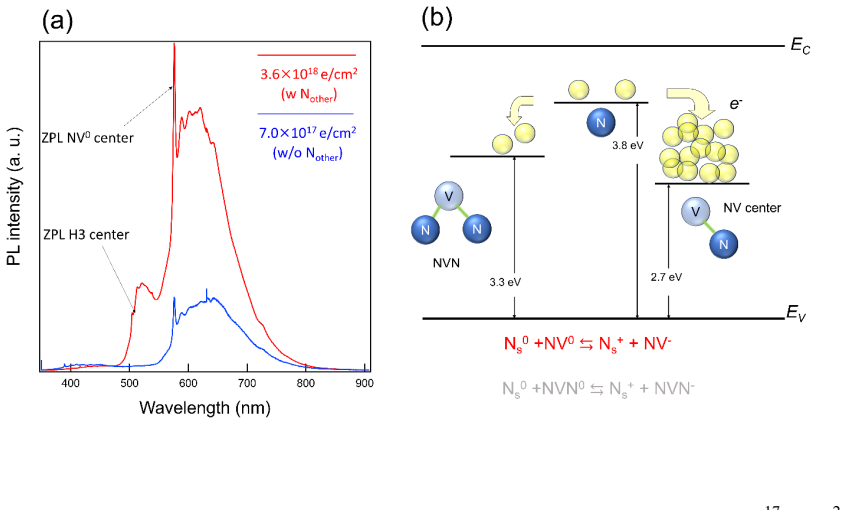
In the high-fluence region of electron beam irradiation, NV0, NV-, Ns0 and Ns+ concentrations decrease while unknown nitrogen-related defects such as H3 centers form. These H3 centers, which are nitrogen-vacancy aggregates, appear after annealing at 1375 ± 25 °C rather than the typically reported temperatures over 1600 °C. This low-temperature formation is attributed to vacancy-mediated nitrogen diffusion and aggregation.
What carries the argument
Vacancy-mediated nitrogen diffusion and aggregation, which enables clustering of nitrogen and vacancies into H3 centers at reduced annealing temperatures after high-fluence irradiation.
If this is right
- Low-fluence irradiation converts Ns0 to NV centers as the dominant process.
- High-fluence irradiation produces vacancies that promote nitrogen aggregation into H3 centers.
- Annealing at 1375 °C suffices for H3 formation when preceded by high-fluence irradiation.
- Defect concentrations can be tuned by adjusting electron beam fluence before annealing.
Where Pith is reading between the lines
- Balancing low and high fluence regimes may help maximize NV center density while limiting unwanted aggregation for sensing applications.
- The same vacancy-creation step could be tested on other substitutional impurities to check whether diffusion temperatures drop similarly.
- Mapping the precise fluence threshold where aggregation begins would allow more controlled defect engineering sequences.
Load-bearing premise
The concentration decreases at high fluence result from formation of H3 centers through vacancy-mediated aggregation rather than other uncharacterized defects or measurement artifacts.
What would settle it
Quantitative measurement showing that the rise in H3 center density exactly accounts for the drop in Ns and NV densities after high-fluence irradiation and 1375 °C annealing, or the absence of such accounting, would confirm or refute the attribution.
Figures
read the original abstract
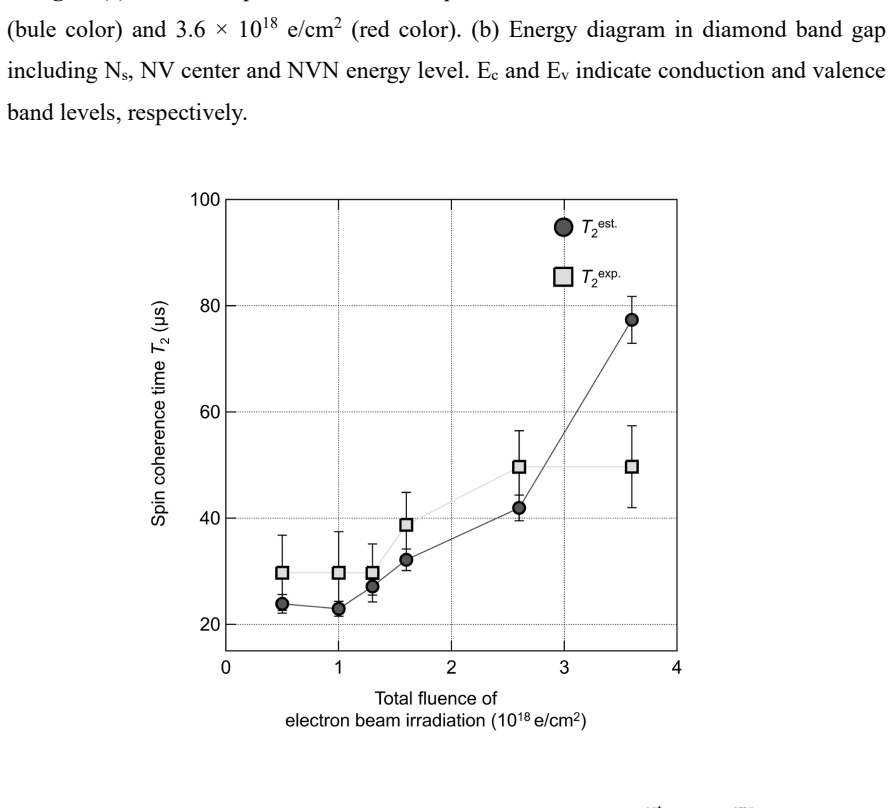
The negatively charged nitrogen vacancy (NV-) center in diamonds is promising point defect for highly sensitive quantum sensing. The formation of high-density NV- centers is essential for improving sensitivity. We performed room-temperature electron beam irradiation (EBI) and annealing on nitrogen-doped high-pressure high-temperature diamond crystals to convert substitutional nitrogen into NV centers. In the low-fluence region of EBI, neutral substitutional nitrogen (Ns0) concentration decreased and NV0 and NV- center concentration increased with increasing EBI fluence. The decrease in Ns0 concentration was comparable to the increase in total NV center concentration; thus, the conversion from Ns0 to NV0 and NV- centers is a dominant defect formation process. In a high-fluence region, NV0 and NV- center and Ns0 and Ns+ concentrations decreased with increasing EBI fluence, indicating the formation of unknown nitrogen-related defects such as the H3 center, which is a nitrogen and vacancy aggregation defect. Although H3 centers were observed at high EBI fluence, their forming annealing temperature of 1375 +- 25 degrees Celsius was lower than the typically reported temperatures over 1600 degrees Celsius. We attribute this low-temperature formation to vacancy-mediated nitrogen diffusion and aggregation.
Editorial analysis
A structured set of objections, weighed in public.
Referee Report
Summary. The manuscript reports room-temperature electron-beam irradiation (EBI) experiments on nitrogen-doped HPHT diamond followed by annealing at 1375 ± 25 °C. In the low-fluence regime, Ns0 concentration decreases while NV0 and NV- increase by comparable amounts, indicating direct conversion. In the high-fluence regime, Ns0, Ns+, NV0 and NV- concentrations all decline; the authors interpret this as aggregation into H3 (N2V) centers and attribute the unusually low formation temperature to irradiation-induced vacancies enabling nitrogen diffusion.
Significance. If the mass-balance and mechanistic attribution hold, the result would demonstrate a practical route to low-temperature nitrogen aggregation in diamond, relevant for controlled defect engineering in quantum-sensing materials. The fluence-dependent crossover between conversion and aggregation regimes supplies new experimental phenomenology on irradiation-driven defect dynamics.
major comments (2)
- [Abstract] Abstract and high-fluence discussion: the claim that observed decreases in Ns0, Ns+, NV0 and NV- 'indicate the formation of unknown nitrogen-related defects such as the H3 center' is not quantitatively supported. No absolute H3 concentrations, absorption cross-sections, or integrated optical intensities are supplied to close the nitrogen mass balance, so alternative explanations (other aggregates, optical saturation, or non-nitrogen defects) remain viable.
- [Abstract] Abstract and discussion of annealing temperature: the attribution of H3 formation at 1375 ± 25 °C to vacancy-mediated diffusion is presented without supporting data. No vacancy concentrations, diffusion-length estimates, or control annealing runs on unirradiated material are reported to demonstrate that the lowered temperature is caused by irradiation-induced vacancies rather than other factors.
minor comments (1)
- [Abstract] Abstract: numerical fluence values, concentration units, and error bars on the reported trends are omitted, reducing the ability to assess the magnitude of the effects.
Simulated Author's Rebuttal
We thank the referee for their careful review and constructive feedback on our manuscript. We address each major comment below and will revise the manuscript accordingly to improve clarity and precision.
read point-by-point responses
-
Referee: [Abstract] Abstract and high-fluence discussion: the claim that observed decreases in Ns0, Ns+, NV0 and NV- 'indicate the formation of unknown nitrogen-related defects such as the H3 center' is not quantitatively supported. No absolute H3 concentrations, absorption cross-sections, or integrated optical intensities are supplied to close the nitrogen mass balance, so alternative explanations (other aggregates, optical saturation, or non-nitrogen defects) remain viable.
Authors: We agree that the current manuscript does not supply absolute H3 concentrations or close the full nitrogen mass balance with optical cross-sections. The observed decreases in Ns0, Ns+, NV0 and NV- at high fluence, together with the spectroscopic detection of H3 centers, indicate aggregation into nitrogen-related defects. We will revise the abstract and high-fluence discussion to state that the data are consistent with formation of nitrogen aggregates (including observed H3 centers) without claiming quantitative closure of the mass balance, thereby acknowledging alternative possibilities. revision: yes
-
Referee: [Abstract] Abstract and discussion of annealing temperature: the attribution of H3 formation at 1375 ± 25 °C to vacancy-mediated diffusion is presented without supporting data. No vacancy concentrations, diffusion-length estimates, or control annealing runs on unirradiated material are reported to demonstrate that the lowered temperature is caused by irradiation-induced vacancies rather than other factors.
Authors: The manuscript reports H3 formation after high-fluence irradiation and annealing at 1375 ± 25 °C, lower than the >1600 °C typically required without irradiation. While this is consistent with vacancy-mediated nitrogen diffusion, we acknowledge the absence of direct vacancy concentration data, diffusion-length calculations, or unirradiated control runs. We will revise the abstract and discussion to present the lowered temperature as enabled by irradiation-induced vacancies as a proposed mechanism, rather than a definitively proven causal link, and note the need for additional experiments. revision: yes
Circularity Check
No circularity; purely experimental observations with inferential attribution
full rationale
The manuscript reports fluence-dependent concentration changes measured via optical absorption and EPR, followed by an attribution of low-temperature H3 formation to vacancy-mediated diffusion. No equations, parameter fits, or derivations appear in the provided text. The central claim is an inference from observed trends (Ns0/NV decreases at high fluence coinciding with H3 appearance) rather than a reduction of any output to its own inputs by construction. Self-citations, if present, are not load-bearing for any quantitative result. This is the expected non-finding for an observational materials-science study.
Axiom & Free-Parameter Ledger
axioms (1)
- domain assumption Optical signatures reliably identify specific nitrogen-vacancy defect centers (NV0, NV-, H3) in diamond.
Reference graph
Works this paper leans on
-
[1]
J. F. Barry, J. M. Schloss, E. Bauch, M. J. Turner, C. A. Hart, L. M. Pham, and R. L. Walsworth, Rev. Mod. Phys. 92, (2020)
2020
-
[2]
Sekiguchi, M
N. Sekiguchi, M. Fushimi, A. Yoshimura, C. Shinei, M. Miyakawa, T. Taniguchi, T. Teraji, H. Abe, S. Onoda, T. Ohshima, and M. Hatano, Phys. Rev. Appl. 21, 064010 (2024)
2024
-
[3]
Shinei, M
C. Shinei, M. Miyakawa, S. Ishii, S. Saiki, S. Onoda, T. Taniguchi, T. Ohshima, and T. Teraji, Appl. Phys. Lett. 119, (2021)
2021
-
[4]
Löfgren, K
R. Löfgren, K. V . Sopiha, S. Öberg, and J. A. Larsson, Comput. Mater. Sci. 250, 113685 (2025)
2025
-
[5]
N. B. Manson, M. Hedges, M. S. J. Barson, R. Ahlefeldt, M. W. Doherty, H. Abe, T. Ohshima, and M. J. Sellars, New J. Phys. 20, 113037 (2018)
2018
-
[6]
Löfgren, R
R. Löfgren, R. Pawar, S. Öberg, and J. A. Larsson, New J. Phys. 20, 023002 (2018)
2018
-
[7]
J. F. Barry, M. J. Turner, J. M. Schloss, D. R. Glenn, Y . Song, M. D. Lukin, H. Park, and R. L. Walsworth, Proc. Natl. Acad. Sci. U. S. A. 113, 14133 (2016)
2016
-
[8]
K. Arai, A. Kuwahata, D. Nishitani, I. Fujisaki, R. Matsuki, Y . Nishio, Z. Xin, X. Cao, Y . Hatano, S. Onoda, and C. Shinei, Commun. Phys. 5, 1 (2022)
2022
-
[9]
Herbschleb, H
E.D. Herbschleb, H. Kato, Y . Maruyama, T. Danjo, T. Makino, S. Yamasaki, I. Ohki, K. Hayashi, H. Morishita, M. Fujiwara, and N. Mizuochi, Nat. Commun. 10, 3766 (2019)
2019
-
[10]
Y . Doi, T. Fukui, H. Kato, T. Makino, S. Yamasaki, T. Tashima, H. Morishita, S. Miwa, F. Jelezko, Y . Suzuki, and N. Mizuochi, Phys. Rev. B Condens. Matter 93, 081203 (2016)
2016
-
[11]
Murai, T
T. Murai, T. Makino, H. Kato, M. Shimizu, T. Murooka, E.D. Herbschleb, H. Morishita, M. Fujiwara, M. Hatano, S. Yamasaki, and N. Mizuochi, Appl. Phys. Lett. 112, 111903 (2018)
2018
-
[12]
Shimizu, T
M. Shimizu, T. Makino, T. Iwasaki, J. Hasegawa, K. Tahara, W. Naruki, H. Kato, S. Yamasaki, and M. Hatano, Diam. Relat. Mater. 63, 192 (2016)
2016
-
[13]
Masuyama, C
Y . Masuyama, C. Shinei, S. Ishii, H. Abe, T. Taniguchi, T. Teraji, and T. Ohshima, Sci. Rep. 14, 1 (2024)
2024
-
[14]
Shinei, Y
C. Shinei, Y . Masuyama, M. Miyakawa, H. Abe, S. Ishii, S. Saiki, S. Onoda, T. Taniguchi, T. Ohshima, and T. Teraji, J. Appl. Phys. 132, (2022)
2022
-
[15]
T. Luo, L. Lindner, J. Langer, V . Cimalla, X. Vidal, F. Hahl, C. Schreyvogel, S. Onoda, S. Ishii, T. Ohshima, and D. Wang, New J. Phys. 24, 033030 (2022). 19
2022
-
[16]
Ishii, S
S. Ishii, S. Saiki, S. Onoda, Y . Masuyama, H. Abe, and T. Ohshima, Quantum Beam Sci., 6(1), 2 (2021)
2021
-
[17]
Shinei, H
C. Shinei, H. Abe, T. Ohshima, and T. Teraji, Diam. Relat. Mater. 140, 110523 (2023)
2023
-
[18]
Teraji and C
T. Teraji and C. Shinei, J. Appl. Phys. 133(16) (2023)
2023
-
[19]
A. T. Collins, J. Phys. Condens. Matter 14, 3743 (2002)
2002
-
[20]
A. M. Zaitsev, Optical Properties of Diamond: A Data Handbook , 2001st ed. (Springer, Berlin, Germany, 2013)
2013
-
[21]
Lühmann, N
T. Lühmann, N. Raatz, R. John, M. Lesik, J. Rödiger, M. Portail, D. Wildanger, F. Kleissler, K. Nordlund, A. Zaitsev, and J.F. Roch, J. Phys. D Appl. Phys. 51, 483002 (2018)
2018
-
[22]
Jones, J
R. Jones, J. P. Goss, H. Pinto, and D. W. Palmer, Diam. Relat. Mater. 53, 35 (2015)
2015
-
[23]
S. T. Alsid, J. F. Barry, L. M. Pham, J. M. Schloss, M. F. O’Keeffe, P. Cappellaro, and D. A. Braje, Phys. Rev. Appl. 12, 044003 (2019)
2019
-
[24]
P. Deák, B. Aradi, M. Kaviani, T. Frauenheim, and A. Gali, Phys. Rev. B 89, (2014)
2014
-
[25]
Umemoto, T
A. Umemoto, T. Iida, M. Yoshino, A. Yoshikawa, and S. Nomura, Nucl. Instrum. Methods Phys. Res. A 1057, 168789 (2023)
2023
-
[26]
Luo, F.A
T. Luo, F.A. Hahl, J. Langer, V . Cimalla, L. Lindner, X. Vidal, M. Haertelt, R. Blinder, S. Onoda, T. Ohshima, and J. Jeske, Philos. Trans. A Math. Phys. Eng. Sci. 382, 20220314 (2024)
2024
-
[27]
Bauch, S
E. Bauch, S. Singh, J. Lee, C.A. Hart, J.M. Schloss, M.J. Turner, J.F. Barry, L.M. Pham, N. Bar-Gill, S.F. Yelin, and R.L. Walsworth, Phys. Rev. B Condens. Matter 102, 134210 (2020). 20 Supplemental: CL spectrum of nitrogen-doped HPHT diamond with high EBI fluence We present the differences in the population of the NVN charge states. The CL measurements w...
2020
discussion (0)
Sign in with ORCID, Apple, or X to comment. Anyone can read and Pith papers without signing in.