KMT-2025-BLG-2093: Free-Floating Planet Candidate Near the Shore of the Einstein Desert
Pith reviewed 2026-06-29 02:45 UTC · model grok-4.3
The pith
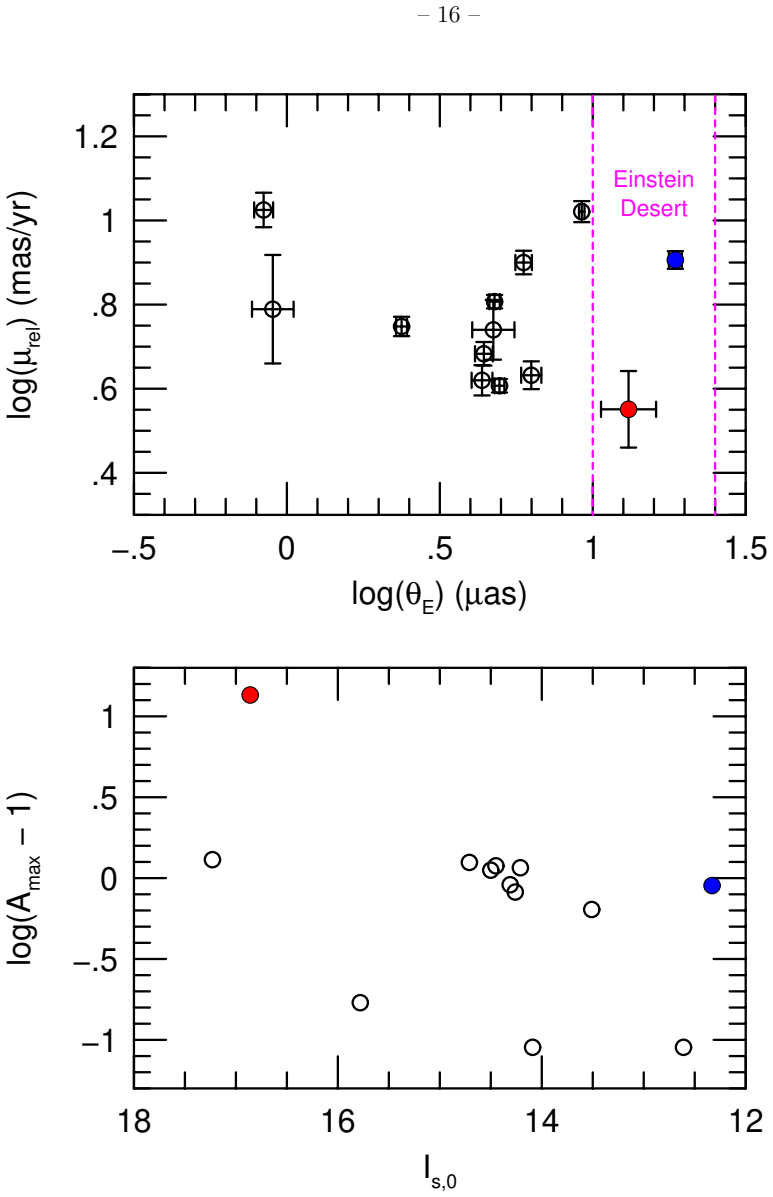
KMT-2025-BLG-2093 is the second isolated microlens with Einstein radius inside the 9-25 microarcsecond Einstein Desert.
A machine-rendered reading of the paper's core claim, the machinery that carries it, and where it could break.
Core claim
The microlensing event KMT-2025-BLG-2093 is isolated and has measured angular Einstein radius θ_E = 13.1 ± 2.8 μas, placing it as the second such object inside the Einstein Desert (9 μas < θ_E < 25 μas) that separates free-floating planets from brown dwarfs and stars.
What carries the argument
The angular Einstein radius θ_E, which fixes the angular scale of the microlensing light curve and assigns the lens to the defined mass-separation interval called the Einstein Desert.
If this is right
- Isolated events inside the desert can mark the transition between planetary-mass and substellar lenses in microlensing samples.
- The light-curve properties of this event supply a reference for identifying comparable candidates in future surveys.
- Missions such as Earth 2.0 and Roman can use the desert interval to prioritize searches for additional free-floating planets.
- Repeated detections near the desert boundaries can help trace the mass distribution of isolated low-mass objects.
Where Pith is reading between the lines
- If more desert events accumulate, the gap may reflect a real feature in the mass function rather than an observational selection effect.
- Space-based astrometry could test whether any of these lenses possess wide, undetected companions that would alter their classification.
- Ground-based networks that already reach microarcsecond precision can be applied systematically to other events to populate the desert region further.
Load-bearing premise
The event is truly isolated with no detectable host star and the light-curve fit yields an Einstein radius that correctly locates the lens inside the stated 9-25 microarcsecond interval.
What would settle it
High-resolution imaging that reveals a host star or new photometry that revises θ_E outside the 9-25 μas window would remove the event from the Einstein Desert.
Figures
read the original abstract
We analyze KMT-2025-BLG-2093, with angular Einstein radius $\theta_{\rm E}=13.1\pm 2.8\,\mu{\rm as}$, which makes it the second isolated microlens that lies in the ``Einstein Desert'' ($9\,\mu{\rm as}<\theta_{\rm E}<25\,\mu{\rm as}$) between free-floating planets (FFPs) on one side and brown dwarfs and stars on the other. We discuss how its characteristics may give clues to future exploration of FFPs, especially in the era of satellite missions that have a major FFP focus, including Earth 2.0 and Roman.
Editorial analysis
A structured set of objections, weighed in public.
Referee Report
Summary. The paper reports the microlensing analysis of KMT-2025-BLG-2093 and derives an angular Einstein radius θ_E = 13.1 ± 2.8 μas. This value places the event as the second isolated microlens inside the Einstein Desert (9 μas < θ_E < 25 μas), separating free-floating planets from brown dwarfs and stars. The authors discuss implications for future FFP searches with satellite missions such as Earth 2.0 and Roman.
Significance. If the θ_E measurement and isolation claim hold after accounting for systematics, the result adds a key data point to the small sample of isolated microlenses in the desert region. This can help constrain the low-mass end of the lens mass function and guide observing strategies for upcoming space-based surveys with a strong FFP focus.
major comments (2)
- [light-curve modeling and θ_E derivation] The 1σ lower bound on θ_E is 10.3 μas, only 1.3 μas above the 9 μas desert edge. The paper must demonstrate (via explicit tests or additional error terms) that systematics in the finite-source parameter ρ from the light-curve fit and in θ_* from the source color/spectral-type determination cannot shift the lower limit below 9 μas.
- [isolation and blending analysis] The central claim requires the event to be isolated (no detectable host star). The manuscript should quantify any possible host flux absorbed into the blend or source parameters and show that it does not bias ρ (and therefore θ_E) enough to move the event out of the desert.
minor comments (2)
- The abstract states the key result but does not mention the survey (KMTNet) or the number of data points; adding this would improve context.
- Notation for the Einstein Desert boundaries is given only in the abstract; repeating the exact interval (9 μas < θ_E < 25 μas) in the main text when first discussing the result would aid readability.
Simulated Author's Rebuttal
We thank the referee for the detailed and constructive report. The comments highlight important aspects of the analysis that require further validation. We have revised the manuscript to incorporate explicit tests addressing both major concerns, strengthening the robustness of the θ_E measurement and the isolation claim.
read point-by-point responses
-
Referee: [light-curve modeling and θ_E derivation] The 1σ lower bound on θ_E is 10.3 μas, only 1.3 μas above the 9 μas desert edge. The paper must demonstrate (via explicit tests or additional error terms) that systematics in the finite-source parameter ρ from the light-curve fit and in θ_* from the source color/spectral-type determination cannot shift the lower limit below 9 μas.
Authors: We agree that the proximity to the boundary warrants explicit checks. In the revised manuscript we have added Monte Carlo tests that perturb ρ over its full posterior range while re-deriving θ_E, together with a grid of source spectral types consistent with the observed color. These tests show that the 1σ lower limit on θ_E remains above 9 μas. We have also introduced an additional 8% systematic floor on θ_* to encompass possible color-calibration uncertainties; the updated θ_E = 13.1 ± 3.0 μas still places the event inside the desert. revision: yes
-
Referee: [isolation and blending analysis] The central claim requires the event to be isolated (no detectable host star). The manuscript should quantify any possible host flux absorbed into the blend or source parameters and show that it does not bias ρ (and therefore θ_E) enough to move the event out of the desert.
Authors: We have expanded the blending analysis section with a quantitative limit on undetected host flux. By injecting synthetic host stars at the maximum flux level still consistent with the observed blend and re-fitting the light curve, we find that any hidden host would bias ρ by at most 4%, corresponding to a shift in θ_E of <0.6 μas. This is insufficient to push the lower bound below 9 μas. The revised manuscript includes these injection tests and the resulting bias estimates. revision: yes
Circularity Check
No circularity: observational report of measured θ_E
full rationale
The paper reports an observed microlensing event with θ_E derived from finite-source light-curve modeling (θ_E = θ_*/ρ) and places the value inside a pre-defined interval (9–25 μas) taken from earlier literature. No step equates the reported result to its own fitted inputs by construction, renames a known pattern, or relies on a self-citation chain whose justification collapses to the present work. The measurement is externally falsifiable via independent photometry and is not a prediction or uniqueness claim derived from the paper's own equations.
Axiom & Free-Parameter Ledger
free parameters (1)
- θ_E =
13.1 ± 2.8 μas
Reference graph
Works this paper leans on
-
[1]
& Lupton, R.H.,1998, , 503, 325
Alard, C. & Lupton, R.H.,1998, , 503, 325
1998
-
[2]
Michaeldalbrow/Pydia: InitialRelease On Github., vv1.0.0, Zenodo
Albrow, M.D. Michaeldalbrow/Pydia: InitialRelease On Github., vv1.0.0, Zenodo
-
[3]
Albrow, M.\ D., Horne, K., Bramich, D.\ M., et al.\ 2009, , 397, 2099
2009
-
[4]
et al.\ 2002, , 572, 521
An, J.H., Albrow, M.D., Beaulieu, J.-P. et al.\ 2002, , 572, 521
2002
-
[5]
Batista, V., Gould, A., Dieters, S. et al. , 529, 102
-
[6]
2015, , 808, 170
Batista, V., Beaulieu, J.-P., Bennett, D.P., et al. 2015, , 808, 170
2015
-
[7]
2015, , 808, 169
Bennett, D.P., Bhattacharya, A., Anderson, J., et al. 2015, , 808, 169
2015
-
[8]
P., Bhattacharya, A., Beaulieu, J
Bennett, D. P., Bhattacharya, A., Beaulieu, J. P., et al. 2020, , 159, 68
2020
-
[9]
Yee, J.C., Feltzing, S.\ et al.\ 2013, , 549, A147
Bensby, T. Yee, J.C., Feltzing, S.\ et al.\ 2013, , 549, A147
2013
-
[10]
Bessell, M.S., & Brett, J.M.\ 1988, , 100, 1134
1988
-
[11]
Bond, I.A., Abe, F., Dodd, R.J., et al.\ 2001, , 327, 868
2001
-
[12]
2019, , 157, 121
Calchi Novati, S., Suzuki, D., Udalski, A., et al. 2019, , 157, 121
2019
-
[13]
Cassan, A., Kubas, D., Beaulieu, J.-P., et al., 2012, Nature, 481, 167
2012
-
[14]
2009a, , 695, 970
Dong, S., Gould, A., Udalski, A., et al. 2009a, , 695, 970
-
[15]
2026, Science, 391, 96
Dong, S., Wu, Z., Ryu, Y.-H.., et al. 2026, Science, 391, 96
2026
-
[16]
2009b, , 698, 1826
Dong, S., Bond, I.A., Gould, A., et al. 2009b, , 698, 1826
-
[17]
1999, , 349, 108
Dominik, M. 1999, , 349, 108
1999
-
[18]
2016, , 595, A1
Gaia Collaboration, Prusti, T., de Bruijne, J.H.J., et al. 2016, , 595, A1
2016
-
[19]
Gaia Collaboration, Brown, A. G. A., Vallenari, A., et al.\ 2018, , 616, 1
2018
-
[20]
Gaudi, B.S.\ 1998, , 506, 533
1998
-
[21]
& Gould, A.\ 1997, , 486, 85
Gaudi, B.S. & Gould, A.\ 1997, , 486, 85
1997
-
[22]
Gaudi, B.S., Albrow, M.D., An, J.\ 2002, , 566, 463
2002
-
[23]
Ge, J., Chen, W., Chen, Y., et al.\ 2024, ChJSS, 44, 400
2024
-
[24]
A., Rejkuba, M., Zoccali, M., et al.\ 2012, , 543, A13
Gonzalez, O. A., Rejkuba, M., Zoccali, M., et al.\ 2012, , 543, A13
2012
-
[25]
& Loeb, A
Gould, A. & Loeb, A. 1992, , 396, 104
1992
-
[26]
1992, , 392, 442
Gould, A. 1992, , 392, 442
1992
-
[27]
1994, , 421, L71
Gould, A. 1994, , 421, L71
1994
-
[28]
1996, , 470, 201
Gould, A. 1996, , 470, 201
1996
-
[29]
2000, , 542, 785
Gould, A. 2000, , 542, 785
2000
-
[30]
2004, , 606, 319
Gould, A. 2004, , 606, 319
2004
- [31]
-
[32]
& Bahcall, J.N
Gould, A., Miralda-Escud\'e, J. & Bahcall, J.N. 1994, , 423, L105
1994
-
[33]
Gould, A., Gaudi, B.S.\ & Han, C.\ 2003, , 591, L53
2003
-
[34]
& Yee, J.C.\ 2013, , 764, 107
Gould, A. & Yee, J.C.\ 2013, , 764, 107
2013
-
[35]
Gould, A., Dong, S., Gaudi, B.S.\ et al.\ 2010, , 720, 1073
2010
-
[36]
Gould, A., Ryu, Y.-H., Calchi Novati, S., et al.\ 2020, JKAS, 53, 9
2020
-
[37]
Gould, A., Zang, W., Mao, S., & Dong, S., 2021, RAA, 21, 133
2021
-
[38]
Gould, A., Han, C., Zang, W.., 2022, , 664A, 13
2022
-
[39]
Gould, A., Jung, Y.K., Hwang, K.-H. et. al., 2022, JKAS, 55, 173
2022
-
[40]
Griest, K.\ & Safizadeh, N.\ 1998, , 500, 37
1998
-
[41]
2006, , 638, 1080
Han, C. 2006, , 638, 1080
2006
-
[42]
& Gaudi, B.S.\ 2008, , 689, 53
Han, C. & Gaudi, B.S.\ 2008, , 689, 53
2008
-
[43]
2016, , 828, 53
Han, C., Udalski, A., Gould, A., et al. 2016, , 828, 53
2016
-
[44]
Han, C., Yee, J.C., Udalski, A., et al.\ 2019, , 158, 102
2019
-
[45]
2019, , 158, 114
Han, C., Bennett, D.P., Udalski, A., et al. 2019, , 158, 114
2019
-
[46]
2020a, , 159, 48
Han, C., Lee, C.-U., Udalski, A., et al. 2020a, , 159, 48
-
[47]
K., et al.\ 2020b, , 641A, 105
Han, C., Shin, I.-G., Jung, Y. K., et al.\ 2020b, , 641A, 105
-
[48]
Han, C., Udalski, A., Lee, C.-U., et al.\ 2021a, , 649, A90
-
[49]
Han, C., Udalski, A., Kim, D., et al.\ 2021b, , 655A, 21
-
[50]
2021a, , 650A, 89
Han, C., Udalski, A., Kim, D., et al. 2021a, , 650A, 89
-
[51]
2021b, , 652A, 145
Han, C., Albrow, M.D., Chung, S.-J., et al. 2021b, , 652A, 145
-
[52]
2021c, , 658A, 62
Han, C., Gould, A., Albrow, M.D., et al. 2021c, , 658A, 62
-
[53]
2014, , 794, 52
Henderson, C.B., Gaudi, B.S., Han, C., et al. 2014, , 794, 52
2014
-
[54]
2020, , 159, 134
Herrera-Martin, A., Albrow, A., Udalski, A., et al. 2020, , 159, 134
2020
-
[55]
T., Irwin, M
Hodgkin, S. T., Irwin, M. J., Hewett, P. C., & Warren, S. J.\ 2009, , 394, 675
2009
-
[56]
1995, , 294, 287
Hog, E., Novikov, I.D., & Polanarev, A.G. 1995, , 294, 287
1995
-
[57]
Holtzman, J.A., Watson, A.M., Baum, W.A., et al.\ 1998, , 115, 1946
1998
-
[58]
2013, , 778, 55
Hwang, K.-H., Choi, J.-Y., Bond, I.A., et al. 2013, , 778, 55
2013
-
[59]
Hwang, K.-H., Udalski, A., Shvartzvald, Y. et al. 2018a, , 155, 20
-
[60]
2018b, , 155, 259
Hwang, K.-H., Udalski, A., Bond, I.A., et al. 2018b, , 155, 259
-
[61]
Hwang, K.-H., Zang, W., Gould, A., et al.., 2022, , 163, 43
2022
-
[62]
2026, , 171, 243
Inyanya, T., Jung, Y.K., Yang, H.., et al. 2026, , 171, 243
2026
-
[63]
J., Lewis, J., Hodgkin, S., et al.\ 2004, , 5493, 411
Irwin, M. J., Lewis, J., Hodgkin, S., et al.\ 2004, , 5493, 411
2004
-
[64]
Johnson, S.A., Penny, M.T., & Gaudi, B.S.\ 2022, , 927, 63
2022
-
[65]
2019, , 158, 28
Jung, Y.K., Gould, A., Udalski, A., et al. 2019, , 158, 28
2019
-
[66]
2020a, , 160, 148
Jung, Y.K., Gould, A., Udalski, A., et al. 2020a, , 160, 148
-
[67]
2021, , 161, 293
Jung, Y.K., Han, C., Udalski, A., et al. 2021, , 161, 293
2021
-
[68]
2024, , 168, 152
Jung, Y.K., Hwang, K.-H., Yang, H., et al. 2024, , 168, 152
2024
-
[69]
Kervella, P., Bersier, D., Mourard, D., et al.\ 2004, , 428, 587
2004
-
[70]
Kervella, P., Th \'e venin, F., Di Folco, E., & S \'e gransan, D.\ 2004b, , 426, 297
-
[71]
2016, JKAS, 49, 37
Kim, S.-L., Lee, C.-U., Park, B.-G., et al. 2016, JKAS, 49, 37
2016
-
[72]
Kim, D.-J., Kim, H.-W., Hwang, K.-H., et al., 2018a, , 155, 76
-
[73]
Kim, H.-W., Hwang, K.-H., Kim, D.-J., et al. 2018b, arXiv:1804.03352
-
[74]
Kim, H.-W., Hwang, K.-H., Shvartzvald, Y., et al. 2018c, arXiv:1806.07545
-
[75]
2021, , 162, 15
Kim, H.-W., Hwang, K.-H., Gould, A., et al. 2021, , 162, 15
2021
-
[76]
2021a, , 503, 2706
Kim, Y.-H., Chung, S.-J., Udalski, A., et al. 2021a, , 503, 2706
-
[77]
2021b, , 162, 17
Kim, Y.H.., Chung, S.-J., Yee, J.-C., et al. 2021b, , 162, 17
-
[78]
Kondo, I., Yee, J.C., Bennett, D.P., et al.\ 2021, , 162, 77
2021
-
[79]
Koshimoto, N., Sumi, T., Bennett, D.P., et al.\ 2023, , 166, 107
2023
-
[80]
& Szymański, M.K.\ 1997, Acta Astron., 47, 319
Kubiak, M. & Szymański, M.K.\ 1997, Acta Astron., 47, 319
1997
discussion (0)
Sign in with ORCID, Apple, or X to comment. Anyone can read and Pith papers without signing in.