Reduction of Probabilistic Chemical Reaction Networks
Pith reviewed 2026-06-29 05:17 UTC · model grok-4.3
The pith
Recovering factor graph structure in Napp-Adams chemical reaction networks enables their reduction while preserving belief-propagation fixed points.
A machine-rendered reading of the paper's core claim, the machinery that carries it, and where it could break.
Core claim
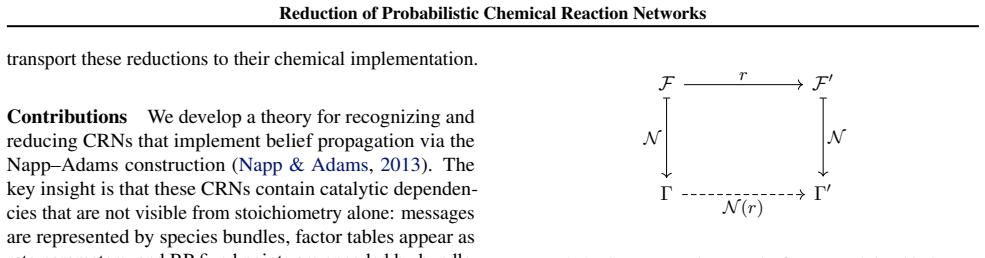
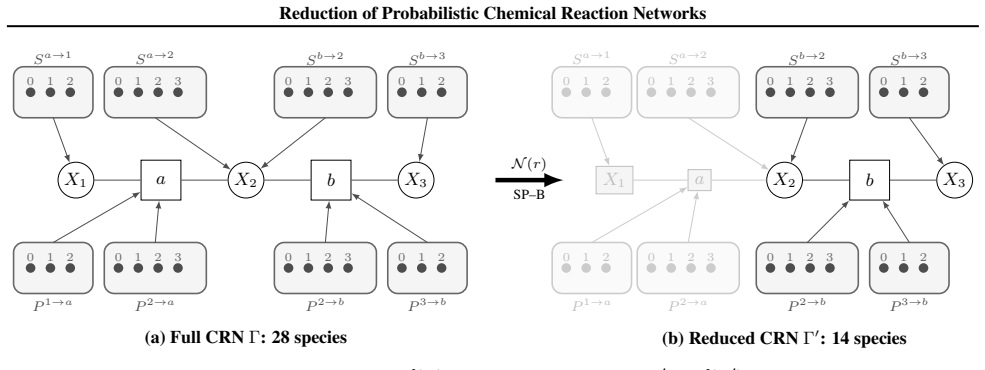
By recovering the factor graph structure encoded in Napp--Adams-compiled CRNs, we transport recent factor-graph reduction results to their chemical implementations, obtaining significantly smaller CRNs while preserving the belief-propagation fixed points on surviving variables.
What carries the argument
Recovery of the factor graph structure from Napp-Adams-compiled CRNs, which transports factor-graph reduction theorems into the chemical reaction network domain while keeping probabilistic semantics intact.
If this is right
- Significantly smaller CRNs can realize the same probabilistic models such as hidden Markov models and factor graphs.
- Belief-propagation fixed points remain unchanged on the variables that survive the reduction.
- Classical CRN reduction methods become applicable once the factor graph is recovered.
- Encoding of Bayesian inference algorithms in biochemical systems requires fewer reactions after reduction.
Where Pith is reading between the lines
- The recovery technique might generalize to other compilation methods that embed probabilistic models in CRNs if analogous structural recovery is possible.
- Reduced CRNs could enable simulation or experimental realization of larger-scale probabilistic computations in synthetic biology contexts.
- This opens a route to systematically shrink other graphical-model-based CRN implementations by first uncovering their underlying factor graphs.
Load-bearing premise
The factor graph structure can be recovered from any Napp-Adams-compiled CRN without losing the probabilistic semantics that the reduction theorems depend on.
What would settle it
A concrete Napp-Adams CRN where the recovered factor graph leads to a reduced network whose belief-propagation fixed points differ from the original on at least one surviving variable.
Figures
read the original abstract
Programming adaptive behaviors at the cellular level is a long-standing goal that raises the question of how probabilistic computation can be implemented in biochemical systems. Chemical reaction networks (CRNs) provide such a substrate and have been shown to realize probabilistic models, including hidden Markov models and factor graphs, with dynamics reproducing Bayesian inference and belief propagation. However, encoding these algorithms typically requires prohibitively large reaction networks, and classical CRN reduction techniques do not directly apply. By recovering the factor graph structure encoded in Napp--Adams-compiled CRNs, we transport recent factor-graph reduction results to their chemical implementations, obtaining significantly smaller CRNs while preserving the belief-propagation fixed points on surviving variables.
Editorial analysis
A structured set of objections, weighed in public.
Referee Report
Summary. The paper claims that recovering the factor-graph structure encoded in Napp-Adams-compiled CRNs allows transport of recent factor-graph reduction theorems to the chemical setting, yielding substantially smaller CRNs whose dynamics still realize the original belief-propagation fixed points on the surviving variables.
Significance. If the recovery step is shown to be semantics-preserving, the result would provide a practical route to compact biochemical implementations of probabilistic inference, directly addressing the size barrier that has limited cellular-scale probabilistic computation.
major comments (2)
- [Abstract / §3 (recovery procedure)] The central claim rests on an algorithmic recovery procedure that extracts the exact variable-factor incidence and rate constants realizing BP fixed points. No description of this procedure, no proof of semantic fidelity, and no verification that the recovered structure matches the original Napp-Adams compilation appear in the manuscript; without these the transport of the reduction theorems cannot be justified.
- [§4 (reduction application)] The reduction theorems being applied are stated only for explicit factor graphs. The manuscript must demonstrate that the recovered incidence matrix and the rate constants that realize the BP messages are identical (up to the eliminated variables) to those of the original compiled CRN; otherwise the fixed-point preservation guarantee does not carry over.
minor comments (2)
- Notation for the recovered factor graph (e.g., incidence matrix, message schedules) should be introduced explicitly and shown to coincide with the standard factor-graph notation used in the cited reduction results.
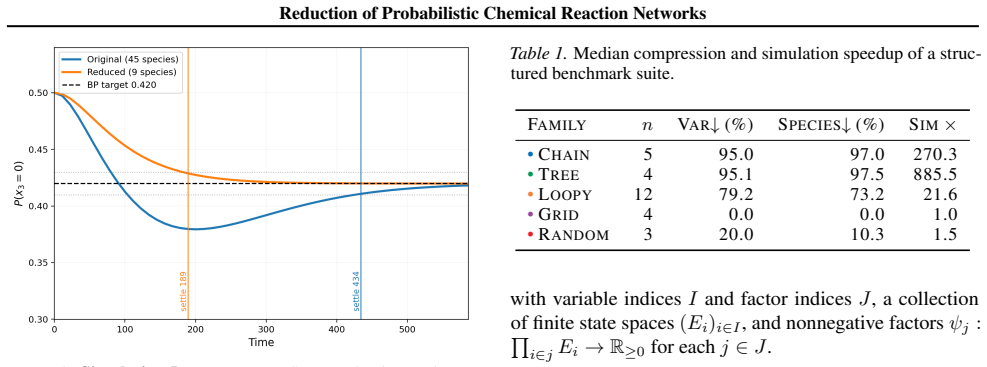
- The abstract states that the reduced CRNs are 'significantly smaller'; quantitative size-reduction statistics (number of species/reactions before and after) should be reported for the concrete examples.
Simulated Author's Rebuttal
We thank the referee for the careful reading and constructive comments. The points identify areas where the manuscript would benefit from expanded detail on the recovery procedure and its verification. We respond to each major comment below and will revise the manuscript to incorporate the requested clarifications.
read point-by-point responses
-
Referee: [Abstract / §3 (recovery procedure)] The central claim rests on an algorithmic recovery procedure that extracts the exact variable-factor incidence and rate constants realizing BP fixed points. No description of this procedure, no proof of semantic fidelity, and no verification that the recovered structure matches the original Napp-Adams compilation appear in the manuscript; without these the transport of the reduction theorems cannot be justified.
Authors: We agree that the current presentation of the recovery procedure in §3 is high-level and lacks an explicit algorithmic description, formal proof of semantic fidelity, and direct verification against the Napp-Adams compilation. In the revised manuscript we will add a dedicated subsection in §3 containing: (i) pseudocode for the recovery algorithm, (ii) a proof that the extracted incidence matrix and rate constants realize the original BP fixed points, and (iii) a side-by-side comparison confirming equivalence to the Napp-Adams output on the surviving variables. This will directly justify the subsequent transport of the reduction theorems. revision: yes
-
Referee: [§4 (reduction application)] The reduction theorems being applied are stated only for explicit factor graphs. The manuscript must demonstrate that the recovered incidence matrix and the rate constants that realize the BP messages are identical (up to the eliminated variables) to those of the original compiled CRN; otherwise the fixed-point preservation guarantee does not carry over.
Authors: We acknowledge that §4 currently applies the reduction theorems without an explicit demonstration of structural identity. In the revision we will insert a new lemma and accompanying verification in §4 that constructs an explicit bijection between the recovered incidence matrix/rate constants and those of the original Napp-Adams CRN (restricted to surviving variables) and shows that the BP message-update equations are identical. This will establish that the fixed-point preservation guarantee transfers without modification. revision: yes
Circularity Check
No significant circularity detected; derivation relies on external reduction theorems
full rationale
The paper's approach centers on recovering factor-graph structure from Napp-Adams CRNs to transport independent factor-graph reduction results. No equations, fitted parameters, or self-definitional steps appear in the provided abstract or description. The reduction theorems are described as 'recent' external results rather than prior self-citations that bear the central load. The recovery step is presented as a methodological bridge without any quoted reduction that equates a prediction to its input by construction. This leaves the derivation self-contained against external benchmarks.
Axiom & Free-Parameter Ledger
Reference graph
Works this paper leans on
-
[1]
ISSN 1742-5689. doi: 10.1098/rsif.2021.0031. URL https://doi.org/10.1098/rsif.2021. 0031. Brijder, R. Computing with chemical reaction networks: A tutorial, 2018. URL https://arxiv.org/abs/ 1811.10361. Cardelli, L., Kwiatkowska, M., and Laurenti, L. Pro- gramming discrete distributions with chemical reaction networks, 2018. URL https://arxiv.org/abs/ 1601...
-
[2]
The free-energy principle: A unified brain theory?Nature Reviews Neuroscience, 11(2): 127–138, 2010
URL https://www.sciencedirect.com/ science/article/pii/S0888613X16302110. Friston, K. The free-energy principle: a unified brain theory? Nature Reviews Neuroscience, 11(2):127–138, Feb 2010. ISSN 1471-0048. doi: 10.1038/nrn2787. URL https: //doi.org/10.1038/nrn2787. Gasparyan, M., Bhalla, U. S., Radulescu, O., and Rao, S. Laplacian dynamics and kron reduc...
-
[3]
10 Reduction of Probabilistic Chemical Reaction Networks Lakin, M
URL https://www.sciencedirect.com/ science/article/pii/S0166223604003352. 10 Reduction of Probabilistic Chemical Reaction Networks Lakin, M. R. Design and simulation of a multilayer chemical neural network that learns via backpropagation.Artificial Life, 29(3):308–335, 08 2023. ISSN 1064-5462. doi: 10.1162/artl a 00405. URL https://doi.org/10. 1162/artl_a...
-
[4]
cc/paper_files/paper/2013/file/ e5e63da79fcd2bebbd7cb8bf1c1d0274-Paper
URL https://proceedings.neurips. cc/paper_files/paper/2013/file/ e5e63da79fcd2bebbd7cb8bf1c1d0274-Paper. pdf. Parr, T., Pezzulo, G., and Friston, K. J.Active Inference: The Free Energy Principle in Mind, Brain, and Behavior. The MIT Press, 03 2022. ISBN 9780262369978. doi: 10. 7551/mitpress/12441.001.0001. URL https://doi. org/10.7551/mitpress/12441.001.0...
-
[5]
URL https://doi.org/10.1090/ S0002-9947-1966-0195042-2
doi: 10.1090/S0002-9947-1966-0195042-2. URL https://doi.org/10.1090/ S0002-9947-1966-0195042-2. Tang, R., Sergeant-Perthuis, G., and Colliaux, D. Imple- mentation of reinforcement learning in chemical reaction networks: application to phototaxis as curiosity-driven exploration. working paper or preprint, April 2026. URL https://hal.science/hal-05576927. T...
-
[6]
Springer International Publishing. ISBN 978-3- 030-00030-1. Wiuf, C., Behera, A., Singh, A., and Gopalkrishnan, M. A reaction network scheme for hidden markov model parameter learning.Journal of The Royal Society Inter- face, 20(203):20220877, 06 2023. ISSN 1742-5689. doi: 10.1098/rsif.2022.0877. URL https://doi.org/ 10.1098/rsif.2022.0877. Yedidia, J. S....
-
[7]
cc/paper_files/paper/2000/file/ 61b1fb3f59e28c67f3925f3c79be81a1-Paper
URL https://proceedings.neurips. cc/paper_files/paper/2000/file/ 61b1fb3f59e28c67f3925f3c79be81a1-Paper. pdf. 12 Reduction of Probabilistic Chemical Reaction Networks Reduction of CRNs A common class of exact reduction methods exploits stoichiometric structure to eliminate subnetworks while preserving steady-state behavior of the unreduced portion. In par...
2000
-
[8]
Each bundleBconsists of a zero speciesB 0 and one coordinate speciesB k for every symbolkof the underlying variable
For every directed edge j→n in the factor graph, introduce a sum bundle Sj→n and a product bundle Pn→j. Each bundleBconsists of a zero speciesB 0 and one coordinate speciesB k for every symbolkof the underlying variable
-
[9]
For each bundleB, add recycling reactions: Bk κr − →B0, k≥1, with a single global recycling rateκ r >0
-
[10]
For each edgej→nand each assignmentk j ∈K j with(k j)n =k, add a sum-bundle production reaction: Sj→n 0 + X n′∈ne(j)\n Pn′→j (kj)n′ ψj(kj) − − − − →Sj→n k + X n′∈ne(j)\n Pn′→j (kj)n′
-
[11]
19 Reduction of Probabilistic Chemical Reaction Networks We write N(A, H) (or simply N(FG)) for this CRN and refer to the map N:FGraph→CRN as the Napp compilation
For each variablenand each statek, add product-bundle reactions: Pn→j 0 + X j′∈ne(n)\j Sj′→n k κprod − − − →Pn→j k + X j′∈ne(n)\j Sj′→n k , with a single global production rateκ prod >0. 19 Reduction of Probabilistic Chemical Reaction Networks We write N(A, H) (or simply N(FG)) for this CRN and refer to the map N:FGraph→CRN as the Napp compilation. Coroll...
-
[12]
The species of Γ and ΓN can be put into bijection bundlewise, preserving zero versus coordinate species, the distinction between sum and product bundles, and catalytic neighbor sets, and under this bijection the change of variables [XB,k]N =s B [XB,k] conjugates the mass–action vector field ofΓto that ofΓ N
-
[13]
In particular, positive steady states ofΓ correspond bijectively, via the same bundlewise rescaling, to positive steady states ofΓ N
-
[14]
Proof of D.2
From the main result of Napp–Adams applied toΓN, any positive steady state of Γ therefore determines a collection of BP messages (defined up to the usual per–message positive rescaling) on FG(Γ) that satisfy the sum–product fixed–point equations for the recovered factor tables{ψ J }. Proof of D.2. Let FG(Γ) be reconstructed from Γ under (W1)–(W6), with fa...
-
[15]
Sum bundlesB J→Q indexed by pairs(J, Q)withQ∈V J
-
[16]
variable region
Product bundlesPindexed by directed incidences(Q, J). The Napp compilation produces exactly one bundle of each type for each such directed incidence. Hence there is a canonical bundlewise bijection between the species sets of Γ and ΓN , preserving bundle type (sum vs. product), zero vs. coordinate species, and state labels. Moreover, by (W4) and (W5), the...
2025
discussion (0)
Sign in with ORCID, Apple, or X to comment. Anyone can read and Pith papers without signing in.