Rare Events Govern Defect Formation under Weak Symmetry Breaking
Pith reviewed 2026-06-29 02:31 UTC · model grok-4.3
The pith
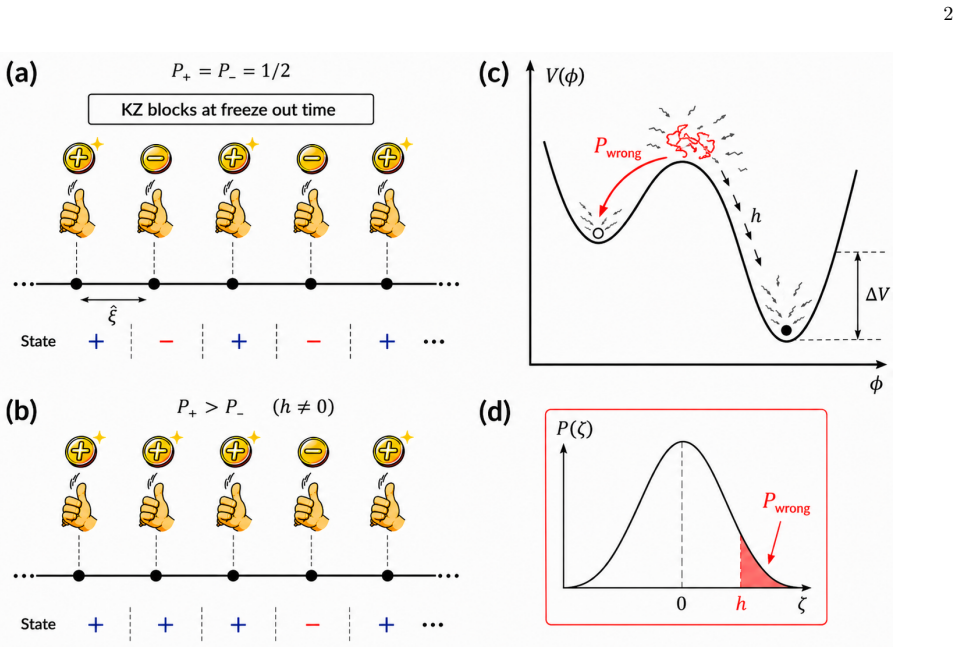
Rare fluctuations into the disfavored state set defect density when symmetry breaking is weak
A machine-rendered reading of the paper's core claim, the machinery that carries it, and where it could break.
Core claim
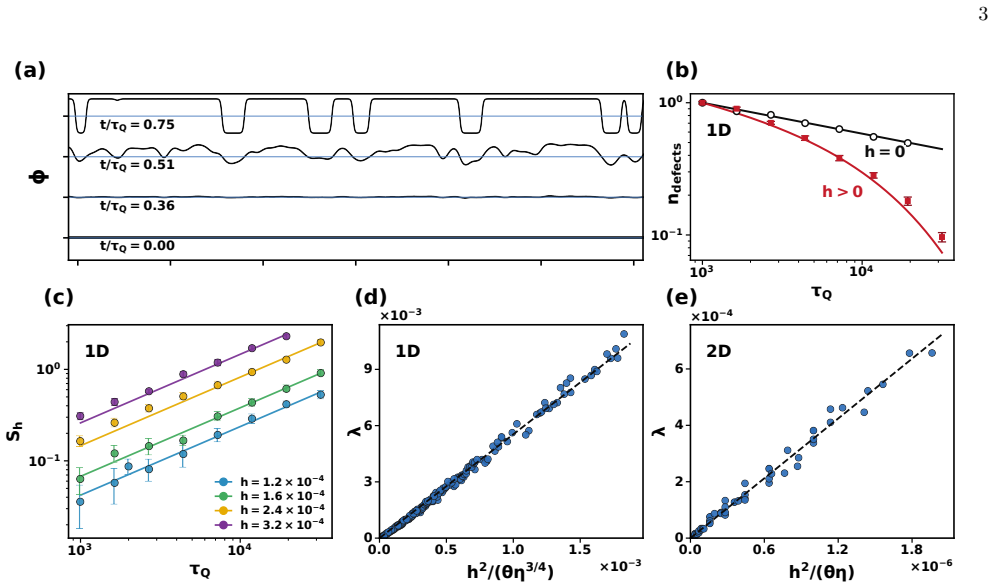
Defect formation under weak symmetry breaking is controlled by rare fluctuations that drive local regions into the disfavored symmetry-broken state. This mechanism yields a closed-form expression for the defect density in arbitrary dimensions, valid in the weak-field and weak-noise limits.
What carries the argument
Large-deviation theory applied to the stochastic Ginzburg-Landau model, which identifies the probability of rare local excursions into the unfavored phase
Load-bearing premise
Large-deviation theory applies directly to the stochastic dynamics of the Ginzburg-Landau model and captures the leading correction in the weak-field and weak-noise regime.
What would settle it
A direct simulation or experiment that measures defect density for varying weak symmetry-breaking field strengths and finds systematic deviation from the predicted closed-form expression.
Figures
read the original abstract
Crossing a continuous phase transition out of equilibrium typically generates topological defects whose density obeys a universal power-law scaling predicted by the Kibble-Zurek mechanism. Recent numerical studies have revealed systematic deviations from this scaling in the presence of weak explicit symmetry breaking, manifested as an additional exponential suppression of defect formation. However, the origin of this correction and a general theoretical framework to describe it have remained elusive. Here, using large-deviation theory, we show that defect formation under weak symmetry breaking is controlled by rare fluctuations that drive local regions into the disfavored symmetry-broken state. This mechanism yields a closed-form expression for the defect density in arbitrary dimensions, valid in the weak-field and weak-noise limits. These theoretical predictions are verified through direct simulations of stochastic Ginzburg-Landau models in one and two spatial dimensions.
Editorial analysis
A structured set of objections, weighed in public.
Referee Report
Summary. The manuscript claims that defect formation under weak explicit symmetry breaking during a continuous phase transition is controlled by rare fluctuations that locally drive the system into the disfavored symmetry-broken state. Using large-deviation theory applied to the stochastic Ginzburg-Landau dynamics, this mechanism produces a closed-form expression for the defect density that holds in arbitrary dimensions in the weak-field and weak-noise limits and accounts for the exponential suppression beyond standard Kibble-Zurek scaling. The predictions are stated to be verified by direct numerical simulations in one and two spatial dimensions.
Significance. If the central derivation is correct, the work supplies a general, dimension-independent theoretical account for the systematic deviations from Kibble-Zurek scaling that have been seen numerically when weak explicit symmetry breaking is present. The approach of invoking large-deviation theory to obtain the leading exponential correction, together with the claim of a closed-form result and multi-dimensional numerical checks, would constitute a substantive advance in the non-equilibrium statistical mechanics of defect formation.
major comments (1)
- [Abstract] The abstract asserts that a closed-form expression is obtained from large-deviation theory, yet neither the rate function nor the explicit mapping from the stochastic Ginzburg-Landau equation to the defect-density formula is shown. Without these steps it is impossible to confirm that the expression is free of fitting parameters and that the large-deviation principle applies directly to the relevant rare-event trajectories in the weak-field/weak-noise regime.
minor comments (1)
- The abstract refers to verification by 'direct simulations' in 1D and 2D but supplies no information on lattice sizes, integration time steps, noise amplitudes, or the precise manner in which the weak-field and weak-noise limits are approached numerically.
Simulated Author's Rebuttal
We thank the referee for their careful reading of the manuscript. We respond to the major comment below.
read point-by-point responses
-
Referee: [Abstract] The abstract asserts that a closed-form expression is obtained from large-deviation theory, yet neither the rate function nor the explicit mapping from the stochastic Ginzburg-Landau equation to the defect-density formula is shown. Without these steps it is impossible to confirm that the expression is free of fitting parameters and that the large-deviation principle applies directly to the relevant rare-event trajectories in the weak-field/weak-noise regime.
Authors: The abstract summarizes the central result at a high level, as is conventional. The rate function is derived in Section II B by applying the large-deviation principle to the stochastic Ginzburg-Landau equation in the weak-noise limit, yielding an explicit functional form. Section III then constructs the explicit mapping: the defect density is obtained by integrating the large-deviation probability of rare fluctuations into the disfavored state over the relevant space-time volume, producing a closed-form expression with no fitting parameters. This establishes the direct applicability of the large-deviation principle to the relevant trajectories in the weak-field/weak-noise regime. We can add a sentence to the abstract referencing these sections for improved clarity. revision: partial
Circularity Check
No significant circularity
full rationale
The derivation applies large-deviation theory to the stochastic Ginzburg-Landau dynamics to obtain a closed-form defect-density expression in the weak-field/weak-noise limit. This step is external (standard large-deviation rate functions) and is then checked against independent 1D/2D simulations. No self-citation chain, fitted parameter renamed as prediction, or self-definitional mapping appears in the abstract or described chain. The result is therefore self-contained against external benchmarks.
Axiom & Free-Parameter Ledger
axioms (1)
- domain assumption Large-deviation theory applies to the stochastic Ginzburg-Landau dynamics and yields the leading correction to defect density in the weak-field and weak-noise limits.
Reference graph
Works this paper leans on
-
[1]
del Campo and W
A. del Campo and W. H. Zurek, International Journal of Modern Physics A29, 1430018 (2014)
2014
-
[2]
Suzuki and W
F. Suzuki and W. H. Zurek, Phys. Rev. Lett.132, 241601 (2024), URLhttps://link.aps.org/doi/10. 1103/PhysRevLett.132.241601
2024
-
[3]
P. Yang, C.-Y. Xia, S. Grieninger, H.-B. Zeng, and M. Baggioli, Phys. Rev. Lett.136, 051602 (2026), URL https://link.aps.org/doi/10.1103/clvs-yk7v
-
[4]
M. I. Freidlin and A. D. Wentzell,Random Perturbations of Dynamical Systems(Springer, Berlin, 2012), 3rd ed
2012
discussion (0)
Sign in with ORCID, Apple, or X to comment. Anyone can read and Pith papers without signing in.