Large-scale structures of the Universe: physics, phenomenology, statistics
Pith reviewed 2026-06-29 03:04 UTC · model grok-4.3
The pith
Nonlinear physics and non-Gaussian statistics must be modeled to extract fundamental physics from galaxy survey data on the cosmic web.
A machine-rendered reading of the paper's core claim, the machinery that carries it, and where it could break.
Core claim
The cosmic web is the large-scale skeleton of matter traced by galaxies and arises from the interplay of gravitational instability in dark matter and the background expansion driven by dark energy. Major surveys map its distribution across vast volumes and cosmic time. Extracting fundamental physics from those maps requires predicting the nonlinear physics that generates non-Gaussian statistics in the matter and galaxy fields.
What carries the argument
The cosmic web, the skeleton of matter formed by gravitational collapse competing with cosmic expansion, whose non-Gaussian statistics encode the underlying physics.
If this is right
- Surveys spanning most of the sky and more than ten billion years become quantitative tests of dark matter and dark energy once non-Gaussian statistics are modeled.
- Nonlinear gravitational evolution must be treated explicitly rather than approximated by linear theory to match observed clustering.
- Challenges in prediction arise directly from the transition to the nonlinear regime and the growth of non-Gaussian features.
- Accurate statistical modeling turns the observed galaxy distribution into a tool for distinguishing between cosmological models.
Where Pith is reading between the lines
- The same modeling framework could be used to test modified gravity scenarios by checking whether the predicted non-Gaussian signatures match observations.
- Combining the statistical approach with direct measurements of expansion history from the same surveys would tighten joint constraints on dark energy.
- Future surveys with higher number density would increase the leverage of non-Gaussian statistics, making the prediction challenge more acute but also more rewarding.
Load-bearing premise
The non-Gaussian statistics produced by the interplay of dark matter gravity and dark energy expansion can be predicted accurately enough that survey measurements will constrain fundamental physics.
What would settle it
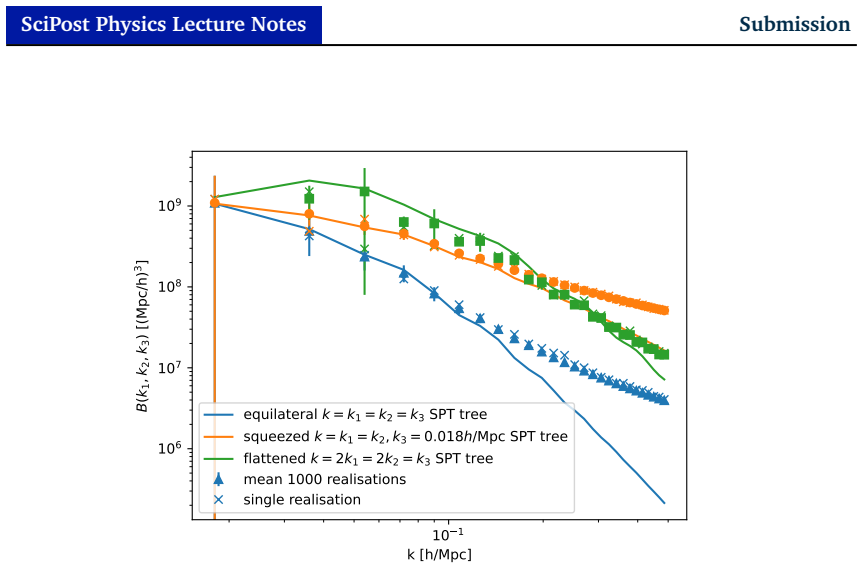
A systematic mismatch between the measured higher-order statistics (such as the bispectrum) of the galaxy distribution in a completed survey and the predictions from standard gravitational instability plus expansion would falsify the claim that the statistics can be modeled sufficiently well.
Figures
read the original abstract
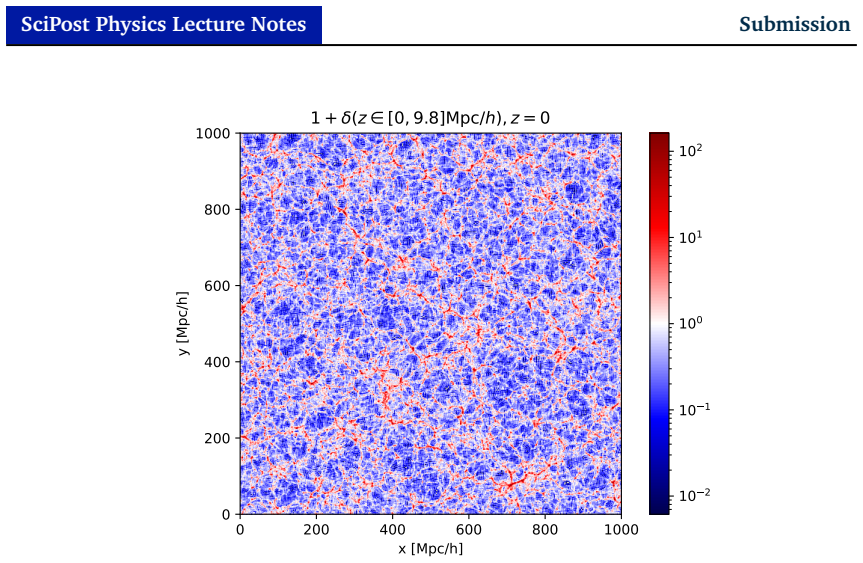
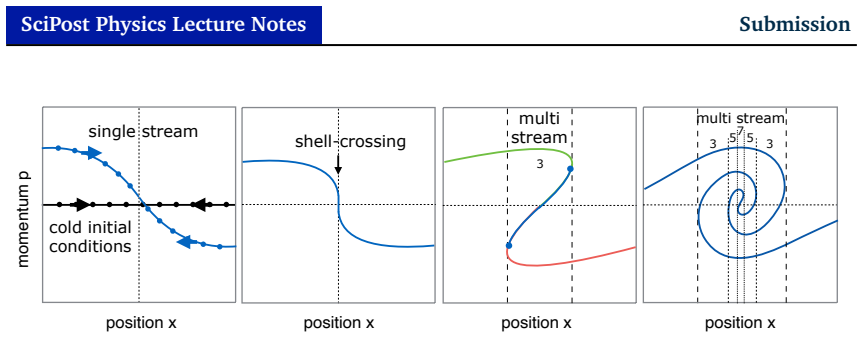
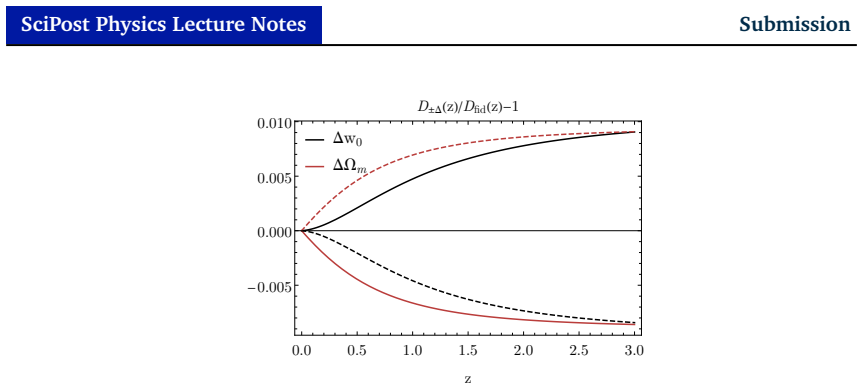
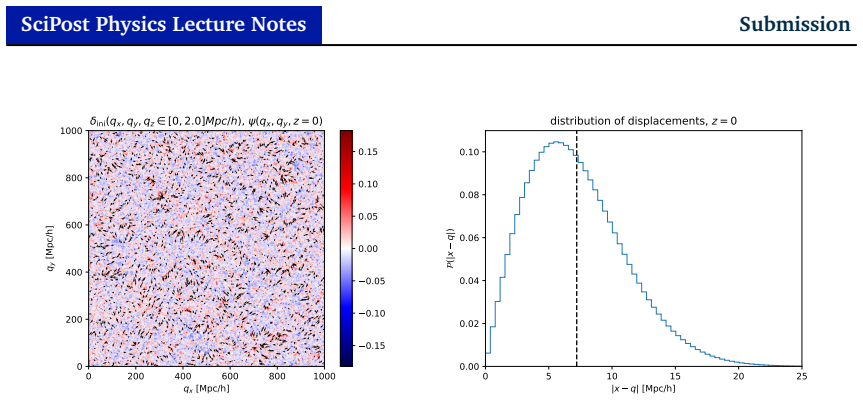
In this series of lectures, we seek to describe the evolution of the cosmic large-scale structure. We will discover the cosmic web - the large-scale skeleton of matter traced by galaxies. It arises from the interplay of the gravitational pull of dark matter and the expansion driven by dark energy. Major large-scale galaxy surveys map the distribution of matter and galaxies across most of the sky, spanning over 10 billion years of cosmic history. I will guide you through some of the principles and challenges behind predicting the statistical properties of the matter and galaxy distribution in vast cosmic volumes. In particular we discuss the underlying nonlinear physics and resulting non-Gaussian statistics that need to be predicted to extract fundamental physics from observational data.
Editorial analysis
A structured set of objections, weighed in public.
Referee Report
Summary. This manuscript is a series of lectures describing the formation and evolution of large-scale cosmic structure in ΛCDM, including the cosmic web arising from dark matter gravity and dark energy expansion, the mapping by galaxy surveys over >10 Gyr, and the need to model nonlinear physics and non-Gaussian statistics to extract fundamental parameters from observations.
Significance. The lectures summarize standard, well-established elements of cosmic web phenomenology and statistics. Because the text advances no new derivations, predictions, data analyses, or falsifiable claims, its significance for research progress in astro-ph.CO is limited; it functions as an educational overview rather than a contribution that would alter the field.
Simulated Author's Rebuttal
We thank the referee for reviewing our lecture series manuscript. We acknowledge that the work is an educational overview synthesizing established results rather than presenting new derivations or analyses, and we address this point directly below.
read point-by-point responses
-
Referee: The lectures summarize standard, well-established elements of cosmic web phenomenology and statistics. Because the text advances no new derivations, predictions, data analyses, or falsifiable claims, its significance for research progress in astro-ph.CO is limited; it functions as an educational overview rather than a contribution that would alter the field. Recommendation: reject
Authors: We agree that the manuscript contains no new scientific claims, derivations, or data analyses, as its explicit purpose (stated in the abstract) is to provide a coherent lecture-series introduction to the physics, phenomenology, and statistics of large-scale structure. We respectfully disagree, however, that this automatically limits its significance to the point of warranting rejection. Lecture notes and pedagogical reviews are routinely published in astro-ph.CO venues precisely because they help train researchers and consolidate knowledge; many such works achieve substantial community impact through citations and use in courses. If the journal's editorial policy excludes purely educational syntheses, we would appreciate clarification, but we maintain that the current manuscript fulfills a legitimate role within the field's literature. revision: no
Circularity Check
No significant circularity; purely descriptive lecture notes
full rationale
The manuscript consists of lecture notes that describe the standard formation of the cosmic web, nonlinear clustering, and non-Gaussian statistics within ΛCDM cosmology. No novel derivations, predictions, or equations are advanced; the text functions as an overview of existing principles rather than a testable argument with load-bearing steps. No self-citations, fitted inputs, or ansatzes are invoked in a manner that reduces claims to their own inputs by construction.
Axiom & Free-Parameter Ledger
axioms (1)
- domain assumption Standard cosmological model in which dark matter provides gravitational instability and dark energy drives accelerated expansion
Reference graph
Works this paper leans on
-
[1]
Journal of Cosmology and Astroparticle Physics , abstract =
Uhlemann, Cora , title =. Journal of Cosmology and Astroparticle Physics , abstract =. 2018 , month =. doi:10.1088/1475-7516/2018/10/030 , url =
-
[2]
doi:10.1007/s41614-021-00055-z , adsurl =
Cosmological Vlasov-Poisson equations for dark matter , journal =. doi:10.1007/s41614-021-00055-z , adsurl =
-
[3]
2014 , eprint=
Dark Sky Simulations: Early Data Release , author=. 2014 , eprint=
2014
-
[4]
The Astrophysical Journal Supplement Series , abstract =
Heitmann, Katrin and Finkel, Hal and Pope, Adrian and Morozov, Vitali and Frontiere, Nicholas and Habib, Salman and Rangel, Esteban and Uram, Thomas and Korytov, Danila and Child, Hillary and Flender, Samuel and Insley, Joe and Rizzi, Silvio , title =. The Astrophysical Journal Supplement Series , abstract =. 2019 , month =. doi:10.3847/1538-4365/ab4da1 , url =
-
[6]
2025 , eprint=
Vlasov Perturbation Theory and the role of higher cumulants , author=. 2025 , eprint=
2025
-
[7]
2025 , eprint=
A Short Introduction to Cosmology and its Current Status , author=. 2025 , eprint=
2025
-
[8]
2025 , eprint=
Numerical Cosmology , author=. 2025 , eprint=
2025
-
[9]
Carrasco, John Joseph M. and Hertzberg, Mark P. and Senatore, Leonardo , year=. The effective field theory of cosmological large scale structures , volume=. Journal of High Energy Physics , publisher=. doi:10.1007/jhep09(2012)082 , number=
-
[10]
Edgeworth streaming model for redshift space distortions
Edgeworth streaming model for redshift space distortions , journal =. doi:10.1103/PhysRevD.92.063004 , archivePrefix =. 1503.08837 , primaryClass =
work page internal anchor Pith review Pith/arXiv arXiv doi:10.1103/physrevd.92.063004
-
[11]
doi:10.1093/mnras/stac904 , archivePrefix =
The matter density PDF for modified gravity and dark energy with Large Deviations Theory , journal =. doi:10.1093/mnras/stac904 , archivePrefix =. 2109.02636 , primaryClass =
-
[12]
Unleashing cosmic shear information with the tomographic weak lensing PDF , volume=
Castiblanco, Lina and Uhlemann, Cora and Harnois-Déraps, Joachim and Barthelemy, Alexandre , year=. Unleashing cosmic shear information with the tomographic weak lensing PDF , volume=. doi:10.33232/001c.121302 , journal=
-
[13]
doi:10.33232/001c.127800 , archivePrefix =
Cosmology on point: modelling spectroscopic tracer one-point statistics , journal =. doi:10.33232/001c.127800 , archivePrefix =. 2409.18182 , primaryClass =
-
[14]
Asgari, Marika and Mead, Alexander J. and Heymans, Catherine , year=. The halo model for cosmology: a pedagogical review , volume=. doi:10.21105/astro.2303.08752 , journal=
-
[15]
FastPM: a new scheme for fast simulations of dark matter and halos
FASTPM: a new scheme for fast simulations of dark matter and haloes , journal =. doi:10.1093/mnras/stw2123 , archivePrefix =. 1603.00476 , primaryClass =
work page internal anchor Pith review Pith/arXiv arXiv doi:10.1093/mnras/stw2123
-
[16]
Solving Large Scale Structure in Ten Easy Steps with COLA
Solving large scale structure in ten easy steps with COLA , journal =. doi:10.1088/1475-7516/2013/06/036 , archivePrefix =. 1301.0322 , primaryClass =
work page internal anchor Pith review Pith/arXiv arXiv doi:10.1088/1475-7516/2013/06/036 2013
-
[17]
doi:10.1088/1475-7516/2025/02/020 , archivePrefix =
BULLFROG: multi-step perturbation theory as a time integrator for cosmological simulations , journal =. doi:10.1088/1475-7516/2025/02/020 , archivePrefix =. 2409.19049 , primaryClass =
-
[18]
doi:10.3847/1538-4357/ab908d , archivePrefix =
Fitting the Nonlinear Matter Bispectrum by the Halofit Approach , journal =. doi:10.3847/1538-4357/ab908d , archivePrefix =. 1911.07886 , primaryClass =
-
[19]
Stable clustering, the halo model and non-linear cosmological power spectra , journal =. doi:10.1046/j.1365-8711.2003.06503.x , archivePrefix =. astro-ph/0207664 , primaryClass =
-
[20]
An accurate halo model for fitting non-linear cosmological power spectra and baryonic feedback models , journal =. doi:10.1093/mnras/stv2036 , archivePrefix =. 1505.07833 , primaryClass =
work page internal anchor Pith review Pith/arXiv arXiv doi:10.1093/mnras/stv2036
-
[21]
Revising the Halofit Model for the Nonlinear Matter Power Spectrum
Revising the Halofit Model for the Nonlinear Matter Power Spectrum , journal =. doi:10.1088/0004-637X/761/2/152 , archivePrefix =. 1208.2701 , primaryClass =
work page internal anchor Pith review Pith/arXiv arXiv doi:10.1088/0004-637x/761/2/152
-
[22]
1960 , publisher=
Characteristic Functions , author=. 1960 , publisher=
1960
-
[23]
GridSPT: Grid-based calculation for perturbation theory of large-scale structure
Grid-based calculation for perturbation theory of large-scale structure , journal =. doi:10.1103/PhysRevD.98.103532 , archivePrefix =. 1807.04215 , primaryClass =
work page internal anchor Pith review Pith/arXiv arXiv doi:10.1103/physrevd.98.103532
-
[24]
doi:10.1093/mnras/staa251 , archivePrefix =
Simulations and symmetries , journal =. doi:10.1093/mnras/staa251 , archivePrefix =. 1910.07097 , primaryClass =
-
[25]
Measuring the Cosmic Evolution of Dark Energy with Baryonic Oscillations in the Galaxy Power Spectrum , journal =. doi:10.1086/432497 , archivePrefix =. astro-ph/0505608 , primaryClass =
work page internal anchor Pith review Pith/arXiv arXiv doi:10.1086/432497
-
[26]
Yoo, Jaiyul and Seljak, Uro s. Mon. Not. Roy. Astron. Soc. 2015. doi:10.1093/mnras/stu2491. arXiv:1308.1093
work page internal anchor Pith review Pith/arXiv arXiv doi:10.1093/mnras/stu2491 2015
-
[27]
doi:10.48550/arXiv.2501.18597 , archivePrefix =
Boosting galaxy clustering analyses with non-perturbative modelling of redshift-space distortions , journal =. doi:10.48550/arXiv.2501.18597 , archivePrefix =. 2501.18597 , primaryClass =
-
[28]
Galaxy Evolution from Halo Occupation Distribution Modeling of DEEP2 and SDSS Galaxy Clustering
Galaxy Evolution from Halo Occupation Distribution Modeling of DEEP2 and SDSS Galaxy Clustering , journal =. doi:10.1086/521074 , archivePrefix =. astro-ph/0703457 , primaryClass =
work page internal anchor Pith review Pith/arXiv arXiv doi:10.1086/521074
-
[29]
Monthly Notices of the Royal Astronomical Society , volume =
Gil-Marín, Héctor and Bautista, Julián E and Paviot, Romain and Vargas-Magaña, Mariana and de la Torre, Sylvain and Fromenteau, Sebastien and Alam, Shadab and Ávila, Santiago and Burtin, Etienne and Chuang, Chia-Hsun and Dawson, Kyle S and Hou, Jiamin and de Mattia, Arnaud and Mohammad, Faizan G and Müller, Eva-Maria and Nadathur, Seshadri and Neveux, Ric...
-
[30]
2025 , eprint=
Weak Gravitational Lensing , author=. 2025 , eprint=
2025
-
[31]
Weak gravitational lensing , journal =. doi:10.1016/S0370-1573(00)00082-X , archivePrefix =. astro-ph/9912508 , primaryClass =
work page internal anchor Pith review Pith/arXiv arXiv doi:10.1016/s0370-1573(00)00082-x
-
[32]
doi:10.1093/mnras/262.3.627 , adsurl =
Merger rates in hierarchical models of galaxy formation , journal =. doi:10.1093/mnras/262.3.627 , adsurl =
-
[33]
On the spatial correlations of Abell clusters. , journal =. doi:10.1086/184341 , adsurl =
-
[34]
Redshift-Space Distortions, Pairwise Velocities and Nonlinearities
Redshift-space distortions, pairwise velocities, and nonlinearities , journal =. doi:10.1103/PhysRevD.70.083007 , archivePrefix =. astro-ph/0407214 , primaryClass =
work page internal anchor Pith review Pith/arXiv arXiv doi:10.1103/physrevd.70.083007
-
[35]
Generation of Vorticity and Velocity Dispersion by Orbit Crossing
Generation of vorticity and velocity dispersion by orbit crossing , journal =. doi:10.1103/PhysRevD.80.043504 , archivePrefix =. 0809.4606 , primaryClass =
work page internal anchor Pith review Pith/arXiv arXiv doi:10.1103/physrevd.80.043504
-
[36]
On the connectivity of the cosmic web: theory and implications for cosmology and galaxy formation
On the connectivity of the cosmic web: theory and implications for cosmology and galaxy formation , journal =. doi:10.1093/mnras/sty1643 , archivePrefix =. 1803.11477 , primaryClass =
work page internal anchor Pith review Pith/arXiv arXiv doi:10.1093/mnras/sty1643
-
[37]
Tessellating the cosmological dark-matter sheet: origami creases in the universe and ways to find them , journal =. doi:10.48550/arXiv.1207.4501 , archivePrefix =. 1207.4501 , primaryClass =
work page internal anchor Pith review Pith/arXiv arXiv doi:10.48550/arxiv.1207.4501
-
[38]
Geometry and Morphology of the Cosmic Web: Analyzing Spatial Patterns in the Universe
Geometry and Morphology of the Cosmic Web: Analyzing Spatial Patterns in the Universe , journal =. doi:10.48550/arXiv.0912.3448 , archivePrefix =. 0912.3448 , primaryClass =
work page internal anchor Pith review Pith/arXiv arXiv doi:10.48550/arxiv.0912.3448
-
[39]
doi:10.1103/RevModPhys.61.185 , adsurl =
The large-scale structure of the universe: Turbulence, intermittency, structures in a self-gravitating medium , journal =. doi:10.1103/RevModPhys.61.185 , adsurl =
-
[40]
The Sponge-like Topology of Large-Scale Structure in the Universe , journal =. doi:10.1086/164347 , adsurl =
-
[41]
doi:10.1038/334129a0 , adsurl =
Theory of adhesion for the large-scale structure of the Universe , journal =. doi:10.1038/334129a0 , adsurl =
-
[42]
Lagrangian cosmological perturbation theory at shell-crossing
Lagrangian Cosmological Perturbation Theory at Shell Crossing , journal =. doi:10.1103/PhysRevLett.121.241302 , archivePrefix =. 1805.08787 , primaryClass =
work page internal anchor Pith review Pith/arXiv arXiv doi:10.1103/physrevlett.121.241302
-
[43]
Post-collapse perturbation theory in 1D cosmology -- beyond shell-crossing
Post-collapse perturbation theory in 1D cosmology - beyond shell-crossing , journal =. doi:10.1093/mnras/stx1501 , archivePrefix =. 1701.09088 , primaryClass =
work page internal anchor Pith review Pith/arXiv arXiv doi:10.1093/mnras/stx1501
-
[44]
Shell-crossing in quasi-one-dimensional flow
Shell-crossing in quasi-one-dimensional flow , journal =. doi:10.1093/mnras/stx1613 , archivePrefix =. 1705.08456 , primaryClass =
work page internal anchor Pith review Pith/arXiv arXiv doi:10.1093/mnras/stx1613
-
[45]
Structure formation beyond shell-crossing: nonperturbative expansions and late-time attractors
Structure formation beyond shell-crossing: nonperturbative expansions and late-time attractors , journal =. doi:10.1088/1475-7516/2018/06/028 , archivePrefix =. 1804.09140 , primaryClass =
work page internal anchor Pith review Pith/arXiv arXiv doi:10.1088/1475-7516/2018/06/028 2018
-
[46]
Self-similar gravitational collapse in an expanding universe , journal =. doi:10.1086/162070 , adsurl =
-
[47]
The two and three-loop matter bispectrum in perturbation theories , volume=
Lazanu, Andrei and Liguori, Michele , year=. The two and three-loop matter bispectrum in perturbation theories , volume=. Journal of Cosmology and Astroparticle Physics , publisher=. doi:10.1088/1475-7516/2018/04/055 , number=
-
[48]
Lagrangian perturbations and the matter bispectrum I: fourth-order model for non-linear clustering
Lagrangian perturbations and the matter bispectrum I: fourth-order model for non-linear clustering , journal =. doi:10.1088/1475-7516/2012/06/021 , archivePrefix =. 1203.4260 , primaryClass =
work page internal anchor Pith review Pith/arXiv arXiv doi:10.1088/1475-7516/2012/06/021 2012
-
[49]
Newtonian and Relativistic Cosmologies
Newtonian and relativistic cosmologies , journal =. doi:10.1103/PhysRevD.85.063512 , archivePrefix =. 1111.2997 , primaryClass =
work page internal anchor Pith review Pith/arXiv arXiv doi:10.1103/physrevd.85.063512
-
[50]
Connection between Newtonian simulations and general relativity
Connection between Newtonian simulations and general relativity , journal =. doi:10.1103/PhysRevD.83.123505 , archivePrefix =. 1101.3555 , primaryClass =
work page internal anchor Pith review Pith/arXiv arXiv doi:10.1103/physrevd.83.123505
-
[51]
Newton to Einstein - dust to dust
Newton to Einstein. , keywords =. doi:10.1088/1475-7516/2014/03/018 , archivePrefix =. 1312.3638 , primaryClass =
work page internal anchor Pith review Pith/arXiv arXiv doi:10.1088/1475-7516/2014/03/018 2014
-
[52]
doi:10.1093/mnras/136.1.101 , adsurl =
Statistical mechanics of violent relaxation in stellar systems , journal =. doi:10.1093/mnras/136.1.101 , adsurl =
-
[53]
Collisional Relaxation in Stellar Systems , journal =. doi:10.1086/149616 , adsurl =
-
[54]
1999, MNRAS, 309, 447, doi: 10.1046/j.1365-8711.1999.02853.x
Large-scale bias and the peak background split , journal =. doi:10.1046/j.1365-8711.1999.02692.x , archivePrefix =. astro-ph/9901122 , primaryClass =
-
[55]
An analytic model for the spatial clustering of dark matter haloes
An analytic model for the spatial clustering of dark matter haloes , journal =. doi:10.1093/mnras/282.2.347 , archivePrefix =. astro-ph/9512127 , primaryClass =
work page internal anchor Pith review Pith/arXiv arXiv doi:10.1093/mnras/282.2.347
-
[56]
2001, MNRAS, 322, 247, doi: 10.1046/j.1365-8711.2001.04072.x 14E
Ellipsoidal collapse and an improved model for the number and spatial distribution of dark matter haloes , journal =. doi:10.1046/j.1365-8711.2001.04006.x , archivePrefix =. astro-ph/9907024 , primaryClass =
-
[57]
Halo Models of Large Scale Structure
Halo models of large scale structure , journal =. doi:10.1016/S0370-1573(02)00276-4 , archivePrefix =. astro-ph/0206508 , primaryClass =
work page internal anchor Pith review Pith/arXiv arXiv doi:10.1016/s0370-1573(02)00276-4
-
[58]
Halo occupation numbers and galaxy bias , journal =. doi:10.1046/j.1365-8711.2000.03779.x , archivePrefix =. astro-ph/0005010 , primaryClass =
-
[59]
Analytic model for galaxy and dark matter clustering , journal =. doi:10.1046/j.1365-8711.2000.03715.x , archivePrefix =. astro-ph/0001493 , primaryClass =
-
[60]
A Universal Density Profile from Hierarchical Clustering
A Universal Density Profile from Hierarchical Clustering , journal =. doi:10.1086/304888 , archivePrefix =. astro-ph/9611107 , primaryClass =
work page internal anchor Pith review Pith/arXiv arXiv doi:10.1086/304888
-
[61]
Earth-mass haloes and the emergence of NFW density profiles
Earth-mass haloes and the emergence of NFW density profiles , journal =. doi:10.1093/mnras/stx1658 , archivePrefix =. 1604.03131 , primaryClass =
work page internal anchor Pith review Pith/arXiv arXiv doi:10.1093/mnras/stx1658
-
[62]
Universal Density Profile for Cosmic Voids
Universal Density Profile for Cosmic Voids , journal =. doi:10.1103/PhysRevLett.112.251302 , archivePrefix =. 1403.5499 , primaryClass =
work page internal anchor Pith review Pith/arXiv arXiv doi:10.1103/physrevlett.112.251302
-
[63]
Zeljko Ivezic and others , title =. 2019 , month =. doi:10.3847/1538-4357/ab042c , url =
-
[64]
2025 , eprint=
Dark Energy Survey Year 6 Results: Photometric Data Set for Cosmology , author=. 2025 , eprint=
2025
-
[65]
2025 , eprint=
KiDS-Legacy: Cosmological constraints from cosmic shear with the complete Kilo-Degree Survey , author=. 2025 , eprint=
2025
-
[66]
Data Release 1 of the Dark Energy Spectroscopic Instrument
Data Release 1 of the Dark Energy Spectroscopic Instrument , journal =. doi:10.48550/arXiv.2503.14745 , archivePrefix =. 2503.14745 , primaryClass =
work page internal anchor Pith review Pith/arXiv arXiv doi:10.48550/arxiv.2503.14745
-
[67]
Using the Schroedinger Equation to Simulate Collisionless Matter , journal =. doi:10.1086/187073 , adsurl =
-
[68]
Semiclassical path to cosmic large-scale structure
Semiclassical path to cosmic large-scale structure , journal =. doi:10.1103/PhysRevD.99.083524 , archivePrefix =. 1812.05633 , primaryClass =
work page internal anchor Pith review Pith/arXiv arXiv doi:10.1103/physrevd.99.083524
-
[69]
On the Schrodinger-Poisson--Vlasov-Poisson correspondence
Schr. , keywords =. doi:10.1103/PhysRevD.97.083519 , archivePrefix =. 1801.03507 , primaryClass =
work page internal anchor Pith review Pith/arXiv arXiv doi:10.1103/physrevd.97.083519
-
[70]
Schr\"odinger method as N-body double and UV completion of dust
Schr. , keywords =. doi:10.1103/PhysRevD.90.023517 , archivePrefix =. 1403.5567 , primaryClass =
work page internal anchor Pith review Pith/arXiv arXiv doi:10.1103/physrevd.90.023517
-
[71]
Tracing the dark matter sheet in phase space , journal =. doi:10.1111/j.1365-2966.2012.21754.x , archivePrefix =. 1111.3944 , primaryClass =
-
[72]
doi:10.1016/j.cnsns.2007.03.012 , adsurl =
Vlasov Poisson: The waterbag method revisited , journal =. doi:10.1016/j.cnsns.2007.03.012 , adsurl =
-
[73]
The Cosmic Web, Multi-Stream Flows, and Tessellations
Cosmic web, multistream flows, and tessellations , journal =. doi:10.1103/PhysRevD.85.083005 , archivePrefix =. 1111.2366 , primaryClass =
work page internal anchor Pith review Pith/arXiv arXiv doi:10.1103/physrevd.85.083005
-
[74]
The Correlation Function in Redshift Space: General Formula with Wide-Angle Effects and Cosmological Distortions , journal =. doi:10.1086/308827 , archivePrefix =. astro-ph/9908056 , primaryClass =
work page internal anchor Pith review Pith/arXiv arXiv doi:10.1086/308827
-
[75]
Nonlinear perturbation theory with halo bias and redshift-space distortions via the Lagrangian picture , journal =. doi:10.1103/PhysRevD.78.083519 , archivePrefix =. 0807.1733 , primaryClass =
work page internal anchor Pith review Pith/arXiv arXiv doi:10.1103/physrevd.78.083519
-
[76]
The locations of halo formation and the peaks formalism
The locations of halo formation and the peaks formalism , journal =. doi:10.1093/mnras/stt2256 , archivePrefix =. 1308.4142 , primaryClass =
work page internal anchor Pith review Pith/arXiv arXiv doi:10.1093/mnras/stt2256
-
[77]
An adaptively refined phase-space element method for cosmological simulations and collisionless dynamics , journal =. doi:10.1093/mnras/stv2304 , archivePrefix =. 1501.01959 , primaryClass =
work page internal anchor Pith review Pith/arXiv arXiv doi:10.1093/mnras/stv2304
-
[78]
ColDICE: a parallel Vlasov-Poisson solver using moving adaptive simplicial tessellation
Sousbie, Thierry and Colombi, St \'e phane. ColDICE : A parallel Vlasov. J. Comput. Phys. 2016. doi:10.1016/j.jcp.2016.05.048. arXiv:1509.07720
work page internal anchor Pith review Pith/arXiv arXiv doi:10.1016/j.jcp.2016.05.048 2016
-
[79]
Monthly Notices of the Royal Astronomical Society , volume =
Maksimova, Nina A and Garrison, Lehman H and Eisenstein, Daniel J and Hadzhiyska, Boryana and Bose, Sownak and Satterthwaite, Thomas P , title =. Monthly Notices of the Royal Astronomical Society , volume =. 2021 , month =. doi:10.1093/mnras/stab2484 , url =
-
[80]
The Uchuu simulations: Data Release 1 and dark matter halo concentrations , volume=
Ishiyama, Tomoaki and Prada, Francisco and Klypin, Anatoly A and Sinha, Manodeep and Metcalf, R Benton and Jullo, Eric and Altieri, Bruno and Cora, Sofía A and Croton, Darren and de la Torre, Sylvain and Millán-Calero, David E and Oogi, Taira and Ruedas, José and Vega-Martínez, Cristian A , year=. The Uchuu simulations: Data Release 1 and dark matter halo...
-
[81]
HACC: Simulating sky surveys on state-of-the-art supercomputing architectures , volume=
Habib, Salman and Pope, Adrian and Finkel, Hal and Frontiere, Nicholas and Heitmann, Katrin and Daniel, David and Fasel, Patricia and Morozov, Vitali and Zagaris, George and Peterka, Tom and Vishwanath, Venkatram and Lukić, Zarija and Sehrish, Saba and Liao, Wei-keng , year=. HACC: Simulating sky surveys on state-of-the-art supercomputing architectures , ...
discussion (0)
Sign in with ORCID, Apple, or X to comment. Anyone can read and Pith papers without signing in.