Revisit Static Aether: Exact Vacuum Solution in Einstein-Aether Theory and Its Analytic Extension
Pith reviewed 2026-06-29 03:30 UTC · model grok-4.3
The pith
Einstein-Aether theory admits an exact static vacuum solution that is Schwarzschild only when the coupling c14 is zero, otherwise producing naked singularities or wormhole geometries.
A machine-rendered reading of the paper's core claim, the machinery that carries it, and where it could break.
Core claim
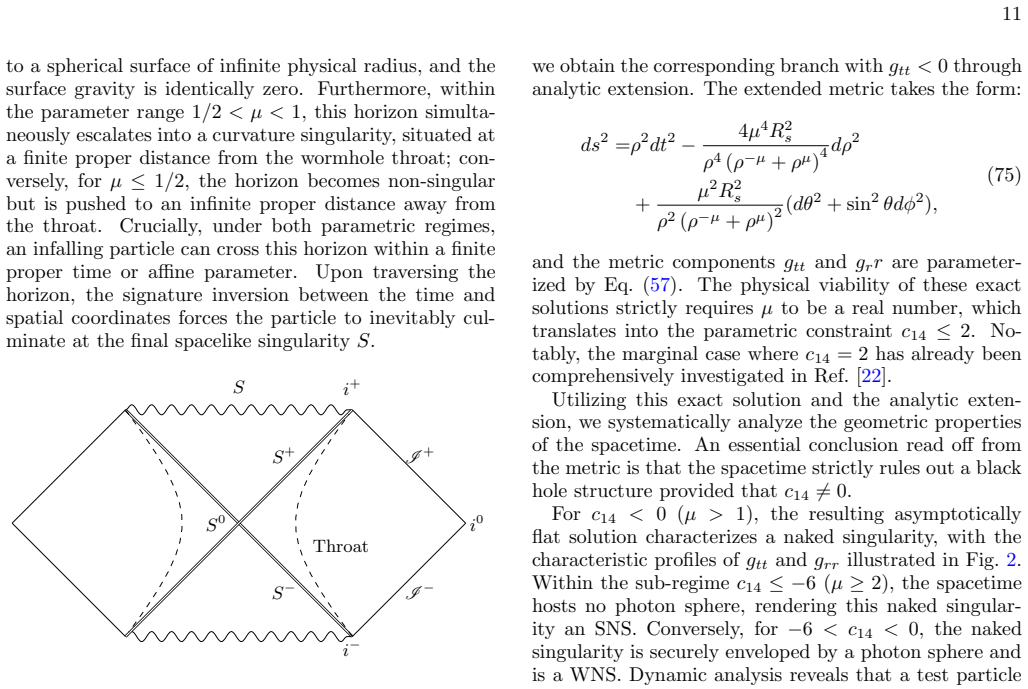
There exists a one-parameter family of exact static vacuum solutions in Einstein-Aether theory parameterized solely by c14. The Schwarzschild solution is recovered only at the isolated value c14=0; every other member is either a naked singularity (c14<0) or a wormhole-like spacetime (0<c14<2) whose maximal extension includes an internal extremal Killing horizon, a region of swapped causal roles for the coordinates, and termination at a spacelike singularity.
What carries the argument
The strictly static aether vector field aligned with the timelike Killing vector, which reduces the Einstein-Aether field equations to an ordinary differential equation whose solution depends only on c14.
Load-bearing premise
The aether vector field is required to be strictly static and aligned with the timelike Killing vector from the outset.
What would settle it
A numerical integration of the Einstein-Aether equations with a non-static aether vector field that fails to recover the claimed one-parameter family would show the solutions exist only under the static ansatz.
Figures
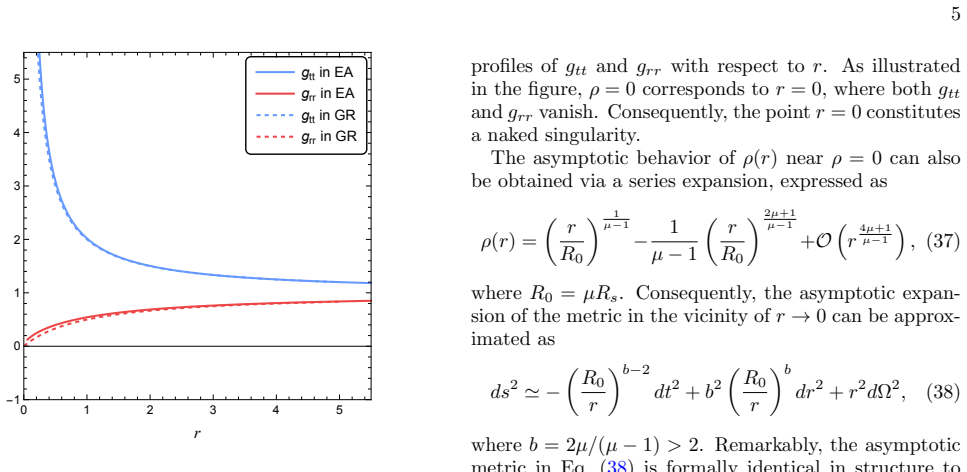
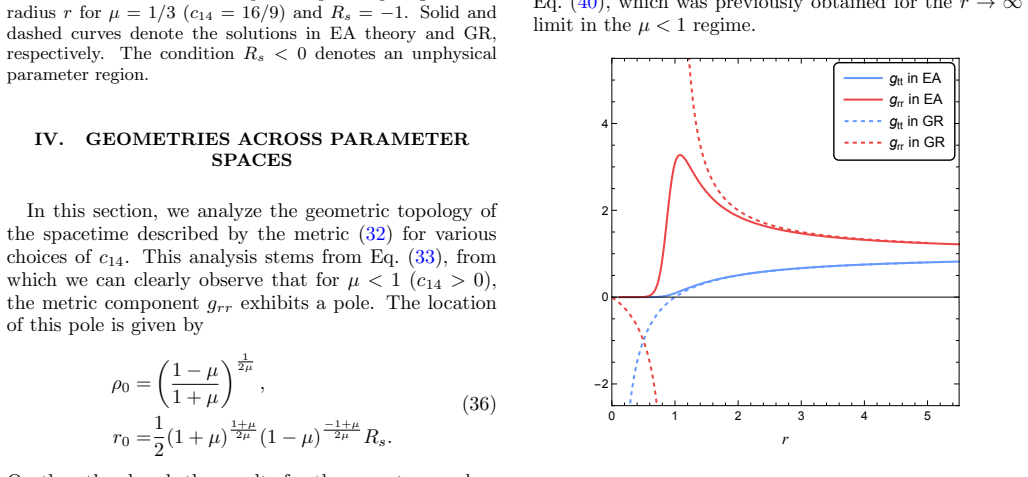
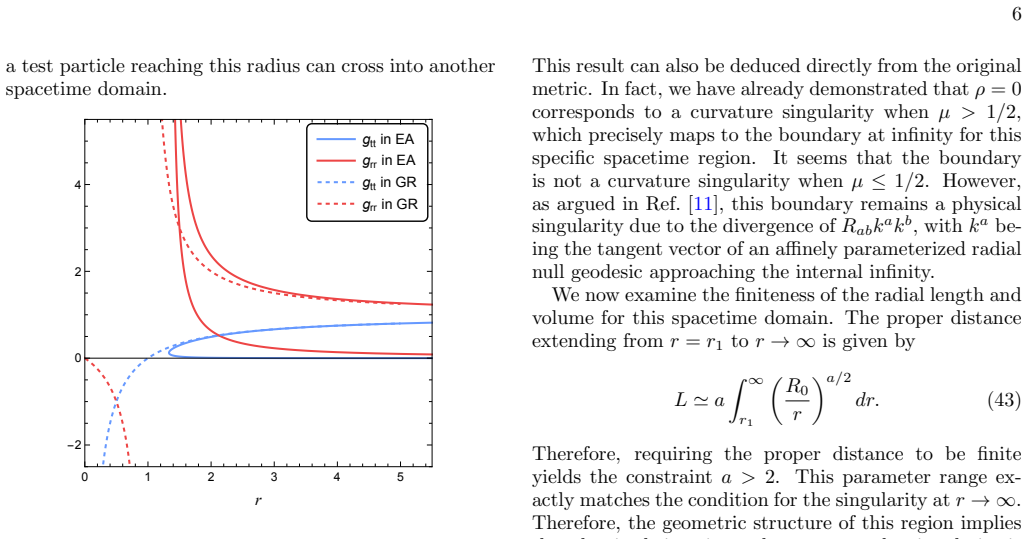
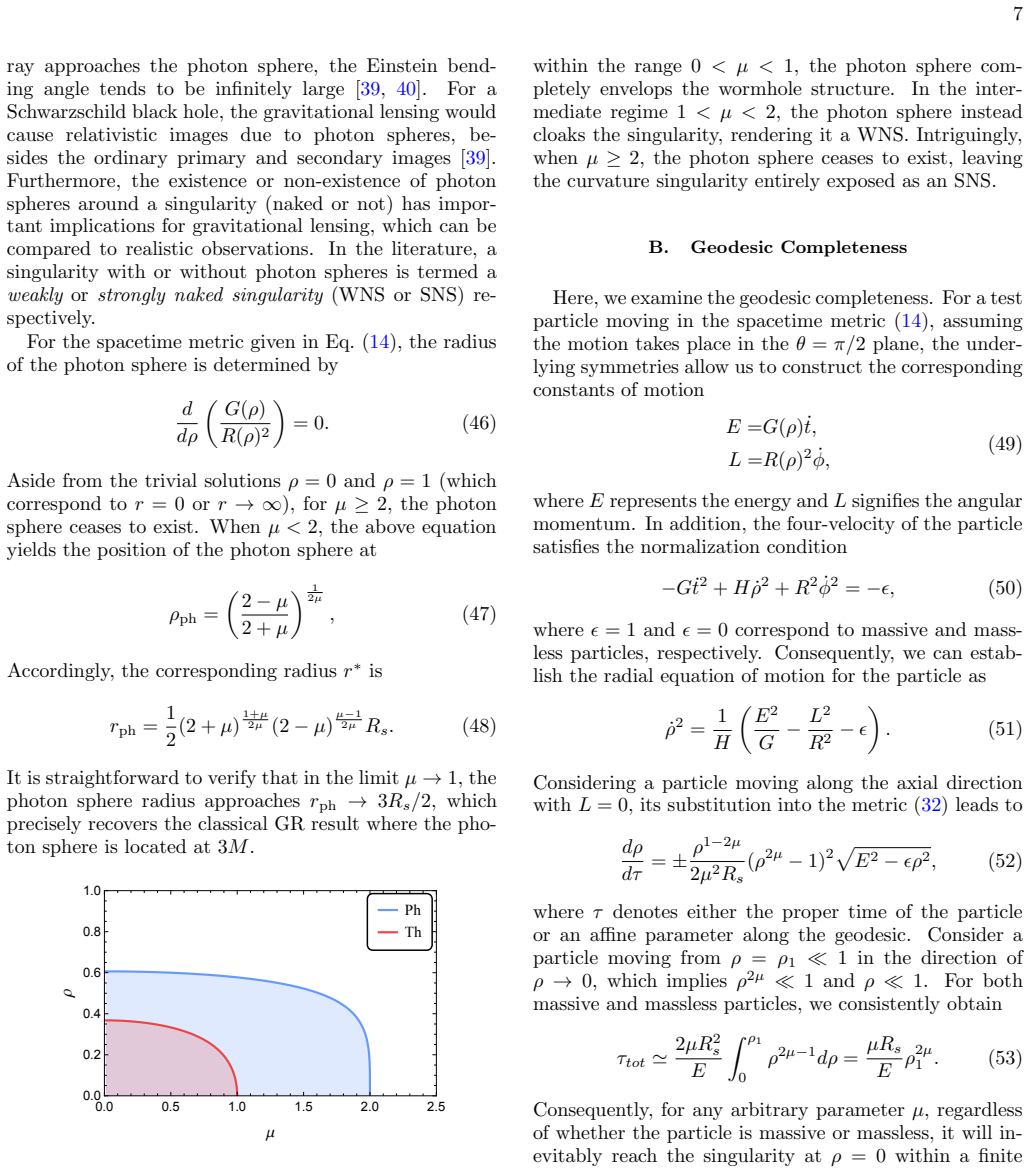
read the original abstract
We obtain an exact analytical vacuum solution of Einstein-Aether theory with a strictly static aether configuration and investigate its maximal extension. The solution depends only on the coupling $c_{14}$ and reduces to the Schwarzschild geometry in the limit $c_{14}=0$. We show that Schwarzschild is an isolated member of this family: for any nonzero $c_{14}$ the spacetime ceases to be a black hole and instead becomes either a naked singularity ($c_{14}<0$) or a wormhole-like geometry ($0<c_{14}<2$). By constructing the complete analytic extension, we demonstrate that the internal infinity of the wormhole corresponds to an extremal Killing horizon. Crossing this horizon leads to a new spacetime region where the causal roles of time and radial coordinates are exchanged, and the spacetime ultimately terminates at a spacelike singularity. The resulting global structure, summarized by the corresponding Carter-Penrose diagrams, reveals a previously unexplored causal completion of the static-aether vacuum spacetime.
Editorial analysis
A structured set of objections, weighed in public.
Referee Report
Summary. The manuscript obtains an exact analytical vacuum solution in Einstein-Aether theory under a strictly static aether ansatz aligned with the timelike Killing vector. The solution depends only on the coupling c_{14} and reduces to the Schwarzschild geometry when c_{14}=0. For nonzero c_{14} the spacetime is either a naked singularity (c_{14}<0) or a wormhole-like geometry (0<c_{14}<2). The authors construct the maximal analytic extension, identifying the internal infinity of the wormhole as an extremal Killing horizon; crossing it exchanges the causal roles of the time and radial coordinates and the spacetime terminates at a spacelike singularity. Carter-Penrose diagrams summarize the global structure.
Significance. If the solution satisfies the complete set of Einstein-Aether equations and the static-aether ansatz is preserved throughout the extension, the result would supply a new one-parameter family of exact vacuum solutions that deviates from Schwarzschild in its causal properties. The explicit dependence on a single coupling and the clean reduction to GR are strengths that facilitate direct comparison. The work would be of interest to researchers studying modified gravity and alternative black-hole structures, provided the ansatz consistency is established.
major comments (2)
- [analytic extension] The strictly static aether configuration (aligned with the timelike Killing vector) cannot be maintained across the extremal Killing horizon described in the analytic extension. Beyond this surface the Killing vector becomes spacelike while the aether vector must remain timelike (u^μ u_μ = −1), so the alignment assumed in the original ansatz is impossible. This directly affects the claimed maximal extension and the associated Carter-Penrose diagrams. (analytic extension section and abstract)
- [vacuum solution derivation] The abstract states that the solution satisfies the Einstein-Aether vacuum equations, but no explicit verification (e.g., substitution into the full set of field equations or the aether equation of motion) is referenced. Because the central claim rests on this being an exact solution, the derivation steps that confirm all components vanish must be shown. (methods or results section)
minor comments (2)
- [solution properties] The range 0 < c_{14} < 2 for the wormhole-like case should be justified by an explicit inequality derived from the metric functions or the aether norm.
- Notation for the aether vector and its alignment with the Killing vector should be introduced once in the introduction rather than only in the abstract.
Simulated Author's Rebuttal
We thank the referee for their thorough review and constructive comments on our manuscript. We address each major comment point by point below.
read point-by-point responses
-
Referee: The strictly static aether configuration (aligned with the timelike Killing vector) cannot be maintained across the extremal Killing horizon described in the analytic extension. Beyond this surface the Killing vector becomes spacelike while the aether vector must remain timelike (u^μ u_μ = −1), so the alignment assumed in the original ansatz is impossible. This directly affects the claimed maximal extension and the associated Carter-Penrose diagrams. (analytic extension section and abstract)
Authors: We thank the referee for identifying this key consistency requirement. The ansatz restricts the aether to align with the timelike Killing vector, which is incompatible with a spacelike Killing vector while enforcing u^μ u_μ = −1. We therefore agree that the strictly static aether configuration cannot be maintained across the horizon. In the revised manuscript we will explicitly restrict the domain of the ansatz to the region where the Killing vector remains timelike, amend the abstract and analytic extension section accordingly, and update the Carter-Penrose diagrams to reflect only the valid portion of the extension. The local vacuum solution and its dependence on c_{14} in the static exterior remain unchanged. revision: yes
-
Referee: The abstract states that the solution satisfies the Einstein-Aether vacuum equations, but no explicit verification (e.g., substitution into the full set of field equations or the aether equation of motion) is referenced. Because the central claim rests on this being an exact solution, the derivation steps that confirm all components vanish must be shown. (methods or results section)
Authors: We agree that explicit verification is required to establish the solution as exact. The revised manuscript will include a dedicated subsection (in the methods or results section) that substitutes the metric and static aether vector into the complete Einstein-Aether field equations and the aether equation of motion, demonstrating component-by-component that all equations are satisfied identically for the given c_{14} parameterization. revision: yes
Circularity Check
No significant circularity detected
full rationale
The paper derives an exact vacuum solution by direct integration of the Einstein-Aether field equations under an imposed strictly static aether ansatz (aligned with the timelike Killing vector). The single free parameter c14 is an external coupling constant of the theory, not determined by or fitted to the solution itself; the c14=0 limit simply recovers the known Schwarzschild metric as a consistency check. The subsequent analytic extension and Carter-Penrose diagrams follow from standard coordinate continuation of the metric functions obtained from the ODEs. No self-citations, fitted inputs renamed as predictions, self-definitional loops, or ansatz smuggling appear in the derivation chain. The result is self-contained against the field equations and the stated ansatz.
Axiom & Free-Parameter Ledger
free parameters (1)
- c14
axioms (2)
- domain assumption Einstein-Aether field equations hold
- ad hoc to paper Aether vector is strictly static
Reference graph
Works this paper leans on
-
[1]
would-be
Conse- quently, the full metric solution is explicitly given by G(ρ) =ρ 2, H(ρ) = 4K 2 2 K3µ2ρ4(µ−1) (ρ2µ −K 3) 4 , R(ρ) = K2ρµ−1 ρ2µ −K 3 , (24) whereK 2 andK 3 are integration constants. Although the metric seemingly depends on two param- eters,K 2 andK 3, diffeomorphism invariance implies that one of them could be a consequence of gauge redundancy. The...
-
[2]
T. Jacobson and D. Mattingly, Gravity with a dynam- ical preferred frame, Phys. Rev. D64, 024028 (2001), arXiv:gr-qc/0007031
Pith/arXiv arXiv 2001
-
[3]
C. Eling and T. Jacobson, Static postNewtonian equiv- alence of GR and gravity with a dynamical preferred frame, Phys. Rev. D69, 064005 (2004), arXiv:gr- qc/0310044
arXiv 2004
-
[4]
T. Jacobson and D. Mattingly, Einstein-Aether waves, Phys. Rev. D70, 024003 (2004), arXiv:gr-qc/0402005
Pith/arXiv arXiv 2004
- [5]
-
[6]
B. Z. Foster and T. Jacobson, Post-Newtonian param- eters and constraints on Einstein-aether theory, Phys. Rev. D73, 064015 (2006), arXiv:gr-qc/0509083
Pith/arXiv arXiv 2006
-
[7]
V. A. Kostelecky, Gravity, Lorentz violation, and the standard model, Phys. Rev. D69, 105009 (2004), arXiv:hep-th/0312310
Pith/arXiv arXiv 2004
-
[8]
R. Bluhm and V. A. Kostelecky, Spontaneous Lorentz violation, Nambu-Goldstone modes, and gravity, Phys. Rev. D71, 065008 (2005), arXiv:hep-th/0412320
Pith/arXiv arXiv 2005
-
[9]
Horava, Quantum Gravity at a Lifshitz Point, Phys
P. Horava, Quantum Gravity at a Lifshitz Point, Phys. Rev. D79, 084008 (2009), arXiv:0901.3775 [hep-th]
Pith/arXiv arXiv 2009
-
[10]
Mukohyama, Horava-Lifshitz Cosmology: A Review, Class
S. Mukohyama, Horava-Lifshitz Cosmology: A Review, Class. Quant. Grav.27, 223101 (2010), arXiv:1007.5199 [hep-th]
Pith/arXiv arXiv 2010
-
[11]
Wang, Hoˇ rava gravity at a Lifshitz point: A progress report, Int
A. Wang, Hoˇ rava gravity at a Lifshitz point: A progress report, Int. J. Mod. Phys. D26, 1730014 (2017), arXiv:1701.06087 [gr-qc]
Pith/arXiv arXiv 2017
-
[12]
C. Eling and T. Jacobson, Spherical solutions in Einstein- aether theory: Static aether and stars, Class. Quant. Grav.23, 5625 (2006), [Erratum: Class.Quant.Grav. 27, 049801 (2010)], arXiv:gr-qc/0603058
Pith/arXiv arXiv 2006
-
[13]
P. Berglund, J. Bhattacharyya, and D. Mattingly, Me- chanics of universal horizons, Phys. Rev. D85, 124019 (2012), arXiv:1202.4497 [hep-th]
Pith/arXiv arXiv 2012
-
[14]
P. Berglund, J. Bhattacharyya, and D. Mattingly, Towards Thermodynamics of Universal Horizons in Einstein-æther Theory, Phys. Rev. Lett.110, 071301 (2013), arXiv:1210.4940 [hep-th]
Pith/arXiv arXiv 2013
-
[15]
C. Gao and Y.-G. Shen, Static Spherically Symmetric Solution of the Einstein-aether Theory, Phys. Rev. D88, 103508 (2013), arXiv:1301.7122 [gr-qc]
Pith/arXiv arXiv 2013
-
[16]
C. Ding, A. Wang, and X. Wang, Charged Einstein- aether black holes and Smarr formula, Phys. Rev. D92, 084055 (2015), arXiv:1507.06618 [gr-qc]
Pith/arXiv arXiv 2015
-
[17]
C. Ding, C. Liu, A. Wang, and J. Jing, Three-dimensional charged Einstein-aether black holes and the Smarr for- mula, Phys. Rev. D94, 124034 (2016), arXiv:1608.00290 [gr-qc]
Pith/arXiv arXiv 2016
-
[18]
K. Lin, F.-H. Ho, and W.-L. Qian, Charged Einstein- æther black holes inn-dimensional spacetime, Int. J. Mod. Phys. D28, 1950049 (2018), arXiv:1704.06728 [gr- qc]
Pith/arXiv arXiv 2018
-
[19]
C. Ding and A. Wang, Thermodynamical study on universal horizons in higherD-dimensional spacetime and aether waves, Phys. Rev. D99, 124011 (2019), arXiv:1811.05779 [gr-qc]
Pith/arXiv arXiv 2019
-
[20]
Oost,Observational Constraints, Exact Plane Wave Solutions, and Exact Spherical Solutions in Einstein- Aether Theory, Ph.D
J. Oost,Observational Constraints, Exact Plane Wave Solutions, and Exact Spherical Solutions in Einstein- Aether Theory, Ph.D. thesis, Baylor U. (2019)
2019
-
[21]
M. Azreg-A¨ ınou, Z. Chen, B. Deng, M. Jamil, T. Zhu, Q. Wu, and Y.-K. Lim, Orbital mechanics and quasiperi- odic oscillation resonances of black holes in Einstein- Æther theory, Phys. Rev. D102, 044028 (2020), arXiv:2004.02602 [gr-qc]
arXiv 2020
-
[22]
R. Chan, M. F. A. da Silva, and V. H. Satheeshkumar, Existence of New Singularities in Einstein-Aether The- ory, JCAP05, 025, arXiv:1912.12845 [gr-qc]
arXiv 1912
-
[23]
R. Chan, M. F. A. Da Silva, and V. H. Satheeshkumar, Spherically symmetric analytic solutions and naked sin- gularities in Einstein–Aether theory, Eur. Phys. J. C81, 317 (2021), arXiv:2003.00227 [gr-qc]
arXiv 2021
-
[24]
M. S. Churilova, Black holes in Einstein-aether theory: Quasinormal modes and time-domain evolution, Phys. Rev. D102, 024076 (2020), arXiv:2002.03450 [gr-qc]
arXiv 2020
-
[25]
M. Khodadi and E. N. Saridakis, Einstein-Æther grav- ity in the light of event horizon telescope observa- tions of M87*, Phys. Dark Univ.32, 100835 (2021), arXiv:2012.05186 [gr-qc]
arXiv 2021
-
[26]
J. Rayimbaev, A. Abdujabbarov, M. Jamil, and W.-B. Han, Dynamics of magnetized particles around Einstein- Æther black hole with uniform magnetic field, Nucl. Phys. B966, 115364 (2021), arXiv:2009.04898 [gr-qc]
arXiv 2021
-
[27]
J. Oost, S. Mukohyama, and A. Wang, Spherically Sym- metric Exact Vacuum Solutions in Einstein-Aether The- ory, Universe7, 272 (2021), arXiv:2106.09044 [gr-qc]
arXiv 2021
-
[28]
R. Chan, M. F. A. da Silva, and V. H. Satheeshkumar, Thermodynamics of Einstein-Aether black holes, Eur. Phys. J. C82, 943 (2022), arXiv:2112.14978 [gr-qc]
arXiv 2022
-
[29]
C. Eling and T. Jacobson, Black Holes in Einstein-Aether Theory, Class. Quant. Grav.23, 5643 (2006), [Erra- tum: Class.Quant.Grav. 27, 049802 (2010)], arXiv:gr- qc/0604088
arXiv 2006
-
[30]
C. Eling, T. Jacobson, and M. Coleman Miller, Neu- tron stars in Einstein-aether theory, Phys. Rev. D 76, 042003 (2007), [Erratum: Phys.Rev.D 80, 129906 (2009)], arXiv:0705.1565 [gr-qc]
Pith/arXiv arXiv 2007
-
[31]
T. Tamaki and U. Miyamoto, Generic features of Einstein-Aether black holes, Phys. Rev. D77, 024026 (2008), arXiv:0709.1011 [gr-qc]
Pith/arXiv arXiv 2008
-
[32]
D. Blas and S. Sibiryakov, Horava gravity versus thermo- dynamics: The Black hole case, Phys. Rev. D84, 124043 (2011), arXiv:1110.2195 [hep-th]
Pith/arXiv arXiv 2011
-
[33]
E. Barausse, T. Jacobson, and T. P. Sotiriou, Black holes in Einstein-aether and Horava-Lifshitz gravity, Phys. Rev. D83, 124043 (2011), arXiv:1104.2889 [gr-qc]
Pith/arXiv arXiv 2011
-
[34]
T. Zhu, Q. Wu, M. Jamil, and K. Jusufi, Shadows and deflection angle of charged and slowly rotating black holes in Einstein-Æther theory, Phys. Rev. D100, 044055 (2019), arXiv:1906.05673 [gr-qc]
arXiv 2019
-
[35]
B. P. Abbottet al.(LIGO Scientific, Virgo), GW170817: Observation of Gravitational Waves from a Binary Neu- tron Star Inspiral, Phys. Rev. Lett.119, 161101 (2017), arXiv:1710.05832 [gr-qc]
Pith/arXiv arXiv 2017
-
[36]
B. P. Abbottet al.(LIGO Scientific, Virgo, Fermi- GBM, INTEGRAL), Gravitational Waves and Gamma- rays from a Binary Neutron Star Merger: GW170817 and GRB 170817A, Astrophys. J. Lett.848, L13 (2017), arXiv:1710.05834 [astro-ph.HE]. 14
Pith/arXiv arXiv 2017
-
[37]
Jacobson, Einstein-aether gravity: A Status report, PoSQG-PH, 020 (2007), arXiv:0801.1547 [gr-qc]
T. Jacobson, Einstein-aether gravity: A Status report, PoSQG-PH, 020 (2007), arXiv:0801.1547 [gr-qc]
Pith/arXiv arXiv 2007
-
[38]
J. Oost, S. Mukohyama, and A. Wang, Constraints on Einstein-aether theory after GW170817, Phys. Rev. D 97, 124023 (2018), arXiv:1802.04303 [gr-qc]
Pith/arXiv arXiv 2018
-
[39]
C.-M. Claudel, K. S. Virbhadra, and G. F. R. Ellis, The Geometry of photon surfaces, J. Math. Phys.42, 818 (2001), arXiv:gr-qc/0005050
Pith/arXiv arXiv 2001
-
[40]
K. S. Virbhadra and G. F. R. Ellis, Schwarzschild black hole lensing, Phys. Rev. D62, 084003 (2000), arXiv:astro-ph/9904193
Pith/arXiv arXiv 2000
-
[41]
K. S. Virbhadra and G. F. R. Ellis, Gravitational lensing by naked singularities, Phys. Rev. D65, 103004 (2002)
2002
-
[42]
S. Liberati, T. Rothman, and S. Sonego, Nonthermal na- ture of incipient extremal black holes, Phys. Rev. D62, 024005 (2000), arXiv:gr-qc/0002019
Pith/arXiv arXiv 2000
-
[43]
Carter, The complete analytic extension of the Reissner-Nordstr¨ om metric in the special case e2 = m 2, Physics Letters21, 423 (1966)
B. Carter, The complete analytic extension of the Reissner-Nordstr¨ om metric in the special case e2 = m 2, Physics Letters21, 423 (1966)
1966
-
[44]
A. I. Janis, E. T. Newman, and J. Winicour, Reality of the Schwarzschild Singularity, Phys. Rev. Lett.20, 878 (1968)
1968
-
[45]
K. S. Virbhadra, S. Jhingan, and P. S. Joshi, Nature of singularity in Einstein massless scalar theory, Int. J. Mod. Phys. D6, 357 (1997), arXiv:gr-qc/9512030
Pith/arXiv arXiv 1997
discussion (0)
Sign in with ORCID, Apple, or X to comment. Anyone can read and Pith papers without signing in.