Performance Analysis and Optimal Design of ORB-Type GRAND Algorithms
Pith reviewed 2026-06-29 02:30 UTC · model grok-4.3
The pith
Ordering error patterns by non-increasing average guessing posterior optimizes ORB-type GRAND algorithms over the considered set.
A machine-rendered reading of the paper's core claim, the machinery that carries it, and where it could break.
Core claim
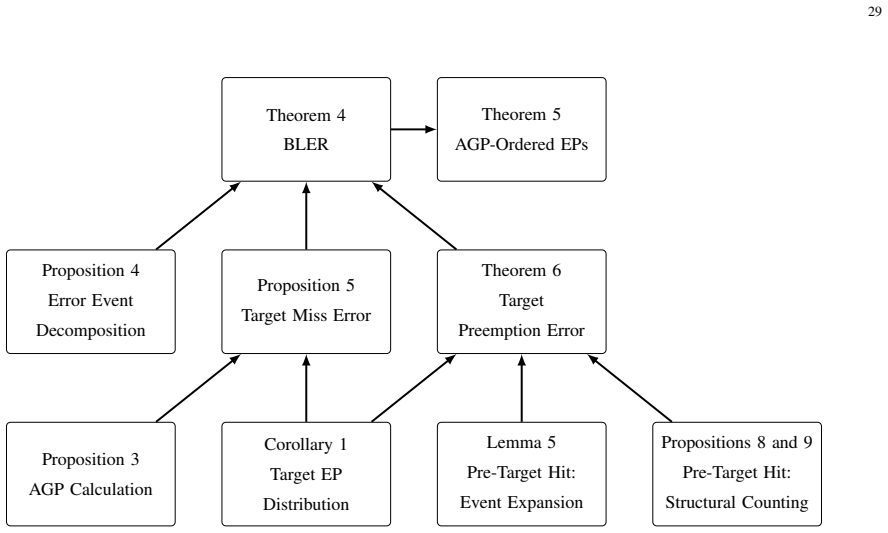
For ORB-type GRAND algorithms the testing order of error patterns is optimized by ranking them in non-increasing order of average guessing posterior; this ordering yields exact performance formulas for random ensembles and, for fixed linear codes, permits a computable bound on the target-preemption term that enables the design of RS-ORBGRAND.
What carries the argument
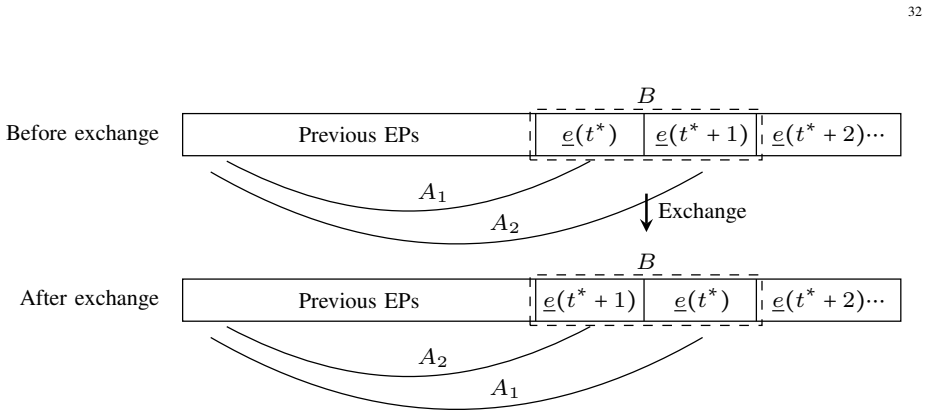
The average guessing posterior (AGP) of an error pattern, a quantity that averages the posterior probability of that pattern given the soft channel outputs and thereby converts decoding into an explicit ordering problem over the error-pattern space.
If this is right
- Exact closed-form expressions exist for block error rate, stopping-time distribution, and average number of tests under a fixed test budget for random code ensembles.
- The target-preemption term for fixed codes can be bounded via higher-order weight relationships of codeword tuples, with a first-order upper bound that is computable.
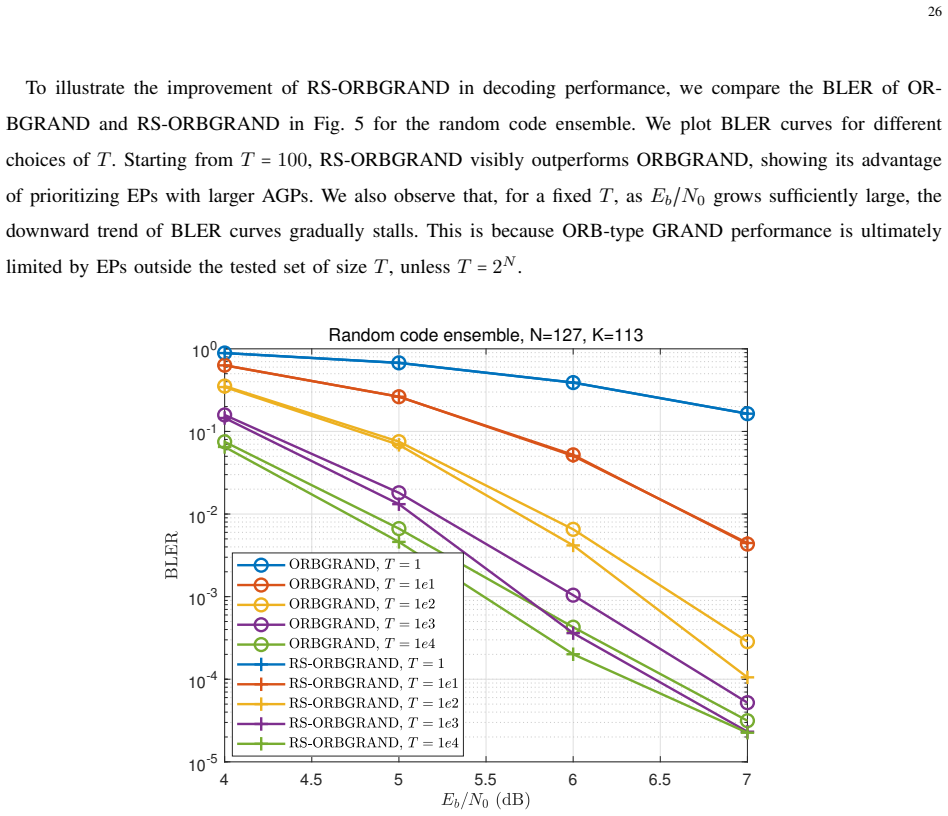
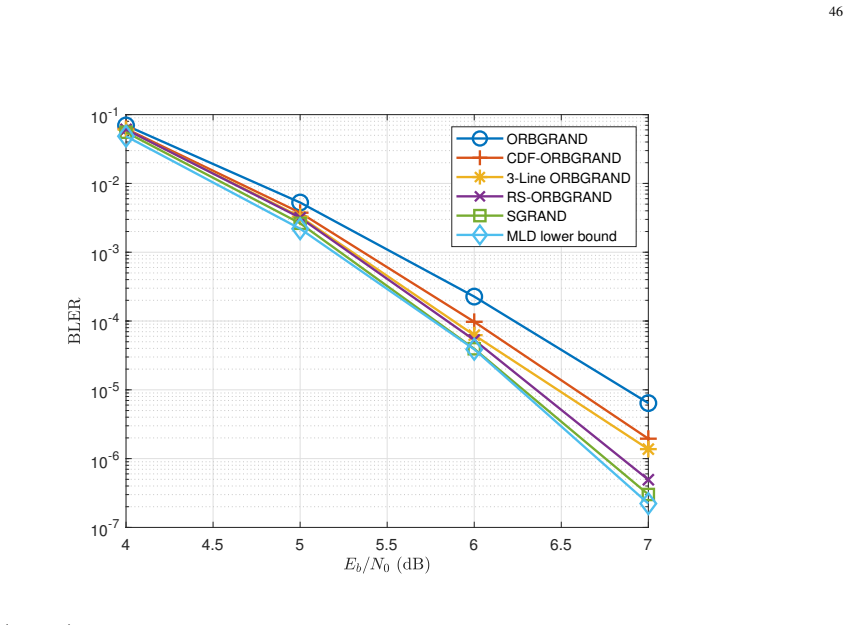
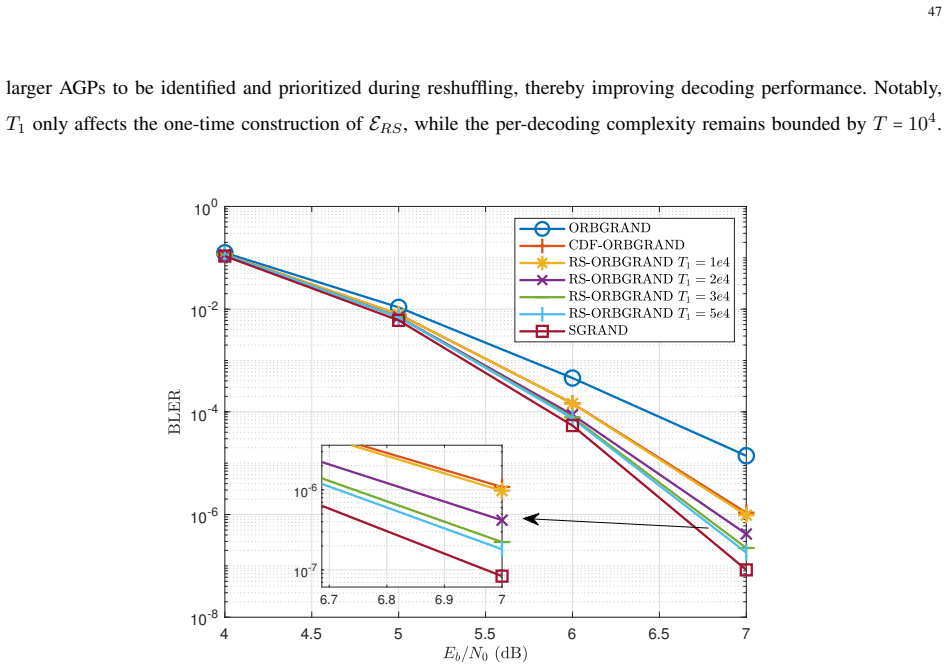
- RS-ORBGRAND improves upon existing ORB-type algorithms and reaches within 0.1 dB of the maximum-likelihood lower bound for the BCH(127,113) code at BLER 10^{-6}.
Where Pith is reading between the lines
- The AGP ordering principle may extend to other soft-information decoders that test candidate error patterns in sequence.
- Incorporating second-order AGP corrections could tighten the bound on target-preemption for short-block-length codes.
- The same reshuffling approach could be tested on other algebraic codes such as Reed-Solomon or polar codes to check generality.
Load-bearing premise
The assumption that AGP values computed from the channel model remain accurate enough to produce the claimed ordering optimality even after the code-dependent target-preemption term is isolated and bounded.
What would settle it
A direct comparison, for any fixed linear code, of block error rates obtained by AGP ordering versus an alternative ordering (such as plain reliability ranking) at identical test budgets, showing whether the AGP order actually yields lower error rate.
Figures
read the original abstract
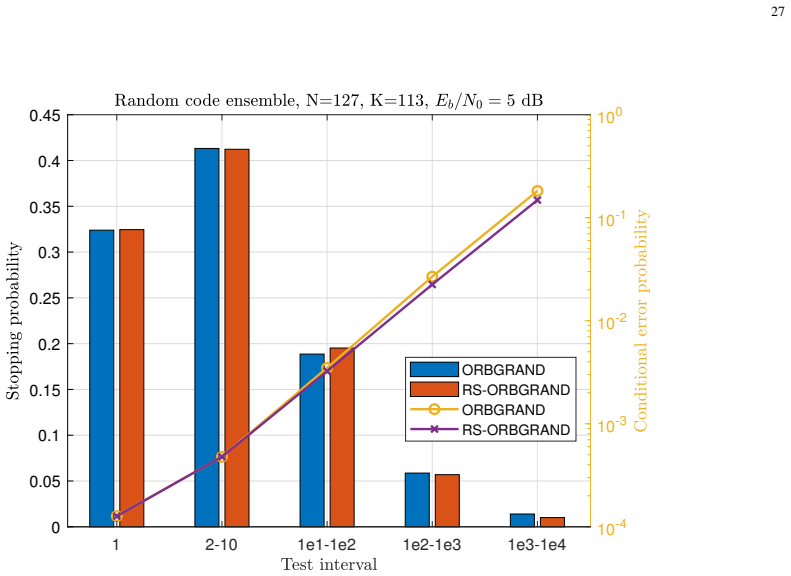
Guessing Random Additive Noise Decoding (GRAND) performs decoding by sequentially guessing channel error patterns (EPs). Ordered Reliability Bits GRAND (ORBGRAND) is a notable instance suitable for efficient implementation, as it schedules EPs solely according to the ranking of soft channel outputs. In this paper, we generalize this principle to a broader class of GRAND algorithms whose testing order depends only on reliability ranking, referred to as ORB-type GRAND. We develop a unified analytical framework based on a key quantity termed the average guessing posterior (AGP), which captures the effectiveness of each EP and reduces decoding into an ordering problem over the EP space. For random code ensembles, we derive exact expressions for the block error rate (BLER), stopping-time distribution, and average number of tests under a fixed test budget. The analysis separates target-miss and target-preemption errors and shows that ordering EPs by non-increasing AGP is optimal over the EP set under consideration. For fixed linear block codes, we derive the BLER expression that isolates the code-dependent target-preemption term and characterize this term through higher-order weight relationships of codeword tuples, with a computable first-order upper bound as a useful special case. Guided by these insights, we formulate ReShuffled-ORBGRAND (RS-ORBGRAND) as an offline AGP-based reshuffling scheme. Numerical results for the Bose--Chaudhuri--Hocquenghem (BCH)$(127,113)$ code show that RS-ORBGRAND consistently improves existing ORB-type GRAND algorithms and lies within $0.1$~dB of a maximum-likelihood decoding lower-bound benchmark at a BLER of $10^{-6}$.
Editorial analysis
A structured set of objections, weighed in public.
Referee Report
Summary. The paper introduces ORB-type GRAND algorithms and a unified framework centered on the average guessing posterior (AGP) to order error patterns (EPs). For random code ensembles it derives exact BLER, stopping-time, and test-count expressions that separate target-miss from target-preemption errors and proves that non-increasing AGP ordering is optimal over the considered EP set. For fixed linear codes it isolates the code-dependent preemption term via higher-order weight relationships of codeword tuples, supplies a computable first-order upper bound, and proposes the offline AGP-reshuffled RS-ORBGRAND scheme. Numerical results for the BCH(127,113) code claim consistent improvement over prior ORB-type methods and a 0.1 dB gap to an ML lower-bound benchmark at BLER 10^{-6}.
Significance. If the fixed-code bound is shown to preserve the claimed ordering, the work supplies a parameter-free derivation of optimal EP ordering from the channel model and posterior, together with exact ensemble expressions and a practical reshuffling algorithm that demonstrably narrows the gap to ML performance. These elements would constitute a clear advance in the analytical design of GRAND decoders.
major comments (2)
- [Abstract (fixed-code BLER expression)] Abstract (paragraph on fixed-code BLER expression): the first-order upper bound on the target-preemption term is derived from higher-order weight relationships, yet the manuscript does not verify its numerical tightness against the actual weight spectrum of BCH(127,113). Because RS-ORBGRAND applies the ensemble-derived AGP ordering directly to this fixed code, any reordering induced by the bound gap would invalidate the optimality claim over the EP set and the attribution of the reported 0.1 dB gain.
- [Numerical results (BCH(127,113))] Numerical results section (BCH(127,113) curves): the 0.1 dB proximity to the ML lower bound at BLER 10^{-6} is presented as evidence of near-optimality, but the evaluation uses the same AGP ordering whose preservation under the first-order bound has not been confirmed for this code; an explicit comparison of the bound versus the true preemption term (or an exhaustive search over the EP set) is required to substantiate the claim.
minor comments (1)
- [Abstract] The separation of target-miss versus target-preemption errors is stated clearly for ensembles but receives only a brief paragraph for fixed codes; a short dedicated subsection or table contrasting the two cases would improve readability.
Simulated Author's Rebuttal
We thank the referee for the constructive and detailed comments. We address each major comment below. We agree that the lack of numerical verification of the bound's tightness for BCH(127,113) requires attention to substantiate the optimality and performance claims, and we will revise accordingly.
read point-by-point responses
-
Referee: [Abstract (fixed-code BLER expression)] Abstract (paragraph on fixed-code BLER expression): the first-order upper bound on the target-preemption term is derived from higher-order weight relationships, yet the manuscript does not verify its numerical tightness against the actual weight spectrum of BCH(127,113). Because RS-ORBGRAND applies the ensemble-derived AGP ordering directly to this fixed code, any reordering induced by the bound gap would invalidate the optimality claim over the EP set and the attribution of the reported 0.1 dB gain.
Authors: We agree that verifying the numerical tightness of the first-order upper bound against the weight spectrum of BCH(127,113) is necessary to confirm preservation of the AGP ordering. The revised manuscript will add a direct comparison of the bound versus the exact preemption term computed from the known weight distribution of this BCH code. This will either confirm that no reordering occurs (supporting the optimality claim) or identify any adjustments needed. revision: yes
-
Referee: [Numerical results (BCH(127,113))] Numerical results section (BCH(127,113) curves): the 0.1 dB proximity to the ML lower bound at BLER 10^{-6} is presented as evidence of near-optimality, but the evaluation uses the same AGP ordering whose preservation under the first-order bound has not been confirmed for this code; an explicit comparison of the bound versus the true preemption term (or an exhaustive search over the EP set) is required to substantiate the claim.
Authors: We acknowledge that the near-ML performance attribution depends on the ordering remaining optimal under the bound for this fixed code. The revision will include the requested explicit comparison using the BCH weight spectrum to evaluate the bound gap and its effect on ordering. An exhaustive search over the full EP set is computationally infeasible for these parameters, but the weight-spectrum method provides a rigorous and feasible alternative that will be presented. revision: yes
Circularity Check
No circularity; AGP-based optimality and bounds derived independently from channel/posterior definitions
full rationale
The paper defines AGP from the channel model and posterior probabilities, then derives exact BLER expressions for random ensembles that separate target-miss and target-preemption, showing AGP ordering optimality as a direct consequence of those expressions. For fixed codes the BLER isolates the code-dependent preemption term via weight relationships with a first-order bound supplied as a computable case; RS-ORBGRAND applies the same AGP ordering offline. No quoted step reduces a claimed prediction to a fitted input, renames a known result, or loads the central claim on a self-citation chain. Numerical BCH(127,113) results are compared to an external ML lower bound rather than forced by construction. The derivation chain remains self-contained against external benchmarks.
Axiom & Free-Parameter Ledger
axioms (2)
- domain assumption Random code ensembles allow exact separation of target-miss and target-preemption errors
- domain assumption Higher-order weight relationships of codeword tuples characterize the target-preemption term
Reference graph
Works this paper leans on
-
[1]
A mathematical theory of communication,
C. E. Shannon, “A mathematical theory of communication,”Bell Syst. Tech. J., vol. 27, no. 3, pp. 379–423, 1948
1948
-
[2]
On the inherent intractability of certain coding problems,
E. Berlekamp, R. McEliece, and H. Van Tilborg, “On the inherent intractability of certain coding problems,”IEEE Trans. Inf. Theory, vol. 24, no. 3, pp. 384–386, 1978
1978
-
[3]
Towards 6G wireless communication networks: Vision, enabling technologies, and new paradigm shifts,
X. You, C.-X. Wang, J. Huang, X. Gao, Z. Zhang, M. Wang, Y . Huang, C. Zhang, Y . Jiang, J. Wanget al., “Towards 6G wireless communication networks: Vision, enabling technologies, and new paradigm shifts,”Sci. China Inf. Sci., vol. 64, pp. 1–74, 2021
2021
-
[4]
Fiber-optic transmission and networking: The previous 20 and the next 20 years,
P. J. Winzer, “Fiber-optic transmission and networking: The previous 20 and the next 20 years,”Opt. Express, vol. 26, no. 18, pp. 24 190–24 239, 2018
2018
-
[5]
A survey of high-speed serializer/deserializer architectures,
T. Mickeviciuset al., “A survey of high-speed serializer/deserializer architectures,”IEEE Access, vol. 9, pp. 116 770–116 793, 2021
2021
-
[6]
Short block-length codes for ultra-reliable low latency communications,
M. Shirvanimoghaddam, M. S. Mohammadi, R. Abbas, A. Minja, C. Yue, B. Matuz, G. Han, Z. Lin, W. Liu, Y . Liet al., “Short block-length codes for ultra-reliable low latency communications,”IEEE Commun. Mag., vol. 57, no. 2, pp. 130–137, 2018
2018
-
[7]
Efficient decoders for short block length codes in 6G URLLC,
C. Yue, V . Miloslavskaya, M. Shirvanimoghaddam, B. Vucetic, and Y . Li, “Efficient decoders for short block length codes in 6G URLLC,” IEEE Commun. Mag., vol. 61, no. 4, pp. 84–90, 2023
2023
-
[8]
Capacity-achieving guessing random additive noise decoding,
K. R. Duffy, J. Li, and M. M ´edard, “Capacity-achieving guessing random additive noise decoding,”IEEE Trans. Inf. Theory, vol. 65, no. 7, pp. 4023–4040, 2019
2019
-
[9]
Guessing noise, not code-words,
——, “Guessing noise, not code-words,” inProc. IEEE Int. Symp. Inf. Theory (ISIT), 2018, pp. 671–675
2018
-
[10]
Soft maximum likelihood decoding using GRAND,
A. Solomon, K. R. Duffy, and M. M ´edard, “Soft maximum likelihood decoding using GRAND,” inProc. IEEE Int. Conf. Commun. (ICC), 2020, pp. 1–6
2020
-
[11]
Guessing random additive noise decoding with symbol reliability information (SRGRAND),
K. R. Duffy, M. M ´edard, and W. An, “Guessing random additive noise decoding with symbol reliability information (SRGRAND),”IEEE Trans. Commun., vol. 70, no. 1, pp. 3–18, 2021
2021
-
[12]
GRAND for Rayleigh fading channels,
S. M. Abbas, M. Jalaleddine, and W. J. Gross, “GRAND for Rayleigh fading channels,” inProc. IEEE Global Commun. Conf. Workshops (GC Wkshps), 2022, pp. 504–509
2022
-
[13]
Using channel correlation to improve decoding-ORBGRAND-AI,
K. R. Duffy, M. Grundei, and M. M ´edard, “Using channel correlation to improve decoding-ORBGRAND-AI,” inProc. IEEE Global Commun. Conf. (GLOBECOM), 2023, pp. 3585–3590
2023
-
[14]
GRAND for fading channels using pseudo-soft information,
H. Sarieddeen, M. M ´edard, and K. R. Duffy, “GRAND for fading channels using pseudo-soft information,” inProc. IEEE Global Commun. Conf. (GLOBECOM), 2022, pp. 3502–3507
2022
-
[15]
Laplacian-ORBGRAND: Decoding for impulsive noise,
J. Feng, K. R. Duffy, and M. M ´edard, “Laplacian-ORBGRAND: Decoding for impulsive noise,” inProc. IEEE Mil. Commun. Conf. (MILCOM), 2024, pp. 1–6
2024
-
[16]
High-performance low-complexity error pattern generation for ORBGRAND decoding,
C. Condo, V . Bioglio, and I. Land, “High-performance low-complexity error pattern generation for ORBGRAND decoding,” inProc. IEEE Global Commun. Conf. Workshops (GC Wkshps), 2021, pp. 1–6
2021
-
[17]
Guessing random additive noise decoding with quantized soft information,
P. Yuan, K. R. Duffy, E. P. Gabhart, and M. M ´edard, “Guessing random additive noise decoding with quantized soft information,” inProc. IEEE Global Commun. Conf. Workshops (GC Wkshps), 2023, pp. 1698–1703. 50
2023
-
[18]
Lin and D
S. Lin and D. J. Costello,Error Control Coding: Fundamentals and Applications. Englewood Cliffs, NJ, USA: Prentice Hall, 2004
2004
-
[19]
A parallelization strategy for GRAND with optimality guarantee by exploiting error pattern tree representation,
L. Wan, H. Yin, and W. Zhang, “A parallelization strategy for GRAND with optimality guarantee by exploiting error pattern tree representation,”IEEE Trans. Commun., vol. 74, pp. 8517–8532, 2026
2026
-
[20]
Ordered reliability bits guessing random additive noise decoding,
K. R. Duffy, W. An, and M. M ´edard, “Ordered reliability bits guessing random additive noise decoding,”IEEE Trans. Signal Process., vol. 70, pp. 4528–4542, 2022
2022
-
[21]
Soft decoding without soft demapping with ORBGRAND,
W. An, M. M ´edard, and K. R. Duffy, “Soft decoding without soft demapping with ORBGRAND,” inProc. IEEE Int. Symp. Inf. Theory (ISIT), 2023, pp. 1080–1084
2023
-
[22]
Block turbo decoding with ORBGRAND,
K. Galligan, M. M ´edard, and K. R. Duffy, “Block turbo decoding with ORBGRAND,” inProc. 57th Annu. Conf. Inf. Sci. Syst. (CISS), 2023, pp. 1–6
2023
-
[23]
High-throughput and energy-efficient VLSI architecture for ordered reliability bits GRAND,
S. M. Abbas, T. Tonnellier, F. Ercan, M. Jalaleddine, and W. J. Gross, “High-throughput and energy-efficient VLSI architecture for ordered reliability bits GRAND,”IEEE Trans. Very Large Scale Integr. (VLSI) Syst., vol. 30, no. 6, pp. 681–693, 2022
2022
-
[24]
S. M. Abbas, M. Jalaleddine, and W. J. Gross,Guessing Random Additive Noise Decoding: A Hardware Perspective. Springer Nature, 2023
2023
-
[25]
Efficient ORBGRAND implementation with parallel noise sequence generation,
C. Ji, X. You, C. Zhang, and C. Studer, “Efficient ORBGRAND implementation with parallel noise sequence generation,”IEEE Trans. Very Large Scale Integr. (VLSI) Syst., vol. 33, no. 2, pp. 435–448, 2024
2024
-
[26]
Improved ORB-GRAND for PAC codes,
Y . Wang, Z. Shi, Z. Han, K. Liet al., “Improved ORB-GRAND for PAC codes,” inProc. 8th IEEE Int. Conf. Commun., Image Signal Process. (CCISP), 2023, pp. 477–481
2023
-
[27]
A fixed latency ORBGRAND decoder architecture with LUT-aided error-pattern scheduling,
C. Condo, “A fixed latency ORBGRAND decoder architecture with LUT-aided error-pattern scheduling,”IEEE Trans. Circuits Syst. I, Reg. Papers, vol. 69, no. 5, pp. 2203–2211, 2022
2022
-
[28]
Approaching maximum likelihood decoding performance via reshuffling ORBGRAND,
L. Wan and W. Zhang, “Approaching maximum likelihood decoding performance via reshuffling ORBGRAND,” inProc. IEEE Int. Symp. Inf. Theory (ISIT), 2024, pp. 31–36
2024
-
[29]
ORBGRAND is almost capacity-achieving,
M. Liu, Y . Wei, Z. Chen, and W. Zhang, “ORBGRAND is almost capacity-achieving,”IEEE Trans. Inf. Theory, vol. 69, no. 5, pp. 2830–2840, 2022
2022
-
[30]
ORBGRAND: Achievable rate for general bit channels and application in BICM,
Z. Li and W. Zhang, “ORBGRAND: Achievable rate for general bit channels and application in BICM,” inProc. IEEE 35th Int. Symp. Pers., Indoor Mobile Radio Commun. (PIMRC), 2024, pp. 1–7
2024
-
[31]
ORBGRAND Is Exactly Capacity-achieving via Rank Companding
——, “ORBGRAND is exactly capacity-achieving via rank companding,”arXiv preprint arXiv:2512.00347, 2025
work page internal anchor Pith review Pith/arXiv arXiv 2025
-
[32]
A finite-blocklength analysis for ORBGRAND,
——, “A finite-blocklength analysis for ORBGRAND,”arXiv preprint arXiv:2603.07526, 2026
-
[33]
List-GRAND: A practical way to achieve maximum likelihood decoding,
S. M. Abbas, M. Jalaleddine, and W. J. Gross, “List-GRAND: A practical way to achieve maximum likelihood decoding,”IEEE Trans. Very Large Scale Integr. (VLSI) Syst., vol. 31, no. 1, pp. 43–54, 2022
2022
-
[34]
Upgrade error detection to prediction with GRAND,
K. Galligan, P. Yuan, M. M ´edard, and K. R. Duffy, “Upgrade error detection to prediction with GRAND,” inProc. IEEE Global Commun. Conf. (GLOBECOM), 2023, pp. 1818–1823
2023
-
[35]
Soft-output (SO) GRAND and iterative decoding to outperform LDPC codes,
P. Yuan, M. M ´edard, K. Galligan, and K. R. Duffy, “Soft-output (SO) GRAND and iterative decoding to outperform LDPC codes,”IEEE Trans. Wireless Commun., vol. 24, no. 4, pp. 3386–3399, 2025
2025
-
[36]
Soft-output guessing codeword decoding,
K. R. Duffy, P. Yuan, J. Griffin, and M. M ´edard, “Soft-output guessing codeword decoding,”IEEE Commun. Lett., vol. 29, no. 2, pp. 328–332, 2024
2024
-
[37]
Feller,An Introduction to Probability Theory and Its Applications, Volume I, 3rd ed
W. Feller,An Introduction to Probability Theory and Its Applications, Volume I, 3rd ed. New York, NY , USA: Wiley, 1968
1968
-
[38]
A theorem on the distribution of weights in a systematic code,
J. MacWilliams, “A theorem on the distribution of weights in a systematic code,”Bell Syst. Tech. J., vol. 42, no. 1, pp. 79–94, 1963
1963
discussion (0)
Sign in with ORCID, Apple, or X to comment. Anyone can read and Pith papers without signing in.