On the Relationship Between Plasma and Tritium Fuel Cycle Through Matter Injection and Particle Exhaust
Pith reviewed 2026-06-29 02:06 UTC · model grok-4.3
The pith
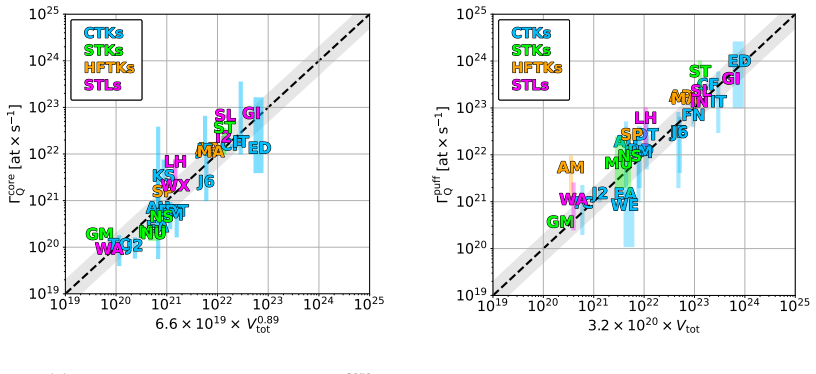
Fuel puffing in detached plasmas exceeds core fuelling by an order of magnitude, forcing substantial tritium into the injected gas and invalidating standard tritium fuel cycle assumptions.
A machine-rendered reading of the paper's core claim, the machinery that carries it, and where it could break.
Core claim
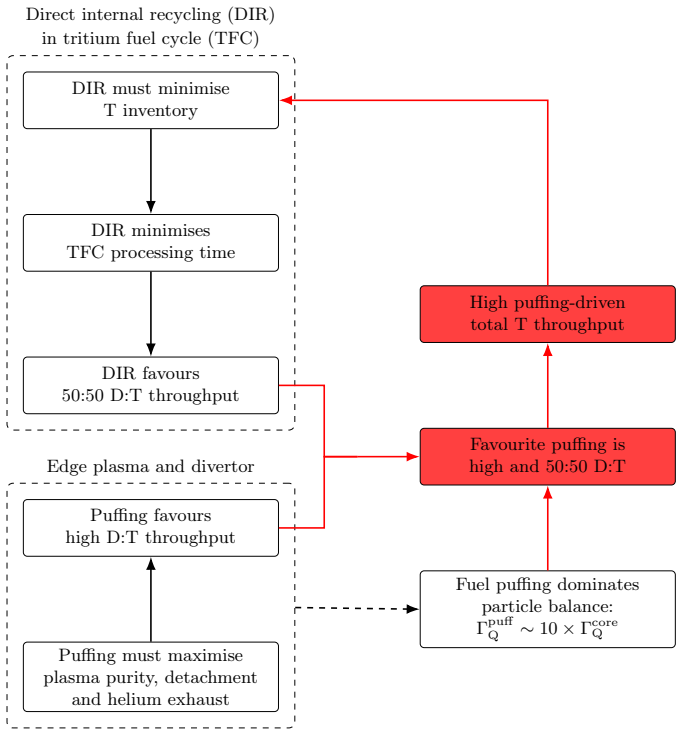
Puffing exceeds core fuelling by about an order of magnitude in detached conditions; therefore tritium must be a substantial component of the puffed fuel. This renders the near-50:50 D:T assumption of direct internal recycling self-defeating and makes tritium inventory, doubling time, required breeding ratio, and pump sizing critical design drivers.
What carries the argument
The measured or modelled ratio of total fuel puffing rate to core fuelling rate in detached plasmas, when inserted into tritium fuel cycle models that previously treated core fuelling as dominant.
If this is right
- Tritium inventory and throughput rise sharply once puffing is included, affecting breeding ratio and pump sizing.
- D-rich, T-lean puffing can meet realistic tritium cycle limits at the cost of about 10 percent lower fusion power.
- Reduced puffing combined with stronger impurity seeding maintains detachment while lowering tritium demands, at the expense of higher core contamination.
- Combined use of both strategies allows scenarios that minimise tritium inventory and throughput while balancing power and contamination.
Where Pith is reading between the lines
- Reactor design frameworks that optimise plasma performance first and then size the tritium cycle afterward will systematically understate tritium requirements.
- The trade-off between edge radiation, core purity, and tritium throughput may set an upper limit on achievable fusion gain that is tighter than core-only calculations suggest.
- Experimental campaigns on existing devices could test whether impurity-seeded detachment can be sustained at the lower puff rates needed to ease tritium cycle constraints.
Load-bearing premise
The puffing-to-core-fuelling ratio observed in current devices will remain roughly the same under the impurity mixes, pumping, and detached conditions expected in a reactor.
What would settle it
Direct measurement, in a reactor-relevant detached plasma with realistic impurity seeding and pumping, of whether the total injected fuel rate is still an order of magnitude above the core fuelling rate needed for the target fusion power.
Figures
read the original abstract
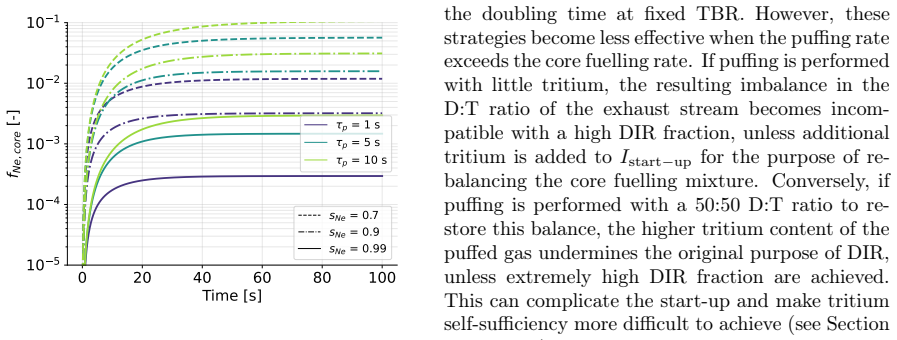
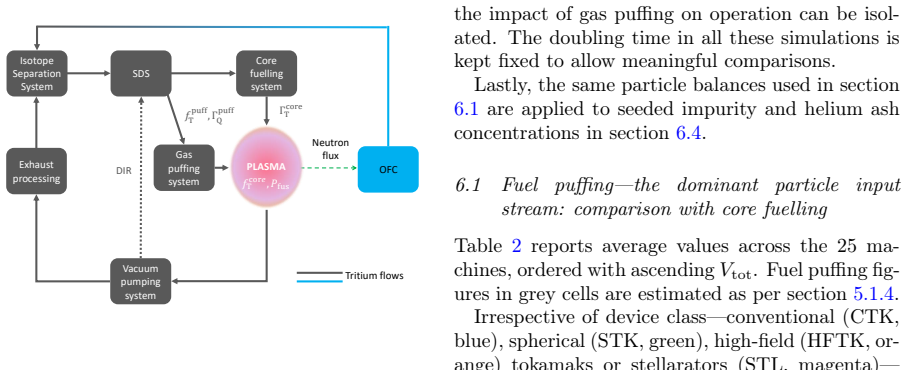
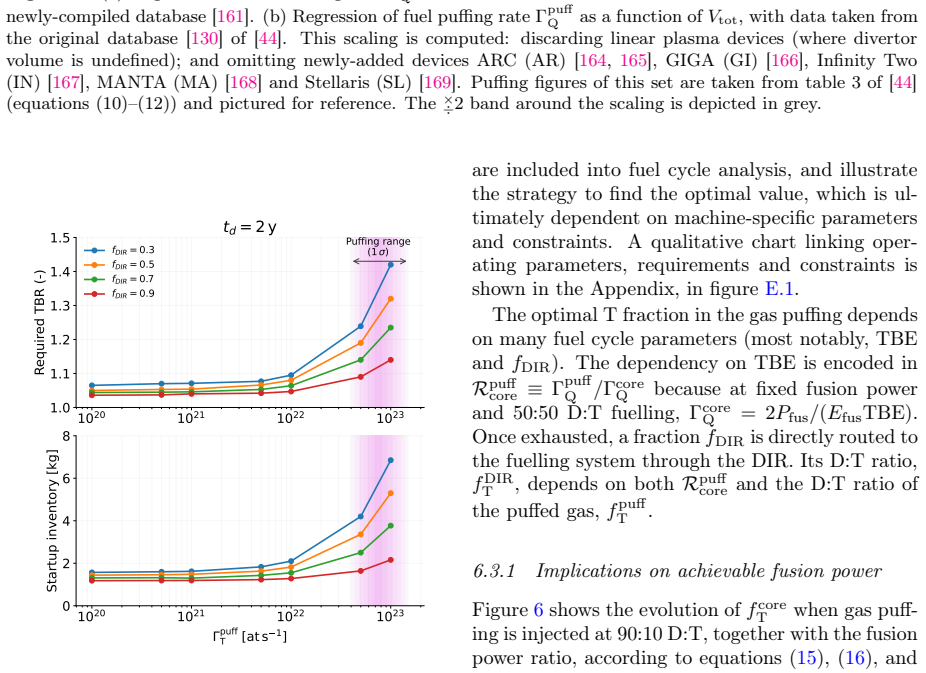
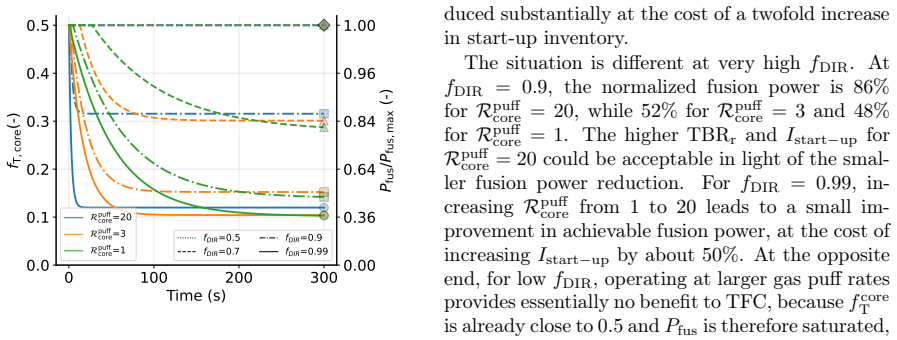
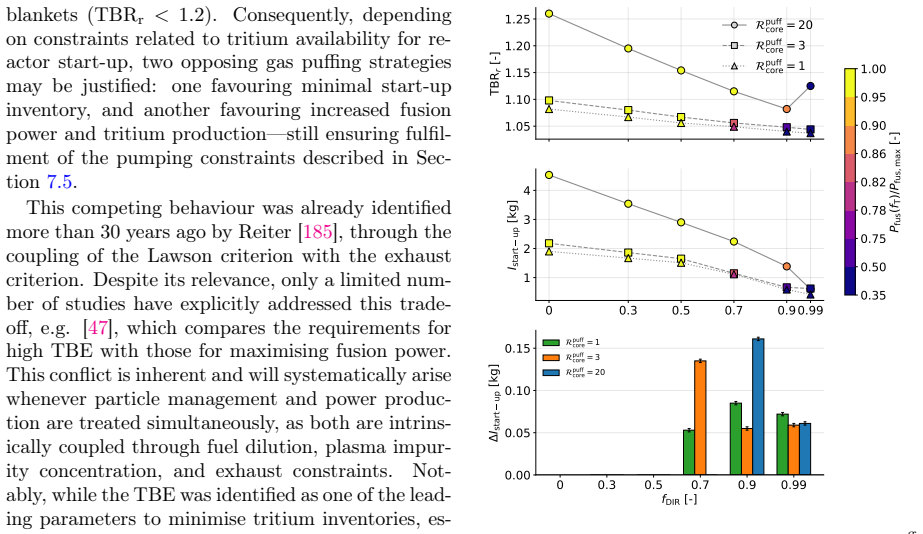
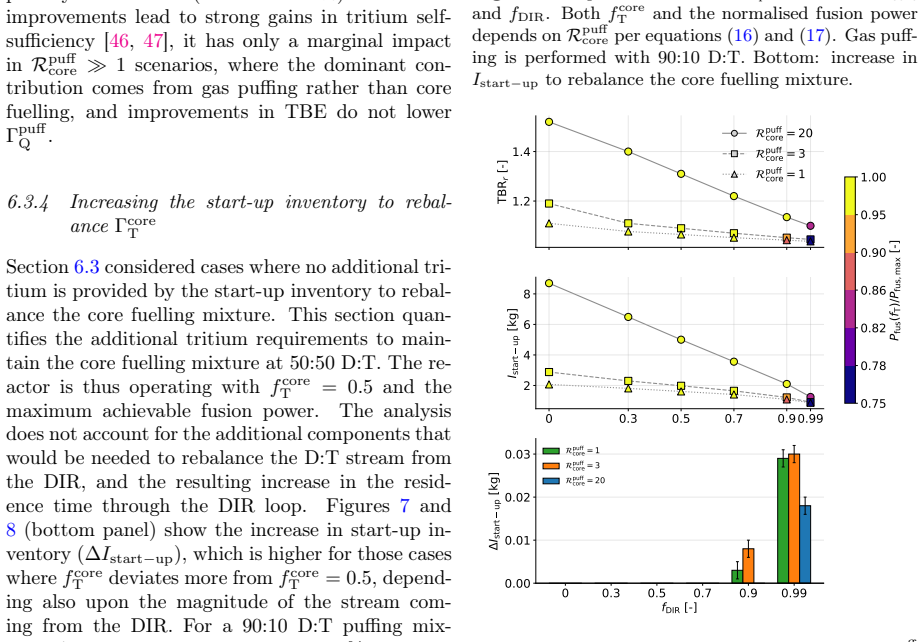
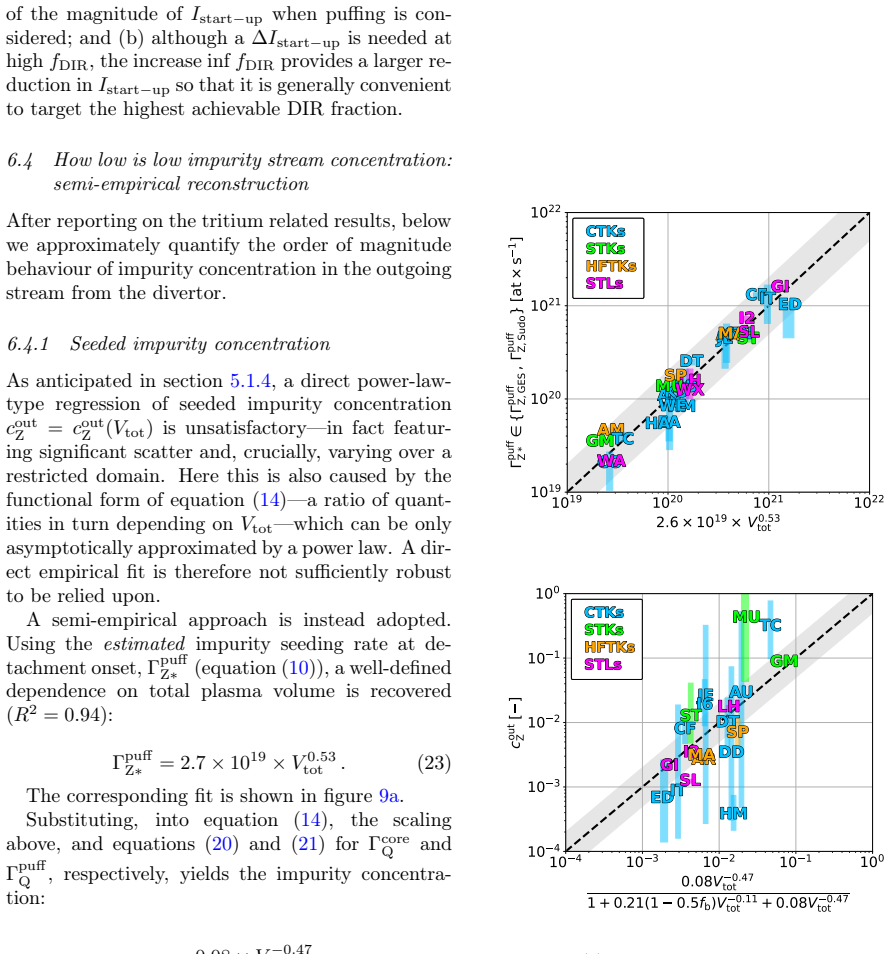
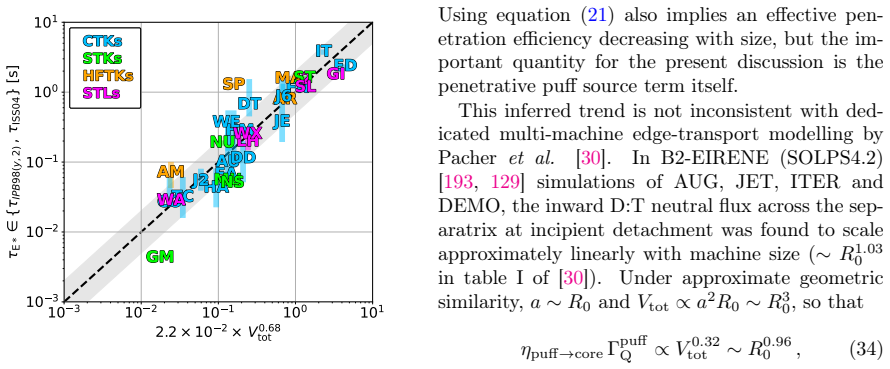
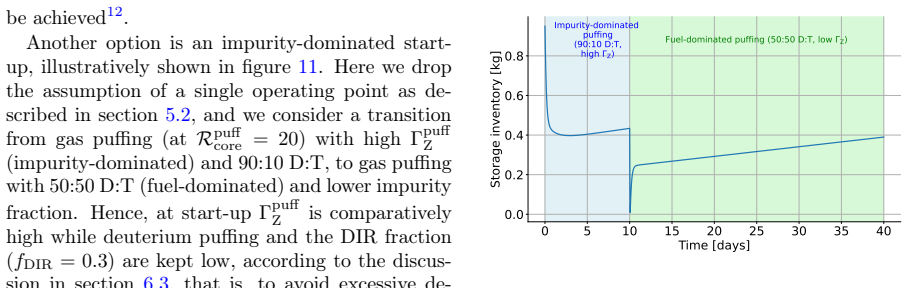
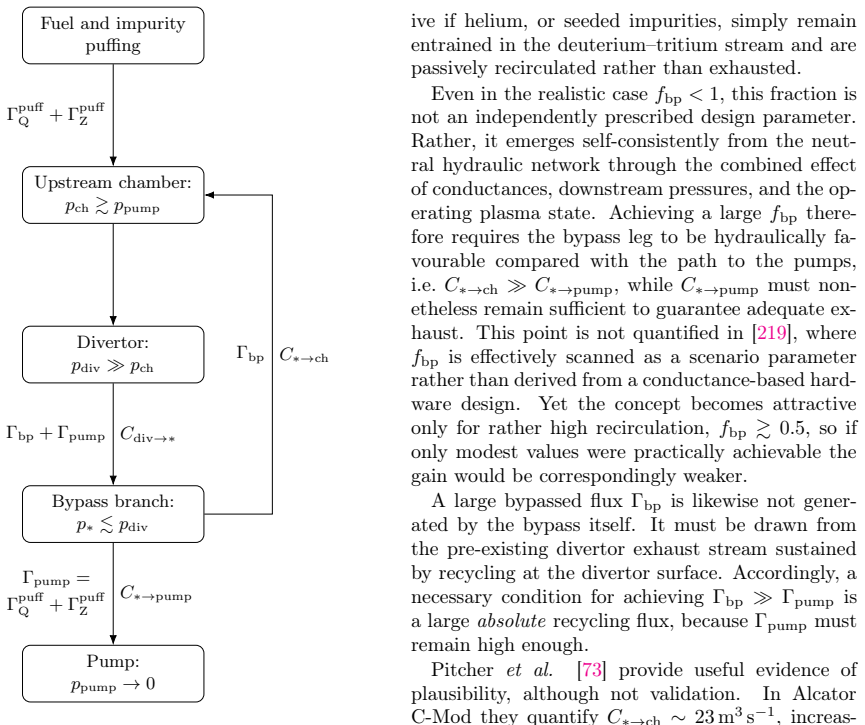
This work identifies an inconsistency between plasma operating scenarios and tritium fuel cycle (TFC) requirements, calling for a re-examination of the traditional reactor-led design approach. The key point is simple: in current TFC architectures, fuel puffing must contain tritium. Moscheni et al. (2026 Nucl. Fusion 66 026008) investigated fuel puffing rates in detached operation. Expanding that database, puffing is shown to exceed core fuelling by about an order of magnitude, from present-day tokamaks to next-step stellarators. Though not unknown in the plasma community, TFC models instead assumed core fuelling to dominate. The implications are severe. In recent TFC architectures, direct internal recycling (DIR) is intended to minimise tritium inventory, but assumes near-50:50 D:T composition. This assumption may become self-defeating: a substantial fraction of the puffed fuel must be tritium. Tritium inventory, doubling time, required breeding ratio, and pump sizing therefore become critical once puffing is properly accounted for. Mitigation is assessed by extending the models of Meschini et al. (2023 Nucl. Fusion 63 126005). For a notional plant, realistic TFC requirements can be met with D-rich, T-lean puffing, at the cost of about 10% lower fusion power. Alternatively, for near-50:50 D:T puffing, reduced fuel puffing with stronger impurity seeding can maintain detachment while alleviating TFC constraints, albeit with higher core contamination. Combined use of these strategies enables scenarios that minimise tritium inventory and throughput while balancing competing requirements. Ultimately, these results place renewed emphasis on the TFC as a central element of reactor design. A viable fusion reactor requires joint optimisation of core plasma, edge plasma, and TFC, implying unavoidable trade-offs across all three.
Editorial analysis
A structured set of objections, weighed in public.
Referee Report
Summary. The paper claims that expanding the fuel-puffing database of Moscheni et al. (2026) shows puffing rates exceed core fuelling by roughly an order of magnitude from present tokamaks to next-step stellarators; this contradicts TFC models (extended from Meschini et al. 2023) that assume core fuelling dominates. The resulting need for substantial tritium in the puff stream undermines the 50:50 D:T assumption of direct internal recycling, inflating tritium inventory, doubling time, breeding ratio and pump sizing. Two mitigation paths are assessed: D-rich/T-lean puffing at ~10% fusion-power cost, or reduced puffing plus stronger impurity seeding; their combination is said to allow acceptable TFC parameters.
Significance. If the reported puffing-to-core ratio and its extrapolation to reactor-relevant detached regimes prove robust, the work correctly identifies an under-appreciated coupling between edge-plasma operation and TFC architecture that has been treated separately in prior design studies. The explicit quantification of the resulting TFC penalties and the two concrete mitigation strategies supply a falsifiable starting point for integrated modelling.
major comments (3)
- [Abstract, §3] Abstract and §3 (database expansion): the central claim that puffing exceeds core fuelling by a factor of ~10 rests on an expanded version of the Moscheni et al. (2026) database, yet the manuscript provides neither the additional data points, the fitting procedure, nor error bars on the ratio; without these the load-bearing numerical factor cannot be independently assessed.
- [§4] §4 (TFC extension): the 10% fusion-power penalty quoted for D-rich puffing is obtained by extending the Meschini et al. (2023) model, but the manuscript does not report the modified equations, the updated parameter values, or the sensitivity of the penalty to the assumed impurity mix and pumping scheme.
- [§5] §5 (reactor extrapolation): the assertion that the observed ratio persists under reactor-relevant detached conditions with the impurity seeding and pumping schemes of the TFC model is stated without a dedicated sensitivity study; changes in SOL transport or detachment-front location could alter the ratio and thereby weaken the inconsistency claim.
minor comments (2)
- [§3] Notation for the puffing-to-core ratio is introduced without an explicit equation number; adding Eq. (X) would improve traceability.
- [Figures 2–4] Figure captions should state the device set and the exact definition of “core fuelling” used in each panel.
Simulated Author's Rebuttal
We thank the referee for the detailed and constructive report. The comments correctly identify gaps in the presentation of supporting data and analyses. We address each major comment below and will incorporate revisions to strengthen the manuscript.
read point-by-point responses
-
Referee: [Abstract, §3] Abstract and §3 (database expansion): the central claim that puffing exceeds core fuelling by a factor of ~10 rests on an expanded version of the Moscheni et al. (2026) database, yet the manuscript provides neither the additional data points, the fitting procedure, nor error bars on the ratio; without these the load-bearing numerical factor cannot be independently assessed.
Authors: We agree that the expanded Moscheni et al. (2026) database, the fitting procedure establishing the ~10x ratio, and error bars are not provided in the current manuscript. This limits independent assessment of the central numerical claim. In the revised version we will add the additional data points (tabulated or plotted), describe the fitting procedure used to quantify the puffing-to-core ratio across the database, and report error bars derived from data scatter and measurement uncertainties. revision: yes
-
Referee: [§4] §4 (TFC extension): the 10% fusion-power penalty quoted for D-rich puffing is obtained by extending the Meschini et al. (2023) model, but the manuscript does not report the modified equations, the updated parameter values, or the sensitivity of the penalty to the assumed impurity mix and pumping scheme.
Authors: We acknowledge that the model extension details are missing. The 10% fusion-power penalty is obtained from the extended Meschini et al. (2023) TFC model, yet the modified equations, specific parameter values for the notional plant, and sensitivity to impurity mix or pumping scheme are not reported. In revision we will include the updated equations, the parameter set used, and a sensitivity study showing how the penalty varies with impurity mix and pumping assumptions. revision: yes
-
Referee: [§5] §5 (reactor extrapolation): the assertion that the observed ratio persists under reactor-relevant detached conditions with the impurity seeding and pumping schemes of the TFC model is stated without a dedicated sensitivity study; changes in SOL transport or detachment-front location could alter the ratio and thereby weaken the inconsistency claim.
Authors: The extrapolation relies on the database spanning detached operation from present tokamaks to next-step stellarators, but we agree that a dedicated sensitivity study on SOL transport and detachment-front location is absent. While the existing database already samples a range of detached conditions, to address the concern we will add a sensitivity analysis in the revised manuscript exploring the impact of plausible variations in SOL transport and detachment location on the puffing-to-core ratio. revision: yes
Circularity Check
Central quantitative claim and TFC extension rely on self-citations to overlapping authors' prior modeling
specific steps
-
self citation load bearing
[Abstract]
"Moscheni et al. (2026 Nucl. Fusion 66 026008) investigated fuel puffing rates in detached operation. Expanding that database, puffing is shown to exceed core fuelling by about an order of magnitude, from present-day tokamaks to next-step stellarators. [...] Mitigation is assessed by extending the models of Meschini et al. (2023 Nucl. Fusion 63 126005)."
The load-bearing quantitative premise (order-of-magnitude puffing excess) and the TFC analysis framework are justified solely by citations to prior publications whose authors overlap with the present paper. The inconsistency between plasma scenarios and TFC requirements therefore inherits modeling assumptions from those self-cited works rather than resting on independent external data or a new derivation within this manuscript.
full rationale
The paper's key result (puffing exceeds core fuelling by ~10x) is obtained by expanding a database from the authors' own 2026 work, while mitigation strategies extend their 2023 TFC model. This makes the inconsistency identification load-bearing on self-citations. However, the paper performs new synthesis and proposes mitigations with independent analytical content rather than reducing any derivation to the inputs by construction. No self-definitional, fitted-prediction, or ansatz patterns are exhibited. The self-citation is therefore noted but does not force the result or eliminate independent value, consistent with a moderate score.
Axiom & Free-Parameter Ledger
Forward citations
Cited by 1 Pith paper
-
Harnessing Toroidal Neutral Flows to Enhance Divertor Particle Exhaust
Toroidally oriented pump inlets reduce back-flow by up to 20% (deuterium) and 33% (helium) and enhance partial pressures by factors of 1.78 and 2.00 in DSMC simulations of plasma-imprinted neutral winds.
Reference graph
Works this paper leans on
-
[1]
BLUE- PRINT: A novel approach to fusion re- actor design,
M. Coleman and S. McIntosh, “BLUE- PRINT: A novel approach to fusion re- actor design,”Fusion Engineering and Design, vol. 139, pp. 26–38, 2019. [On- line]. Available: https://www.sciencedirect. com/science/article/pii/S0920379618308019
2019
-
[2]
O. Meneghini, T. Slendebroek, B. Lyons, K. McLaughlin, J. McClenaghan, L. Stagner, J. Harvey, T. Neiser, A. Ghiozzi, G. Dose, J. Guterl, A. Zalzali, T. Cote, N. Shi, D. Weisberg, S. Smith, B. Grierson, and J. Candy, “FUSE (Fusion Synthesis Engine): A Next Generation Framework for Integrated Design of Fusion Pilot Plants,”arXiv, 2024. [Online]. Available: ...
arXiv 2024
-
[3]
“PROCESS
M. Kovari, F. Fox, C. Harrington, R. Kembleton, P. Knight, H. Lux, and J. Morris, ““PROCESS”: A sys- tems code for fusion power plants–Part 2: Engineering,”Fusion Engineering and Design, vol. 104, pp. 9–20, 2016. [Online]. Available: https://www.sciencedirect.com/ science/article/abs/pii/S0920379616300072
2016
-
[4]
An ad- vanced computational algorithm for sys- tems analysis of tokamak power plants,
Z. Dragojlovic, A. Rene Raffray, F. Na- jmabadi, C. Kessel, L. Waganer, L. El- Guebaly, and L. Bromberg, “An ad- vanced computational algorithm for sys- tems analysis of tokamak power plants,” Fusion Engineering and Design, vol. 85, no. 2, pp. 243–265, 2010. [Online]. Available: https://www.sciencedirect.com/ science/article/pii/S0920379610000414
2010
-
[5]
Efforts towards improvement of systems codes for the Broader Approach DEMO design,
M. Nakamura, R. Kemp, H. Utoh, D. J. Ward, K. Tobita, R. Hiwatari, and G. Fe- derici, “Efforts towards improvement of systems codes for the Broader Approach DEMO design,”Fusion Engineering and Design, vol. 87, no. 5, pp. 864–867, 2012, tenth International Symposium on Fusion Nuclear Technology (ISFNT-10). [Online]. Available: https://www.sciencedirect.com...
2012
-
[6]
M. Coleman, J. Cook, F. Franza, I. Maione, S. McIntosh, J. Morris, D. Short, A. Blair, M. Bluteau, H. Brookset al., “bluemira,” Zenodo, 2025. [Online]. Available: https: //doi.org/10.5281/zenodo.19385066
-
[7]
Plasma physics for fusion re- actor system codes: Framework and model code,
E. Fable, C. Angioni, M. Siccinio, and H. Zohm, “Plasma physics for fusion re- actor system codes: Framework and model code,”Fusion Engineering and Design, vol. 130, pp. 131–136, 2018. [Online]. Available: https://www.sciencedirect.com/ science/article/pii/S0920379618302801
2018
-
[8]
DEMO reactor design using the new modular system code SYCOMORE,
C. Reux, L. Di Gallo, F. Imbeaux, J.-F. Artaud, P. Bernardi, J. Bucalossi, G. Ciraolo, J.-L. Duchateau, C. Fausser, D. Galassi, P. Hertout, J.-C. Jaboulay, A. Li-Puma, B. Saoutic, L. Zani, and I.-T. Contributors, “DEMO reactor design using the new modular system code SYCOMORE,”Nuclear Fusion, vol. 55, no. 7, p. 073011, jun 2015. [Online]. Available: https...
2015
-
[9]
On the implementation of new technology modules for fusion re- actor systems codes,
F. Franza, L. Boccaccini, U. Fisher, P. Gade, and R. Heller, “On the implementation of new technology modules for fusion re- actor systems codes,”Fusion Engineering and Design, vol. 98-99, pp. 1767–1770, 2015, proceedings of the 28th Symposium On Fusion Technology (SOFT-28). [Online]. Available: https://www.sciencedirect.com/ science/article/pii/S0920379615001933
2015
-
[10]
Development of a tokamak re- actor system code and its application for concept development of a demo reactor,
B. G. Hong, D. W. Lee, S.-K. Kim, and Y. Kim, “Development of a tokamak re- actor system code and its application for concept development of a demo reactor,” Fusion Engineering and Design, vol. 83, no. 10, pp. 1615–1618, 2008, proceed- ings of the Eight International Symposium of Fusion Nuclear Technology. [Online]. Available: https://www.sciencedirect.co...
2008
-
[11]
SOLPS-ITER modelling of helium transport, recycling and pumping at the ASDEX Upgrade toka- mak,
A. Zito, O. Pan, M. Wischmeier, A. Kapp- atou, A. Kallenbach, S. Makarov, M. Bernert, M. Cavedon, D. Reiter, U. Stroth, and the ASDEX Upgrade Team, “SOLPS-ITER modelling of helium transport, recycling and pumping at the ASDEX Upgrade toka- mak,”Nuclear Fusion, vol. 65, no. 4, p. 046022, mar 2025. [Online]. Available: https: //dx.doi.org/10.1088/1741-4326/adbe90
-
[12]
Effect of neutral screening on pump- ing efficiency in the DEMO divertor,
S. Varoutis, Y. Igitkhanov, and C. Day, “Effect of neutral screening on pump- ing efficiency in the DEMO divertor,” Fusion Engineering and Design, vol. 146, pp. 1741–1746, Sep. 2019. [Online]. Available: https://www.sciencedirect.com/ science/article/pii/S0920379619303515 44
2019
-
[13]
3D numerical study of neutral gas dynamics in the DTT particle exhaust using the DSMC method,
C. Tantos, S. Varoutis, V. Hauer, C. Day, and P. Innocente, “3D numerical study of neutral gas dynamics in the DTT particle exhaust using the DSMC method,”Nuclear Fusion, vol. 64, no. 1, p. 016019, nov 2023. [Online]. Available: https://doi.org/10.1088/ 1741-4326/ad0c80
2023
-
[14]
Review of blanket designs for advanced fusion reactors,
T. Ihli, T. Basu, L. Giancarli, S. Kon- ishi, S. Malang, F. Najmabadi, S. Nishio, A. Raffray, C. Rao, A. Sagara, and Y. Wu, “Review of blanket designs for advanced fusion reactors,”Fusion Engineering and Design, vol. 83, no. 7, pp. 912–919, 2008, proceedings of the Eight International Sym- posium of Fusion Nuclear Technology. [On- line]. Available: https:...
2008
-
[15]
Dy- namic thermal-hydraulic modelling of the eu demo hcpb breeding blanket cool- ing loops,
A. Froio, C. Bachmann, F. Cismondi, L. Savoldi, and R. Zanino, “Dy- namic thermal-hydraulic modelling of the eu demo hcpb breeding blanket cool- ing loops,”Progress in Nuclear Energy, vol. 93, pp. 116–132, 2016. [Online]. Available: https://www.sciencedirect.com/ science/article/pii/S014919701630186X
2016
-
[16]
Materials chal- lenges for the fusion nuclear science fa- cility,
A. Rowcliffe, L. Garrison, Y. Yamamoto, L. Tan, and Y. Katoh, “Materials chal- lenges for the fusion nuclear science fa- cility,”Fusion Engineering and Design, vol. 135, pp. 290–301, 2018, spe- cial Issue: FESS-FNSF Study. [Online]. Available: https://www.sciencedirect.com/ science/article/pii/S0920379617307524
2018
-
[17]
DEMO structural materials qualification and development,
M. Gorley, G. Aiello, J. Henry, T. Nozawa, G. Pintsuk, M. Rieth, and H. Tanigawa, “DEMO structural materials qualification and development,”Fusion Engineering and Design, vol. 170, p. 112513, 2021. [Online]. Available: https://www.sciencedirect.com/ science/article/pii/S0920379621002891
2021
-
[18]
EU DEMO Remote Maintenance System development during the Pre-Concept Design Phase,
O. Crofts, A. Loving, M. Torrance, S. Bud- den, B. Drumm, T. Tremethick, D. Chauvin, M. Siuko, W. Brace, V. Milushev, M. Mit- twollen, T. Lehmann, F. Rauscher, G. Fisc- her, P. Pagani, Y. Wang, C. Baars, and A. Vale, “EU DEMO Remote Maintenance System development during the Pre-Concept Design Phase,”Fusion Engineering and Design, vol. 179, p. 113121, 2022...
2022
-
[19]
The ITER remote maintenance system,
A. Tesini and J. Palmer, “The ITER remote maintenance system,”Fusion Engineering and Design, vol. 83, no. 7, pp. 810–816, 2008, proceedings of the Eight International Sym- posium of Fusion Nuclear Technology. [On- line]. Available: https://www.sciencedirect. com/science/article/pii/S092037960800255X
2008
-
[20]
The European roadmap towards fusion electricity,
A. Donné, “The European roadmap towards fusion electricity,”Philosophical Transactions of the Royal Society A, vol. 377, p. 2141, 2019. [Online]. Available: https: //doi.org/10.1098/rsta.2017.0432
-
[21]
Benefits and Chal- lenges of Advanced Divertor Configura- tions in DEMO,
R. Kembleton, M. Siccinio, F. Maviglia, and F. Militello, “Benefits and Chal- lenges of Advanced Divertor Configura- tions in DEMO,”Fusion Engineering and Design, vol. 179, p. 113120, 2022. [On- line]. Available: https://www.sciencedirect. com/science/article/pii/S092037962200120X
2022
-
[22]
C. Cowley, D. Moulton, and B. Lipschultz, “Isolating the impacts of divertor closure on fueling and detachment with simpli- fied SOLPS-ITER simulations of MAST- U,”Physics of Plasmas, vol. 33, no. 2, p. 022508, 02 2026. [Online]. Available: https://doi.org/10.1063/5.0271055
-
[23]
Assessment of DEMO challenges in technology and physics,
H. Zohm, “Assessment of DEMO challenges in technology and physics,”Fusion Engineering and Design, vol. 88, no. 6, pp. 428–433, 2013, proceedings of the 27th Symposium On Fusion Technology (SOFT-27); Liège, Belgium, September 24-28, 2012. [Online]. Available: https://www.sciencedirect.com/ science/article/pii/S0920379613000021
2013
-
[24]
Physics conclusions in support of ITER W divertor monoblock shaping,
R. Pitts, S. Bardin, B. Bazylev, M. van den Berg, P. Bunting, S. Carpentier-Chouchana, J. Coenen, Y. Corre, R. Dejarnac, F. Escour- biac, J. Gaspar, J. Gunn, T. Hirai, S.-H. Hong, J. Horacek, D. Iglesias, M. Komm, K. Krieger, C. Lasnier, G. Matthews, T. Morgan, S. Panayotis, S. Pestchanyi, A. Podolnik, R. Nygren, D. Rudakov, G. De Temmerman, P. Vondracek,...
2017
-
[25]
Power exhaust in tokamaks and scenario integration is- sues,
A. Loarte and R. Neu, “Power exhaust in tokamaks and scenario integration is- sues,”Fusion Engineering and Design, vol. 122, pp. 256–273, 2017. [Online]. Available: https://www.sciencedirect.com/ science/article/pii/S092037961730724X
2017
-
[26]
Physics basis for the first ITER tung- sten divertor,
R. Pitts, X. Bonnin, F. Escourbiac, H. Frerichs, J. Gunn, T. Hirai, A. Kukushkin, E. Kaveeva, M. Miller, D. Moulton, V. Rozhansky, I. Senichenkov, E. Sytova, O. Schmitz, P. Stangeby, G. De Tem- merman, I. Veselova, and S. Wiesen, “Physics basis for the first ITER tung- sten divertor,”Nuclear Materials and En- ergy, vol. 20, p. 100696, 2019. [Online]. Avai...
2019
-
[27]
B. Ploeckl, P. T. Lang, A. Frattolillo, Y. Igitkhanov, B. Pégourié, E. Fable, C. Day, and C. Gliss, “Matter Injection in EU- DEMO: The Preconceptual Design,”Fusion Science and Technology, vol. 77, no. 4, pp. 266–278, 2021. [Online]. Available: https: //doi.org/10.1080/15361055.2021.1903784
-
[28]
Neutral recirculation—the key to control of divertor operation,
A. Kukushkin and H. Pacher, “Neutral recirculation—the key to control of divertor operation,”Nuclear Fusion, vol. 56, no. 12, p. 126012, sep 2016. [Online]. Available: https: //doi.org/10.1088/0029-5515/56/12/126012
-
[29]
On benchmarking of simulations of particle transport in ITER,
Y.-S. Na, F. Koechl, A. Polevoi, C. Byun, D. Na, J. Seo, F. Felici, A. Fukuyama, J. Garcia, N. Hayashi, C. Kessel, T. Luce, J. Park, F. Poli, O. Sauter, A. Sips, P. Strand, A. Teplukhina, I. Voitsekhovitch, A. Wisitsorasak, X. Yuan, and T. I. T. G. on Integrated Operation Scenarios, “On benchmarking of simulations of particle transport in ITER,”Nuclear Fu...
-
[30]
Scaling of ITER diver- tor parameters – interpolation from 2D modelling and extrapolation,
H. Pacher, A. Kukushkin, G. Pacher, and G. Janeschitz, “Scaling of ITER diver- tor parameters – interpolation from 2D modelling and extrapolation,”Journal of Nuclear Materials, vol. 313-316, pp. 657– 663, 2003, Plasma-Surface Interactions in Controlled Fusion Devices 15. [Online]. Available: https://www.sciencedirect.com/ science/article/pii/S0022311502013740
2003
-
[31]
F. Koechl, R. Ambrosino, P. Belo, M. Cav- inato, G. Corrigan, L. Garzotti, D. Harting, A. Kukushkin, A. Loarte, M. Mattei, E. Militello-Asp, V. Parail, M. Romanelli, G. Saibene, and R. Sartori, “Evaluation of fuelling requirements for core density and divertor heat load control in non-stationary phases of the ITER DT 15 MA baseline scenario,”Nuclear Fusio...
-
[32]
Effect of the tokamak size in edge transport modelling and im- plications for DEMO,
H. Pacher, A. Kukushkin, G. Pacher, G. Janeschitz, D. Coster, V. Kotov, and D. Reiter, “Effect of the tokamak size in edge transport modelling and im- plications for DEMO,”Journal of Nuc- lear Materials, vol. 363-365, pp. 400–406, 2007, plasma-Surface Interactions-17. [On- line]. Available: https://www.sciencedirect. com/science/article/pii/S0022311507000797
2007
-
[33]
Overview of the third JET deuterium-tritium campaign,
A. Kappatou, M. Baruzzo, A. Hakola, E. Joffrin, D. Keeling, B. Labit, E. Tsitrone, N. Vianello, M. Wischmeier, I. Balboa, J. Bernardo, M. Bernert, T. Bosman, S. Brezinsek, D. Brida, I. S. Carvalho, P. Carvalho, L. Ceelen, C. D. Challis, I. Coffey, T. Dittmar, M. Dunne, M. Faitsch, A. R. Field, L. Frassinetti, L. Garzotti, Z. Ghani, C. Giroud, S. Henderson...
-
[34]
Overview of deuterium-tritium nuc- lear operations at JET,
R. Villari, X. Litaudon, J. Mailloux, M. Dentan, N. Fonnesu, Z. Ghani, L. Packer, F. Rimini, R. Vila, R. Afanasenko, J. Algua- cil, P. Batistoni, P. Beaumont, S. Bradnam, P. Carman, J. Catalan, M. Cecchetto, A. Colangeli, D. Croft, J. Cufe, M. De Pietri, M. Fabbri, J. Figueiredo, D. Flammini, 46 C. Grove, A. Hjalmarsson, V. Ioannou- Sougleridis, L. Jones,...
2025
-
[35]
Deuterium and tritium experiments on TFTR,
J. D. Strachan, H. Adler, C. W. Barnes, S. Batha, M. G. Bell, R. Bell, M. Bitter, N. L. Bretz, R. Budny, C. E. Bush, M. Caorlin, Z. Chang, D. S. Darrow, H. Duong, R. Durst, P. C. Efthimion, R. Fisher, R. J. Fonck, E. Fredrickson, B. Grek, L. R. Grisham, G. Hammett, R. J. Hawryiuk, W. Heidbrink, H. W. Herrmann, K. W. Hill, J. Hosea, H. Hsuan, A. Janos, D. ...
-
[36]
Tritium reserves and supply for commercial fusion deployment,
S. Meschini, “Tritium reserves and supply for commercial fusion deployment,”Submitted to Nuclear Fusion, 2026
2026
-
[37]
Plasma Physics and Technology Aspects of the Deuterium–Tritium Fuel Cycle for Fusion Energy: Summary of a Tech- nical Meeting,
International Atomic Energy Agency, “Plasma Physics and Technology Aspects of the Deuterium–Tritium Fuel Cycle for Fusion Energy: Summary of a Tech- nical Meeting,” International Atomic En- ergy Agency (IAEA), Vienna, Austria, Tech. Rep. IAEA-TECDOC-2049, 2024. [On- line]. Available: https://www-pub.iaea.org/ MTCD/Publications/PDF/TE-2049web.pdf
2049
-
[38]
A smart three-loop fuel cycle architecture for DEMO,
C. Day, B. Butler, T. Giegerich, B. Ploeckl, and S. Varoutis, “A smart three-loop fuel cycle architecture for DEMO,”Fu- sion Engineering and Design, vol. 146, pp. 2462–2468, Sep. 2019. [Online]. Available: https://www.sciencedirect.com/ science/article/pii/S0920379619305538
2019
-
[39]
Tritium burn efficiency in deuterium–tritium magnetic fu- sion,
D. G. Whyte, R. Delaporte-Mathurin, S. E. Ferry, and S. Meschini, “Tritium burn efficiency in deuterium–tritium magnetic fu- sion,”Nuclear Fusion, vol. 63, no. 12, p. 126019, Sep. 2023. [Online]. Available: https://dx.doi.org/10.1088/1741-4326/acf3fb
-
[40]
Modeling helium compression and enrichment in DIII-D edge plasmas using the SOLPS-ITER code,
R. Masline and D. Whyte, “Modeling helium compression and enrichment in DIII-D edge plasmas using the SOLPS-ITER code,” Jun. 2025, arXiv:2506.17468 [physics]. [Online]. Available: http://arxiv.org/abs/2506.17468
arXiv 2025
-
[41]
Analysis and modelling of Inner Fuel Cycle performance using exhaust bypass and Direct Internal Recycling,
F. Hattab, Y. Igitkhanov, V. Narcisi, A. San- tucci, F. Giannetti, G. V. Centomani, P. A. Staniec, R. Kembleton, and T. Giegerich, “Analysis and modelling of Inner Fuel Cycle performance using exhaust bypass and Direct Internal Recycling,”Fusion Engineering and Design, vol. 225, p. 115668, Apr. 2026. [On- line]. Available: https://www.sciencedirect. com/s...
2026
-
[42]
Ad- vances in fuel cycle modeling and analysis,
S. Meschini, G. Ferrero, R. Delaporte- Mathurin, G. Iob, A. Morandi, G. Centomani, R. Testoni, G. Tynan, and S. Ferry, “Ad- vances in fuel cycle modeling and analysis,” in2025 Symposium on Fu- sion Engineering, Boston, MA, USA, Jul. 2025. [Online]. Available: https:// airdrive.eventsair.com/eventsairsthcusprod/ production-plasmafusion-public/ 399c47fcd9f4...
2025
-
[43]
Modeling fueling and divertor pupmping to quantify tritium burn efficiency in transient conditions,
A. Morandi, S. Meschini, and R. Testoni, “Modeling fueling and divertor pupmping to quantify tritium burn efficiency in transient conditions,” in2025 Simposium 47 on Fusion Engineering, Boston, MA, USA, 2025. [Online]. Available: https:// airdrive.eventsair.com/eventsairsthcusprod/ production-plasmafusion-public/ 399c47fcd9f447d18e0955a5b1baae52
2025
-
[44]
Multi-machine scaling laws for fuel and impurity puffing rates sufficient for detachment access: a systematic review of magnetic confinement fusion devices,
M. Moscheni, A. Herrmann, R. Kembleton, M. Kryjak, S. Lazerson, F. Levi, M. Siccinio, P. Staniec, T. Giegerich, C. Tantos, and t. G. Fusion Team, “Multi-machine scaling laws for fuel and impurity puffing rates sufficient for detachment access: a systematic review of magnetic confinement fusion devices,” Nuclear Fusion, vol. 66, no. 2, p. 026008, dec
-
[45]
Available: https://doi.org/10
[Online]. Available: https://doi.org/10. 1088/1741-4326/ae287c
-
[46]
An over- view of the STEP divertor design and the simple models driving the plasma exhaust scenario,
S. Henderson, R. Osawa, S. Newton, D. Moulton, L. Xiang, R. Futtersack, M. Kry- jak, C. Ridgers, J. Karhunen, A. Jarvinen, A. Hudoba, S. Bakes, F. Eriksson, H. Meyer, M. Lord, A. Tarazona, A. Cureton, A. Barth, B. Chuilon, T. Hebrard, S. Wang, Z. Vizvary, D. Vaccaro, F. Perez Smith, J. Farrington, J. Harrison, B. Dudson, and B. Lipschultz, “An overview of...
-
[47]
M. Abdou, M. Riva, A. Ying, C. Day, A. Loarte, L. R. Baylor, P. Humrickhouse, T.F.Fuerst, andS.Cho, “Physicsandtechno- logy considerations for the deuterium–tritium fuel cycle and conditions for tritium fuel self sufficiency,”Nuclear Fusion, vol. 61, no. 1, p. 013001, Nov. 2020. [Online]. Available: https: //dx.doi.org/10.1088/1741-4326/abbf35
-
[48]
Modeling and analysis of the tritium fuel cycle for ARC- and STEP-class D-T fusion power plants,
S. Meschini, S. E. Ferry, R. Delaporte- Mathurin, and D. G. Whyte, “Modeling and analysis of the tritium fuel cycle for ARC- and STEP-class D-T fusion power plants,”Nuclear Fusion, vol. 63, no. 12, p. 126005, Sep. 2023. [Online]. Available: https://doi.org/10.1088/1741-4326/acf3fc
-
[49]
Breeder blanket and tritium fuel cycle feasibility of the Infinity Two Fusion Pilot Plant,
D. W. S. Clark, B. Goh, S. Ramirez, E. Pflug, J. Smandych, J. R. Kessing, C. Moreno, T. D. Bohm, P. P. H. Wilson, L. Singh, A. Cerfon, N. R. Mandell, J. C. Schmitt, W. Guttenfelder, C. Lau, M. S. Tillack, and J. M. Canik, “Breeder blanket and tritium fuel cycle feasibility of the Infinity Two Fusion Pilot Plant,”Journal of Plasma Physics, pp. 1–48, Mar. 2...
2025
-
[50]
Cfedr tritium fuel cycle model and tritium self-sufficiency analysis,
C. Jin, X. Zhang, L. Gui, Y. Jiang, and S. Zheng, “Cfedr tritium fuel cycle model and tritium self-sufficiency analysis,”Fusion En- gineering and Design, vol. 228, p. 115766, 2026
2026
-
[51]
Divertor heat flux reduction by D2 injection in DIII-D,
T. Petrie, D. Buchenauer, D. Hill, C. Klepper, S. Allen, R. Campbell, A. Futch, R. Groebner, A. Leonard, S. Lippmann, M. Ali Mahdavi, M. Rensink, and P. West, “Divertor heat flux reduction by D2 injection in DIII-D,” Journal of Nuclear Materials, vol. 196-198, pp. 848–853, 1992, plasma-Surface Interac- tions in Controlled Fusion Devices. [Online]. Availab...
1992
-
[52]
Pellet Core Fuel- ing in Tokamaks, Stellarators and Reversed Field Pinches,
E. Geulin and B. Pégourié, “Pellet Core Fuel- ing in Tokamaks, Stellarators and Reversed Field Pinches,”Plasma and Fusion Research, vol. 17, pp. 2102101–2102101, 2022. [On- line]. Available: https://www.jstage.jst.go.jp/ article/pfr/17/0/17_2102101/_article
2022
-
[53]
N. Panadero, F. Koechl, A. Polevoi, J. Baldzuhn, C. Beidler, P. Lang, A. Loarte, A. Matsuyama, K. McCarthy, B. Pégourié, and Y. Turkin, “A comparison of the influ- ence of plasmoid-drift mechanisms on plasma fuelling by cryogenic pellets in ITER and Wendelstein 7-X,”Nuclear Fusion, vol. 63, no.4, p.046022, mar2023.[Online].Available: https://doi.org/10.10...
-
[54]
Fuelling of deuterium–tritium plasma by peripheral pellets in JET experiments,
M. Valovič, S. Aleiferis, P. Blatchford, A. Boboc, M. Brix, P. Carvalho, I. Carvalho, M. Fontdecaba Climent, D. Dunai, L. Frass- inetti, L. Garzotti, F. Köchl, J. Lowry, E. de la Luna, C. Maggi, R. Morales, S. Nowak, C. Olde, D. Réfy, F. Rimini, S. Silburn, Z. Stancar, G. Tvalashvili, M. Vecsei, and the JET Contributors, “Fuelling of deuterium–tritium pla...
-
[55]
P. T. Lang, H. Meyer, G. Birkenmeier, A. Burckhart, I. S. Carvalho, E. Delabie, L. Frassinetti, G. Huijsmans, G. Kocsis, A. Loarte, C. F. Maggi, M. Maraschek, 48 B. Ploeckl, F. Rimini, F. Ryter, S. Saarelma, T. Szepesi, E. Wolfrum, A. U. Team, and J. Contributors, “ELM control at the L→H transition by means of pellet pacing in the ASDEX Upgrade and JET al...
-
[56]
Pellet triggering of edge loc- alized modes in low collisionality pedestals at DIII-D,
R. Wilcox, L. Baylor, A. Bortolon, M. Knolker, C. Lasnier, D. Shiraki, I. Bykov, C. Chrystal, F. Scotti, C. Paz-Soldan, and A. Wingen, “Pellet triggering of edge loc- alized modes in low collisionality pedestals at DIII-D,”Nuclear Fusion, vol. 62, no. 2, p. 026017, dec 2021. [Online]. Available: https://doi.org/10.1088/1741-4326/ac3b8b
-
[57]
Overview of the design of the ITER heating neutral beam injectors,
R. S. Hemsworth, D. Boilson, P. Blatchford, M. D. Palma, G. Chitarin, H. P. L. de Esch, F. Geli, M. Dremel, J. Graceffa, D. Marcuzzi, G. Serianni, D. Shah, M. Singh, M. Urbani, and P. Zaccaria, “Overview of the design of the ITER heating neutral beam injectors,” New Journal of Physics, vol. 19, no. 2, p. 025005, feb 2017. [Online]. Available: https: //doi...
-
[58]
Heating neutral beams for ITER: negative ion sources to tune fusion plasmas,
M. J. Singh, D. Boilson, A. R. Polevoi, T. Oikawa, and R. Mitteau, “Heating neutral beams for ITER: negative ion sources to tune fusion plasmas,”New Journal of Physics, vol. 19, no. 5, p. 055004, may 2017. [Online]. Available: https://doi.org/10.1088/ 1367-2630/aa639d
2017
-
[59]
Overview of neutral beam injectors for plasma heating and diagnostics developed at Budker INP,
I. Shikhovtsev, A. Ivanov, V. Davydenko, Y. Belchenko, G. Abdrashitov, V. Belov, T. Akhmetov, V. Amirov, A. Brul, P. Deichuli, and et al., “Overview of neutral beam injectors for plasma heating and diagnostics developed at Budker INP,” Journal of Plasma Physics, vol. 90, no. 1, p. 155900301, 2024. [Online]. Available: https://www.cambridge.org/core/journa...
2024
-
[60]
S.-J. Lee, E. Madenci, Y.-S. Na, P. de Marné, M. Dibon, P. Heinrich, S. Jachmich, G. Papp, T. Peherstorfer, and the ASDEX Up- grade Team, “Peridynamic modelling of cryogenic deuterium pellet fragmentation for shattered pellet injection in toka- maks,”Nuclear Fusion, vol. 64, no. 10, p. 106023, aug 2024. [Online]. Available: https://doi.org/10.1088/1741-43...
-
[61]
Partial detachment of high power discharges in ASDEX Upgrade,
A. Kallenbach, M. Bernert, M. Beurskens, L. Casali, M. Dunne, T. Eich, L. Giannone, A. Herrmann, M. Maraschek, S. Potzel, F. Reimold, V. Rohde, J. Schweinzer, E. Viezzer, M. Wischmeier, and the ASDEX Upgrade Team, “Partial detachment of high power discharges in ASDEX Upgrade,”Nuc- lear Fusion, vol. 55, no. 5, p. 053026, apr
-
[62]
Available: https://dx.doi.org/ 10.1088/0029-5515/55/5/053026
[Online]. Available: https://dx.doi.org/ 10.1088/0029-5515/55/5/053026
-
[63]
Core transport modelling of the DTT full power scenario using different fuelling strategies,
B.Baiocchi, L.Aucone, I.Casiraghi, L.Figini, F. Koechl, and P. Mantica, “Core transport modelling of the DTT full power scenario using different fuelling strategies,”Nuclear Fusion, vol. 63, no. 10, p. 106009, aug 2023. [Online]. Available: https://doi.org/10.1088/ 1741-4326/acef3b
2023
-
[64]
Pellet- Injector Technology—Brief History and Key Developments in the Last 25 Years,
S. K. Combs and L. R. Baylor, “Pellet- Injector Technology—Brief History and Key Developments in the Last 25 Years,”Fusion Science and Technology, vol. 73, no. 4, pp. 493–518, May 2018. [Online]. Available: https: //doi.org/10.1080/15361055.2017.1421367
-
[65]
Comparison of fueling efficiency from different fueling locations on DIII-D,
L. R. Baylor, T. C. Jernigan, R. J. Colchin, G. L. Jackson, L. W. Owen, and T. W. Petrie, “Comparison of fueling efficiency from different fueling locations on DIII-D,” Journal of Nuclear Materials, vol. 313-316, no. SUPPL., pp. 530–533, 2003. [Online]. Available: https://www.sciencedirect.com/ science/article/abs/pii/S0022311502014563
2003
-
[66]
Observation of a reduced-turbulence regime with boron powder injection in a stellarator,
F. Nespoli, S. Masuzaki, K. Tanakaet al., “Observation of a reduced-turbulence regime with boron powder injection in a stellarator,” Nature Physics, vol. 18, pp. 350–356, 2022. [Online]. Available: https://doi.org/10.1038/ s41567-021-01460-4
2022
-
[67]
Using rational surfaces to improve pellet fuelling in stellarators,
N. Panadero, K. McCarthy, B. Pégourié, R. Carrasco, I. García-Cortés, R. García, J. Hernández-Sánchez, F. Köchl, J. Martínez- Fernández, R. Sakamotoet al., “Using rational surfaces to improve pellet fuelling in stellarators,”Journal of Plasma Physics, vol. 89, no. 6, p. 955890601, 2023. [Online]. Available: https://www.cambridge.org/core/ journals/journal...
2023
-
[68]
Considerations on the DEMO pellet fuelling system,
P. T. Lang, C. Day, E. Fable, Y. Igit- khanov, F. Köchl, R. Mooney, B. Pegourie, B. Ploeckl, R. Wenninger, and H. Zohm, “Considerations on the DEMO pellet fuelling system,”Fusion Engineering and Design, vol. 96-97, pp. 123–128, Oct. 2015. [On- line]. Available: https://www.sciencedirect. com/science/article/pii/S0920379615002434
2015
-
[69]
J. McClenaghan, L. Lao, P. Parks, W. Wu, J. Zhang, and V. Chan, “Self-consistent investigation of density fueling needs on ITER and CFETR utilizing the new Pellet Ablation Module,”Nuclear Fusion, vol. 63, no. 3, p. 036015, feb 2023. [Online]. Available: https://doi.org/10.1088/1741-4326/acb1c6
-
[70]
Physics of ultimate detachment of a tokamak divertor plasma,
S. I. Krasheninnikov and A. S. Kukushkin, “Physics of ultimate detachment of a tokamak divertor plasma,”Journal of Plasma Physics, vol. 83, no. 5, p. 155830501, Oct. 2017. [Online]. Avail- able: https://www.cambridge.org/core/ journals/journal-of-plasma-physics/article/ physics-of-ultimate-detachment-of-a-tokamak-divertor-plasma/ B1A927D0F8DD3BB9C19A436C25C6FF31
2017
-
[71]
Analytical calculations for impurity seeded partially detached di- vertor conditions,
A. Kallenbach, M. Bernert, R. Dux, F. Reimold, M. Wischmeier, and AS- DEX Upgrade Team, “Analytical calculations for impurity seeded partially detached di- vertor conditions,”Plasma Physics and Controlled Fusion, vol. 58, no. 4, p. 045013, feb 2016. [Online]. Available: https: //doi.org/10.1088/0741-3335/58/4/045013
-
[72]
Divertor of the European DEMO: Engineering and technologies for power exhaust,
J. You, G. Mazzone, E. Visca, H. Greu- ner, M. Fursdon, Y. Addab, C. Bachmann, T. Barrett, U. Bonavolontà, B. Böswirth, F. Castrovinci, C. Carelli, D. Coccorese, R. Coppola, F. Crescenzi, G. Di Gironimo, P. Di Maio, G. Di Mambro, F. Domptail, D. Dongiovanni, G. Dose, D. Flammini, L. Forest, P. Frosi, F. Gallay, B. Ghidersa, C. Harrington, K. Hunger, V. Im...
2022
-
[73]
High gas throughput SOLPS-ITER simulations extending the ITER database to strong detachment,
J. Lore, X. Bonnin, J.-S. Park, R. Pitts, and P. Stangeby, “High gas throughput SOLPS-ITER simulations extending the ITER database to strong detachment,” Nuclear Fusion, vol. 62, no. 10, p. 106017, 2022. [Online]. Available: https: //dx.doi.org/10.1088/1741-4326/ac8a5f
-
[74]
Impurity screening in Ohmic and high confinement (H-mode) plasmas in the Alcator C-Mod tokamak,
G. M. McCracken, B. Lipschultz, B. LaBom- bard, J. A. Goetz, R. S. Granetz, D. Jablon- ski, S. Lisgo, H. Ohkawa, P. C. Stangeby, J. L. Terry, and Alcator Group, “Impurity screening in Ohmic and high confinement (H-mode) plasmas in the Alcator C-Mod tokamak,”Physics of Plasmas, vol. 4, no. 5, pp. 1681–1689, 05 1997. [Online]. Available: https://doi.org/10....
-
[75]
The effect of divertor baffling on Alcator C-Mod discharges,
C. S. Pitcher, C. J. Boswell, J. A. Goetz, B. LaBombard, B. Lipschultz, J. E. Rice, and J. L. Terry, “The effect of divertor baffling on Alcator C-Mod discharges,”Physics of Plasmas, vol. 7, no. 5, pp. 1894– 1903, 05 2000. [Online]. Available: https: //doi.org/10.1063/1.874013
-
[76]
Com- patibility of the radiating divertor with high performance plasmas in DIII-D,
T. Petrie, M. Wade, N. Brooks, M. Fenster- macher, M. Groth, A. Hyatt, R. Isler, C. Las- nier, A. Leonard, M. Mahdavi, G. Porter, M. Schaffer, J. Watkins, and W. West, “Com- patibility of the radiating divertor with high performance plasmas in DIII-D,”Journal of Nuclear Materials, vol. 363-365, pp. 416–420, 2007, plasma-Surface Interactions-17. [On- line]...
2007
-
[77]
Predictive modeling of the deu- terium gas puffing effect on impurity and heat flux compression for the HL-2M di- vertor by SOLPS,
Y. Zhou, G. Zheng, H. Du, J. Li, and L. Xue, “Predictive modeling of the deu- terium gas puffing effect on impurity and heat flux compression for the HL-2M di- vertor by SOLPS,”Fusion Engineering and Design, vol. 182, p. 113222, 2022. [On- line]. Available: https://www.sciencedirect. com/science/article/pii/S0920379622002186
2022
-
[78]
SOLPS-ITER modeling of deu- terium throughput impact on the ITER SOL plasma,
E. Kaveeva, S. Makarov, I. Senichenkov, V. Rozhansky, I. Veselova, X. Bonnin, and R. Pitts, “SOLPS-ITER modeling of deu- terium throughput impact on the ITER SOL plasma,”Nuclear Materials and En- ergy, vol. 35, p. 101424, 2023. [Online]. 50 Available: https://www.sciencedirect.com/ science/article/pii/S2352179123000637
2023
-
[79]
J.-S. Park, X. Bonnin, R. Pitts, and J. Lore, “Impact of gas injection location and divertor surface material on ITER fusion power op- eration phase divertor performance assessed with SOLPS-ITER*,”Nuclear Fusion, vol. 64, no. 3, p. 036002, jan 2024. [Online]. Available: https://doi.org/10.1088/1741-4326/ad1d11
-
[80]
R. Osawa, S. Newton, D. Moulton, S. Hende- rson, V. Badicelet al., “Assessment of the impact of fuelling puff location on diver- tor impurity compression and enrichment in STEP,”Nuclear Fusion, vol. 64, no. 10, p. 106007, 2024. [Online]. Available: https: //dx.doi.org/10.1088/1741-4326/ad677a
discussion (0)
Sign in with ORCID, Apple, or X to comment. Anyone can read and Pith papers without signing in.