Fast and Feasible: Permutation-based Constrained Reranking for Revenue Maximization
Pith reviewed 2026-06-29 02:27 UTC · model grok-4.3
The pith
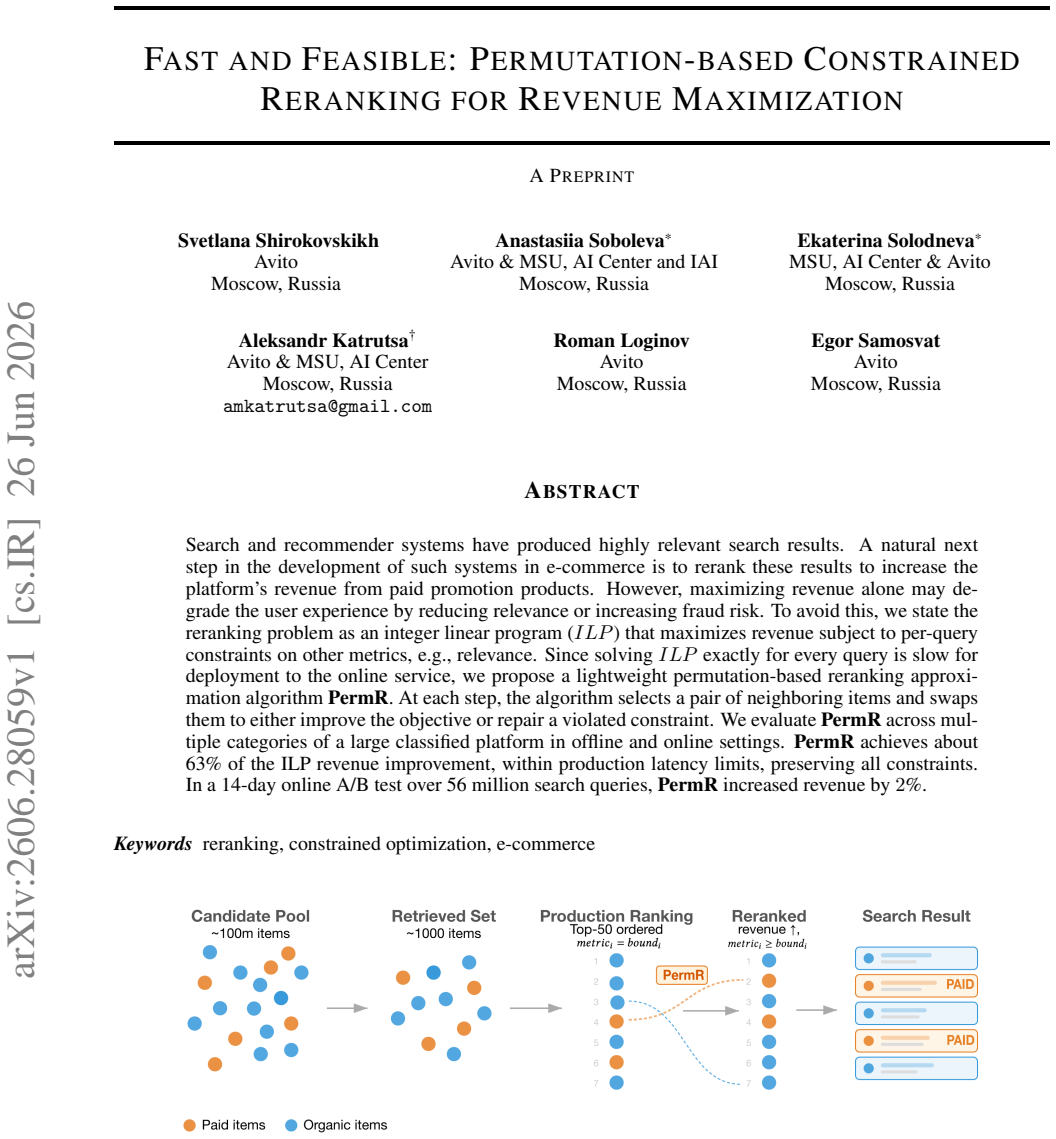
PermR approximates the revenue-maximizing reranking solution by swapping neighboring items, capturing 63 percent of the ILP gain while staying fast and constraint-compliant.
A machine-rendered reading of the paper's core claim, the machinery that carries it, and where it could break.
Core claim
The central claim is that a sequence of adjacent transpositions, each chosen to improve the objective or repair a constraint violation, produces a feasible ranking whose revenue is a substantial fraction of the ILP optimum and whose computation finishes inside the latency budget required by an online service.
What carries the argument
PermR, the algorithm that iteratively selects neighboring pairs and swaps them when the move either increases revenue or eliminates a constraint violation, stopping when no such swap remains.
If this is right
- The method can be inserted into production search pipelines because its per-query runtime stays within latency limits.
- All per-query constraints on metrics such as relevance remain satisfied after reranking.
- Revenue increases by 2 percent in large-scale live traffic without measurable degradation of other metrics.
- The same local-swap procedure works across several distinct categories of a classified-ads platform.
Where Pith is reading between the lines
- If the initial ranking already lies close to the feasible region, fewer swaps are needed and the revenue gap to the ILP shrinks.
- Replacing the adjacent-swap neighborhood with a wider set of allowed transpositions could recover a larger share of the optimum at modest extra cost.
- The same feasibility-preserving local search could be applied to other ranking objectives that admit an ILP formulation but must run in real time.
Load-bearing premise
Repeated swaps of neighboring items suffice to reach a solution close enough to the ILP optimum while always satisfying the per-query constraints.
What would settle it
A set of queries where PermR returns a feasible ranking whose revenue is substantially below the true ILP optimum, or where the final ranking violates one of the stated constraints.
Figures
read the original abstract
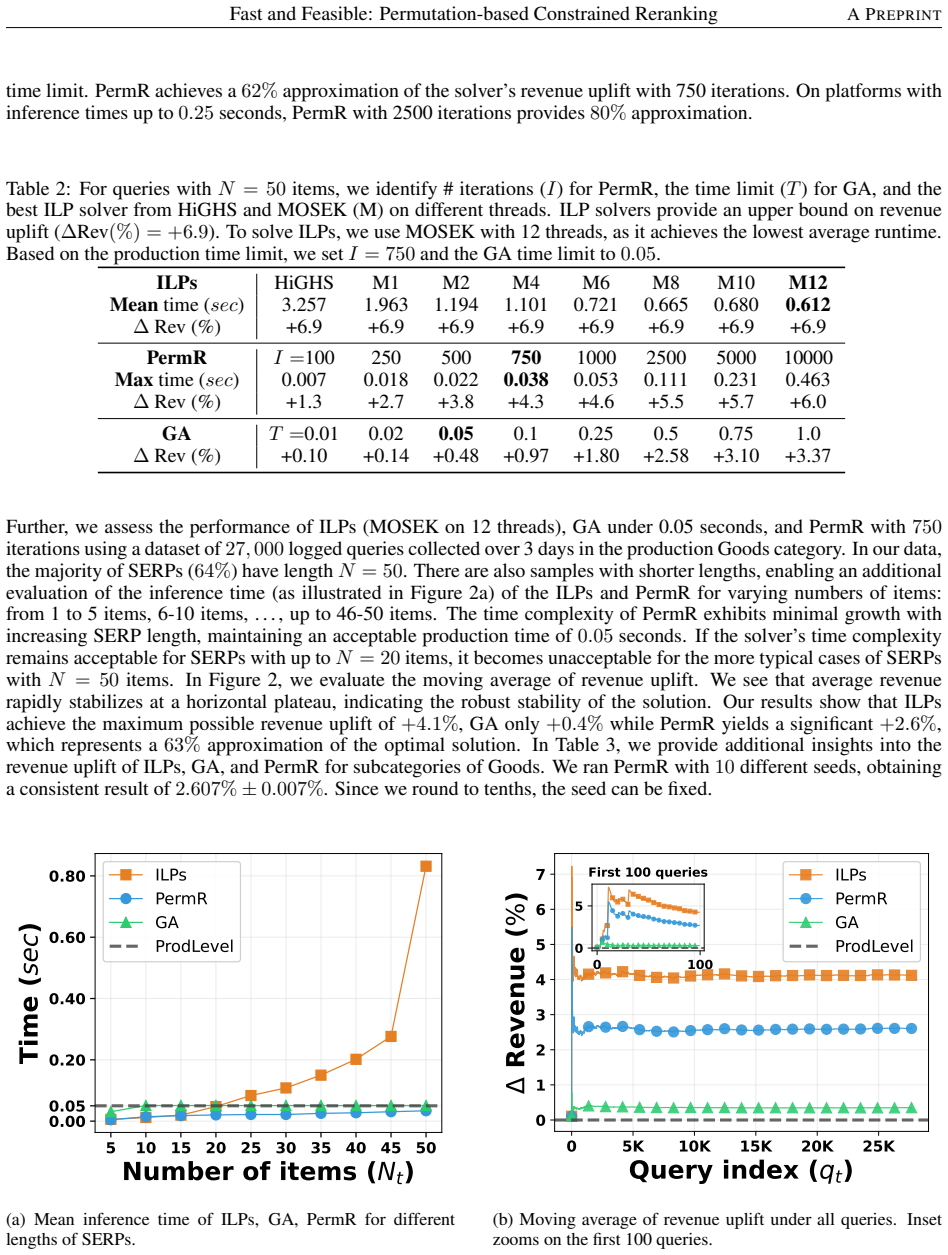
Search and recommender systems have produced highly relevant search results. A natural next step in the development of such systems in e-commerce is to rerank these results to increase the platform's revenue from paid promotion products. However, maximizing revenue alone may degrade the user experience by reducing relevance or increasing fraud risk. To avoid this, we state the reranking problem as an integer linear program ($ILP$) that maximizes revenue subject to per-query constraints on other metrics, e.g., relevance. Since solving $ILP$ exactly for every query is slow for deployment to the online service, we propose a lightweight permutation-based reranking approximation algorithm PermR. At each step, the algorithm selects a pair of neighboring items and swaps them to either improve the objective or repair a violated constraint. We evaluate PermR across multiple categories of a large classified platform in offline and online settings. PermR achieves about 63\% of the ILP revenue improvement, within production latency limits, preserving all constraints. In a 14-day online A/B test over 56 million search queries, PermR increased revenue by $2$\%.
Editorial analysis
A structured set of objections, weighed in public.
Referee Report
Summary. The manuscript formulates constrained revenue-maximizing reranking as an integer linear program (ILP) and introduces PermR, an iterative adjacent-swap procedure that improves the revenue objective or repairs constraint violations. Offline tests across categories report that PermR recovers ~63% of the ILP revenue gain while respecting all per-query constraints and meeting production latency; a 14-day online A/B test on 56 million queries shows a 2% revenue lift.
Significance. If the empirical claims hold, the work supplies a deployable heuristic that makes constrained optimization practical for high-volume e-commerce search, where exact ILP solving is infeasible. The combination of offline approximation quality and online business-metric improvement is a concrete contribution to production IR systems.
major comments (3)
- [Problem statement / ILP section] Problem statement / ILP section: the exact mathematical formulation of the ILP (objective, variables, and the per-query constraint inequalities) is not supplied. Without it the 63% recovery figure cannot be interpreted or reproduced, and it is impossible to judge how constraint density affects the gap between PermR and the ILP optimum.
- [PermR algorithm description] PermR algorithm description: the procedure is stated to consist of repeated neighboring swaps that either raise revenue or restore feasibility, yet no termination argument, bound on Kendall-tau distance traveled, or escape-from-local-optima mechanism is given. This directly bears on the central claim that local swaps reliably reach a point whose revenue is 63% of the ILP optimum under the tested constraint regimes.
- [Experimental evaluation] Experimental evaluation: the offline and online sections omit the precise constraint definitions used, the ILP solver and time limits, statistical tests for the reported lifts, and the full set of baselines. These omissions make it impossible to assess whether the 63% and 2% figures are robust or sensitive to the particular item-score distributions and constraint tightness of the evaluated categories.
minor comments (1)
- [Abstract] Abstract and introduction should explicitly state the number and types of constraints enforced in the reported experiments.
Simulated Author's Rebuttal
We thank the referee for the constructive feedback. We address each major comment below and commit to revisions that add the requested mathematical and experimental details without altering the core claims.
read point-by-point responses
-
Referee: [Problem statement / ILP section] Problem statement / ILP section: the exact mathematical formulation of the ILP (objective, variables, and the per-query constraint inequalities) is not supplied. Without it the 63% recovery figure cannot be interpreted or reproduced, and it is impossible to judge how constraint density affects the gap between PermR and the ILP optimum.
Authors: We agree the explicit ILP was omitted. The revised manuscript will present the full formulation: maximize sum revenue * x_{i,p} subject to assignment constraints, per-query relevance lower bounds, and other metric inequalities, with binary position variables x. This will directly support interpretation of the 63% recovery. revision: yes
-
Referee: [PermR algorithm description] PermR algorithm description: the procedure is stated to consist of repeated neighboring swaps that either raise revenue or restore feasibility, yet no termination argument, bound on Kendall-tau distance traveled, or escape-from-local-optima mechanism is given. This directly bears on the central claim that local swaps reliably reach a point whose revenue is 63% of the ILP optimum under the tested constraint regimes.
Authors: PermR is a greedy local-search heuristic that terminates when no improving or feasibility-restoring adjacent swap exists or after a fixed iteration cap chosen for latency. We will state the termination rule explicitly. No theoretical bound on Kendall-tau distance or escape mechanism exists, as the method is not guaranteed to reach the global optimum; the 63% figure remains an empirical observation under the tested regimes. We will clarify this heuristic character. revision: partial
-
Referee: [Experimental evaluation] Experimental evaluation: the offline and online sections omit the precise constraint definitions used, the ILP solver and time limits, statistical tests for the reported lifts, and the full set of baselines. These omissions make it impossible to assess whether the 63% and 2% figures are robust or sensitive to the particular item-score distributions and constraint tightness of the evaluated categories.
Authors: We will augment the experimental sections with the exact per-query constraint thresholds, the ILP solver and its time limits, p-values or confidence intervals for the lifts, and the complete baseline set. These additions will allow readers to evaluate robustness. revision: yes
Circularity Check
No circularity: empirical evaluation of heuristic algorithm on external traffic
full rationale
The paper formulates an ILP for constrained revenue maximization and introduces the PermR heuristic (adjacent swaps to improve objective or repair violations). Reported gains (63% of ILP improvement offline; 2% revenue lift in 14-day A/B test on 56M queries) are direct measurements against external data and the ILP baseline. No equations, fitted parameters, or self-citations reduce these outcomes to inputs by construction. The derivation chain consists of problem statement plus algorithmic procedure plus independent empirical validation.
Axiom & Free-Parameter Ledger
axioms (1)
- domain assumption The revenue-maximization reranking task with per-query metric constraints can be expressed as an integer linear program.
Reference graph
Works this paper leans on
-
[1]
Semantic models for the first-stage retrieval: A comprehensive review.ACM Transactions on Information Systems (TOIS), 40(4):1–42, 2022
Jiafeng Guo, Yinqiong Cai, Yixing Fan, Fei Sun, Ruqing Zhang, and Xueqi Cheng. Semantic models for the first-stage retrieval: A comprehensive review.ACM Transactions on Information Systems (TOIS), 40(4):1–42, 2022
2022
-
[2]
A com- prehensive survey on retrieval methods in recommender systems.ACM Transactions on Information Systems, 44(1):1–43, 2025
Junjie Huang, Jizheng Chen, Jianghao Lin, Jiarui Qin, Ziming Feng, Weinan Zhang, and Yong Yu. A com- prehensive survey on retrieval methods in recommender systems.ACM Transactions on Information Systems, 44(1):1–43, 2025. 6 Fast and Feasible: Permutation-based Constrained RerankingA PREPRINT
2025
-
[3]
Neural re-ranking in multi-stage recommender systems: A review.arXiv preprint arXiv:2202.06602, 2022
Weiwen Liu, Yunjia Xi, Jiarui Qin, Fei Sun, Bo Chen, Weinan Zhang, Rui Zhang, and Ruiming Tang. Neural re-ranking in multi-stage recommender systems: A review.arXiv preprint arXiv:2202.06602, 2022
-
[4]
Ekaterina Solodneva, Alexandra Khirianova, Aleksandr Katrutsa, Roman Loginov, Andrey Tikhanov, Egor Samosvat, and Yuriy Dorn. RARe: Raising Ad Revenue Framework with Context-Aware Reranking.arXiv preprint arXiv:2504.05308, 2025
-
[5]
A generative re-ranking model for list-level multi- objective optimization at taobao
Yue Meng, Cheng Guo, Yi Cao, Tong Liu, and Bo Zheng. A generative re-ranking model for list-level multi- objective optimization at taobao. InProceedings of the 48th International ACM SIGIR Conference on Research and Development in Information Retrieval, pages 4213–4218, 2025
2025
-
[6]
Multi-objective reinforcement learning for recommender systems: a comprehensive survey of methods, challenges, and future directions: Z
Zaizi Fatima Ezzahra, Abakarim Sana, Qassimi Sara, and Rakrak Said. Multi-objective reinforcement learning for recommender systems: a comprehensive survey of methods, challenges, and future directions: Z. Fatima Ezzahra et al.International Journal of Multimedia Information Retrieval, 14(4):33, 2025
2025
-
[7]
A survey of recommender systems with multi-objective optimization
Yong Zheng and David Xuejun Wang. A survey of recommender systems with multi-objective optimization. Neurocomputing, 474:141–153, 2022
2022
-
[8]
Balancing relevance criteria through multi-objective optimization
Joost van Doorn, Daan Odijk, Diederik M Roijers, and Maarten de Rijke. Balancing relevance criteria through multi-objective optimization. InProceedings of the 39th International ACM SIGIR conference on Research and Development in Information Retrieval, pages 769–772, 2016
2016
-
[9]
Multiobjective Pareto-Efficient Approaches for Recommender Systems.ACM Trans
Marco Tulio Ribeiro, Nivio Ziviani, Edleno Silva De Moura, Itamar Hata, Anisio Lacerda, and Adriano Veloso. Multiobjective Pareto-Efficient Approaches for Recommender Systems.ACM Trans. Intell. Syst. Technol., 5(4), December 2015
2015
-
[10]
Haihao Lu, Luyang Zhang, and Yuting Zhu. The Power of Linear Programming in Sponsored Listings Ranking: Evidence from Field Experiments.arXiv preprint arXiv:2403.14862, 2024
-
[11]
Constrained Multi-Slot Optimization for Ranking Recommendations
Kinjal Basu, Shaunak Chatterjee, and Ankan Saha. Constrained multi-slot optimization for ranking recommen- dations.arXiv preprint arXiv:1602.04391, 2016
work page internal anchor Pith review Pith/arXiv arXiv 2016
-
[12]
Fairness of exposure in rankings
Ashudeep Singh and Thorsten Joachims. Fairness of exposure in rankings. InProceedings of the 24th ACM SIGKDD international conference on knowledge discovery & data mining, pages 2219–2228, 2018
2018
-
[13]
Qi Hao, Tianze Luo, and Guangda Huzhang. Re-ranking with constraints on diversified exposures for homepage recommender system.arXiv preprint arXiv:2112.07621, 2021
-
[14]
V ersion Mosek=11.1.6, 2025
MOSEK ApS.The MOSEK Python Fusion API manual. V ersion Mosek=11.1.6, 2025
2025
-
[15]
Parallelizing the dual revised simplex method.Mathematical Programming Computation, 10(1):119–142, 2018
QHJAJ Huangfu and JA Julian Hall. Parallelizing the dual revised simplex method.Mathematical Programming Computation, 10(1):119–142, 2018
2018
-
[16]
John Wiley & Sons, 2020
Laurence A Wolsey.Integer programming. John Wiley & Sons, 2020
2020
-
[17]
Ranking Items by the Current-Preferences and Profits: A List-wise Learning-to-Rank Approach to Profit Maximization
Hong-Kyun Bae, Hae-Ri Jang, Won-Yong Shin, and Sang-Wook Kim. Ranking Items by the Current-Preferences and Profits: A List-wise Learning-to-Rank Approach to Profit Maximization. InProceedings of the ACM on Web Conference 2025, pages 5010–5021, 2025
2025
-
[18]
Globally Optimized Mutual Influence Aware Ranking in E-Commerce Search
Tao Zhuang, Wenwu Ou, and Zhirong Wang. Globally optimized mutual influence aware ranking in e-commerce search.arXiv preprint arXiv:1805.08524, 2018
work page internal anchor Pith review Pith/arXiv arXiv 2018
-
[19]
Users and Contemporary SERPs: A (Re-) Investigation
Nirmal Roy, David Maxwell, and Claudia Hauff. Users and Contemporary SERPs: A (Re-) Investigation. InPro- ceedings of the 45th international ACM SIGIR conference on research and development in information retrieval, pages 2765–2775, 2022
2022
-
[20]
Progressive Refinement of E-commerce Search Ranking Based on Short-Term Activities of the Buyer
Taoran Sheng, Sathappan Muthiah, Atiq Islam, and Jinming Feng. Progressive Refinement of E-commerce Search Ranking Based on Short-Term Activities of the Buyer. InProceedings of the 48th International ACM SIGIR Conference on Research and Development in Information Retrieval, pages 4370–4374, 2025
2025
-
[21]
Springer Nature, 2022
Aleksandr Chuklin, Ilya Markov, and Maarten De Rijke.Click models for web search. Springer Nature, 2022
2022
-
[22]
Blank and K
J. Blank and K. Deb. pymoo: Multi-Objective Optimization in Python.IEEE Access, 8:89497–89509, 2020. 7
2020
discussion (0)
Sign in with ORCID, Apple, or X to comment. Anyone can read and Pith papers without signing in.