Southern Massive Stars at High Angular Resolution (SMaSH+): Properties of hierarchical massive triples
Pith reviewed 2026-06-29 02:21 UTC · model grok-4.3
The pith
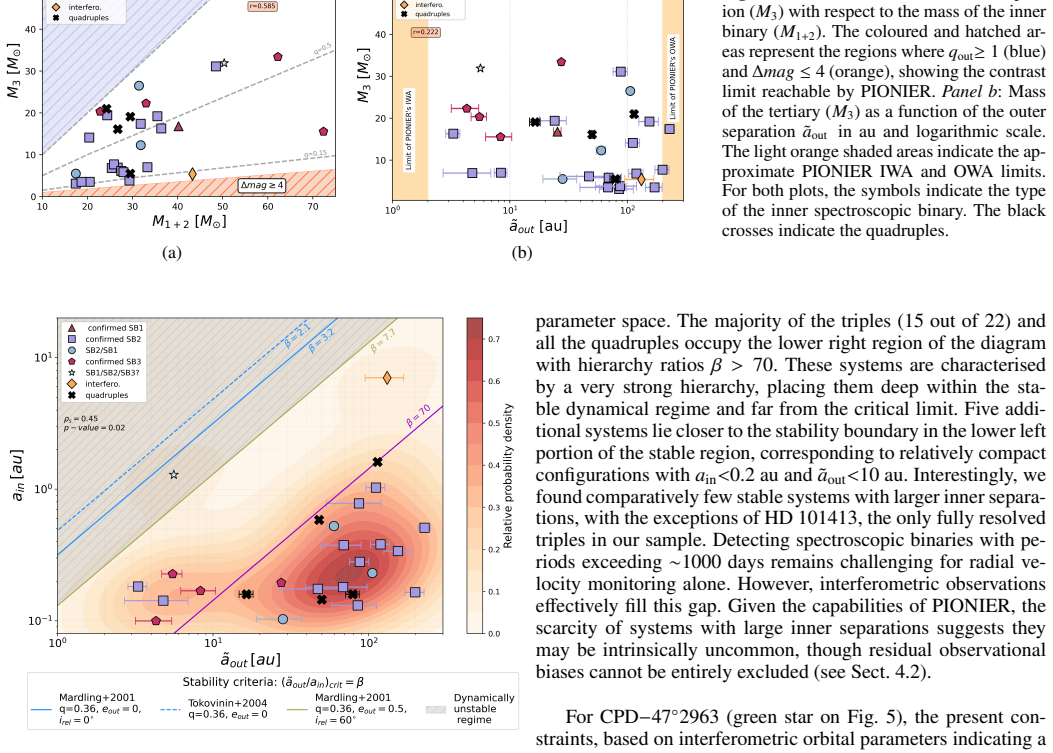
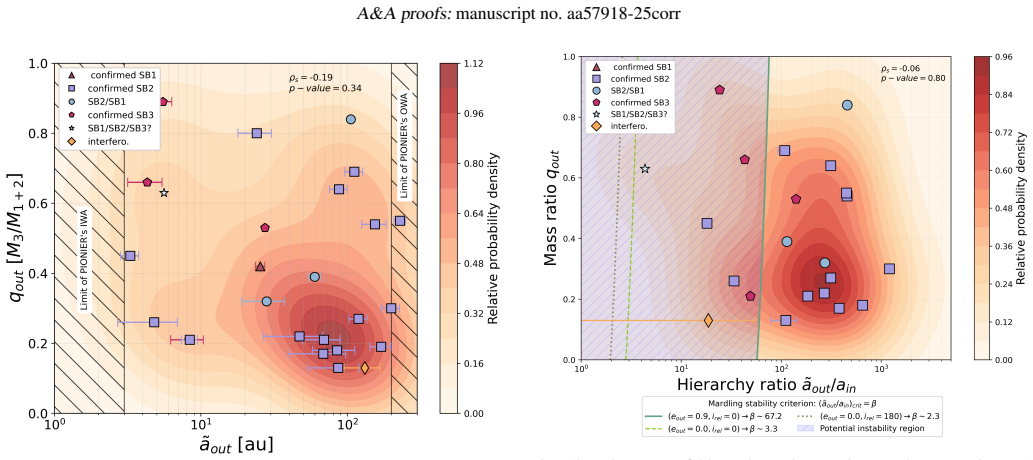
The first representative distributions for hierarchical massive triples show strongly hierarchical architectures with tight inner binaries under 1 au and outer-to-inner ratios above 70.
A machine-rendered reading of the paper's core claim, the machinery that carries it, and where it could break.
Core claim
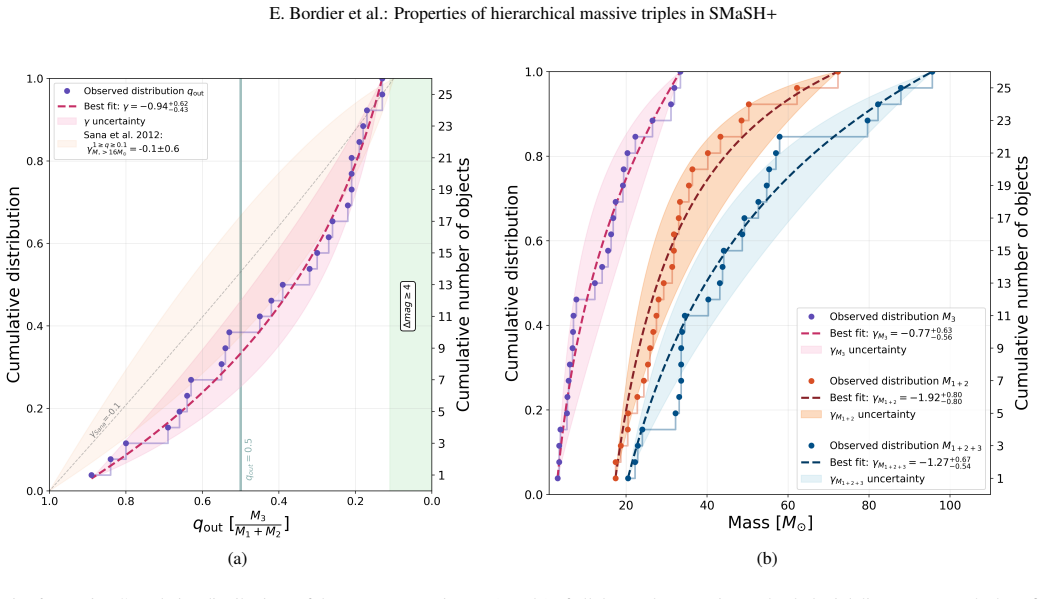
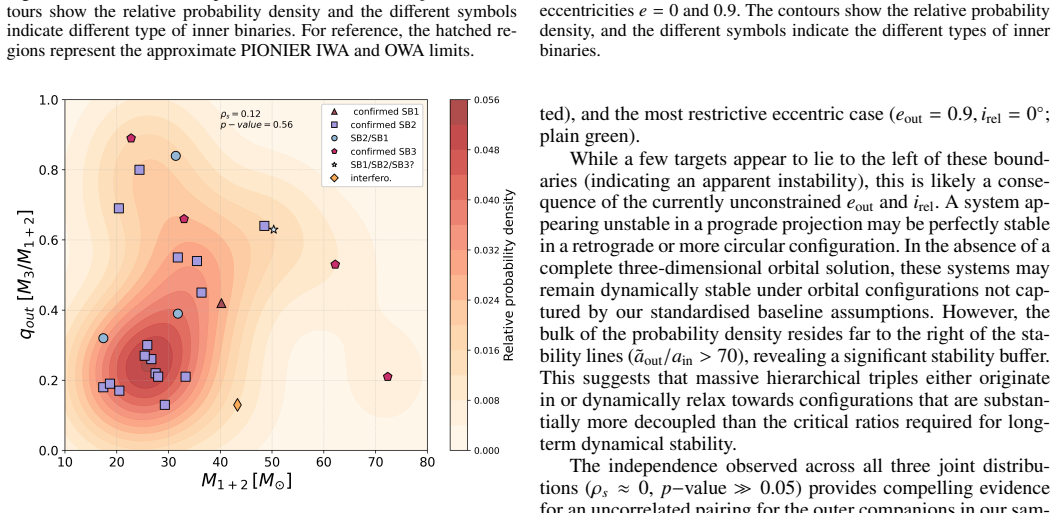
The central claim is that the sample of 26 O-type hierarchical triples is dominated by strongly hierarchical configurations consisting primarily of tight inner spectroscopic binaries with separations less than 1 au and wider tertiaries with outer-to-inner separation ratios greater than 70 for most systems. No significant correlation appears between tertiary mass and either inner-binary mass or outer separation. For two to four of the five systems with well-constrained orbital solutions, general relativistic precession dominates over von Zeipel-Kozai-Lidov oscillations, and ten systems host relatively massive tertiaries especially at closer outer separations.
What carries the argument
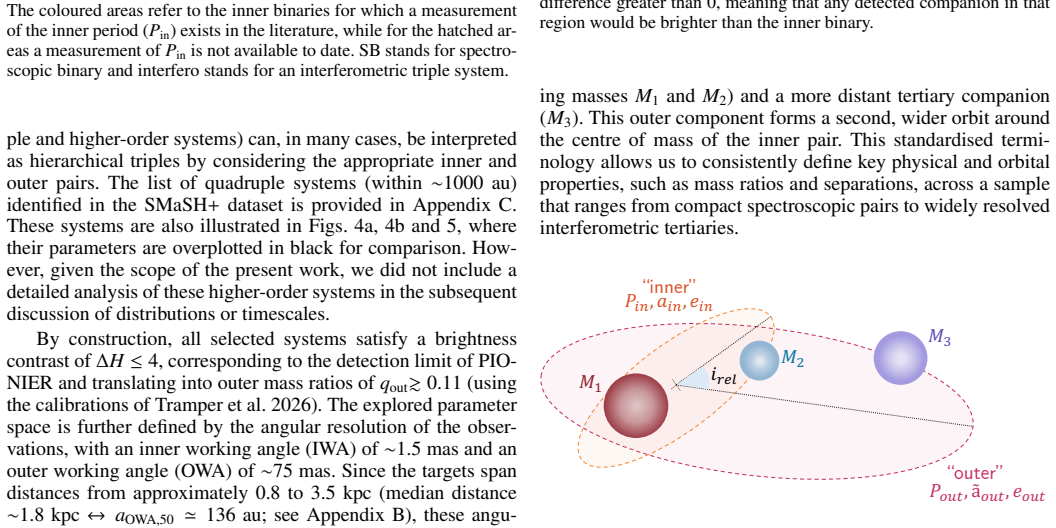
The homogeneous analysis of 26 O-type hierarchical triples that combines spectroscopic data for inner binaries with interferometric and aperture masking detections of tertiary companions within about 200 au.
If this is right
- The derived distributions supply observationally grounded inputs for population synthesis and evolutionary models of massive stars.
- Tertiary companions can influence the evolution of inner binaries through secular processes in a subset of systems.
- General relativistic precession dominates von Zeipel-Kozai-Lidov oscillations in most systems with measured orbits, limiting eccentricity growth from that mechanism.
- Systems with massive tertiaries (mass ratio above 0.5) occur preferentially at smaller outer separations below 30 au.
Where Pith is reading between the lines
- These distributions could be compared directly to outputs from different triple-star formation simulations to test which channels dominate.
- The absence of clear correlations between parameters implies that formation and early evolution permit a broad range of architectures rather than enforcing tight relations.
- Extending similar analyses to post-main-sequence stages or lower-mass triples would reveal whether the strong hierarchy persists across evolutionary phases.
Load-bearing premise
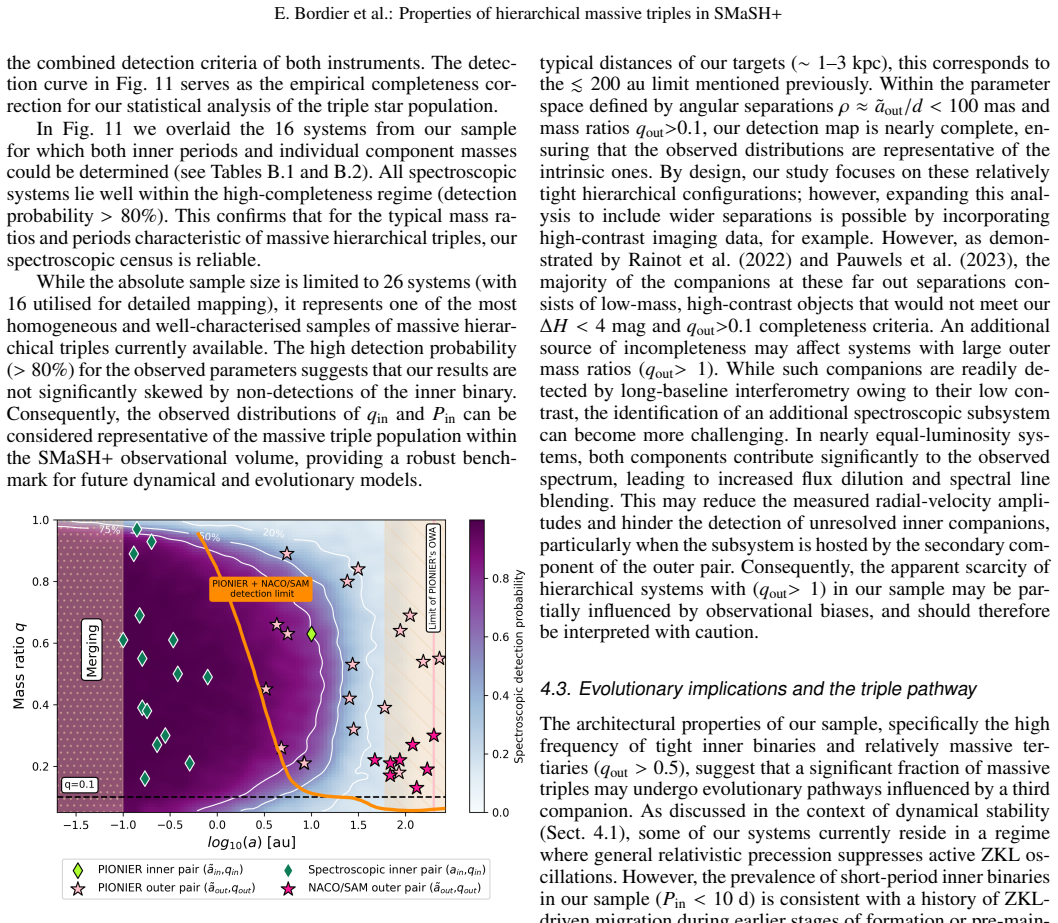
The 26 identified systems together with the completeness evaluation form a representative sample of the underlying population of massive hierarchical triples.
What would settle it
An independent survey that selects a larger complete sample of massive stars and recovers substantially different distributions of inner separations, outer-to-inner ratios, or mass ratios would show that the current sample is not representative.
Figures

read the original abstract
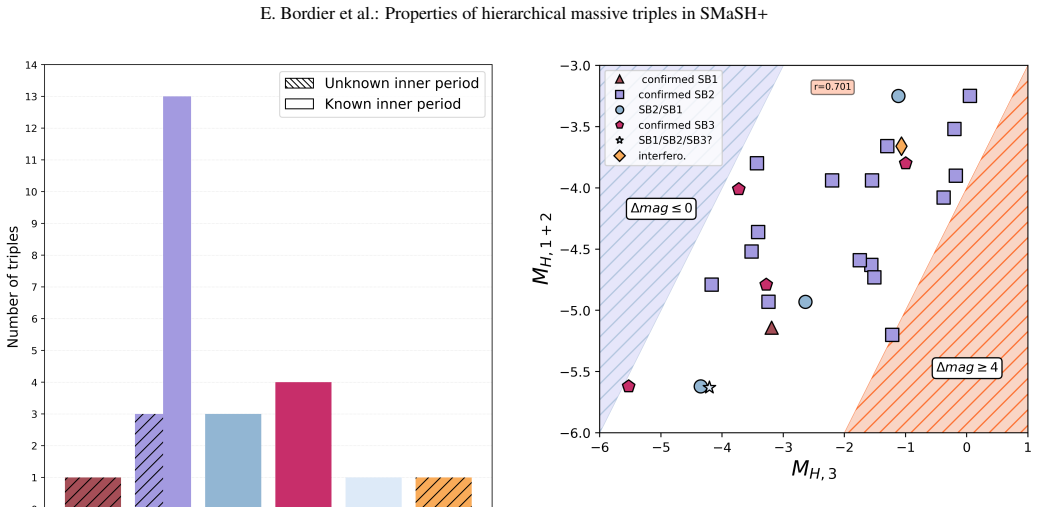
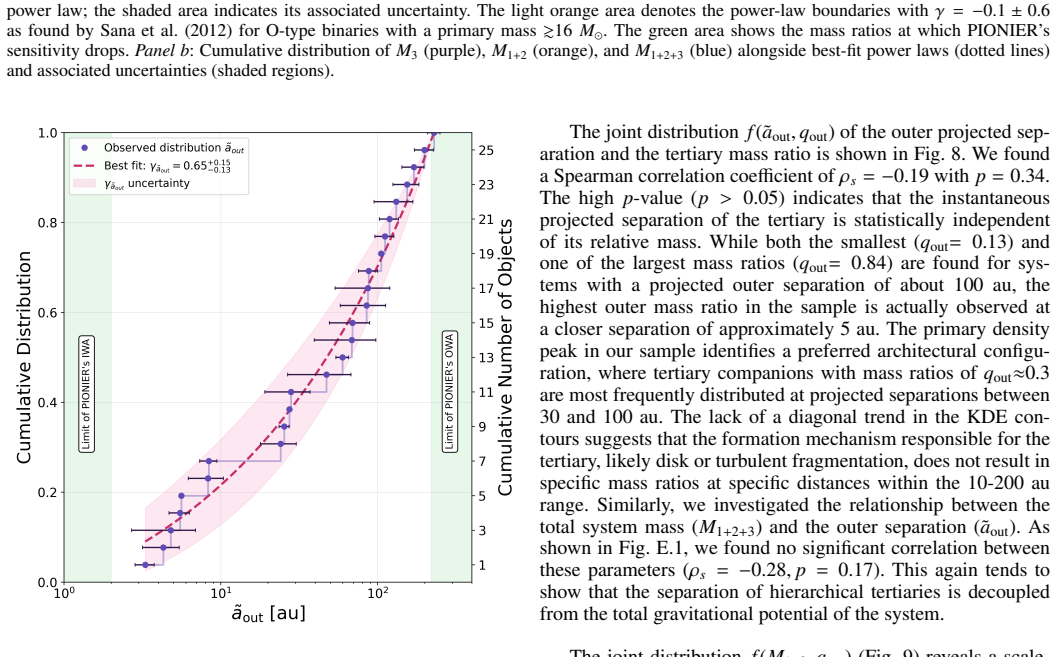
While massive stars are frequently found in triple architectures, the lack of observed parameter distributions has long remained a bottleneck for statistical models of their evolution. We compile the first representative set of physical and orbital distributions for main-sequence hierarchical massive triples. We present a homogeneous analysis of 26 O-type hierarchical triples identified in the SMaSH+ survey by combining spectroscopic data for inner binaries with interferometric and aperture masking detections of tertiary companions within $\sim$200 au. We derive the distributions of masses, mass ratios, and separations, and investigate their joint probability density functions. We assess the dynamical stability of these systems and estimate the relative importance of secular processes by comparing the von Zeipel-Kozai-Lidov (ZKL) timescale to the general relativistic precession timescale for five systems with well-constrained orbital solutions. Finally, we evaluate the observational completeness. The sample is dominated by strongly hierarchical configurations, consisting primarily of tight inner spectroscopic binaries(a_in< 1 au) and wider tertiaries (a_out/a_in $>$ 70 for most systems). We find no significant correlation between tertiary mass and either inner-binary mass or outer separation, indicating a broad diversity of system architectures. Ten systems host relatively massive tertiaries (q_out>0.5), especially at closer outer separations (a_out$\lesssim$30 au). For two to four systems out of five, general relativistic precession dominates over ZKL oscillations in their current configuration. These results provide the first observationally grounded distributions of key parameters for massive hierarchical triples and offer important constraints for population synthesis and evolutionary models, particularly regarding the role of tertiary companions in shaping binary evolution.
Editorial analysis
A structured set of objections, weighed in public.
Referee Report
Summary. The manuscript compiles the first representative distributions of physical and orbital parameters for main-sequence O-type hierarchical massive triples using a homogeneous analysis of 26 systems from the SMaSH+ survey. Spectroscopic data constrain the inner binaries while interferometric and aperture-masking observations detect tertiaries within ~200 au; the work derives mass, mass-ratio, and separation distributions, assesses dynamical stability, compares ZKL and GR precession timescales for five systems, and evaluates observational completeness. The central result is that the sample is dominated by strongly hierarchical architectures (a_in < 1 au, a_out/a_in > 70 for most systems) with no significant tertiary-mass correlations and GR precession dominating ZKL in 2–4 of the five well-constrained cases.
Significance. If the completeness corrections are robust, the work supplies the first observationally grounded parameter distributions for massive hierarchical triples, directly constraining population-synthesis and binary-evolution models that currently lack such empirical anchors. The homogeneous re-analysis and explicit stability checks are positive features.
major comments (2)
- [observational completeness evaluation (abstract and associated section)] The headline claim that the 26-system sample yields representative distributions rests on the completeness evaluation. The manuscript does not provide a quantitative description of the joint selection function that combines spectroscopic detection probability for the inner binary (favoring a_in ≲ 1 au and high q_in) with interferometric/aperture-masking detection for the tertiary (favoring a_out ≳ few au and q_out above a threshold). Without explicit marginalization over the full (a_in, q_in, a_out, q_out) space or an assessment of possible undetected systems, it remains unclear whether the reported dominance of a_out/a_in > 70 and the lack of mass–separation correlation are intrinsic or artifacts of the survey window.
- [dynamical stability and ZKL/GR comparison] The stability and timescale comparison is performed for only five systems with “well-constrained orbital solutions.” The manuscript should state the formal uncertainties on the outer orbital elements used to compute the ZKL and GR timescales and demonstrate that the conclusion (GR dominating in 2–4 systems) is robust to those uncertainties.
minor comments (3)
- [tables] Table 1 (or equivalent system table) should include the individual completeness weights or detection probabilities assigned to each system so that readers can reproduce the corrected distributions.
- [results on correlations] The text states “no significant correlation” between tertiary mass and inner-binary mass or outer separation; the statistical test (e.g., Spearman rank, p-value threshold) used to reach this conclusion should be stated explicitly.
- [figures] Figure captions for the separation and mass-ratio histograms should indicate whether the plotted histograms are raw counts or completeness-corrected.
Simulated Author's Rebuttal
We thank the referee for the constructive comments and positive assessment of the manuscript's significance. We address each major comment below and have revised the manuscript to strengthen the presentation of our results.
read point-by-point responses
-
Referee: [observational completeness evaluation (abstract and associated section)] The headline claim that the 26-system sample yields representative distributions rests on the completeness evaluation. The manuscript does not provide a quantitative description of the joint selection function that combines spectroscopic detection probability for the inner binary (favoring a_in ≲ 1 au and high q_in) with interferometric/aperture-masking detection for the tertiary (favoring a_out ≳ few au and q_out above a threshold). Without explicit marginalization over the full (a_in, q_in, a_out, q_out) space or an assessment of possible undetected systems, it remains unclear whether the reported dominance of a_out/a_in > 70 and the lack of mass–separation correlation are intrinsic or artifacts of the survey window.
Authors: We agree that a more quantitative description of the joint selection function would improve the manuscript. In the revised version we expand the completeness section with explicit estimates of the combined spectroscopic and interferometric detection probabilities across the relevant parameter ranges, including a discussion of how these biases may affect the reported dominance of a_out/a_in > 70 and the absence of mass-separation correlations. While a full marginalization over the four-dimensional space lies beyond the scope of the current survey analysis, the added quantitative framework clarifies the survey window and supports the representativeness claim. revision: yes
-
Referee: [dynamical stability and ZKL/GR comparison] The stability and timescale comparison is performed for only five systems with “well-constrained orbital solutions.” The manuscript should state the formal uncertainties on the outer orbital elements used to compute the ZKL and GR timescales and demonstrate that the conclusion (GR dominating in 2–4 systems) is robust to those uncertainties.
Authors: We will revise the dynamical analysis section to report the formal uncertainties on the outer orbital elements for the five systems. We will also add a sensitivity test showing that the conclusion (GR precession dominating ZKL in 2–4 systems) remains unchanged when the outer elements are varied within their 1σ uncertainties. These additions directly address the robustness concern. revision: yes
Circularity Check
No circularity: purely observational compilation of measured quantities
full rationale
The paper compiles observed distributions of masses, mass ratios, and separations from 26 systems using spectroscopic and interferometric data, followed by a completeness assessment and stability checks. No equations or steps reduce a claimed prediction or first-principles result to fitted inputs by construction, nor do any load-bearing claims rest on self-citations, imported uniqueness theorems, or smuggled ansatzes. The representativeness claim is an external assumption about selection biases, not a self-referential derivation. This matches the default case of an honest observational study with no circular steps.
Axiom & Free-Parameter Ledger
axioms (1)
- domain assumption Standard assumptions in stellar spectroscopy and interferometry allow reliable derivation of masses, mass ratios, and separations from combined data sets.
Reference graph
Works this paper leans on
-
[1]
The Red MSX Source Survey: the Massive Young Stellar Population of our Galaxy
The Red MSX Source Survey: The Massive Young Stellar Population of Our Galaxy. , keywords =. doi:10.1088/0067-0049/208/1/11 , archivePrefix =. 1308.0134 , primaryClass =
work page internal anchor Pith review Pith/arXiv arXiv doi:10.1088/0067-0049/208/1/11
-
[2]
Twin Herbig-Haro Jets and Molecular Outflows in L1228. , keywords =. doi:10.1086/176486 , adsurl =
-
[3]
2002, MNRAS, 329, 355, doi: 10.1046/j.1365-8711.2002.04988.x
The population of the Galactic plane as seen by MSX. , keywords =. doi:10.1046/j.1365-8711.2002.05785.x , archivePrefix =. astro-ph/0206391 , primaryClass =
-
[4]
The Red MSX Source survey: ammonia and water maser analysis of massive star-forming regions. , keywords =. doi:10.1111/j.1365-2966.2011.19594.x , archivePrefix =. 1107.3913 , primaryClass =
-
[5]
The Luminosity Functions and Timescales of MYSOs and Compact HII regions
The RMS Survey: The Luminosity Functions and Timescales of Massive Young Stellar Objects and Compact H II Regions. , keywords =. doi:10.1088/2041-8205/730/2/L33 , archivePrefix =. 1102.4702 , primaryClass =
work page internal anchor Pith review Pith/arXiv arXiv doi:10.1088/2041-8205/730/2/l33 2041
-
[6]
Adaptive Optical System Technologies II , year = 2003, editor =
NAOS, the first AO system of the VLT: on-sky performance. Adaptive Optical System Technologies II , year = 2003, editor =. doi:10.1117/12.459332 , adsurl =
-
[7]
NAOS-CONICA first on sky results in a variety of observing modes. Instrument Design and Performance for Optical/Infrared Ground-based Telescopes , year = 2003, editor =. doi:10.1117/12.460044 , adsurl =
-
[8]
Larry Bradley and Brigitta Sipőcz and Thomas Robitaille and Erik Tollerud and Zé Vinícius and Christoph Deil and Kyle Barbary and Tom J Wilson and Ivo Busko and Axel Donath and Hans Moritz Günther and Mihai Cara and P. L. Lim and Sebastian Meßlinger and Simon Conseil and Azalee Bostroem and Michael Droettboom and E. M. Bray and Lars Andersen Bratholm and ...
-
[9]
DAOPHOT: A Computer Program for Crowded-Field Stellar Photometry. , keywords =. doi:10.1086/131977 , adsurl =
-
[10]
The young massive SMC cluster NGC 330 seen by MUSE. I. Observations and stellar content. , keywords =. doi:10.1051/0004-6361/201936743 , archivePrefix =. 1911.03477 , primaryClass =
-
[11]
The 6-GHz methanol multibeam maser catalogue - IV. Galactic longitudes 186 -330 including the Orion-Monoceros region. , keywords =. doi:10.1111/j.1365-2966.2011.20229.x , archivePrefix =. 1201.0787 , primaryClass =
-
[12]
Distances to southern 6.7-GHz methanol masers through H I self-absorption. , keywords =. doi:10.1111/j.1365-2966.2011.19418.x , adsurl =
-
[13]
BLAST: The Mass Function, Lifetimes, and Properties of Intermediate Mass Cores from a 50 deg ^ 2 Submillimeter Galactic Survey in Vela (ell 265 ). , keywords =. doi:10.1088/0004-637X/707/2/1824 , archivePrefix =. 0904.1207 , primaryClass =
work page internal anchor Pith review Pith/arXiv arXiv doi:10.1088/0004-637x/707/2/1824
-
[14]
Star formation in the VELA molecular clouds. I. The IRAS-bright class I sources. , keywords =
-
[15]
Trigonometric Parallaxes of Massive Star-Forming Regions. VI. Galactic Structure, Fundamental Parameters, and Noncircular Motions. , keywords =. doi:10.1088/0004-637X/700/1/137 , archivePrefix =. 0902.3913 , primaryClass =
work page internal anchor Pith review Pith/arXiv arXiv doi:10.1088/0004-637x/700/1/137
-
[16]
Annual Parallax Determination toward a New X-Ray-emitting Class 0 Candidate with the Water Maser in the NGC 2264 Star-forming Region. , keywords =. doi:10.1088/0067-0049/211/2/18 , adsurl =
-
[17]
A ^ 13 CO Survey of Molecular Clouds in Gemini and Auriga. , keywords =. doi:10.1086/313119 , adsurl =
-
[18]
Spin Precession Along Circular Orbits in Stationary Axially Symmet- ric Spacetimes
Studies of ultracompact HII regions - III. Near-infrared survey of selected regions. , year = 1999, month = nov, volume =. doi:10.1046/j.1365-8711.1999.02890.x , adsurl =
-
[19]
2001, MNRAS, 322, 231, doi: 10.1046/j.1365-8711.2001.04022.x
Mid-infrared observations of methanol maser sites and ultracompact H ii regions: signposts of high-mass star formation. , keywords =. doi:10.1046/j.1365-8711.2001.04352.x , adsurl =
-
[20]
The SOFIA Massive (SOMA) Star Formation Survey. I. Overview and First Results. , keywords =. doi:10.3847/1538-4357/aa74c8 , archivePrefix =. 1610.05373 , primaryClass =
work page internal anchor Pith review Pith/arXiv arXiv doi:10.3847/1538-4357/aa74c8
-
[21]
Dynamics of a Massive Binary at Birth
Dynamics of a massive binary at birth. Nature Astronomy , keywords =. doi:10.1038/s41550-019-0718-y , archivePrefix =. 1903.07532 , primaryClass =
work page internal anchor Pith review Pith/arXiv arXiv doi:10.1038/s41550-019-0718-y 1903
-
[22]
A synthetic view on structure and evolution of the Milky Way. , keywords =. doi:10.1051/0004-6361:20031117 , adsurl =
-
[23]
Search for associations containing young stars (SACY). VI. Is multiplicity universal? Stellar multiplicity in the range 3-1000 au from adaptive-optics observations. , keywords =. doi:10.1051/0004-6361/201525794 , archivePrefix =. 1505.07837 , primaryClass =
work page internal anchor Pith review Pith/arXiv arXiv doi:10.1051/0004-6361/201525794
-
[24]
Carina High-contrast Imaging Project for massive Stars (CHIPS). I. Methodology and proof of concept on QZ Car ( HD 93206). , keywords =. doi:10.1051/0004-6361/201936448 , archivePrefix =. 2006.01914 , primaryClass =
-
[25]
A pilot survey of the binarity of Massive Young Stellar Objects with $K$ band adaptive optics
A pilot survey of the binarity of Massive Young Stellar Objects with K-band adaptive optics. , keywords =. doi:10.1093/mnras/stz014 , archivePrefix =. 1901.04716 , primaryClass =
work page internal anchor Pith review Pith/arXiv arXiv doi:10.1093/mnras/stz014 1901
-
[26]
2011, MNRAS, 411, 2439, doi: 10.1111/j.1365-2966.2010.17855.x 20
The binary fraction and mass ratio of Be and B stars: a comparative Very Large Telescope/NACO study. , keywords =. doi:10.1111/j.1365-2966.2010.16609.x , archivePrefix =. 1003.0618 , primaryClass =
-
[27]
Deep, multiband photometry of low-mass stars to reveal young clusters: A blind study of the NGC2264 region. , keywords =. doi:10.1051/0004-6361/201833253 , archivePrefix =. 1811.02731 , primaryClass =
work page internal anchor Pith review Pith/arXiv arXiv doi:10.1051/0004-6361/201833253
-
[28]
The Young Cluster and Star Forming Region NGC 2264
The Young Cluster and Star Forming Region NGC 2264. Handbook of Star Forming Regions, Volume I , year = 2008, editor =. doi:10.48550/arXiv.0808.3835 , adsurl =
work page internal anchor Pith review Pith/arXiv arXiv doi:10.48550/arxiv.0808.3835 2008
-
[29]
Mid-infrared interferometry of the massive young stellar object NGC 2264 IRS 1
Mid-infrared interferometry of the massive young stellar object NGC 2264 IRS 1. , keywords =. doi:10.1051/0004-6361/201116699 , archivePrefix =. 1107.0928 , primaryClass =
work page internal anchor Pith review Pith/arXiv arXiv doi:10.1051/0004-6361/201116699
-
[30]
Resolved 24.5 micron emission from massive young stellar objects
Resolved 24.5 micron emission from massive young stellar objects. , keywords =. doi:10.1051/0004-6361:200810771 , archivePrefix =. 0811.4050 , primaryClass =
work page internal anchor Pith review Pith/arXiv arXiv doi:10.1051/0004-6361:200810771
-
[31]
NGC 2264 IRS1: The central engine and its cavity
NGC 2264 IRS 1: The Central Engine and Its Cavity. , keywords =. doi:10.1086/379141 , archivePrefix =. astro-ph/0311156 , primaryClass =
work page internal anchor Pith review Pith/arXiv arXiv doi:10.1086/379141
-
[32]
NGC 2264 IRS: Evidence for Triggered Star Formation. , keywords =. doi:10.1086/311096 , adsurl =
-
[33]
, year = 1972, month = mar, volume =
Infrared Objects in H II Regions. , year = 1972, month = mar, volume =. doi:10.1086/180890 , adsurl =
-
[34]
Unveiling the traits of massive young stellar objects through a multi-scale survey. , keywords =. doi:10.1051/0004-6361/202039748 , archivePrefix =. 2102.05087 , primaryClass =
-
[35]
Probing the envelopes of massive young stellar objects with diffraction limited mid-infrared imaging
Probing the envelopes of massive young stellar objects with diffraction limited mid-infrared imaging. , keywords =. doi:10.1051/0004-6361/201118689 , archivePrefix =. 1202.4348 , primaryClass =
work page internal anchor Pith review Pith/arXiv arXiv doi:10.1051/0004-6361/201118689
-
[36]
The RMS Survey: Mid-Infrared Observations of Candidate Massive YSOs in the Southern Hemisphere
The RMS survey: mid-infrared observations of candidate massive YSOs in the southern hemisphere. , keywords =. doi:10.1051/0004-6361:20077663 , archivePrefix =. 0709.2040 , primaryClass =
work page internal anchor Pith review Pith/arXiv arXiv doi:10.1051/0004-6361:20077663 2040
-
[37]
The RMS Survey: Radio observations of candidate massive YSOs in the southern hemisphere
The RMS survey. Radio observations of candidate massive YSOs in the southern hemisphere. , keywords =. doi:10.1051/0004-6361:20065837 , archivePrefix =. astro-ph/0605738 , primaryClass =
work page internal anchor Pith review Pith/arXiv arXiv doi:10.1051/0004-6361:20065837
-
[38]
A Survey of Extended H$_2$ Emission from Massive YSOs
A survey of extended H _ 2 emission from massive YSOs. , keywords =. doi:10.1093/mnras/stv914 , archivePrefix =. 1504.06174 , primaryClass =
work page internal anchor Pith review Pith/arXiv arXiv doi:10.1093/mnras/stv914
-
[39]
Star formation in the Vela Molecular Clouds: A new protostar powering a bipolar jet. , keywords =. doi:10.1051/0004-6361:20041959 , adsurl =
-
[40]
RCW36: characterizing the outcome of massive star formation
<ASTROBJ>RCW36</ASTROBJ>: characterizing the outcome of massive star formation. , keywords =. doi:10.1051/0004-6361/201321752 , archivePrefix =. 1308.3238 , primaryClass =
work page internal anchor Pith review Pith/arXiv arXiv doi:10.1051/0004-6361/201321752
-
[41]
A distance limited sample of massive molecular outflows
A distance-limited sample of massive molecular outflows. , keywords =. doi:10.1093/mnras/stv1635 , archivePrefix =. 1509.00199 , primaryClass =
work page internal anchor Pith review Pith/arXiv arXiv doi:10.1093/mnras/stv1635
-
[42]
Infall and Outflow Motions towards a Sample of Massive Star Forming Regions from the RMS Survey
Infall and outflow motions towards a sample of massive star-forming regions from the RMS survey. , keywords =. doi:10.1093/mnras/sty701 , archivePrefix =. 1803.03501 , primaryClass =
work page internal anchor Pith review Pith/arXiv arXiv doi:10.1093/mnras/sty701
-
[43]
The RMS Survey: Near-IR Spectroscopy of Massive Young Stellar Objects
The RMS survey: near-IR spectroscopy of massive young stellar objects. , keywords =. doi:10.1093/mnras/sts681 , archivePrefix =. 1301.4109 , primaryClass =
work page internal anchor Pith review Pith/arXiv arXiv doi:10.1093/mnras/sts681
-
[44]
A multi-scale exploration of a massive young stellar object - a transition disk around G305.20+0.21?
A multi-scale exploration of a massive young stellar object. A transition disk around G305.20+0.21?. , keywords =. doi:10.1051/0004-6361/201834583 , archivePrefix =. 1903.04393 , primaryClass =
work page internal anchor Pith review Pith/arXiv arXiv doi:10.1051/0004-6361/201834583 1903
-
[45]
Tying the Geometrical Traits of Massive Young Stellar Objects and Their Disks to a Potential Evolutionary Sequence Using Infrared Observations. , keywords =. doi:10.3847/1538-4357/ac1741 , archivePrefix =. 2108.05234 , primaryClass =
-
[46]
Spitzer-IRAC GLIMPSE of high mass protostellar objects. II. SED modelling of a bona fide sample. , keywords =. doi:10.1051/0004-6361/200810902 , archivePrefix =. 0901.2053 , primaryClass =
work page internal anchor Pith review Pith/arXiv arXiv doi:10.1051/0004-6361/200810902 2053
-
[47]
A hot compact dust disk around a massive young stellar object
A hot compact dust disk around a massive young stellar object. , keywords =. doi:10.1038/nature09174 , archivePrefix =. 1007.5062 , primaryClass =
work page internal anchor Pith review Pith/arXiv arXiv doi:10.1038/nature09174
-
[48]
Search for massive protostar candidates in the southern hemisphere. II. Dust continuum emission. , keywords =. doi:10.1051/0004-6361:20053999 , archivePrefix =. astro-ph/0510422 , primaryClass =
work page internal anchor Pith review Pith/arXiv arXiv doi:10.1051/0004-6361:20053999
-
[49]
Tracing jet emission at the base of a high-mass YSO. First AMBER/VLTI observations of the Br emission in IRAS 13481-6124. , keywords =. doi:10.1051/0004-6361/201628203 , archivePrefix =. 1603.06860 , primaryClass =
work page internal anchor Pith review Pith/arXiv arXiv doi:10.1051/0004-6361/201628203
-
[50]
A multi-wavelength interferometric study of the massive young stellar object IRAS 13481-6124
A multi-wavelength interferometric study of the massive young stellar object IRAS 13481-6124. , keywords =. doi:10.1051/0004-6361/201527502 , archivePrefix =. 1511.03195 , primaryClass =
work page internal anchor Pith review Pith/arXiv arXiv doi:10.1051/0004-6361/201527502
-
[51]
CO bandhead emission of massive young stellar objects: determining disc properties
CO bandhead emission of massive young stellar objects: determining disc properties. , keywords =. doi:10.1093/mnras/sts537 , archivePrefix =. 1212.0554 , primaryClass =
work page internal anchor Pith review Pith/arXiv arXiv doi:10.1093/mnras/sts537
-
[52]
A near-IR spectroscopic survey of massive jets towards EGOs
A near-infrared spectroscopic survey of massive jets towards extended green objects. , keywords =. doi:10.1051/0004-6361/201423992 , archivePrefix =. 1410.4041 , primaryClass =
work page internal anchor Pith review Pith/arXiv arXiv doi:10.1051/0004-6361/201423992
-
[53]
AMBER/VLTI high spectral resolution observations of the Br emitting region in HD 98922. A compact disc wind launched from the inner disc region. , keywords =. doi:10.1051/0004-6361/201526002 , archivePrefix =. 1508.00798 , primaryClass =
work page internal anchor Pith review Pith/arXiv arXiv doi:10.1051/0004-6361/201526002
-
[54]
Hot dust, ionised gas, and binarity at au scales
The first interferometric survey of massive YSOs in the K-band. Hot dust, ionised gas, and binarity at au scales. , keywords =. doi:10.1051/0004-6361/202141373 , archivePrefix =. 2108.02868 , primaryClass =
-
[55]
Massive Binaries in High-Mass Star-forming Regions: A Multiepoch Radial Velocity Survey of Embedded O Stars. , keywords =. doi:10.1086/509705 , archivePrefix =. astro-ph/0610085 , primaryClass =
work page internal anchor Pith review Pith/arXiv arXiv doi:10.1086/509705
-
[56]
Multiple Star Systems in the Orion Nebula
Multiple star systems in the Orion nebula. , keywords =. doi:10.1051/0004-6361/201833575 , archivePrefix =. 1809.10376 , primaryClass =
work page internal anchor Pith review Pith/arXiv arXiv doi:10.1051/0004-6361/201833575
-
[57]
The VLA/ALMA Nascent Disk And Multiplicity (VANDAM) Survey of Orion Protostars. V. A Characterization of Protostellar Multiplicity. , keywords =. doi:10.3847/1538-4357/ac36d2 , archivePrefix =. 2111.05801 , primaryClass =
-
[58]
The Origin and Evolution of Multiple Star Systems
The Origin and Evolution of Multiple Star Systems. Protostars and Planets VII , year = 2023, editor =. doi:10.48550/arXiv.2203.10066 , archivePrefix =. 2203.10066 , primaryClass =
work page internal anchor Pith review Pith/arXiv arXiv doi:10.48550/arxiv.2203.10066 2023
-
[59]
The origin of close massive binaries in the M17 star-forming region. , keywords =. doi:10.1051/0004-6361/202141849 , archivePrefix =. 2203.05036 , primaryClass =
-
[60]
Southern Massive Stars at High Angular Resolution: Observational Campaign and Companion Detection
Southern Massive Stars at High Angular Resolution: Observational Campaign and Companion Detection. , keywords =. doi:10.1088/0067-0049/215/1/15 , archivePrefix =. 1409.6304 , primaryClass =
work page internal anchor Pith review Pith/arXiv arXiv doi:10.1088/0067-0049/215/1/15
-
[61]
Search for associations containing young stars (SACY). VIII. An updated census of spectroscopic binary systems exhibiting hints of non-universal multiplicity among their associations. , keywords =. doi:10.1051/0004-6361/202037830 , archivePrefix =. 2010.08575 , primaryClass =
-
[62]
Close companions around young stars
Close Companions around Young Stars. , keywords =. doi:10.3847/1538-3881/ab13b1 , archivePrefix =. 1903.10523 , primaryClass =
work page internal anchor Pith review Pith/arXiv arXiv doi:10.3847/1538-3881/ab13b1 1903
-
[63]
The VLA/ALMA Nascent Disk and Multiplicity (VANDAM) Survey of Perseus Protostars. VI. Characterizing the Formation Mechanism for Close Multiple Systems. , keywords =. doi:10.3847/1538-4357/aae1f7 , archivePrefix =. 1809.06434 , primaryClass =
work page internal anchor Pith review Pith/arXiv arXiv doi:10.3847/1538-4357/aae1f7
-
[64]
2010, MNRAS, 401, 2343, doi: 10.1111/j.1365-2966.2009.15859.x
The mass ratio and formation mechanisms of Herbig Ae/Be star binary systems. , keywords =. doi:10.1111/j.1365-2966.2009.15708.x , archivePrefix =. 0910.1774 , primaryClass =
-
[65]
Is stellar multiplicity universal? Tight stellar binaries in the Orion Nebula Cluster
Is stellar multiplicity universal? Tight stellar binaries in the Orion nebula Cluster. , keywords =. doi:10.1093/mnras/sty1180 , archivePrefix =. 1805.00965 , primaryClass =
work page internal anchor Pith review Pith/arXiv arXiv doi:10.1093/mnras/sty1180
-
[66]
The crucial role of higher order multiplicity in wide binary formation: a case study using the -Pictoris moving group. , keywords =. doi:10.1093/mnras/stw926 , archivePrefix =. 1604.06094 , primaryClass =
work page internal anchor Pith review Pith/arXiv arXiv doi:10.1093/mnras/stw926
-
[67]
A Survey of Stellar Families: Multiplicity of Solar-Type Stars
A Survey of Stellar Families: Multiplicity of Solar-type Stars. , keywords =. doi:10.1088/0067-0049/190/1/1 , archivePrefix =. 1007.0414 , primaryClass =
work page internal anchor Pith review Pith/arXiv arXiv doi:10.1088/0067-0049/190/1/1
-
[68]
The VLA Nascent Disk and Multiplicity Survey of Perseus Protostars (VANDAM). II. Multiplicity of Protostars in the Perseus Molecular Cloud. , keywords =. doi:10.3847/0004-637X/818/1/73 , archivePrefix =. 1601.00692 , primaryClass =
work page internal anchor Pith review Pith/arXiv arXiv doi:10.3847/0004-637x/818/1/73
-
[69]
The M-dwarfs in Multiples (MinMs) survey - I. Stellar multiplicity among low-mass stars within 15 pc
The M-dwarfs in Multiples (MINMS) survey - I. Stellar multiplicity among low-mass stars within 15 pc. , keywords =. doi:10.1093/mnras/stv384 , archivePrefix =. 1503.00724 , primaryClass =
work page internal anchor Pith review Pith/arXiv arXiv doi:10.1093/mnras/stv384
-
[70]
Mapping the Shores of the Brown Dwarf Desert. II. Multiple Star Formation in Taurus-Auriga. , keywords =. doi:10.1088/0004-637X/731/1/8 , archivePrefix =. 1101.4016 , primaryClass =
work page internal anchor Pith review Pith/arXiv arXiv doi:10.1088/0004-637x/731/1/8
-
[71]
Stellar Multiplicity. , keywords =. doi:10.1146/annurev-astro-081710-102602 , archivePrefix =. 1303.3028 , primaryClass =
work page internal anchor Pith review Pith/arXiv arXiv doi:10.1146/annurev-astro-081710-102602
-
[72]
The Evolution of the Multiplicity of Embedded Protostars. I. Sample Properties and Binary Detections. , keywords =. doi:10.1088/0004-6256/135/6/2496 , archivePrefix =. 0803.1656 , primaryClass =
work page internal anchor Pith review Pith/arXiv arXiv doi:10.1088/0004-6256/135/6/2496
-
[73]
Multiple protostellar systems. II. A high resolution near-infrared imaging survey in nearby star-forming regions. , keywords =. doi:10.1051/0004-6361:20077270 , archivePrefix =. 0710.0827 , primaryClass =
work page internal anchor Pith review Pith/arXiv arXiv doi:10.1051/0004-6361:20077270
-
[74]
Mind Your Ps and Qs: The Interrelation between Period (P) and Mass-ratio (Q) Distributions of Binary Stars. , keywords =. doi:10.3847/1538-4365/aa6fb6 , archivePrefix =. 1606.05347 , primaryClass =
work page internal anchor Pith review Pith/arXiv arXiv doi:10.3847/1538-4365/aa6fb6
-
[75]
Binary interaction dominates the evolution of massive stars
Binary Interaction Dominates the Evolution of Massive Stars. Science , keywords =. doi:10.1126/science.1223344 , archivePrefix =. 1207.6397 , primaryClass =
work page internal anchor Pith review Pith/arXiv arXiv doi:10.1126/science.1223344
-
[76]
Carina High-contrast Imaging Project for massive Stars (CHIPS). II. O stars in Trumpler 14. , keywords =. doi:10.1051/0004-6361/202141562 , archivePrefix =. 2111.12361 , primaryClass =
-
[77]
Evidence for hardening as the formation scenario of massive close binaries
A relation between the radial velocity dispersion of young clusters and their age. Evidence for hardening as the formation scenario of massive close binaries. , keywords =. doi:10.1051/0004-6361/202039673 , archivePrefix =. 2101.01604 , primaryClass =
-
[78]
The observed multiplicity properties of B-type stars in the Galactic young open cluster NGC 6231. , keywords =. doi:10.1051/0004-6361/202141037 , archivePrefix =. 2108.07814 , primaryClass =
-
[79]
Estimating Distances from Parallaxes. V. Geometric and Photogeometric Distances to 1.47 Billion Stars in Gaia Early Data Release 3. , keywords =. doi:10.3847/1538-3881/abd806 , archivePrefix =. 2012.05220 , primaryClass =
work page internal anchor Pith review Pith/arXiv arXiv doi:10.3847/1538-3881/abd806 2012
-
[80]
M., Sobral, D., Smail, I., et al
A spectroscopic survey on the multiplicity of high-mass stars. , keywords =. doi:10.1111/j.1365-2966.2012.21317.x , archivePrefix =. 1205.5238 , primaryClass =
discussion (0)
Sign in with ORCID, Apple, or X to comment. Anyone can read and Pith papers without signing in.