Universality of Bubble Coalescence in Electrolytic Media
Pith reviewed 2026-06-29 01:59 UTC · model grok-4.3
The pith
Electrolyte effects in bubble coalescence only renormalize timescales without changing the underlying film drainage dynamics.
A machine-rendered reading of the paper's core claim, the machinery that carries it, and where it could break.
Core claim
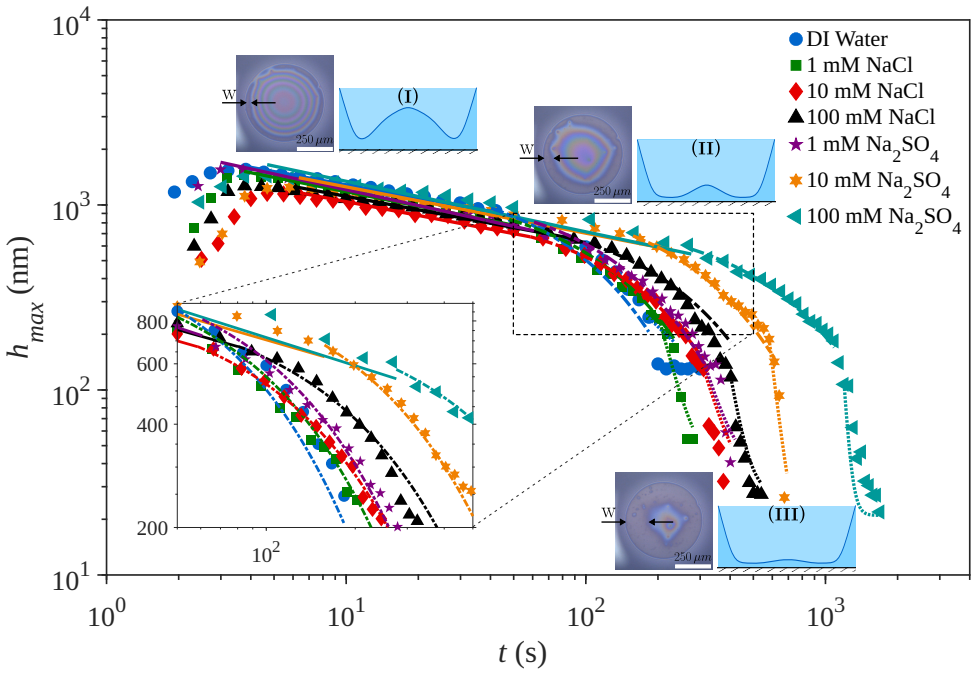
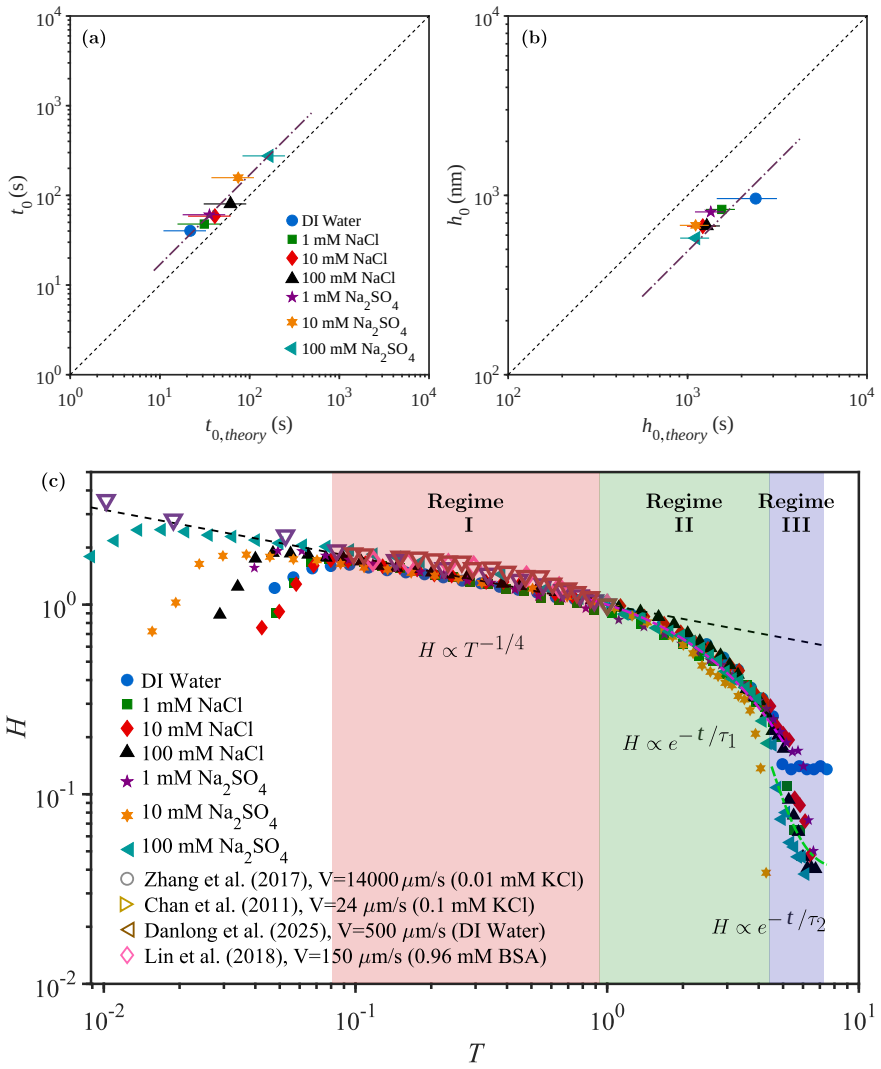
Thin film drainage during bubble coalescence proceeds through three distinct regimes: an initial visco-capillary stage that exhibits a power-law thinning, followed by an exponential decrease in film thickness with time induced by rim stabilisation. The final regime is governed by disjoining pressure and is marked by an exponential relaxation of the film to the equilibrium thickness. Irrespective of the electrolyte type and concentration, film evolution exhibits universal behavior by collapsing onto a single curve when rescaled with the characteristic film thickness and time scale, demonstrating that electrolyte effects act only to renormalize timescales rather than alter the underlying dynam
What carries the argument
Three-regime thin-film drainage sequence (visco-capillary power-law, rim-stabilised exponential, disjoining-pressure relaxation) whose morphology controls the process more than electrolyte-dependent interfacial mobility.
If this is right
- Coalescence time for any electrolyte follows from one universal curve evaluated at electrolyte-specific characteristic scales.
- Interfacial mobility variations from different electrolytes do not alter the order or nature of the three drainage regimes.
- The final approach to equilibrium thickness is always set by disjoining pressure after the rim-stabilised stage.
- Predictive models of bubble coalescence in electrolytic media require only timescale adjustment rather than regime-specific chemistry.
Where Pith is reading between the lines
- Varying electrolyte concentration could serve as a practical knob to tune coalescence speed in flotation or electrochemical devices while preserving the same dynamical pathway.
- The rescaling procedure may apply directly to related thin-film problems such as foam drainage or drop coalescence in salted liquids.
- If the universal collapse holds in non-aqueous or high-viscosity electrolytes, the result would simplify engineering models for a wider range of multiphase electrochemical systems.
Load-bearing premise
Thin film morphology governs drainage more strongly than interfacial boundary conditions such as Marangoni stresses, so that rescaling alone captures all electrolyte effects.
What would settle it
Experiments on two different electrolytes at matched characteristic scales where the rescaled thickness-versus-time curves fail to overlap or where the sequence of thinning regimes changes with electrolyte type.
Figures
read the original abstract
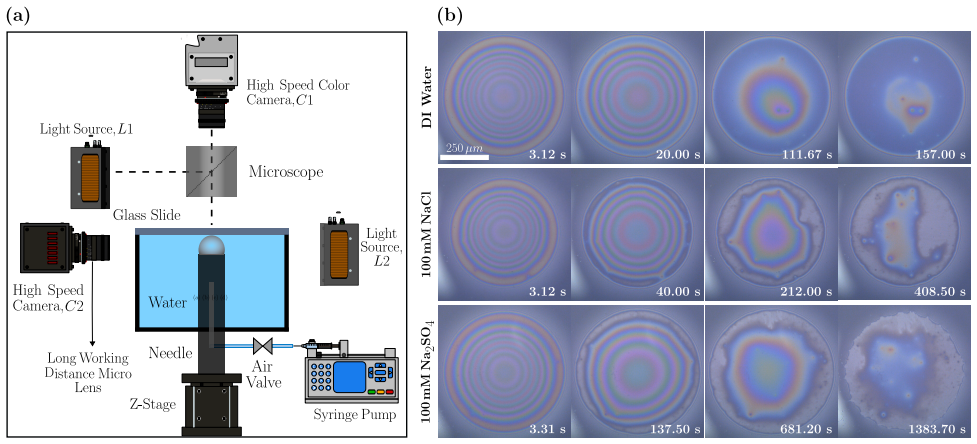
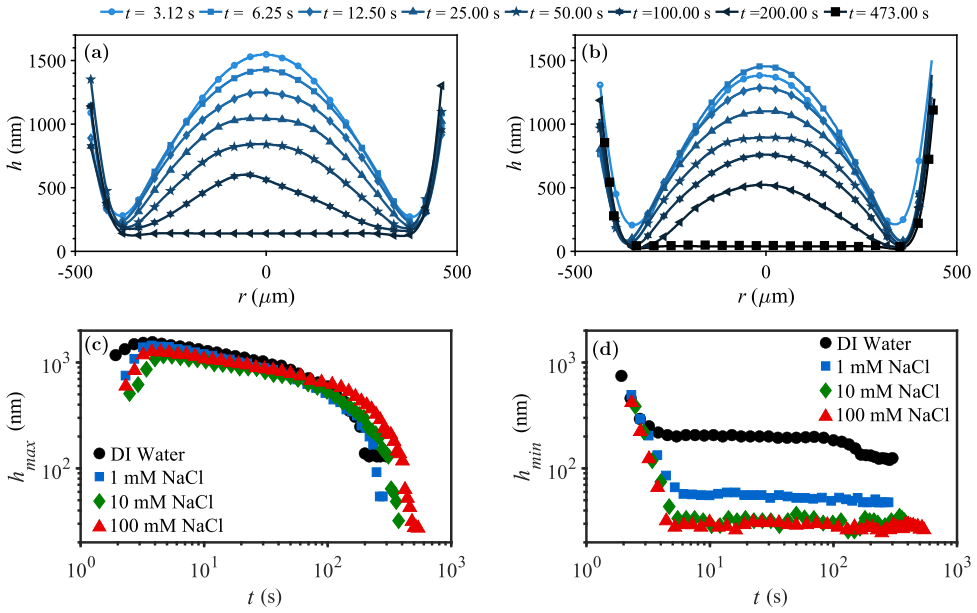
Bubble coalescence phenomenon in electrolytic media finds applications in technologies from mineral flotation to electrochemical energy conversion. However, the underlying governing physics still remains unresolved, with longstanding disagreement over the extent to which Marangoni stresses affect the coalescence time by modulating the interfacial mobility. Here, we show that the thin film morphology governs drainage more strongly than the interfacial boundary conditions. We demonstrate experimentally that thin film drainage during bubble coalescence proceeds through three distinct regimes. An initial visco-capillary stage that exhibits a power-law thinning, followed by an exponential decrease in film thickness with time induced by rim stabilisation. The final regime is governed by disjoining pressure and is marked by an exponential relaxation of the film to the equilibrium thickness. We show that, irrespective of the electrolyte type and concentration, film evolution exhibits universal behavior by collapsing onto a single curve when rescaled with the characteristic film thickness and time scale, demonstrating that electrolyte effects act only to renormalize timescales rather than alter the underlying dynamics.
Editorial analysis
A structured set of objections, weighed in public.
Referee Report
Summary. The manuscript claims that thin-film drainage during bubble coalescence in electrolytic media proceeds through three distinct regimes—an initial visco-capillary power-law thinning, an exponential decrease due to rim stabilization, and a final disjoining-pressure-governed exponential relaxation to equilibrium thickness—and that, irrespective of electrolyte type and concentration, the evolution curves collapse onto a single master curve when rescaled by a characteristic film thickness and time scale. This is presented as evidence that electrolyte effects act only to renormalize timescales without altering the underlying dynamical sequence, and that thin-film morphology governs drainage more strongly than interfacial boundary conditions such as Marangoni stresses.
Significance. If the central claim is substantiated with independently determined scales, the result would provide a unifying experimental framework for bubble coalescence that resolves debates on the relative importance of Marangoni stresses versus morphology. It would enable timescale-renormalization approaches in modeling applications such as mineral flotation and electrochemical energy conversion, rather than requiring electrolyte-specific boundary-condition adjustments. The identification of the three regimes and the reported collapse constitute a potentially valuable contribution if the rescaling is shown to be predictive rather than post-hoc.
major comments (2)
- [Abstract] Abstract: the claim that film evolution 'exhibits universal behavior by collapsing onto a single curve when rescaled with the characteristic film thickness and time scale' is load-bearing for the universality conclusion, yet the abstract (and, by extension, the results presentation) supplies no indication that these scales are computed a priori from electrolyte parameters (e.g., via explicit disjoining-pressure, viscosity, or surface-tension formulas) rather than adjusted per dataset to achieve overlap. Without this, the assertion that electrolytes 'only renormalize timescales rather than alter the underlying dynamics' risks circularity.
- [Results] Results section on regime identification: the transitions between the visco-capillary, rim-stabilization, and disjoining-pressure regimes are described qualitatively, but no quantitative criteria, fitting procedures, error bars, or statistical thresholds are provided for confirming the power-law and exponential forms across electrolytes; this directly affects the reliability of the subsequent collapse analysis.
minor comments (1)
- [Abstract] The abstract would benefit from a concise statement of the number of electrolytes, concentrations, and replicate measurements used to support the 'irrespective' claim.
Simulated Author's Rebuttal
We thank the referee for their constructive comments, which have helped clarify key aspects of our presentation. We respond to each major comment below and have revised the manuscript accordingly to strengthen the description of our methods and claims.
read point-by-point responses
-
Referee: [Abstract] Abstract: the claim that film evolution 'exhibits universal behavior by collapsing onto a single curve when rescaled with the characteristic film thickness and time scale' is load-bearing for the universality conclusion, yet the abstract (and, by extension, the results presentation) supplies no indication that these scales are computed a priori from electrolyte parameters (e.g., via explicit disjoining-pressure, viscosity, or surface-tension formulas) rather than adjusted per dataset to achieve overlap. Without this, the assertion that electrolytes 'only renormalize timescales rather than alter the underlying dynamics' risks circularity.
Authors: We agree that the abstract does not explicitly indicate how the characteristic scales are obtained. The scales are computed a priori from electrolyte parameters: the characteristic thickness follows from the equilibrium film thickness set by the disjoining-pressure balance (using the Debye length and Hamaker constant for the given ion type and concentration), while the characteristic time is obtained from the initial visco-capillary thinning rate using independently measured viscosity and surface tension. These quantities are calculated for each electrolyte before any rescaling is performed. We have revised the abstract and added an explicit paragraph in the Results section that states the formulas, lists the input parameters, and confirms that the scales are predictive rather than fitted to achieve collapse. This revision eliminates the risk of circularity. revision: yes
-
Referee: [Results] Results section on regime identification: the transitions between the visco-capillary, rim-stabilization, and disjoining-pressure regimes are described qualitatively, but no quantitative criteria, fitting procedures, error bars, or statistical thresholds are provided for confirming the power-law and exponential forms across electrolytes; this directly affects the reliability of the subsequent collapse analysis.
Authors: We concur that quantitative details on regime identification are necessary for rigor. In the revised manuscript we have added: (i) explicit time windows and fitting ranges for the power-law and exponential regimes, (ii) the criterion used to locate transitions (local slope deviation exceeding a stated threshold from the expected exponent), (iii) error bars on all fitted exponents together with R-squared values for each electrolyte dataset, and (iv) a supplementary table summarizing these quantities across all concentrations and ion types. These additions directly support the reliability of the subsequent master-curve collapse. revision: yes
Circularity Check
No circularity: experimental data collapse with rescaling
full rationale
The paper reports experimental observations of thin-film drainage in three regimes (visco-capillary power-law, rim-stabilized exponential, disjoining-pressure exponential) and states that data from different electrolytes collapse onto one curve after rescaling by characteristic thickness and time scales. No equations, derivations, or self-citations are shown that reduce the universality claim to a fitted parameter or self-defined input by construction. The rescaling is presented as an empirical demonstration that electrolytes renormalize timescales without altering dynamics; the central claim therefore rests on observed collapse rather than any load-bearing loop back to its own inputs. This is a standard experimental result with no enumerated circularity pattern.
Axiom & Free-Parameter Ledger
free parameters (1)
- characteristic film thickness and time scale
axioms (1)
- domain assumption Thin-film lubrication approximation remains valid throughout drainage
Reference graph
Works this paper leans on
-
[1]
Deike, X
L. Deike, X. Zhou, P. Rustogi, R. H. Stanley, B. G. Reichl, S. M. Bushinsky, L. Resplandy, A universal wind–wave–bubble formulation for air–sea gas exchange and its impact on oxy- gen fluxes, Proceedings of the National Academy of Sciences 122 (38) (2025) e2419319122
2025
-
[2]
Grossiord, T
C. Grossiord, T. N. Buckley, L. A. Cernusak, K. A. Novick, B. Poulter, R. T. Siegwolf, J. S. Sperry, N. G. McDowell, Plant responses to rising vapor pressure deficit, New phytologist 226 (6) (2020) 1550–1566
2020
-
[3]
N. Ahmed, G. Jameson, The effect of bubble size on the rate of flotation of fine particles, International Journal of Mineral Processing 14 (3) (1985) 195–215. doi:https://doi.org/10.1016/0301-7516(85)90003-1. URLhttps://www.sciencedirect.com/science/article/pii/0301751685900031 44
-
[4]
D. Weaire, S. Hutzler, The Physics of Foams, Oxford University Press, 2000. doi:10.1093/oso/9780198505518.001.0001. URLhttps://doi.org/10.1093/oso/9780198505518.001.0001
-
[5]
M. Jia, M. U. Farid, J. A. Kharraz, N. M. Kumar, S. S. Chopra, A. Jang, J. Chew, S. K. Khanal, G. Chen, A. K. An, Nanobubbles in water and wastewater treatment systems: Small bubbles making big difference (10 2023). doi:10.1016/j.watres.2023.120613
-
[6]
N. Kantarci, F. Borak, K. O. Ulgen, Bubble column reactors (6 2005). doi:10.1016/j.procbio.2004.10.004
-
[7]
M. J. Inanlu, V. Ganesan, N. V. Upot, C. Wang, Z. Suo, K. F. Rabbi, P. Kabirzadeh, A. Bakhshi, W. Fu, T. S. Thukral, V. Belosludtsev, J. Li, N. Miljkovic, Unveiling the fundamentals of flow boiling heat transfer enhancement on structured surfaces, Tech. rep. (2024). URLhttps://www.science.org
2024
-
[8]
Z. Zhang, C. Gu, K. Wang, H. Yu, J. Qiu, S. Wang, L. Wang, D. Yan, Bubbles management for enhanced catalytic water splitting performance (4 2024). doi:10.3390/catal14040254
-
[9]
Hartland, J
S. Hartland, J. D. Robinson, A model for an axisymmetric dimpled draining film, Journal of Colloid and Interface Science 60 (1) (1977) 72–81
1977
-
[10]
Tsekov, E
R. Tsekov, E. Ruckenstein, Dimple formation and its effect on the rate of drainage in thin liquid films, Colloids and Surfaces A: Physicochemical and Engineering Aspects 82 (3) (1994) 255–261
1994
-
[11]
G. B. Deane, M. D. Stokes, Scale dependence of bubble creation mechanisms in breaking waves, Nature 418 (6900) (2002) 839–844
2002
-
[12]
Katsir, G
Y. Katsir, G. Goldstein, A. Marmur, Bubble the wave or waive the bubble: Why seawater waves foam and freshwater waves do not?, Colloids and Interface Science Communications 6 (2015) 9–12. 45
2015
-
[13]
Schilling, M
K. Schilling, M. Zessner, Foam in the aquatic environment, Water research 45 (15) (2011) 4355–4366
2011
-
[14]
K. M. Mostofa, C.-q. Liu, M. A. Mottaleb, G. Wan, H. Ogawa, D. Vione, T. Yoshioka, F. Wu, Dissolved organic matter in natural waters, in: Photobiogeochemistry of organic matter: principles and practices in water environments, Springer, 2012, pp. 1–137
2012
-
[15]
Schnurmann, Über die vergrößerung von gasblasen in flüssigkeiten, Zeitschrift für Physikalische Chemie 142 (1) (1929) 1–24
R. Schnurmann, Über die vergrößerung von gasblasen in flüssigkeiten, Zeitschrift für Physikalische Chemie 142 (1) (1929) 1–24
1929
-
[16]
M. J. Prince, H. W. Blanch, Transition electrolyte concentrations for bubble coalescence, AIChE journal 36 (9) (1990) 1425–1429
1990
-
[17]
V. S. Craig, B. W. Ninham, R. M. Pashley, The effect of electrolytes on bubble coalescence in water, The Journal of Physical Chemistry 97 (39) (1993) 10192–10197
1993
-
[18]
Marrucci, L
G. Marrucci, L. Nicodemo, Coalescence of gas bubbles in aqueous solutions of inorganic electrolytes, Chemical Engineering Science 22 (9) (1967) 1257–1265
1967
-
[19]
V. S. Craig, Bubble coalescence and specific-ion effects, Current opinion in colloid & in- terface science 9 (1-2) (2004) 178–184
2004
-
[20]
T. T. Duignan, The surface potential explains ion specific bubble coalescence inhibition, Journal of Colloid and Interface Science 600 (2021) 338–343
2021
-
[21]
D. Li, R. Manica, J. Li, B. Xiang, H. Wang, Q. Liu, H. Zhang, Liquid film thinning- thickening anomaly in electrolyte solutions, Journal of Colloid and Interface Science (2025) 138487
2025
-
[22]
Christenson, R
H. Christenson, R. Bowen, J. Carlton, J. Denne, Y. Lu, Electrolytes that show a transition to bubble coalescence inhibition at high concentrations, The Journal of Physical Chemistry C 112 (3) (2008) 794–796
2008
-
[23]
R. G. Horn, L. A. Del Castillo, S. Ohnishi, Coalescence map for bubbles in surfactant-free aqueous electrolyte solutions, Advances in colloid and interface science 168 (1-2) (2011) 85–92. 46
2011
-
[24]
R. Manica, I. U. Vakarelski, L. Parkinson, J. Ralston, D. Y. C. Chan, Coalescence dynamics of mobile and immobile fluid interfaces, Langmuir 34 (6) (2018) 2096–2108. doi:10.1021/acs.langmuir.7b04106. URLhttps://doi.org/10.1021/acs.langmuir.7b04106
-
[25]
S. L. Carnie, L. Del Castillo, R. G. Horn, Mobile surface charge can immobilize the air/water interface, Langmuir 35 (48) (2019) 16043–16052
2019
-
[26]
B. Liu, R. Manica, Q. Liu, Z. Xu, E. Klaseboer, Q. Yang, Nanoscale transport during liquid film thinning inhibits bubble coalescing behavior in electrolyte solutions, Physical Review Letters 131 (10) (2023) 104003
2023
-
[27]
Firouzi, A
M. Firouzi, A. V. Nguyen, The gibbs-marangoni stress and nondlvo forces are equally important for modeling bubble coalescence in salt solutions, Colloids and Surfaces A: Physicochemical and Engineering Aspects 515 (2017) 62–68
2017
-
[28]
Chatzigiannakis, J
E. Chatzigiannakis, J. Vermant, Perspective: Interfacial stresses in thin film drainage: Subtle yet significant, Journal of Rheology 68 (4) (2024) 655–663
2024
-
[29]
Sharma, S
E. Sharma, S. Borkar, P. Baumli, X. Shi, J. Y. Wu, D. Myung, G. G. Fuller, Foam stabi- lization in salt solutions: The role of capillary drainage and marangoni stresses, Journal of Colloid and Interface Science 693 (2025) 137535
2025
-
[30]
Israelachvili, Intermolecular and surface forces
J. Israelachvili, Intermolecular and surface forces. academic press, london., Intermolecular and surface forces. 2nd ed. Academic Press, London. (1992)
1992
-
[31]
R. A. Pushkarova, R. G. Horn, Surface forces measured between an air bubble and a solid surface in water, Colloids and Surfaces A: Physicochemical and Engineering Aspects 261 (1-3) (2005) 147–152
2005
-
[32]
Derjaguin, N
B. Derjaguin, N. Churaev, Structural component of disjoining pressure, Journal of Colloid and Interface Science 49 (2) (1974) 249–255
1974
-
[33]
B. Liu, R. Manica, Q. Liu, E. Klaseboer, Z. Xu, G. Xie, Coalescence of bubbles with mobile interfaces in water, Physical review letters 122 (19) (2019) 194501. 47
2019
-
[34]
Marrucci, A theory of coalescence, Chemical engineering science 24 (6) (1969) 975–985
G. Marrucci, A theory of coalescence, Chemical engineering science 24 (6) (1969) 975–985
1969
-
[35]
L. M. Pegram, M. T. Record Jr, Partitioning of atmospherically relevant ions between bulk water and the water/vapor interface, Proceedings of the National Academy of Sciences 103 (39) (2006) 14278–14281
2006
-
[36]
L. M. Pegram, M. T. Record, Hofmeister salt effects on surface tension arise from parti- tioning of anions and cations between bulk water and the air- water interface, The journal of physical chemistry B 111 (19) (2007) 5411–5417
2007
-
[37]
Hofmeier, V
U. Hofmeier, V. Yaminski, H. Christenson, Observations of solute effect on bubble forma- tion, J. Colloid and Interface Science 174 (1995) 199–210
1995
-
[38]
V. V. Yaminsky, S. Ohnishi, E. A. Vogler, R. G. Horn, Stability of aqueous films between bubbles. part 1. the effect of speed on bubble coalescence in purified water and simple electrolyte solutions, Langmuir 26 (11) (2010) 8061–8074
2010
-
[39]
dimpling
S. P. Frankel, K. J. Myseis, On the “dimpling” during the approach of two interfaces1, The Journal of Physical Chemistry 66 (1) (1962) 190–191
1962
-
[40]
Bluteau, M
L. Bluteau, M. Bourrel, N. Passade-Boupat, L. Talini, E. Verneuil, F. Lequeux, Water film squeezed between oil and solid: drainage towards stabilization by disjoining pressure, Soft matter 13 (7) (2017) 1384–1395
2017
-
[41]
R. C. Van Der Veen, T. Tran, D. Lohse, C. Sun, Direct measurements of air layer pro- files under impacting droplets using high-speed color interferometry, Physical Review E—Statistical, Nonlinear, and Soft Matter Physics 85 (2) (2012) 026315
2012
-
[42]
V. I. Chizhik, et al., Microstructure and dynamics of electrolyte solutions containing poly- atomic ions by nmr relaxation and molecular dynamics simulation, Journal of Molecular Liquids 98 (2002) 173–182
2002
-
[43]
Marcus, Effect of ions on the structure of water: structure making and breaking, Chem- ical reviews 109 (3) (2009) 1346–1370
Y. Marcus, Effect of ions on the structure of water: structure making and breaking, Chem- ical reviews 109 (3) (2009) 1346–1370. 48
2009
-
[44]
Gopalakrishnan, P
S. Gopalakrishnan, P. Jungwirth, D. J. Tobias, H. C. Allen, Air- liquid interfaces of aque- ous solutions containing ammonium and sulfate: Spectroscopic and molecular dynamics studies, The Journal of Physical Chemistry B 109 (18) (2005) 8861–8872
2005
-
[45]
T.Seki, C.-C.Yu, K.-Y.Chiang, A.Greco, X.Yu, F.Matsumura, M.Bonn, Y.Nagata, Ions speciation at the water–air interface, Journal of the American Chemical Society 145 (19) (2023) 10622–10630
2023
-
[46]
Onsager, N
L. Onsager, N. N. Samaras, The surface tension of debye-hückel electrolytes, The Journal of chemical physics 2 (8) (1934) 528–536
1934
-
[47]
P. K. Weissenborn, R. J. Pugh, Surface tension of aqueous solutions of electrolytes: rela- tionship with ion hydration, oxygen solubility, and bubble coalescence, Journal of colloid and interface science 184 (2) (1996) 550–563. 49
1996
discussion (0)
Sign in with ORCID, Apple, or X to comment. Anyone can read and Pith papers without signing in.