Neural-Network extraction of TMDs with SIDIS data
Pith reviewed 2026-06-29 03:16 UTC · model grok-4.3
The pith
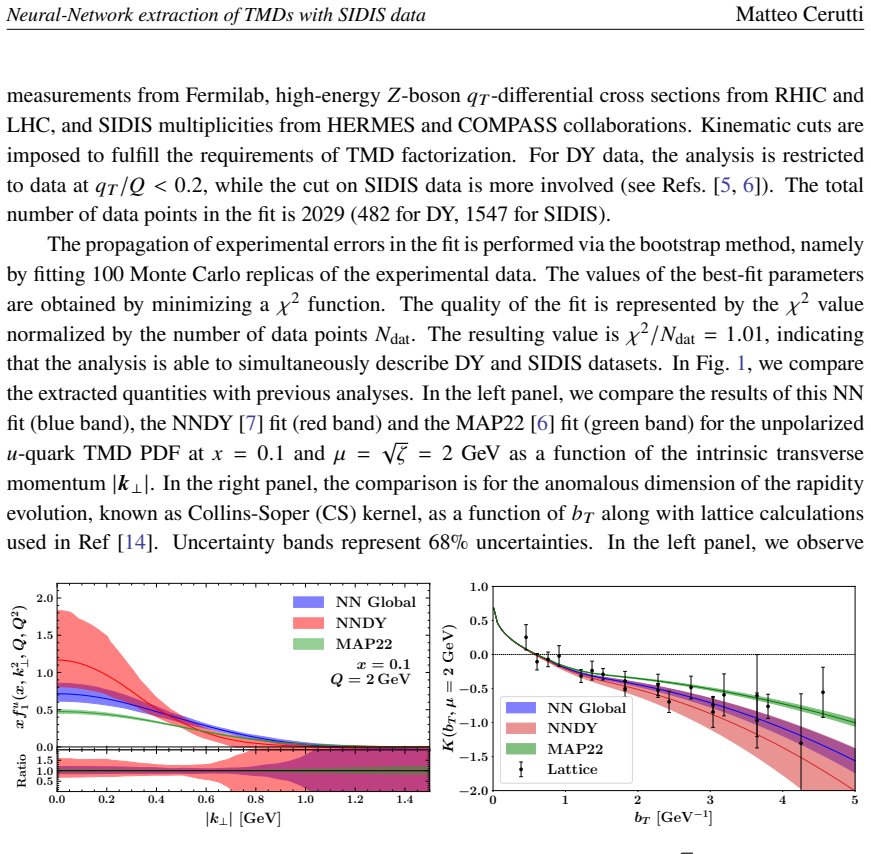
Adding SIDIS data to a neural-network fit produces broader unpolarized TMD PDFs than a Drell-Yan-only extraction while shrinking the uncertainties.
A machine-rendered reading of the paper's core claim, the machinery that carries it, and where it could break.
Core claim
A neural-network parametrization fitted simultaneously to Drell-Yan and SIDIS data at N³LL accuracy produces broader unpolarized TMD PDFs than a neural-network fit restricted to Drell-Yan data, with reduced uncertainties relative to the DY-only neural-network result but still larger than those from traditional models.
What carries the argument
Neural-network parametrization of unpolarized TMD PDFs that permits simultaneous inclusion of Drell-Yan and SIDIS datasets at N³LL accuracy.
If this is right
- Future measurements at Jefferson Lab and the Electron-Ion Collider can tighten the constraints on the TMDs.
- The neural-network approach lowers model dependence compared with fixed functional forms.
- Including both processes simultaneously reduces the size of the uncertainty bands relative to a Drell-Yan-only neural-network extraction.
Where Pith is reading between the lines
- The result suggests that traditional model fits may be underestimating uncertainties by restricting the functional freedom too early.
- Combining processes with different kinematic coverages can map out the transverse-momentum dependence more completely than single-process fits.
- The same neural-network machinery could be applied to polarized TMDs once sufficient data become available.
Load-bearing premise
The neural-network parametrization remains flexible and unbiased across the kinematic ranges of both datasets, so that any broadening or uncertainty change can be attributed to the data rather than to the choice of fit method.
What would settle it
A new high-precision measurement of the unpolarized TMD width in a kinematic bin already covered by both processes that lies outside the uncertainty band of the combined neural-network fit would falsify the reported broadening.
Figures
read the original abstract
A first global analysis of unpolarized Transverse-Momentum-Dependent (TMD) distributions based on a neural-network (NN) parametrization is presented. Drell-Yan (DY) and semi-inclusive deep inelastic scattering (SIDIS) data are simultaneously included at next-to-next-to-next-to-leading logarithmic (N$^3$LL) accuracy. The results indicate that the inclusion of SIDIS data leads to broader unpolarized TMD PDFs compared to a DY-only NN extraction. The associated uncertainties are reduced with respect to the DY-only case, while remaining larger than the ones obtained using traditional models. These results demonstrate the potential of flexible NN parametrizations in reducing model dependence and provide guidance for future high-precision measurements at Jefferson Lab and the Electron-Ion Collider.
Editorial analysis
A structured set of objections, weighed in public.
Referee Report
Summary. The manuscript presents the first global analysis of unpolarized TMD distributions using a neural-network parametrization, simultaneously fitting Drell-Yan and SIDIS data at N³LL accuracy. It reports that inclusion of SIDIS data produces broader TMD PDFs than a DY-only NN extraction, with reduced uncertainties relative to the DY-only case (though still larger than those from traditional parametrizations), and positions this as evidence for the value of flexible NN approaches in reducing model dependence.
Significance. If the central claims are substantiated, the work would demonstrate the viability of NN parametrizations for TMD phenomenology at high perturbative order, offering a route to incorporate heterogeneous datasets with reduced functional bias. This has potential implications for precision TMD studies at Jefferson Lab and the EIC. The simultaneous DY+SIDIS fit at N³LL is technically noteworthy, but the significance hinges on whether observed changes in width and uncertainty can be cleanly attributed to the data rather than the fitting procedure.
major comments (2)
- [NN fit procedure and comparison (results section)] The central claim that SIDIS inclusion broadens the TMD PDFs and reduces uncertainties (abstract and results) is load-bearing and requires explicit demonstration that the NN architecture, hyper-parameters, training protocol, and stopping criterion are identical between the DY-only and DY+SIDIS fits. Without such tests (e.g., fixed random seed, same early-stopping rule, or identical hyper-parameter scan), differences in the extracted non-perturbative functions could arise from changes in the NN's effective bias or regularization when the training set grows, rather than from the additional data. This concern directly affects attribution of the headline result.
- [Uncertainty treatment and validation (results section)] The reported uncertainty reduction upon adding SIDIS data lacks supporting details on the uncertainty propagation method (e.g., NN ensemble variance, Hessian, or replica method) and on data compatibility or cross-validation checks. The abstract supplies no quantitative information on fit quality, χ^{2} values, or validation procedures, making it impossible to assess whether the uncertainty reduction is robust or an artifact of the fitting setup.
minor comments (1)
- [Abstract] The abstract would be strengthened by including at least one quantitative indicator of fit quality or the kinematic coverage of the combined dataset.
Simulated Author's Rebuttal
We thank the referee for the detailed and constructive report. The two major comments highlight important points on reproducibility of the NN fits and transparency of uncertainty estimation. We address each below and have revised the manuscript accordingly to strengthen the attribution of results to the data.
read point-by-point responses
-
Referee: The central claim that SIDIS inclusion broadens the TMD PDFs and reduces uncertainties (abstract and results) is load-bearing and requires explicit demonstration that the NN architecture, hyper-parameters, training protocol, and stopping criterion are identical between the DY-only and DY+SIDIS fits. Without such tests (e.g., fixed random seed, same early-stopping rule, or identical hyper-parameter scan), differences in the extracted non-perturbative functions could arise from changes in the NN's effective bias or regularization when the training set grows, rather than from the additional data.
Authors: We confirm that the identical NN architecture (same number of layers and nodes), hyper-parameter set, training protocol (including optimizer, learning rate schedule, and early-stopping rule), and stopping criterion were used for both the DY-only and DY+SIDIS fits; no re-tuning occurred when SIDIS data were added. To make this explicit and allow direct verification, we have added a new subsection (and associated table) in the results section that lists the common hyper-parameters, training settings, and a reproducibility test performed with fixed random seed. These additions demonstrate that the observed broadening and uncertainty reduction arise from the additional data rather than changes in the NN effective bias. revision: yes
-
Referee: The reported uncertainty reduction upon adding SIDIS data lacks supporting details on the uncertainty propagation method (e.g., NN ensemble variance, Hessian, or replica method) and on data compatibility or cross-validation checks. The abstract supplies no quantitative information on fit quality, χ^{2} values, or validation procedures, making it impossible to assess whether the uncertainty reduction is robust or an artifact of the fitting setup.
Authors: Uncertainties are obtained from the variance across an ensemble of independently trained networks (different random initializations, same architecture and data). We have expanded the methods and results sections to describe this procedure in detail, added the total χ²/dof values for both fits, included a table of per-experiment χ² contributions, and reported a cross-validation check (hold-out subsets of SIDIS data). Quantitative fit-quality metrics have also been inserted into the abstract. These revisions allow the reader to evaluate the robustness of the uncertainty reduction. revision: yes
Circularity Check
No circularity: standard phenomenological NN fit with direct data-driven outputs.
full rationale
The paper performs a neural-network parametrization of TMDs fitted simultaneously to DY and SIDIS datasets at N³LL. The central claims (broader TMD PDFs and reduced uncertainties upon adding SIDIS) are the direct numerical outputs of these two separate fits; they do not reduce by construction to any input via self-definition, renaming, or load-bearing self-citation. No equations or statements in the provided text equate a derived quantity to its own fit parameters or prior author results. The extraction is self-contained against the external data benchmarks it uses.
Axiom & Free-Parameter Ledger
free parameters (1)
- neural-network weights and biases
Reference graph
Works this paper leans on
-
[1]
Dilepton production from polarized hadron hadron collisions
S. Arnold, A. Metz and M. Schlegel, Phys. Rev. D79(2009), 034005 doi:10.1103/PhysRevD.79.034005 [arXiv:0809.2262 [hep-ph]]
work page internal anchor Pith review Pith/arXiv arXiv doi:10.1103/physrevd.79.034005 2009
-
[2]
Semi-inclusive deep inelastic scattering at small transverse momentum
A. Bacchetta, M. Diehl, K. Goeke, A. Metz, P. J. Mulders and M. Schlegel, JHEP02(2007), 093 doi:10.1088/1126-6708/2007/02/093 [arXiv:hep-ph/0611265 [hep-ph]]
work page internal anchor Pith review Pith/arXiv arXiv doi:10.1088/1126-6708/2007/02/093 2007
-
[3]
S. Anedda, V. Bertone, G. Bozzi and M. Cerutti, [arXiv:2605.28216 [hep-ph]]
-
[4]
V. Moos, I. Scimemi, A. Vladimirov and P. Zurita, JHEP11(2025), 134 doi:10.1007/JHEP11(2025)134 [arXiv:2503.11201 [hep-ph]]
-
[5]
A. Bacchettaet al.[MAP (Multi-dimensional Analyses of Partonic distributions)], JHEP08 (2024), 232 doi:10.1007/JHEP08(2024)232 [arXiv:2405.13833 [hep-ph]]
-
[6]
A. Bacchettaet al.[MAP (Multi-dimensional Analyses of Partonic distributions)], JHEP10 (2022), 127 doi:10.1007/JHEP10(2022)127 [arXiv:2206.07598 [hep-ph]]
-
[7]
Bacchettaet al.[MAP (Multi-dimensional Analyses of Partonic distributions)], Phys
A. Bacchettaet al.[MAP (Multi-dimensional Analyses of Partonic distributions)], Phys. Rev. Lett.135(2025) no.2, 021904 doi:10.1103/csc2-bj91 [arXiv:2502.04166 [hep-ph]]
-
[8]
M. Cerutti, J. P. Chen, U. D’Alesio, H. Gao, S. Jia, V. Khachatryan, A. Prokudin, L. Rossi, Y. Tian and Z. Zhao, [arXiv:2512.20897 [nucl-ex]]
-
[9]
R. Abdul Khalek, A. Accardi, J. Adam, D. Adamiak, W. Akers, M. Albaladejo, A. Al- bataineh, M.G.Alexeev, F.AmeliandP.Antonioli,et al.Nucl.Phys.A1026(2022), 122447 doi:10.1016/j.nuclphysa.2022.122447 [arXiv:2103.05419 [physics.ins-det]]
-
[10]
J. Collins, Camb. Monogr. Part. Phys. Nucl. Phys. Cosmol.32(2011), 1-624 Cambridge University Press, 2011, ISBN 978-1-009-40184-5, 978-1-009-40183-8, 978-1-009-40182-1 doi:10.1017/9781009401845
-
[11]
J. C. Collins, D. E. Soper and G. F. Sterman, Nucl. Phys. B250(1985), 199-224 doi:10.1016/0550-3213(85)90479-1
- [12]
-
[13]
MAP Collaboration,https://github.com/MapCollaboration/NangaParbat-Legacy
-
[14]
A. Avkhadiev, V. Bertone, C. Bissolotti, M. Cerutti, Y. Fu, S. Rodini, P. Shanahan, M. Wagman and Y. Zhao, Phys. Rev. Lett.136(2026) no.17, 171902 doi:10.1103/zphz-4k8q [arXiv:2510.26489 [hep-ph]]. 5
discussion (0)
Sign in with ORCID, Apple, or X to comment. Anyone can read and Pith papers without signing in.