Noise-Directed Adaptive Remapping for Integer Optimization: from qubits to (encoded) qudits
Pith reviewed 2026-06-29 03:27 UTC · model grok-4.3
The pith
Extending NDAR to integer optimization adds gauge freedoms that let noise guide comparisons among qudit-native, binary, one-hot, and domain-wall encodings.
A machine-rendered reading of the paper's core claim, the machinery that carries it, and where it could break.
Core claim
The extension of NDAR to integer optimization rests on the feasibility of the noise attractor together with the existence of compatible gauge transformations that preserve an efficiently implementable circuit family for each encoding. When these conditions hold, the qudit-native, binary, one-hot, and domain-wall encodings each admit NDAR but produce different interactions between noise-induced dynamics and the optimization landscape, as illustrated on the Max-k-colorable subgraph problem. This supplies a concrete, noise-based criterion for ranking encoding choices at the device level.
What carries the argument
Noise attractor together with encoding-specific gauge transformations that preserve an efficiently implementable circuit family.
If this is right
- Each of the four encodings satisfies the NDAR criteria to different degrees and therefore exhibits distinct advantages and tradeoffs.
- Noise-induced dynamics interact with the solution landscape in an encoding-dependent manner.
- NDAR supplies a systematic procedure for selecting the gauge transform at each iteration when the problem domain is integer-valued.
- The same noise-based ranking can be applied to any integer optimization problem once the three requirements are verified for its encodings.
Where Pith is reading between the lines
- Experimental tests on superconducting qudit hardware could directly measure whether the predicted encoding-dependent noise attractors appear in practice.
- The gauge-selection step could be automated by searching over the space of allowed transformations at each iteration rather than using a fixed rule.
- The same NDAR machinery might be tested on other integer problems such as scheduling or partitioning to check whether the relative ranking of encodings remains stable.
Load-bearing premise
The noise attractor must be feasible and compatible gauge transformations must exist that keep the circuit family efficient for each encoding.
What would settle it
A concrete simulation or device run on the Max-k-colorable subgraph problem that shows the noise attractor is unreachable or that no gauge transformation preserves both the attractor and an efficient circuit family for the domain-wall encoding.
Figures
read the original abstract
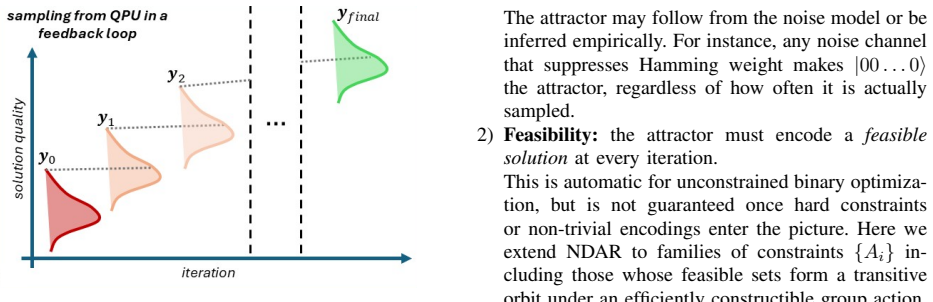
We extend Noise-Directed Adaptive Remapping (NDAR), a recently proposed heuristic meta-algorithm that leverages device noise as a computational resource, to optimization problems over discrete (integer) domains. While originally introduced for unconstrained binary optimization, the proposed generalization introduces additional gauge degrees of freedom at the logical level, such that the gauge transformation applied at each iteration is no longer unique, allowing tailoring to particular encodings or quantum hardware. We identify encoding-dependent requirements for NDAR beyond binary domains: feasibility of the noise attractor, existence of compatible gauge transformations that preserve an efficiently implementable circuit family, and a systematic way to select the transform to apply at each step. We analyze these criteria for qudit-native and for binary, one-hot, and domain-wall qubit encodings, using the Max-k-colorable subgraph problem as a running example. We demonstrate that these encodings can exhibit distinct advantages and tradeoffs when integrated within the NDAR framework, particularly in how noise-induced dynamics interact with the solution landscape and choice of encoding. Our results indicate that NDAR-guided noise considerations provide a new criterion for comparing device-level encoding choices for quantum optimization. Finally, we outline directions toward experimental realization in superconducting qudit devices and further algorithmic improvements.
Editorial analysis
A structured set of objections, weighed in public.
Referee Report
Summary. The paper extends Noise-Directed Adaptive Remapping (NDAR) from binary to integer optimization by introducing logical gauge degrees of freedom that allow the remapping transform to be tailored to specific encodings. It identifies three encoding-dependent requirements (feasibility of the noise attractor, existence of compatible gauge transformations preserving efficient circuit families, and a systematic selection rule), analyzes them for qudit-native, binary, one-hot, and domain-wall encodings on the Max-k-colorable subgraph problem, demonstrates distinct advantages and tradeoffs across encodings, and concludes that NDAR supplies a new noise-based criterion for comparing device-level encoding choices. Directions for superconducting-qudit experiments are outlined.
Significance. If the feasibility and gauge-preservation conditions are shown to hold with explicit constructions, the work would supply a concrete, noise-aware method for selecting among qubit and qudit encodings in optimization and a practical way to turn device noise into a computational resource. The systematic treatment of multiple encodings on a single running example and the emphasis on circuit-family preservation are strengths that could influence encoding choices in near-term hardware.
major comments (2)
- [Abstract and analysis section] Abstract and § on analysis of encodings: the headline claim that NDAR provides a new criterion for comparing encodings rests on the existence of feasible noise attractors and gauge transformations that keep the circuit family efficiently implementable for qudit-native, binary, one-hot, and domain-wall mappings. The manuscript identifies these requirements and states that they are analyzed, yet supplies no explicit construction of the attractor or gauge map (beyond the binary case) nor verification that the resulting dynamics remain inside the feasible set; without those constructions the comparison criterion remains conditional rather than demonstrated.
- [Max-k-colorable subgraph example] § on Max-k-colorable subgraph example: the demonstration of distinct advantages across encodings is presented as evidence for the new criterion, but the reported results appear to assume satisfaction of the three requirements rather than exhibiting them; a concrete check (e.g., explicit gauge map for one-hot or domain-wall that preserves the circuit family while mapping the noise attractor to valid colorings) is needed to make the tradeoff claims load-bearing.
minor comments (2)
- Notation for the gauge transformation and the noise-attractor map should be introduced with a single consistent symbol set early in the manuscript to avoid later ambiguity when comparing encodings.
- The outline of experimental directions would benefit from a short table listing the circuit-depth or gate-count overhead implied by each encoding under the NDAR gauge choice.
Simulated Author's Rebuttal
We thank the referee for their careful reading and constructive comments, which correctly identify the need for explicit constructions to strengthen the claims. We address each major point below and will revise the manuscript accordingly.
read point-by-point responses
-
Referee: [Abstract and analysis section] Abstract and § on analysis of encodings: the headline claim that NDAR provides a new criterion for comparing encodings rests on the existence of feasible noise attractors and gauge transformations that keep the circuit family efficiently implementable for qudit-native, binary, one-hot, and domain-wall mappings. The manuscript identifies these requirements and states that they are analyzed, yet supplies no explicit construction of the attractor or gauge map (beyond the binary case) nor verification that the resulting dynamics remain inside the feasible set; without those constructions the comparison criterion remains conditional rather than demonstrated.
Authors: We agree that the current manuscript identifies the three encoding-dependent requirements and provides a conceptual analysis for each encoding but does not supply explicit constructions of the noise attractors or gauge maps (beyond the binary case) nor explicit verification that the dynamics remain feasible. In the revised version we will add these explicit constructions for the qudit-native, one-hot, and domain-wall encodings, together with verification that the resulting gauge-transformed dynamics stay inside the feasible set. This will convert the comparison criterion from conditional to demonstrated. revision: yes
-
Referee: [Max-k-colorable subgraph example] § on Max-k-colorable subgraph example: the demonstration of distinct advantages across encodings is presented as evidence for the new criterion, but the reported results appear to assume satisfaction of the three requirements rather than exhibiting them; a concrete check (e.g., explicit gauge map for one-hot or domain-wall that preserves the circuit family while mapping the noise attractor to valid colorings) is needed to make the tradeoff claims load-bearing.
Authors: We acknowledge that the example section presents the distinct advantages and tradeoffs under the assumption that the three requirements hold, without exhibiting explicit gauge maps or attractor mappings for the non-binary encodings. In the revision we will include concrete checks: explicit gauge maps for one-hot and domain-wall encodings that preserve the circuit family, together with verification that the noise attractor is mapped to valid colorings. These additions will make the tradeoff claims load-bearing. revision: yes
Circularity Check
No significant circularity; extension and analysis are self-contained
full rationale
The paper extends the previously introduced NDAR heuristic to integer optimization by adding gauge degrees of freedom and identifies three encoding-dependent requirements (feasibility of noise attractor, compatible gauge transformations preserving efficient circuits, and systematic transform selection). These requirements are then analyzed for qudit-native, binary, one-hot, and domain-wall encodings on the Max-k-colorable subgraph example, with claimed demonstrations of distinct advantages. No quoted step reduces a claimed result to a fitted parameter, self-defined quantity, or unverified self-citation chain by construction; the reference to the 'recently proposed' NDAR supplies only the base method while the generalization, requirement identification, and new comparison criterion rest on the independent analysis presented.
Axiom & Free-Parameter Ledger
Reference graph
Works this paper leans on
-
[1]
Improving quantum approximate optimization by noise-directed adaptive remapping,
F. B. Maciejewski, J. Biamonte, S. Hadfield, and D. Venturelli, “Improving quantum approximate optimization by noise-directed adaptive remapping,”Quantum, vol. 9, p. 1906, 2025
1906
-
[2]
A quantum approximate optimization algorithm,
E. Farhi, J. Goldstone, and S. Gutmann, “A quantum approximate optimization algorithm,”arXiv preprint arXiv:1411.4028, 2014
Pith/arXiv arXiv 2014
-
[3]
From the quantum approximate optimization algorithm to a quantum alternating operator ansatz,
S. Hadfield, Z. Wang, B. O’gorman, E. G. Rieffel, D. Venturelli, and R. Biswas, “From the quantum approximate optimization algorithm to a quantum alternating operator ansatz,”Algorithms, vol. 12, no. 2, p. 34, 2019
2019
-
[4]
Challenges and opportunities for quantum informa- tion hardware,
D. D. Awschalom, H. Bernien, R. Hanson, W. D. Oliver, and J. Vuˇckovi´c, “Challenges and opportunities for quantum informa- tion hardware,”Science, vol. 390, no. 6777, pp. 1004–1010, 2025
2025
-
[5]
Challenges and opportunities in quantum optimization,
A. Abbas, A. Ambainis, B. Augustino, A. B ¨artschi, H. Buhrman, C. Coffrin, G. Cortiana, V . Dunjko, D. J. Egger, B. G. Elmegreen, et al., “Challenges and opportunities in quantum optimization,” Nature Reviews Physics, pp. 1–18, 2024
2024
-
[6]
Qudits and high- dimensional quantum computing,
Y . Wang, Z. Hu, B. C. Sanders, and S. Kais, “Qudits and high- dimensional quantum computing,”Frontiers in Physics, vol. 8, p. 589504, 2020
2020
-
[7]
Construction of a qudit using schr ¨odinger cat states and generation of hybrid entanglement between a discrete-variable qudit and a continuous- variable qudit,
Q.-P. Su, T. Liu, Y . Zhang, and C.-P. Yang, “Construction of a qudit using schr ¨odinger cat states and generation of hybrid entanglement between a discrete-variable qudit and a continuous- variable qudit,”Physical Review A, vol. 104, no. 3, p. 032412, 2021
2021
-
[8]
Quantum information scrambling on a superconducting qutrit processor,
M. S. Blok, V . V . Ramasesh, D. I. Schuster, and I. Siddiqi, “Quantum information scrambling on a superconducting qutrit processor,”Physical Review X, vol. 11, p. 021010, 2021
2021
-
[9]
A programmable qudit-based quan- tum processor,
Y . Chi, J. Huang, Z. Zhang, J. Mao, Z. Zhou, X. Chen, C. Zhai, J. Bao, T. Dai, H. Yuan,et al., “A programmable qudit-based quan- tum processor,”Nature communications, vol. 13, no. 1, p. 1166, 2022
2022
-
[10]
Universal qudit quantum computation with trapped ions,
M. Ringbauer, M. Meth, L. Postler, R. Stricker, I. Pogorelov, B. P. Lanyon, R. Blatt, and T. Monz, “Universal qudit quantum computation with trapped ions,”Nature Physics, vol. 18, pp. 1053– 1057, 2022
2022
-
[11]
Two-qutrit quantum al- gorithms on a programmable superconducting processor,
T. Roy, Z. Li, E. Kapit, and D. Schuster, “Two-qutrit quantum al- gorithms on a programmable superconducting processor,”Physical Review Applied, vol. 19, no. 6, p. 064024, 2023
2023
-
[12]
The2t-qutrit, a two-mode bosonic qutrit,
A. Denys and A. Leverrier, “The2t-qutrit, a two-mode bosonic qutrit,”Quantum, vol. 7, p. 1032, 2023
2023
-
[13]
Empowering a qudit- based quantum processor by traversing the dual bosonic ladder,
L. B. Nguyen, N. Goss, K. Siva, Y . Kim, E. Younis, B. Qing, A. Hashim, D. I. Santiago, and I. Siddiqi, “Empowering a qudit- based quantum processor by traversing the dual bosonic ladder,” Nature Communications, vol. 15, no. 1, p. 7117, 2024
2024
-
[14]
Benchmarking the performance of a high-q cavity qudit using random unitaries,
N. Bornman, T. Roy, J. A. Job, N. Anand, G. N. Perdue, S. Zorzetti, and M. S. Alam, “Benchmarking the performance of a high-q cavity qudit using random unitaries,”Quantum Science and Technology, vol. 10, no. 2, p. 025062, 2025
2025
-
[15]
Ultracoherent super- conducting cavity-based multiqudit platform with error-resilient control,
T. Kim, T. Roy, X. You, A. C. Li, H. Lamm, O. Pronitchev, M. Bal, S. Garattoni, F. Crisa, D. Bafia,et al., “Ultracoherent super- conducting cavity-based multiqudit platform with error-resilient control,”arXiv preprint arXiv:2506.03286, 2025
arXiv 2025
-
[16]
Near- term application engineering challenges in emerging supercon- ducting qudit processors,
D. Venturelli, E. Gustafson, D. Kurkcuoglu, and S. Zorzetti, “Near- term application engineering challenges in emerging supercon- ducting qudit processors,”arXiv preprint arXiv:2506.05608, 2025
arXiv 2025
-
[17]
Domain wall encoding of discrete variables for quantum annealing and qaoa,
N. Chancellor, “Domain wall encoding of discrete variables for quantum annealing and qaoa,”Quantum Science and Technology, vol. 4, no. 4, p. 045004, 2019
2019
-
[18]
Ising formulations of many NP problems,
A. Lucas, “Ising formulations of many NP problems,”Frontiers in physics, vol. 2, p. 5, 2014
2014
-
[19]
On the representation of Boolean and real functions as hamiltonians for quantum computing,
S. Hadfield, “On the representation of Boolean and real functions as hamiltonians for quantum computing,”ACM Transactions on Quantum Computing, vol. 2, p. 1–21, Dec. 2021
2021
-
[20]
Hybrid quantum- classical algorithms for approximate graph coloring,
S. Bravyi, A. Kliesch, R. Koenig, and E. Tang, “Hybrid quantum- classical algorithms for approximate graph coloring,”Quantum, vol. 6, p. 678, 2022
2022
-
[21]
Encoding trade-offs and design toolkits in quantum algorithms for discrete optimiza- tion: coloring, routing, scheduling, and other problems,
N. P. Sawaya, A. T. Schmitz, and S. Hadfield, “Encoding trade-offs and design toolkits in quantum algorithms for discrete optimiza- tion: coloring, routing, scheduling, and other problems,”Quantum, vol. 7, p. 1111, Sept. 2023
2023
-
[22]
Numerical gate synthesis for quantum heuristics on bosonic quantum processors,
A. B. ¨Ozg¨uler and D. Venturelli, “Numerical gate synthesis for quantum heuristics on bosonic quantum processors,”Frontiers in Physics, vol. 10, p. 900612, 2022
2022
-
[23]
Quantum approximate optimization algorithm for qudit systems,
Y . Deller, S. Schmitt, M. Lewenstein, S. Lenk, M. Federer, F. Jendrzejewski, P. Hauke, and V . Kasper, “Quantum approximate optimization algorithm for qudit systems,”Physical Review A, vol. 107, no. 6, p. 062410, 2023
2023
-
[24]
A. Apte, S. Boulebnane, Y . Jin, S. Omanakuttan, M. A. Perlin, and R. Shaydulin, “Quantum approximate optimization of integer graph problems and surpassing semidefinite programming for max-k-cut,”arXiv preprint arXiv:2602.05956, 2026
Pith/arXiv arXiv 2026
-
[25]
Bosonic quantum codes for amplitude damping,
I. L. Chuang, D. W. Leung, and Y . Yamamoto, “Bosonic quantum codes for amplitude damping,”Physical Review A, vol. 56, no. 2, p. 1114, 1997
1997
-
[26]
Quantum error-correcting codes for qudit amplitude damping,
M. Grassl, L. Kong, Z. Wei, Z.-Q. Yin, and B. Zeng, “Quantum error-correcting codes for qudit amplitude damping,”IEEE Trans- actions on Information Theory, vol. 64, no. 6, pp. 4674–4685, 2018
2018
-
[27]
Noise-adapted qudit codes for amplitude-damping noise,
S. Dutta, D. Biswas, and P. Mandayam, “Noise-adapted qudit codes for amplitude-damping noise,”Physical Review A, vol. 111, no. 3, p. 032438, 2025
2025
-
[28]
Quantification and character- ization of leakage errors,
C. J. Wood and J. M. Gambetta, “Quantification and character- ization of leakage errors,”Physical Review A, vol. 97, no. 3, p. 032306, 2018
2018
-
[29]
Universal pulses for superconducting qudit ladder gates,
B. Li, F. C ´ardenas-L´opez, A. Lupascu, and F. Motzoi, “Universal pulses for superconducting qudit ladder gates,”PRX Quantum, vol. 6, no. 3, p. 030357, 2025
2025
-
[30]
Ausiello, P
G. Ausiello, P. Crescenzi, G. Gambosi, V . Kann, A. Marchetti- Spaccamela, and M. Protasi,Complexity and approximation: Combinatorial optimization problems and their approximability properties. Springer Science & Business Media, 2012
2012
-
[31]
Stabilizer states and clifford operations for systems of arbitrary dimensions and modular arithmetic,
E. Hostens, J. Dehaene, and B. De Moor, “Stabilizer states and clifford operations for systems of arbitrary dimensions and modular arithmetic,”Physical Review A, vol. 71, no. 4, p. 042315, 2005
2005
-
[32]
Ancilla-driven quantum computation for qudits and continuous variables,
T. Proctor, M. Giulian, N. Korolkova, E. Andersson, and V . Kendon, “Ancilla-driven quantum computation for qudits and continuous variables,”Physical Review A, vol. 95, no. 5, p. 052317, 2017
2017
-
[33]
Highly-efficient quantum fourier transformations for certain non-abelian groups,
E. M. Murairi, M. S. Alam, H. Lamm, S. Hadfield, and E. Gustafson, “Highly-efficient quantum fourier transformations for certain non-abelian groups,”Physical Review D, vol. 110, no. 7, p. 074501, 2024
2024
-
[34]
Quantum circuit synthesis with qudit phase gadget method,
S. Yang, L. Xu, G. Tian, and X. Sun, “Quantum circuit synthesis with qudit phase gadget method,”arXiv preprint arXiv:2504.12710, 2025
arXiv 2025
-
[35]
Universal control of an oscillator with dispersive coupling to a qubit,
S. Krastanov, V . V . Albert, C. Shen, C.-L. Zou, R. W. Heeres, B. Vlastakis, R. J. Schoelkopf, and L. Jiang, “Universal control of an oscillator with dispersive coupling to a qubit,”Physical Review A, vol. 92, no. 4, p. 040303, 2015
2015
-
[36]
Cavity state manipulation using photon-number selective phase gates,
R. W. Heeres, B. Vlastakis, E. Holland, S. Krastanov, V . V . Albert, L. Frunzio, L. Jiang, and R. J. Schoelkopf, “Cavity state manipulation using photon-number selective phase gates,” Physical review letters, vol. 115, no. 13, p. 137002, 2015
2015
-
[37]
Efficient, direct compilation of su (n) operations into snap & displacement gates,
J. Job, “Efficient, direct compilation of su (n) operations into snap & displacement gates,”arXiv preprint arXiv:2307.11900, 2023
arXiv 2023
-
[38]
Qudit gate de- composition dependence for lattice gauge theories,
D. M. K ¨urkc ¸¨uoglu, H. Lamm, and A. Maestri, “Qudit gate de- composition dependence for lattice gauge theories,”arXiv preprint arXiv:2410.16414, 2024
arXiv 2024
-
[39]
Investigating parameter trainability in the snap-displacement protocol of a qudit system,
O. Ogunkoya, K. Morris, and D. M. K ¨urkc ¸¨uoglu, “Investigating parameter trainability in the snap-displacement protocol of a qudit system,”Physica Scripta, vol. 100, no. 7, p. 075109, 2025
2025
-
[40]
Fast universal control of an oscillator with weak dispersive coupling to a qubit,
A. Eickbusch, V . Sivak, A. Z. Ding, S. S. Elder, S. R. Jha, J. Venkatraman, B. Royer, S. M. Girvin, R. J. Schoelkopf, and M. H. Devoret, “Fast universal control of an oscillator with weak dispersive coupling to a qubit,”Nature Physics, vol. 18, no. 12, pp. 1464–1469, 2022
2022
-
[41]
Conditional-not displacement: Fast mul- tioscillator control with a single qubit,
A. A. Diringer, E. Blumenthal, A. Grinberg, L. Jiang, and S. Hacohen-Gourgy, “Conditional-not displacement: Fast mul- tioscillator control with a single qubit,”Physical Review X, vol. 14, no. 1, p. 011055, 2024
2024
-
[42]
M. Lapointe-Majoret al., “Optimizing pulse shapes of an echoed conditional displacement gate in a superconducting bosonic sys- tem,”arXiv preprint arXiv:2408.05299, 2024
arXiv 2024
-
[43]
Dynamics of qudit gates and effects of spectator modes on optimal control pulses,
A. B. ¨Ozg¨uler and J. A. Job, “Dynamics of qudit gates and effects of spectator modes on optimal control pulses,”Physical Review A, vol. 109, no. 5, p. 052404, 2024
2024
-
[44]
Elementary gates for quantum computation,
A. Barenco, C. H. Bennett, R. Cleve, D. P. DiVincenzo, N. Mar- golus, P. Shor, T. Sleator, J. A. Smolin, and H. Weinfurter, “Elementary gates for quantum computation,”Physical review A, vol. 52, no. 5, p. 3457, 1995
1995
-
[45]
Evidence of scaling advantage for the quantum approximate op- timization algorithm on a classically intractable problem,
R. Shaydulin, C. Li, S. Chakrabarti, M. DeCross, D. Herman, N. Kumar, J. Larson, D. Lykov, P. Minssen, Y . Sun,et al., “Evidence of scaling advantage for the quantum approximate op- timization algorithm on a classically intractable problem,”Science Advances, vol. 10, no. 22, p. eadm6761, 2024
2024
-
[46]
S. A. Hadfield,Quantum algorithms for scientific computing and approximate optimization. Columbia University, 2018
2018
-
[47]
Xy mix- ers: Analytical and numerical results for the quantum alternating operator ansatz,
Z. Wang, N. C. Rubin, J. M. Dominy, and E. G. Rieffel, “Xy mix- ers: Analytical and numerical results for the quantum alternating operator ansatz,”Physical Review A, vol. 101, no. 1, p. 012320, 2020
2020
-
[48]
Asymptotic improvements to quantum circuits via qutrits,
P. Gokhale, J. M. Baker, C. Duckering, N. Brown, K. R. Brown, and F. T. Chong, “Asymptotic improvements to quantum circuits via qutrits,” inProceedings of the 46th International Symposium on Computer Architecture (ISCA), pp. 554–566, ACM, 2019
2019
-
[49]
Exploration of superconducting multi-mode cavity architectures for quantum computing,
A. Reineri, S. Zorzetti, T. Roy, and X. You, “Exploration of superconducting multi-mode cavity architectures for quantum computing,” in2023 IEEE International Conference on Quantum Computing and Engineering (QCE), vol. 1, pp. 1342–1348, IEEE, 2023
2023
-
[50]
Y . Liu, S. Singh, K. C. Smith, E. Crane, J. M. Martyn, A. Eick- busch, A. Schuckert, R. D. Li, J. Sinanan-Singh, M. B. Soley, et al., “Hybrid oscillator-qubit quantum processors: Instruction set architectures, abstract machine models, and applications,”arXiv preprint arXiv:2407.10381, 2024
arXiv 2024
-
[51]
High-fidelity parametric beamsplitting with a parity- protected converter,
Y . Lu, A. Maiti, J. W. O. Garmon, S. Ganjam, Y . Liu, J. Cao, B. J. Chapman, T. Tsunoda, A. Eickbusch, R. J. Schoelkopf, and M. H. Devoret, “High-fidelity parametric beamsplitting with a parity- protected converter,”Nature Communications, vol. 14, p. 5767, 2023
2023
-
[52]
Error-detectable bosonic entangling gates with a noisy ancilla,
T. Tsunoda, J. D. Teoh, W. D. Kalfus, S. Rosenblum, A. Eick- busch, N. E. Frattini, P. Reinhold, R. J. Schoelkopf, M. H. Devoret, L. Jiang, and S. M. Girvin, “Error-detectable bosonic entangling gates with a noisy ancilla,”PRX Quantum, vol. 4, no. 2, p. 020354, 2023
2023
-
[53]
Fast sideband control of a weakly coupled multimode bosonic memory,
Y . Huang, S. DiNapoli, G. Rockwood, A. Vrajitoarea, S. Boutin, W.-L. Ma, T. Roy, and S. Chakram, “Fast sideband control of a weakly coupled multimode bosonic memory,”arXiv preprint arXiv:2503.10623, 2025
arXiv 2025
-
[54]
Simulating electronic structure on bosonic quantum computers,
R. Dutta, N. Cao, A. Bhattacharyya, J. Mead, A. Pal,et al., “Simulating electronic structure on bosonic quantum computers,” Journal of Chemical Theory and Computation, vol. 21, p. 2281, 2025
2025
-
[55]
Qudit dynamical decoupling on a superconducting quantum processor,
V . Tripathi, N. Goss, A. Vezvaee, L. B. Nguyen, I. Siddiqi, and D. A. Lidar, “Qudit dynamical decoupling on a superconducting quantum processor,”Physical Review Letters, vol. 134, no. 5, p. 050601, 2025
2025
-
[56]
Uniformly decaying sub- spaces for error-mitigated quantum computation,
N. Suri, J. Saied, and D. Venturelli, “Uniformly decaying sub- spaces for error-mitigated quantum computation,”Physical Review A, vol. 110, no. 4, p. 042621, 2024
2024
-
[57]
Harnessing intrinsic noise for quantum simulation of open quantum systems,
S. Dambal, A. Sone, and Y . Zhang, “Harnessing intrinsic noise for quantum simulation of open quantum systems,”arXiv preprint arXiv:2510.21075, 2025
arXiv 2025
-
[58]
En- hancing ndar with delay-gate-induced amplitude damping,
W.-H. Tam, H. Matsuyama, R. Sakai, and Y . Yamashiro, “En- hancing ndar with delay-gate-induced amplitude damping,”arXiv preprint arXiv:2504.12628, 2025
arXiv 2025
-
[59]
Quantum ap- proximate optimization via noise-directed adaptive warm-starting,
F. Maciejewski, S. Hadfield, O. Wallis, G. Pennington, S. Brand- hofer, S. Woerner, D. J. Egger, and D. Venturelli, “Quantum ap- proximate optimization via noise-directed adaptive warm-starting,” arXiv (to appear), 2026
2026
-
[60]
Non-binary unitary error bases and quantum codes,
E. Knill, “Non-binary unitary error bases and quantum codes,” arXiv preprint quant-ph/9608048, 1996
Pith/arXiv arXiv 1996
-
[61]
Fault-tolerant quantum computation with higher- dimensional systems,
D. Gottesman, “Fault-tolerant quantum computation with higher- dimensional systems,”Chaos, Solitons & Fractals, vol. 10, no. 10, pp. 1749–1758, 1999
1999
-
[62]
Nonbinary quantum stabilizer codes,
A. Ashikhmin and E. Knill, “Nonbinary quantum stabilizer codes,”IEEE Transactions on Information Theory, vol. 47, no. 7, pp. 3065–3072, 2001
2001
-
[63]
Qudit surface codes and gauge theory with finite cyclic groups,
S. S. Bullock and G. K. Brennen, “Qudit surface codes and gauge theory with finite cyclic groups,”Journal of Physics A: Mathematical and Theoretical, vol. 40, no. 13, p. 3481, 2007
2007
-
[64]
Fault-tolerant resource comparison of qudit and qubit encodings for diagonal quadratic operators,
S. Godwood, D. M. K ¨urkc ¸¨uo˘glu, G. N. Perdue, M. Maneyro, and A. Roggero, “Fault-tolerant resource comparison of qudit and qubit encodings for diagonal quadratic operators,”arXiv preprint arXiv:2604.26792, 2026
Pith/arXiv arXiv 2026
-
[65]
Warm-starting quantum optimization,
D. J. Egger, J. Mare ˇcek, and S. Woerner, “Warm-starting quantum optimization,”Quantum, vol. 5, p. 479, 2021
2021
-
[66]
A non-variational quantum ap- proach to the job shop scheduling problem,
M. A. Lopez-Ruiz, E. L. Tucker, E. M. Arnold, E. Epifanovsky, A. Kaushik, and M. Roetteler, “A non-variational quantum ap- proach to the job shop scheduling problem,”arXiv preprint arXiv:2510.26859, 2025
arXiv 2025
-
[67]
Quantum-enhanced markov chain monte carlo for combinatorial optimization,
K. V . Marshall, D. J. Egger, M. Garn, F. Schiavello, S. Brand- hofer, C. Zoufal, and S. Woerner, “Quantum-enhanced markov chain monte carlo for combinatorial optimization,”arXiv preprint arXiv:2602.06171, 2026
arXiv 2026
-
[68]
Iterative warm-start optimization with quantum imaginary time evolution,
P. C. Lotshaw, T. Morris, S. Hadfield, and R. Bennink, “Iterative warm-start optimization with quantum imaginary time evolution,” arXiv preprint arXiv:2604.26047, 2026
Pith/arXiv arXiv 2026
-
[69]
A multilevel approach for solving large-scale qubo problems with noisy hybrid quantum approximate optimization,
F. B. Maciejewski, B. G. Bach, M. Dupont, P. A. Lott, B. Sundar, D. E. B. Neira, I. Safro, and D. Venturelli, “A multilevel approach for solving large-scale qubo problems with noisy hybrid quantum approximate optimization,” in2024 IEEE High Performance Ex- treme Computing Conference (HPEC), pp. 1–10, IEEE, 2024
2024
-
[70]
Quantum ap- proximate optimization algorithm pseudo-boltzmann states,
P. D ´ıez-Valle, D. Porras, and J. J. Garc ´ıa-Ripoll, “Quantum ap- proximate optimization algorithm pseudo-boltzmann states,”Phys- ical review letters, vol. 130, no. 5, p. 050601, 2023
2023
-
[71]
Approximate boltzmann distribu- tions in quantum approximate optimization,
P. C. Lotshaw, G. Siopsis, J. Ostrowski, R. Herrman, R. Alam, S. Powers, and T. S. Humble, “Approximate boltzmann distribu- tions in quantum approximate optimization,”Physical Review A, vol. 108, no. 4, p. 042411, 2023
2023
discussion (0)
Sign in with ORCID, Apple, or X to comment. Anyone can read and Pith papers without signing in.