Background-Induced Forces from Quadratically Coupled Ultralight Dark Matter
Pith reviewed 2026-06-30 01:18 UTC · model grok-4.3
The pith
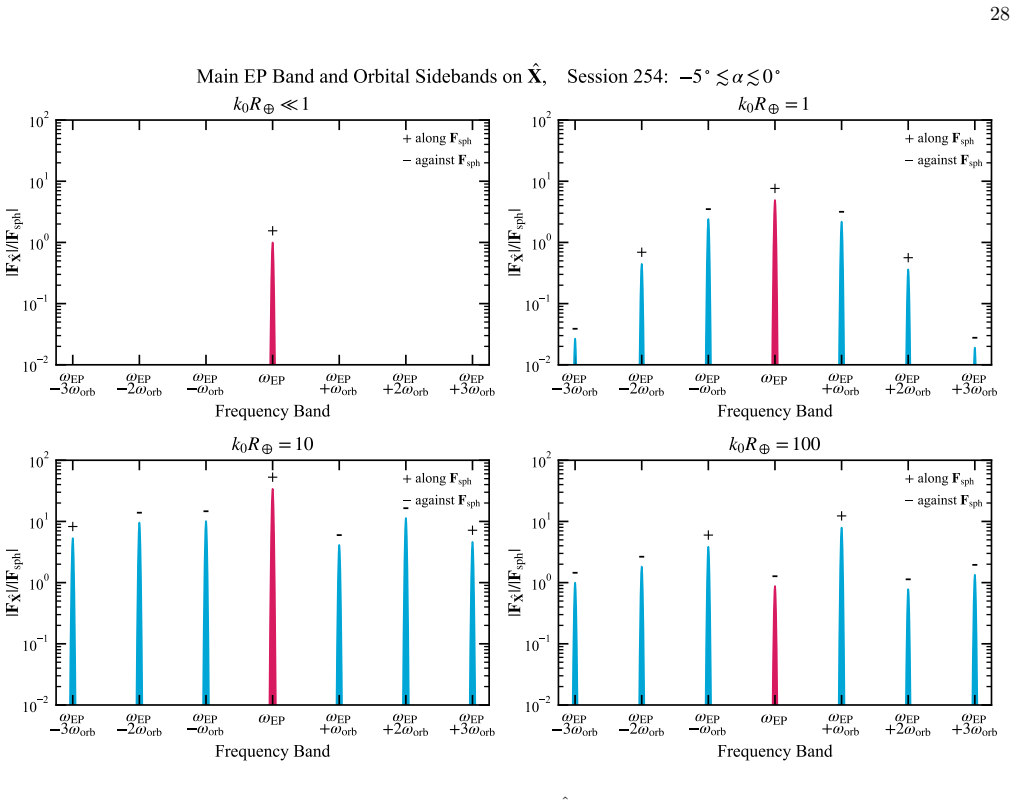
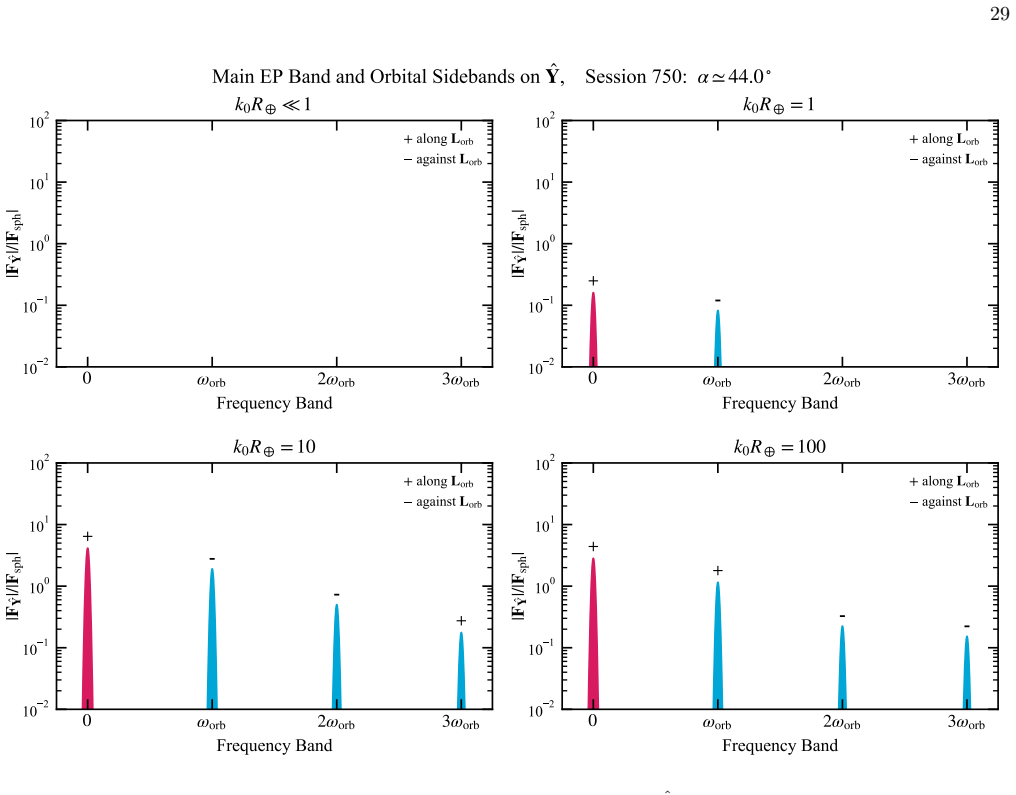
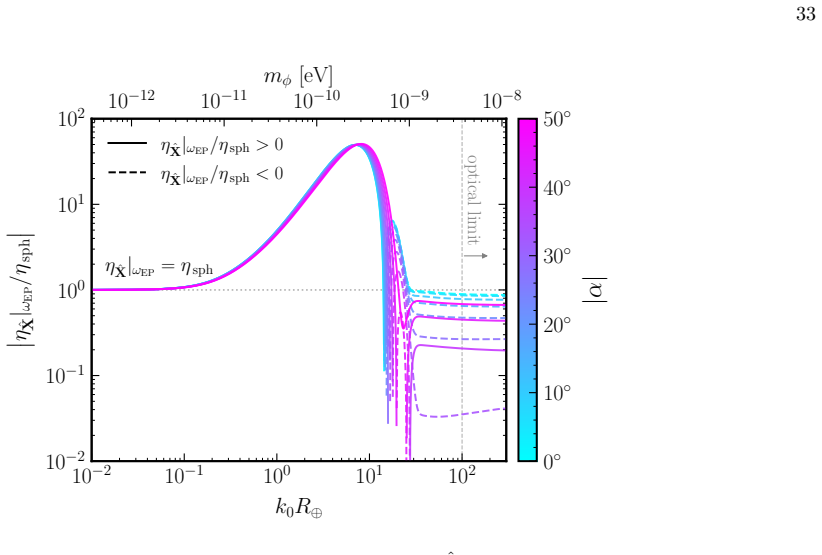
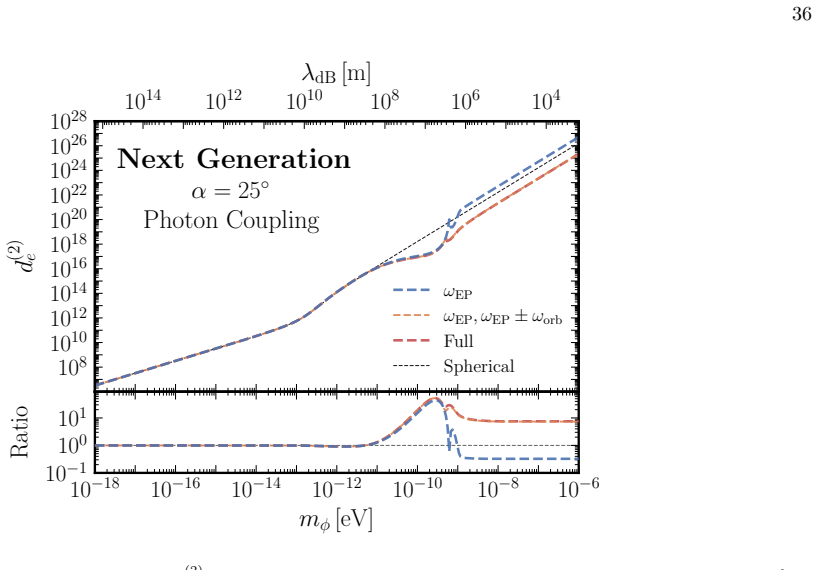
Earth screening splits the force from quadratically coupled ultralight dark matter into multiple sidebands whose relative amplitudes vary annually.
A machine-rendered reading of the paper's core claim, the machinery that carries it, and where it could break.
Core claim
Quadratically coupled ultralight scalar dark matter behaves as a coherent classical field that induces a composition-dependent force through its background. The partial-wave treatment of dark-matter scattering off the Earth determines the force's angular dependence and supplies an analytic description valid for short wavelengths. Earth screening therefore generates a characteristic frequency-band structure that splits the signal into multiple sidebands, with relative amplitudes that vary annually from the Earth's velocity through the halo.
What carries the argument
Partial-wave treatment of dark-matter scattering off the Earth, which fixes the angular dependence of the screened force and produces the sideband frequency structure.
If this is right
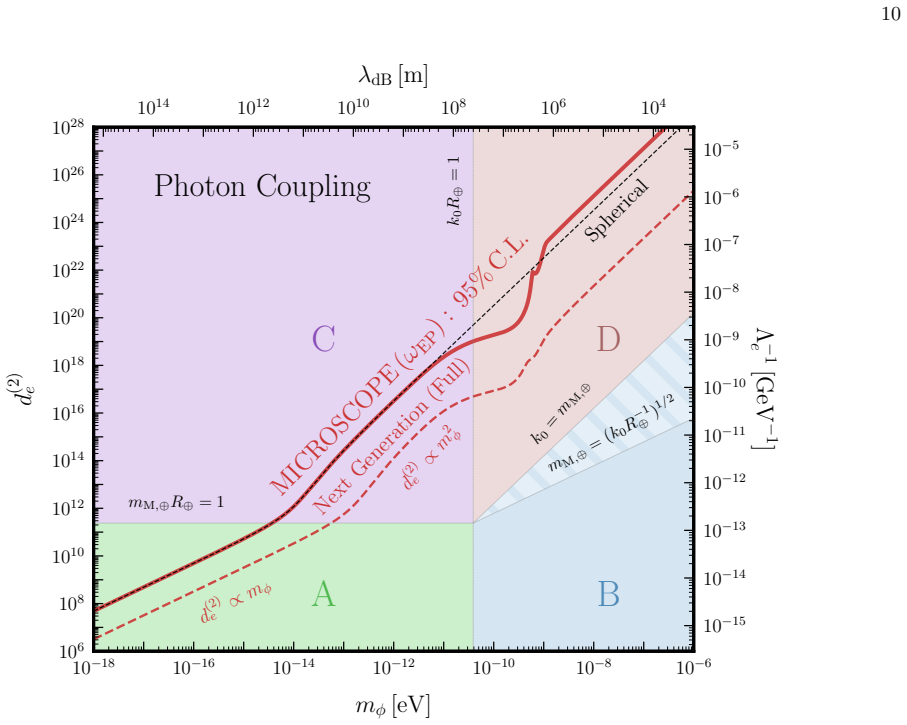
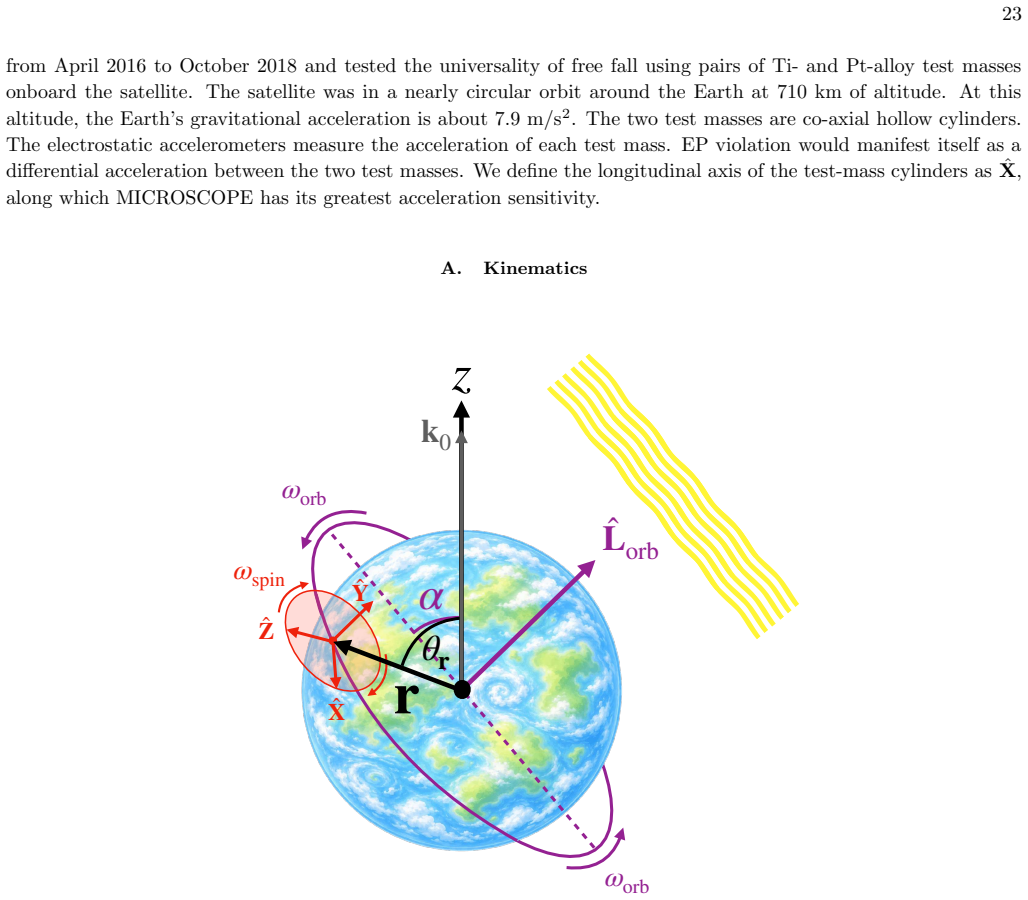
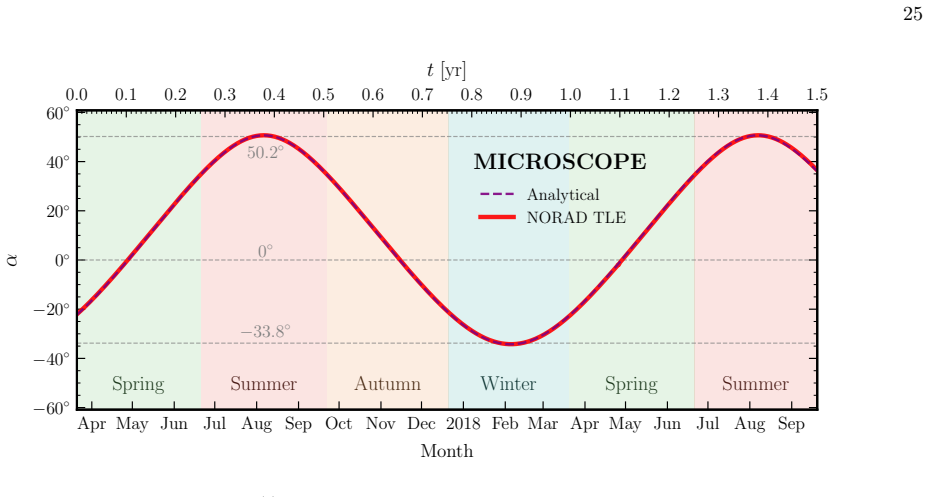
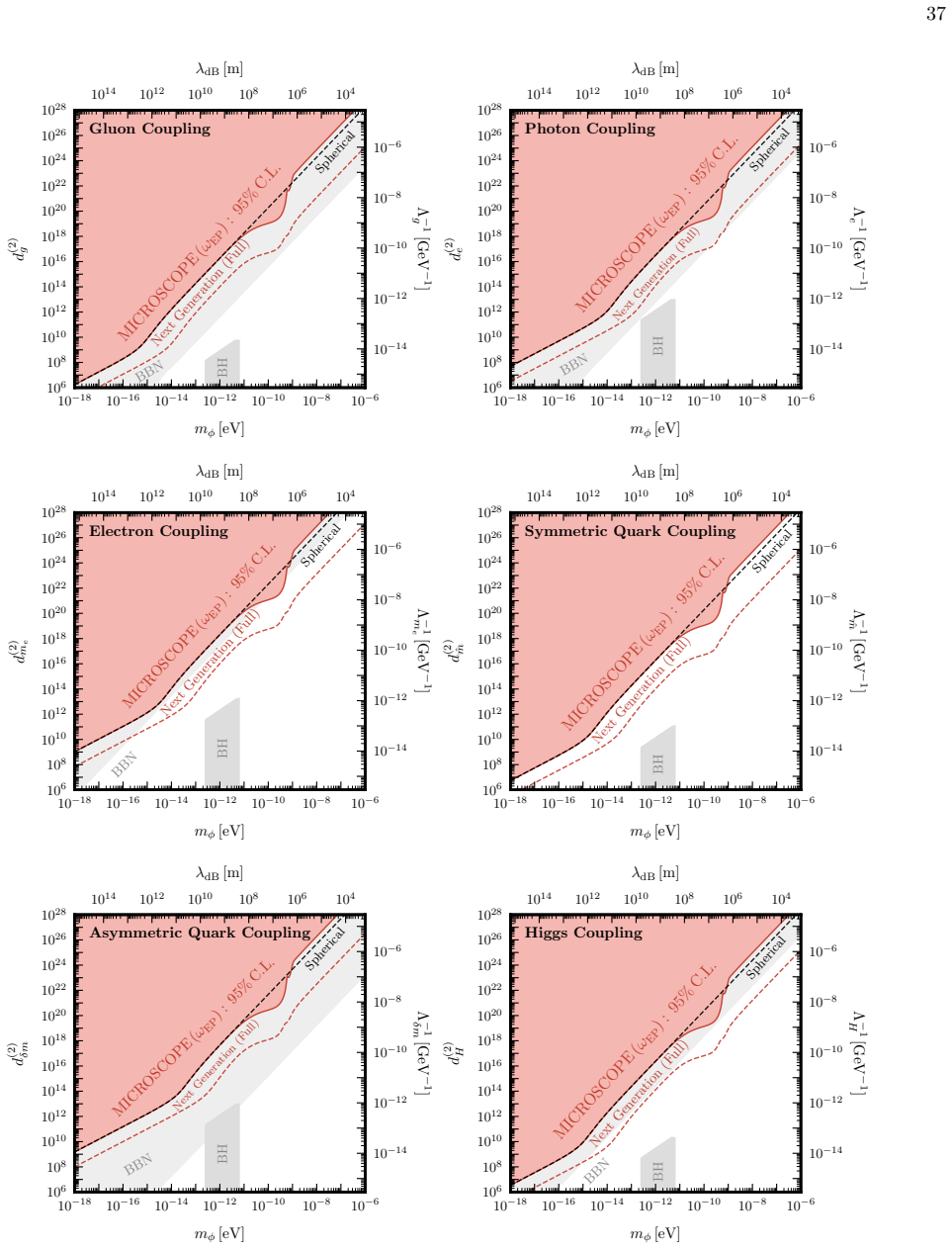
- Re-evaluation of the MICROSCOPE mission limits on equivalence-principle violations from ultralight scalar dark matter.
- Proposed space-based tests such as Galileo Galilei and STE-QUEST can raise their sensitivity by folding the full frequency-band information into the analysis.
- The sideband structure supplies a distinctive experimental signature that distinguishes the dark-matter force from other backgrounds.
- A complete signal template can now be built that incorporates both the sidebands and their annual modulation.
Where Pith is reading between the lines
- The annual modulation of sideband ratios could be used to extract the dark-matter velocity distribution in a single experiment.
- Similar band-structure effects may appear in any screened equivalence-principle test performed on a rotating or orbiting platform.
- Incorporating the sideband template reduces the chance that a real signal is dismissed as noise in broadband searches.
Load-bearing premise
The ultralight scalar can be treated as a coherent classical background whose quadratic coupling to matter yields a composition-dependent force that the scattering calculation captures accurately beyond spherical symmetry.
What would settle it
Presence or absence of the predicted sideband frequency structure together with its annual amplitude variation in data from an equivalence-principle experiment such as MICROSCOPE.
Figures
read the original abstract
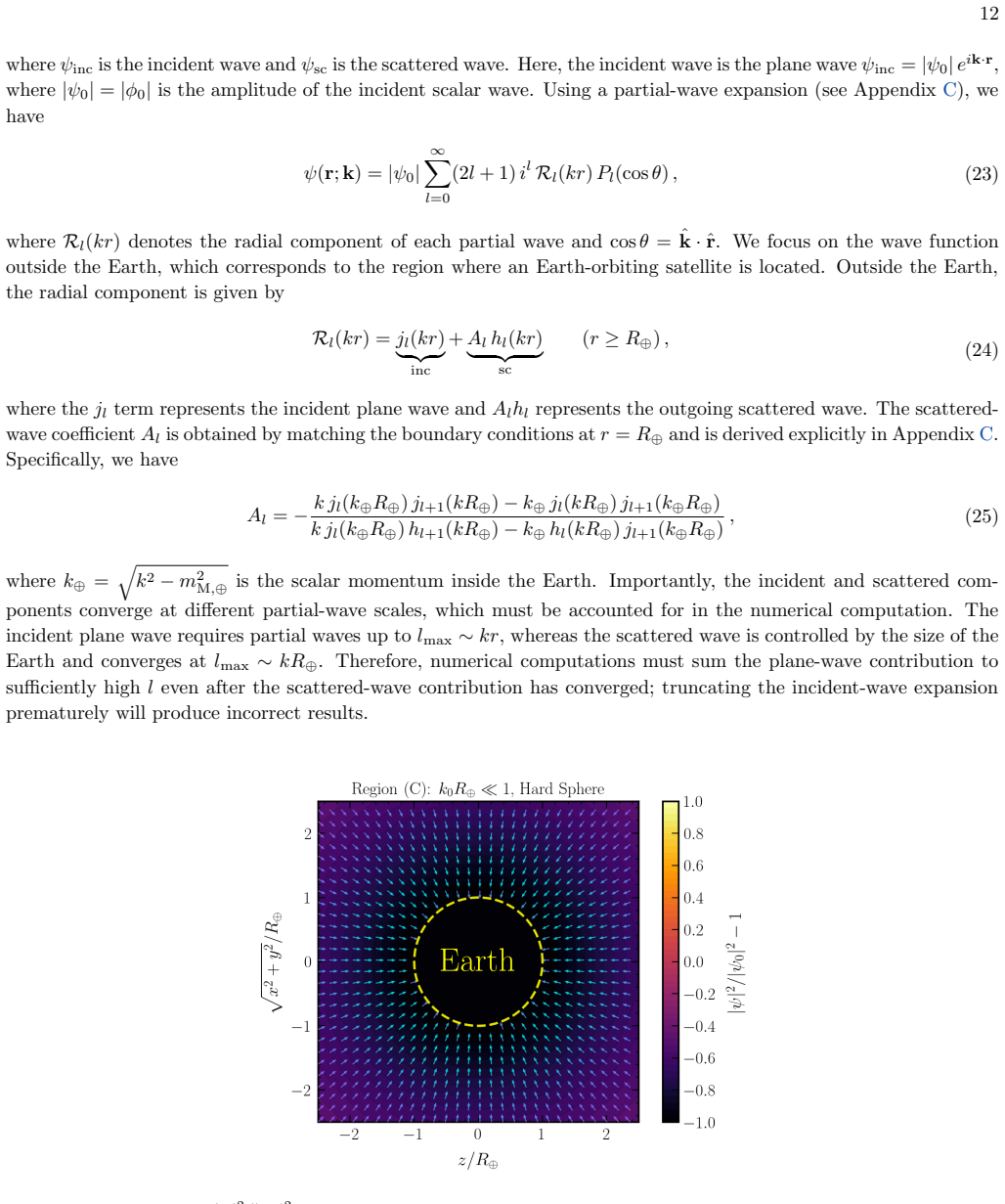
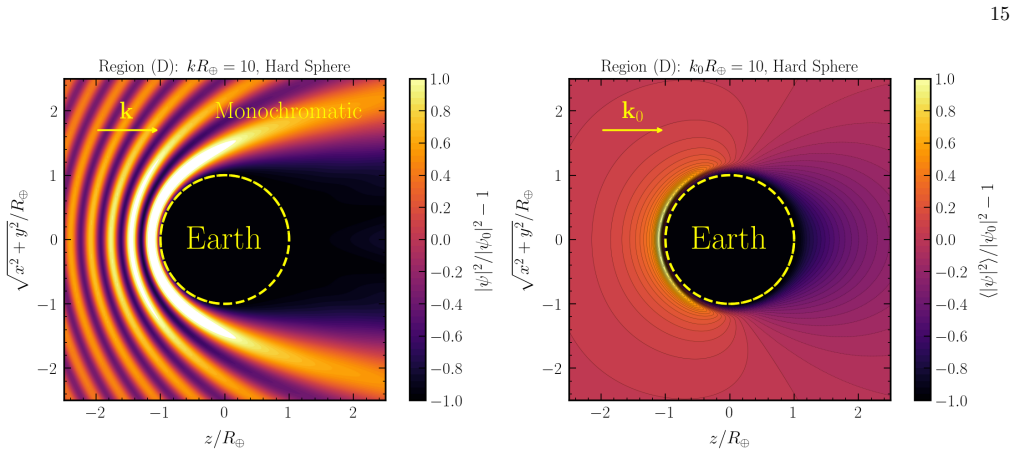
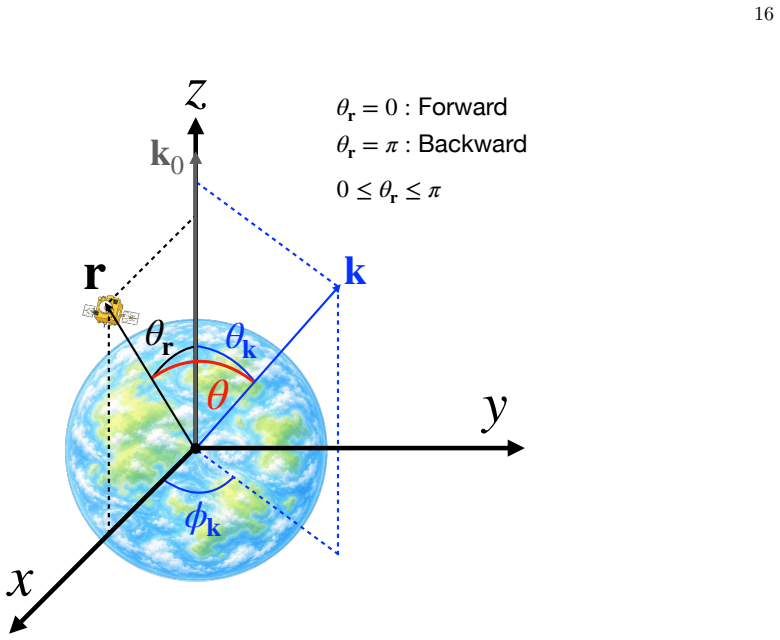
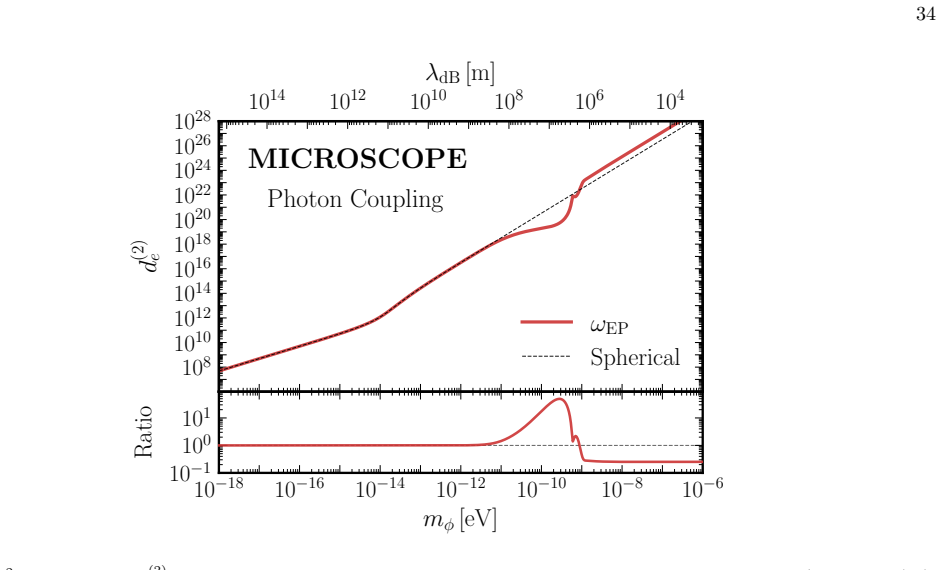
Quadratically coupled ultralight scalar dark matter behaves as a coherent classical field whose interactions with matter can induce a composition-dependent force through the dark matter background. We present a complete calculation of this background-induced force beyond the spherically symmetric approximation. Using a partial-wave treatment of dark-matter scattering, we determine its angular dependence and derive an analytic description valid even when the dark-matter wavelength is much smaller than the Earth's radius. We show for the first time that Earth screening generates a characteristic frequency-band structure, splitting the signal into multiple sidebands that provide a distinctive experimental signature. We further show that the relative amplitudes of these sidebands vary annually due to the Earth's motion through the dark-matter halo, enabling the construction of a complete signal template. As an application of these results, we re-evaluate constraints from the MICROSCOPE mission, which currently provides the strongest laboratory limits on equivalence-principle violations from ultralight dark matter. We further show that proposed space-based equivalence-principle experiments, such as Galileo Galilei and STE-QUEST, can significantly enhance their sensitivity to ultralight scalar dark matter by incorporating the full frequency-band information.
Editorial analysis
A structured set of objections, weighed in public.
Referee Report
Summary. The manuscript presents a partial-wave treatment of scattering for quadratically coupled ultralight scalar dark matter off the Earth, deriving an analytic form for the induced composition-dependent force that remains valid when the DM de Broglie wavelength is much smaller than the Earth's radius. It claims this screening produces a frequency-band structure consisting of multiple sidebands whose relative amplitudes exhibit annual modulation from the Earth's motion through the DM halo, and applies the result to re-evaluate MICROSCOPE bounds while forecasting improved reach for Galileo Galilei and STE-QUEST.
Significance. If the partial-wave derivation and sideband amplitudes hold, the work supplies a distinctive, falsifiable signal template (frequency bands plus annual variation) that strengthens the experimental case for ultralight scalar DM in equivalence-principle tests. The explicit analytic result valid for lambda << R_Earth and the first-principles scattering approach constitute clear technical strengths.
minor comments (3)
- [Abstract] The abstract states an 'analytic description valid even when the dark-matter wavelength is much smaller than the Earth's radius' but does not cite the specific limiting-case checks (e.g., recovery of the spherical result or the long-wavelength limit) that would confirm the partial-wave expansion.
- Notation for the quadratic coupling and the local DM density should be introduced once in the main text with a single symbol set, rather than re-defined in each application section.
- Figure captions for any angular-dependence or sideband plots should explicitly state the values of the free parameters (ultralight scalar mass, quadratic coupling, local density) used in the displayed curves.
Simulated Author's Rebuttal
We thank the referee for their positive summary of our work, recognition of its technical strengths, and recommendation for minor revision. No specific major comments were provided in the report.
Circularity Check
No significant circularity identified
full rationale
The paper presents a first-principles partial-wave scattering calculation of the background-induced force from quadratically coupled ultralight scalar DM, deriving the angular dependence, frequency-band sideband structure from Earth screening, and annual amplitude variation from the Earth's motion through the DM halo. These features follow directly from the stated assumptions of a coherent classical field and composition-dependent force without any reduction to fitted parameters inside the work, self-citation chains bearing the central claim, or renaming of known results. The derivation is self-contained.
Axiom & Free-Parameter Ledger
free parameters (3)
- ultralight scalar mass
- quadratic coupling constant
- local dark-matter density
axioms (3)
- domain assumption Ultralight scalar dark matter behaves as a coherent classical field
- domain assumption Quadratic coupling to matter produces a composition-dependent force
- standard math Partial-wave expansion accurately describes dark-matter scattering off the Earth
Reference graph
Works this paper leans on
-
[1]
vol”, “surf
Atomic Mass In this section, we introduce the composition of atomic mass in terms of the constituent rest masses and the nuclear binding energy. We briefly explain its origin and then discuss how it depends on variations of the fundamental constants given by Eq. (3). To start with, we decompose the atomic massm A as mA = (EA)rm + (EA)bind , (A6) where (E ...
-
[2]
Sincek F is governed bym 2 π through the saturation condition,r 0 inherits the same dependence, and consequentlyE em acquires an implicit dependence onm 2 π
with the degenerate Fermi gas expression nsat =γ N R |k|≤kF d3k (2π)3 , whereγ N = 2×2 accounts for the spin of both proton and neutron. Sincek F is governed bym 2 π through the saturation condition,r 0 inherits the same dependence, and consequentlyE em acquires an implicit dependence onm 2 π
-
[3]
The analytical results for the effective scalar–SM coupling are consistent with Ref
Dilaton Charge: Analytical Expressions In this section, we derive the dilaton charge for the coupling scenarios discussed in this work: the effective scalar–SM coupling, the Higgs portal, the universal coupling, and the light QCD axion. The analytical results for the effective scalar–SM coupling are consistent with Ref. [3], but is expressed in a more com...
-
[4]
E(SEMF) em 0.72 MeV # Z(Z−1) A4/3 , (A21) (QA)me = 5.5×10 −4 h me 0.511 MeV i Z A , (A22) (QA) ˆm= 0.064 h σπN 60 MeV i + 0.045
Nuclear Physics Inputs In the previous section, we derived the analytical expressions for the dilaton charges. We now combine these expressions with inputs from nuclear and hadronic physics to obtain their numerical values. Since the numerical formulas most commonly used in the literature were introduced in Refs. [2, 3] in 2010, it is useful to identify w...
2010
-
[5]
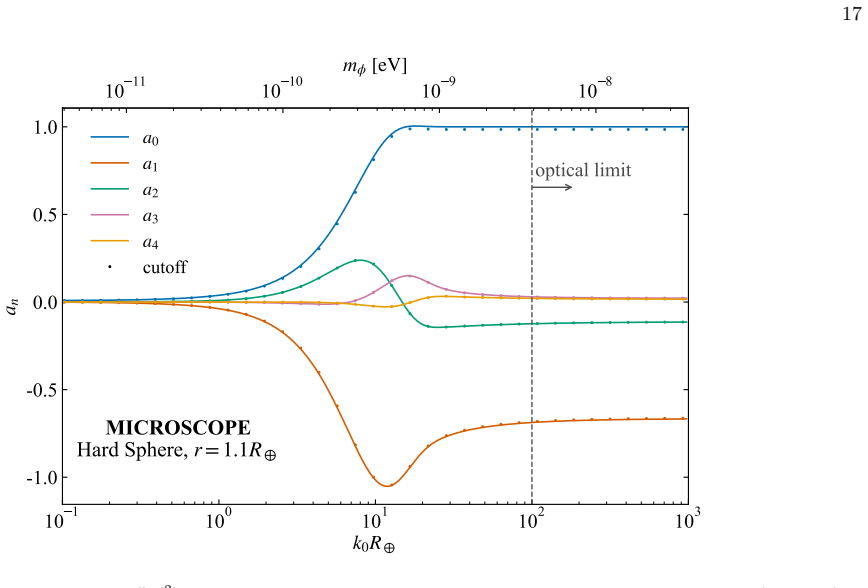
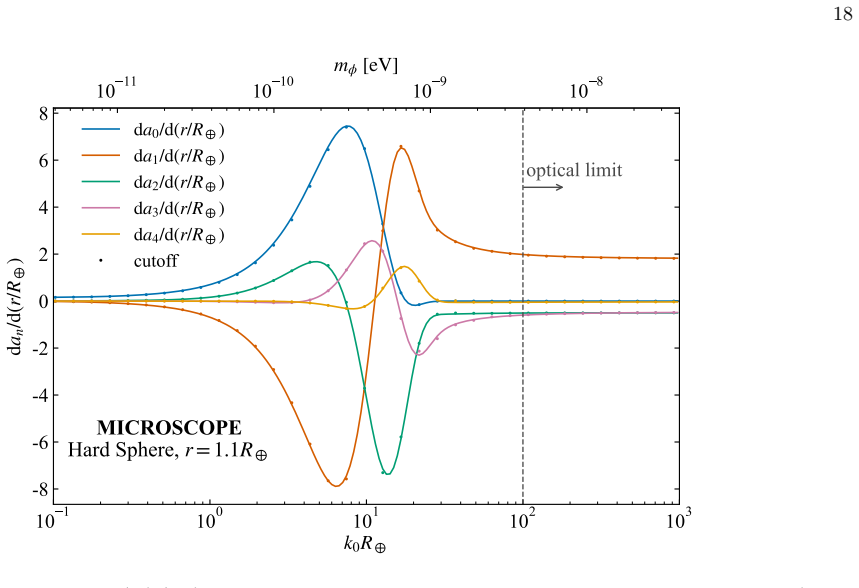
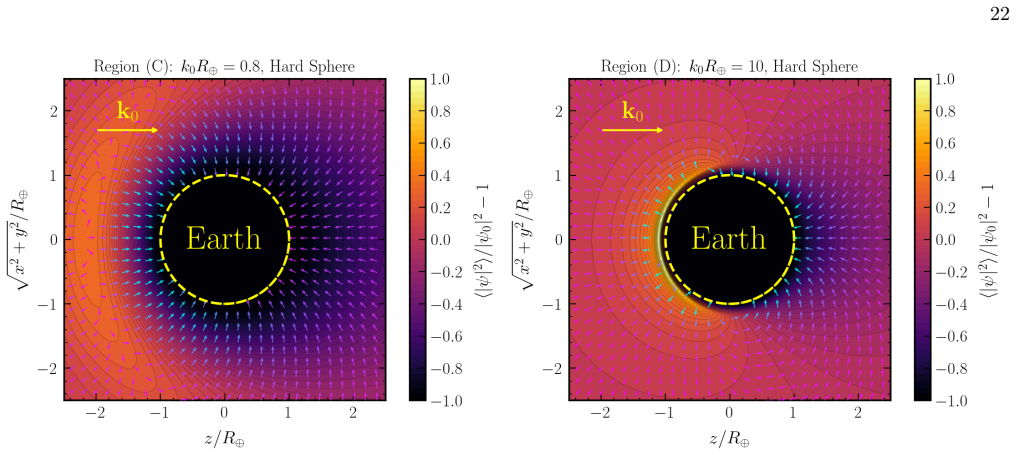
Monochromatic Wave Function A monochromatic incident plane wave with a specified momentumkcan be expanded in spherical coordinates as ψinc(r;k) =|ψ 0|eik·r =|ψ 0| ∞X l=0 (2l+ 1)i l jl(kr)P l(cosθ). (C1) When an incident plane wave scatters off a potential barrier, such as that induced by the Earth, the total wavefunction contains both the incident wave an...
-
[6]
(C4) of the outside field, we calculate the square of the monochromatic field and integrate it with respect to the Standard Halo Model (SHM)
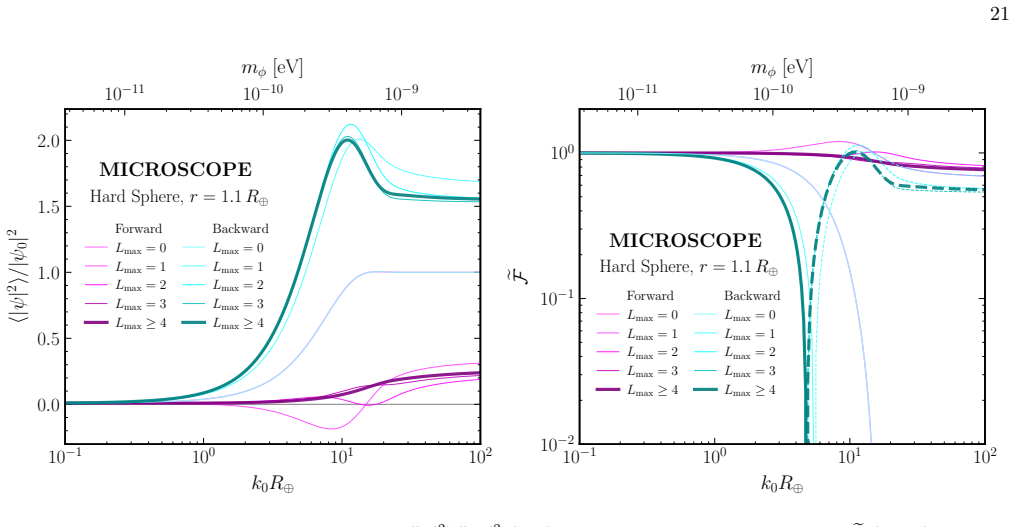
Phase Space Integration With the general expression Eq. (C4) of the outside field, we calculate the square of the monochromatic field and integrate it with respect to the Standard Halo Model (SHM). We begin by simplifying the squared of a monochromatic wavefunction with fixed incident momentumk. Specifically, we have |ψ(r;k)| 2 =|ψ 0|2 ∞X l=0 ∞X l′=0 (2l+...
-
[7]
New Horizons: Scalar and Vector Ultralight Dark Matter,
D. Antypaset al., “New Horizons: Scalar and Vector Ultralight Dark Matter,” (2022), arXiv:2203.14915 [hep-ex]
arXiv 2022
-
[8]
Phenomenology of the Equivalence Principle with Light Scalars,
Thibault Damour and John F. Donoghue, “Phenomenology of the Equivalence Principle with Light Scalars,” Class. Quant. Grav.27, 202001 (2010), arXiv:1007.2790 [gr-qc]
Pith/arXiv arXiv 2010
-
[9]
Equivalence Principle Violations and Couplings of a Light Dilaton,
Thibault Damour and John F. Donoghue, “Equivalence Principle Violations and Couplings of a Light Dilaton,” Phys. Rev. D82, 084033 (2010), arXiv:1007.2792 [gr-qc]
Pith/arXiv arXiv 2010
-
[10]
Can dark matter induce cosmological evolution of the fundamental constants of Nature?
Y. V. Stadnik and V. V. Flambaum, “Can dark matter induce cosmological evolution of the fundamental constants of Nature?” Phys. Rev. Lett.115, 201301 (2015), arXiv:1503.08540 [astro-ph.CO]
Pith/arXiv arXiv 2015
-
[11]
Fundamental constants: from measurement to the universe, a window on gravitation and cosmol- ogy,
Jean-Philippe Uzan, “Fundamental constants: from measurement to the universe, a window on gravitation and cosmol- ogy,” (2024), arXiv:2410.07281 [astro-ph.CO]
arXiv 2024
-
[12]
Searching for dilaton dark matter with atomic clocks,
Asimina Arvanitaki, Junwu Huang, and Ken Van Tilburg, “Searching for dilaton dark matter with atomic clocks,” Phys. Rev. D91, 015015 (2015), arXiv:1405.2925 [hep-ph]
Pith/arXiv arXiv 2015
-
[13]
Search for ultralight scalar dark matter with atomic spectroscopy,
Ken Van Tilburg, Nathan Leefer, Lykourgos Bougas, and Dmitry Budker, “Search for ultralight scalar dark matter with atomic spectroscopy,” Phys. Rev. Lett.115, 011802 (2015), arXiv:1503.06886 [physics.atom-ph]
Pith/arXiv arXiv 2015
-
[14]
A. Hees, J. Gu´ ena, M. Abgrall, S. Bize, and P. Wolf, “Searching for an oscillating massive scalar field as a dark matter candidate using atomic hyperfine frequency comparisons,” Phys. Rev. Lett.117, 061301 (2016), arXiv:1604.08514 [gr-qc]
Pith/arXiv arXiv 2016
-
[15]
New bounds on dark matter coupling from a global network of optical atomic clocks,
P. Wcis loet al., “New bounds on dark matter coupling from a global network of optical atomic clocks,” Sci. Adv.4, eaau4869 (2018), arXiv:1806.04762 [physics.atom-ph]
Pith/arXiv arXiv 2018
-
[16]
Precision metrology meets cosmology: improved constraints on ultralight dark matter from atom-cavity frequency comparisons,
Colin J Kennedy, Eric Oelker, John M Robinson, Tobias Bothwell, Dhruv Kedar, William R Milner, G Edward Marti, Andrei Derevianko, and Jun Ye, “Precision metrology meets cosmology: improved constraints on ultralight dark matter from atom-cavity frequency comparisons,” Physical Review Letters125, 201302 (2020)
2020
-
[17]
M. Filzinger, S. D¨ orscher, R. Lange, J. Klose, M. Steinel, E. Benkler, E. Peik, C. Lisdat, and N. Huntemann, “Improved Limits on the Coupling of Ultralight Bosonic Dark Matter to Photons from Optical Atomic Clock Comparisons,” Phys. Rev. Lett.130, 253001 (2023), arXiv:2301.03433 [physics.atom-ph]
arXiv 2023
-
[18]
Ultralight Dark Matter Search with Space-Time Separated Atomic Clocks and Cavities,
Melina Filzinger, Ashlee R. Caddell, Dhruv Jani, Martin Steinel, Leonardo Giani, Nils Huntemann, and Benjamin M. Roberts, “Ultralight Dark Matter Search with Space-Time Separated Atomic Clocks and Cavities,” Phys. Rev. Lett.134, 031001 (2025), arXiv:2312.13723 [hep-ph]
arXiv 2025
-
[19]
Dark Matter Direct Detection with Accelerometers,
Peter W. Graham, David E. Kaplan, Jeremy Mardon, Surjeet Rajendran, and William A. Terrano, “Dark Matter Direct Detection with Accelerometers,” Phys. Rev. D93, 075029 (2016), arXiv:1512.06165 [hep-ph]
Pith/arXiv arXiv 2016
-
[20]
Violation of the equivalence principle from light scalar dark matter,
Aur´ elien Hees, Olivier Minazzoli, Etienne Savalle, Yevgeny V. Stadnik, and Peter Wolf, “Violation of the equivalence principle from light scalar dark matter,” Phys. Rev. D98, 064051 (2018), arXiv:1807.04512 [gr-qc]
Pith/arXiv arXiv 2018
-
[21]
Wake forces in a background of quadratically coupled mediators,
Ken Van Tilburg, “Wake forces in a background of quadratically coupled mediators,” Phys. Rev. D109, 096036 (2024)
2024
-
[22]
Clare Burrage, Angus Macdonald, and Elisa Todarello, “Using the Pericentre Precession of LAGEOS II to Constrain Quadratically Coupled Ultralight Dark Matter,” (2026), arXiv:2605.28248 [hep-ph]
Pith/arXiv arXiv 2026
-
[23]
AEDGE: Atomic Experiment for Dark Matter and Gravity Exploration in Space,
Yousef Abou El-Neajet al.(AEDGE), “AEDGE: Atomic Experiment for Dark Matter and Gravity Exploration in Space,” EPJ Quant. Technol.7, 6 (2020), arXiv:1908.00802 [gr-qc]
arXiv 2020
-
[24]
AION: An Atom Interferometer Observatory and Network,
L. Badurinaet al., “AION: An Atom Interferometer Observatory and Network,” JCAP05, 011 (2020), arXiv:1911.11755 [astro-ph.CO]
arXiv 2020
-
[25]
Matter-wave Atomic Gradiometer Interferometric Sensor (MAGIS-100),
Mahiro Abeet al.(MAGIS-100), “Matter-wave Atomic Gradiometer Interferometric Sensor (MAGIS-100),” Quantum Sci. Technol.6, 044003 (2021), arXiv:2104.02835 [physics.atom-ph]
arXiv 2021
-
[26]
Ultralight scalar dark matter detection with ZAIGA,
Wei Zhao, Xitong Mei, Dongfeng Gao, Jin Wang, and Mingsheng Zhan, “Ultralight scalar dark matter detection with ZAIGA,” Int. J. Mod. Phys. D31, 2250037 (2022), arXiv:2110.11564 [physics.atom-ph]
arXiv 2022
-
[27]
Parkes Pulsar Timing Array constraints on ultralight scalar-field dark matter,
Nataliya K. Poraykoet al., “Parkes Pulsar Timing Array constraints on ultralight scalar-field dark matter,” Phys. Rev. D98, 102002 (2018), arXiv:1810.03227 [astro-ph.CO]
arXiv 2018
-
[28]
Constraining ultralight vector dark matter with the Parkes Pulsar Timing Array second data release,
Yu-Mei Wu, Zu-Cheng Chen, Qing-Guo Huang, Xingjiang Zhu, N. D. Ramesh Bhat, Yi Feng, George Hobbs, Richard N. Manchester, Christopher J. Russell, and R. M. Shannon (PPTA), “Constraining ultralight vector dark matter with the Parkes Pulsar Timing Array second data release,” Phys. Rev. D106, L081101 (2022), arXiv:2210.03880 [astro-ph.CO]
arXiv 2022
-
[29]
Constraining fundamental constant variations from ultralight dark matter with pulsar timing arrays,
David E. Kaplan, Andrea Mitridate, and Tanner Trickle, “Constraining fundamental constant variations from ultralight dark matter with pulsar timing arrays,” Phys. Rev. D106, 035032 (2022), arXiv:2205.06817 [hep-ph]. 59
arXiv 2022
-
[30]
Probing Quadratically Coupled Ultralight Dark Matter with Pulsar Timing Arrays,
Xucheng Gan, Hyungjin Kim, and Andrea Mitridate, “Probing Quadratically Coupled Ultralight Dark Matter with Pulsar Timing Arrays,” (2025), arXiv:2510.13945 [hep-ph]
Pith/arXiv arXiv 2025
-
[31]
The phenomenology of quadrat- ically coupled ultra light dark matter,
Abhishek Banerjee, Gilad Perez, Marianna Safronova, Inbar Savoray, and Aviv Shalit, “The phenomenology of quadrat- ically coupled ultra light dark matter,” JHEP10, 042 (2023), arXiv:2211.05174 [hep-ph]
arXiv 2023
-
[32]
Torsion-balance tests of the weak equivalence principle,
T. A. Wagner, S. Schlamminger, J. H. Gundlach, and E. G. Adelberger, “Torsion-balance tests of the weak equivalence principle,” Class. Quant. Grav.29, 184002 (2012), arXiv:1207.2442 [gr-qc]
Pith/arXiv arXiv 2012
-
[33]
Joel Berg´ e, Philippe Brax, Gilles M´ etris, Martin Pernot-Borr` as, Pierre Touboul, and Jean-Philippe Uzan, “MICRO- SCOPE Mission: First Constraints on the Violation of the Weak Equivalence Principle by a Light Scalar Dilaton,” Phys. Rev. Lett.120, 141101 (2018), arXiv:1712.00483 [gr-qc]
Pith/arXiv arXiv 2018
-
[34]
Result of the MICROSCOPE weak equivalence principle test,
Pierre Touboulet al., “Result of the MICROSCOPE weak equivalence principle test,” Class. Quant. Grav.39, 204009 (2022), arXiv:2209.15488 [gr-qc]
arXiv 2022
-
[35]
Emergent long-range interactions in Bose-Einstein Condensates,
Lasha Berezhiani and Justin Khoury, “Emergent long-range interactions in Bose-Einstein Condensates,” Phys. Rev. D 99, 076003 (2019), arXiv:1812.09332 [hep-th]
Pith/arXiv arXiv 2019
-
[36]
Detecting ultralight dark matter with matter effect,
Xucheng Gan, Da Liu, Di Liu, Xuheng Luo, and Bingrong Yu, “Detecting ultralight dark matter with matter effect,” JHEP02, 043 (2026), arXiv:2504.11522 [hep-ph]
arXiv 2026
-
[37]
Momentum and Matter Matter for Axion Dark Matter Matters on Earth,
Abhishek Banerjee, Itay M. Bloch, Quentin Bonnefoy, Sebastian A. R. Ellis, Gilad Perez, Inbar Savoray, Konstantin Springmann, and Yevgeny V. Stadnik, “Momentum and Matter Matter for Axion Dark Matter Matters on Earth,” (2025), arXiv:2502.04455 [hep-ph]
arXiv 2025
-
[38]
Enhanced Axion-wind near Earth’s Surface,
Yeray Garcia del Castillo, Benjamin Hammett, and Joerg Jaeckel, “Enhanced Axion-wind near Earth’s Surface,” (2025), arXiv:2502.04456 [hep-ph]
arXiv 2025
-
[39]
Constraints on ultralight scalar dark matter with quadratic couplings,
Thomas Bouley, Philip Sørensen, and Tien-Tien Yu, “Constraints on ultralight scalar dark matter with quadratic couplings,” JHEP03, 104 (2023), arXiv:2211.09826 [hep-ph]
arXiv 2023
-
[40]
Solving the Hierarchy Problem Discretely,
Anson Hook, “Solving the Hierarchy Problem Discretely,” Phys. Rev. Lett.120, 261802 (2018), arXiv:1802.10093 [hep-ph]
Pith/arXiv arXiv 2018
-
[41]
Naturalness without new particles,
Anson Hook, “Naturalness without new particles,” JHEP04, 048 (2021), arXiv:1902.06758 [hep-ph]
Pith/arXiv arXiv 2021
-
[42]
Time-varying fine structure constant from naturally ultralight dark matter,
Dawid Brzeminski, Zackaria Chacko, Abhish Dev, and Anson Hook, “Time-varying fine structure constant from naturally ultralight dark matter,” Phys. Rev. D104, 075019 (2021), arXiv:2012.02787 [hep-ph]
arXiv 2021
-
[43]
Luca Di Luzio, Belen Gavela, Pablo Quilez, and Andreas Ringwald, “An even lighter QCD axion,” JHEP05, 184 (2021), arXiv:2102.00012 [hep-ph]
arXiv 2021
-
[44]
Dark matter from an even lighter QCD axion: trapped misalignment,
Luca Di Luzio, Belen Gavela, Pablo Quilez, and Andreas Ringwald, “Dark matter from an even lighter QCD axion: trapped misalignment,” JCAP10, 001 (2021), arXiv:2102.01082 [hep-ph]
arXiv 2021
-
[45]
Cosmologically varying kinetic mixing,
Xucheng Gan and Di Liu, “Cosmologically varying kinetic mixing,” JHEP11, 031 (2023), arXiv:2302.03056 [hep-ph]
arXiv 2023
-
[46]
Natural Ultralight Dark Matter: The Quadratic Twin,
C´ edric Delaunay, Michael Geller, Zamir Heller-Algazi, Gilad Perez, and Konstantin Springmann, “Natural Ultralight Dark Matter: The Quadratic Twin,” (2025), arXiv:2507.12514 [hep-ph]
arXiv 2025
-
[47]
Ultralight Dark Matter from the Edge of Field Space,
Mathias Becker, Francesco D’Eramo, and Ville Vaskonen, “Ultralight Dark Matter from the Edge of Field Space,” Phys. Rev. Lett.136, 201003 (2026), arXiv:2511.09622 [hep-ph]
Pith/arXiv arXiv 2026
-
[48]
Behavior of current divergences under SU(3) x SU(3),
Murray Gell-Mann, R. J. Oakes, and B. Renner, “Behavior of current divergences under SU(3) x SU(3),” Phys. Rev. 175, 2195–2199 (1968)
1968
-
[49]
Introduction to chiral perturbation theory,
Stefan Scherer, “Introduction to chiral perturbation theory,” Adv. Nucl. Phys.27, 277 (2003), arXiv:hep-ph/0210398
Pith/arXiv arXiv 2003
-
[50]
Sub-eV scalar dark matter through the super-renormalizable Higgs portal,
Federico Piazza and Maxim Pospelov, “Sub-eV scalar dark matter through the super-renormalizable Higgs portal,” Phys. Rev. D82, 043533 (2010), arXiv:1003.2313 [hep-ph]
Pith/arXiv arXiv 2010
-
[51]
Review of particle physics,
S. Navaset al.(Particle Data Group), “Review of particle physics,” Phys. Rev. D110, 030001 (2024)
2024
-
[52]
Mach’s Principle and a Relativistic Theory of Gravitation,
C. Brans and R. H. Dicke, “Mach’s Principle and a Relativistic Theory of Gravitation,” Phys. Rev.124, 925–935 (1961)
1961
-
[53]
Tensor-multi-scalar theories of gravitation,
T. Damour and G. Esposito-Farese, “Tensor-multi-scalar theories of gravitation,” Class. Quant. Grav.9, 2093–2176 (1992)
2093
-
[54]
BBN constraints on universally-coupled ultralight scalar dark matter,
Sergey Sibiryakov, Philip Sørensen, and Tien-Tien Yu, “BBN constraints on universally-coupled ultralight scalar dark matter,” JHEP12, 075 (2020), arXiv:2006.04820 [hep-ph]
arXiv 2020
-
[55]
Role of regularization in quantum corrections to the scalar - tensor theories of gravity,
Yasunori Fujii, “Role of regularization in quantum corrections to the scalar - tensor theories of gravity,” Mod. Phys. Lett. A12, 371–380 (1997), arXiv:gr-qc/9610006
Pith/arXiv arXiv 1997
-
[56]
An Equivalence principle for scalar forces,
Lam Hui and Alberto Nicolis, “An Equivalence principle for scalar forces,” Phys. Rev. Lett.105, 231101 (2010), arXiv:1009.2520 [hep-th]
Pith/arXiv arXiv 2010
-
[57]
Quantum Equivalence Principle Violations in Scalar-Tensor Theories,
Cristian Armendariz-Picon and Riccardo Penco, “Quantum Equivalence Principle Violations in Scalar-Tensor Theories,” Phys. Rev. D85, 044052 (2012), arXiv:1108.6028 [hep-th]
Pith/arXiv arXiv 2012
-
[58]
Scalar-tensor theories, trace anomalies and the QCD-frame,
Francesco Nitti and Federico Piazza, “Scalar-tensor theories, trace anomalies and the QCD-frame,” Phys. Rev. D86, 122002 (2012), arXiv:1202.2105 [hep-th]
Pith/arXiv arXiv 2012
-
[59]
Probing axions with neutron star inspirals and other stellar processes,
Anson Hook and Junwu Huang, “Probing axions with neutron star inspirals and other stellar processes,” JHEP06, 036 60 (2018), arXiv:1708.08464 [hep-ph]
Pith/arXiv arXiv 2018
-
[60]
Effects of theta on the deuteron binding energy and the triple-alpha process,
Lorenzo Ubaldi, “Effects of theta on the deuteron binding energy and the triple-alpha process,” Phys. Rev. D81, 025011 (2010), arXiv:0811.1599 [hep-ph]
Pith/arXiv arXiv 2010
-
[61]
Giovanni Grilli di Cortona, Edward Hardy, Javier Pardo Vega, and Giovanni Villadoro, “The QCD axion, precisely,” JHEP01, 034 (2016), arXiv:1511.02867 [hep-ph]
Pith/arXiv arXiv 2016
-
[62]
Neutron stars with excep- tionally light QCD axions,
Mia Kumamoto, Junwu Huang, Christian Drischler, Masha Baryakhtar, and Sanjay Reddy, “Neutron stars with excep- tionally light QCD axions,” Phys. Rev. D112, 043008 (2025), arXiv:2410.21590 [hep-ph]
arXiv 2025
-
[63]
Jordan Gu´ e, Aur´ elien Hees, and Peter Wolf, “Violation of the equivalence principle induced by oscillating rest mass and transition frequency, and its detection in atom interferometers,” Phys. Rev. D110, 035005 (2024), arXiv:2401.14742 [hep-ph]
arXiv 2024
-
[64]
Axion bounds from quantum technology,
Martin Bauer, Sreemanti Chakraborti, and Guillaume Rostagni, “Axion bounds from quantum technology,” JHEP05, 023 (2025), arXiv:2408.06412 [hep-ph]
arXiv 2025
-
[65]
Search for QCD coupled axion dark matter with the MICROSCOPE space experiment,
Jordan Gu´ e, Peter Wolf, and Aur´ elien Hees, “Search for QCD coupled axion dark matter with the MICROSCOPE space experiment,” (2025), arXiv:2504.00720 [hep-ph]
arXiv 2025
-
[66]
Search for Axionlike Dark Matter through Nuclear Spin Precession in Electric and Magnetic Fields,
C. Abelet al., “Search for Axionlike Dark Matter through Nuclear Spin Precession in Electric and Magnetic Fields,” Phys. Rev. X7, 041034 (2017), arXiv:1708.06367 [hep-ph]
Pith/arXiv arXiv 2017
-
[67]
White dwarfs as a probe of exceptionally light QCD axions,
Reuven Balkin, Javi Serra, Konstantin Springmann, Stefan Stelzl, and Andreas Weiler, “White dwarfs as a probe of exceptionally light QCD axions,” Phys. Rev. D109, 095032 (2024), arXiv:2211.02661 [hep-ph]
arXiv 2024
-
[68]
Constraints on light QCD and CP-violating axions from the death line of rotation-powered pulsars,
Samuel J. Witte, Andrea Caputo, Stefan Stelzl, Alexander Chernoglazov, Alexander A. Philippov, and Surjeet Rajen- dran, “Constraints on light QCD and CP-violating axions from the death line of rotation-powered pulsars,” (2025), arXiv:2512.11023 [hep-ph]
arXiv 2025
-
[69]
Neutrino Oscillations in Matter,
L. Wolfenstein, “Neutrino Oscillations in Matter,” Phys. Rev. D17, 2369–2374 (1978)
1978
-
[70]
Resonance Amplification of Oscillations in Matter and Spectroscopy of Solar Neutrinos,
S. P. Mikheyev and A. Yu. Smirnov, “Resonance Amplification of Oscillations in Matter and Spectroscopy of Solar Neutrinos,” Sov. J. Nucl. Phys.42, 913–917 (1985)
1985
-
[71]
Resonant amplification of neutrino oscillations in matter and solar neutrino spec- troscopy,
S. P. Mikheyev and A. Yu. Smirnov, “Resonant amplification of neutrino oscillations in matter and solar neutrino spec- troscopy,” Nuovo Cim. C9, 17–26 (1986)
1986
-
[72]
Radiative Corrections to Neutrino Indices of Refraction,
F. J. Botella, C. S. Lim, and W. J. Marciano, “Radiative Corrections to Neutrino Indices of Refraction,” Phys. Rev. D 35, 896 (1987)
1987
-
[73]
Neutrino dispersion at finite temperature and density,
Dirk N¨ otzold and Georg Raffelt, “Neutrino dispersion at finite temperature and density,” Nucl. Phys. B307, 924–936 (1988)
1988
-
[74]
Flavour-dependent radiative correction to neutrino-neutrino refraction,
Alessandro Mirizzi, Stefano Pozzorini, Georg G. Raffelt, and Pasquale D. Serpico, “Flavour-dependent radiative correction to neutrino-neutrino refraction,” JHEP10, 020 (2009), arXiv:0907.3674 [hep-ph]
Pith/arXiv arXiv 2009
-
[75]
Mikheyev-Smirnov-Wolfenstein matter potential at the one-loop level in the Standard Model,
Jihong Huang and Shun Zhou, “Mikheyev-Smirnov-Wolfenstein matter potential at the one-loop level in the Standard Model,” Phys. Rev. D108, 093010 (2023), arXiv:2307.04685 [hep-ph]
arXiv 2023
-
[76]
Ein neuer Effekt bei Eintritt der Supraleitf¨ ahigkeit,
W. Meissner and R. Ochsenfeld, “Ein neuer Effekt bei Eintritt der Supraleitf¨ ahigkeit,” Naturwiss.21, 787–788 (1933)
1933
-
[77]
John David Jackson,Classical Electrodynamics(Wiley, 1998)
1998
-
[78]
NEW MACROSCOPIC FORCES?
J. E. Moody and Frank Wilczek, “NEW MACROSCOPIC FORCES?” Phys. Rev. D30, 130 (1984)
1984
-
[79]
The Dispersion Theory of Dispersion Forces,
G. Feinberg, J. Sucher, and C. K. Au, “The Dispersion Theory of Dispersion Forces,” Phys. Rept.180, 83 (1989)
1989
-
[80]
Effects of Bose-Einstein condensation on forces among bodies sitting in a boson heat bath,
F. Ferrer and J. A. Grifols, “Effects of Bose-Einstein condensation on forces among bodies sitting in a boson heat bath,” Phys. Rev. D63, 025020 (2001), arXiv:hep-ph/0001185
Pith/arXiv arXiv 2001
discussion (0)
Sign in with ORCID, Apple, or X to comment. Anyone can read and Pith papers without signing in.