Calabi-Yau Metrics with Full Moduli Dependence
Pith reviewed 2026-06-30 01:12 UTC · model grok-4.3
The pith
Approximate analytic expressions for Ricci-flat Calabi-Yau metrics can be constructed with explicit dependence on complex-structure and Kähler moduli.
A machine-rendered reading of the paper's core claim, the machinery that carries it, and where it could break.
Core claim
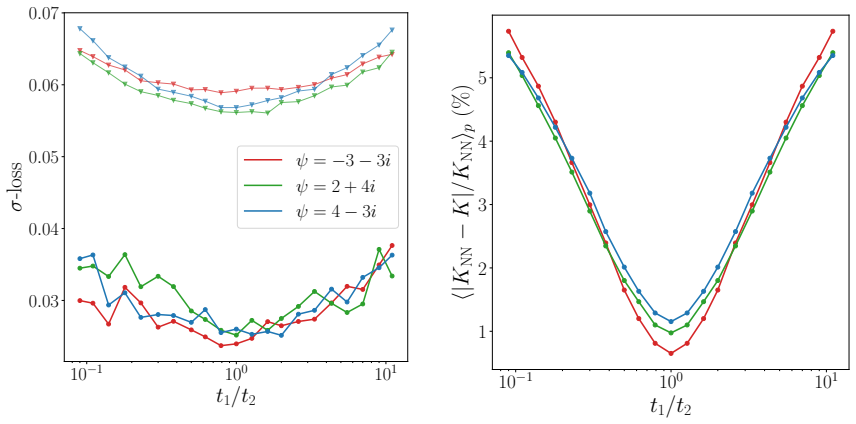
Approximate analytic expressions for Ricci-flat Calabi-Yau metrics with explicit complex-structure and Kähler moduli dependence are constructed by combining machine-learned numerical data with symbolic regression applied to an explicit Ansatz for the Kähler potential with moduli-dependent coefficients. For a one-parameter family of bi-cubic three-folds in P² × P², the resulting metrics achieve percent-level agreement with the underlying numerical data.
What carries the argument
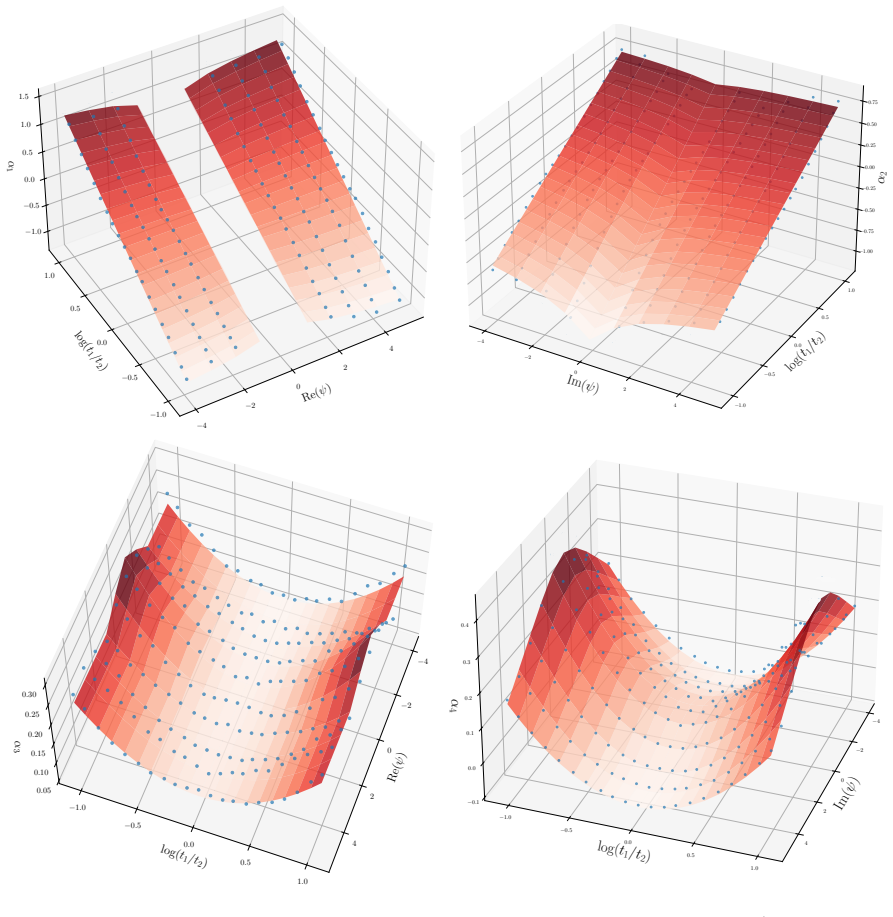
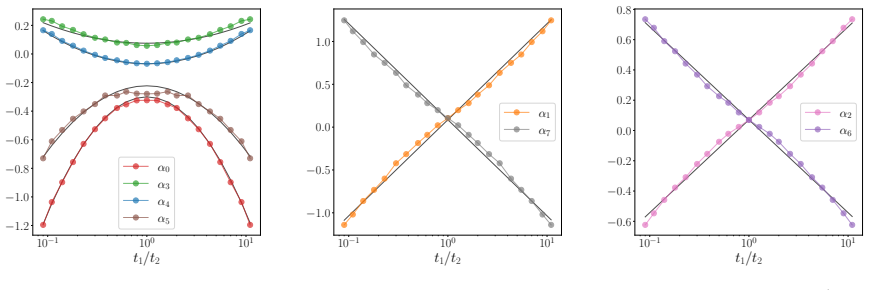
An explicit Ansatz for the Kähler potential whose coefficients are functions of the moduli, fitted to numerical data and then symbolically regressed to analytic form.
If this is right
- The approach yields explicit moduli dependence for both Kähler and complex-structure parameters.
- Percent-level accuracy is achieved for the chosen one-parameter family of bi-cubic three-folds.
- The method combines numerical machine learning with symbolic regression to produce usable analytic approximations.
Where Pith is reading between the lines
- If the Ansatz form generalizes, the method could reduce the need for full numerical recomputation at each moduli point.
- The analytic expressions might allow direct differentiation or integration over moduli space in effective theories.
- Extensions to multi-parameter families could test whether the percent-level accuracy holds more generally.
Load-bearing premise
The specific form of the Ansatz for the Kähler potential with moduli-dependent coefficients is flexible enough to approximate the true metric dependence to percent-level accuracy.
What would settle it
Computing the numerical Ricci-flat metric at an additional moduli value outside the training set and finding that the analytic approximation deviates by significantly more than one percent would falsify the claim of percent-level agreement.
Figures
read the original abstract
Recent advances in numerical and machine-learning methods have enabled highly accurate constructions of Ricci-flat metrics on compact Calabi-Yau three-folds. For phenomenological applications it is crucial to understand how these metrics vary across moduli space. In this work, we construct approximate analytic expressions for Ricci-flat Calabi-Yau metrics with explicit complex-structure and K\"ahler moduli dependence by combining machine-learned numerical data with symbolic regression. Our approach is based on an explicit Ansatz for the K\"ahler potential with moduli-dependent coefficients. Fitting this Ansatz to numerical data and applying symbolic regression allows us to reconstruct analytic formulae for these coefficients, thereby obtaining approximate Ricci-flat metrics with explicit moduli dependence. We apply the construction to a one-parameter family of bi-cubic three-folds in $\mathbb{P}^2 \times \mathbb{P}^2$, achieving percent-level agreement with the underlying numerical data.
Editorial analysis
A structured set of objections, weighed in public.
Referee Report
Summary. The paper claims to construct approximate analytic expressions for Ricci-flat Calabi-Yau metrics with explicit complex-structure and Kähler moduli dependence by combining machine-learned numerical data with symbolic regression. The approach is based on an explicit Ansatz for the Kähler potential with moduli-dependent coefficients. Fitting this Ansatz to numerical data and applying symbolic regression allows reconstruction of analytic formulae for these coefficients. The construction is applied to a one-parameter family of bi-cubic three-folds in P² × P², achieving percent-level agreement with the underlying numerical data.
Significance. If the result holds, this provides a method to obtain analytic approximations to Calabi-Yau metrics that depend explicitly on the moduli, which is important for string phenomenology applications. The combination of numerical methods with symbolic regression to produce closed-form expressions is a strength of the work.
major comments (2)
- [§3] §3, Eq. (8): The explicit Ansatz for the Kähler potential allows coefficients to be moduli-dependent functions, but no a priori geometric argument or completeness check is supplied showing that this functional form is sufficiently flexible to reproduce the true Ricci-flat metric to percent-level accuracy over the full moduli space; the reported agreement is therefore empirical and could be limited by the Ansatz choice.
- [§4.2] §4.2: The symbolic regression step is described, but the manuscript supplies no information on the precise algorithm used, the size and distribution of validation sets, error bars on the fitted expressions, or quantitative tests of accuracy at moduli values away from the training points; this information is required to substantiate the central claim of robust percent-level agreement.
minor comments (2)
- [Abstract] The abstract states 'percent-level agreement' without specifying the precise error measure (e.g., relative L² error on the metric components or on the volume form).
- [Figures] Figure captions should explicitly state the range of moduli values sampled and whether the plotted points are training or validation data.
Simulated Author's Rebuttal
We thank the referee for their careful reading of the manuscript and for the constructive comments. We address each major point below and indicate the corresponding revisions.
read point-by-point responses
-
Referee: §3, Eq. (8): The explicit Ansatz for the Kähler potential allows coefficients to be moduli-dependent functions, but no a priori geometric argument or completeness check is supplied showing that this functional form is sufficiently flexible to reproduce the true Ricci-flat metric to percent-level accuracy over the full moduli space; the reported agreement is therefore empirical and could be limited by the Ansatz choice.
Authors: We agree that the validation remains empirical. The Ansatz in Eq. (8) is chosen to respect the toric structure of the ambient space and the known form of the Kähler potential for hypersurface Calabi-Yau threefolds while allowing explicit moduli dependence. A general completeness theorem lies outside the scope of the work, which instead demonstrates practical utility for this family. In the revised manuscript we have expanded the discussion in §3 to motivate the functional form from the geometry of the bi-cubic and have added further numerical checks at additional moduli values to quantify the Ansatz flexibility. revision: yes
-
Referee: §4.2: The symbolic regression step is described, but the manuscript supplies no information on the precise algorithm used, the size and distribution of validation sets, error bars on the fitted expressions, or quantitative tests of accuracy at moduli values away from the training points; this information is required to substantiate the central claim of robust percent-level agreement.
Authors: We accept that these implementation details were insufficiently documented. The revised §4.2 now specifies the symbolic regression algorithm (genetic programming via the PySR library), the training/validation split (including the distribution of moduli points), error estimates on the resulting analytic expressions, and explicit accuracy tests performed at moduli values withheld from training. These additions directly address the request for quantitative support of the reported agreement. revision: yes
Circularity Check
No significant circularity; derivation anchored to external numerical data
full rationale
The paper's central construction begins with an explicit Ansatz for the Kähler potential whose coefficients are fitted directly to independent machine-learned numerical Ricci-flat metrics on the bi-cubic family; symbolic regression is then applied to those fitted coefficients to produce closed-form expressions. No step in the provided abstract or description reduces the final analytic metric to its inputs by definition, renames a known result, or relies on a self-citation chain for a uniqueness claim. The reported percent-level agreement is the expected outcome of fitting, not a hidden prediction, and the method remains self-contained against the external numerical benchmark.
Axiom & Free-Parameter Ledger
free parameters (1)
- moduli-dependent coefficients in the Kähler-potential ansatz
axioms (1)
- domain assumption The chosen functional form of the Kähler-potential ansatz is adequate to capture the metric's moduli dependence
Reference graph
Works this paper leans on
-
[1]
Physical Yukawa couplings in heterotic string compactifications
Giorgi Butbaia, Dami´ an Mayorga Pe˜ na, Justin Tan, Per Berglund, Tristan H¨ ubsch, Vishnu Jejjala, and Challenger Mishra. “Physical Yukawa couplings in heterotic string compactifications”. In: Adv. Theor. Math. Phys.28.8 (2024), pp. 2783–2822.doi:10.4310/atmp.241119041341. arXiv: 2401.15078 [hep-th]
-
[2]
Computation of quark masses from string theory
Andrei Constantin, Cristofero S. Fraser-Taliente, Thomas R. Harvey, Andre Lukas, and Burt Ovrut. “Computation of quark masses from string theory”. In:Nucl. Phys. B1010 (2025), p. 116778.doi:10.1016/j.nuclphysb.2024.116778. arXiv:2402.01615 [hep-th]
-
[3]
Precision string phenomenology
Per Berglund, Giorgi Butbaia, Tristan H¨ ubsch, Vishnu Jejjala, Dami´ an Mayorga Pe˜ na, Chal- lenger Mishra, and Justin Tan. “Precision string phenomenology”. In:Phys. Rev. D111.8 (2025), p. 086007.doi:10.1103/PhysRevD.111.086007. arXiv:2407.13836 [hep-th]
-
[4]
Some numerical results in complex differential geometry
S. K. Donaldson. “Some numerical results in complex differential geometry”. In:Pure Appl. Math. Q.(2009), pp. 571–618.doi:10.4310/PAMQ.2009.v5.n2.a2
-
[5]
Michael R. Douglas, Robert L. Karp, Sergio Lukic, and Rene Reinbacher. “Numerical Calabi- Yau metrics”. In:J. Math. Phys.49 (2008), p. 032302.doi:10.1063/1.2888403. arXiv:hep- th/0612075
-
[6]
Calabi-Yau Metrics for Quotients and Complete Intersections
Volker Braun, Tamaz Brelidze, Michael R. Douglas, and Burt A. Ovrut. “Calabi-Yau Metrics for Quotients and Complete Intersections”. In:JHEP05 (2008), p. 080.doi:10.1088/1126- 6708/2008/05/080. arXiv:0712.3563 [hep-th]. 12
work page internal anchor Pith review Pith/arXiv arXiv doi:10.1088/1126- 2008
-
[7]
Eigenvalues and Eigenfunctions of the Scalar Laplace Operator on Calabi-Yau Manifolds
Volker Braun, Tamaz Brelidze, Michael R. Douglas, and Burt A. Ovrut. “Eigenvalues and Eigen- functions of the Scalar Laplace Operator on Calabi-Yau Manifolds”. In:JHEP07 (2008), p. 120. doi:10.1088/1126-6708/2008/07/120. arXiv:0805.3689 [hep-th]
work page internal anchor Pith review Pith/arXiv arXiv doi:10.1088/1126-6708/2008/07/120 2008
-
[8]
Energy functionals for Calabi-Yau metrics
Matthew Headrick and Ali Nassar. “Energy functionals for Calabi-Yau metrics”. In:Adv. Theor. Math. Phys.17.5 (2013), pp. 867–902.doi:10.4310/ATMP.2013.v17.n5.a1. arXiv:0908.2635 [hep-th]
work page internal anchor Pith review Pith/arXiv arXiv doi:10.4310/atmp.2013.v17.n5.a1 2013
-
[9]
Numerical Metrics, Curvature Expansions and Calabi-Yau Manifolds
Wei Cui and James Gray. “Numerical Metrics, Curvature Expansions and Calabi-Yau Manifolds”. In:JHEP05 (2020), p. 044.doi:10.1007/JHEP05(2020)044. arXiv:1912.11068 [hep-th]
-
[10]
Machine Learning Calabi–Yau Metrics
Anthony Ashmore, Yang-Hui He, and Burt A. Ovrut. “Machine Learning Calabi–Yau Metrics”. In:Fortsch. Phys.68.9 (2020), p. 2000068.doi:10.1002/prop.202000068. arXiv:1910.08605 [hep-th]
-
[11]
Moduli-dependent Calabi-Yau and SU(3)-structure metrics from Machine Learning
Lara B. Anderson, Mathis Gerdes, James Gray, Sven Krippendorf, Nikhil Raghuram, and Fabian Ruehle. “Moduli-dependent Calabi-Yau and SU(3)-structure metrics from Machine Learning”. In: JHEP05 (2021), p. 013.doi:10.1007/JHEP05(2021)013. arXiv:2012.04656 [hep-th]
-
[12]
Neural network approxi- mations for Calabi-Yau metrics
Vishnu Jejjala, Damian Kaloni Mayorga Pena, and Challenger Mishra. “Neural network approxi- mations for Calabi-Yau metrics”. In:JHEP08 (2022), p. 105.doi:10.1007/JHEP08(2022)105. arXiv:2012.15821 [hep-th]
-
[13]
Calabi-Yau Metrics, En- ergy Functionals and Machine-Learning
Anthony Ashmore, Lucille Calmon, Yang-Hui He, and Burt A. Ovrut. “Calabi-Yau Metrics, En- ergy Functionals and Machine-Learning”. In:International Journal of Data Science in the Math- ematical Sciences1.1 (2023), pp. 49–61.doi:10.1142/S2810939222500034. arXiv:2112.10872 [hep-th]
-
[14]
Learning Size and Shape of Calabi-Yau Spaces
Magdalena Larfors, Andre Lukas, Fabian Ruehle, and Robin Schneider. “Learning Size and Shape of Calabi-Yau Spaces”. In: (Nov. 2021). arXiv:2111.01436 [hep-th]
arXiv 2021
-
[15]
Numerical metrics for complete intersection and Kreuzer–Skarke Calabi–Yau manifolds
Magdalena Larfors, Andre Lukas, Fabian Ruehle, and Robin Schneider. “Numerical metrics for complete intersection and Kreuzer–Skarke Calabi–Yau manifolds”. In:Mach. Learn. Sci. Tech. 3.3 (2022), p. 035014.doi:10.1088/2632-2153/ac8e4e. arXiv:2205.13408 [hep-th]
-
[16]
CYJAX: A package for Calabi-Yau metrics with JAX
Mathis Gerdes and Sven Krippendorf. “CYJAX: A package for Calabi-Yau metrics with JAX”. In:Mach. Learn. Sci. Tech.4.2 (2023), p. 025031.doi:10 . 1088 / 2632 - 2153 / acdc84. arXiv: 2211.12520 [hep-th]
arXiv 2023
-
[17]
K3 metrics from little string theory
Shamit Kachru, Arnav Tripathy, and Max Zimet. “K3 metrics from little string theory”. In: (Oct. 2018). arXiv:1810.10540 [hep-th]
arXiv 2018
-
[18]
K3 metrics
Shamit Kachru, Arnav Tripathy, and Max Zimet. “K3 metrics”. In: (June 2020). arXiv:2006. 02435 [hep-th]
2020
-
[19]
Approximate Ricci-flat Metrics for Calabi-Yau Manifolds
Seung-Joo Lee and Andre Lukas. “Approximate Ricci-flat Metrics for Calabi-Yau Manifolds”. In: (June 2025). arXiv:2506.15766 [hep-th]. 13
arXiv 2025
-
[20]
Calabi–Yau Metrics with K¨ ahler Moduli Dependence
Andrei Constantin, Andre Lukas, and Luca A. Nutricati. “Calabi–Yau Metrics with K¨ ahler Moduli Dependence”. In:arXiv:2603.12384(Mar. 2026). arXiv:2603.12384 [hep-th]
Pith/arXiv arXiv 2026
-
[21]
Joyce.Compact Manifolds with Special Holonomy
D.D. Joyce.Compact Manifolds with Special Holonomy. Oxford mathematical monographs. Oxford University Press, 2000.isbn: 9780198506010
2000
-
[22]
Miles Cranmer.Interpretable Machine Learning for Science with PySR and SymbolicRegression.jl
-
[23]
arXiv:2305.01582 [astro-ph.IM].url:https://arxiv.org/abs/2305.01582
-
[24]
Symbolic approximations to Ricci-flat metrics via extrin- sic symmetries of Calabi–Yau hypersurfaces
Viktor Mirjani´ c and Challenger Mishra. “Symbolic approximations to Ricci-flat metrics via extrin- sic symmetries of Calabi–Yau hypersurfaces”. In:Mach. Learn. Sci. Tech.6.3 (2025), p. 035029. doi:10.1088/2632-2153/adf68c. arXiv:2412.19778 [hep-th]. 14
discussion (0)
Sign in with ORCID, Apple, or X to comment. Anyone can read and Pith papers without signing in.