Magnetic symmetry implications of the zero- and applied-field Hall effect of UNi₄B
Pith reviewed 2026-06-30 00:23 UTC · model grok-4.3
The pith
Finite zero-field Hall resistivity in two orientations of UNi4B rules out prior magnetic space groups and requires Cm' or Pm' symmetry.
A machine-rendered reading of the paper's core claim, the machinery that carries it, and where it could break.
Core claim
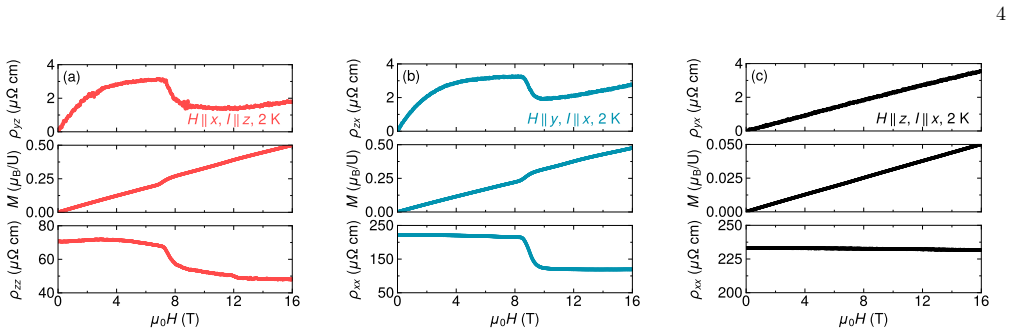
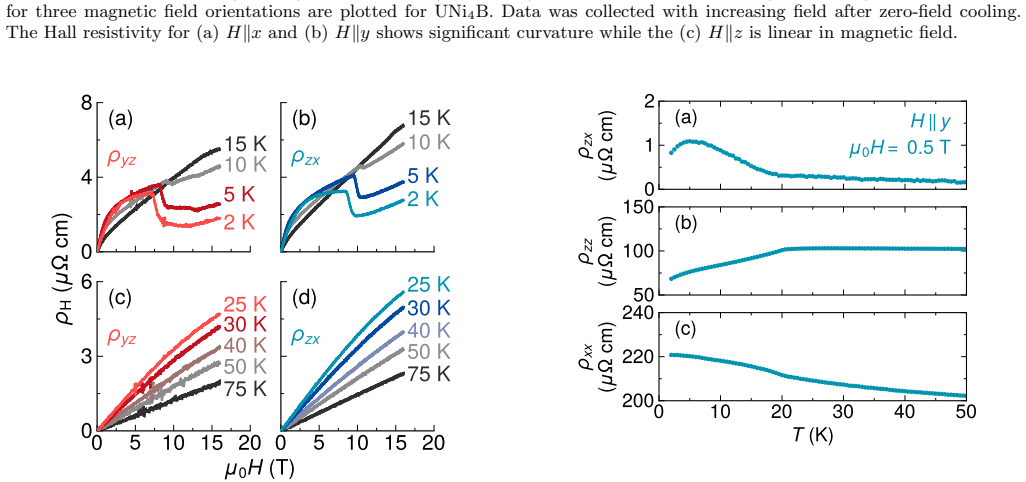
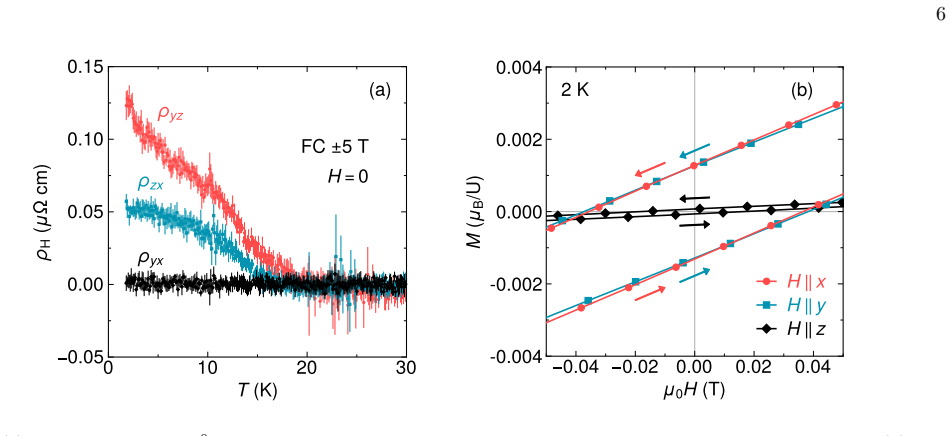
The zero-field Hall resistivity of UNi4B is finite for H parallel to x (I parallel to z) and H parallel to y (I parallel to x), appearing at the onset of antiferromagnetic order, while the out-of-plane channel remains linear. This pattern, together with the curved field dependence up to 8 T, cannot be reconciled with the magnetic space groups previously inferred from neutron data. The only magnetic symmetries consistent with all three data sets (Hall resistivity, neutron diffraction, and magnetoelectric effect) are Cm' or Pm'.
What carries the argument
Magnetic space-group symmetry that dictates which components of the Berry curvature and magnetoelectric tensor are allowed by the arrangement of uranium moments.
If this is right
- The zero-field magnetic structure of UNi4B must belong to Cm' or Pm' symmetry.
- An intrinsic, momentum-space Berry curvature term contributes measurably to the transverse resistivity when the field lies in the uranium-moment plane.
- The same symmetry also accounts for the observed magnetoelectric response.
- The Hall signal vanishes above TN, confirming that the effect is tied to the onset of long-range magnetic order.
Where Pith is reading between the lines
- If Cm' or Pm' symmetry is confirmed, the material offers a platform in which both the anomalous Hall effect and the magnetoelectric effect are controlled by the same magnetic point-group elements.
- Analogous symmetry filtering could be applied to other noncollinear antiferromagnets whose Hall data appear at odds with their reported magnetic structures.
Load-bearing premise
The curved field dependence of the Hall resistivity is produced mainly by intrinsic Berry curvature rather than by extrinsic scattering mechanisms.
What would settle it
A neutron diffraction refinement that finds a magnetic space group other than Cm' or Pm' yet still permits a finite zero-field Hall resistivity in the yz and zx channels would falsify the claim.
Figures
read the original abstract
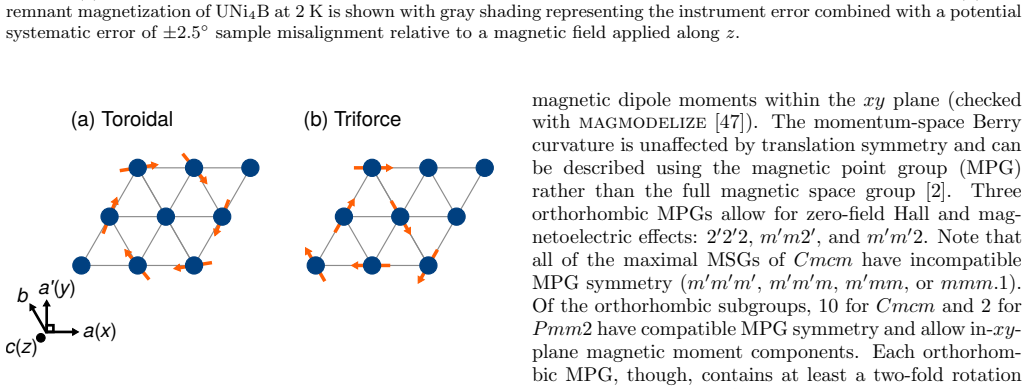
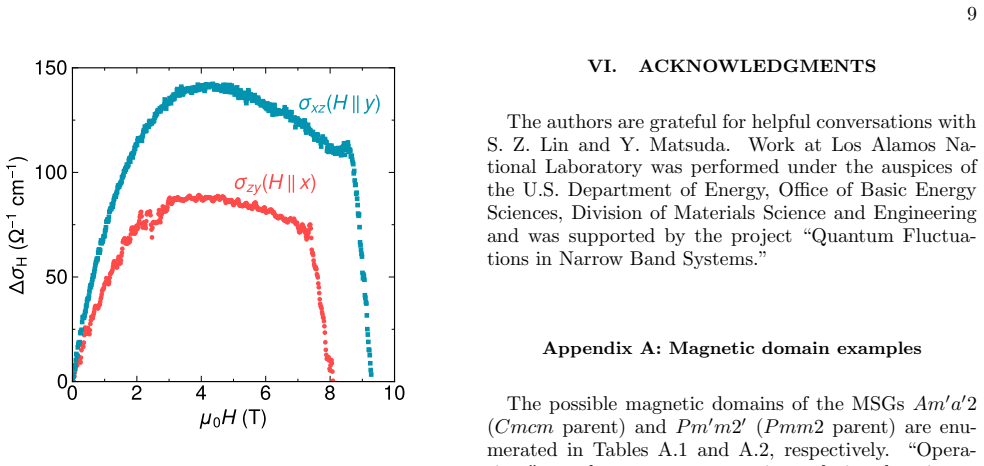
The zero-field and applied-field Hall effects in noncollinear antiferromagnets provide evidence for topological states of matter and are tied to materials' magnetic symmetry. For UNi$_4$B, the antiferromagnetic state with $T_\mathrm{N}=20$ K at zero and low magnetic field is debated due to recent magnetoelectric measurements and theory work calling into question the proposed toroidal arrangement of magnetic dipole moments. For a magnetic field applied within the plane of uranium magnetic moments, the field-dependent Hall resistivity of UNi$_4$B shows a curved response for $\rho_{yz}$ ($H{\parallel}x$, $I{\parallel}z$) and $\rho_{zx}$ ($H{\parallel}y$, $I{\parallel}x$) up to $\sim$8 T at 2 K, while an out-of-plane field results in linear behavior of $\rho_{yx}$ ($H{\parallel}z$, $I{\parallel}x$) up to 16 T. Analysis using conventional empirical relationships for the Hall effect indicate that an intrinsic effect from momentum-space Berry curvature contributes significantly to the curved transverse resistivity. Moreover, a finite zero-field Hall effect emerges at the onset of magnetic order for $\rho_{yz}$ and $\rho_{zx}$, further supporting an intrinsic origin of the Hall response. Symmetry arguments for a finite Berry curvature, an observable magnetoelectric effect, and reported magnetic structures suggest that the previously proposed magnetic space groups for the zero-field magnetic structure cannot account for the observed finite zero-field effect for two Hall orientations. Instead, we propose that $Cm'$ or $Pm'$ magnetic symmetry, depending on the parent nonmagnetic space group, is consistent with Hall resistivity, neutron diffraction, and magnetoelectric effect measurements.
Editorial analysis
A structured set of objections, weighed in public.
Referee Report
Summary. The manuscript reports zero- and finite-field Hall resistivity measurements on the noncollinear antiferromagnet UNi₄B. It finds curved field dependence in ρ_yz (H∥x) and ρ_zx (H∥y) up to ~8 T, linear behavior in ρ_yx (H∥z), and a finite zero-field Hall signal in the first two geometries that onsets at T_N=20 K. Conventional empirical decomposition attributes the curvature to intrinsic Berry curvature. Symmetry analysis of the observed Hall tensor components, combined with neutron diffraction and magnetoelectric data, rules out previously proposed magnetic space groups and instead identifies Cm' or Pm' (depending on parent space group) as compatible.
Significance. If the symmetry mapping holds, the work resolves a debate on the zero-field magnetic structure of UNi₄B by showing that only the proposed groups simultaneously allow finite zero-field antisymmetric conductivity for the measured in-plane geometries while remaining consistent with neutron propagation vector, moment directions, and magnetoelectric response. The combination of transport, diffraction, and ME data provides a concrete experimental constraint on magnetic symmetry in a candidate topological antiferromagnet.
major comments (2)
- [Symmetry analysis] Symmetry analysis section: the central claim that previously proposed magnetic space groups are incompatible with finite zero-field ρ_yz and ρ_zx requires an explicit enumeration of all magnetic subgroups consistent with the reported propagation vector, moment directions, and parent space group, together with the allowed components of the conductivity tensor at H=0. Without this tabulation the incompatibility conclusion cannot be verified.
- [Hall resistivity measurements] Hall data analysis (around the discussion of curved ρ_yz and ρ_zx): attribution of the nonlinear field dependence to intrinsic Berry curvature rests on standard empirical decomposition into ordinary, anomalous, and topological terms; the manuscript does not provide an independent check (e.g., temperature scaling, comparison to band-structure Berry curvature, or exclusion of extrinsic mechanisms) that would confirm this decomposition is valid for UNi₄B.
minor comments (2)
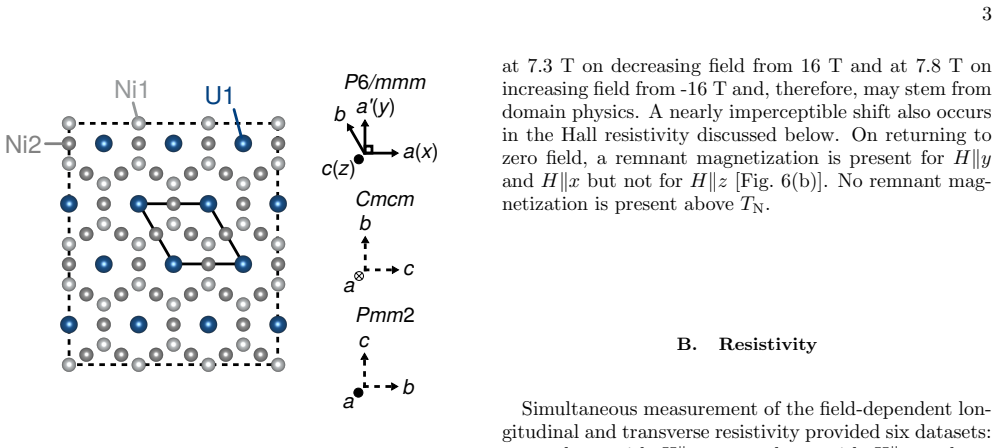
- [Figures] Figure captions and axis labels: the three Hall geometries (ρ_yz, ρ_zx, ρ_yx) would benefit from an explicit crystal-axis schematic showing current and field directions relative to the uranium moment plane.
- [Discussion] The abstract states that Cm' or Pm' are consistent with all three data sets; the main text should state which parent nonmagnetic space group leads to each magnetic group.
Simulated Author's Rebuttal
We thank the referee for their careful reading of the manuscript and for the constructive comments, which help clarify the presentation of our symmetry analysis and Hall data interpretation. We address each major comment below and indicate the revisions we will make.
read point-by-point responses
-
Referee: Symmetry analysis section: the central claim that previously proposed magnetic space groups are incompatible with finite zero-field ρ_yz and ρ_zx requires an explicit enumeration of all magnetic subgroups consistent with the reported propagation vector, moment directions, and parent space group, together with the allowed components of the conductivity tensor at H=0. Without this tabulation the incompatibility conclusion cannot be verified.
Authors: We agree that an explicit enumeration would make the symmetry conclusions more transparent and verifiable. The manuscript's symmetry arguments are based on the observed finite zero-field Hall components in two in-plane geometries, combined with the known propagation vector, moment directions from neutron diffraction, and magnetoelectric response. In the revised version we will add a table that lists all magnetic subgroups consistent with the parent space group and propagation vector, their allowed antisymmetric conductivity tensor elements at H=0, and a direct comparison showing which groups permit the measured ρ_yz and ρ_zx while remaining compatible with the other experimental constraints. This tabulation will explicitly demonstrate the incompatibility of previously proposed groups and the compatibility of Cm' or Pm'. revision: yes
-
Referee: Hall data analysis (around the discussion of curved ρ_yz and ρ_zx): attribution of the nonlinear field dependence to intrinsic Berry curvature rests on standard empirical decomposition into ordinary, anomalous, and topological terms; the manuscript does not provide an independent check (e.g., temperature scaling, comparison to band-structure Berry curvature, or exclusion of extrinsic mechanisms) that would confirm this decomposition is valid for UNi₄B.
Authors: The curved field dependence is analyzed using the standard empirical decomposition into ordinary, anomalous, and topological (Berry curvature) contributions, which is the conventional approach in the field. The additional observation that a finite zero-field Hall signal onsets exactly at T_N=20 K provides supporting evidence for an intrinsic magnetic origin tied to the antiferromagnetic order. We acknowledge that independent verification such as explicit temperature scaling of the nonlinear term or direct comparison to calculated Berry curvature would further strengthen the claim. In the revision we will expand the discussion to include the temperature dependence of the Hall resistivity components and explicitly note the empirical nature of the decomposition while highlighting the zero-field onset as corroborating evidence. revision: partial
Circularity Check
No circularity; symmetry selection based on independent experimental constraints and standard tables
full rationale
The paper's central argument enumerates magnetic space groups compatible with neutron diffraction propagation vectors and moment directions, then checks which of those groups permit the observed zero-field Hall tensor components (finite ρ_yz and ρ_zx but not necessarily ρ_yx) together with the reported magnetoelectric response. This selection uses tabulated symmetry properties of the conductivity tensor and magnetoelectric tensor; it does not fit parameters to the Hall data and then re-label the fit as a prediction, nor does any step reduce by definition to a prior result from the same authors. The derivation chain therefore remains externally falsifiable against the raw neutron, Hall, and magnetoelectric datasets.
Axiom & Free-Parameter Ledger
axioms (2)
- domain assumption Magnetic space-group symmetry determines the allowed components of the Berry curvature and therefore which Hall resistivity tensor elements can be finite at zero field.
- domain assumption The curved field dependence of the transverse resistivity can be attributed to an intrinsic momentum-space Berry curvature contribution using conventional empirical relationships.
Reference graph
Works this paper leans on
-
[1]
Quantum Fluctua- tions in Narrow Band Systems
for every remaining magnetic subgroup. Representa- tive examples are shown in Appendix A for theAm ′a′2 (#40.207) subgroup ofCmcmand theP m ′m2′ (#25.60) subgroup ofP mm2. Populating multiple orthorhombic magnetic domains, therefore, will not lead to two finite zero-field Hall components, and monoclinic MSGs must be considered. Following the same procedur...
2010
-
[2]
Nagaosa, J
N. Nagaosa, J. Sinova, S. Onoda, A. H. MacDonald, and N. P. Ong, Anomalous hall effect, Reviews of modern physics82, 1539 (2010)
2010
-
[3]
Suzuki, T
M.-T. Suzuki, T. Koretsune, M. Ochi, and R. Arita, Clus- ter multipole theory for anomalous Hall effect in antifer- romagnets, Physical Review B95, 094406 (2017)
2017
-
[4]
ˇSmejkal, A
L. ˇSmejkal, A. H. MacDonald, J. Sinova, S. Nakatsuji, and T. Jungwirth, Anomalous hall antiferromagnets, Na- ture Reviews Materials7, 482 (2022)
2022
-
[5]
H. Chen, Q. Niu, and A. H. MacDonald, Anomalous Hall effect arising from noncollinear antiferromagnetism, Physical Review Letters112, 017205 (2014)
2014
-
[6]
B. G. Ueland, C. F. Miclea, Y. Kato, O. Ayala- Valenzuela, R. D. McDonald, R. Okazaki, P. H. To- bash, M. A. Torrez, F. Ronning, R. Movshovich, Z. Fisk, E. D. Bauer, I. Martin, and J. D. Thompson, Control- lable chirality-induced geometrical hall effect in a frus- trated highly correlated metal, Nature Communications 3, 1067 (2012)
2012
-
[7]
K¨ ubler and C
J. K¨ ubler and C. Felser, Non-collinear antiferromagnets and the anomalous hall effect, Europhysics Letters108, 67001 (2014)
2014
-
[8]
S¨ urgers, W
C. S¨ urgers, W. Kittler, T. Wolf, and H. v. L¨ ohneysen, Anomalous Hall effect in the noncollinear antiferromag- net Mn5Si3, AIP Advances6(2016)
2016
-
[9]
H. Tsai, T. Higo, K. Kondou, T. Nomoto, A. Sakai, A. Kobayashi, T. Nakano, K. Yakushiji, R. Arita, S. Miwa, Y. Otani, and S. Nakatsuji, Electrical manip- ulation of a topological antiferromagnetic state, Nature 580, 608 (2020)
2020
-
[10]
Y. Deng, X. Liu, Y. Chen, Z. Du, N. Jiang, C. Shen, E. Zhang, H. Zheng, H.-Z. Lu, and K. Wang, All- electrical switching of a topological non-collinear antifer- romagnet at room temperature, National Science Review 10, nwac154 (2023)
2023
-
[11]
H. Xie, N. Zhang, Y. Ma, X. Chen, L. Ke, and Y. Wu, Efficient noncollinear antiferromagnetic state switching induced by the orbital Hall effect in chromium, Nano Letters23, 10274 (2023)
2023
-
[12]
Nakatsuji, N
S. Nakatsuji, N. Kiyohara, and T. Higo, Large anoma- lous hall effect in a non-collinear antiferromagnet at room temperature, Nature527, 212 (2015)
2015
-
[13]
Park, Y.-G
P. Park, Y.-G. Kang, J. Kim, K. H. Lee, H.-J. Noh, M. J. Han, and J.-G. Park, Field-tunable toroidal moment and anomalous Hall effect in noncollinear antiferromagnetic Weyl semimetal Co 1/3TaS2, npj Quantum Materials7, 42 (2022)
2022
-
[14]
Kirstein, P
E. Kirstein, P. Park, W. Cho, C. D. Batista, J.-G. Park, and S. A. Crooker, Tunable chiral and nematic states in the triple-Q antiferromagnet Co1/3TaS2, Nature Commu- nications (2026)
2026
-
[15]
Zhang, S
K.-X. Zhang, S. Lee, W. Cho, and J.-G. Park, Current switching of topological spin chirality in the van der Waals antiferromagnet Co 1/3TaS2, Advanced Materials , e22943 (2026)
2026
-
[16]
Machida, S
Y. Machida, S. Nakatsuji, S. Onoda, T. Tayama, and T. Sakakibara, Time-reversal symmetry breaking and spontaneous Hall effect without magnetic dipole order, Nature463, 210 (2010)
2010
-
[17]
Nagaosa and Y
N. Nagaosa and Y. Tokura, Topological properties and dynamics of magnetic skyrmions, Nature nanotechnology 8, 899 (2013)
2013
-
[18]
Liang, J
D. Liang, J. P. DeGrave, M. J. Stolt, Y. Tokura, and S. Jin, Current-driven dynamics of skyrmions stabilized in MnSi nanowires revealed by topological Hall effect, Nature communications6, 8217 (2015)
2015
-
[19]
S. A. M. Mentink, H. Nakotte, A. De Visser, A. A. Men- ovsky, G. J. Nieuwenhuys, and J. A. Mydosh, Reduced- moment antiferromagnetism in single-crystal UNi 4B, Physica B: Condensed Matter186, 270 (1993)
1993
-
[20]
S. A. M. Mentink, A. Drost, G. J. Nieuwenhuys, E. Frik- kee, A. A. Menovsky, and J. A. Mydosh, Magnetic order- ing and frustration in hexagonal UNi4B, Physical Review Letters73, 1031 (1994)
1994
-
[21]
S. A. M. Mentink, G. J. Nieuwenhuys, H. Nakotte, A. A. Menovsky, A. Drost, E. Frikkee, and J. A. Mydosh, Mag- netization and resistivity of UNi 4B in high magnetic fields, Physical Review B51, 11567 (1995)
1995
-
[22]
S. A. M. Mentink, H. Amitsuka, A. De Visser, Z. Slaniˇ c, D. P. Belanger, J. J. Neumeier, J. D. Thompson, A. A. Menovsky, J. A. Mydosh, and T. E. Mason, Thermody- namic study of the magnetic phase transition in UNi 4B, Physica B: Condensed Matter230, 108 (1997)
1997
-
[23]
Bando, T
Y. Bando, T. Suemitsu, K. Takagi, H. Tokushima, Y. Echizen, K. Katoh, K. Umeo, Y. Maeda, and T. Tak- abatake, Large thermoelectric power in several metallic compounds of cerium and uranium, Journal of Alloys and Compounds313, 1 (2000)
2000
-
[24]
Hidaka, T
H. Hidaka, T. Yanagisawa, C. Tabata, F. Kon, H. Amit- suka, Y. Shimizu, and D. Aoki, Magnetic field angle de- 11 pendence of the magnetic phase diagram in UNi4B, Phys- ical Review B112, 144418 (2025)
2025
-
[25]
Y. Haga, A. Oyamada, T. D. Matsuda, S. Ikeda, and Y. ¯Ounki, Crystal structure of frustrated antiferromagnet UNi4B, Physica B: Condensed Matter403, 900 (2008)
2008
-
[26]
Willwater, S
J. Willwater, S. S¨ ullow, M. Reehuis, R. Feyerherm, H. Amitsuka, B. Ouladdiaf, E. Suard, M. Klicpera, M. Valiˇ ska, J. Posp´ ıˇ sil, and V. Sechovsk´ y, Crystallo- graphic and magnetic structure of UNi4 11B, Physical Re- view B103, 184426 (2021)
2021
-
[27]
Takeuchi, Y
R. Takeuchi, Y. Kishimoto, H. Kotegawa, H. Harima, Y. Homma, F. Honda, A. Nakamura, Y. Shimizu, D. Li, D. Aoki, and H. Tou, 11B-NMR investigation for crys- tal structure in antiferromagnet UNi 4B, inProceedings of J-Physics 2019: International Conference on Multi- pole Physics and Related Phenomena(2020) p. 013001
2019
-
[28]
Tabata, H
C. Tabata, H. Sagayama, H. Saito, H. Nakao, and H. Amitsuka, X-ray crystal structure analysis of magne- toelectric metal UNi 4B, Journal of the Physical Society of Japan90, 064601 (2021)
2021
-
[29]
Saito, K
H. Saito, K. Uenishi, N. Miura, C. Tabata, H. Hidaka, T. Yanagisawa, and H. Amitsuka, Evidence of a new current-induced magnetoelectric effect in a toroidal mag- netic ordered state of UNi 4B, Journal of the Physical Society of Japan87, 033702 (2018)
2018
-
[30]
S. A. M. Mentink, G. J. Nieuwenhuys, A. A. Menovsky, J. A. Mydosh, A. Drost, and E. Frikkee, Antiferromag- netic order and spin frustration in UNi 4B, Physica B: Condensed Matter206, 473 (1995)
1995
-
[31]
Ishitobi and K
T. Ishitobi and K. Hattori, Triple-qpartial magnetic or- ders induced by quadrupolar interactions: Triforce or- der scenario for UNi 4B, Physical Review B107, 104413 (2023)
2023
-
[32]
I. P. Val’ovka and Y. B. Kuz’ma,New ternary borides with structures of CeCo 3B2 and CeCo 4B type, Tech. Rep. (Lvov State Univ., USSR, 1974)
1974
-
[33]
Ederer and N
C. Ederer and N. A. Spaldin, Towards a microscopic the- ory of toroidal moments in bulk periodic crystals, Physi- cal Review B—Condensed Matter and Materials Physics 76, 214404 (2007)
2007
-
[34]
N. A. Spaldin, M. Fiebig, and M. Mostovoy, The toroidal moment in condensed-matter physics and its relation to the magnetoelectric effect, Journal of Physics: Con- densed Matter20, 434203 (2008)
2008
-
[35]
Hayami, H
S. Hayami, H. Kusunose, and Y. Motome, Toroidal or- der in metals without local inversion symmetry, Physical Review B90, 024432 (2014)
2014
-
[36]
Movshovich, M
R. Movshovich, M. Jaime, S. Mentink, A. A. Menovsky, and J. A. Mydosh, Second low-temperature phase tran- sition in frustrated UNi 4B, Physical Review Letters83, 2065 (1999)
2065
-
[37]
Yanagisawa, H
T. Yanagisawa, H. Matsumori, H. Saito, H. Hidaka, H. Amitsuka, S. Nakamura, S. Awaji, D. I. Gorbunov, S. Zherlitsyn, J. Wosnitza, K. Uhl´ ıˇ rov´ a, M. Valiˇ ska, and V. Sechovsk´ y, Electric quadrupolar contributions in the magnetic phases of UNi4B, Physical Review Letters126, 157201 (2021)
2021
-
[38]
Oyamada, T
A. Oyamada, T. Inohara, E. Yamamoto, and Y. Haga, Anomalous hall effect in a triangular-lattice antiferro- magnet UNi 4B, Progress in Nuclear Science and Tech- nology5, 128 (2018)
2018
- [39]
-
[40]
Oyamada, M
A. Oyamada, M. Kondo, T. Itou, S. Maegawa, D. X. Li, and Y. Haga, Spin dynamics in a triangular antiferro- magnet UNi4B, inJournal of Physics: Conference Series, Vol. 145 (IOP Publishing, 2009) p. 012044
2009
-
[41]
Kishimoto, H
Y. Kishimoto, H. Matsuno, H. Kotegawa, H. Tou, H. Saito, H. Amitsuka, Y. Homma, A. Nakamura, D. Li, F. Honda, and D. Aoki, Magnetic anisotropy on the sin- gle crystal UNi4B probed by 11B NMR, Physica B: Con- densed Matter536, 564 (2018)
2018
-
[42]
See Supplemental Material at [URL will be inserted by publisher] for additional information
-
[43]
Schr¨ oder, J
P. Schr¨ oder, J. Willwater, S. S¨ ullow, R. Sibille, M. Klicpera, J. Posp´ ıˇ sil, M. Reehuis, T. Yanagisawa, H. Amitsuka, and H. Saito, The magnetic high field phases of UNi 4B, inInternational Conference on Mag- netism 2024(2024)
2024
-
[44]
Mihalik, F
M. Mihalik, F. E. Kayzel, A. A. Menovsky, R. W. A. Hendrikx, T. J. Gortenmulder, and J. A. Mydosh, Crys- tal growth and characterisation of UNi4 11B ternary com- pound, Journal of Crystal Growth167, 621 (1996)
1996
-
[45]
S. A. M. Mentink, G. J. Nieuwenhuys, A. A. Menovsky, J. A. Mydosh, K. Sugiyama, Y. Bando, and T. Taka- batake, Magnetic phase diagram and low-dimensional ex- citations of hexagonal UNi4B, Journal of Magnetism and Magnetic Materials140, 1415 (1995)
1995
-
[46]
Eguchi and S
G. Eguchi and S. Paschen, Robust scheme for magne- totransport analysis in topological insulators, Physical Review B99, 165128 (2019)
2019
-
[47]
Shimizu, A
Y. Shimizu, A. Maurya, Y. Homma, M. Kimata, T. Helm, A. Nakamura, D. Li, A. Miyake, and D. Aoki, Hall effect on nontrivial quadrupole order in quasi- kagome compound URhSn, Journal of the Physical Soci- ety of Japan95, 043601 (2026)
2026
-
[48]
J. M. Perez-Mato, S. V. Gallego, E. S. Tasci, L. Elcoro, G. de la Flor, and M. I. Aroyo, Symmetry-based compu- tational tools for magnetic crystallography, Annual Re- view of Materials Research45, 217 (2015)
2015
-
[49]
Hayami, M
S. Hayami, M. Yatsushiro, Y. Yanagi, and H. Kusunose, Classification of atomic-scale multipoles under crystallo- graphic point groups and application to linear response tensors, Physical Review B98, 165110 (2018)
2018
-
[50]
J. J. Cederholm, Z. Xu, Y. Guo, M. Ovesen, T. Olsen, K. M. Krighaar, C. Knekna, J. R. Soh, Y. Lee, N. Qureshi, J. A. Rodriguez Velamazan, E. Ressouche, A. T. Boothroyd, and H. Jacobsen, Ground state mag- netic structure of Mn3Sn, Physical Review B113, 174437 (2026)
2026
-
[51]
S. V. Gallego, J. Etxebarria, L. Elcoro, E. S. Tasci, and J. M. Perez-Mato, Automatic calculation of symmetry- adapted tensors in magnetic and non-magnetic materials: a new tool of the bilbao crystallographic server, Founda- tions of Crystallography75, 438 (2019)
2019
-
[52]
V. M. Edelstein, Spin polarization of conduction elec- trons induced by electric current in two-dimensional asymmetric electron systems, Solid State Communica- tions73, 233 (1990)
1990
-
[53]
Watanabe and Y
H. Watanabe and Y. Yanase, Group-theoretical classifi- cation of multipole order: Emergent responses and can- didate materials, Physical Review B98, 245129 (2018)
2018
-
[54]
Jahn, Note on the Bhagavantam–Suranarayana method of enumerating the physical constants of crys- tals, Acta Crystallographica2, 30 (1949)
H. Jahn, Note on the Bhagavantam–Suranarayana method of enumerating the physical constants of crys- tals, Acta Crystallographica2, 30 (1949). 12
1949
-
[55]
Tenzin, A
K. Tenzin, A. Roy, H. Jafari, B. Banas, F. T. Cera- soli, M. Date, A. Jayaraj, M. Buongiorno Nardelli, and J. S lawi´ nska, Analogs of Rashba-Edelstein effect from density functional theory, Physical Review B107, 165140 (2023)
2023
-
[56]
S. A. Mentink, T. E. Mason, A. Drost, E. Frikkee, B. Becker, A. A. Menovsky, and J. A. Mydosh, UNi 4B: ordered and disordered uranium moments, Physica B: Condensed Matter223, 237 (1996)
1996
-
[57]
Asaba, S
T. Asaba, S. M. Thomas, M. Curtis, J. D. Thompson, E. D. Bauer, and F. Ronning, Anomalous Hall effect in the kagome ferrimagnet GdMn 6Sn6, Physical Review B 101, 174415 (2020)
2020
-
[58]
J.-X. Yin, W. Ma, T. A. Cochran, X. Xu, S. S. Zhang, H.-J. Tien, N. Shumiya, G. Cheng, K. Jiang, B. Lian, Z. Song, G. Chang, I. Belopolski, D. Multer, M. Litske- vich, Z.-J. Cheng, X. P. Yang, B. Swidler, H. Zhou, H. Lin, T. Neupert, Z. Wang, N. Yao, T.-R. Chang, S. Jia, and M. Z. Hasan, Quantum-limit Chern topolog- ical magnetism in TbMn 6Sn6, Nature583,...
2020
-
[59]
Q. Wang, K. J. Neubauer, C. Duan, Q. Yin, S. Fujitsu, H. Hosono, F. Ye, R. Zhang, S. Chi, K. Krycka, H. Lei, and P. Dai, Field-induced topological Hall effect and double-fan spin structure with ac-axis component in the metallic kagome antiferromagnetic compound YMn6Sn6, Physical Review B103, 014416 (2021)
2021
-
[60]
A. M. Glazer, M. I. Aroyo, and A. Authier, Seitz symbols for crystallographic symmetry operations, Foundations of Crystallography70, 300 (2014). Magnetic symmetry implications of the zero- and applied-field Hall effect of UNi 4B Supplemental Material Z. W. Riedel, W. S. Simeth, S. M. Thomas, F. Ronning, and E. D. Bauer 1 Additional magnetization data Fiel...
2014
discussion (0)
Sign in with ORCID, Apple, or X to comment. Anyone can read and Pith papers without signing in.