Graphene as a Tunable Nonradiative Bath for Moir\'e Excitons
Pith reviewed 2026-06-30 00:53 UTC · model grok-4.3
The pith
Graphene's Fermi level tunes nonradiative quenching of moiré excitons, letting photoluminescence quenching probe their localization length.
A machine-rendered reading of the paper's core claim, the machinery that carries it, and where it could break.
Core claim
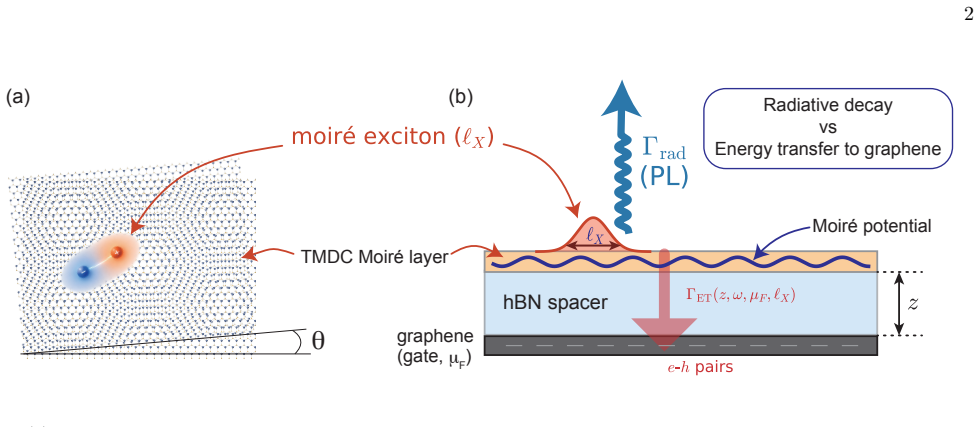
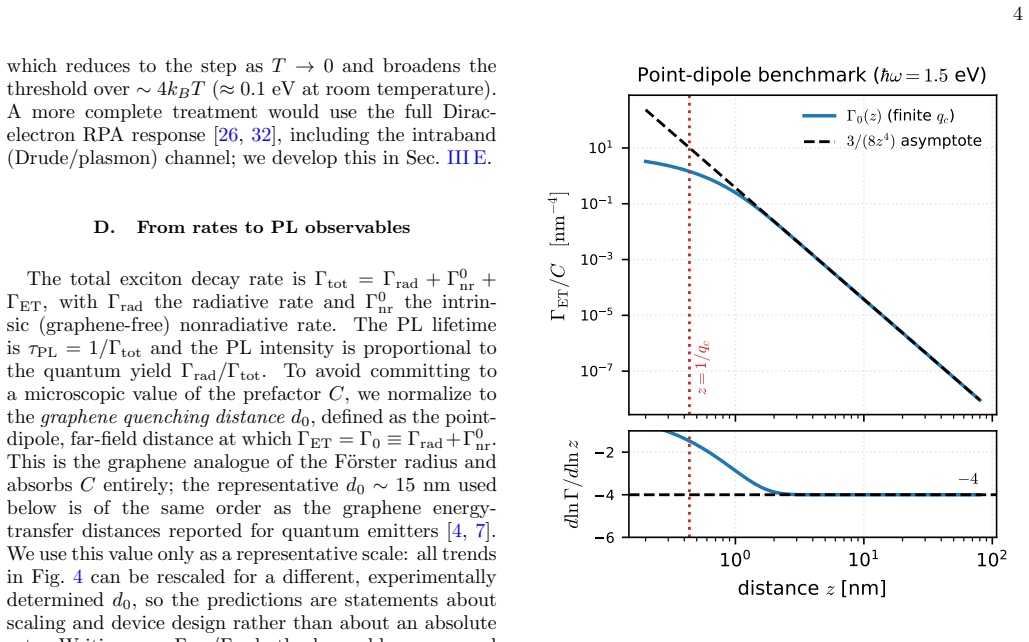
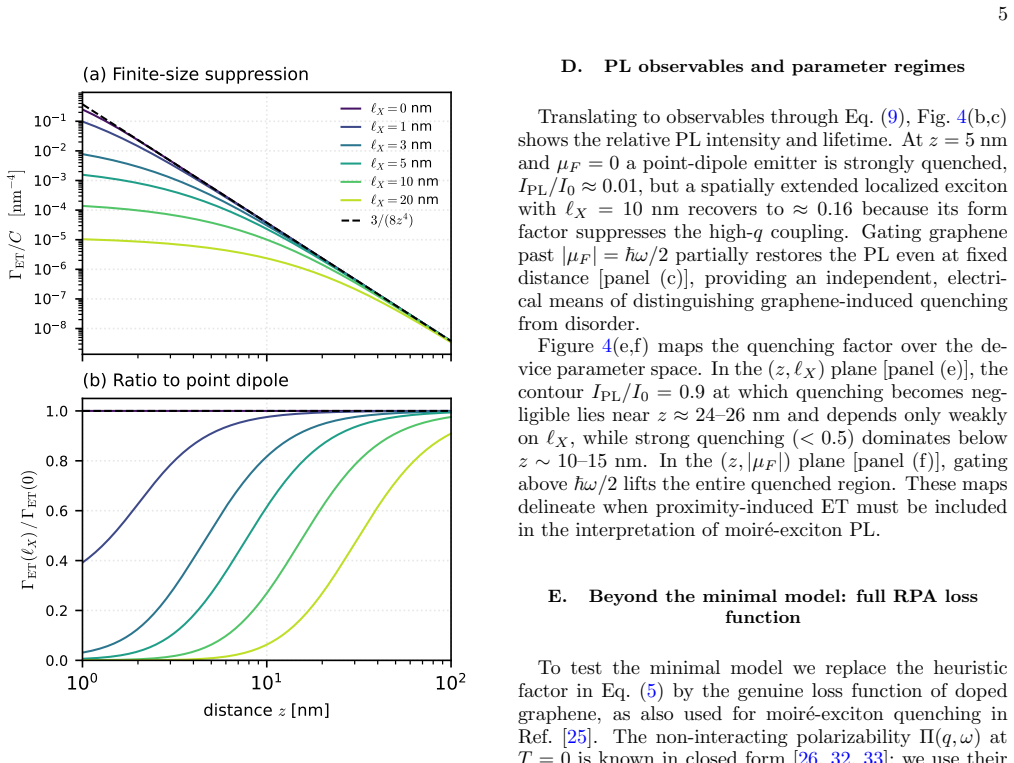
Starting from Fermi's golden rule, the transfer rate is written as the overlap between the exciton near-field spectrum and the long-wavelength electronic loss function of graphene, weighted by an exciton form factor. In the point-dipole limit the framework reproduces the established GET∝z−4 law for energy transfer to graphene. Including the finite spatial extent of a moiré exciton through a Gaussian form factor with localization length lX, we show that high-momentum components of the near field are filtered out for z≲lX, so that the transfer rate -- and hence the photoluminescence (PL) quenching -- can serve as a probe of exciton localization. Treating graphene as a gate-tunable bath, a Paul
What carries the argument
The overlap integral between the exciton near-field spectrum (weighted by Gaussian form factor of width lX) and graphene's long-wavelength electronic loss function.
If this is right
- The photoluminescence quenching rate depends on exciton localization length and can probe it when graphene separation is less than or comparable to that length.
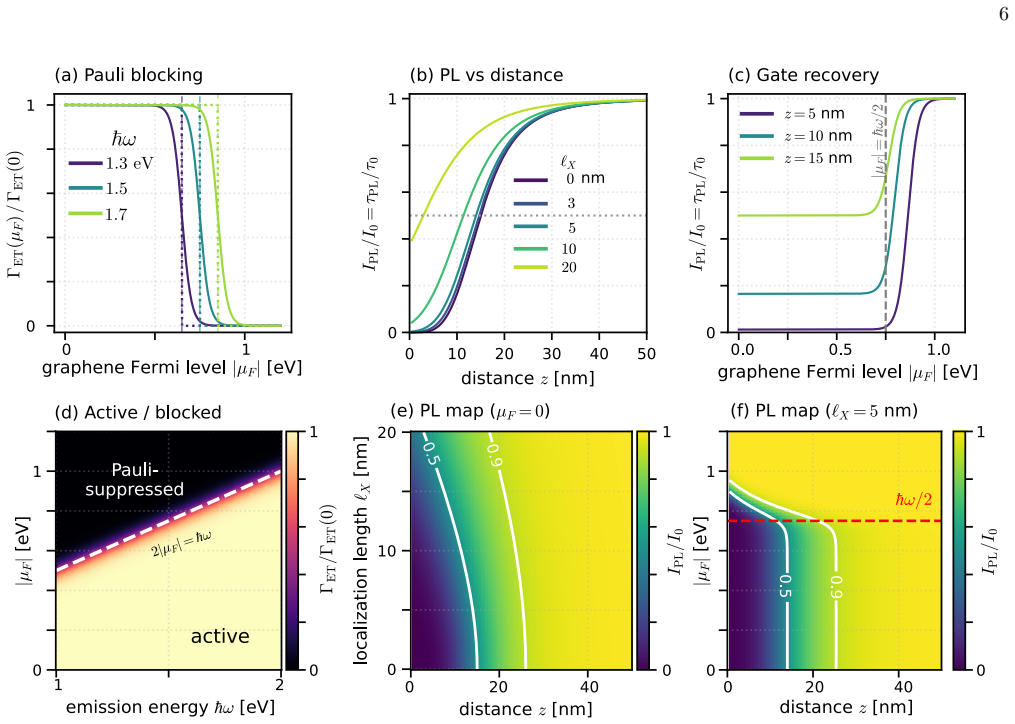
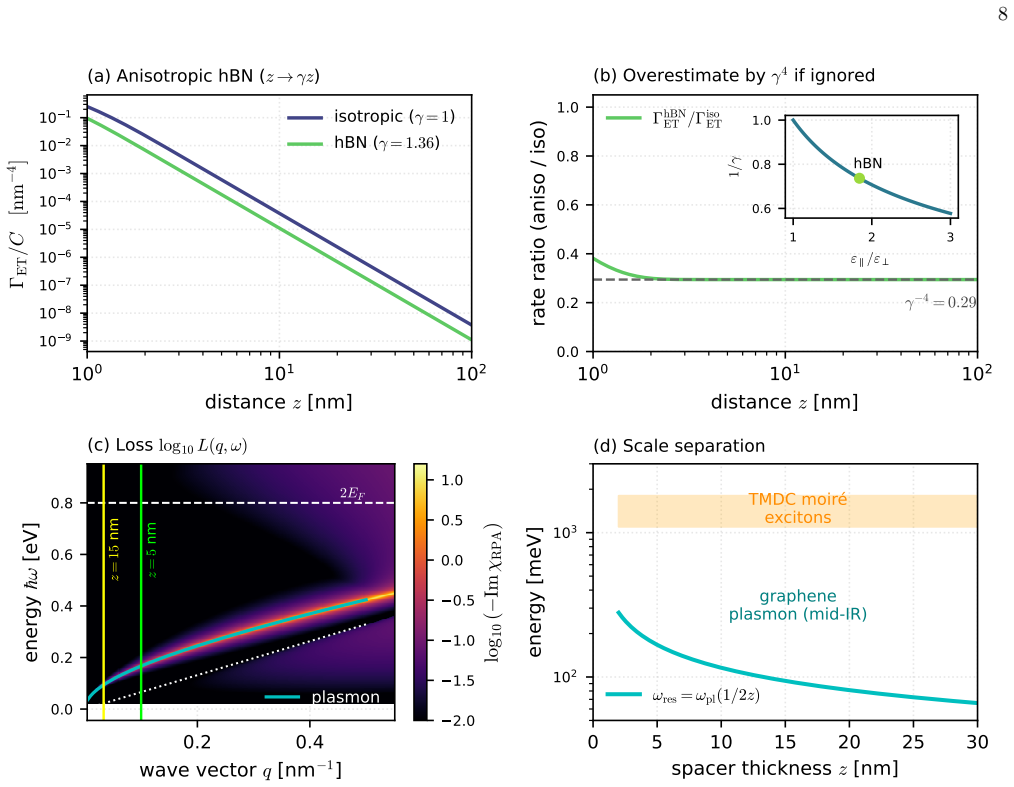
- Pauli blocking suppresses interband electron-hole excitations and partially restores PL intensity and lifetime once 2|μF| approaches ħω.
- Graphene-induced quenching dominates the optical response of TMD/hBN/graphene heterostructures over identifiable ranges of spacer thickness, localization length, emission energy, and Fermi level.
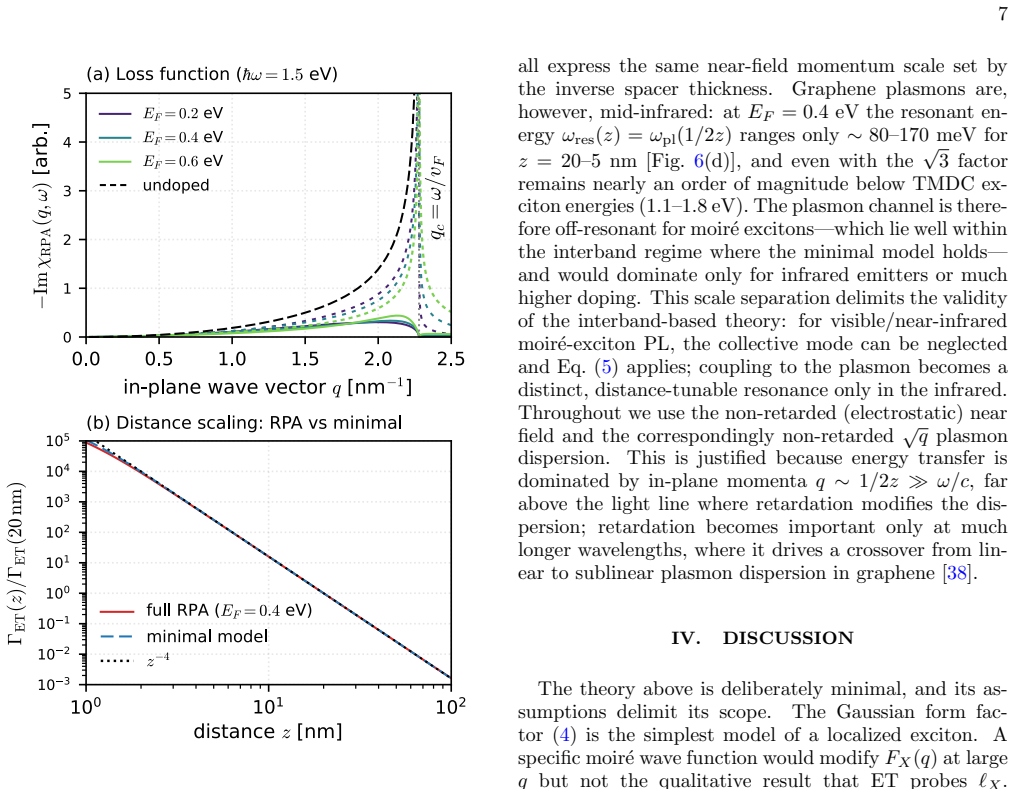
- The minimal model reproduces the z^{-4} law only in the point-dipole limit and matches full RPA results to within a few percent for near-infrared parameters.
Where Pith is reading between the lines
- Varying spacer thickness and gate voltage while tracking PL could map exciton localization length experimentally.
- The same overlap construction could be applied to energy transfer between excitons and other gate-tunable 2D conductors.
- Active electrical control of exciton lifetime via graphene gating might be tested in optoelectronic heterostructure devices.
Load-bearing premise
The long-wavelength loss function of graphene together with a Gaussian exciton form factor captures the transfer rate to within a few percent of full calculations.
What would settle it
Measuring photoluminescence intensity versus gate voltage and finding no recovery when the Fermi level reaches half the emission energy would falsify the Pauli-blocking suppression of interband excitations.
Figures
read the original abstract
A minimal theory for the nonradiative transfer of energy from a two-dimensional (2D) exciton -- especially a moir\'e-localized exciton -- to a nearby graphene layer is presented. Starting from Fermi's golden rule, the transfer rate is written as the overlap between the exciton near-field spectrum and the long-wavelength electronic loss function of graphene, weighted by an exciton form factor. In the point-dipole limit the framework reproduces the established $\GET\propto z^{-4}$ law for energy transfer to graphene. Including the finite spatial extent of a moir\'e exciton through a Gaussian form factor with localization length $\lX$, we show that high-momentum components of the near field are filtered out for $z\lesssim\lX$, so that the transfer rate -- and hence the photoluminescence (PL) quenching -- can serve as a probe of exciton localization. Treating graphene as a gate-tunable bath, a Pauli-blocking model predicts that interband electron-hole excitations are strongly suppressed once $2|\muF|$ approaches $\hbar\omega$, partially restoring PL intensity and lifetime. Benchmarking against the full random-phase-approximation loss function of doped graphene confirms the minimal model to within a few percent over the relevant distance range for representative near-infrared exciton parameters. We map the resulting PL observables over experimentally relevant ranges of spacer thickness, localization length, emission energy, and Fermi level, and identify when graphene-induced quenching dominates the optical response of transition-metal dichalcogenide/hexagonal boron nitride/graphene heterostructures. A graphene gate thus acts not as a passive electrostatic element but as a tunable 2D electronic reservoir whose long-wavelength response can be probed through exciton PL quenching.
Editorial analysis
A structured set of objections, weighed in public.
Referee Report
Summary. The paper develops a minimal theory for nonradiative energy transfer from a 2D moiré exciton to a nearby graphene layer, starting from Fermi's golden rule. The transfer rate is expressed as an overlap integral between the exciton's near-field spectrum (weighted by a Gaussian form factor with localization length lX) and graphene's long-wavelength loss function. In the point-dipole limit it recovers the established GET ∝ z^{-4} scaling; finite lX filters high-q components for z ≲ lX, allowing the rate (and thus PL quenching) to probe localization. A Pauli-blocking model for doped graphene predicts strong suppression of interband e-h excitations once 2|μF| approaches ħω, partially restoring PL intensity and lifetime. The minimal model is benchmarked against the full RPA loss function of doped graphene and shown to agree within a few percent over relevant distances for near-IR parameters; the resulting PL observables are mapped versus spacer thickness, lX, emission energy, and Fermi level to identify regimes where graphene quenching dominates in TMD/hBN/graphene stacks.
Significance. If the benchmarking holds, the framework supplies a simple, experimentally usable expression for gate-tunable nonradiative quenching that directly links PL lifetime and intensity to exciton localization length. The reproduction of the z^{-4} law, the explicit Pauli-blocking prediction, and the few-percent RPA agreement constitute concrete strengths that could be tested in existing heterostructure devices. The work therefore offers a practical tool for interpreting and engineering exciton-graphene interactions in 2D optoelectronics.
major comments (1)
- [Benchmarking against RPA (abstract and main text)] The central claim that the long-wavelength loss function plus Gaussian form factor reproduces full RPA results to within a few percent (and thereby justifies the Pauli-blocking predictions) rests on the benchmarking step. The abstract states this check was performed over the relevant distance range for near-infrared parameters, but the manuscript must explicitly report the precise values of lX, z, ħω, and doping range used, together with the maximum relative deviation observed, so that readers can judge whether the agreement remains load-bearing for the localization-probe and gate-tunability conclusions.
minor comments (1)
- Notation for the localization length (lX) and Fermi level (μF) should be defined at first use and kept consistent with the symbols appearing in the plotted observables.
Simulated Author's Rebuttal
We thank the referee for the positive evaluation and the recommendation for minor revision. The single major comment requests explicit reporting of benchmarking parameters and the observed deviation; we agree this improves clarity and will revise the manuscript accordingly.
read point-by-point responses
-
Referee: [Benchmarking against RPA (abstract and main text)] The central claim that the long-wavelength loss function plus Gaussian form factor reproduces full RPA results to within a few percent (and thereby justifies the Pauli-blocking predictions) rests on the benchmarking step. The abstract states this check was performed over the relevant distance range for near-infrared parameters, but the manuscript must explicitly report the precise values of lX, z, ħω, and doping range used, together with the maximum relative deviation observed, so that readers can judge whether the agreement remains load-bearing for the localization-probe and gate-tunability conclusions.
Authors: We agree that the manuscript should state the precise benchmarking parameters and the quantitative deviation explicitly. The abstract refers to 'representative near-infrared exciton parameters' and 'a few percent' agreement, but does not list the exact values. In the revised manuscript we will add these details (values of l_X, z range, ħω, doping range, and the maximum relative deviation) in the benchmarking section so that readers can assess the approximation directly. This addition will not alter the conclusions but will make the justification for the minimal model and Pauli-blocking predictions fully transparent. revision: yes
Circularity Check
No significant circularity; derivation is self-contained from standard methods
full rationale
The paper starts from Fermi's golden rule to express the transfer rate as an overlap integral involving the exciton near-field spectrum, the long-wavelength loss function of graphene, and a Gaussian form factor. It recovers the established z^{-4} scaling in the point-dipole limit as a consistency check and validates the minimal model against the full RPA loss function to within a few percent over the relevant parameter range. The Pauli-blocking treatment for gate tuning is presented as a conventional approximation. No load-bearing steps reduce by construction to fitted inputs, self-definitions, or unverified self-citations; the central mapping of PL observables follows directly from these independent inputs and the external benchmark.
Axiom & Free-Parameter Ledger
free parameters (2)
- localization length lX
- Fermi level μF
axioms (3)
- standard math Fermi's golden rule gives the nonradiative transfer rate as overlap of exciton near-field spectrum and graphene loss function
- domain assumption Long-wavelength electronic loss function of graphene suffices for the relevant distances
- ad hoc to paper Gaussian spatial profile adequately represents the moiré exciton extent
Reference graph
Works this paper leans on
-
[1]
R. S. Swathi and K. L. Sebastian, J. Chem. Phys.129, 054703 (2008)
2008
-
[2]
R. S. Swathi and K. L. Sebastian, J. Chem. Phys.130, 086101 (2009)
2009
-
[3]
F¨ orster, Ann
T. F¨ orster, Ann. Phys. (Leipzig)437, 55 (1948)
1948
-
[4]
Gaudreau, K
L. Gaudreau, K. J. Tielrooij, G. E. D. K. Prawiroat- modjo, J. Osmond, F. J. Garc´ ıa de Abajo, and F. H. L. Koppens, Nano Lett.13, 2030 (2013)
2030
-
[5]
Z. Chen, S. Berciaud, C. Nuckolls, T. F. Heinz, and L. E. Brus, ACS Nano4, 2964 (2010)
2010
-
[6]
Federspiel, G
F. Federspiel, G. Froehlicher, M. Nasilowski, S. Pedetti, A. Mahmood, B. Doudin, S. Park, J.-O. Lee, D. Halley, B. Dubertret, P. Gilliot, and S. Berciaud, Nano Lett.15, 1252 (2015)
2015
-
[7]
K. J. Tielrooij, L. Orona, A. Ferrier, M. Badioli, G. Nav- ickaite, S. Coop, S. Nanot, B. Kalinic, T. Cesca, L. Gau- dreau, Q. Ma, A. Centeno, A. Pesquera, A. Zurutuza, H. de Riedmatten, P. Goldner, F. J. Garc´ ıa de Abajo, P. Jarillo-Herrero, and F. H. L. Koppens, Nat. Phys.11, 281 (2015)
2015
-
[8]
J. Lee, W. Bao, L. Ju, P. J. Schuck, F. Wang, and A. Weber-Bargioni, Nano Lett.14, 7115 (2014)
2014
-
[9]
G´ omez-Santos and T
G. G´ omez-Santos and T. Stauber, Phys. Rev. B84, 165438 (2011)
2011
-
[10]
K. A. Velizhanin and A. Efimov, Phys. Rev. B84, 085401 (2011)
2011
-
[11]
G. Wang, A. Chernikov, M. M. Glazov, T. F. Heinz, X. Marie, T. Amand, and B. Urbaszek, Rev. Mod. Phys. 90, 021001 (2018)
2018
-
[12]
Chernikov, T
A. Chernikov, T. C. Berkelbach, H. M. Hill, A. Rigosi, Y. Li, B. Aslan, D. R. Reichman, M. S. Hybertsen, and T. F. Heinz, Phys. Rev. Lett.113, 076802 (2014)
2014
-
[13]
K. L. Seyler, P. Rivera, H. Yu, N. P. Wilson, E. L. Ray, D. G. Mandrus, J. Yan, W. Yao, and X. Xu, Nature567, 66 (2019)
2019
-
[14]
K. Tran, G. Moody, F. Wu, X. Lu, J. Choi, K. Kim, A. Rai, D. A. Sanchez, J. Quan, A. Singh, J. Emb- ley, A. Zepeda, M. Campbell, T. Autry, T. Taniguchi, K. Watanabe, N. Lu, S. K. Banerjee, K. L. Silverman, S. Kim, E. Tutuc, L. Yang, A. H. MacDonald, and X. Li, Nature567, 71 (2019)
2019
-
[15]
C. Jin, E. C. Regan, A. Yan, M. I. B. Utama, D. Wang, S. Zhao, Y. Qin, S. Yang, Z. Zheng, S. Shi, K. Watanabe, T. Taniguchi, S. Tongay, A. Zettl, and F. Wang, Nature 567, 76 (2019)
2019
-
[16]
Shinokita, K
K. Shinokita, K. Watanabe, T. Taniguchi, and K. Mat- suda, ACS Nano16, 16862 (2022)
2022
-
[17]
H. Kim, K. Aino, K. Shinokita, W. Zhang, K. Watanabe, T. Taniguchi, and K. Matsuda, Adv. Opt. Mater.11, 2300146 (2023)
2023
-
[18]
N. F. Ahmad, Y. Urano, K. Watanabe, T. Taniguchi, D. Kozawa, and R. Kitaura, Appl. Phys. Lett.128, 231901 (2026)
2026
-
[19]
Yu, G.-B
H. Yu, G.-B. Liu, J. Tang, X. Xu, and W. Yao, Sci. Adv. 3, e1701696 (2017)
2017
-
[20]
F. Wu, T. Lovorn, and A. H. MacDonald, Phys. Rev. B 97, 035306 (2018)
2018
-
[21]
K. F. Mak and J. Shan, Nat. Nanotechnol.17, 686 (2022)
2022
-
[22]
H. Baek, M. Brotons-Gisbert, Z. X. Koong, A. Campbell, M. Rambach, K. Watanabe, T. Taniguchi, and B. D. Ger- ardot, Sci. Adv.6, eaba8526 (2020)
2020
-
[23]
Fezai and S
I. Fezai and S. Jaziri, Superlattices Microstruct.109, 71 (2017)
2017
-
[24]
Eddhib, S
R. Eddhib, S. Ayari, A. Hichri, and S. Jaziri, Phys. Rev. B104, 115426 (2021)
2021
-
[25]
Hichri, T
A. Hichri, T. Amand, and S. Jaziri, Phys. Rev. Mater.5, 114002 (2021)
2021
-
[26]
E. H. Hwang and S. Das Sarma, Phys. Rev. B75, 205418 (2007)
2007
-
[27]
Rivera, J
P. Rivera, J. R. Schaibley, A. M. Jones, J. S. Ross, S. Wu, G. Aivazian, P. Klement, K. Seyler, G. Clark, N. J. Ghimire, J. Yan, D. G. Mandrus, W. Yao, and X. Xu, Nat. Commun.6, 6242 (2015)
2015
-
[28]
Ciarrocchi, D
A. Ciarrocchi, D. Unuchek, A. Avsar, K. Watanabe, T. Taniguchi, and A. Kis, Nat. Photonics13, 131 (2019). 11
2019
-
[29]
F. Wang, Y. Zhang, C. Tian, C. Girit, A. Zettl, M. Crom- mie, and Y. R. Shen, Science320, 206 (2008)
2008
-
[30]
Z. Q. Li, E. A. Henriksen, Z. Jiang, Z. Hao, M. C. Martin, P. Kim, H. L. Stormer, and D. N. Basov, Nat. Phys.4, 532 (2008)
2008
-
[31]
L. A. Falkovsky and A. A. Varlamov, Eur. Phys. J. B56, 281 (2007)
2007
-
[32]
Wunsch, T
B. Wunsch, T. Stauber, F. Sols, and F. Guinea, New J. Phys.8, 318 (2006)
2006
-
[33]
Das Sarma, S
S. Das Sarma, S. Adam, E. H. Hwang, and E. Rossi, Rev. Mod. Phys.83, 407 (2011)
2011
-
[34]
T. Ando, J. Phys. Soc. Jpn.75, 074716 (2006)
2006
-
[35]
Laturia, M
A. Laturia, M. L. Van de Put, and W. G. Vandenberghe, npj 2D Mater. Appl.2, 6 (2018)
2018
-
[36]
A. N. Grigorenko, M. Polini, and K. S. Novoselov, Nat. Photonics6, 749 (2012)
2012
-
[37]
F. J. Garc´ ıa de Abajo, ACS Photonics1, 135 (2014)
2014
-
[38]
Deng and K
H.-Y. Deng and K. Wakabayashi, Phys. Rev. B92, 045434 (2015)
2015
- [39]
-
[40]
R. R. Chance, A. Prock, and R. Silbey, Adv. Chem. Phys. 37, 1 (1978)
1978
-
[41]
Froehlicher, E
G. Froehlicher, E. Lorchat, and S. Berciaud, Phys. Rev. X8, 011007 (2018)
2018
-
[42]
Tebbe, M
D. Tebbe, M. Sch¨ utte, K. Watanabe, T. Taniguchi, C. Stampfer, B. Beschoten, and L. Waldecker, Phys. Rev. Lett.132, 196902 (2024)
2024
-
[43]
Lorchat, L
E. Lorchat, L. E. Parra L´ opez, C. Robert, D. Lagarde, G. Froehlicher, T. Taniguchi, K. Watanabe, X. Marie, and S. Berciaud, Nat. Nanotechnol.15, 283 (2020)
2020
-
[44]
Kozawa, A
D. Kozawa, A. Carvalho, I. Verzhbitskiy, F. Giustiniano, Y. Miyauchi, S. Mouri, A. H. Castro Neto, K. Matsuda, and G. Eda, Nano Lett.16, 4087 (2016)
2016
-
[45]
Manolatou, H
C. Manolatou, H. Wang, W. Chan, S. Tiwari, and F. Rana, Phys. Rev. B93, 155422 (2016)
2016
-
[46]
L. A. Jauregui, A. Y. Joe, K. Pistunova, D. S. Wild, A. A. High, Y. Zhou, G. Scuri, K. De Greve, A. Sushko, C.-H. Yu, T. Taniguchi, K. Watanabe, D. J. Needleman, M. D. Lukin, H. Park, and P. Kim, Science366, 870 (2019)
2019
-
[47]
R. R. Nair, P. Blake, A. N. Grigorenko, K. S. Novoselov, T. J. Booth, T. Stauber, N. M. R. Peres, and A. K. Geim, Science320, 1308 (2008)
2008
discussion (0)
Sign in with ORCID, Apple, or X to comment. Anyone can read and Pith papers without signing in.