REVIEW 2 major objections 2 minor 1 cited by
Semi-Implicit Stellarator Magnetohydrodynamics with Nodal Spectral Elements
T0 review · 2 major / 2 minor · reviewed 2026-06-30 · grok-4.3
Pith's one-line read A semi-implicit MHD formulation with 2D nodal spectral elements and 3D ideal-MHD operator computes nonlinear stellarator dynamics at large timesteps.
desk verdict NIMSTELL extends NIMROD to stellarators via 2D nodal spectral elements plus Fourier toroidal with a 3D energy-integral semi-implicit operator, and the verifications on interchange and W7-A tearing look usable. read the letter →
The pith
A machine-rendered reading of the paper's core claim, the machinery that carries it, and where it could break.
The reading
What carries the argument
The semi-implicit operator derived from the ideal-MHD energy integral using 3D pressure and magnetic fields, paired with continuous H1 (or optionally H(curl)) nodal spectral elements in the poloidal plane and Fourier expansion in the generalized toroidal angle.
What would settle it
A run of the W7-A rotating-ellipse tearing-mode test at a timestep several times the explicit limit that produces either growing numerical noise or a nonlinear evolution visibly different from the JOREK reference solution would falsify the claim of maintained accuracy.
Extended reading notes
Core claim
The central claim is that a semi-implicit time advance for toroidally shaped MHD systems, discretized with 2D nodal spectral elements over the poloidal plane and Fourier modes in the generalized toroidal angle, remains accurate and stable at large timesteps when the implicit operator is taken from the ideal-MHD energy integral constructed with three-dimensional pressure and magnetic fields; the same 3D representation is used for all equilibrium and time-dependent quantities, allowing direct modeling of non-axisymmetric stellarator equilibria.
Load-bearing premise
The semi-implicit operator built from the ideal-MHD energy integral with three-dimensional fields stays accurate and stable at large timesteps for genuinely non-axisymmetric stellarator equilibria without unacceptable numerical artifacts.
Editorial extensions
If this is right
- Convergence is obtained by either increasing the number of elements (h-refinement) or the polynomial degree within each element (p-refinement).
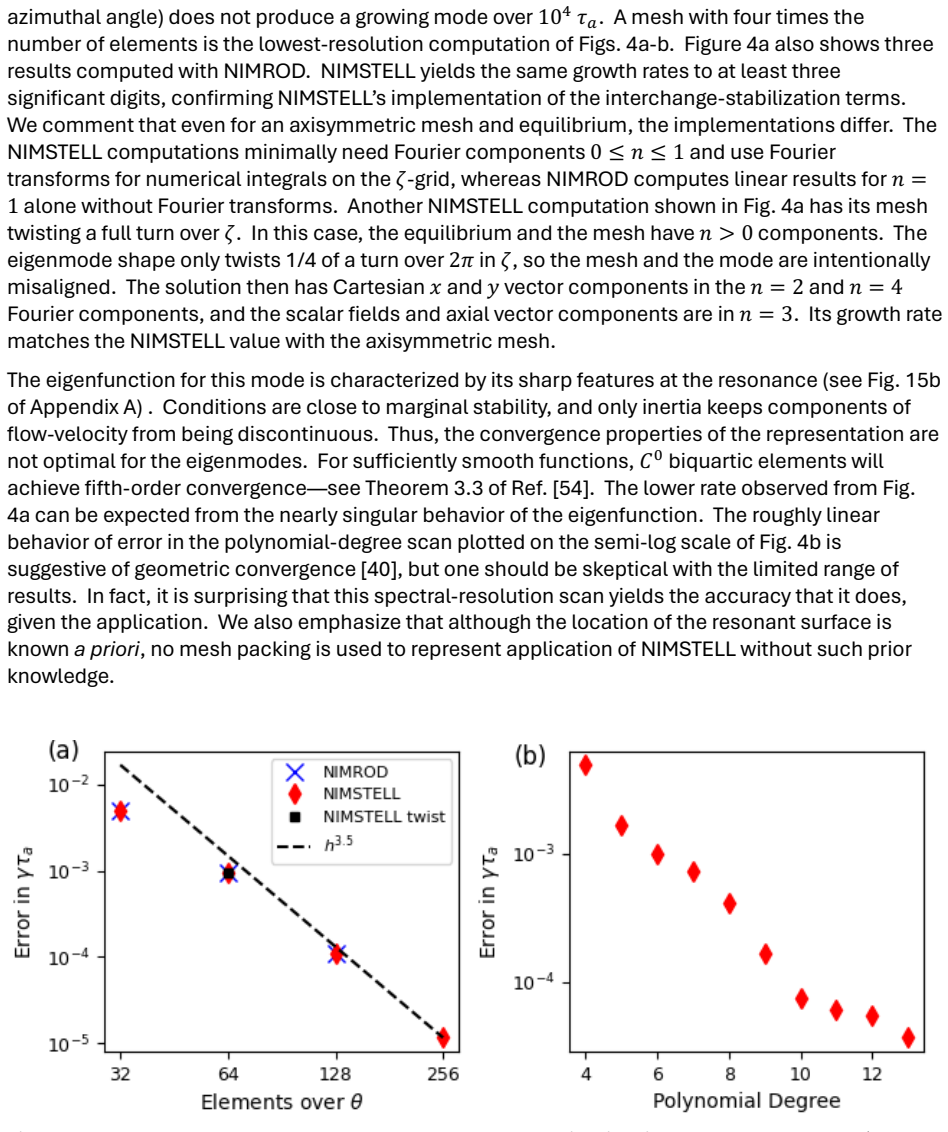
- Both the continuous H1 expansion of magnetic-field components with diffusive divergence control and the optional H(curl) vector-potential representation reproduce linear and nonlinear results from established codes on ideal interchange and tearing.
- Algebraic systems arising from the implicit steps are preconditioned by including the Fourier components of each stellarator mode family.
- The vector-potential option requires a minimum electrical resistivity at given spatial resolution to suppress numerical noise in interchange simulations.
Reading between the lines
- The method opens the possibility of following the evolution of MHD modes that are linearly unstable yet permit robust operation in stellarator experiments.
- Because the semi-implicit operator uses the full 3D fields, the same framework could be applied to other toroidally confined devices whose equilibria depart strongly from axisymmetry.
- The ability to switch between H1 and H(curl) representations within one code base allows direct comparison of how divergence control and gauge choice affect long-time nonlinear behavior.
Signed reviews
Editorial analysis
A structured set of objections, weighed in public.
Referee Report
Summary. The manuscript presents a new semi-implicit formulation for nonlinear MHD computations in stellarators. It employs 2D nodal spectral elements over the poloidal plane with Fourier representation in a generalized toroidal angle, expanding geometric mappings and equilibrium fields in the same 3D basis. The semi-implicit operator is constructed from the ideal-MHD energy integral using 3D pressure and magnetic fields. The NIMSTELL implementation generalizes NIMROD, supports continuous H1 and optional H(curl) representations, and is verified linearly and nonlinearly on resonant ideal interchange (stable-side convergence) and on tearing modes in the W7-A rotating-ellipse case against JOREK. Preconditioning incorporates stellarator mode families.
Significance. If the central claims hold, the work supplies a verified computational capability for macroscale MHD dynamics in genuinely non-axisymmetric stellarator equilibria, addressing a recognized need in fusion plasma modeling. The nodal spectral-element discretization enables systematic h- or p-refinement, the 3D energy-integral operator targets large-timestep stability, and direct comparisons to NIMROD and JOREK on standard interchange and tearing benchmarks provide concrete evidence of correctness. These elements collectively advance the toolkit for stellarator-specific nonlinear simulations.
major comments (2)
- [Verification (interchange and W7-A tearing)] The central claim of accuracy and stability at large timesteps for non-axisymmetric equilibria rests on the semi-implicit operator derived from the 3D ideal-MHD energy integral. The manuscript should supply quantitative data (e.g., timestep size relative to explicit CFL limits, growth-rate errors, and any numerical artifacts) for the W7-A tearing case and the interchange verification to substantiate this for genuinely 3D configurations.
- [H(curl) representation and interchange verification] For the H(curl) vector-potential representation, the reported requirement of a minimum electrical resistivity to suppress numerical noise on interchange is a load-bearing limitation. The text should quantify the resistivity threshold relative to physical values and spatial resolution, and clarify whether this affects the method's applicability to ideal or low-resistivity regimes.
minor comments (2)
- [Abstract] Abstract contains the typographical error 'diUusive' (should read 'diffusive').
- [Implementation and preconditioning] The description of preconditioning by 'stellarator mode families' would benefit from an explicit statement of how the Fourier components are grouped and whether this choice is problem-dependent.
Simulated Author's Rebuttal
We thank the referee for the positive evaluation and the recommendation of minor revision. We address the two major comments point by point below. Both points identify areas where the manuscript can be strengthened with additional quantitative detail and clarification; we will incorporate these changes in the revised version.
read point-by-point responses
-
Referee: [Verification (interchange and W7-A tearing)] The central claim of accuracy and stability at large timesteps for non-axisymmetric equilibria rests on the semi-implicit operator derived from the 3D ideal-MHD energy integral. The manuscript should supply quantitative data (e.g., timestep size relative to explicit CFL limits, growth-rate errors, and any numerical artifacts) for the W7-A tearing case and the interchange verification to substantiate this for genuinely 3D configurations.
Authors: We agree that explicit quantitative metrics would strengthen the verification claims for the 3D cases. The existing simulations contain the requested information (timestep sizes normalized to explicit CFL limits, growth-rate errors relative to NIMROD and JOREK, and notes on any observed artifacts). In the revised manuscript we will add a dedicated table or subsection presenting these data for both the resonant ideal interchange and the W7-A tearing-mode cases to directly support the large-timestep stability assertions. revision: yes
-
Referee: [H(curl) representation and interchange verification] For the H(curl) vector-potential representation, the reported requirement of a minimum electrical resistivity to suppress numerical noise on interchange is a load-bearing limitation. The text should quantify the resistivity threshold relative to physical values and spatial resolution, and clarify whether this affects the method's applicability to ideal or low-resistivity regimes.
Authors: The manuscript already states that the H(curl) implementation requires a minimum resistivity to suppress noise on interchange at given resolutions. We will expand this discussion with concrete examples of the threshold (expressed, for instance, as a function of polynomial degree and element size, or in terms of magnetic Reynolds number) and will compare these values to typical physical resistivities encountered in stellarator plasmas. We will also add an explicit statement that the H1 representation is the appropriate choice for ideal or very-low-resistivity regimes, while the H(curl) option is intended for resistive MHD applications. These additions will clarify the method's scope of applicability. revision: yes
Circularity Check
No significant circularity in derivation chain
full rationale
The manuscript describes a generalization of the existing NIMROD semi-implicit MHD framework to stellarator geometry via 2D nodal spectral elements plus Fourier representation in a generalized toroidal angle, with the implicit operator taken directly from the standard ideal-MHD energy integral evaluated on 3D fields. All load-bearing steps (geometric mapping, choice of H1 vs H(curl) spaces, preconditioning by mode families, and the stabilization technique) are either standard discretizations or explicit extensions whose correctness is checked by external verification against JOREK on the W7-A tearing case and by convergence tests on resonant interchange. No equation reduces to a fitted parameter renamed as a prediction, no ansatz is smuggled via self-citation, and the cited NIMROD references supply independent, previously published numerical methods rather than a closed self-referential loop. The derivation chain is therefore self-contained against external benchmarks.
Assumptions & free parameters
Cite this review
Pith. "Pith review of Semi-Implicit Stellarator Magnetohydrodynamics with Nodal Spectral Elements." pith.science (2026). https://pith.science/paper/LZMQWQPS
@misc{pith2026260628613,
  author       = {Pith},
  title        = {Pith review of: Semi-Implicit Stellarator Magnetohydrodynamics with Nodal Spectral Elements},
  year         = {2026},
  howpublished = {\url{https://pith.science/paper/LZMQWQPS}},
  note         = {Machine review of arXiv:2606.28613}
}
read the original abstract
Nonlinear time-dependent computation of macroscale dynamics in stellarators is motivated by laboratory results showing the possibility of robust operation in conditions where magnetohydrodynamic (MHD) modes are linearly unstable. A new formulation of semi-implicit MHD computation for toroidally shaped magnetic confinement systems uses 2D nodal spectral elements over the poloidal plane and Fourier representation over a generalized toroidal angle. Geometric mappings and steady-state (equilibrium) fields are expanded in the same 3D representation as the time-evolved fields to model non-axisymmetric configurations. For accuracy at large timestep, the semi-implicit operator is based on the ideal-MHD energy integral using 3D pressure and magnetic fields. The nodal spectral elements allow numerical convergence through either h-refinement or p- refinement. Our implementation (NIMSTELL) with the continuous H1 expansion of magnetic-field components and diUusive divergence control is a generalization of the NIMROD code [JCOMP 195, 355]. The NIMSTELL implementation is verified linearly and nonlinearly on resonant ideal interchange, where convergence from the stable side results from the stabilization method used in NIMROD [JCOMP 319, 61]. Optionally, NIMSTELL may use an H(curl) representation for vector potential, and both magnetic representations are verified with respect to results from JOREK [Phys. Plasmas 29, 063901] on linear and nonlinear magnetic tearing in the W7-A rotating-ellipse configuration. Application of the existing vector-potential implementation to interchange shows that it needs a minimum level of electrical resistivity to avoid numerical noise for a given level of spatial resolution. Solving the algebraic systems from the implicit parts of the time advance is facilitated by including the Fourier components of stellarator mode families in each preconditioning operation.
Figures


Figures from the paper (5 more)


Forward citations
Cited by 1 Pith paper
-
AGNI: A differentiable MHD stability solver & optimizer for magnetic confinement fusion devices
A differentiable, GPU-accelerated solver computes finite-toroidal-mode ideal MHD instabilities and their gradients, with a benchmark agreement against NIMSTELL on a stellarator case.
Reference graph
Works this paper leans on
-
[1]
Modelling of NSTX hot vertical displacement events using M3D-C1,
D. Pfemerlé, N. Ferraro, S. C. Jardin, I. Krebs, and A. Bhattacharjee, “Modelling of NSTX hot vertical displacement events using M3D-C1, ” Phys. Plasmas, vol. 25, no. 5, p. 056106, Apr. 2018, doi: 10.1063/1.5016348. [12] H. R. Strauss, B. C. Lyons, and M. Knolker, “Resistive wall tearing mode disruptions in DIII-D and ITER tokamaks, ” Phys. Plasmas, vol. ...
-
[2]
Approach to nonlinear magnetohydrodynamic simulations in stellarator geometry,
Y . Zhou, N. M. Ferraro, S. C. Jardin, and H. R. Strauss, “Approach to nonlinear magnetohydrodynamic simulations in stellarator geometry, ” Nucl. Fusion, vol. 61, no. 8, p. 086015, July 2021, doi: 10.1088/1741-4326/ac0b35. [26] Y . Zhou, K. Aleynikova, C. Liu, and N. M. Ferraro, “Benign Saturation of Ideal Ballooning Instability in a High-Performance Stel...
-
[3]
S. C. Jardin, J. Breslau, and N. Ferraro, “A high-order implicit finite element method for integrating the two-fluid magnetohydrodynamic equations in two dimensions, ” Journal of Computational Physics, vol. 226, no. 2, pp. 2146–2174, Oct. 2007, doi: 10.1016/j.jcp.2007.07.003. [42] S. J. P . Pamela, G. T. A. Huijsmans, and M. Hoelzl, “A generalised formulati...
-
[4]
DESC Github repository. [Online]. Available: https://github.com/PlasmaControl/DESC/tree/master [71] NERSC Perlmutter system. [Online]. Available: https://docs.nersc.gov/systems/perlmutter/architecture/ [72] J. N. Shadid, R. P . Pawlowski, J. W. Banks, L. Chacón, P . T. Lin, and R. S. Tuminaro, “Towards a scalable fully-implicit fully-coupled resistive MHD...
Reviewed June 30, 2026 · model on record in the stance chip above.
Discussion (0). Continue with ORCID to comment.